On the plus side, the psycho murdering an entire theater group trapped in a locked building is wearing a beautiful owl mask. On the minus, as noted by a letterboxd user this is “super limp [with] dogshit gore FX, awful sound mix, lame characters.” I also felt like it was holding back for a PG rating, feeling tame despite the chopped-off body parts. So, the worst of the four Soavi horrors, but also the earliest – and the climactic scene where the final girl is retrieving a key amidst the Owl’s murder tableau looked great.

A collaboration from the writers of Porno Holocaust and Ghosthouse (there’s your problem). Old Cop was Mickey Knox of the Roger Corman Frankenstein. The Brave Theater Director (who once throws an actress at the chainsaw-wielding killer to save himself) is David Brandon of Jubilee. The actor/dancer who was supposed to play the owl and the security guy who finally shoots the murderous fake owl had both played in City of the Living Dead, and final girl Barbara Cupisti would return as art restorationist of The Church.

Happy SHOCKtober 2021! Reliably a few weeks behind on the blog, but I’m actually catching up, and I helpfully started watching horror movies in September so I’d be able to post them in October. I realized pretty early that this is the movie where the crazy-eyed Nic Cage meme comes from. Cage gives a massive performance, more goofy than you can imagine, speaking the whole time in a Posh Bill & Ted accent, and it seems for a long time like some poor fool director’s movie was ruined because he couldn’t keep a handle on Cage – but it turns out his being uncontrollably weird is a vital part of the plot.

Cage brings home a drunk hot girl, but they get chased out of his apartment by a bat on a string, then he spends half the movie tormenting his secretary (Maria Conchita Alonso, between The Running Man and Predator 2) looking for a missing contract. The bat and the contract, along with the 80’s beats and the accent make the movie hard to take seriously, but Cage is just so enjoyable. He believes that Jennifer Beals has turned him into a vampire (she hasn’t) and that he can’t see his reflection (we can) so he needs to feed, buying some cheap plastic fangs and murdering girls at dance clubs. He grabs and eats a pigeon, brutally breaks up with his imaginary girlfriend, and finally gets staked at home by the secretary’s brother. From the writer of After Hours!

Visions in Meditation #1

Uniquely wonderful experience watching this with Marvin Pontiac’s Asylum Tapes in the headphones, though it’s more of a vocal album than I was expecting and probably distracted from the visuals at times. Regular handheld and sometimes extreme-jitter, mostly nature, snow and slushy river, mountain valley at different times of year. SB seems to be able to walk around outside and capture images in ways nobody else does. Aperture keeps opening all the way, washing everything in white. I suppose it’s meditative – earth and mist and water, finally fire in the last few seconds.

–
Visions in Meditation #2 (Mesa Verde)

Tourist film of mountainside stone ruins with accompanying travel footage shot through windows, but it gets bleary and bendy, and brings in cameos by deer, geese and a nude man in a field. I played along with Chesley/Albini/Midyett’s “Irish” which lent a dirge-metal atmosphere well-suited to the ruins.

–
Visions in Meditation #3 (Plate’s Cave)

Sometimes there is plinky space-music in the caverns. Other things combined and juxtaposed with caverns: a carnival, a snowy road. More tourist-film car-window stuff, but the last section is focused on a whirlwind in a field, and if there’s anyone I want to see filming a whirlwind it’s our Stan. Ends on black with electro-chirp music by Rick Corrigan (who is still recording, and has stuff on bandcamp).

–
Visions in Meditation #4 (D.H. Lawrence)

The most distorted of the four, swirling earth and skies. A few glimpses of humanity: a reflection, a backlit figure, a closeup on toes. Silent, so I accompanied it with three songs from the new Low album… I couldn’t help myself, the bandcamp page said Rick Corrigan is RIYL John Zorn, and Zorn’s playing Big Ears with Low, and I’m obsessed with Low’s new record. Anyway Camper just texted to say it’s okay, that the Low/Brakhage combo is frisson-inducing.

Twin girls in Budapest grow up separately, both end up dating a thin-faced Tesla-type character (Nostalgia star Oleg Yankovskiy). Lots of appealing birth-of-cinema and -electricity stuff.

From my notes:
– She tries to bomb the minister at the cinema
– They go to the zoo and the monkey narrates a flashback
– Stars and electric lightbulbs whisper to each other

Dorota Segda as Dora:

Dorota Segda as Lili:

Oleg:

Movie opens with “uncle” yelling at unseen hole diggers, then a boy with a (comically? horribly? we don’t know yet) hoarse voice comes out and curses into the camera. For maybe a decade I’ve been half-meaning to watch this movie because it’s supposed to be great, then avoiding it since it’s a horrors-of-war through eyes-of-a-child story. Turns out it’s not the depressing slog I imagined, but has big Emir Kusturica energy, hardly ever stops being amazing even when it starts being completely brutal. Let’s keep avoiding Son of Saul for the time being, though.

Our boy Fliora finds a gun, so is allowed to leave his family and join the Belorussian soldiers in WWII – then he’s ordered to swap his good boots for an older soldier’s, and gets left behind. No fighting yet, already a good amount of crying. He soon teams up with older Glasha and they dodge bombings and forge minefields and swamps, as Fliora and Glasha become ever-more traumatized by their experiences. We get the post-bombing tinnitus sound – I didn’t think they were doing that in the 1980’s. The explosions in this movie look unlike normal war-movie explosions – they look dangerous! It’s an angry movie, also bringing to mind Hard To Be a God, and gets extremely brutal as it goes on.

Bird Content: Fliora stomps on a nest full of eggs (boo), but later a beautiful stork looks in on our heroes (yay).

Mark Le Fanu for Criterion:

The film’s working title, before it turned into the biblical exhortation Come and See, was Kill Hitler. Klimov was always careful to explain in interviews that this was not to be taken in its literal meaning but rather as referring to a sort of universal moral imperative: “Kill the Hitler that lurks potentially in all of us!”

Klimov was married to Larisa Shepitko, whose films I’d very much like to see. Cinematographer Aleksey Rodionov would later work with Sally Potter. Lead kid Aleksey Kravchenko kept acting, was recently in The Painted Bird. Filmed in Belarus, which was in the news for arresting dissidents the morning after I watched this.

Memorial screening for Charles Grodin and Yaphet Kotto, here playing a criminal banker and an FBI agent with his identity stolen, respectively. Robert De Niro is the bounty hunter returning Grodin from NY to LA. It’s a wacky crime comedy road movie, with the cops and the gangsters (led by Dennis Farina) and RdN’s rival hunter Marvin (John Ashton of Beverly Hills Cop) all after them, so it’s sufficiently incident-packed to be a hugely successful commercial hit. Throwing in a sad visit to RdN’s family, and morally letting the criminal off the hook at the end turns it into a solid 80’s classic (pretty sure I saw it in theaters on first release) and also a semi-remake of Remember The Night. Got tired of Marvin, didn’t buy that the criminal snipers would open fire on the cops, otherwise lives up to the legend.

My first Jarman movie, and it’s a proper narrative bio-pic, full of painting and poetry and light. Clear dialogue from a superb group of actors. I did wonder about the 17th century historical accuracy of a few lines – I try not to think about such things, but fortunately Jarman sent the signal to stop worrying when a character pulled out a solar-powered calculator halfway in.

Jarman’s fifth feature, and from the descriptions of the others, this sounds like one of his more conventional movies. Older Caravaggio and his mute assistant and Tilda would become Jarman regulars.

Caravaggio Nigel Terry, who’d played King Arthur in Excalibur:

Assistant and adopted son Jerusaleme: Spencer Leigh

Lover of the boxer and Caravaggio, in her feature debut, Tilda Swinton:

Roustabout boxer Sean Bean, who may have murdered pregnant Tilda:

Young Caravaggio: Dexter Fletcher would go on to direct fellow bio-pic Rocketman.

Cardinal Michael Gough, who encourages all this:

“Linda, this is just like Easy Rider, except now it’s our turn.” Right after buying a new house and mercedes in anticipation of a big promotion, Albert Brooks gets tranferred to New York instead, so he tells his boss to shove it and with wife Julie Hagerty (the Airplane! movies) trades in everything for an RV. On their first night they get the bridal suite at a Vegas hotel, and she stays up all night gambling away their savings at roulette. Kind of a dismal comedy, Brooks mostly insufferable but has some good lines, like how once he’s in a position of responsibility he can finally afford to be irresponsible. Alice Stoehr on letterboxd: “By the end, all these two idiots have discovered … is that they’re incapable of self-discovery.”

Lost in Atlanta:

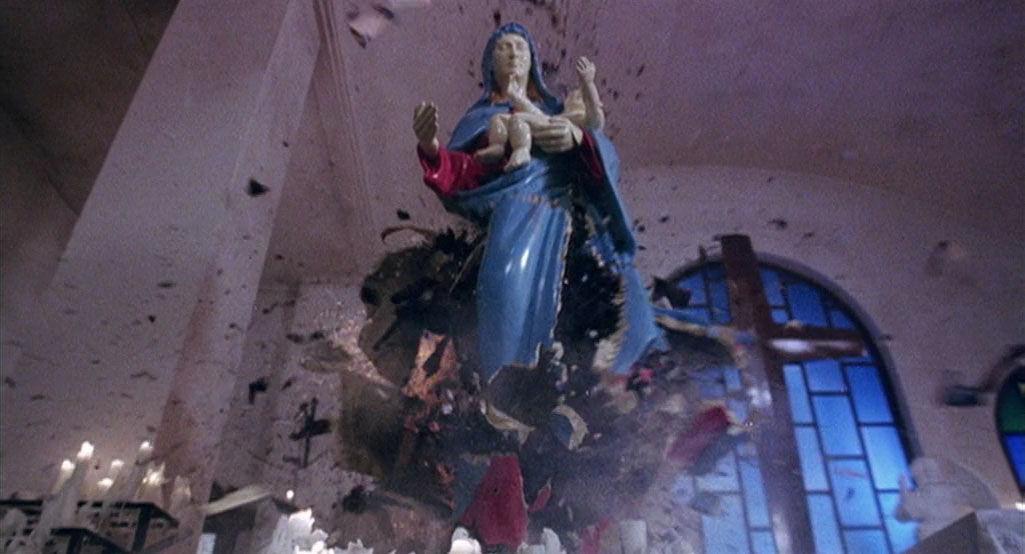
Just trying to chill with some Chinese action movies on Easter, I end up choosing a film where a Mary and Jesus statue explodes.

Mouseover to blow up the statue:
image

Before the church job, Chow’s hit in a restaurant goes bad and he blinds a singer after killing 12 guys while using the infinite ammo cheat code on his dual pistols. Danny Lee is a disgraced supercop who also hurt a woman on a job, sent to protect a guy who Chow is sent to kill, but after witnessing the supposedly ruthless Chow save a girl from the line of fire, Danny falls in love with him and they end up fighting together.

Danny Lee was in City on Fire with Chow, had portrayed Bruce Lee in the 70’s:

Thanks to Woo, I learned it’s hard to lipsync when the song plays at normal speed and everything else is in slow-motion. Also dig the trick of burning gunpowder to seal a wound, which I just saw in Monster Hunter. It’s a just-pretty-good movie beloved by people who need to see invincible sunglasses-wearing heroes firing two guns whilst jumping through the air, Woo’s followup to the Better Tomorrow movies. Tsui Hark produced, while Woo produced Hark’s Better Tomorrow III.

Sally Yeh starred in Hark’s Peking Opera Blues, a singer who retired from movies after this: