Like an Oliveira film shot by Kaurismaki. Hilariously deadpan, and I was digging all the bold, formal framing, the editing games, the odd performances. Everyone has a clear, straight-ahead gaze while speaking, declaring their line then pausing just the right amount before the next line, reminding me of Sicilia!

And since I was enjoying watching the movie so much, and since I hadn’t read anything about it before watching, it snuck up on me late that it’s a version of my least favorite movie logline: cranky guy (Fabrizio Rongione, who I just saw as Riquet in Rosetta) is saddled with kid he barely knows, they go on road trip and learn stuff from each other.

Less dramatically captivating, his wife (Christelle Prot of every Eugène Green film) stays behind and visits Riquet’s sister, who suffers from fainting spells and is stressed that her brother is leaving soon to attend architecture school. At the end she feels better and Riquet’s horizons are broadened and he teaches the cranky guy the importance of light and everyone’s happy except me, but the first 80% of the movie looked fantastic so I can’t complain.

D. Ehrlich:

Combining the knowingly arch style of Abbas Kiarostami (whose Certified Copy towers over and belittles this film) with the didactically educational passion of your favorite art professor, La Sapienza alternately feels like a self-reflexive love story or a haunted history lesson—its best scenes play like both. Full of bright ideas but so unsure of how to humanize them (the film’s characters often feel like they’re simply supporting the structures they’re in, as wispy and translucent as the ghosts to which they’re constantly alluding), La Sapienza manages to effectively condemn modern life for its lack of memory.

The director as a wise Iraqi refugee:

V. Rizov:

For all this, La Sapienza is a pretty lovely film. Symmetricities are everywhere, starting with that opening architectural showreel, which deliberately avoids perfect symmetricity … In Alexandre and Goffredo’s slowly-warming-up relationship, there’s much talk of what purpose these buildings serve. The older man, a former builder of factories, wants to focus on anti-urbanist structures; his would-be student is even more utopian/regressive in his ideals, positive that architecture’s function is nothing less than to create spaces filled with people and light. The light will protect and inspire the people, who will complete the empty space, which is precisely the function they serve for Green. Rather than merely acting as reference points for scale, it’s the human presence (in the work itself and those standing within it) that makes architecture worth looking at.

Played the Locarno fest with Horse Money, The Princess of France, Listen Up Philip and winner From What Is Before.

Movie #1 of my Hors Money Assasatan Crisis Trilogy, where I watched critically-acclaimed art films that I was absolutely guaranteed to love, and loved none of them, and I don’t know what’s wrong with me anymore. This was #3 on Cinema Scope’s year-end list, and it’s ceaselessly beautiful, with interesting framing, characters seen through grasses and curtains and beams of light. Was worried that I wouldn’t figure out the story – well, I got most of it even if some character relationships stayed fuzzy (who were they trying to protect from being buried alive at the end, and why, and why is secretly-pregnant mistress Huji important?), but the drama felt so dead, everything standing so still between the rare, short action scenes, I felt myself pondering switching to The Grandmaster instead.

In the Weibo province in the 9th century, Yinniang is sent away with her aunt Princess Jiaxin, where she trains to become an unparalleled assassin, and is later sent back to kill her noble cousin Tian Ji’an – but she decides to protect him instead, for claimed political (but probably personal) reasons.

J. Cronk:

As the narrative moves away from the cloistered confines of Tian’s estate in the film’s second half, following the banished aide-de-camp Xia Ling (Juan Ching-tian) as he’s escorted to the border and out of harm’s way after speaking out of order, the irreconcilable nature of Yinniang’s mission grows ever more pronounced, as she dutifully continues to do away with rivals — at one point even interceding in battle on behalf of Tian’s garrison — while hesitating to fulfill her ultimate duty.

Not everyone loved it, I guess… concurring here with M. D’Angelo, who may also have been dreaming of The Grandmaster:

I should have realized that Hou would always rather make a stillness movie than an action movie … My favorite thing Hou has ever done, by far, is the first segment of Three Times, mostly because it feels more like Wong Kar-wai than like Hou.

A rare widescreen shot:

Speaking of The Grandmaster, The Razor Chen Chang played the governor/cousin. Yinniang was Three Times star Qi Shu. This won best director awards at Cannes and the Golden Horse festival in Taiwan.

I watched this on the eve of this year’s Berlin fest, where Côté has a new film premiering. I’ve seen his Bestiaire but thought I’d check out one of his fictional features as part of the Festifest Quest. Was enjoying this on the level of a Sundancey relationship drama about interesting characters. The movie’s good at creating characters – nobody here seems to have been blandly injected for plot purposes. Longer-than-usual takes, kind of an unusual trajectory without feeling too indie-quirky. Then an ending I didn’t see coming at all. I mean, the movie lets you know it’s coming, sets it up pretty well, but… that’s just not how movies end, so you don’t believe the signs until it’s too late.

Vic+Flo ont vu un barracuda:

Vic is Pierrette Robitaille (of horny-Snow-White movie L’odyssée d’Alice Tremblay), just out of prison, staying at her disabled uncle’s house under the twice-weekly watch of sensitive parole officer Guillaume (Marc-André Grondin of Goon and C.R.A.Z.Y.). Younger Flo (Romane Bohringer of Savage Nights) moves in, is more restless than Vic, frequenting the local bar where she picks up guys. Flo, also an ex-con, is being followed by a sinister couple: Jackie and her mute enforcer, who pay increasingly threatening visits

A. Nayman:

If this ursine-monikered movie has a true spirit animal, it’s Marie Brassard’s scarily cherubic interloper Jackie, who belongs on any short list of great contemporary villainesses; when she sneers at Vic that “people like me don’t exist in real life,” it’s a taunt that at once solidifies and undermines the parable-like qualities of Cote’s storytelling.

How parole officer Guillaume first appears to Flo:

Won an award in Berlin, where it played with Closed Curtain, Side Effects, Nobody’s Daughter Haewon and big winner Child’s Pose, which I haven’t heard about since. Apparently it’s considered “slow cinema,” though I didn’t find it that slow. Also, I must’ve missed the bear (but not the trap).

Opens with violence and chatty criminals and I’m suspicious because Tarantino-influenced movies are never good. But hey, there’s Sid Haig, and the dialogue is really quite good, so I sat back and enjoyed.

Blackhat baddies:

Sid is killed straight away, then his fellow cannibal-graveyard-defiler David Arquette (also of cannibal western Ravenous) is taken from the nearby town along with the doctor (Lili Simmons, star of TV’s Banshee, which is somehow not X-Men-related) and young Deputy Nick. So a four-man team heads out to track and rescue them from evil. It’s a variation on a John Ford-type story, with a few modern twists (woman doctor, cave-dwelling troglodytes distinct from the more reasonable natives).

D. Ehrlich:

It adds up to approximately nothing, and never seems to make the most of its accomplishments (the business of dealing with the bad guys is more than a little shrugged off), but 4 men — the right 4 men — shuffling through the frontier in search of god knows what… works for me.

3 of the right 4 men:

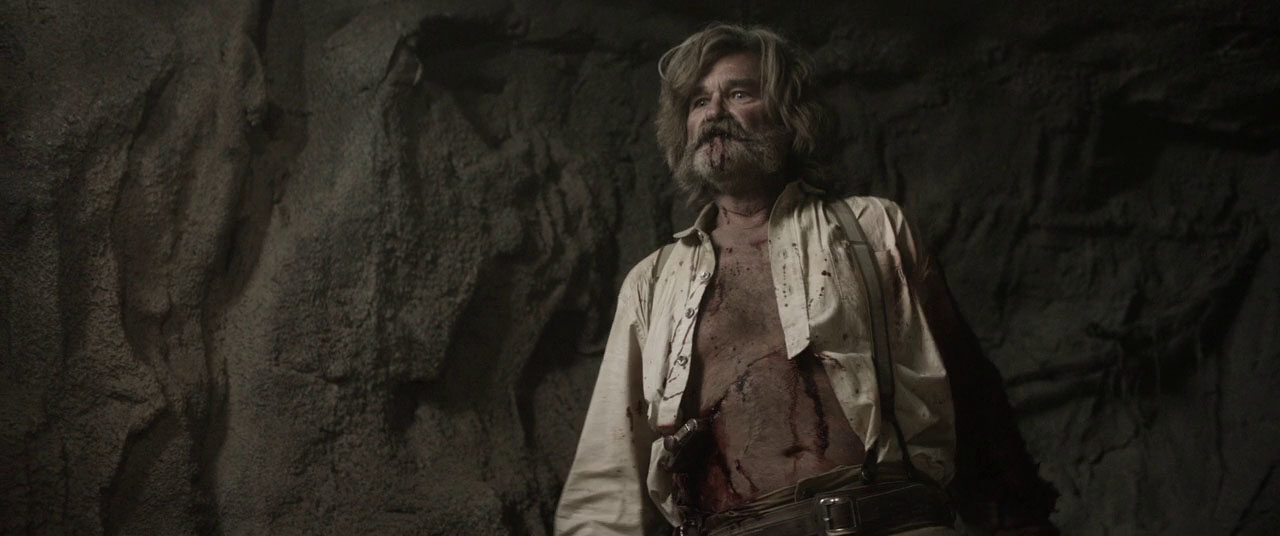
The four men: Sheriff Kurt Russell (this makes a nice Hateful Eight companion), the doctor’s injured but determined husband Patrick Wilson, pro Indian-killer Matthew “Racer X” Fox, and the primary reason to keep watching, Assistant Deputy Richard Jenkins as Stumpy. They don’t seem especially optimistic about their chances, and this is justified when they reach the caves – Fox is killed but takes down a handful of cannibals with him, and the others are imprisoned, where they witness this movie’s big gory reason to exist: Deputy Nick being split clear in half by the titular tomahawk. Fortunately they’ve left Wilson behind, and he mounts a last-minute rescue.

M. D’Angelo:

Zahler does reasonably well by the genre visually, given his budget, but flavorful Old West dialogue (“You been squirtin’ lemon juice in my eye since I came in here” — this in response to Kurt Russell’s priceless delivery of the line “You’re pretty angry for a guy named Buddy”) and amusing riffs on stock characters are the main attraction here.

Roughly in descending order of how much I loved ’em.

World of Tomorrow (Don Hertzfeldt)

Duh.

We Can’t Live Without Cosmos (Konstantin Bronzit)

An ode to friendship and space travel. Pretty traditional-looking animation with some fun effects (I loved when the stars turned into falling snow) and a beautiful story. Bronzit has made a bunch of shorts including the oscar-nom Lavatory Lovestory.

Prologue (Richard Williams)

Firstly, holy crap, Richard Williams is still working. Looks like a very good figure-drawing exercise come to life – a single “shot” detailing a violent gladiator fight and the moments before and after.

If I Was God (Cordell Barker)

That’s National Film Board of Canada legend Cordell Barker, of The Cat Came Back and Strange Invaders fame. The animation here does not disappoint, terrific stop-motion, though the story’s just alright: reminiscing of schoolday fantasies.

Sanjay’s Super Team (Sanjay Patel)

Saw this with The Good Dinosaur.

Bear Story (Gabriel Osorio Vargas)

From Chile – Lonely bear has a complicated mechanical box that tells his life story of being kidnapped and imprisoned by Pinochet’s police zookeepers, losing his family while away – though in the mechanical version his family stays. Not wowed by the animation but I loved the inventiveness of the “mechanics”. Doesn’t Osorio mean “bear river”? Was that bear the director?

The Loneliest Stoplight (Bill Plympton)

Not Plympton’s best work about inanimate objects in love (that’d be The Fan and the Flower), but cute. Patton Oswalt voices a stoplight who’s had some good times but is now mostly forgotten since everyone takes the highway.

The Short Story of a Fox and a Mouse (bunch of French directors)

Hard to focus with the girl behind me saying “soooo cute!” over and over, but I guess a fox and a mouse take turns saving each other’s lives and become friends. Second animated movie I’ve seen this month casting owls as the villains.

Catch It (bunch of French directors)

A wannabe Ice Age, meerkats vs. a vulture. Every year when this program needs to fill time it throws in something animated by a gang of French people.


These shorts programs are fun, even though World of Tomorrow looked better on my TV than on the movie screen somehow. Watched the 2014 program at The Ross and the 2013 in Atlanta… and I guess the 2006… so I’d have some catching up to do if I got a sudden urge to watch all the oscar-nominated animated shorts ever… not that I’d do a thing like that.

Maybe it’s a gimmick, but it worked for me, belatedly. I spent most of the movie wondering at the widescreen cinematography (which seems to use its black bars as a weapon, subtracting from the picture rather than adding) and the going-nowhere story, only gradually realizing that friendly, innocent Simon is being revealed as a liar and woman-beater.

Adam Cook:

The portentous title immediately creates an anticipation for the events that will follow. Yet whilst there is a logic to the title, Campos smartly plays with the audience’s expectations as this is not a serial killer thriller but the character study of a detached sociopath who leeches off others before discarding them when they have fulfilled their usefulness. Simon is a complicated and ambiguous character, weak and pitiful yet cunning and manipulative. He is a man who adapts himself to take advantages of situations, appearing hurt and helpless yet always in control.

American Simon is Brady Corbet (part of the Melancholia wedding meltdown) and his girl in Paris is Mati Diop (35 Shots of Rum), and the two cowrote their parts together with Campos, whose third feature Christine premiered at Sundance the week I watched this.

The movie that blew up my twitter the most in December, from “bear rape” to “movie pussies”. And it won the golden globe over Carol, Mad Max, Room and Spotlight. But it’s by Iñárritu, who I haven’t trusted since the putrid 21 Grams, and I was ambivalent to his oscar-winning Birdman. So surely the question on everyone’s mind is: did I enjoy The Revenant? Yes!

This one’s not done as a fake single-take – and who told me it was? – but rather shot with a grotesque wide-angle lens by the great Emmanuel Lubezki and edited by Soderbergh’s man Stephen Mirrione. I guess Leo DiCaprio is the gone-native white dude with a half-breed son and the two of them are well-paid to guide and protect a crew of trappers under siege by a group of natives looking for a kidnapped girl, rival French trappers (who kidnapped the girl), snow, bears, and worst of all, their own greedy compatriots. After Leo is half-destroyed by a bear, trapper Tom Hardy murders Leo’s son and abandons Leo to the elements, returning to camp to collect his reward for valiantly trying to help (Tom’s word against nobody’s). But Leo survives a million horrible things, makes it to camp and gets Captain Domhnall Gleeson (having a good year with Ex Machina and Brooklyn) to go after the villainous Hardy.

So yeah, I was convinced by the film, went along with the ride, edge of my seat like a disgusting, frozen, bloodied Panic Room, and didn’t even feel bad about it afterwards. Some folks weren’t as persuaded.

J. Christley:

That The Revenant is egregiously overlong is almost beside the point; audiences will manage their expectations in that regard. What pushes the film, at long last, into the icy river, is its very design, as a monument to slick, mercenary grandeur.

He makes a good point about The Big Sky being a more efficient film, but did The Big Sky have characters named Trapper Hatchet In Back and Dave Stomach Wound?

I knew this was based on a Patricia Highsmith story, but when I saw the opening scene I thought “oh no, is this a remake of Brief Encounter?” Fortunately it goes in a different direction pretty quickly, and while Brief Encounter may have a perfect ending for the 1940’s, Carol has the perfect ending for right now.

Carol (Cate Blanchett) is the interesting rich lady who makes eyes at young department store cashier Therese (Rooney Mara) one Christmas shopping season, and eventually they’re in love, vacationing across the country, not realizing they’re being pursued by private investigators hired by Carol’s husband Kyle Chandler. Not much to say about the movie, plot-wise, since it’s all about perfectly chosen moments and a beautiful visual atmosphere.

F. Zaman in Reverse Shot:

It doesn’t engage with questions of why or how its protagonists are gay, or create simplistic dynamics between homophobic villains and damaged queer heroes. It lets the characters just be, as they are, a defiant act of passive resistance against the assumption that queerness needs to be justified – and that it is the primary quality of the queer person. Just as Haynes is reinvigorating the melodrama genre in films like Carol, Far from Heaven, and even Velvet Goldmine, he is also reframing history to include others — people of color, counterculture figures, queers — in a meaningful way. Carol is also full of visceral pleasures, capturing subjective but universal experiences, like the way the world seems to blur when that certain someone touches your wrist for first time.

Sometimes I get behind on the ol’ movie blog because I watch a movie I’d been expecting to like and it turns out I have nothing to say about it and can’t even bring myself to write a plot description. Fortunately there’s Cinema Scope to tell me what to think.

Inspired by a bunch of viral videos! Yes, exclamation mark. I’m still confused by the bus-ride finale, but at least now I know it’s part of the director’s weird urge to incorporate his favorite youtube videos into the script. Full of gentle doom music, plus some Vivaldi. Won a million awards, including a prize at Cannes – where Mark Peranson wrote:

The film benefits immensely from Ostlund viewing this familial tragedy through a wry microscopic lens, which helps counteract his Haneke-like tendencies: when Tomas bursts out crying after faking tears mere seconds earlier, and then can’t stop, the situation is at the same time funny-sad and funny ha-ha. There’s a glimmer of warmth to be found in the winter chills, and Ostlund’s accomplishment is rare: Force Majeure is an example of universal distance. Here, man is the animal.

It’s actually Oostlund, or Oestlund, or O-with-two-dots-stlund, but my Macbook has decided to disable the useful feature where I used to hold down a vowel key and it would ask me how I’d like to decorate it with accent marks and such.

So this is the movie where the dad abandons his family during an apparent avalanche, and this leads to strife. It’s got the same problem as most movies (and possibly most relationships): that of communication. They can’t move past this moment because the dad refuses to talk about it, even though the mom doesn’t want to talk about anything else. They drag other couples into their vacation-crisis, sparking little sub-crises everywhere.

The family with Fanny and Mats:

Whiteout rescue – possibly staged for the kids’ benefit:

A. Muredda:

Ultimately, Force Majeure isn’t about “the crisis of masculinity” so much as the way personal edges never quite get shaved off with the adoption of archetypal roles: not just father and husband, but also mother and girlfriend. In a film rife with smart visual set pieces, from Tomas’ flight from the table to a later family excursion into whiteout conditions that allows him to reassert his dominance, the richest belongs to Ebba. Late in a day off from her family, mostly spent sitting at the hotel bar and having a private ski, Ebba relieves herself in the bushes off to the side of the hill, the camera slowly pushing in on her face as she hears what sounds like her little tribe slowly coming down the slope before her; she tearfully looks in their direction but doesn’t announce herself, troubled by her momentary separateness but not about to change it. Tomas’ actions during what ought to have been a redemptive defining moment are the ones that will surely inspire the most post-screening discussions, as they do with the couples Ebba solicits, but what sets Force Majeure apart is this heightened sensitivity to how even an event as minor as Ebba’s little breather is incongruous with the stories that families tell about who they are.