Ooooooooooooooooh…

The claw!
Ooooooooooooooooh…
The claw!
This was both wonderful – an inventively whimsical little ride of a rigorous art film – and tedious in that way that non-narrative films can be. It wouldn’t be a Snow work if it didn’t test my patience a little – it’s part of his charm. This kind of thing is always very different with an audience, not that I think it’s likely I’ll ever get the chance. I picked up visual similarities to Presents and Sshtoorrty… not so much Wavelength unless you count every zoom as a reference to Wavelength (which I guess some critics do).
People walk through a door with the title printed on it (this is where the zoom comes in), while we hear Snow, offscreen, instructing each on the entrance of their timing. Cut to inside the office, and the camera rolls to the right, an infinite camera move since the set is digitally joined at the seams. He electrocutes all his actors, a chair disappears in a lap dissolve, blatant digital effects pop up, then the picture twists like a ribbon as it transitions to next scene. Apparently these are many different actors dressed similarly to give the appearance of a regular cast of characters, but I can’t see subtleties like that on my VHS copy… a shame.

A family sits in their garishly (digitally) decorated living room with a wall mirror reflecting the camera until objects fly off the wall and destroy themselves while the people sit still staring at the sky inside their television. Obnoxious noise permeates, except when one would expect a sound effect (during an explosion, say) when it goes silent.

A classroom is shot from above until the kids notice the camera, stack their desks so they can reach it.

Two people enter a too-small doorway at the same time, fusing and morphing into a slow-moving doorway-shaped block, which lumbers back into the infinite-loop office set. The credits show up before the hour mark and begin to lap themselves. The whole movie rewinds. Then at the end a couple enters a cinema and sits down to watch an early animated work by Snow.
J Hoberman calls it “that rarest of things—a summarizing work. Like Chantal Akerman’s Jeanne Dielman or Chris Marker’s Sans Soleil, it could be used to conclude Motion Pictures 101. … Rigorously predicated on irreducible cinematic facts, Snow’s structuralist epics – Wavelength and La Région Centrale – announced the imminent passing of the film era. Rich with new possibilities, *Corpus Callosum heralds the advent of the next. Whatever it is, it cannot be too highly praised.
Hoberman again: “a bonanza of wacky sight gags, outlandish color schemes, and corny visual puns that can be appreciated equally as an abstract Frank Tashlin comedy and as a playful recapitulation of the artist’s career.”
Pop Matters:
Similarly, domestic life in *Corpus Callosum is irrevocably altered by innovations. The home is filled with televisions, pizzas, and empty glasses. Intense oranges and pinks make the living room seem alive and breathing. The walls are decorated with paintings, an eye-test chart, a crutch, and a skeleton. A mirror reflecting what appears to be Snow and his film crew forms the focal point, reminding us that this film has an author, just as our own environments have human creators. In one 12-minute sequence, objects on the walls begin exploding, one at a time, into beautiful pixel starbursts. Snow, the reflected “god” (for he is creator of this space and the characters who dwell within) appears here to be an Old Testament type: he can give and he can take away.

NY Times:
In keeping with his lighter side, *Corpus is also fun … But then it starts to feel as if things are going on for too long. Mr. Snow realizes he is literally playing with time, though, and even jokes about it: he inserts the credits in the middle of the picture. … We get the point, but the movie goes on and on, using repetition to comment on repetitive behavior.
Rosenbaum, who ranked it his #1 movie of 2002, above even Platform: “Not counting the asterisk, the title refers to the tissue connecting the hemispheres of the brain, an apt reference given the prodigious and joyful inventiveness on display.”
In Snow’s description he says:
The sound – electronic like the picture – is also a continuous metamorphosis and as the film’s “nervous system”, is as important to the film as the picture. Or: the sound and the picture are two hemispheres joined by the artist. *Corpus Callosum is resolutely “artificial”, it not only wants to convince, but also to be a perceived pictorial and musical phenomenon.
… a shame, since my copy had lousy sound.

Funny that I watched this the day after The Last Movie, since it turns out Snow put out a record called “The Last LP”.
Snow, interviewed:
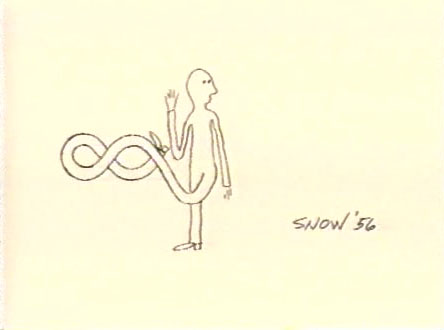
“Although it was all done in the computer, so there isn’t any film in it except for a little tiny bit at the end which is something I did in 1956 and is in a sense my first film. The film I usually refer to as my first film A to Z which is a cut out animation film in 1956. Where as what appears at the end here is, well something which we used to call flimsies. You see I started out in animation and that is how I got involved with film. We used to make the drawings on tracing paper, we would put them on pins with one over the other on a light box and you would draw them. And I did this little sequence of this leg stretching in 1956, but I never shot it, I just kept it as a flimsy. So I guess that is in a sense my first film or at least it was intended to be shot as film. But it was not shot as a film.”
Offscreen: Has it changed over the years, the audience reception?
Michael Snow: Yes. I don’t know what is happening to people but they are not as tough as they used to be. … I really want to make physical things so that the experience is a real experience and not just conceptual. Well yes there are ideas in the works, but they are also body affects, like the panning, for example in Back and Forth. I’ve seen someone get sick and people have fainted with La Region Centrale, so I must be doing something right.
WonderRoot’s Generally Local, Mostly Independent Filmmakers’ Night
Atlanta, Day One (John Duke and Kris Valeriano)
I liked. KV wears a three-dollar suit, tours picturesque ruins of Atlanta before he starts breaking down. I dig the editing at the end, as it cuts between scenes where he’s in the same physical pose, giving the impression of one movement transporting across locations.
Mouth 2 Mouth (Patrick Coll and Chris Chambers)
Hilarious, very short animation.
Until Dust (Nathan Honnold)
I remember saying to Jimmy afterwards that it’s good to know I’m not the only Guy Maddin fan in Atlanta, but I don’t remember much else. Oh wait, here it is on Vimeo! Blurry-focus titles, one of which says “hairdressing school,” yep, I stand by my Maddin comparison. Too bad it’s one of the only pieces projected interlaced, since it was shot originally on super8 film.
Rex (Jackson McDonald)
A guy picks up girls to feed to his hungry dragon. Shot decently and colorfully, complete with flashbacks.
Breathe (Fletcher Holmes)
Clever special-effects demo, shot underwater and somehow keyed, breathing SFX added later prompting a “how’d you DO that?” from the crowd.
17 Degrees Ain’t Nothing (Carlton Mackey and Dane Jefferson)
Two dudes got a camera, but what to film? They chose to interview some homeless people for an hour – and that hour changed their lives (the lives of the two dudes, not of the homeless people). A year later, footage is edited, theme songs are written, still photos are panned and zoomed, and lessons are learned.
The Charm and Rant of Charlotte Pomerate (Beth Malone)
The filmmaker has, what was it, a grandfather involved in “very far left” politics? And his wife wrote children’s books. And she was interviewed by her granddaughter, then the interview was turned into a claymation video… but it’s more “clay” than “mation”. Clay-still-life. Combines two styles I don’t like (documentaries about one’s relatives + animating audio conversations) but it was cute so I couldn’t stay mad.
Passion Seeker (Chris Chamber)
Video for a song by Little Tybee and Adron edited from 1930’s-90’s film clips. Played at around 2fps, and it’d be important to know whether that was intentional. If so, I’m not a big fan. If not, hey WonderRoot, I can give you advice on how to fix that. The song was nice.
Christmas and Hanukkah (Garry Bowden)
“Love is coming for us all,” says the description. A straight-faced romance soap-opera that inspired derisive laughter from the audience. Could Bowden be the Tommy Wiseau of Atlanta? Could he even be of Atlanta? I didn’t recognize any of the scenery, and it’s mostly shot outdoors. Story follows two people who find each other after sour breakups, shot by a man with a handicam but without a plan.
Heaven (Chris Sailor)
Heaven is a parking lot where echoes both precede and follow your words. You should be quiet, according to the man behind you in a creepy mask, but you are not. Also, you’d like a cigarette.
One Minute Fluid Toons on Paper (Brett W. Thompson)
Finally, the long-awaited return of Fluid Toons! Less narrative (and without the awesome sound effects) than the last installment, but any Fluid Toons is good Fluid Toons.
Godamsterdam: Yellow Fever (Ben Cohen)
Part of a web series celebrating political incorrectness. It’s no Sarah Silverman Program but it made me chuckle. Probably the most ambitious project here, setting up a regular cast of characters and a whole series of shorts, with higher than usual production values.
Between “My Year of Flops” and “I Watched This On Purpose,” the AV Club watches a bunch of known-to-be-bad movies and reports back on the experience. I also have an unhealthy urge to watch stupid movies, but I don’t have the kind of free time they’ve got. I just want to know if I’m missing out on anything, and if the movie’s got a built-up mystery, what’s the big twist at the end. And now, thanks to netflix streaming, I can watch any part of any bad movie instantly. So here’s a rundown on the last ten minutes of…
Delgo (2008, Adler & Maurer)
Our hero Freddie Prinze Jr. is inspired by princess Jennifer Love Hewitt to go fight the evil queen. Animation really is as bad as they said, does not look like something that should be in a theater in 2008. I looked for Avatar parallels – got the enchanted forest, peace-loving fairy inhabitants (not cat-people at all) who ride dragons, and the cliche-and-catchprase-littered dialogue. Chris Kattan (ugh) rallies all the planet’s species to attack evil there at the end, also an Avatar plot point. Oooh, Delgo uses the Force. Isn’t the Force trademarked? J.L. Hewitt kills evil stepmother Anne Bancroft (I’m sorry this was your final film, Anne Bancroft) and peace is brought unto the land. Full of corny-ass jokes and hot, forbidden interspecies love.
Pandorum (2009, Christian Alvart)
A bearded Dennis Quaid seems possessed by some supernatural sci-fi evil. This is way more talky than Event Horizon. Ben Foster (X-Men 3, Northfork), I assume, is experiencing some kinda psychological special effects. Oh they are not in space, but underwater – that’s the big revelation, allowed a couple seconds of floaty luminescent peace before it’s back to punching Dennis Quaid. He fights some girl who is not Carrie-Anne Moss. Now is Ben possessed by the ancient evil? Wait, nevermind, a crack in the hull. Oh, the evil is some kind of cat beast. Catmen from Pandorum – more Avatar references? Ben and the girl surface. Happy ending? I can’t tell. Director Alvart is a German making it big in Hollywood with writer Travis Milloy, who once wrote a Jason Schwartzman movie that nobody saw.
The Alphabet Killer (2008, Rob Schmidt)
Tim Hutton (Ghost Writer, The Dark Half) must be the killer here. He’s trying to sedate Eliza Dushku, but she uses her Buffy moves to bust his face and escape. She tries to trap him in a way that would totally not work, but totally does, and dude escapes, gunshot in the foot, into the river. Is she raving incomprehensibly, or is the string music just up too loud? Later, in the hospital, Cary Elwes (I’ve not seen him since Saw) proclaims that this is all his fault (I’m willing to accept that). She never recovers and Hutton gets away, ouch. Schmidt made one of the more enjoyable Masters of Horror eps, and writer Tom Malloy did something called The Attic which looks even worse than this.
Righteous Kill (2008, Jon Avnet)
Pacino is gonna get shot by DeNiro! Or is DeNiro gonna get shot by Pacino? The editing is confusing and every shot is a close-up. Now there’s a showdown in an 80’s-movie factory, both of them with guns. I don’t know what they’re saying because Katy made me turn off the sound, but Pacino is pissed, and his hair isn’t as bad as it usually is, and Carla Gugino (Watchmen, Sin City) is hanging around. Nevermind all that, Pacino got totally shot to death by DeNiro! He gave a long speech I didn’t hear, then some shit happens, I wasn’t looking anymore. From the director of 88 Minutes (and Fried Green Tomatoes) and the writer of Inside Man.
Underworld: Rise of the Lycans (2009, Patrick Tatopoulos)
Sooo dark! I see werewolves, and some Lord of the Rings business, but it’s all so dark. The action is very actiony. HooRAY, Bill Nighy of Shaun of the Dead is the self-serious lead bad guy in a ridiculous costume. He shall face off against a pissed, bearded Michael Sheen, who screams “I loved her,” which means that Rhona Mitra (Doomsday) might be dead. Wait, Nighy is a vampire! He got sunlit then stabbed through the head by a righteous Sheen, which Katy did not appreciate seeing. Oh and Nighy is still alive in the twist ending here, as is Rhona Mitra. The director was a creature designer on the first two movies, never a good sign. Jesus, nine writers?
Lies and Illusions (2009, Tibor Takacs)
Christian Slater does his hammy always-talking thing in the backseat of a made-for-1991-TV-looking full-frame car chase. Sarah Ann Schultz is trapped after a huge crash, while Christa Campbell shoots at some baddies who are not Cuba Gooding Jr. The sound mix is awful, very Slater-heavy with crap music, but wait, CGJr showed up and shot Slater, which STILL didn’t shut him up. Sarah Ann Schultz sneaks onto Cuba’s airplane, and parachutes out leaving the plane to crash, in the most hilarious special effects attempt of 2009. Tibor, of course, made the excellent The Gate and less-excellent The Gate II back in the 80’s – doesn’t look like he’s doing so well now. From the writer of nothing, and cinematographer of Trapped Ashes (but given a Magnum P.I.-era TV videocamera).
Angels & Demons (2009, Ron Howard)
Tom Hanks discovers secret cameras taping the board room! He sees a very sinister Stellan Skarsgard (ha ha, he is always sinister) saying quizzical shit to an incredulous Ewan McGregor. Apparently Ewan spread illuminati rumors to stop SS from trying to find scientific proof of God? Or something, anyway Ewan frames SS and gets him shot in flashback, to the despair of all the cardinals reviewing security tapes with Hanks and some girl who is not Audrey Tautou. Later, a guy who might be Armin Mueller-Stahl presides as scary Germans tail a bruised Ewan until he sets himself on fire. The evidence is destroyed, and the crowd goes wild. Where does Jesus’s granddaughter fit into all this? From the writers of Zathura, Secret Window, Constantine and Deep Blue Sea, ouch.
A Letter to Uncle Boonmee (2009, Apichatpong Weerasethakul)
Slow-panning shots outside looking in, but mostly inside looking out. Unique location (Nabua village in Thailand) but also unique photography style. I wonder if another filmmaker could’ve found images half as strong as these. As for the story, well, as usual with A.W. I don’t really get it. The village has a history of violence and repression, and this (fictional?) uncle is unseen, addressed by a narrator. Actually it’s more than one narrator, reading the same script, which is later critiqued for accuracy of dialect as we continue roaming the houses, looking slowly up at the trees. Makes me want to catch up with A.W.’s features that I’ve missed. Later: So I have, with Syndromes and a Century. Its dialogue repetition and shots of trees from inside buildings reminded me of this short.
Academic Hack:
In a stunning act of political avant-gardism, Joe has adapted Thai Buddhist tenets regarding reincarnation as a means for excavating the hidden history of a troubled landscape. As his camera slowly creeps and pans through darkened, abandoned homes, Apichatpong is displaying the remnants of a repressed past, in an assertion of ghostly, vertical time. … Joe’s dominant visual cue throughout Boonmee is the depiction of dark, illegible interiors whose porous walls and broken-out windows allow the bright green of the jungle to puncture the once-domestic space with light and texture. As beautiful as the effect may be, it is also chilling, since it represents the breakdown of human effort’s separation from natural encroachment, the dissolution of basic boundaries.
–
We Work Again (1937)
A newsreel short about how “we” (meaning black americans, though it sounds like the regular white studio voiceover guy saying “we”) are finding jobs after the depression – mostly jobs in the arts, thanks to the federal works agency. Contains rare footage of Orson Welles’ “Voodoo Macbeth,” which used all black actors and looks like it could’ve used a higher prop budget.

–
The Little White Cloud That Cried (2009, Guy Maddin)
Commissioned for a Jack Smith program. It reminded me of Kenneth Anger, with the classic pop songs strung together, the soft-focus closeups, but that’s probably because I barely know anything about Jack Smith. Lots (lots!) of nudity, largely (maybe entirely) transsexuals. Typical Maddin editing (which is to say: exhilarating). It’s either art or the best porno I’ve ever seen.

Someone got the filmmaker by accident. He looks so intense!

Send Me To The ‘Lectric Chair (2009, Guy Maddin)
No credits. Need to get a copy someday without interlacing. Made for the Rotterdam festival for an outdoor exhibit. Isabella is in the ‘lectric chair. A man rushes to save her, too late, embraces her as the switch is pulled. Charming homemade effects: tin foil, sparklers and exercise equipment. Louis Negin (reused footage from Glorious?) dances shirtless in celebration!
Maddin: “Now, I was immediately told no nudity, I was immediately told no strobing, so strobing became the new taboo. It would throw the citizens of Rotterdam into epileptic fits flipping on the sidewalks.”

More, from a simply fantastic interview with Maddin: “My condition for doing it was that I got permission to re-use the footage in my next feature. Whenever I accept a short film commission, I get permission to use the footage from it and so I’m slowly assembling clips… and in this financially depressed time, you need to. It’s a Frankenstein feature film built together from a bunch of dead short commissions.”

–
Zoo (1962, Bert Haanstra)
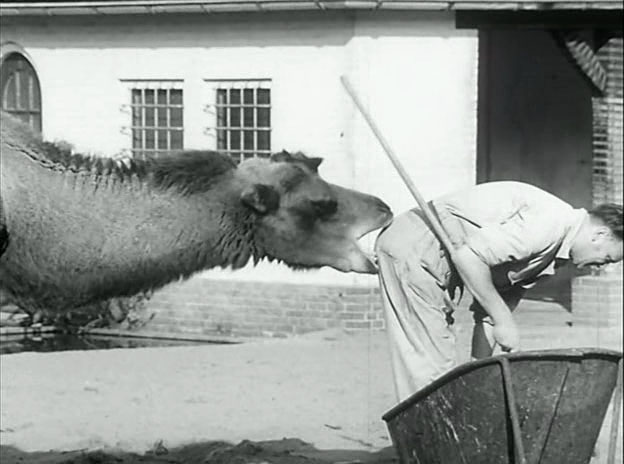
One of the greatest short films ever. He must have shot for days and days to get so many great shots of animals and spectators, then associatively edited them together into a docu-comedy. I learned from the ravingly positive writeup on the official Bert site that it was all filmed with a hidden camera.
–
Contact (2009, Jeremiah Kipp)
Boy and girl visit dealer, get bottled drug and take it together naked. Bad trip ensues. Girl’s concerned parents wait at home, until she shows up late, hugs daddy. Very little spoken dialogue – for artistic sake, or with international film fest distribution in mind? Heavy-handed sound design with echoey shock-horror effects with a sidetrack into 8-bit glitch noise.

–
The Bookworm (1939, Hugh Harman)
The crappiest little time-filler of an MGM cartoon. Can’t imagine anyone wanting to buy these as a set, so may as well parcel ’em out as bonus content on other discs. Poe’s raven wants to catch a bookworm (that’s a worm who eats books) to put in the Macbeth witches’ cauldron, but the worm is saved by characters from other books, with a complete lack of imagination, not even the har-har caricature value of those not-great Tashlin library shorts. Why would the books want to save a bookworm anyway? This seems an important part of the story, and it’s just ignored. Ted on IMDB overthinks the movie, says it’s “amazingly sophisticated in its abstraction,” no kidding. A Tashlin movie would just blow Ted’s head right off. Harman put more effort into the same year’s classic short Peace On Earth.
–
Love On Tap (1939, George Sidney)
At least with The Bookworm you can tune out the story and watch the animation, but there’s no joy in this one. Well, it’s a musical short so I guess you’ve got dancing, but that’s not much of an attraction. Story goes this dude is trying to marry a gal who leads a dance troupe, but her dancers are whiny dependent brats and she caters to their every whim, putting off the guy until he threatens to leave instead of marrying her. He should’ve. Sidney later directed celebrated musicals like Annie Get Your Gun and Kiss Me Kate… guess you gotta start somewhere.
–
Michelangelo Eye to Eye (2004, Michelangelo Antonioni)
Antonioni silently contemplates the work of another Michelangelo. 15 minutes of static or slowly tracking shots, with just room noise until an ethereal choir sings us out into the credits. Nice to see that after all these years, M.A. is still filming people dwarfed by giant structures and pillars.

–
Wake Up, Freak Out, Then Get a Grip (2008, Leo Murray)
A cute cartoon illustrating how we’re all going to die from global warming. Only Leo doesn’t say we’ll all die, he says all the good species of animals will die, leaving rats and roaches, and since there won’t be enough resources left for all of us, those with the most guns and lowest morals will survive to slaughter the rest. Then he says we can’t stop things by being jolly good consumers and buying fluorescent bulbs, we must rather campaign our governments and friendly local corporations to smarten up. Not likely! Move inland.
The adventures of a tall blue cat man on a blacklight-mooned planet climbing fluorescent disco trees. How appropriate that the film follows a preview for Tim Burton’s Alice In Wonderland.
Katy and I liked it!
“If things could talk…”
Our hero Lily Rabe, doing something quirky:
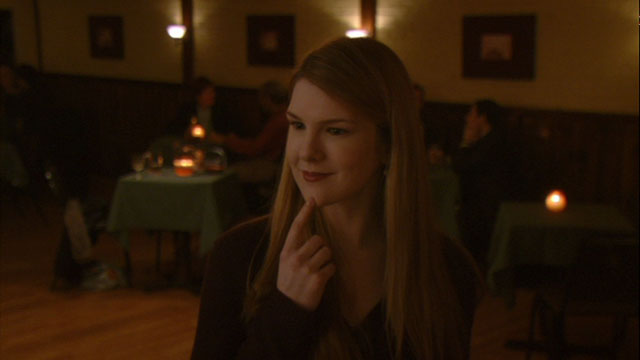
Mona (Lily Rabe, a little Drew Barrymorish) is on the run from her mom, dealing with mysterious strangers and memories of her deceased father who used to play a Calvinball version of tic tac toe with her on the beach. A boy finds her wallet, uses her cash to take piano lessons from teacher Kevin Corrigan (Jerry Rubin in Steal This Movie). Five animated commentators (including the voice of David Cross) play a game involving the plot and props of the movie.
D. London on guitar:

Mona likes elevator operator Daniel London (the guy who isn’t Bonny Bill Oldham in Old Joy) but they have a falling-out when Jane Lynch (of A Mighty Wind, possibly my favorite performer here) spills beer on Mona. The cartoon characters intervene, causing the woman who hired Mona (to sort through and retype mysterious papers) to have a seizure in order to reunite Mona with the elevator man and reconcile her with her mother. Possibly.
Cartoon gramma torture:
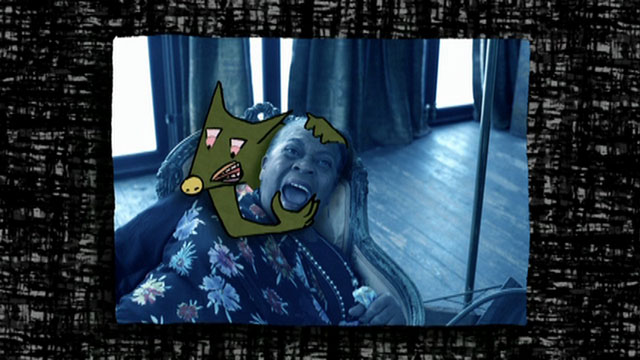
A quirky indie drama, not realistic in the slightest, but the animation and the digital tomfoolery let us know that’s intentional. Playful and childish and full of cameos (John Sayles is Mona’s landlord, Eugene Mirman is the night elevator man, Jon Benjamin is a cop, and Jon Glaser is an open-mic performer named Toooot). The first voice we hear is Robyn Hitchcock, appropriately as a train conductor.
Jane Lynch (Role Models, Smiley Face) poses next to Hubley artwork:
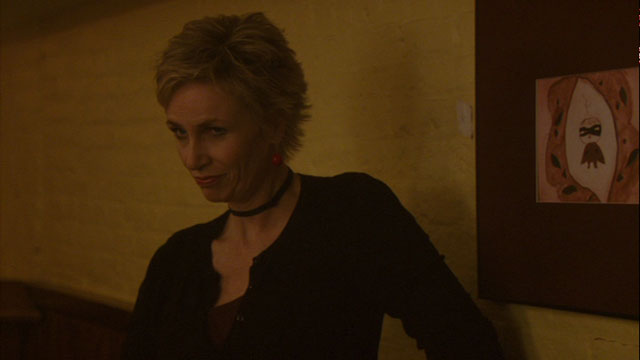
Hubley’s first feature, very good as far as Sundancey indies go.
Yo La Tengo provides a chill soundtrack (and connections to half the guest stars).
Watercolor self-images by Jeff Scher, whose short films I’ve been enjoying:

Cute movie, actually one of my favorite Disney cartoons. That’s probably because I first saw it when I still liked Disney movies (age 10-ish) and didn’t see it again when I was sick of them (age 12-20). Watched it this time because I’ve been listening to Roger Miller albums on repeat all autumn and I never realized he played the troubadour narrator rooster and contributed songs to this movie. Miller has three original songs, Johnny Mercer wrote one, then there was a crappy love ballad which of course is the one that got oscar-nominated (and easily beaten by “The Way We Were”).
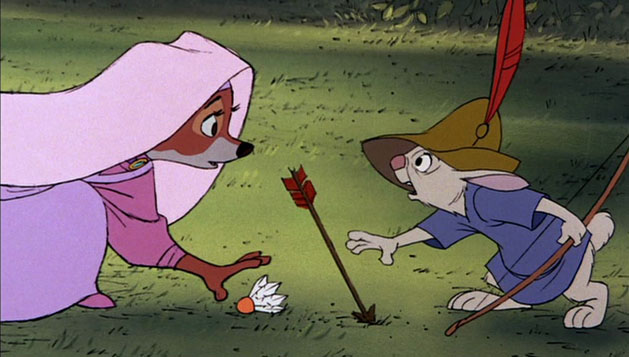
I thought Robin and Little John had a fight on a log but that must’ve been the Errol Flynn version. And I was expecting King Richard’s appearance at the end to be dramatic, a la Sean Connery in Prince of Thieves or Patrick Stewart in Men in Tights, but his scene got deleted for being frightening to children, so he only appears in epilogue. Lots of talk of death and hangings for a kids movie.
Director Wolfgang was a Disney animation lifer, from early 30’s shorts through feaures in the late 70’s. Robin is Brian Bedford (Grand Prix) – he doesn’t get his name on the poster like Tom Hanks in Toy Story. Former bandleader Phil Harris as Little John sounds annoyingly close to his Baloo. Andy Devine (Friar Tuck) was in Stagecoach and The Man Who Shot Liberty Valance. Monica Evans was in The Odd Couple, abruptly disappeared from the movies after voicing Maid Marian. Pat Buttram (heh), a western actor in the early 50’s, has the most memorable voice in the movie as the Sheriff. The oft-awarded Peter Ustinov (Lola Montes, Spartacus, Logan’s Run) is the prince (and the king) and famously gap-toothed comic Terry-Thomas (Danger: Diabolik, Bachelor Flat) is his snake assistant.
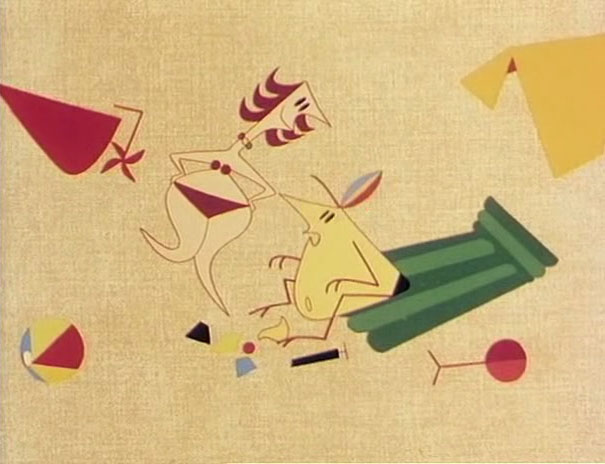
Surogat (1961, Dusan Vukotic)
Slightly naughty beach picture about a fat guy who brings inflatable ball, boat, car, food and girl. Real great anything-goes animation. Disney, Friz Freling and Chuck Jones must’ve cancelled each other out, giving the award to the underdog foreigner.
The Crunch Bird (1971, Ted Petok)
“Crunch bird, my ass!” Ugh, punchline shorts. Was there no competition this year? I would’ve awarded Thank You Mask Man over this. From a co-writer of What’s Up Tiger Lily, this beat a comic Canadian short about evolution and an adaptation of an Oscar Wilde fairy tale (OW wrote fairy tales?).

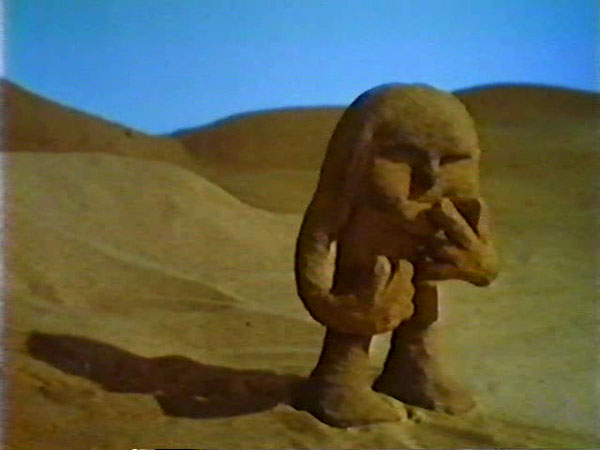
The Sand Castle (1977, Co Hoedeman)
A desert man with arms and legs but no body creates clay creatures to help him build a giant sand castle. All stop-motion, the short that (probably deservedly) beat Doonesbury at the oscars.
Every Child (1979, Eugene Fedorenko)
More of a foley demonstration than a proper cartoon. The animation is there I guess, though slightly Squiggle-visioney. Wow, someone sings the Umbrellas of Cherbourg theme. So the foley guys are telling the story of an unwanted baby… to a baby. One foley guy went on to voice the French version of Chief Quimby on Inspector Gadget. This beat a short called Dream Doll which I’d like to see, apparently an X-rated spoof of The Red Balloon.
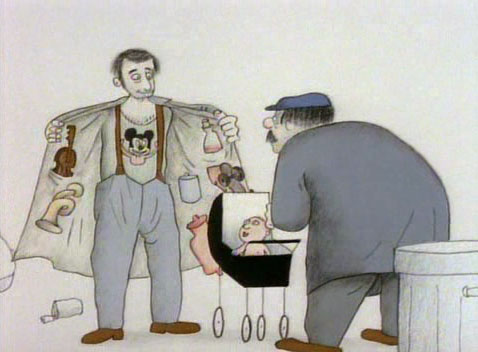
Tango (1981, Zbigniew Rybczynski)
An empty room, simple tango music. A kid (looks like stop-motion cut-out photographs) throws a ball into the room, comes in, throws the ball outside, leaves, repeat. Then another person is added, then another and another, none of them interacting with each other until the very end. How’d they do it? Beat out some stop-motion from the great Will Vinton and a half-hour piece about a snowman.

The Man Who Planted Trees (1987, Frédéric Back)
Just about the happiest thing ever, so lovely it made my head hurt. Story of a lonely shepherd who singlehandedly reforests an entire region of France. I looked it up, hoping that it’s a true story, and unbelievably it is. Narrated by the familiar voice of Christopher Plummer and animated with lush, colorful sketches. The romantic short from the creators of Bob & Margaret and a big of head-morphing Bill Plympton hilarity never stood a chance against this beauty.

A Greek Tragedy (1985, Nicole Van Goethem)
The characters are man/pillars holding up a stone wall that has fallen into ruins. When it finally collapses, the pillars are free to frolic. The kind of simple cuteness you’d see at a festival with three of four similar pieces, not the kind I’d think would win a major award. Hard times in 1986. Actually this beat Luxo Jr. somehow. I guess computer animation wasn’t in style until ’88. At the same time, it’s nice

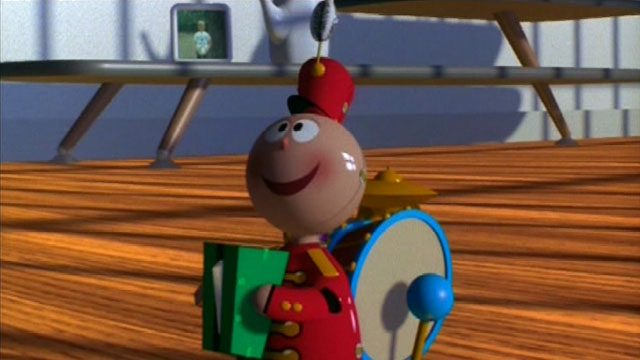
Tin Toy (1988, John Lasseter)
A one-man-band toy escapes the wrath of a slimy toddler, then grudgingly returns to cheer it up when it’s crying only to be ignored in favor of an empty box and a paper bag. Clear precedent to Toy Story. 1988 computer technology was not up to the task of accurate baby rendering, but it’s still pretty cool looking. It beat a Tex Avery-style short from the future director of FernGully and Cordell Baker’s great The Cat Came Back.
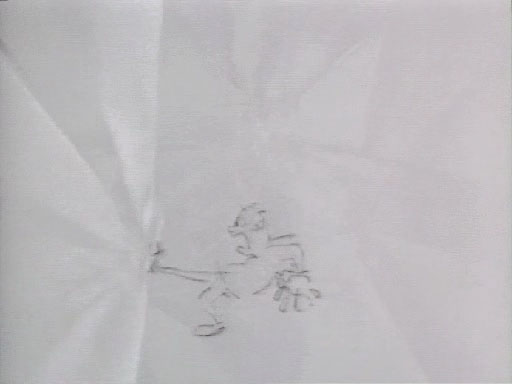
Manipulation (1991, Daniel Greaves)
A good ol’ artist’s-hands-interacting-with-drawing-table short, somewhere between Duck Amuck and Rejected. Funny how one of the most recent shorts is the one available in the lowest quality. The line-drawing guy turns 3D at the end, which I think was done in claymation. Very inventive and fun. Apparently Greaves’ Flatworld is also a must-see. No U.S. shorts in this year’s competition – this UK film beat out two Canadian pieces (including long-time fave Blackfly).
Mona Lisa Descending a Staircase (1992, Joan C. Gratz)
Really wonderful little animated film which would probably be the greatest thing ever if I was an art history major. Since I only knew about five of the paintings which were mighty-morphing into each other, I probably attribute more of the film’s beauty to its director than I probably should. Oh wait, it won the oscar so I guess I’m not the only one who was impressed.
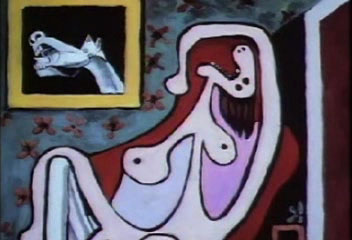
Then again, some of it is just silliness.

Quest (1996, Tyron Montgomery)
A man made of sand navigates increasingly more difficult and dangerous worlds of paper, rock, metal and water. The end is the beginning – would work as a looping DVD or art installation. Nice stop-motion, like The Sand Castle but I liked this one better, Thought it was anti-technology for a while, but now I think its just trying to say the world is a dangerous place. Competition included an Aardman, a Canadian piece I’ve seen but don’t remember, and a stop-motion short from a future Pixar animator.
