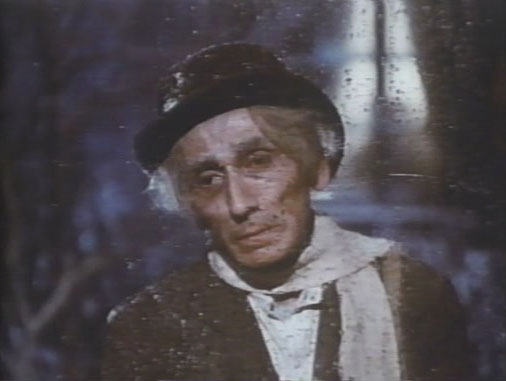
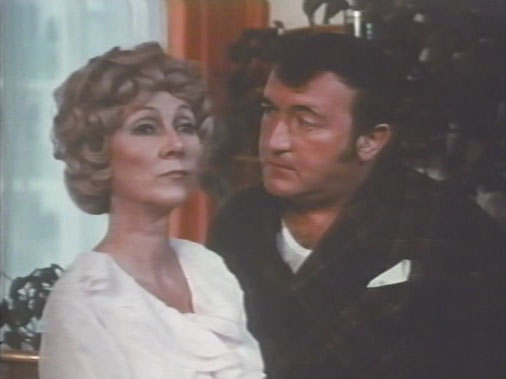
Anthology horror with a lousy framing story, exactly like Dr. Terror’s House of Horrors. This is actually based on the comics, didn’t just steal the title. Buncha pricks on a tourist romp in some ancient crypts get lost, run into evil cryptkeeper Ralph Richardson (bad parson of The Holly and the Ivy), leading to series of flashbacks before revealing that they’ve all been dead all along.

First, TV star Joan Collins kills her husband (for the insurance) on Christmas, then she’s stalked by a psycho killer santa.

Next, Ian Hendry (Repulsion) leaves his wife to run off with a girl, but he dies in a car crash then comes back a zombie.

Robin Phillips wants to do some realty scheme, but friendly old Peter Cushing refuses to step aside, so Robin destroys the old man, who comes back a zombie and kills him.

Richard Greene (Hound of the Baskervilles) dies in a car crash after his financial advisor (Roy Dotrice, Mozart’s dad in Amadeus) wishes on the monkey’s paw, then he and Greene’s wife have second thoughts and wish him alive again, but he lives in zombie-agony. Three zombie stories in a row!

Mustache businessman Nigel Patrick (The League of Gentlemen) becomes new head of a home for the blind and slashes budgets for everything to the despair of Patrick Magee (Alex’s tormentee/tormentor in A Clockwork Orange), who plots elaborate revenge.

“Men were vulgar. They wanted to forget their history. Only funerals seemed true, as they passed streets of dirty houses, like tombs for the living.”

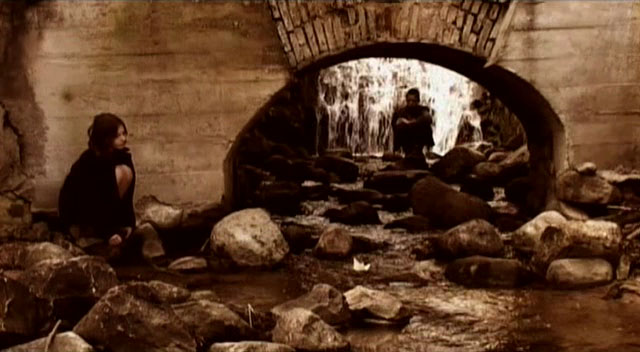
Almost an anthology film – three stories with no overlapping characters, set maybe in the 1920’s or 30’s. An adaptation of three separate works – a fact I didn’t catch in the opening credits. Very strange, but as magnetic and thrilling as Non.

The Immortals

A burst of music over the opening, then the first line, from a father to his son, is “Kill yourself.” Both father (Jose Pinto of Abraham’s Valley) and son (Luis Miguel Cintra, star of Non) are the most famous scientists of their respective generation. But the father is feeling washed-up and forgotten, and urges his son to die at the height of his fame.

Time out for a picnic with Marta (Isabel Ruth of The Uncertainty Principle), an old student/flame of the father’s, then back to the apartment. The son won’t be convinced, refuses to swallow cyanide, but agrees to fix his father’s curtain rod over the back door, at which time his dad pushes him over the balcony, then jumps after, yelling about immortality.

I’d noted that the movie felt like theater, the old man playing towards an imagined crowd instead of his son, in a single location except for the cutaways to the picnic and a downstairs neighbor’s place as the men fell to their deaths – and it was theater after all. A half hour into the movie, a curtain raises, and we begin to follow a couple groups of friends who have been watching the play, never to return to the scientist family.

Suzy

Square-jawed Diogo Doria of Non and his friend David Cardoso are paying as much attention to a pair of courtesans/prostitutes in another box as to the play. Cardoso meets the girls and reports back, having claimed Gabi (Rita Blanco) as his own, and later, Doria starts spending much time with Suzy (the ever-present Leonor Silveira), though he remains rational when he sees her out with other men.

All along, I’m suspicious that this will be another play, even though the atmosphere has changed – it’s more realistic, mostly shot in long takes (as was the first episode), but still held at a strange remove, with ellipses of undetermined lengths between scenes.

Suzy: “I have wealthy lovers, dresses by the best seamstresses, everything, except happiness.” Eventually she’s seeing Doria less often, though they exchange letters. In the end, Suzy has died in hospital during an operation (“she said: it’s a small thing”), but he keeps writing the letters. Cardoso stops by to visit his pathetic friend, and tells him a story.

Mother of the River

Young Fisalina (Leonor Baldaque, star of The Portuguese Nun) is in love with Ricardo Trepa (who played her husband in Christopher Columbus, The Enigma). But it’s not that simple: there are customs, rules, meddling parents and a small, stifling village. So she sneaks off to see the Mother of the River (Irene Papas, greek singer in A Talking Picture, also star of Z). “I love a boy with pretty teeth. I do not know how to marry him… curse me, but set me free.” So the mother takes Fisalina through a candlelit cavern to the edge of the water.

The next day Fisalina notices her fingertips are golden. She hides them from everyone, but no longer feels urgent towards her boy, and seems at peace with the village. During a candlelight festival, the light shines off her fingers and she is discovered, a witch! “Fisalina, reckless, fated, has chosen to live beside the deep water, where she will wait a thousand years before swapping lives with someone else.”

Goldfinger:

Trepa, despondent:

Oliveira has returned to these writers: his A Caixa was a play by Prista Monteiro (The Immortals), and he’s done at least four major films based on stories by Agustina Bessa-Luis (Mother of the River).

D. Kehr says the segments are “all centered on themes of death and eternity and presented sequentially as social comedy, existential tragedy and lyrical epic,” but Rosenbaum, more correctly I think, says it’s “the theme of existential identity” that unites the stories.

Middle of R.R.’s war trilogy, six episodes about different wartime encounters with (mostly?) Americans. The movie’s subject is that “war is an epidemic that sweeps up everyone in its path,” sayeth the TV narrator. A pretty active and mobile camera, and big noisy music by brother Renzo. Fellini was co-writer and assistant director. A whole bunch of writers, including Alfred Hayes (later Clash By Night and Human Desire) who might account for the surprisingly not-bad English dialogue.

1.
A couple of misunderstandings. U.S. soldiers come to town, recruit a local girl to lead them over the mine-laced lava path. Joe stays in a building with her while the others go ahead. Nazis wander in as Joe is connecting with the girl despite their language barrier, shoot Joe then toss her off the cliff. When the Americans return, they assume the traitorous Italian girl killed their friend then ran off.

2.
Black American soldier hangs out with kid, drunkenly assaults a puppet show, gets his shoes stolen, later comes after the kid to reclaim his shoes but leaves empty-handed, shocked to realize that the kids live in rubble, their parents dead from the bombings. It’s practically a Germany Year Zero prequel.

3.
This and the previous episode give the impression that there were about 200 people in wartime Italy. Very easy to find someone you’re looking for in the streets, or to run into an old acquaintance. Kind of a cheesy episode, a soldier sleeping with some lowlife whore (Maria Michi, the drug-addled turncoat in Rome Open City), telling her dreamily about this perfect upright Italian girl he met before the war, wishing he could meet her again and marry her – of course they are the same girl. Interesting, the Allies shown as liberating heroes, then as witnesses to (or, more likely, causers of) Italy’s immediate post-liberation decline into poverty and desperation.

4.
Nurse Harriet Medin (later in Blood and Black Lace and The Horrible Dr. Hichcock) enlists headstrong dude named Massimo (Renzo Avanzo, later a co-writer of The Golden Coach) trying to get into zone the rebels (partisans) control, only for her to find out her man, now leader of the locals, died that morning. The most action-packed fighting scenes of the movie.

5.
This was a favorite. Three American chaplains visit a monastery, are welcomed happily until the monks find out one is a protestant and one a jew, then commence praying and fasting in hopes that the two can be saved.

6.
The most typically propagandistic of the episodes, showing Italian partisans, British and American soldiers helping each other and fighting together, while Nazis kill peaceful villagers then capture our heroes and murder them all. A downbeat, defeated finale, ending in death like the other two movies in the War Trilogy.

A very late entry for…

Initiated by Shadowplay

Le final film de Jean Renoir, made for television when the director was in his mid-70’s, eight years after his last theatrical picture The Elusive Corporal. Some tinges of bitterness, of sadness and despair, but as always Jean is finally generous and life-affirming, closing with a whole town roaring laughter, making me laugh in response.

But first, Renoir minimizes expectations. Away from the monumental cinema screen (which he often conflated with a theatrical stage), now working for television, he envisions a diminished stage, a tiny theater, and so presents short stories instead of one long work.

A rich loudmouth (Roland Bertin of The Model Couple, The Hairdresser’s Husband), in a move imitated by Lars Von Trier for The Five Obstructions, pays a homeless guy to watch his friends’ Christmas feast through the restaurant window. Some of his guests are bummed, so they flit off elsewhere, leaving this guy outside making restaurant patrons nervous until the maitre d’ pays him in food and wine to buzz off. The bum (Nino Formicola) brings the food to his girlfriend (singer Milly, in The Conformist the same year) under a bridge – they celebrate the holiday talking together (but not eating) then lie down and freeze to death with happy smiles on their face. A weird holiday fable, and a circular one for Renoir, who’d filmed The Little Match Girl (with much window gazing and freezing to death) over forty years prior.

Gaze from outside:

Gaze from inside:

As with the concept of the “petit theater” itself, the next episode can be seen as a cranky old-timer’s refusal to accept modern technology, but in both cases he suffuses his premise with humor, downplaying the crankiness in favor of amusement. It’s the most comedic and musical of the pieces, featuring a Greek choir of townsfolk, a painting that changes expression, and cartoonishly fun acting.

Marguerite Cassan (my favorite actor of the same year’s La Rupture – mother of the husband-gone-mad) wants only an electric floor buffer, and bullies her husband about it until the next-door neighbor, an electric floor buffer sales rep, overhears and comes over to demo the product. Unfortunately, Cassan’s poor husband (Pierre Olaf of Camelot) slips on the ultra-smooth floor and dies. She remarries a man with a stronger will (Jacques Dynam, who played buffoon inspector Juve’s second-in-command in the 1964 Fantomas) who insists she not run the machine while he’s home. She disobeys and he hurls it out the window, so she hurls herself out the window. That’s two Renoir stories in a row that end in demise.

M. Cassan giving the silent treatment to first husband:

M. Cassan giving the silent treatment to second husband:

Part Three is a musical interlude featuring Jeanne Moreau (the same year she was/wasn’t in Orson Welles’s The Deep) singing “When Love Dies.” Incredibly, the producers of the VHS copy I watched decided not to subtitle the song.

The final segment was my favorite. Duvallier (Fernand Sardou), a well-loved retired captain, resides happily in his big house with his young wife (Francoise Arnoul, lead girl in French Cancan) and a lovestruck maid (the rarely seen Dominique Labourier, a few years before starring in Celine and Julie Go Boating), spending his days in town playing bowls (a similar game to bocce). All is bliss until the wife is discovered to be sleeping with a friend of his, then it’s tears all around. Duvallier ponders the situation, asking townsfolk for advice, while the friend first decides to leave town (him: “He loves you”, Mrs. Duvallier: “Yes, but only when I’m happy. When I’m unhappy I upset him, and if you leave I’ll be unhappy.”) then proposes a duel. But Duvallier decides it’s best for everyone to stay happy, to live as they have been, and so the trio goes into town for a game of bowls. It’s the most cheerful movie about infidelity that I’ve ever seen.

Final bow:

It’s been a pretty outstanding SHOCKtober over here. I did well to avoid the usual direct-to-video garbage of the last few years and watch stuff I’d actually heard would be good. So I figured I was due for a disappointment when I popped in Kwaidan, another period Japanese piece where everybody moves too slowly – another Ugetsu, in other words. But though it’s definitely true that everyone moves too slowly (and the more rich and upper-class, the slower they move) it’s an awesome looking movie, and even the stories I liked less were a pleasure to watch. I don’t know much about Kobayashi, but easily figured out that he had a background in painting. Watched the full-length version from Masters of Cinema.

1. The Black Hair
Rentaro Mikuni (The Burmese Harp, Vengeance Is Mine, Teshigahara’s Rikyu) is a samurai who has fallen on hard times. He has a good wife, Michiyo Aratama (Sword of Doom, The Human Condition, Ozu’s The End of Summer) but he “could not understand the value of love,” tells his wife “for men, advancement is the most important” and walks out on her, moves away and marries the daughter (Misako Watanabe of Youth of the Beast) of a rich man. But he finds himself unhappy, misses his first wife, so one day he throws it all away and returns to her, finding his property decrepit and run down, but her still sewing quietly in a corner. Or is she? After he pledges he’ll stay with her forever, she’s revealed to be a ghost. He ages about fifty years in the span of a minute, in a pretty awesome scene, then falls to the ground.

2. The Woman of the Snow
This one has the most remarkable images, which is good since I already know the story, first from Tales from the Darkside: The Movie but it also has similarities to The Crane Wife tale. A woodcutter (Tatsuya Nakadai, star of The Human Condition and The Face of Another, played the old king in Ran) is caught in a storm with an older man and witnesses a sort of Jack Frost woman freezing the man to death. She lets him live if he promises to never tell what he’s seen. Soon after, he meets a girl (Keiko Kishi of Early Spring, Sydney Pollack’s The Yakuza), falls in love, gets married, has kids, and one day laughingly tells her about that day in the snow, at which point his wife turns back into the snow demon and leaves him, saying if their children ever have reason to complain about his parenting she will return and kill him. The sky is a series of colorfully painted backdrops, often with an eye in the middle, always watching the woodcutter.

3. Hoichi, The Earless
I assumed for a while that the subtitles had missed a letter in “Fearless,” but no. This was the longest and best story. Set in a monastery near the site of an ancient sea battle, with head priest Takashi Shimura (the older detective in Stray Dog and star of Ikiru) and blind errand boy Hoichi (Katsuo Nakamura of Demons, Sad Vacation). Ghosts of the defeated army appear at a shrine and send a warrior to fetch Hoichi to sing them the story of the sea battle. He secretly performs for them all week, until the priest finds out, and tells him he’s in great danger. The priests write scripture across Hoichi’s skin – but miss his ears. The warrior comes and can’t find the singer, “I will take these ears to my lord to prove his commands have been obeyed.” The ghosts leave, and from then on, people come from all over and pay to hear the famed Hoichi the Earless play his music.

4. In a Cup of Tea
Kan’emon Nakamura (Mizoguchi’s 47 Ronin and Miyamoto Musashi) is a very serious warrior, a guard I think. He sees another man’s smiling reflection in a cup of tea, but drinks it anyway. The ghost (Noboru Nakaya, husband of the Woman in the dunes) appears “in person” with his retainers, challenging the warrior, who finds he cannot fight them since they can disappear at will. But all this is a story being written by an author (Osamu Takizawa of Fires on the Plain) who goes missing until his reflection is seen inside a pot of water – the weirdest of the four stories, and a good one to end on. Kobayashi made 20-some other movies, all of which I must see immediately.

Anthology film, with segments listed in decreasing order of greatness.

IRAN
A schoolteacher, an Afghan refugee in Iran with no equipment or facilities, tries to convey the 9/11 attacks to children whose world doesn’t extend far beyond the local well. By Samira Makhmalbaf (At Five in the Afternoon)
image

BURKINA FASO
“Bin Laden, come back, please. We all need you here.” Idrissa Ouedraogo, director of Tilai, turns in an unlikely comedy. A kid has to drop out of school to support his mother, thinks he spots Osama Bin Laden, so he and his friends set out to capture him for the reward money. Osama gets away, the kids pleading for him to return so they can get paid. Kind of hilarious and awesome.
image

INDIA
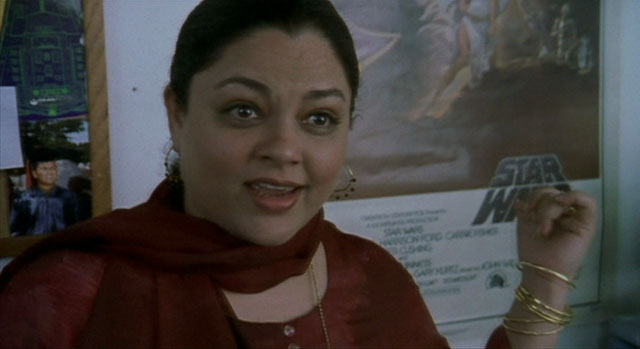
Mira Nair, following up Monsoon Wedding (and working with the same writer), recounts a based-on-true story of a woman whose son goes missing on Sept 11, is accused by the authorities of being a terrorist before he’s discovered to have been trying to help. The mother (Tanvi Azmi, I think) is excellent in this. When first questioned by the FBI, she points to her son’s posters, saying he’s American, he loves Star Wars, but she doesn’t say it defensively, just as a mother delightedly telling someone about her son. The final shot in this segment is my favorite of the whole anthology.
image

UNITED KINGDOM
Ken Loach, between Sweet Sixteen and Tickets, takes a completely anti-sympathetic approach, choosing to discuss the American-backed Sept. 11, 1973 coup that killed Salvador Allende, including footage from The Battle of Chile. There was probably a time I would’ve considered this tacky, but now I’m thinking “good for you, Ken Loach.”
image

USA
Sean Penn, recently off The Pledge (and I Am Sam, shhh), shoots an Ernest Borgnine one-man show in a grubby apartment in the shadow of the towers. Ernest putters around, laying out clothes for his absent wife, talking constantly, in his own crazy world, tending to a pot of dead flowers. Tower 1 goes down and sunlight flows through Ernie’s window for the first time in decades, bringing the flowers magically to life but waking him up to the reality that his wife is gone. Weird, sad one… I liked it better than Katy did.
image

JAPAN
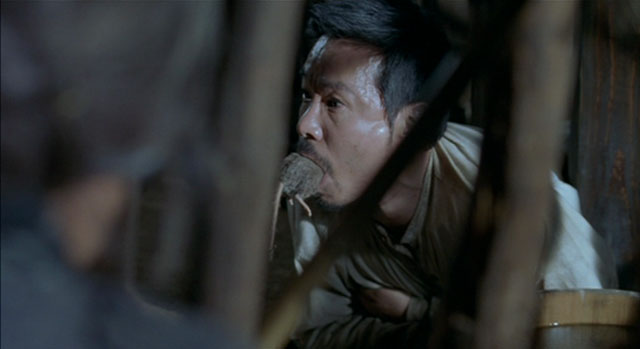
The final film of Shohei Imamura (The Eel, Vengeance Is Mine), with writer Daisuke Tengan (Audition, The Most Terrible Time In My Life), and if Shohei were alive he’d have some explaining to do. A man returns from the holy war (WWII) a spaced-out wreck, thinking he’s a snake (Katy did not appreciate the scene in which he swallowed a rat). Closes with the line “There is no such thing as a holy war.” Very odd way to end the anthology… still not sure what I think of it, though Mr. Grunes has named it one of his ten faves of the decade.
image

FRANCE
Claude Lelouch (Roman de gare) directs an offbeat story of a French tour guide for the deaf in NYC. His girlfriend is writing him a note saying she’ll leave him unless there’s a miracle, then he comes home covered in dust. I liked it better the second time through.
image

BOSNIA-HERZEGOVINA
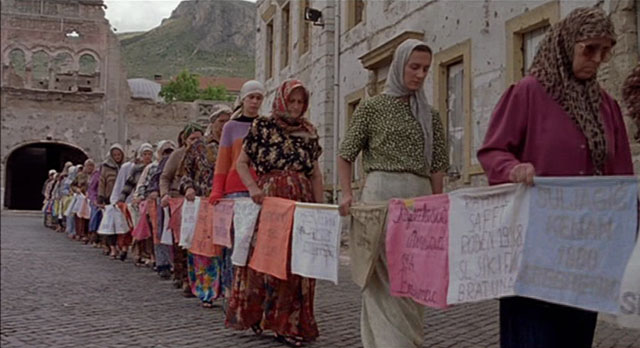
In 2002 director Danis Tanovic was high off his oscar-win for No Man’s Land. Since then, he’s adapted a Kieslowski script (Hell) and made one with Colin Farrell and Christopher Lee that played in Toronto. Women are going out for their weekly protest of something (local war/genocide) when 9/11 hits. They don’t know what to do, go protest anyway. Lightweight.
image

ISRAEL
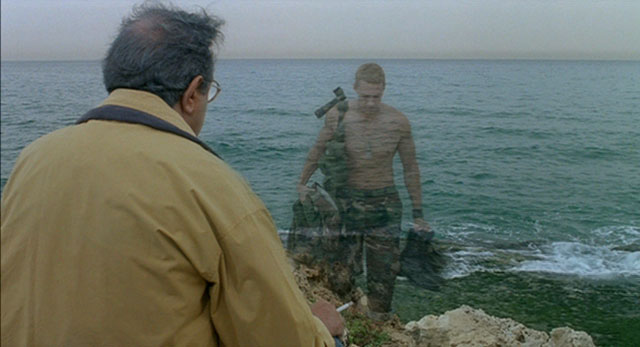
None of my Amos Gitai experiences have been happy ones. Starts with a guy disarming or examining a bomb after another explosion has already killed a few people, then the news team covering the event is told they’re not on the air because of coverage of 9/11. Gitai could be saying local problems feel humble compared to the scope of the 9/11 attacks, or maybe that America is hogging the spotlight away from his country’s problems, or possibly that it’s all Palestine’s fault.
image

EGYPT
Youssef Chahine seems like a humorless Elia Suleiman, not that I know more about either of them than their Chacun son cinema segments. Here, Chahine pulls the same trick as in that anthology, a piece where I think he’s full of himself, then I think maybe he’s joking and it’s modesty in disguise, but no, he is just full of himself. Someone said “Youssef, write a September 11th movie” and he scribbled down every thought that came to mind then filmed them in that order.
image

MEXICO
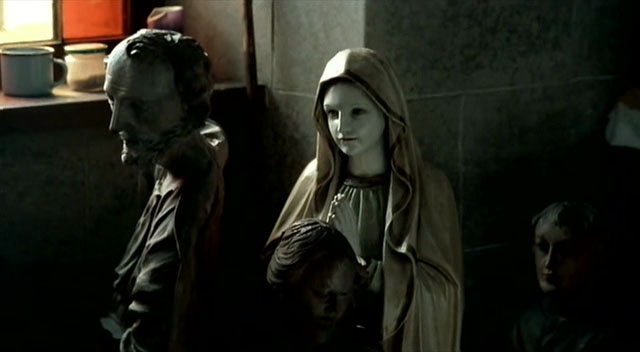
Alejandro González Iñárritu, between the great Amores Perros and the not-great 21 Grams, shot ten minutes of black punctuated occasionally by shots of people falling from the towers and closing with this quote.
image

Visions of Europe is a 2004 anthology film with shorts by various directors about the current state of the continent, which I’ve already started to watch earlier and still may never finish. Pretty hit or miss.

The Miracle (Martin Sulik)
An immaculate conception story, the girl’s parents and priest trying to get answers. God’s message, via the girl, “We mustn’t build tower blocks. The big ones must heed the small. We need to travel more to resist the false messiah.” Weird, kinda spooky. Not sure if the floating coffee cup at the end helped or not.
image

Anna Lives In Marghera (Francesca Comencini)
Briskly edited montage of an Italian student who participates in Rage Against The Machine-soundtracked political protests and prays when she’s not working on her thesis about industrial pollution.
image

Children Lose Nothing (Sharunas Bartas)
A girl collects frogs. Two boys fight over a girl. A paper boat! Finely photographed brownish little art short. Symbolic of something!
image

Room For All (Constantine Giannaris)
Talking heads tell us about the immigrant experience in Greece. Giannaris just made a movie called Gender Pop – the title alone is more interesting than this.

Prologue (Béla Tarr)
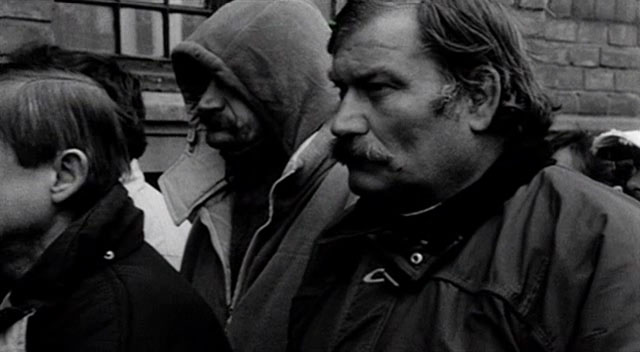
Loooong black-and-white dolly shot (imagine that) with pretty music by Mihaly Vig showing hundreds of people waiting in line to get food. Tibor Takacs was one name in the credits – could it be the director of The Gate?
image

Invisible State (Aisling Walsh)
A serious man in a suit tells us angrily about human trafficking. “They will tell of Irish eyes not smiling.” Walsh made a teary Aidan Quinn drama the previous year.
image

Crossroad (Malgorzata Szumowska)
The adventures of a catholic cross outdoors at a crossroad. Eventually some coroners take down the classic Jesus and replace it with a blobby new plastic Jesus. Was it supposed to be funny? I found it kinda funny.
image

Paris By Night (Tony Gatlif)
Immigrants on the run, one of them injured, run through the Paris streets to some good music. Jarmuschy. Same year as Gatlif’s acclaimed Exiles.
image

From skimming the extras, it sounds like this was a labor of love by American Cinematheque programming head Dennis Bartok, friend of Dante and Hellman, who wrote and produced. So on one hand, I respect the years spent assembling this, getting the help of excellent but underworked filmmakers, crafting an old-time hollywood-referencing haunted-house anthology story. On the other hand, it’s neither scary nor visually interesting nor creatively written – not exactly destined to be a horror classic.

Looks like the only non-Dante-directed films Dick Miller has been in since 1995 are a Lou Diamond Phillips thriller and a sci-fi comedy from the Lost Skeleton of Cadavra guy:
img

In the wraparound story directed by Joe Dante, bunch of Hollywood residents have received free tickets to tour an abandoned studio. Henry Gibson drives them around, getting an ornery Dick Miller to open the spooky gate leading them to the haunted house set. Or is it a real haunted house?!? The bunch (eight or so) seem to be trapped, so Henry prompts them to each tell a personal scary story in hopes of coaxing the house to let them leave.

Cool model shot from the haunted house:
img

GIRL WITH THE GOLDEN BREASTS

The latest work I’ve seen by Ken Russell since I wasn’t able to finish Whore. He’s still at it, making flamboyant, perverse little pictures. Girl gets breast implants to make herself more appealing to casting directors. It works, and soon she’s bonking some stud (both in a picture and behind the scenes), but her breasts have a tendency to bite, which is upsetting her man.

img

She goes back to the plastic surgery joint, but her doctor is on ice so she’s confronted with these guys instead:

img

The middle one is Mad Ken himself. Boobs, computer graphics and campy hilarity… it’s all downhill from here.

JIBAKU

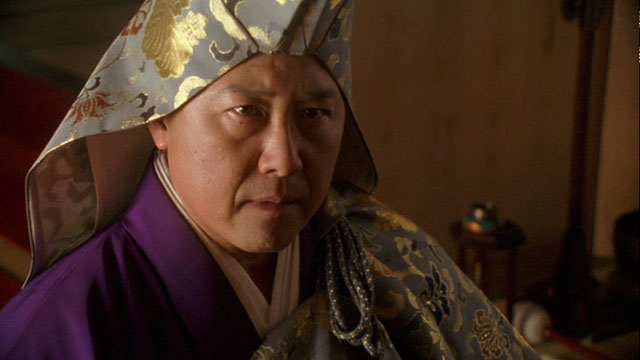
Sean S. Cunningham (who hasn’t done anything I’ve heard of since Friday the 13th) immediately drags everything down after the blitz of fun provided by Ken a few minutes earlier. Julia and her husband are in Japan for some boring business. They run into a dead guy, so a monk (Ryo Ishibashi – warden in Big Bang Love, star of Suicide Circle and Audition) tries to comfort them.

He was also in Dream Cruise:
img

Julia has an affair with a young dude named Seishin (is it the guy who killed himself earlier?), goes to some kinda sex-hell which awkwardly combines live-action and anime. Her husband saves her, whew. Key line: “I was sexually molested by a dead monk and dragged into the mouth of Buddhist hell.”

Hell looks like a Japanese cartoon; Why am I not surprised?

img

STANLEY’S GIRLFRIEND

Monte Hellman, formerly known for such awesomeness as Two Lane Blacktop and The Shooting, now this is his first film since Silent Night, Deadly Night III. A shame. The movie itself is a shame, too…

John Saxon (Nightmare on Elm St., Mitchell), looking good for being in his seventies:
img

This is a deadly dull segment (with some classic film references, including L’Atalante) about a young filmmaker (no longer played by John Saxon, alas) who hangs out with his talented friend Stanley, who stops going out one month after he gets a hot girlfriend. Stan suddenly disappears, leaving the hot girlfriend to our man Leo, who proceeds to have a torrid affair with her.

img

But she ruins his life and sucks away his talent, leaving him a hollow shell of a failed Hollywood burnout for the rest of his life. While Stanley (last name withheld) moves to England, freed from the woman’s curse, and makes such classics as A Clockwork Yellow, Half Metal Jacket, Dr. Lovestrange and The Shinning, leaving Leo in his will a short film from the early 1900’s of the girlfriend, an ageless vampire!

Nice color for 1900:
img

MY TWIN, THE WORM

John Gaeta, VFX guy from the Matrix series, shines here. Maybe it’s because he had more to prove, or because he’s had recent practice making decent films, but this is pretty good.

img

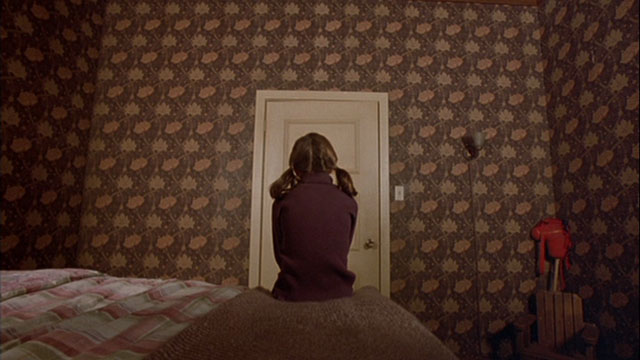
The story is nothing much… woman is unable to get a tapeworm removed because she’s pregnant, so baby and worm develop together, and as girl grows up, she has a secret worm-sister who avenges her against evil babysitters. Some nice visual style almost makes up for the by-the-books plainness of the previous two episodes. The last three segments need visual style to survive, because they’re talky and the dialogue is boring (I have the feeling Ken did some uncredited writing on his bit).
img

Back to our framing story and it turns out everyone here is… dead? Or damned? Or supposed to be dead but escaped Final Destination style and now being rounded up by grim reaper Henry Gibson?

Oh no, Henry Gibson (Magnolia, The ‘burbs, The Nutty Professor) died last month. I hadn’t heard. This was his second to last film.
img

“Trapped Ashes is a reflection of Hollywood as a place that’s sort of between living and dying, between being famous and being forgotten.”

Three half-hour Tokyo-set films by three famous non-Japanese filmmakers. I didn’t read the reviews very closely but I gather that some viewers thought the Michel Gondry segment about a struggling couple moving into the city and the Bong Joon-ho segment about socially-dysfunctional residents of an earthquake-prone Tokyo were pretty good and the Leos Carax segment about a sewer-dwelling monster was awful, and some viewers agreed that the Gondry and Bong were pretty good but thought the Carax was brilliant. A fan of Carax’s Lovers on the Bridge, I assumed I’d fall into the latter group, but I wound up finding the whole experience somewhat unsatisfying. By the time I finished watching six previews and an overlong ad for the film festival through an allergy-induced headache I was ready to go home already. Then the movies themselves, a far cry from Paris, je t’aime, seemed awfully down on their host city, and the whole thing was kind of a bummer (and a digital-video-looking bummer at that).

Gondry’s bit featured a wannabe-filmmaker come to the city with his first film, which turns out to be terrible, and his girlfriend (Ayako Fujitani of the Gamera trilogy) who feels like nobody notices her. There’s fanciful talk of dreams and ghosts, and in the end she turns into a piece of furniture, a wooden chair. She’s picked up by a musician, and finally finds happiness – to be of use.

After this portrait of selfish men in an inhospitable city, Carax dives right in with a sewer-dwelling monster (Denis Lavant, of Lovers on the Bridge and Chaplin in Mister Lonely) named Merde walking the street shoving and groping people and being a general nuisance. It’s all jolly and hilarious until he finds a cache of grenades in an underground cave, and on his next rampage he blows up a bunch of people and is arrested for murder. Now we get an achingly prolonged trial where the monster is represented by a lookalike (but more posh) lawyer (Jean-François Balmer of films by Ruiz, Chabrol, Akerman), who speaks our guy’s mythic language of grunts, whines and head-slaps. It’s all over-silly and over-serious at the same time, and I don’t know what to think when the unrepentant Lavant is hung at the end.

Bong tries to restore some whimsy to the proceedings with Shaking Tokyo. His story of a shut-in (Teruyuki Kagawa, in Serpent’s Path a decade ago, starring in the new Tokyo Sonata) is at least the most Japanese of the three stories, the reclusive “hikikomori” being a recent phenomenon of that country – as far as I’m concerned, the other two movies could be set in any major city. Due to an earthquake, our guy accidentally makes eye contact with another person for the first time in a decade, and that person is substitute pizza-delivery girl Yû Aoi, who has button-like tattoos representing different emotions – when one is pushed it determines how she feels. The next day, she decides to shut herself away in her room, along with seemingly everyone else in the city, while our guy steels himself and goes outside to search for her, leading to a cutey happy ending when he presses her LOVE button. The “earthquake changes everything” conceit reminded me of Chan-Wook Park’s short Judgement, and the empty city reminded me of Pulse.

Bong: “I had an image of the people of Tokyo as oddly repressed, defensively lonely… I think I had a desire to wake them up, shake up and liberate such people. That’s where the title, Shaking Tokyo came from and how the motif of the earthquake also came about.”

I guess I’m liking the three movies better now that I’m thinking about them, but at the time they didn’t seem to be working together and I wasn’t sure what the movie’s point was. I’m sure it’ll be like Eros or Three Extremes, where the omnibus concept disappears in time and I start to think of ’em as decent individual shorts.