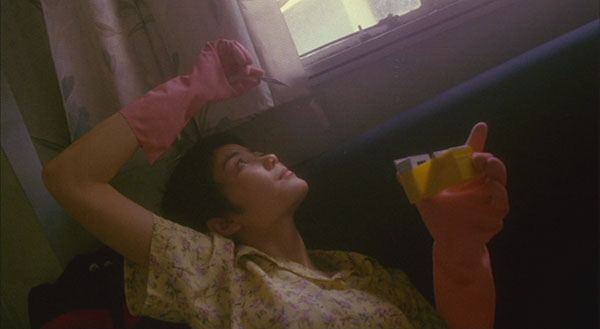
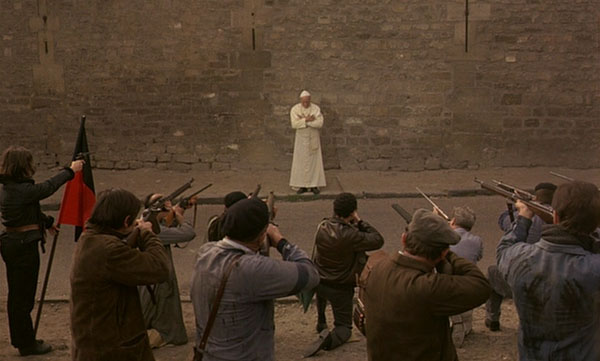
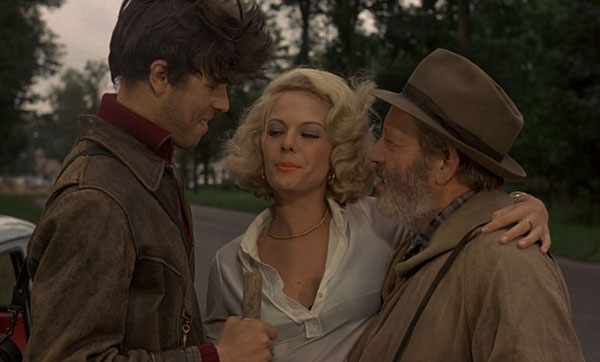
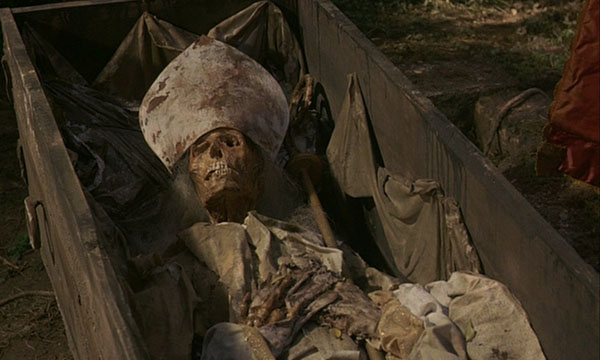
Movie seems to do everything you’re not supposed to do (shoot objects instead of the people who are talking, cast a superstar actress and never show her eyes, use tons of slow-mo without speeding up the camera, drop the entire plot and start a whole new movie halfway in) but does it with such romantic style that instead of being considered a wrongheaded failure, it influenced moviemaking for the next decade. Watched in gorgeous high-def (not represented by screenshots below).

Brigitte Lin had very different roles in this (in which she barely talks and never removes her wig and shades) and Ashes of Time in her final year as a film star before retiring. She’s a secret criminal here, helping foreigners pack their bags full of hidden drugs and get fake passports out of the country, getting threatened and chased, shooting a fella… it’s hard out here for Brigitte Lin.
image

Takeshi Kaneshiro (of House of Flying Daggers) plays sad Cop 223 (he’s the same sad cop in Fallen Angels), who got dumped by his girlfriend a month before his birthday, and plays a game involving nearly-expired canned pineapple imagining she’ll come back. He hangs around a fast food place chatting with the owner and hoping to catch a glimpse of Brigitte Lin, with whom he becomes obsessed without ever finding out about the criminal angle. Eventually Faye Wong starts working at the food joint and the movie shifts focus.
image

Tony “Tony 1” Leung (currently appearing in John Woo’s Red Cliff) is Cop 663 who also frequents the food stand, though we never see him and Cop 223 in the same scene, so they may as well have been the same character. He still has a girlfriend (a flight attendant, she gets some scenes) though he soon loses her. He certainly notices Faye Wong, talks with her, but only becomes interested in her towards the end when it’s too late.
image

Faye Wong was only in three films in the decade between this and 2046. She keeps herself busy being a billion-selling superstar musician. Here she bounces around filling orders to “California Dreaming” until she gets unhealthily obsessed with Tony 1, intercepts the keys his ex tried to return, and starts entering his apartment every day, cleaning, playing, accidentally flooding, dancing, hiding and substituting his stuff until he finally breaks out of his brooding fog and starts to notice. Soon as he does, she disappears to California for a year, returning for a sweet final scene at the food joint.
image

“Where do you want to go?”
“Wherever you want to take me.”

JULY 2019: Watched again, with Katy this time, on Criterion Channel, after I had “Dreams” stuck in my head for our whole HK trip.

49th Parallel (1941)

The Archers wouldn’t exist as a production company and Pressburger wouldn’t get a co-director credit until the following year’s One of Our Aircraft is Missing – he just contributed the story for this Powell-directed piece of WWII propaganda. Movie hammers home its points (nazis are bad; Canada is great) with a series of episodes, each of which further weakens the nazi force which is inexplicably (I was spacing out during the first ten minutes) invading Canada and making their way south to the USA.

The first, last and most effective attacks are made by our valiant troops, who kick off the fun by bombing the nazi sub which has just landed six advance soldiers to secure a trading post. Now these six guys (led by hardass Eric Portman, kindly given a role the next year as a loyal allied copilot as payback from P&P for being such an effective nazi) constitute the entire german force in Canada – if they can cause some damage and make it to neutral USA they’ll be hailed at home as heroes, so it’s of moral importance to stop them. Seems perverse to me that my flag-swingin’ nazi-hatin’ country was considered a legal safe haven for german troops in ’41.

There I am in Canada, right between Carberry and ASSMNBOINE:
image

First stop: the outpost. They hang out there for a while, steal some gear and shoot a whole pile of eskimos. Meanwhile, horror of horrors, who should be at the outpost but Lawrence Olivier playing a French-Canadian trapper just returned from a year expedition (so unaware that Canada’s at war). F-C Olivier joins Japanese Mickey Rooney from Breakfast at Tiffany’s and Blackface Bing Crosby from Holiday Inn in the Casting Mistakes Hall of Fame. If the movie was meant as a love letter to Canada, I can’t figure why Powell would want to start off with such a loud, ridiculous caricature of a Canadian. Maybe Olivier, recently in Rebecca, brought great publicity to the project so nobody wanted to risk insult by having him tone down the accent. Anyway, he quickly gets up to speed, decides what side he needs to be on, and makes a grab for the radio, getting himself killed. The nazis hail a plane, then kill the pilots and take off, getting one man shot by an eskimo.

What’s the only thing hammier than Laurence Olivier as a French Canadian? Laurence Olivier as a dying French Canadian. “Let me axe you one kestion.”
image

Plane crashes in the water – that’s another nazi down, four to go. They stumble into a group of religious commie idealists with german roots led by noble Anton Walbrook (ballet instructor in The Red Shoes), and thinking they’ve found kindred souls, Portman makes a big hitler speech which falls flat. Time to move on, but one nazi (Niall MacGinnis – not a very german sounding name – of The Edge of the World, later Zeus in Jason and the Argonauts) is inspired by the freedom of this community, decides to stay on and be a baker and be in love with hot local chick (Glynis Johns of The Sundowners, The Cabinet of Caligari), so other dudes execute him. Harsh segment, but also the most beautiful part of the film, visually and idealistically.

Germans always heil each other before going to bed:
image

Big city parade, the authorities are closing in on our men. They make an announcement describing the three germans – one cracks under pressure and gets captured. Last two nazis hide out in the woods, bust in on a society escapee, pacifist writer Leslie Howard in his teepee, enjoy his hospitality then tie him up and break all his stuff to settle a political disagreement. Our pacifist escapes, chases the guys down, and beats the shit out of one of ’em. I see Leslie Howard played Henry Higgins in Pygmalion – makes sense, he seems the Higgins type. He was killed in the war a couple years after this came out.

This was meant to be inspirational:
image

Last guy (Portman, natch) makes it to the border on a freight train, runs into an AWOL soldier (Raymond Massey of The Fountainhead, East of Eden) and takes his uniform. Soldier wakes up, realizes they’ve made it to the states, but convinces the train dudes to send ’em back over the border (still locked in their freight car) with the excuse that Eric Portman wasn’t on the manifest. Massey advances on Portman, giving one of the best final lines in cinema history: “I’m not asking for those pants… I’m just taking ’em.”

Edited by David Lean (which is why it’s over two hours long, ha) who’d start directing the following year, and shot by the future D.P. of Lean’s Lawrence of Arabia. Movie is too talky and obvious, but then, it’s a government-funded piece of propaganda. Given that fact, and the problems of filming during wartime, the movie is almost impossibly good – and at the very least it’s a nice tour through Canada.


I Know Where I’m Going! (1945)

Whew, a wonderful poem of a film, foggy and deadly romantic. Wendy Hiller (Eliza in that same Pygmalion with Leslie Howard, which now I must see; in Lynch’s The Elephant Man 35 years later) meets dashing Roger Livesey (the fat man in Colonel Blimp…!) on her way to meet her fiancee and falls in love with him instead.

Title is well explained in the elegant opening credits segment. Joan (Hiller) is obsessed with wealth and manages to climb higher and higher, finally gets engaged to super-wealthy guy who lives on a remote Scottish isle. One of my favorite-ever scene transitions, a puff of smoke from a top hat turns into the smokestack of a train engine, and she’s off to be married.

image

After a nuts dream sequence aboard the train (see above), Joan finds that she can’t cross to the island because of the fog, nor can anyone cross from there to pick her up. Stranded, she tries not to make friends with Torquil MacNeil (Livesey) but can’t seem to help it… hangs out on the mainland with him, his welcoming friend Catriona (Pamela Brown, Hoffmann’s silent companion), and local falconer Col. Barnstaple (an actual falconer, does a hilarious job in his only acting role).

Livesey and Pamela:
image

Barnstaple and Hiller:
image

Conflict arises because Joan is starting to like Livesey (an awfully likeable guy – friendly and handsome and a good dancer, plus it turns out, the laird of the island where her man lives). No longer knowing where she’s going (!), she panics, decides she must get to the island immediately. Praying for wind to lift the fog didn’t work, since now the wind is too high to sail, but she bribes the boatman’s son into taking her. That doesn’t work out, ship is almost wrecked, saved by brave Roger. The next day, she’s finally headed for the island, Roger staying behind. Roger strolls into an ancient castle to which his family has been forbidden entry for generations and, well, the ending is too wonderful to retell.

image

Adding to the spooky atmosphere is music by Allan Gray (protagonist of Vampyr). There’s more: falcons, a whirlpool, and a phone booth by a waterfall, plus glorious location photography, but I’ll be watching it all again soon.

Finally, since it’s awards season in the movie world, one of my three known readers David Cairns has awarded this site a Premio Dardos. David writes the only film blog I read, the tremendously entertaining Shadowplay, and he still finds time to contribute articles to The Auteurs. The Premio Dardos is a JPEG image of unknown origin (unless I bother to google it) that comes with a series of rules I might not follow, but it’s sorta like if your shitty local band gets paid a compliment by a nationally-touring rock act – still an honor.

image

The large family house still stands, where once lived two parents, two sons and a daughter (now grown with children of their own), and one best friend who often visited. They’re all somewhat miserable now, especially the daughter, a playwright who never smiles. The family reconvenes for the first time in years (after one had been banished for a time) in the big house because of a life-threatening illness. Old problems re-emerge, along with some new ones, and there’s a secret love affair involving the best friend. BUT ENOUGH ABOUT THE ROYAL TENENBAUMS, here’s the acclaimed new holiday picture from the director of the even-more-acclaimed Kings and Queen.

An IMDB review of K&Q calls Arnaud’s earlier 1996 drama “a rambling, shambling, thoroughly engaging 3 hour trip through the lives of a group of rambling, shambling, lost characters, made by a director looking to pour as much raw life into a film as possible and let the rest sort itself out. He has no interest in a well-knit story.” The same goes for this one, much to Katy’s frustration. This is roughly the same kind of movie as Happy Go Lucky, but instead of following the quirky life of one main character for two hours, we’ve got ten main characters for two and a half, so obviously we come away with less depth from anyone here than we did with Poppy in H-G-L – another Katy complaint. I liked the movie a fair bit. It’s an engrossing family sketch with great performances and no big scripted moments, fake-sounding climactic speeches or tidy resolutions, and the filmmaking was spot-on, tracking skillfully between a hundred different people and events (and featuring a hundred different music styles), cutting quickly without every becoming wearying or losing the threads of things. But then again, the Traumatic Family Drama isn’t really my bag, and while I’d happily watch this again over Rachel Getting Married (our last big family trauma film similarly featuring lots of shaky-cam cinematography), I’d even more happily forget both of ’em and sit through another show of Happy-Go-Lucky (or, ahem, The Royal Tenenbaums).

Junon (Catherine Deneuve, last seen in A Talking Picture) is sick (not visibly), needs marrow transplant. Her jolly, supportive husband Abel (Jean-Paul Roussillon of Same Old Song) rigorously calculates her chances of survival. Hot-tempered middle child Henri (star Jean-Do in Diving Bell and the Butterfly), eventual marrow donor, bounces around with his new girlfriend Faunia (Emmanuelle Devos, star of La Moustache and Read My Lips) joking around and getting people upset at him. Tormented oldest child Elizabeth (Anne Consigny, Jean-Do’s dictation assistant in Diving Bell) tries to protect her schizophrenic, suicidal teen son Paul, usually without the help of her husband Claude (Hippolyte Girardot, intrusive downstairs neighbor in Flight of the Red Balloon). Meek youngest child Ivan (filmmaker and regular Raoul Ruiz actor Melvil Poupaud) hangs out with wife Sylvia (Chiara Mastroianni of Love Songs and Ready To Wear, daughter of C. Deneuve and Marcello M.) and their two kids, and best friend/cousin/painter Simon.

Whew. So having introduced the characters, here’s where I lay out their story arcs and intersections, but I can’t think of a whole lot of those. There’s some to-do about Paul, a potential marrow donor, and whether his mental state is up for it. Junon and Faunia go shopping. Sylvia sleeps with Simon, in one of the only forward plot developments.

Easier to list are things the movie brings up which are not fully explored (or only barely). The childhood death of a sibling (who also needed a marrow transplant). Why Liz went from tolerating her brother Henri to hating him. Ivan’s reaction to catching his wife in bed with his cousin. And so on… but maybe it’s all comprehensible in hindsight, removed from the kinetic hustle of the movie. Take Henri’s Jewish girlfriend Faunia: a veiled attack on his possibly antisemitic mother, with whom he’s had a bitter history, plus, as an outsider who has never met the family, a window for the audience into the family home, someone for whom old family frictions can be described without the movie having to resort to narration (although it does – main characters talk to the camera), her outsider nature reinforced by her Jewishness on Christmas eve (she goes home before the day). Hmmm, that actually wasn’t so hard.

Shot by Eric Gautier, an impressive Assayas and Resnais D.P. who also did Into The Wild and Gabrielle. References include Shakespeare, Emerson, Funny Face, The Ten Commandments, The New World, and Angela Bassett’s ass.

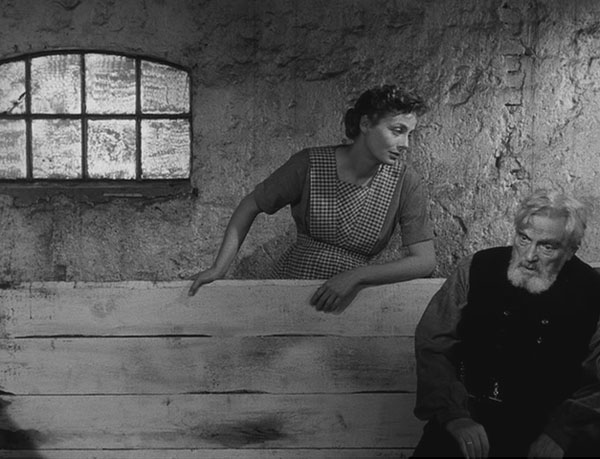
Proud father of three Morten Borgen has carved out a name for himself in the community. A devout Christian farmer, his beliefs differ somehow (I wasn’t exactly sure how) from those of the local prayer group and he’s trying to win more converts to his side. His son Mikkel’s wife Inger, the only woman of the house, is a mother of two with a third on the way.
image

Son Johannes was supposed to be a religion scholar, but he had a terrible time with Kierkegaard and lost his damned mind, now walks the house claiming to be Jesus Christ when he isn’t wandering the countryside lost.
image

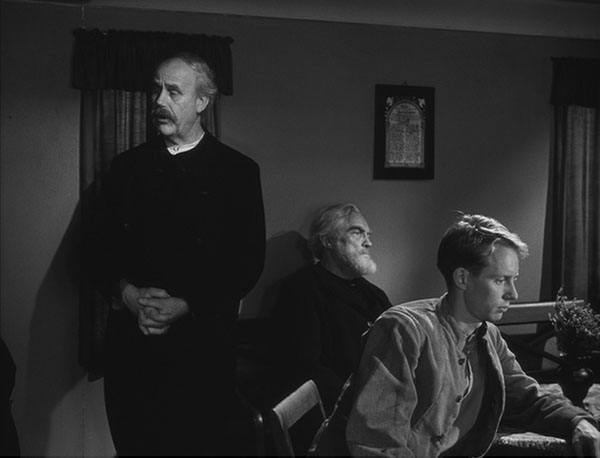
Youngest son (right) Anders wants to marry the daughter of Peter Petersen (left), leader of the town prayer group, but he’s disallowed because of the two older men’s religious feud.
image

When Inger’s pregnancy is suddenly in trouble, Peter wishes her death.
His wish is granted.
image

Johannes reappears mid-funeral during a reconciliation of the two stubborn men, who put aside their differences of belief so their children can be together. In front of the men, the kids, the doctor and Inger’s atheist husband Mikkel, Jesus-Johannes raises Inger from the dead.
image

Movie is set in 1925, so only the doctor has a car. Moves rather slow, glad I had some coffee in me. Didn’t seem like my thing for a while – flashbacks to Gertrud, a movie I didn’t get – but an hour later I’ve gotta admit it’s one of the most beautiful works of cinema ever made. Just look at these fucking stills. I’m sure there’s more reading I could do, tons and tons of articles written about it, but I’m gonna skip ’em and let it stand for itself right now.

This will sound awfully disrespectful, but you’d think the renowned master of montage Eisenstein, he who reinvented movie editing, could pick up the pace a little. This movie drags. Each shot has a wonderful composition, and each shot is held for a second or two too long. And to be more disrespectful still, I beg to differ with E. Von Mueller calling Prokofiev’s score the best in history. But maybe he’s kicking back at home with an LP of the full orchestral arrangement, not the weak bits on the film itself (Criterion essay on the director/composer collaboration calls the soundtrack on the film “like a chamber ensemble recorded over a telephone”). I’ve still got to hear the re-recorded score sometime. And I intended to… but after the movie and the DVD commentary, I didn’t feel like going through it a third time.

The bloodless battle on the ice wasn’t exactly choreographed by Sammo Hung… buncha overarmored guys clumsily smacking into each other with weapons. But I’ve made fun of the acclaimed classic film enough now. Composition-wise it is beyond reproach… some of the most amazing-looking shots of the 30’s. A beautiful movie and a swell piece of anti-German propaganda (which is why it was celebrated, then banned, then celebrated).

How you know the Germans are Bad Men: they toss naked babies into fire:
image

Russia is under Mongol rule, but this is mostly ignored. Nevsky kicked the asses of the Swedes or some other country previously, so he’s called on to protect Russia from the invading Germans, who have already conquered one major town and killed everyone in it, including babies. Meanwhile in another town, two tough guys are competing for the only pretty girl. She says she’ll marry whichever fights the most bravely. So off they go with Nevsky, the town armorer (who dies from being too generous, giving away his best armor and saving the leftovers for himself) and a hot warrior woman. Battle on the ice lasts some 30 minutes. Crowd scenes outdo most of your Braveheart / Lord of the Rings epic battles with lovely, artistic shots of actual masses of people (outdone later in Ivan The Terrible), but close-ups of battle are a little lame. After, one guy is dying, other guy generously tosses the pretty girl at him and goes after the hot warrior chick. The glory of Russia is restored (well, they’re still under Mongol rule) and Nevsky goes back to his humble fishing life, after issuing a stern warning to the Germans which is screamed across the screen in giant bold text!

Mr. Nevsky:
image

One of the least jokey of Sturges’s films (up there with Unfaithfully Yours), but makes up for that by being completely wonderful. Katy and I watched together for the first time. Even when I know it’s coming, I can’t help but jump when Sullivan says how much he wants to make O Brother Where Are Thou. No plot overview needed, watched it enough times.

William “Muggsy” Demarest, one of my favorites, plays the same type as always. More prominent in this movie are the butler and valet, Eric Blore and Robert Grieg, who were apparently professional butler-actors throughout the 30’s and 40’s. Veronica Lake was 21 when this was shot, looks younger. As famous as I thought she was, I’ve only heard of three of her movies (also The Blue Dahlia and I Married a Witch). Looks like after the 40’s, she switched careers from acting to drinking. I mainly know Joel McCrae from this, but apparently he was in a bunch of westerns. The poor “colored chef”, Charles R. Moore, has 100+ movie roles, all of them listed as porter, driver, bootblack, elevator operator or prisoner. Lot of in-film shouts-out to Capra and Lubitsch, who at this time were working on Meet John Doe and To Be or Not to Be.

image

Todd McCarthy calls Sturges “the first screenwriter to decisively break through as a director”… guess I never realized that’d never happened before 1940. Now it happens all the time (see Synecdoche New York).

The DVD commentary starts out funny, mostly a good time but sometimes one of them will resort to narrating and saying “that’s so great”. The Rise and Fall of an American Dreamer doc is better, with a full career overview of Sturges, going into the whole post-Conquering Hero part of his life which I had wondered about – it’s sad stuff.

On a drunken socialite scavenger hunt, Irene picks up “forgotten man” Godfrey at the dump. He asks her for a job, and she hires him as the family butler. A shave and a new suit later, he shows up at the house, gets shown around by the maid Molly, introduced to dizzy & spacy Irene, mean & nasty sister Cornelia, their eccentric mother, frustrated father, and an artist named Carlo who just hangs around. Irene and Molly are hot for Godfrey, Cornelia wants to get rid of him, and he seems too smart to be a regular bum.

But aha, Godfrey is a Harvard business man who gave away all his money to live free, and after regaining his self-respect by being a good butler, he takes the jewels that Cornelia tries to plant to get him arrested, pawns ’em, makes a fortune on some stock deals, bails out the broke father (after dad hurls Carlo through a window), then gets Cornelia back her necklace. Godfrey opens a happenin’ joint called The Dump, hires his old dump buddies, Irene follows him to his office and marries him by force.

Plot description doesn’t sound amazing, but it’s a screwball comedy… the fun is in watching smooth pencil-mustached Godfrey (post-Thin Man William Powell) deal with daffy Irene (post-Twentieth Century Carole Lombard) and Cornelia (pre-Stage Door Gail Patrick), surrounded by the unflappable mom (post-Gay Divorcee Alice Brady), furious dad (big, frog-voiced Eugene Pallette, pre-Lady Eve), sadsack Molly (pre-You Only Live Once Jean Dixon), easily-spooked Carlo (pre-You Can’t Take It With You Mischa Auer) and their boring harvard friend Tommy Gray (John Ford regular Alan Mowbray) who doesn’t actually add to the fun, he’s just around as a plot contrivance. Other than Gray, everyone here is wonderful and the writing is super. The whole harvard-dump thing struck me a little wrong, but it’s a depression-era cheer-up madcap comedy so I let it go. Would happily watch this again. Katy liked it too but complained that it wasn’t one of the greatest comedies of all time, because she can’t just walk away happy from a movie for some reason.

Former cartoonist La Cava’s 160th movie, if IMDB is to be believed, and the co-writer worked on three Marx Brothers movies. I looked for Frank Tashlin-esque cartoony bits but couldn’t find any. Movie got acting nominations in all four categories, plus directing and writing at the oscars, but won nothing. Within a decade, Lombard and Brady were dead and Patrick, Pallette and Dixon were retired. Didn’t seem like a cast that was on the way out the door. Movie was remade in the 50’s with David Niven, June Allyson and Eva “Green Acres” Gabor.

M. Kennedy at Bright Lights: “Repeatedly, La Cava and company serve up the rich as silly, frivolous, childlike, and trivial, while the poor are strong, dignified, generous, and compassionate. Miraculously, he gives us these elemental distinctions without the torpor of penny-ante philosophizing or the goo of Capraesque speechifying.”

December 2022: Watched again – Katy is mad about the ending but agrees that the rest is good.

This is one of Buñuel’s anarchic sketch films (see also: Simon of the Desert, Phantom of Liberty) which he made in between his relatively more normal, subversive upper-class films (in this case between Belle de Jour and Tristana). I still think I appreciate his films more than I enjoy them, but the more of them I watch, the more I feel that his career is unassailable, that his last twenty years of filmmaking produced one long masterpiece. It turns out I had seen this before, though I barely remembered it. Must’ve rented the tape from Videodrome. Don’t think I finished it last time, because it got foggier around the halfway point.

image

Such a smart and well-researched movie, I don’t feel qualified to discuss it. I can discuss the cinematic aspects though. Good photography with no surprises, unusually long shots but not noticeably/showoffy long. Buñuel’s movies always feel the tiniest bit too slow for me, too perfectly calm and collected, the acting and sets and camerawork too high-quality for their content, which I suppose is the point.

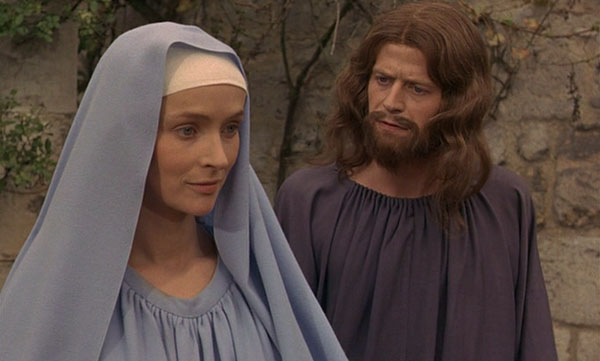
The plot is a “picaresque”, two beggars wander into various scenarios during their long walk from Paris France to a holy pilgrimage spot in Santiago Spain – although it turns out they’re not on a pilgrimage themselves, they just heard there’s a huge crowd in Santiago where they can get rich on spare change. Different historical periods and bible stories blend into their present-day 1960’s voyage without anyone batting an eye. They meet Satan(?), the Whore of Babylon, and lots of people discussing the six central mysteries of Catholicism and their associated heresies. They do not meet Jesus, the Virgin Mary, the Marquis de Sade or the Pope, but they’re all in the movie via sidetracks from the main action (though one could argue that it’s all sidetracks). Plenty of surreal moments keep the movie lively even when the dialogue is all obscure religious debate.

image

French cinematographer Christian Matras was about Buñuel’s age, had also shot most of Max Ophüls’ best films, also The Eagle Has Two Heads with Cocteau and Grand Illusion with Renoir. Co-writer Jean-Claude Carrière (also an occasional actor) worked on most of Bunuel’s 60’s-70’s stuff and over a hundred other movies, including recent ones like Chinese Box, Birth and Goya’s Ghosts. The guy who played Jesus starred in Rohmer’s sixth moral tale a couple years later. Virgin Mary Edith Scob was in Franju’s Judex in the 60’s, and lately in some Raoul Ruiz films and the newest by Olivier Assayas. Of the two tramps, the older would be in the next two of Buñuel’s French films, and the younger would star in Clouzot’s La Prisonnière and Godard’s Détective.

image

In the DVD interviews, Ian Christie tries to make us feel better for not knowing the historical references – he says nobody knew them. He got a press kit. The film was influenced by The Saragossa Manuscript, which sounds cool. “What heresy means for him is a kind of metaphor, I think, for human beings’ fascination with arguing about the immaterial, the invisible, trying to bolt it down and make it literal.” Screening when it did, it was alternately seen as cleverly reflecting or having nothing to do with the political and social upheaval in late 60’s France. Interview with the writer and documentary on the DVD are both pretty alright, nothing that needs repeating here.

Our two bums with the whore of babylon:
image

Michel Piccoli as the Marquis de Sade:
image

Alain Cuny as the mysterious walkin’ guy:
image

L’Age d’or reference:
image

When the movie began, I immediately noticed Jean-Claude Brialy’s hair. Who is this guy? I’ve seen him in earlier films (Paris Belongs To Us, A Woman is a Woman and Le Beau Serge) and a later film (Phantom of Liberty) but I can’t remember him. I think he might be the guy on the right in my middle screenshot of Le Coup du berger but without the beard and the hair it is impossible to tell. That hair… so distracting. Laying on the couch, I alternated between taking in the luxurious outdoor camerawork and watching Brialy’s hair. The birds fought on me for the first ten minutes before Our Bird settled on the couch in front of my head and New Bird camped on my shoulder with his tail right in my eye. So I thought about the birds, and Brialy’s hair, and the sunlight in the film, then I realized that a half hour had passed and I still wasn’t paying attention to the dialogue.

Brialy & Laura:
image

So maybe not the ideal screening of Claire’s Knee… or maybe it was! Either way, I got the feeling that I liked the previous two movies better, despite expectations that this would be the masterpiece of the Six Moral Tales. Seems like the Tales are wearing themselves thin. Guy in picturesque location with distant girlfriend flirts with young girls but ultimately stays with his girlfriend… it’s La Collectionneuse again.

Claire:
image

This time the guy is bushy Brialy, spending the month before he gets married in his old home town (I think), possibly to sell the family home, though we never see him do anything productive. His co-conspirator (see also: Vidal in My Night at Maud’s) is an Italian writer with a distracting accent, Aurora. Brialy flirts first with big-haired 16-yr-old Laura, then with her (slightly older?) step-sister Claire, whose knee we don’t see until towards the end of the picture. Laura is happy to lightly play around and talk with Brialy but they both know there’s nothing serious, then he is briefly tempted by Claire, tries to break her up with her boyfriend, then comforts her when they are stranded in the rain together by rubbing the titular knee. He goes home to his fiancee, thinking himself a dark stranger who changed these two young girls’ lives, but Laura hardly seems to notice him in the last few days, and Claire is back with her boy two minutes after Brialy has left. Even if the rest of the story was nothing special, I liked this ending, which gives more of an inner life to the female characters than previous entries have done.

(R-L): Sad Claire, her knee, Brialy:
image

Beautifully shot by master of light Nestor Almendros the same year he did Bed & Board and The Wild Child for Truffaut. Hardly any of the actors besides Brialy had been in any films before, but most would appear in later Rohmer films from time to time. This won best film from both the U.S. and French critics societies, but lost a best-foreign Golden Globe (with fellow loser The Conformist) to an Israeli movie that isn’t out on video (which itself lost the best-foreign Oscar to The Garden of Finzi-Continis).

image

My (comparatively) negative feelings about this one extend to the DVD extras, too. First we’ve got a nothing TV interview with the cast, where we learn that Brialy has been Rohmer’s friend for a long time, and the girls somewhat enjoyed working on the film, and everyone is miffed that Rohmer won’t appear on the show himself. Then there’s The Curve by Edwige Shakti, a short based on a basic scenario by Rohmer. Shekti herself stars as the usually topless girlfriend of an art-obsessed young man. She challenges his remarks that he was drawn to her because she reminded him of different specific artworks. It’s a cute enough short, but its appeal lies more in watching the director’s breasts than in the uninteresting 30fps video work or the consciously Rohmer-talky dialogue.

The Curve:
image