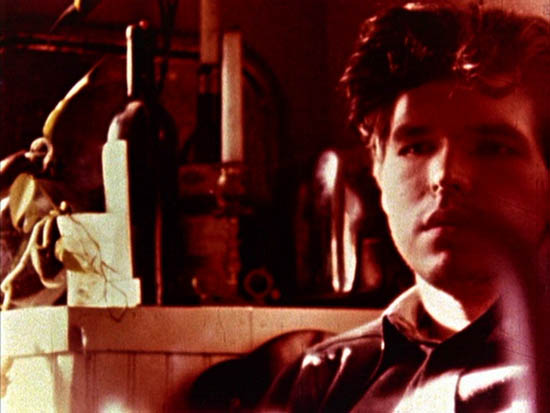
There’s something to be said for filming everything at weird angles and heightening your entire movie at once and having arrogant cheesehead lead characters… casting yourself as a rich & powerful murderer and casting your wife as your daughter… using flashbacks and narration and tossing in some goofy comedy scenes. The movie kept me guessing, stylistically if not story-wise.

image missing

image missing

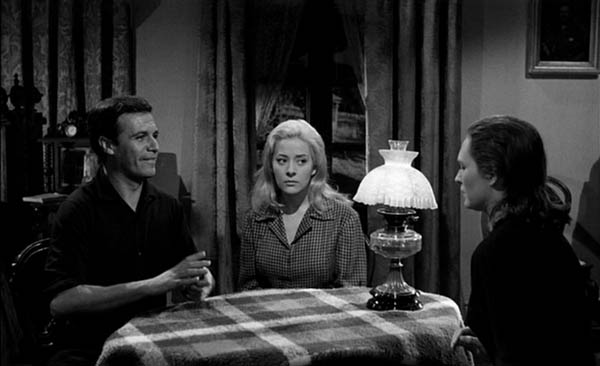
Stars a bunch of non-stars, like Robert Arden and Paola Mori. Akim Tamiroff, the reluctant old guy in the beat-up apartment in the only non-flashback scenes, was in The Trial, Touch of Evil, some Preston Sturges movies, Ocean’s Eleven and Alphaville.

Arden, with the high-class name of Guy Van Stratten, is the cheesehead who starts chasing after Arkadin’s daughter Raina. Arkadin hires Guy to dig up Arkadin’s own past, then follows, killing people Guy meets with. Arkadin is thwarted at the airport after tying up the last loose end (Akim Tamiroff) then leaps from his private plane when he believes that Guy has told the daughter all that’s happened.

image missing

Liked the movie but it’s not like “let’s have some friends over and watch mr. arkadin”. This was the corinth version… gotta check out the others sometime.

image missing

Here’s my email to Jimmy the next day.
———–

Time vs. The Leopard (or Burt’s Eyebrows: The Movie)

So it completely slipped my mind that I hate Italian movies, and I went to see The Leopard last night.

An IMDB reviewer says “To anyone interested in serious concerns, cinematically expressed with grace and intelligence, I would urge you to see this splendid film.”

Serious concerns? Concerns about what? About being serious? The movie is serious about being serious. It seems serious about the people of Sicily, about its sense of history and its future, and about our lead man Burt and his serious eyebrows and sideburns.

In the past few weeks I’ve watched movies by Bela Tarr, Wong Kar-Wai, and Luis Bunuel, plus The Double Life of Veronique and The Fountain. Been using all of those to think about how the movies present time, how they stretch time and contract time and enhance it and make it stop and start. It’s one of the main things movies do that other art forms don’t. It’s hard to change your sense of time with a play, with a painting.

The clock in White Hall to the left of the movie screen is stopped dead, and I liked to look over at it during The Leopard as if to confirm that the movie was frozen in a moment, that it was not progressing, that it had barely started and it was nowhere near the end. A great movie seems to fly by… I want to start it right up again after it ends, but then I notice the real time on the VCR clock, and remember that in real time, in my real day, two hours have gone by and I can’t play it again and I probably should be cleaning the office or going to bed. The Leopard left me with no such illusions. I felt the full force of all one hundred and eighty minutes… plus more minutes! The movie was even longer than it actually was! I feared that Visconti was filming new scenes while we watched, that the movie was looping itself, that the elderly couple behind me would not live to see the credits!

Nice restored print with very strong color. Good low-light and natural-light photography. The movie is a painting, with a painting’s sense of time. It wants to be looked at, but it does not propel you forward. Maybe people want this, to be slowed down, frozen in time focusing deeply on Burt Lancaster’s eyebrows and sideburns (an obsession of mine while the film was in progress), but I’m not so sure. I heard heavy sighs from the crowd, a few people left, at least one fell asleep, and some started talking and wandering around when one of them got a leg cramp. On my way out I walked past a couple discussing how the final dance sequence seemed way too long.

Was this done on purpose? As Prince Burt Fabrizio Lancaster is aging, thinking back on his life, thinking about the changes in Italy, watching the old power structure of which he is a part slowly decline, are we supposed to feel his sense of the moment stretching to the breaking point? Did the director know that the final dance sequence is way too long? Was he rudely extending the scene to force us into Burt’s mindset, to show us that from Burt’s age and position, this dressy ball is tiring and meaningless?

Sometimes when I notice that a movie is using longer-than-usual shots, I try counting shots to see just how long they are. At one point in The Leopard, I think they were running around five to six seconds on average, but it’s actually hard to count seconds in Leopard-time, which is more agonizingly slow than real time. When watching Werckmeister Harmonies (which I haven’t finished yet), I counted only eleven shots (plus or minus a couple) in the first forty minutes. And those forty minutes fly by! Bela Tarr expresses time in a mysterious and alluring way. Luchino Visconti (and Fellini, and Pasolini, and possibly Rossellini but probably not De Sica or Leone) expresses time in the most leaden way possible. I’m surprised that Visconti ever built up the energy to start filming. I’m sure, though, that he never stopped filming The Leopard, that the studio took what he’d shot so far and edited it into a movie. IMDB says he died 13 years after the movie’s release. There must be 13 years worth of deleted scenes, of sequel, of continuing ballroom dances and palaces in disrepair and golden harvest fields by moonlight, of candlelit interiors and Sicilian cityscapes at dusk, all sitting in a chest in Casa Visconti, waiting to be discovered by anyone bored enough to venture there. The ten thousand minute director’s cut!

Other notable things about the movie: Frenchman Alain Delon (of Le Samourai and L’Eclisse) as young rebel Tancredi… a DeNiro-looking priest who is omnipresent in the first half of the movie and strangely missing from the second half… all the young soldiers look like Cary Elwes… some pretty women (the prettiest of whom starred in Fellini’s 8 1/2 the same year)… and of course the lousy dubbing and sound design and the interruptive, full-of-itself Nino Rota score (Italians don’t seem to think that sound is an important part of a movie).

At the end of the movie, Burt Lancaster is old, he’s tired and he’s crying. And so am I. I drove straight home and trimmed my eyebrows.

Bunuel’s brief return to Franco-era Spain before escaping back to Mexico and then heading to France. Viridiana (Silvia Pinal, Simon of the Desert‘s devil) is about to be a nun, but her superiors say that first she must visit her benefactor, her widower uncle Don Jaime. The trip seems to be going fine so far.

image missing

But Viridiana is a crappy nun and gets tricked into wearing her aunt’s wedding gown, then gets drugged and put to bed. Don Jaime (Fernando Rey of That Obscure Object and Discreet Charm) tells her she was raped and now can’t return to the convent, but then confesses the truth… she flees and he kills himself.

image missing

Viridiana gets to split the estate with her handsome cousin Jorge (Francisco Rabal of L’Eclisse and Nazarin). She leaves the convent and attempts to make a home for a bunch of beggars. But she’s no good at that either… they take over the house and attack her.

image missing

Viridiana finally accepts her fate and sits down with Jorge and the housekeeper in a menage-a-trois-suggestive final scene.

image missing

Very interesting movie. Glad I played with all the DVD extras and read up a little on it. Not much to say about it, myself, except to repeat unimportant trivia I’ve learned (Sylvia and Juan Luis smuggled the film out of the country to Cannes, where it unexpectedly won).

Terrific! Maybe the best samurai movie I’ve seen. I never cared much for samurai movies, though… still, this was a blast. Stylish and musical in that late-60’s manner, with all the zooms and close-ups and depth-of-field tricks that you’d want.

Tatsuya Nakadai is Genta, “a former samurai haunted by his past, prefers living anonymously with gangsters” and Etsushi Takahashi is Hanji, “previously a farmer, longs to become a noble samurai”. Criterion’s promo blurb continues: “But when both men discover the wrongdoings of the nefarious clan leader, they side with a band of rebels who are under siege at a remote mountain cabin. Based on the same source novel as Akira Kurosawa’s Sanjuro, Kill! playfully tweaks samurai film convention, borrowing elements from established chanbara classics and seasoning them with a little Italian western.”

Tatsuya Nakadai starred in When a Woman Ascends the Stairs, Sanjuro (second-billed to Mifune), Harakiri, High and Low (again second to Mifune), Kwaidan, The Face of Another, Sword of Doom, Samurai Rebellion, Kagemusha (title role), Ran (the elderly lord) and this year’s The Inugamis. Wowie.

Lots of samurai movie recommendations in Chris D’s essay at the Criterion site. One day when I’ve completely run out of must-see movies, I must see the whole Zatoichi series. “What is so rewarding about Kill! is Okamoto’s expert balance of seemingly disparate elements. He walks a tightrope, skillfully juggling humorous moments, fierce swordplay, and more sober, dramatic sequences, all punctuated by Masaru Sato’s alternately whimsical and wistful score.” Howard Hampton’s essay is useful too, and saves me from attempting a character description: “Tatsuya Nakadai as a hobo swordsman, plus a peasant bumpkin turned would-be samurai, a dispossessed retainer, one kidnapped chamberlain and one kidnap-per-chamberlain, a mercenary who needs thirty ryo to buy his wife’s freedom from a brothel, and even seven squabbling samurai in search of a raison d’être.”

Guess I strongly prefer these late 60’s samurai movies to the stuffy, slow, traditional 50’s ones that everyone so reveres. This one, darker and more cynical, reminds me more of Seijun Suzuki than Akira Kurosawa. Fun, nimble little movie, and brilliant looking camerawork throughout.

A movie I definitely need (and want) to see again. Completely beautiful, more striking than any of the three colors movies. It was late and I enjoyed getting swept up in the whole thing, didn’t worry too much about which Veronique was which (I think it was one for a while, then the other), making comparisons to Jean-Pierre Jeunet films, and watching for reflections and refractions in glass(es) a la the Criterion cover art.

Star Irene Jacob was also in Red and Beyond The Clouds, won best actress at Cannes for this one. Cinematographer did Blue, The Scar, Gattaca, Black Hawk Down (hello oscar nom) and the next Harry Potter.

Veronika (Poland) drops dead during her first big singing performance, and her unknowing double Véronique (Paris) feels the loss and quits her singing lessons to be a teacher. Véronique sees a puppeteer who later summons her via a series of mailed clues. Some kind of fate theme, which would tie it to the Decalogue I guess. Storyline seems so unimportant compared to the visuals, the sensation while watching.

image missing

Katy said she liked it but then never mentioned it again.

Interesting from the Criterion essay by Jonathan Romney:
“Kieslowski denied that there were any metaphors in his films… Yet he also confessed that he aspired to those moments when a film manages to escape from literalism. If Véronique spurs us to search for meaning in a maze of fragmentary significations, it is perhaps because Kieslowski made the film in just such a spirit of pursuit, quite simply in the sense of teasing out narrative shape. By Kieslowski’s estimation, he and editor Jacques Witta prepared some twenty rough cuts of Véronique, some more narratively transparent, others considerably more opaque. … Finally, the Véronique we have is one among a multitude of possible versions. It is this incompleteness, this sense of the provisional and arbitrary, that finally ensures the film’s sense of mystery and saves it from the sometimes oppressive weight of narrative authority that finally overburdens Three Colors.”

image missing

image missing

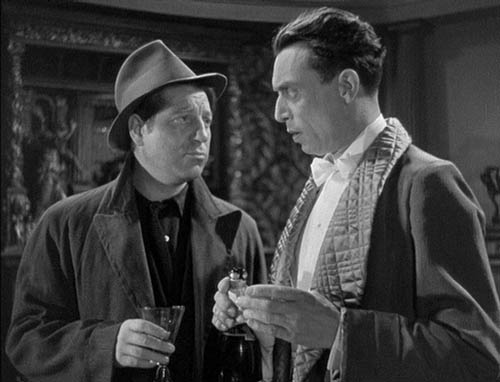
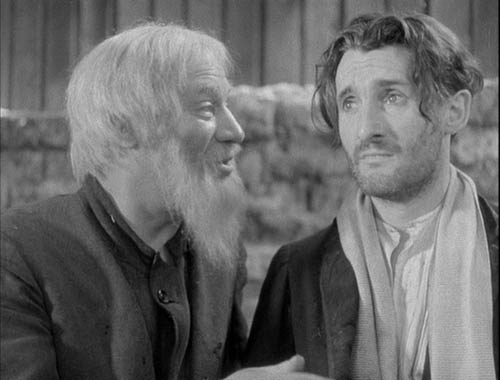
Jean Gabin is Pepel, lifelong thief, lives in a shifty boarding house, likes his girlfriend’s sister. Girlfriend’s dad owns the place but doesn’t enjoy it one bit. Along comes Louis Jouvet as The Baron, or ex-Baron, as he’s fired from his post for unpaid gambling debts as soon as he’s introduced. Pepel met the Baron after breaking into his house, and they become good friends at the boarding house. But life is hard: the resident poet kills himself and Pepel gets into trouble when the old man dies in a fight. But in the end, Pepel gets off easily, wanders into the sunset with his new girlfriend, and the Baron stays behind.

image missing

image missing

Leave it to Renoir to turn a bitter, harsh reality-check on the “lower depths” of humanity into actually a pretty upbeat and hopeful movie, if you look at it a certain way. Enjoyed it pretty well… more than La Bete Humanine for the most part. Will wait for further comment till I see the Kurosawa version. Katy did not watch it, but I’m sure she wanted to.

image missing

image missing

A thorough viewing of the second disc of my favorite DVD set in the world this weekend. Some thoughts:

I do not know how to talk about Brakhage. Mostly on this site I talk about story, quality of performance… how do I talk about a non-narrative motion painting? Don’t have the background or vocabulary for that.

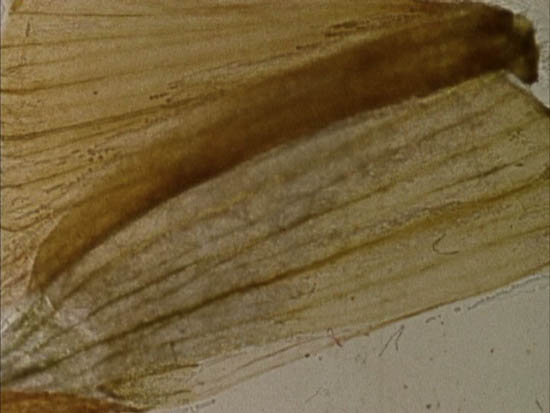
Cat’s Cradle and Window Water Baby Moving are early ones with actual camera shots of actual things. The editing of Window Water is entrancing.

Mothlight will be great forever. I’ve watched it twenty times now.

Then, chronologically, came Dog Star Man and Act Of Seeing, which I haven’t watched yet because I am afraid of them. The scariest nightmare I’ve had in a decade resulted from falling asleep during my only attempted viewing of Dog Star Man, and if Window Water is so attractive and disturbing, I can just not imagine how my stomach will feel after viewing The Act Of Seeing.

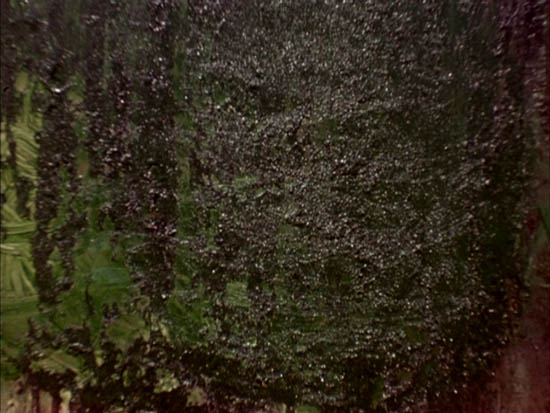
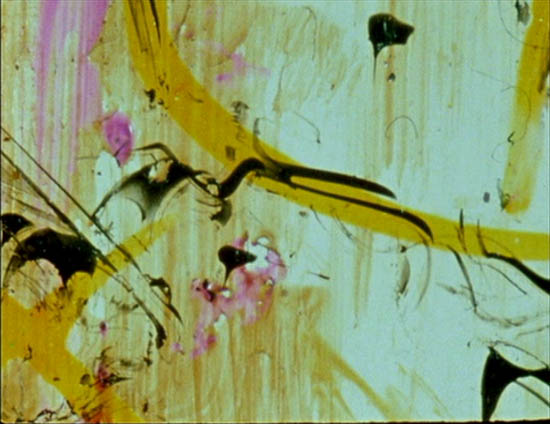
Eye Myth (a nine-second film) took a year to complete because Brakhage had to convince himself that it could be done, had never done a hand-painted film before. Mothlight was almost a decade earlier, but I guess Eye Myth was a big step. I’ve watched it a ton of times just because I can.

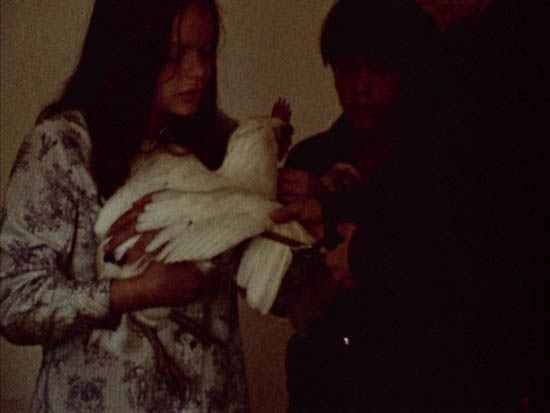
I’m not so wild about the visuals of The Wold Shadow (painting on glass over a view of the forest) or The Stars Are Beautiful (creation myths with shots of home and chickens with sync sound) or Kindering (kids at play), but then The Dante Quartet and Rage Net hit hard… some of my favorites of the painted films.

Black Ice and Delicacies and Study In Color are creepy. The screen shots below reveal nothing about those two. The Dark Tower is always a favorite. And I don’t remember ever seeing Commingled Containers before so I watched it three times. Can’t understand what it is, what those things are, what is happening. Something in a stream? What are “containers”? Beautiful, of course. That applies to all of the above… beautiful, beautiful, blah.

Need to read Brakhage’s book(s), to read Fred Camper’s writings, to read the DVD liner notes again and listen to the interviews with Brakhage on the discs. But I don’t expect to learn much that will gain me a deeper appreciation of the films… they need no explanation.

Matt Stone and Trey Parker were Brakhage’s students. He acted in Cannibal the Musical and loved the South Park movie. Incredible.

Katy did not watch it. I’m afraid to show her any Brakhage. What if she doesn’t love it? How will I explain or convince?

A barrage of screen shots.

Cat’s Cradle
image missing

Window Water Baby Moving
image missing

Mothlight
image missing

Eye Myth
image missing

The Wold Shadow
image missing

The Garden of Earthly Delights
image missing

The Stars Are Beautiful
image missing

Kindering
image missing

I… Dreaming
image missing

The Dante Quartet
image missing

Nightmusic
image missing

Rage Net
image missing

Glaze of Cathexis
image missing

Delicacies of Molten Horror Synapse
image missing

For Marilyn
image missing

Black Ice
image missing

Study in Color and Black and White
image missing

Stellar
image missing

Crack Glass Eulogy
image missing

The Dark Tower
image missing

Commingled Containers
image missing

Love Song
image missing

After a decade of slow self-education in cinephilia, I’ve finally sat down and watched an Ozu movie.

image missing

These happy folks are travelling to the city to visit their children and grandchildren. It’s implied that they won’t make the trip again, then right after they get home, the wife dies. The kids aren’t very receptive, can’t be bothered to break away from their daily lives and jobs and make time to treat their parents with respect and attention. Their daughter-in-law, though, wife of their deceased son, takes them in, takes time off work to entertain them, and is the one who seems saddest at the wife’s funeral.

image missing

Nicely paced, very well told story. Liked it surprisingly well… figured it’d be an overlong slow-paced thing full of symbolism I don’t understand… but it’s just a modern family story. Apparently all of Ozu’s films are modern family stories, each just like the last, and all just as good. Looking forward to finding out for myself.

image missing

Listened to thirty minutes of the commentary before my burned DVD crashed the computer and I gave up. Remember allll the shots have those low camera angles demonstrated by the cinematographer in Tokyo-Ga. He says something about ellipses in continuity, how actions are implied but not shown and how characters names and positions are slowly revealed instead of being explained up front… viewer has to pay closer attention than usual to figure out what’s happening. Says Ozu’s signature dialogue is “It’s a beautiful day”, said twice in this movie. Setsuko Hara (the daughter-in-law, above) was “one of the genuine superstars of Japanese cinema”. Wenders’ Until the End of the World is a tribute to Ozu (maybe I won’t hate it next time after I’ve seen a few Ozu films). Tokyo Story is sometimes seen as a remake of Leo McCarey’s Make Way For Tomorrow. And Ozu makes “mini documentaries of Japanese middle-class life”.

Katy didn’t watch it. Can’t even guess if she would’ve liked it or not.
EDIT 2015: Katy liked it.

I guess a movie about a quirky dysfunctional family seemed new in 1989, but while I was watching this, Little Miss Sunshine, the umpteenth quirky dysfuctional family drama/comedy this year alone, was playing across the street. I don’t want to see that, so why should I want to see this?

image missing

The myth of Jane Campion, for one. The myth of Dayton and Faris at Sundance has got nothing on the myth of Jane Campion. Shots like the one above and story quirks like the one below (the question mark on his forehead foretold by a fortune teller leads Kay to go after him) redeem it for the most part, but overall it feels lightweight and obvious (the final death of Sweetie, who falls from the treehouse, naked and painted black, is an easy ending for this type of movie).

image missing

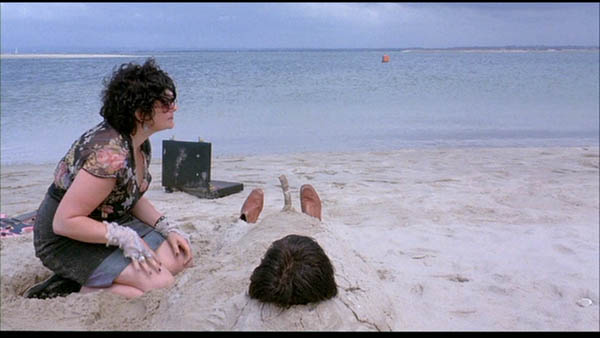
Kay hasn’t much to say for herself, Bob (below, buried in sand with Sweetie) is a red herring, only the parents are interesting as having allowed Sweetie to get to the point where she ends up. Even Kay’s relationship with Question Mark and her fear of trees seemed to mean little, but I guess Sweetie fell from a tree so there’s that. A little commentary-tracking should clear up a lot, but I don’t think I’ll put the time in. Maybe watching the short films or renting An Angel At My Table or The Piano would be more rewarding.

image missing

Shouldn’t be hard on the movie… I enjoyed it for the most part, liked all the scenes Sweetie was in especially. Katy didn’t watch, but would’ve been frustrated by the ineffectual dad character. Or is that only in sitcoms?