“The dead should keep quiet.”

Now that i’ve watched Franju’s Shadowman and Judex, lesser-known masterpieces of light, shadow and creepy atmosphere with pulpy serial subjects, it’s time to revisit the original. I’m not sure how he got from Blood of the Beast to the psychiatric hospital drama Head Against the Wall, but as cofounder of the Cinematheque Francaise, perhaps he had an omnivorous love for poetic film in all forms.

Upbeat carnival music – not creepy sounding, which possibly makes it even creepier – as a woman with a pearl necklace (Alida Valli of The Third Man, schoolmistress of Suspiria) furtively dumps a trenchcoated faceless body (movie always fades out quickly after showing us anything faceless) into the river. She works for surgeon Pierre Brasseur (the actor Lemaitre in Children of Paradise), who saved her face from disfigurement and hopes to completely recreate a face for his even-more-disfigured daughter Edith Scob, who spends most of the movie behind an uncanny featureless mask, as recently spotted at the end of Holy Motors.

In her full-faced years, Edith dated a handsome young doctor with plastic hair (Francois Guerin of The Aristocrats), who suspects she is still alive and involves a heavy-set inspector (Alexandre Rignault of La Chienne and Mon Oncle d’Amerique) in the case. I get the young doctor confused with a young cop (Claude Brasseur, Pierre’s son, of The Elusive Corporal), but neither of them ultimately matters.

L-R: elder Brasseur, elder cop, young doctor, young Brasseur/cop:

Paulette having her treatment:

The very reasonable-acting mad doctor kidnaps more girls, attempting to graft their faces onto his daughter’s to only temporary avail – first Edna (Juliette Mayniel of Chabrol’s Les Cousins), who escapes into the main house then suicides when she sees herself in a mirror, then police-plant Paulette (Beatrice Altariba, Cosette in the Jean Gabin Les Miserables). Faceless Edith, hidden away in her room with no entertainment except her own funeral program, finally loses her patience, frees Paulette, stabs the pearl-choker assistant in the throat and sets the lab dogs loose on her dad, then wanders outside, a walking statue surrounded by doves.

Franju made after Head Against the Wall, assisted by Claude Sautet (a noted director in the 1970’s). Cinematographer Eugen Schufftan had shot People On Sunday, worked with GW Pabst, Max Ophuls, Rene Clair and Edgar Ulmer. A quiet movie but for the judicious, counterintuitive use of upbeat music.

Melancholy character drama about a washed-up pornographer. Technically speaking it’s a very nice movie, though it would help if I knew or cared what the story was about.

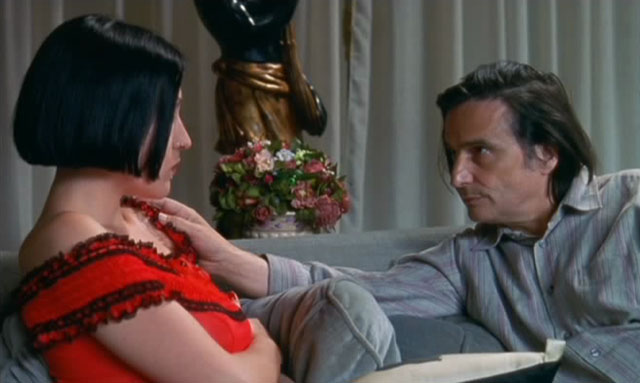
Pornographer and subject:

Jean-Pierre Leaud is the title character Jacques, having a rough patch with his career, his woman (Dominique Blanc of Belvaux’s Trilogy) and his son (Jeremie Renier, star of L’enfant), who is in love with Alice Houri (star of Nenette and Boni). At the beginning a narrator sums up Jacques’s career, telling us he never completed his final film The Animal in 1984 (the outline of which reminds me of Borowczyk’s nude-girl hunt The Beast). But the movie isn’t set in ’84, so I’m thinking it’s about Jacques trying (failing) to come out of retirement, with his producer (Andre Marcon, Roland in Up, Down, Fragile) taking over in the middle of his comeback shoot, leaving Jacques jobless and lost again. Ends with Jacques giving an interview to Catherine Mouchet (star of Alain Cavalier’s Therese).

Twin Peaks reference: girl dancing backwards with red curtains

M. Sicinski:

If The Pornographer has one major flaw, it’s that Bonello invests too much stock in Jacques’s integrity as an artist. Although the film is fairly clear-eyed about the kitsch factor within his most sincere ideas … The Pornographer is still indebted to certain romanticist pieties regarding art vs. commerce.

J. Renier:

The Guardian:

Essentially, the film is about the brutalisation of feeling. Leaud’s performance, a study in weary hope over experience, is as expressive as anything he has done in years. His director isn’t exactly an admirable man, but according to Bonello, whose criticism of French society is scathing, the world is worse than he is.

The Adventures of James and David (2002, Bertrand Bonello)

I still don’t think I have a good sense of Bonello’s style after watching The Pornographer and this silly short about two brothers (played by two brothers). David is a hairdresser who just opened his own place, and James is a DJ in a “Canadian electronica collective” (LOL 2002). They must not have been close, since James barely realizes his brother has financed, remodeled and opened an entire salon. Anyway, David gives James a terrible haircut (worse than the one in Cosmopolis) and that’s the joke, then it says “end of episode one,” and I don’t think there were any more episodes.

Cindy, The Doll Is Mine (2005, Bertrand Bonello)

Photographer (not pornographer) and subject, both played by Asia Argento (I didn’t realize this until the credits). Subject is told to try different poses, patient photographer only shoots when ready, finally asks if subject can cry, “because I think it would move me.” After a snack break, subject puts on a Blonde Redhead track, and manages to cry, which manages to move the photographer. All told, I liked this better than the previous two Bonellos.

Asia 1:

Asia 2:

Poor French shoeshine guy Marcel, who doesn’t know his wife has terminal cancer, comes across an illegally-immigrated kid from Gabon who escaped from a shipping container. The boy hopes to get to London, but Marcel needs to raise 3000 euros for the smugglers to take him across. Meanwhile the kid’s photo is in the papers (caption: “connections to Al-Qaeda?”) and a police inspector is hot on their trail.

Sounds dreary, but wait! Kaurismaki somehow turns this into a political fantasy, tossing realism aside and assigning all characters extreme benevolence. Tack on a miraculous ending – Marcel’s beloved wife recovers from her cancer – and somehow the darkly ironic A.K. has made the feel-good movie of the year. A perfect example of Katy’s current interest in socially-conscious fiction imagining an idealized future.

Oh yeah, in order to raise the money, Marcel convinces local celebrity Little Bob to hold a “trendy charity concert,” in exchange for ending a dispute between Bob and his wife.

Marcel is Andre Wilms, who apparently played the same character in La Vie de Boheme, and his wife is Kati Outinen, Ophelia in Hamlet Goes Business. Marcel and young Idrissa are helped out by baker Yvette, her mom (Elina Salo – Gertrud in Hamlet Goes Business), Marcel’s fellow shoeshiner “Chang” (actually Vietnamese), and eventually the police inspector himself (Jean-Pierre Darroussin, star of Red Lights). Director Pierre Etaix plays the wife’s doctor. The only irredeemable character, a local meddler who twice tries to get Idrissa arrested, is played by Jean-Pierre Leaud.

Won some prizes with funny names at Cannes but got trounced by The Artist at the Cesars.

M. Sicinski:

Those of us who have been following Kaurismaki’s cinema over the past twenty-five or so years will not be surprised by this vote of confi­dence in the human race. We may immediately recognize un film d’Aki by his patented brand of affective reserve and rumpled formalism – he favors blue and beige foregrounds that hold the light with a warm, painterly glow; tends to limit camera movement; tamps down overt drama from his performers; and envelops this deadpan field of action with a unique musical ambience, chiefly derived from 1950s and ’60s rockabilly. There’s also a fair amount of free-flowing alcohol. But it’s his artistic and empathetic alignment with society’s outcasts that truly defines his cinema. The world of Finland’s highest-profile auteur, not unlike that of Howard Hawks, is one of hard-won faith in basic decency, an unsentimental humanism that can even squeeze in space for love.

“That’s the sickness that comes from thinking about film.”

Some notes I took:

He cuts up some woman and puts her body in a trunk. On a train, a man tells stories about a mysterious rider with a companion speaking to him from inside a small suitcase.
Mentions of Grenada and Marrakesh
Middle-east parody?
Communicating by dance
Protagonist tends to wail
The subtitled part is the movie our protag is watching
White-robe is the Sailor? from Three Crowns? Yes he is.
Very good string music, reminiscent of Three Crowns
Protag has no memories.

Some of this will be wrong, and much will be left out. I will happily watch the movie again, hopefully from some glorious high-res copy released in the future, not a fan-subtitled compressed file made from a two-decades-old beta videotape.

To start with, our guy gets a job at a movie theater. “The films we projected, I never knew who chose them, but I think that nothing that was shown was ever watched.” He and erratic coworker Kasim sleep in the projection booth, living there with Kasim’s girlfriend Fatima. Our guy meets an unknown uncle, then an unknown nephew, then goes on a journey (see note above about cutting up and trunking some poor woman).

Suddenly: “Here begins the story of Aba Yahyar ibn Abu Bakhra as recounted by Ibn Abas may it please Allah”. A riddle-spouting djinn sets a crazily fake-bearded young man searching for his crazy uncles, then he finds the “seven sleepers of ephesus” inside a giant mouth (flashback to the giant teeth in City of Pirates). Also, twin brothers (“the only thing that distinguished them was that one drank more water”) love the same woman. Took me a while to realize that all this is the film-within-the-film.

Bearded man seeks uncle:

Giant teeth:

Back in the projection booth, Fatima eats and drinks sound and images by grabbing them off the projector beam with her hand, and our guy gets into a bloody fight with Kasim. Back in the inner film, more uncles and twins starts to jumble together. “Thus I discovered I no longer needed to watch the film. Henceforth, it would be part of me. I would see it projected on the walls of my room, on the face of my nephew and on the sheets of my bed. I could discern it in a dog’s bark, a man’s groan or a bird’s song, all of them telling me one grand tale of my two fathers, my two uncles and my mother, the dancer.”

Sailor:

The Sailor says he collects the decapitated heads of thieves, shows off his heads and one removed eye to Rosalia (the inner film’s fascinating mystery woman). Back at the theater, our protagonist comes to some final realization (“I’ve never had any memories, and in the space of that day I had aged some fifty years”) and leaves the building, ghostlike.

From (the only) IMDB review:

So not a fiction film but about fiction, immortal stories without particular author or answer, that always seem to begin by their narrator with “I heard a story”…

Based partly on a Persian novel by Sadegh Hedayat. A plot summary of the 1975 film version sounds twisty and surreal, and almost nothing like the Ruiz version except that it involves a young man fixated on a memory of a glimpsed “ethereal” woman.

Hard to tell which actors played whom, but Jean-François Lapalus is the lead, and Jessica Forde (star of Rohmer’s Four Adventures of Reinette and Mirabelle) was in there somewhere.

Maybe right here:

“It is at once an enormous joke and a cosmic, existential work on the human condition.” There’s little writing on this obscure Ruiz feature online, but Rouge has published an essential Luc Moullet piece.

Weird and delightful movie with a Gang of Four/Va Savoir feel, but more so, made with the usual suspects: Pascal Bonitzer and Christine Laurent on script and Nicole Lubtchansky editing, plus Christophe Pollock (Class Relations, In Praise of Love) shooting.

We follow three women: Louise (Marianne Denicourt of La Belle Noiseuse), Ninon (Nathalie Richard, “Madame” in Never Let Me Go, also Irma Vep), and Ida (Laurence Côte of Gang of Four). Louise just got out of a hosiptal of some sort and inherited a house from her aunt. Ninon has short blonde hair, works in moped delivery. An hour in, both of them have met Roland (Andre Marcon, king in Joan the Maid), a slightly mysterious (but not too mysterious – he runs a business making theater sets down the street) stalker who knew Louise’s dead aunt and has knowledge of a secret club (of course he does). But the club really exists, and seems honestly sinister, and I’m impressed that Rivette has finally given in to his secret-society teases (though come to think of it, the one in Don’t Touch The Axe was pretty effective), but then it turns out to be kind of a joke. Meanwhile Ida just creeps about, or sits at her library job trying to remember the title of a song in her head.

A girl (Louise) and a gun:

Intrigue: Louise has a stalker, actually a bodyguard named Lucien (Bruno Todeschini, thief of Va Savoir) hired by her dad. Ninon steals cash from work and gets away with it, though her coworker who was manning the register gets fired. Roland has secret papers proving that Louise’s dad is a crook. There seems to be a lot of wordplay that isn’t translating in the subtitles. And halfway through, the movie becomes a musical!

Ninon and Louise find something to dance about:

The girls visit a nightclub called Backstage, where Vivre Sa Vie star Anna Karina is a singer (and Ninon is an electrifying dancer). It’s here that Louise gets pulled into the secret club, where she is chosen to kill another member, then given a gun filled with blanks. Bodyguard Lucien is falling for Louise, Ninon is involved with Roland, and Ida has a weird connection with Anna Karina – I’m afraid I missed the point of Ida’s role besides the joy of watching Laurence Côte. Actually that might have been the point of the entire film.

Adrian Martin on the first musical number: “Haut bas fragile is about the dream of everyday life metamorphosing – via only the slightest nudges of stylisation – into the idealised realm of art, and specifically popular-musical art. Rivette’s films, with their obsessive walkers and mannered talkers, have frequently circled this moment of ignition, but here he goes all the way: love expresses itself in ironic, playful postures and swooning falls.”

J. Rosenbaum:

All three actresses created their own characters – a procedure Rivette also followed in Out 1 and Celine and Julie Go Boating. And just as Jean-Pierre Léaud and Juliet Berto are solitaires in Out 1 and Julie is one in Celine and Julie before she meets Celine, Ida in Up Down Fragile might be described as someone who’d like to be in a musical but can’t because she doesn’t yet know who she is. The adopted daughter of provincial parents whose letters she doesn’t answer, she’s obsessed with fantasies about who her real mother might be and with tracking down a song from her early childhood, of which she remembers only fragments. (Eventually her obsession leads to a meeting with Sarah, a cabaret singer, played by Anna Karina, whom we’ve already seen in scenes with Ninon and Louise.) Narratively and musically, Ida’s in a perpetual state of becoming – the only creature to whom she’s attached is a cat. Meanwhile the other lines in the fugue are the processes by which Ninon and Louise acquire romance and friendship and thereby work their way into musical numbers, all of them various kinds of duets.

A rare director cameo:

June 2024: Watched again in HD. Some points I’d forgotten: Ida is sad that she doesn’t know who her parents are, and Roland is trying to hide the fact that Louise’s dad is a scumbag.

Lately… Nathalie Richard became a Michael Haneke regular, then a Bertrand Mandico regular, costarring in his new Conann movie… Marianne Denicourt was in a bunch by Claude Lelouch and an Agatha Christie miniseries by the Martyrs guy… Laurence Côte was just in a Virginie Efira identical twins melodrama that played Cannes… and we’re still mad at André Marcon for leaving Isabelle Huppert in Things to Come.

The ultimate movie-movie, starring Denis Lavant 11 times.

Prologue in a movie theater where he is locked in a room with a secret-panel door to which his metal finger is the key.

“Oscar” leaves a giant house as a banker, gets into limo driven by the great Edith Scob (looking much more lively than she did in Summer Hours – I know it was acting and makeup, but I was concerned), is told he has nine appointments today and starts getting into makeup.

1. He plays a hunched homeless woman begging for change, seeing mostly pavement and shoes.

2. Motion-capture room inside a factory – he is covered in tracking markers like the kind Andy Serkis is always wearing. First he enacts an acrobatic fight scene, then runs on a treadmill firing a machine gun, then is joined by a red-rubber-suited woman for a mutant sex scene.

3. “Merde,” he mutters as he glances at the dossier. And so he is Merde, striding through the cemetery eating flowers until he comes across a photo shoot. He bites a camera assistant’s fingers off then abducts model Eva Mendes (of Bad Lieutenant 2), takes her to the sewer, reconfigures her clothes and lays in her lap naked. Best joke of the movie: the headstones all advertise the deceased’s websites.

4. Beleaguered father picks up daughter Angele from a party where she was too shy to dance and mingle. He takes it badly because she lied and said she had a great time.

5. Musical intermission with accordions, time to reflect on the movie. At some point between scenes Michel Piccoli visits the limo to discuss Oscar’s work. Cameras are mentioned – the fact that they used to be these big things but are now tiny and hidden everywhere. So Oscar is a sort of character film-actor of the future. The first two parts he played couldn’t be more different (old and feeble vs. acrobatic, grim realism vs. stark techno-future), so we’re seeing a range of Oscar’s performance types before the second half gets more personal.

6. A bald guy with facial scars knifes another guy to death in a warehouse, makes that guy up to look like himself, then gets knifed by the dying man, ending in a hilarious visual joke, two Oscars dying side-by-side on the ground. As he staggers back to the limo, helped by Edith, we wonder – which one was Oscar, and were either of the stabbings real?

7. He’s a dying man in bed, having a final conversation with sad niece Lea. Further ruptures in the structure: when the old man is “rambling incoherently” he recites lines from previous episodes, and after he “dies” we watch him get back up and leave, chatting briefly with the actress playing his niece on the way out.

7.5?: He quickly makes Edith stop the limo, throws on a red barbed-wire stocking cap and shoots himself-as-the-banker dining along the sidewalk, then gets shot to death. Edith runs over, apologizes to everyone saying it’s a mistaken identity and collects him (stocking-cap, not banker).

8?: During a limo-driver right-of-way argument he wanders off, seeing a girl he knows (Kylie Minogue). They’re in the same line of work and had major history together – she sings a song to fill us in. He seems to be himself (Oscar) here, and she’s preparing for a role where she’s suicidal, waiting for another man. On his way back to the limo, Oscar runs screaming over her dead body, having performed her scene and jumped to the pavement. If she’s as “dead” as he becomes in his scenes then she’ll be fine in a few seconds – and if this wasn’t a performance but the “real” Oscar then why can’t he see her anymore, and why the extreme reaction to her death?

9. Anyway, Oscar ends up at a house full of chimps, whom he kisses goodnight. Edith parks the limo, puts on her Eyes Without a Face mask and walks off. Then the limos converse, tail lights flashing as they speak.

Need to watch this again – not because I may have missed a scene or listed them out of order, but because the movie (and Lavant) is completely amazing [edit: watched again; Katy didn’t like it]. From skimming the critics’ reports I was prepared for something extremely crazy and nonsensical, but this made plenty of sense, and is a completely unique piece of meta-cinema. Caroline Champetier, cinematographer of this and Merde, also shot Of Gods and Men, Rivette’s Gang of Four and Class Relations.

D. Lim: “… as close as Carax has come to an artistic manifesto: a film about life as cinema and cinema as life.”

Beautiful Daiga (Yekaterina Golubeva, mysterious sister/lover of Pola X) has emigrated from Lithuania to Paris and is looking for a place to stay and work. Theo (Alex Descas, father in 35 Shots of Rum) is a struggling musician, and his brother Camille (Richard Courcet) a transvestite dancer. One of these three people might be connected to the serial “Granny Killer” who has been terrorizing Paris for a while.

Theo is from Martinique, married to Mona (Beatrice Dalle of The Intruder, also an intruder in Inside). Their relationship issues provide a solid center to the murder mystery plot – turns out Camille and his lover Raphael are the wanted criminals, killing old women and robbing their apartments for money to party.

Sort of like 35 Shots of Rum, following a few characters, you gradually realize who they are and how they know each other, more grounded and straightforward than The Intruder or Trouble Every Day – only instead of ending with a wedding, it ends with two guys being locked up.

Senses of Cinema provides a handle on many of her films: “Denis continues to explore the legacy of colonial and post-colonial societies by concentrating upon shared experiences of displacement – through an ensemble of characters who are struggling to find, return to or willfully create a sense of home, possibility, passion, belonging.”

I also watched her nine-minute segment from A Propos de Nice the following year, tragically entitled Nice, Very Nice. Young Denis regular Gregoire Colin is snatched off the sidewalk by some guys he knows, given a gun and an apparently convincing speech (we don’t hear it – there’s no spoken dialogue). Colin stops at the beach to think, then heads through a parade to a restaurant, where he finds and kills his man. The plot seems like an excuse to film the parade.

Eduardo de Gregorio, cowriter of the great Celine and Julie Go Boating, died last month. I don’t know any of his non-Rivette works, so I watched one he wrote/directed and one he adapted from a Borges story directed by Bertolucci, both very good.

Surreal Estate (1976, Eduardo de Gregorio)

A novelist (Corin Redgrave, Vanessa and Lynn’s brother) seeks a country house in France as an investment – can’t find gate so he climbs the wall. A sexy, ghostly Bulle Ogier shows him around then abruptly disappears when he attempts to enter a forbidden room. Already he’s referring to his situation as novelistic: “Her act was pointless. The mixture of old clothes, erotic come-on and overacted hysteria was in the most hackneyed gothic tradition, a tradition I had done my own small part to debase.”

Next time he meets a different girl (Marie-France Pisier, Bulle’s fiction-house coinhabitant in Celine & Julie) and an older servant (Gigi star Leslie Caron). He rightly comes to think that the vanishing girls are part of an imaginative scam to get him to buy the house, and decides that he must meet Bulle again to write a book about her – but eventually he buys with the understanding that the two beautiful girls will stay there with him – which they do not.

Leslie Caron:

Marie-France:

I lost track at the end of who really was working for whom, and who knew what about which scam, instead paying attention to the mobile camera creeping around corners, the great crazed piano music, and the self-conscious gothic atmosphere the film is creating. Shot by Ricardo Aronovich (Ruiz’s Time Regained and Klimt) with assistant director Claire Denis!

But maybe losing track of the plot threads and simply reveling in the atmosphere of mystery was the film’s intent. It seems to purposely confound expectations in order to mess with Redgrave, beyond simply the goal of selling the house, and the girls end up competing for him (and against him), while Caron takes a larger role than first expected, and even takes over narration for a while.

D. Cairns in The Forgotten:

Secret passages and two-way mirrors are hinted at. What emerges is a much stranger yarn, one which never fully coalesces into an “explanation.” Depending on one’s inclinations, this is either less or much more satisfying than the initial Scooby Doo plot. What seems to be the case is that the younger women are actresses playing parts for the dubious benefit of Redgrave, whose mind starts to unravel when faced with such duplicity. … The idea of actors performing a semi-improvised “play” in a real location with an unwitting stooge as co-star is a beautifully Rivettian one.

Of course, Marie-France Pisier (Agathe) had problems with flowers in Celine & Julie as well.


The Spider’s Stratagem (1970, Bernardo Bertolucci)

Bertolucci made this the same year as The Conformist. I think I’ve underestimated him because the only movie I’ve watched in the last decade was his underwhelming The Dreamers. Similarities to Surreal Estate: it’s about an outsider entering an enclosed world full of unknown intrigues. Also, both movies have overt Macbeth references. Very elegant camerawork, outdoing the other feature.

Young Athos comes to the town where his militant anti-fascist father (also Athos, and they look identical) lived and was murdered. He meets his father’s mistress Draifa (Alida Valli of The Third Man, schoolmistress of Suspiria), who sets Athos to investigating the murder. The town is hostile to his queries, and Athos feels endangered from all fronts except by creepy Draifa who wants to hook him up with a young niece so he’ll stay. Then when he tries to flee in frustration, the secretive parties suddenly open up.

The main suspect was fascist Beccaccia, who finally tells Athos “unfortunately, it wasn’t us who killed your father.” Elder Athos’s three friends, who seem alternately welcoming and sinister, finally give up the plot – that Athos had ratted on his own group when they’d planned to bomb a visiting Mussolini, then had allowed them to shoot him instead, martyring him for the cause.

Ebert:

He’s on a strange sort of quest. He doesn’t seem to really care much who killed his father (if you’ll forgive me for not taking the plot at quite face value). In a way, he is his own father, or his father’s alter-ego. Magnani was the only vital life force in the district, and the district defined itself by his energy. Even the fascist brownshirts gained stature and dignity because Magnani opposed them, and Bertolucci demonstrates this with a great scene at an outdoor dance. The brownshirts order the band leader to play the fascist anthem. All dancing stops, and everyone looks at Magnani to see what he’ll do. Coolly, elegantly, he selects the most beautiful girl and begins to dance with her.

Not at all surprised when the end credits told me it’s based on a novel. The novel was Herman Melville’s follow-up to Moby Dick, which according to wikipedia was “a critical and financial disaster… universally condemned for both its morals and its style.” The movie plays like a piece of tragic literature without feeling uncomfortable in its present-day setting. I mean that as a compliment, but it also means the plot, as strange as it initially seems, has a feeling of inevitability. It opens on a rich couple, happy, alive and in love, so I know things won’t end well. Maybe it would be interesting to someday make a movie that opens on a loving couple who manage to stay that way.

Anonymously bestselling author Pierre (Guillaume Depardieu, star of Don’t Touch The Axe) is engaged to marry Lucie, but already a weird incestual vibe is creeping in when he calls his mom “sister” and gets all clingy around her. His best friend Thibault returns from travels, congratulates Pierre on his engagement to their mutual childhood friend Lucie, seems sincere about it. But Pierre is distracted by a stalker, and when he finally catches her, she claims to be his long-lost sister Isabelle, hidden away and raised in Bosnia. So Pierre visits some good places to die: the highway at night, a massive unstable rock, a waterfall, then tells his fiancee and mother that he’s moving to Paris by himself.

Pierre and mother:

Pierre tells Isabelle (Yekaterina Golubeva, sinister stalker in The Intruder): “for the world, you’ll be my wife,” even though nobody in Paris knows who he is so it shouldn’t matter. They immediately run into trouble on both sides of the law, Thibault throws him out, and newly-disillusioned Pierre is having trouble with his follow-up novel. His agent: “The need to spit the world’s sinister truth in its face is as old as the world itself.” Another woman and a little girl travel with them – I was never sure who they were, exactly, but the girl dies after being smacked in the head by a passer-by, and the couple moves again.

Now they’re in a warehouse run by a drums-and-feedback noise conductor and his all-black-clothed orchestra – just the kind of thing people assume goes on in Paris – and now their public/private roles seem reversed, as they sleep together when nobody is looking, but stay in separate beds. Back in the country, Pierre’s distraught mom (Catherine Deneuve, the same year she did Ruiz’s Time Regained) gets on his motorcycle and dies on the highway at night – so it beats the massive rock and the waterfall as the movie’s foreshadowed death monument. Lucie tracks Pierre down and stays with them (“we’ll say you’re my cousin”).

More troubles: Isabelle jumps off the winter ferry trying to die, Pierre publicly identifies himself as the author of the bestselling novel but is called an impostor, nobody wants his new book (“a raving morass that reeks of plagiarism”), Thibault is harassing them, and Pierre is getting shit from his conductor/landlord, whose musicans apparently also double as his private militia. So Pierre grabs some guns, goes into town and blows Thibault’s head off, is packed into the police van as his women both run after him, then Isabelle walks in front of a speeding ambulance.

It struck me as ironic that Pierre is trying to write a great, tortured novel, seeking the ultimate truths, while all his relationships are full of lies. Watched this because I enjoyed the unhinged awesomeness of Carax’s Lovers on the Bridge and his Merde short, and I’m hearing that his new one is bananas. But this was apparently the grimly serious piece between features of transcendent weirdness, despite a blood-soaked dream-sequence or two. I was looking forward to the Dirty Three score, but it’s actually by Scott Walker – what was I thinking of?

Lucie, in happier times:

Senses of Cinema:

If compared to Jean-Luc Godard and later Philippe Garrel in his first works, in Pola X we find a Carax closer to Jacques Rivette – who, not in vain, has declared that for him this is the most beautiful French film of the ’90s. The Rivettian airs can be found, for example, in the importance of the ideas of conspiracy, secrecy and masks; in the shots of large interior spaces like factory buildings and chateaus; and, above all, in the treatment of time: so many meters of film are used to follow the characters’ journeys, living the process with them – at the beginning of the film we follow Pierre all the way from the chateau where he lives to Lucie’s home, including the ferry ride; similarly, at the end of the film Carax spends a lot of time following Pierre’s journey to Thibault.