Kind of a clunky picture about a lovestruck band leader who takes his group to Brazil and falls for a local firebrand. Lots of time wasted on groany romantic drama between musical numbers, then the nine-minute songs wear out their welcome until I start hoping for the return of the groany drama. It’s saved by the charisma of the band members and some light filmmaking flourishes – over-the-top musical bits with oddball camera placement and silly-ass graphic transitions between every scene – brought to you by Thornton Freeland (directed Brewster’s Millions) and D.P. J. Roy Hunt (who also shot I Walked With a Zombie – someone needs to look into this guy). I don’t remember anymore why we watched this in film class at Tech (following Wings and Things To Come), probably something to do with 1930’s audiences’ love and fascination for new technologies such as the aeroplane (“electric tie rack! rackin’ up electric ties!”).

Something like Ginger Rogers’s 25th film, but Fred Astaire’s first, and it’s remembered for that. Central music number The Carioca was oscar-nominated, but beaten by Astaire & Rogers’ follow-up The Continental from The Gay Divorcee. Both songs are five minutes too long, so I’d like to cast my belated vote for the third nominee, Bing Crosby and Miriam Hopkins’s cross-dressing college gangster comedy She Loves Me Not.

Dolores del Rio was harmless in this, would turn up in Journey Into Fear with Orson Welles a decade later. Less harmless was star bandleader Gene Raymond, our blonde German-looking chunkhead romantic lead. Suppose I might have to see him again in Mr. and Mrs. Smith or If I Had a Million, but mostly he had the courtesy to stay out of the more acclaimed movies of the 30’s. Good-natured gentleman Raul Roulien as Dolores’s family-arranged fiancee failed to make as much of an impression as did Etta Moten (“the first Negro woman to play a dignified role in pictures”) who sang a verse of The Carioca, or Eric Blore (Sullivan’s valet) and Franklin Pangborn (another future Sturges player) as comically uptight hotel managers in the opening scene.

Katy says she’ll do a guest write-up for Gigi, so consider this a placeholder. She liked the filmmaking very much, and I’m sure it was very good (Minnelli can do no wrong) but I was put off by the story.

Young Gigi (Leslie Caron, who was actually 26, so I guess it’s all okay) is being taught by her family how to please men, and super-rich Gaston (Louis Jourdan of Letter from an Unknown Woman, which we watched directly afterwards) is bored with every girl in town except Gigi. At the end he decides that he loves her, much to the delight of her family, including dirty old grandfather Maurice Chavelier (27 years after The Smiling Lieutenant), motherly (but not her mother – Gigi has no parents) Alvarez (Hermione Gingold of The Music Man) and stickler aunt Alicia (Isabel Jeans, star of two Hitchcock movies in the 20’s). Won an awful lot of oscars – pretty much everything but acting and special effects.

First Minnelli movie I’ve watched since Meet Me In St. Louis (and his 13th since then – I must catch up). Writers of Singin’ in the Rain (and it shows, with all the behind-the-scenes crossover) but different songwriters. I didn’t know much about it, besides its position on some lists of great films, but was still impressed at how great it was, in direction and dancing and music (in that order) more than anything else. Katy enjoyed, too.

Fred Astaire, a decade after Holiday Inn, is looking more alive and alert than ever, despite being in character as a has-been showman. He’s paired with (eventual love-interest, natch) young Cyd Charisse of Singin’ in the Rain by two enthusiastic show writers. They bring the project to an overbearing actor/director, but he turns their comedy into a dreary version of Faust, so after the investors have given up the writers reclaim the play and undo the director’s pretentious changes, touring to eventual acclaim. It’s all in fun.

Nanette Fabray (of not much else, but still alive, so there’s time) as a writer of the play holds her own in the singing and dancing scenes, but her comic foil partner Oscar Levant (a composer and pianist, also of An American In Paris and Humoresque) I found more hammy and grating. Maybe it was more his big clown face than his acting, but there’s something unpleasant about him. Jack Buchanan, as the director (who is good-natured enough to stay with the play after the rewrite), is far better here as a noisy, self-obsessed Orson Welles caricature than as the fey hero of Lubitsch’s Monte Carlo. The one scene with a major dancer who’s not one of our stars is when Astaire dances through an arcade with Leroy Daniels. It’s a wonderful dance, and even more wonderful that Daniels is apparently playing himself, known around Hollywood as a rhythmic shoe-shiner who had a hit country song written about him.

No Oscar nomination for the song “That’s Entertainment” – I guess it wasn’t considered an original song. I liked all the songs pretty well, though Katy notes they didn’t try to make any sort of unified sense out of them. We get Astaire and pals in baby clothes dancing on their knees to “Triplets,” country Nanette in “Louisiana Hayride,” and Cyd’s big-drama “New Sun in the Sky”. As the cast regains control of their play and starts to turn it back into an entertaining piece, these songs get added seemingly at random. It adds to the comedy that we never remotely see how these bits connect in the finished play.

“A comic strip in 7 episodes on the life of Richard Strauss 1864-1949” Strauss is played as a power-hungry megalomaniac by Christopher Gable (also of Russell’s Tchaikovsky film The Music Lovers). The film itself is fanciful and alive, and surely one of the best biographic movies I’ve seen.

image

Only two years after 2001: A Space Odyssey, Russell accompanies that film’s big opening song with shots of a caveman who soon runs into religious mania and screaming nuns (both of which would be rampant in The Devils the following year).

image

“Alas, the time is coming when man will give birth to no more stars. The dead end of mankind is approaching.” I could quote every line and display stills from every shot. This seems way too extravagant to be a made-for-public-television movie, and too good to be a long-censored rarity. Only ten years until this can be shown legally despite the Strauss family’s objections, unless copyright law is extended like it always is.

image

We get a love triangle in the box seats at the opera, scenes of Macbeth, Don Quixote, a fun Salome with two lead actresses, and the infamous garden party with the nazis. Yes, the film does feature Strauss giving Hitler a piggyback ride, both of them grinning and playing violins. Various fantasies, both nightmarish (Allied soldiers interrupt Strauss’s innocent mountain vacation and murder his family) and wishful (his glorious music pounds critics into submission).

image

Kenneth Colley (Jesus in Life of Brian) – the only actor to play both Jesus and Hitler?
image

“A life completely away from politics and war – that is what I’ve always longed for.” Ends with a speech by an aged Strauss distancing himself from the nazi party, “There’s no stain on my character. These nazis are criminals, I’ve always known that.” But a minute later complains about “Jewish stubbornness” before catching himself. Russell partly credits Richard Strauss with scenario/dialogue, saying he used the man’s own words in the script. A scathing portrayal.

image

IMDB has incomplete credits. Judith Paris (a nun in The Devils) played Strauss’s wife Pauline, Vladek Sheybal (camp classic The Apple, Russell’s Women In Love) was Goebbels and Imogen Claire (appeared in and choreographed Lisztomania) was one of the two Salomes.

image

Tape number at top of screenshots provided so the BBC can locate their tapes and release this properly. Timecode (below) provided so you can easily find your favorite scenes. Thank me later.

The MBC:

The complete title reveals Russell’s intention to create a satirical political cartoon on the life of the German composer, who Russell saw as a “self-advertising, vulgar, commercial man . . . [a] crypto-Nazi with the superman complex underneath the facade of the distinguished elderly composer.” And, although, according to Russell, “95 percent of what Strauss says in the film he actually did say in his letters and other writings,” many critics and viewers found Russell’s treatment of the venerated composer itself to be vulgar.

Set in Paris but I don’t think there’s a single Parisian (character or actor). Stiff lunkhead footballer Randolph Scott (Ride Lonesome), looking convincingly awkward on the delicate Paris sets, is tagging along for some reason with Fred Astaire (here winningly named Huck Haines) and Fred’s band of musical entertainers.

Randolph looks to his rich aunt Roberta (Helen Westley, who also appeared with Irene Dunne in Show Boat) for a place to stay while Fred negotiates with blustery “Russian” Luis Alberni (hotel owner in Easy Living, chef in The Lady Eve) for a place to work.

Enter Fred’s love interest Ginger Rogers. Where did she come from again? I don’t remember, but she’s somewhat hindered here by her awful fake accent and by Fred’s fancy for solo tapdances. Fred’s got no humility – this was only his third film (between Gay Divorcee and Top Hat) and something like Ginger’s 30th. The two dances she participates in are wonderful, especially the first where she wears pants so we can see what she’s up to.

Aaand enter Irene Dunne (pre-Awful Truth, same year she was in John Stahl’s Magnificent Obsession) as Randolph’s love interest. I hate to see a dumb American dude being fought over by a European princess (Dunne, who has also been secretly designing Roberta’s all-the-rage fashions) and an aggressively rich American (Claire Dodd), but maybe Randy is more handsome than I realize. Irene is also secretly (?) the sister of the building’s doorman (Victor Varconi: Pontius Pilate in DeMille’s King of Kings), which leads to misunderstandings. Hmmm. Ultimately what matters is we get some oscar-nominated songs, some Fred/Ginger dances, and some comedic running-around. I like Irene Dunne whenever she’s not singing (she’s fond of the piercing Jeanette MacDonald style, which would thankfully die after the 30’s).

Remade in the 50’s with Red Skelton and Zsa Zsa Gabor. Lucille Ball appears in a fashion montage at the end. IMDB trivia gives clues how to spot her, but I guess my laptop DVD drive is dying so I can’t get screenshots.

Another early Lubitsch musical. This one starts promisingly with wonderful shots of a wedding which the bride has abandoned (her dress deflated on a chair, the groom traveling under a row of umbrellas) and proceeds to a decent song (the foppish groom – Claud Allister – informing his guests that he will retrieve the girl). Alas, it’s to be the last decent song because after heroine Jeanette MacDonald (of Love Me Tonight) is introduced, she’ll do all the singing in Snow White screech-falsetto.

Zasu Pitts looks wary: madame could start singing at any moment.
image

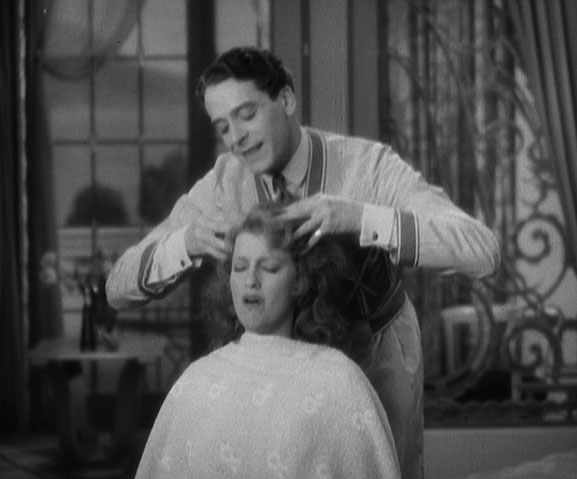
We quickly abandon the abandoned husband to follow Jeanette, escaping by train with loyal maid Zasu Pitts (Greed, Lazybones) to Monte Carlo, where she meets many hopeful fellows and hires 20 assistants – all on credit since she has no money. One especially hopeful fellow is smiley, overconfident Jack Buchanan, who singlemindedly goes after her, finally gaining entry to her hotel suite by posing as a hairdresser then taking over all her servant positions when she has to let everyone go since she can’t pay them.

image

Of course Buchanan is secretly wealthy, so after Jeanette gives up hope of escape and is again going out with her prince from the beginning, Jack makes his move and she escapes again.

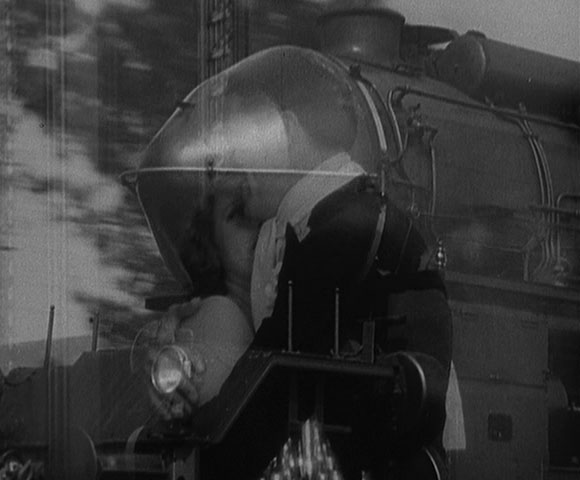
A train embrace:
image

Perfectly decent movie, though I didn’t notice many attention-grabbing Lubitschisms after the intro. Felt more like a simply-plotted cheapie. The only real disappointment (besides Jeanette’s singing) was a hollow-eyed, sad-mouthed Zasu Pitts, seeming to slow down the film whenever on screen. My favorite was the prince, so winning a being a loser in the opening scenes.

What’s up with Donen always having a co-director? Abbott was 70 at the time, and unless this is a misprint he lived to be 107.

A pre-Pillow Talk Doris Day is a workers’ union representative named Babe in a pajama factory, and Broadway actor John Raitt is the new middle manager Sid (but everyone calls him Sorokin – they’re into weird nicknames in this movie) who fires her. Seems like a fine setup for a romantic comedy if you ask me. I liked this, though I got complained at for falling asleep and had to finish it the next day. Katy didn’t like the songs, and a musical lives or dies by its songs, so it died. We both noticed the color was dull and drab, but IMDB people all rave about the bright colors, so maybe there’s a better DVD out there.

So yeah, Sid has to fire Babe, but she’s still on the union committee demanding a seven-and-a-half cent hourly raise, causing slowdowns and sabotage to shake up the owner, Mr. Hasler. This causes the committee (which consists of Babe, a heavy girl named Mae, a glasses guy who likes Mae, and a twitty nasal-voiced Marilyn-wannabe) to break into song and dance.

Sid also likes Babe, but doesn’t get much ground there. So he takes to stalking her friend Gladys (Carol Haney), the boss’s assistant, until he gets the key to the safe where the books are kept. I think he catches the boss embezzling money which had been earmarked for an employee raise six months earlier, and negotiates that they get their raise (non-retroactively) and nobody gets in trouble… which is sort of a copout, but maybe the movie didn’t want to appear too pro-union. Of course this means Sid gets the girl.

I told Katy that Carol Haney reminded me of Shirley MacLaine in Artists & Models. MacLaine was Haney’s understudy for this role on Broadway! I am good. Haney was great in this, and attention-grabbing with her dance to “Steam Heat” and singing on “Hernando’s Hideaway,” but this was her final film and she died of illness not long afterwards. Mae, unsurprisingly, didn’t have much of a Hollywood career, playing roles such as “angry lady”, “housing lady” and “fat lady.” Nasal-lady Barbara Nichols’ short life in film included Sweet Smell of Success and Beyond a Reasonable Doubt.

Sid Sorokin was nothing special, but Doris Day really came to life in this one. I liked Haney’s songs and the weird union plot and the neon signs that label everything in the pajama factory. Wasn’t keen on the playful comic romp of Gladys’s jealous husband Heinz chasing her around with a knife at the end, but overall found it a better-than-average musical.

Katy told me Jack Black was in a depression after this movie failed, so I felt bad for skipping it and thought I’d rent it to cheer the guy up. Maybe it’s director Liam Lynch who’s in a depression… if your feature debut bombs, do you get a second chance? I hope he’s at least working on a second album (and more music videos).

The celeb cameos are as good as you could hope for – meaning the film isn’t weighed down by the awkward injection of whichever actors would say yes, but they actually have funny parts that work with the movie. Amy Poehler as a waitress: (“do we have to pay for all these refills?”, “No, you’re so pretty you get everything for free.”), Neil Hamburger gets about one line, Dave Grohl was apparently the devil, Tim Robbins is surprisingly good at silly comedy under lots of makeup – only Ben Stiller is a problem as a prophetic Guitar Center employee, and even that is only because his scene goes on too long.

After an outstanding musical intro (a kid who is perfect as a young Jack Black with Meat Loaf as his metal-disapproving father), the D members meet and perform open mic nights, but in order to win the big open-mic grand prize they’ll need the titular pick made from satan’s horn. It’s a mix of some original episodes (biggest fan Lee is in the movie; they borrow then trash his car) and music videos (the final scene is basically the “Tribute” video with a less catchy song, and there’s a hilarious shroomy Sasquatch sequence). Kept me entertained.

Think this is one of those seminal films that make people foam at the mouth about the 1970’s being the best-ever movie decade. Usually I’m skeptical, but this one lives up to the rep. Can’t believe it took me this long to watch it. One of Altman’s scattershot ensemble pieces illustrating life, sex, violence, media and politics over one weekend in the mid-70’s, closer to the messy truthfulness of Short Cuts than the more conceptually-unified Prairie Home Companion. Plot, then, defies simple description, so here are a bunch of character sketches instead.

Solo Opry stars:
Tommy Brown and Haven Hamilton (Henry Gibson, suspicious neighbor in The Burbs) are the friendly male stars, while Connie White (Karen Black of Burnt Offerings, House of 1000 Corpses) and Barbara Jean (Ronee Blakley, Nancy’s fred-krueger-killin’ mom in Nightmare On Elm Street) are bitter rivals. BJ is recovering from exhaustion, acts slightly crazy throughout the picture.

The Trio:
Up-and-coming band “Tom, Bill & Mary” consists of relatively uptight Bill (Altman regular Allan Nicholls), Mary (Christa Raines of Ridley Scott’s The Duellists) who is married to Bill but secretly sleeping with Tom, and bearded free-spirit Tom (Keith Carradine of Street of No Return) who sleeps with near every girl in the movie.

Politicians:
Third-party candidate Hal Phillip Walker (inexplicably running in state “primaries” in a misuse of political language) is often heard but never seen. His campaign manager John Triplette (Michael Murphy of Tanner ’88, X-Men 3) is everywhere, trying to recruit music stars for a rally. Del Reese (Ned Beatty of Deliverance, Network, Stroker Ace) is a heavy dude assisting Triplette. Triplette basically tricks Haven and Barbara Jean into appearing at the climactic rally.

Media:
Off on her own is BBC journalist Opal (Geraldine Chaplin, the year before NoroĆ®t). I was happy to see her at first, but her character is so awfully self-absorbed and oblivious to the world and personalities that she’s purportedly researching, she soon became mere comic relief.

Crazies:
The ever-present magician-looking guy on a three-wheeled hog was Jeff Goldblum’s third movie role (California Split was his second). Shelley Duvall, in the middle of her Altman film streak (ended with Popeye) plays a flamboyant girl often explained away with “she’s from California.” A boarder at her house named Kenny shoots Barbara Jean at the rally in the final scene, and the guy who tries to stop him, army private Kelly (Scott Glenn, just played Rumsfeld in W.) has been stalking B.J. throughout the movie. Poor Sueleen Gay (a great name, played by Gwen Welles of California Split) is an enthusiastic red-haired waitress who wrongly thinks she can sing, reduced to strip-teasing at a pre-rally bar party.

The Rest:
Sueleen’s coworker Wade looks out for her. Sad Mr. Green (Keenan Wynn, guy leading the attack on General Ripper in Dr. Strangelove, also in Point Blank, Piranha, Laserblast, Parts: The Clonus Horror) is the California girl’s uncle; his wife dies in the hospital. Barnett (Allen Garfield of Brian De Palma’s early films) is Barbara Jean’s controlling husband/manager. And Lily Tomlin, in her first film, is campaign fella Del Reese’s wife, mother of two deaf kids, who sneaks away to sleep with former flame Tom of the trio.

Movie made piles of money. Won piles of awards except at the oscars (lost to Cuckoo’s Nest), baftas (Alice Doesn’t Live Here Anymore) and grammies (Jaws). Acting awards were difficult – Golden Globes gave it four nominations just for best supporting actress, surely a record. Lots of gossipy maybe-true bits online: Nashville was going to be two movies, the unused footage was to become a miniseries, and a sequel was written and cast before falling apart.

Shot in wide-ass cinemascope with no close-ups (by the D.P. of Coffy and Silent Movie), so screenshots aren’t much help. Would be reeeeal nice to see on the big screen someday. Did not play the DVD commentary by Robert Altman because I didn’t want to listen to him drift in and out of sleep for 2.5 hours.