Excerpt from a J. Rosenbaum article, graciously explaining what the film was about:

The first text, read by Huillet, is an excerpt from a letter written by Friedrich Engels to Karl Kautsky describing the impoverished state of the French peasantry on the eve of the French Revolution … we see the various places in France that are described as they appear today … The second part of the film, roughly twice as long, uses a more recent Marxist text about the Egyptian peasants’ resistance to the English occupation prior to the “petit-bourgeois” revolution of Neguib in 1952 – a more journalistic text by Mahmoud Hussein, author of Class Struggles in Egypt. In both sections, it is suggested that the peasants revolt too soon and succeed too late. Once again, the locations cited in the text are filmed by Straub-Huillet … the sites of revolutionary struggle, again mainly rural.

I wish I’d read that right before watching, instead of afterward. But even if I completely missed the filmmakers’ intentions until I researched it later on, I did enjoy the movie. It’s peaceful to watch, and I had fun trying to compare it to other films. I considered Chantal Akerman (From The Other Side) and even Michael Snow (La Region Centrale), but I slowly realized it’s a huge influence on Profit Motive and the Whispering Wind.

After the two long sections, it ends with stock footage and a radio announcer, again bringing to mind Profit Motive with its street-march finale.

Near the beginning, the camera whirls around a traffic circle while we hear something about revolution (get it? circle? revolution?) and the bourgeoisie, then on to other towns and cities. “Out of 130 families there are 60 which are impoverished.” Much space between blocks of narration, giving me time to attempt understanding of the directors’ politics. The narration itself is sometimes not much help – I wish they’d have checked to see if John Hurt had a couple free hours instead of recording it themselves.

Notes I took:
– colonialist readings of Egyptian history
– Peasant revolts vs. French occupiers
– A couple of revolts are put down, old power prevails
– Narration is directly giving us information, but so slowly
– Second narrator is better
– Ferocious repression in Egypt
– Imprisonment, military rounding people up and searching them

At least now I understand the long horizontal-pan establishing shot in Manfred Blank’s documentary that I watched with Class Relations – it’s a reference to this movie.

The longest-held static shot:

After around ninety-five minutes, the camera follows a man with a donkey cart – the first time it’s followed any living thing all movie.

“But it is the reformist petit bourgoise forces sprung from the army who took the initiative of the coup d’etet of 1952”

“And from 1955 to 1967 the mass movement would be dismantled and (courted?) by a new ruling (caste?) inheriting all the vices of the old and betraying the national dignity which had served its ascension.”

More from Rosenbaum – this is excellent:
“The very slow pans, according to Dave Kehr, always move in the same direction as the wind, and it is largely the sense one has of the film’s profound attentiveness to the material world that makes the film so singular a documentary – calling to mind the three living quotations cited by Straub before the screening of the film at the Collective for Living Cinema on April 30, 1983:”

D. W. Griffith at the end of his life: “What modern movies lack is the wind in the trees.”

Rosa Luxembourg: “The fate of insects is not less important than the revolution.”

Cézanne, who painted Mont Saint-Victoire again and again: “Look at this mountain, once it was fire.”

Often I just don’t know what is happening. A title card says “the commisars”, now people are marching with guns, groups are handing scraps of paper to a man who’s collecting them on his bayonet, then a title says “To the telephone office!” What did all those things mean?

It was all very important at the time, a film portrayal of recent political upset and revolution, but with my lack of background in Russian history, most of the movie seems a blur of dates and places and crowds, the significance of most scenes lost, and very few of the alarmingly great compositions of other Eisenstein films. There’s some of the dramatic editing of course – when the crowd is fired upon it seems like single-frame edits, unreal. I don’t think Trotsky comes off well in the end. At least I managed to get used to the unnecessary sound effects all over the DVD.

Funny how I’ve never watched this until now, and everyone else has. Even Katy has seen it more than once. So, moments that seem fresh to me are probably way over-discussed to everyone else. I mentioned the movie to Steve and he says “that sailor sure smashed the hell out of that plate, eh,” referring to one of my favorite bits, a decisive moment of minor rebellion which Eisenstein shows repeatedly, from multiple angles, like an explosion in a Die Hard movie.

Due to unrest over spoiled food, the ship’s captain decides to hang a bunch of crew members – a bad move, since the others have been simmering rage againt their superiors, and choose this moment to mutiny, their leader Vakulinchuk shouting “brothers!” as a rally cry – a shout that will be repeated at the end, when the other battleships descending on Potemkin, presumably to quash the rebellion, choose to join it instead. Before that, the State is shown as brutally repressive, mowing down innocent civilians (children! mothers!) pitilessly on the steps of Odessa, where the ship lands and becomes a heroic symbol to the locals.

An imagined, phantom hanging:

Such an impressive piece of filmmaking and propaganda for the working man, it was banned in Britain and France for fear of sparking revolution. I watched the restored high-def version and was glad to discover that it’s a vibrant, brilliant movie, not the dusty old piece of film history I feared it might be. The movement and editing are rightly acclaimed, but the photography of individual shots is spectacular as well – compares very favorably to those gorgeously-lit Sternberg films I’ve been watching, only this was shot on location.

I dig the the hand-painted red flag hoisted over the ship. The ship’s crazy-haired priest was portrayed as a villain with a cross he wielded as a weapon, on the side of the power elite against the people. A guy in Odessa tries to use the crowd’s fervor for his own purposes, yells out “smash the Jews” and ends up getting smashed himself, the first casualty on the shores.

Another splendid Sternberg movie with an Alloy Orchestra score – how Criterion spoils us. It’s hard to fully embrace a movie with the dialogue “From now on you are my prisoner of war… and my prisoner of love.” But once I accepted the melodramatic story elements, this was almost the equal of Sternberg’s great Underworld.

Supposedly based on a real person, Emil Jannings is a powerful Russian general who escapes the country during the 1917 revolution (between this, Potemkin and Mother, Russian revolutions have been coming up often) and scrapes by in the U.S. as a Hollywood extra. This is not portrayed as a glamorous career path – note that The Life and Death of 9413: A Hollywood Extra was made in the same year. We’re also shown a bunch of resentful bastards at the studio costuming department, as if Sternberg and his writer were out to de-glamorize the movie-making process.

Directed by Michael William Powell:

Back in Russia, General Jannings (after his three great movies with Murnau, so already a star) clashes with young idealist revolutionary William Powell (with perhaps a thicker, less refined mustache than he sports in the Thin Man films). I was glad to see Evelyn Brent (Feathers in Underworld) again, and Sternberg and his photographer light her as ecstatically as before. She’s attached to Powell until taken prisoner by Jannings, eventually warming to him and helping him escape once the tables are turned. Later in Hollywood, Powell plans to shame the former general by casting him in a film that re-enacts his defeat, but the general gets too caught up in his nostalgic fervor and dies of a heart attack. Powell seems to forgive him after that, seeing that they both loved their country, just in different ways – which helps explain Evelyn’s split loyalties as well.

Evelyn Brent, revolutionary:

A. Kaes for Criterion:

Von Sternberg seems to have been fascinated by Jannings’s acting style and persona and did not restrain them in The Last Command. Instead, he used the actor’s histrionic theatricality to explore the power of performance and filmic illusion themselves—a subject he would continue to mine for the rest of his career.

Dramatizes the 1905 Russian Revolution. Although I didn’t know that until I looked it up after the movie, because I know nothing of history or Russia. Apparently Battleship Potemkin is about a military uprising during the same time, and the 1905 events led to the 1917 revolution which took out the Tsars and formed the Soviet Union. So that’s why the ending, which seems tragic, is filmed as if it’s a great victory.

Full of great editing, a few cool overlapping images. Pudovkin worked under Lev Kuleshov, using his teacher’s montage theories to make grand works of propaganda, “far less ambiguously so than his rival Eisenstein.” I was in the mood for some Russian cinema, thought I’d watch a bunch of early features leading up to Emory’s presentation of I Am Cuba on 35mm, but I got busy, only watched this one and missed Cuba.

Brilliantly tense movie, vaguely similar to the other film called Mother I’ve watched recently in that both mothers try to free their sons from jail, becoming more like their sons along the way. In this one, she is partly responsible for his arrest, revealing a cache of weapons he was hiding after his group’s unionist revolt takes a bad turn. Later, she has turned against the state and teamed with the unionists, marching on the prison to free their comrades. Everyone we liked is dead in the end, but the individual is unimportant anyhow; the movement lives on.

J. Jones:
“The montage effects are different from those of Eisenstein, who believed editing was a way of achieving dissonance, making a jagged cinema of conflict. Pudovkin is more lyrical. His cross-cuts, while dramatic, do not break up but enhance the narrative.”

Also checked out:
Twilight of a Woman’s Soul (1913, Yevgeni Bauer)

Unfortunately, I found it a dullsville tableau drama, despite minor excitement over a mild camera move or two, a flashback and the presence of such a taboo subject as rape in a silent film. Seems like a good study film for an early-cinema class, but it’s not thrilling my current urge to watch quality Russian cinema. The film’s writer played the rapist, ha.

“You’ll be your own downfall.”

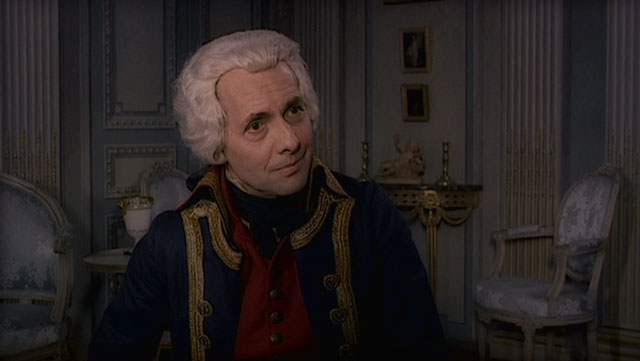
The Lady of the title is Grace Elliott, a Brit in France during the 1789-93 French Revolution. Actually the French title is L’anglaise et la duc but Grace is Scottish, claiming English nationality for simplicity when it’s suddenly very dangerous to be a French aristocrat in France. The movie’s intertitles and much dialogue are taken directly from her diaries.

image

The Duke is one of my favorite Jean-Pierre Jeunet actors, but I didn’t recognize anyone else. Star Lucy Russell has failed to break into the Hollywood mainstream (landing such roles as “female restaurant guest” and “classy shopper #3” in recent big films). Ach, I missed Alain Libolt (Renaud in Out 1) as the Duke of Biron.

Renaud plus 30 years:
image

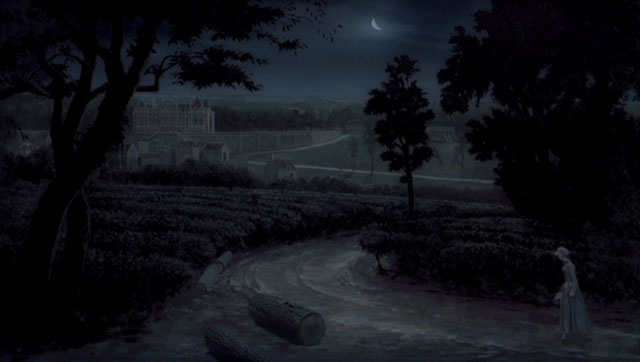
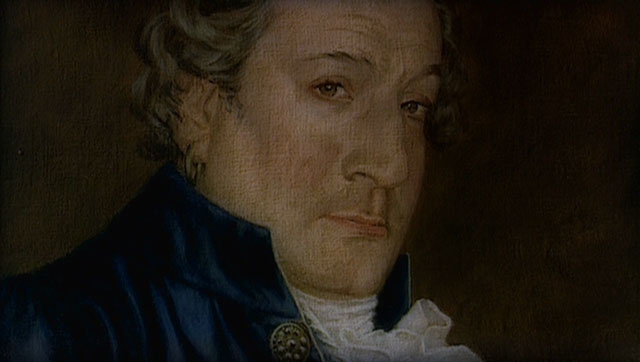
Grace is pure aristocracy, the very target of the revolution, and her sympathies lie with her friends whom she sees being rounded up and killed by the brutish masses. Steadfast in her devotions (though lying to stay alive), she’s contrasted with her friend the Duke, who changes with the times and ends up voting for the execution of the king. Plays like one of Rohmer’s Moral Tales only with more action, more heads on stakes, and more awesome digital backdrops of period Paris standing in for the usual stifling production design and avoidance of outdoor shots (except by filmmakers with Scorsese-budgets). Slant, in fact, called it an “economical antidote to the bloated costume drama.” Grace tries to negotiate the changing world without compromising her belief in the class system, while the Duke either adapts his morals or never had any to begin with. The main thing this movie has over the other Rohmers I’ve seen is historical interest… I delighted in the details of the revolution, about which I know very little. I thought the movie rather anti-revolution, which seems shockingly out of fashion, and one “Grunes” confirms that this was a problem:

Rohmer pitches the action from Elliott’s perspective, with which his own Roman Catholic penchant for order prompts him to identify—hence, the controversy the film engendered in France. Thus the street mobs are unwashed, grisly, barbaric, obscene; poor Louis XVI!

image

It’s hard to know what to make of the movie’s politics. There’s also a long scene where she successfully hides a Marquis from the police. We don’t get to know the guy very well, but he’s not made out as a man who deserves to die, so bravo, I guess. When Grace is finally arrested and held for two days for possession of a letter from an Englishman, the letter ironically turns out to praise the French revolution to the heavens. These examples and the duality in the title make it seem relatively even-handed, despite being adapted from Grace’s own horrified writings.

Duke Jean-Claude Dreyfus:
image

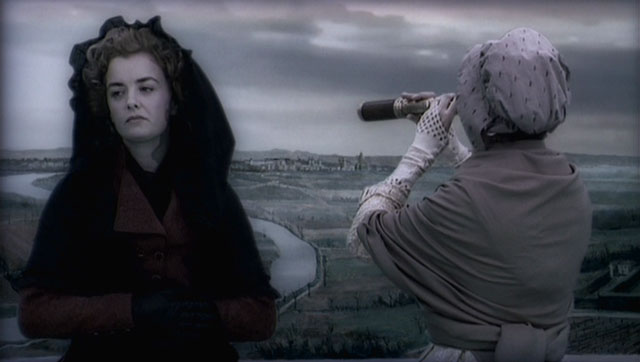
Watched this the night the director died. It got mentions on decade-end lists, with some screenshots that got stuck in my head (like the one below, peering into a painting with a telescope), so I’d planned to watch it soon anyway. I didn’t hear much when it came out, probably because of the timing (sept-oct, 2001). Beaten out for its only two César nominations by Amelie and Brotherhood of the Wolf.

image

NY Times:

The moral dilemmas that Grace and the Duke face are diagrammed, in Mr. Rohmer’s inimitable fashion, with equal measures of clarity and complexity. The director manages to evade both the stuffy antiquarianism and the pandering anachronism that subvert so many cinematic attempts at historical inquiry. His characters are neither costumed moderns, just like us only with better furniture, nor quaint curiosities whose odd customs we observe with smug condescension. They seem at once entirely real and utterly of their time. And the time itself feels not so much reconstructed as witnessed.

image

I’ll close by outright stealing an entire blog post by from Glenn Kenny, only because I want to always be able to find this Rohmer quote.

My films, you say, are literary: The things I say could be said in a novel. Yes, but what do I say? My characters’ discourse is not necessarily my film’s discourse.

There is certainly literary material in my tales, a preestablished novelistic plot that could be developed in writing and that is, in fact, sometimes developed in the form of a commentary. But neither the text of these commentaries, nor that of my dialogues, is my film: Rather, they are things that I film, just like the landscapes, faces, behavior, and gestures. And if you say that speech is an impure element, I no longer agree with you. Like images, it is a part of the life I film.

What I say, I do not say with words. I do not say it with images, either, with all due respect to partisans of pure cinema, who would speak with images as a deaf-mute does with his hands. After all, I do not say, I show. I show people who move and speak. That is all I know how to do, but that is my true subject. The rest, I agree, is literature.
—From “Letter to a critic [concerning my Contes moraux]”

An absolute monster of a movie. No longer called The Argentine and Guerrilla, it’s been simplified to Che part 1 and Che part 2 then run together into a “roadshow” with a 15-min intermission, a printed program, and no trailers, credits or titles.

Part one has flashbacks (or flashforwards, depending on your point of view) to Guevara speaking at the U.N., epic movie music, and titles telling us when and where (within Cuba) the action is taking place. Emphasis on Che’s medical skills and on all facets of the revolutionary struggle: weapons training, psychology and ideology, strategy and inter-group politics. Far as we can tell, it’s Fidel Castro who is leading the men, and Che is going where he’s told – though he gets the final glory of capturing the capital himself (against orders, which were to wait a couple days for the main group to arrive).

Part two: no flashbacks, no narrator, less obvious music, and titles simply number the days since Che’s arrival in Bolivia. Starts out a crafty spy tale, with Che in a master disguise to get into the country with everybody looking for him, then meeting the countrymen who yearn for revolution and think the time is right. Alas, the time is not right… the highly organized military government tracks the men, bombs their camps with help from the U.S., and most damning of all, turns the local citizens against the revolutionaries.

Part one is too much of a hero-portrait with too much of a classic film-history-reenactment trajectory, but part two is too dark, too gritty and hopeless with not enough signposts for the audience. The combination could’ve made for two so-so movies, but it doesn’t – not at all – instead, the weaknesses of each disappear in the presence of the other, forming one extremely strong work, probably Soderbergh’s best.

From the writer of Eragon and Jurassic Park III… I’m serious! Besides Cannes-winner Del Toro and hundreds of unfamiliar faces, we had Catalina Moreno (of Fast Food Nation, Maria Full of Grace), Gaston Pauls (star of Nine Queens), Lou Diamond Phillips (who I didn’t recognize; only place I’ve seen him in 20 years is Bats), Jsu Garcia (Traffic, Nightmare on Elm Street) and a cameo by Matt Damon.

White kid with single parent is kicked out of his expensive prep school for disciplinary reasons and finds himself at public school, where he wants desperately to be popular so he takes to doing semi-illegal things and ends the movie a hero. Meanwhile, an adult and semi-father-figure to the kid expresses his depression and disconnection by hanging out at the pool behind his house and looking sad. Prison is involved, the school bully is fought then befriended, Cat Stevens songs are heard… but enough about Rushmore, I’m supposed to be writing about Charlie Bartlett! I don’t really want to, though – I wanna write about House and Wavelength and Fantomas instead, so I’ll keep this short.

Pretty good movie… kid becomes the psychotherapist of his whole school, prescribing drugs he gets from his own analyst after finding out you can get high off Ritalin. His dad is not dead but in prison, Charlie ashamed doesn’t walk to talk about/to him. RD Jr. is like a dull cross between Bill Murray in Rushmore and the principal in Ferris Bueller, but a good and sympathetic character. Hope Davis is actually better than Downey as Charlie’s crazy/spacey mother. Charlie has a crush on the principal’s daughter, and consults one kid into attempted suicide before he’s caught. Principal is fired (and ends up with a happier job as a teacher) after students (only slightly provoked by Charlie) trash the school as a protest against cameras in the student lounge.

Jonathan Rosenbaum compares it not to Rushmore but to Pump Up The Volume and Mumford. “Charlie Bartlett might not be as bold as its predecessor. Yet given how politically gutless most teen movies have become, it may provoke audiences as much as [Pump Up The Volume] did 18 years ago. I’ve lost count of the number of times its opening has been delayed since I first saw it last July, so clearly it has somebody worried that its defiant spirit will cut into its profitability—which is entirely to its credit.”