My taunting of Katy for complaining about long movies (“long” > 105 minutes) bit me in the ass today. After an hour delay the movie started, and after 2.5 hours I was the first to moan about how LONG that damned movie was.

The project may have been initiated by the country of Namibia, but it says Burnett wrote and directed, so I’m laying the blame at his feet. So what went wrong? The other Burnett movies I’ve seen centered around small communities, so maybe his style can’t support stretching out to epic scale with ten countries and a hundred characters. Katy points out that Danny Glover had the only character with any depth, and Burnett said in an interview that Glover’s character was fictional, a blending of three or four real people, so maybe Burnett has problems with writing history and his strength is in fictionalization. After the recent reissue of Killer of Sheep, every film critic fell over himself to declare Burnett an American treasure, so maybe the combined weights of feeling like he has to live up to his reputation and deliver a high-quality picture, and feeling like it’s his duty to truthfully deliver the story of Namibia to the rest of the world led to too much compromise.

Plot: Young Sam Nujoma grew up in “South West Africa” (aka Namibia), a country governed by nazi… i mean Germans and occupied by South Africa. Sam always dreamed of a free Namibia. He met some guys who also wanted that, and started a political/guerrilla movement called SWAPO. He went to church and met minister Danny Glover. Then he pissed off to the United Nations and stayed there for twenty years, finally returning as president of his newly-independent nation. Yay!

I didn’t realize that Carl Lumbly (who played grown-up Sam Nujoma in a series of fake beards) was also the easily-manipulated slacker Junior in Burnett’s To Sleep With Anger.

Quoting myself in an email:
Movie feels long, and yet each scene feels too short. Tries to tell the *entire* story of Namibia AND of [Nujoma] without leaving anything out, so it’s an epic and a biopic crammed into 2.5 hours. Script feels like a wikipedia article. And story problems aside, it’s full of traditional epic-sounding music, and traditional cutting and camerawork… doesn’t feel like the idiosyncratic artworks that the other Burnett films I’ve seen (Sheep, Wedding, Anger, the shorts) felt like. Disappointing. BUT it’s got some great shots and some fine acting, and the stories of Namibia and Nujoma are interesting, so it was at least worth sitting through. It’s not total crap (like Amazing Grace), just not the great movie I was hoping for.

Resnais’s fourth feature, coming out the same year as Rivette’s The Nun. Watched this once before and have practically no memory of it, so this time I read the screenplay then watched again. By doing so, and by watching it alongside the other Resnais films I’ve seen this year, I’m sure I’ll remember and appreciate it more than I did before, but it also makes me wonder about the nature of Resnais’s art, because he has filmed Spanish writer Jorge Semprún’s screenplay word for word and shot for shot. Semprún describes flashback cuts and actors’ facial expressions, and there it is on the screen. The film isn’t as poetic and dreamy as Resnais’ other films of this period, but it definitely fits in with them, has a similar feel, plays like the work of the same artist. The book felt more tense, and the movie felt more melancholy, like a somewhat lighter Army of Shadows.

Story takes place across just a couple of days (not counting flashes-backs-and-forward) in Paris suburbs, two weeks before a planned protest and strike in Spain. Diego aka Carlos aka Domingo aka The Passenger (Yves Montand, halfway between his starring roles in Let’s Make Love and Tout va bien) returns from Spain to warn his underground anti-Franco activist organization (led by chief Jean Dasté) about the recent police crackdown in Madrid which led to the arrest of some operatives including one good friend. Diego wants to warn his other friend Juan away from returning to Spain, but Juan is already on his way to Barcelona. Diego was himself detained at the border, his false passport inspected by Customs official Michel Piccoli, which leads to complications later. Diego lives (on the rare occasions when he is back in France) with lover Ingrid Thulin (a Bergman regular who is wonderful in this movie) but he also half-heartedly messes around with a young Geneviève Bujold, daughter of the man whose passport he borrowed and herself a revolutionary, but with a younger group that practices impatient and violent means of returning Spain to her mythical (never existent) past Marxist glory. Diego and his group (incl. pro smuggler Jean Bouise, who later played Warok in Out 1) resent that Spain has become a symbol of the radical left but without any definite progress, that they’ve lost more and more comrades promoting these strikes and protests which are never as widespread or effective as intended. They continue their struggle, workmanlike but without much hope… a tone more fitting (in France) for the mid 70’s than the mid 60’s. Interesting that this came out right when Resnais’s contemporaries were about to turn to politics, then he followed it up with the much less political Je t’aime, je t’aime.

Writer Semprún later adapted screenplays for Costa-Gavras and wrote Stavisky for Resnais. He must be the only non-English speaker to receive TWO oscar nominations for writing. Shot by his regular guy Sacha Vierny with music by Giovanni Fusco, an Antonioni regular who died of a heart attack in May ’68.

The movie is called “stylistically orthodox” and “one of his most accessible films.” It’s not reportage-style realism, just straight drama, which never feels heightened by technique even though there are some signature smooth tracking shots and the love scene with Bujold is downright expressionist. I found the look and the camerawork to be more Muriel than Je t’aime, but of course the editing is completely unlike either of those.

Time Out: “Perhaps it is the film’s directness and obviously dated aspects (middle-age male angst faced with effervescent feminine adoration having become such a staple ‘art movie’ subject) that have made it seem a minor item in an often challenging director’s career.”

Harvard: “A series of premonitions told in flash-forward near the film’s conclusion make powerful statements about memory and aspiration, commitment and faith.”

A. Agarwal: “The film ends in inevitability. Thulin, the mistress whose devotion sometimes makes Montand uncomfortable yet at peace with himself, learns Montand is going to be sucked into a trap, and she starts out to let him know and save him from crossing into Spain. The film ends here, yet there’s a shadow of death over it. Either Thulin will not be able to save Montand, or she will be able to save him and Montand will quit this life and spend the remaining part of it trying to make peace with himself and his country.”

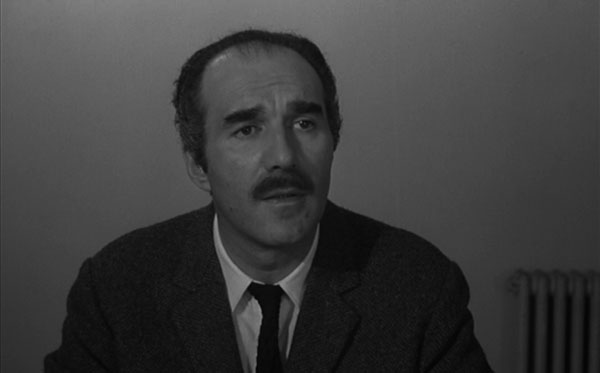
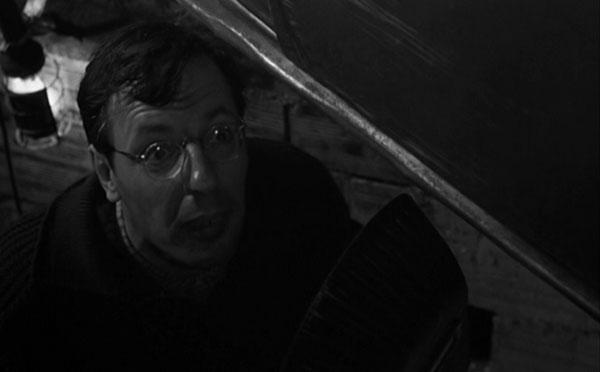
Michel Piccoli
image

Jean Daste
image

Warok
image

Genevieve Bujold
image

Thulin & Montand
image

image

Estonia was invaded by Russia, then nazis, then Russia again. It sucked for them, but they had music in their hearts and joined for an annual concert to celebrate their heritage. Eventually they became free again, hoorah!

Katy has been listening to me whine about film technique for so long that it’s gotten to her. Even though this is a heartwarming documentary about strong, likeable people fighting and winning back their rights and their country through nonviolence and music, we had to grudgingly agree that it was a kinda crappy documentary, made with passion but made by amateurs.

One awesome scene, especially after having just watched Grin Without a Cat, a movie full of global violent protest, featured the Estonian congress building surrounded by anti-independence Russian groups, residents who had grown up in Estonia after being forcibly relocated there a generation earlier by the USSR to more fully integrate their empire. The government sent out a call for help on the radio, and the Russians found themselves surrounded by absolute hordes of Estonians, at which point they gave uo their quest for revolution and just wanted to escape. The Estonian crowd parted, the Russians left. No screaming or hitting, no rocks or bombs thrown, just piles and piles of people coming out to demonstrate for their independence.

“Why sometimes do images begin to tremble?”

From the film:

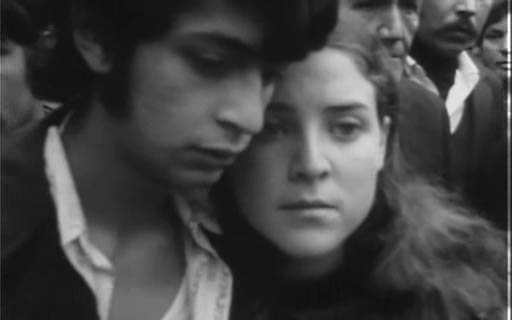
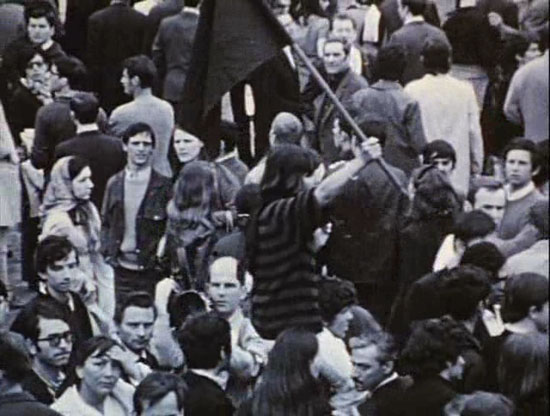
1967 saw the arrival of a rather peculiar breed of adolescents. They all looked alike. They would immediately recognize each other. They seemed to posses a silent but absolute knowledge of certain issues but to be totally ignorant about others. Their hands were unbelievable skillful at pasting up posters, handing paving stones, spraying on walls short and cryptic messages which stuck in the memory, all the while calling for more hands to pass on the message they’d received but had not completely deciphered. Those fragile hands have left us the mark of their fragility. Once they even wrote it on a banner. “The workers will take the flag of struggle from the fragile hands of the students.” But that was the following year.
image

Watched the 3-hour 2008 edit with English narration. There are so many versions of this out there… maybe next time I can watch the 2008 or 1977 French with subtitles.

I thought I’d have more to say about it… three hours’ worth of Chris Marker’s most celebrated film, but I don’t really. Marker is mainly credited as an editor here, arranging others’ footage to show a bigger picture. There’s no wall-to-wall narration, just pops up occasionally. And I’m starting to notice a real sadness beneath many of Marker’s films… the same feeling in Chats Perches is present here. Glad I prepped a little by watching Sixth Side of the Pentagon and Battle of Chile, but I still had to check on wikipedia to see what exactly happened in Bolivia (Che Guevara killed Oct. 1967) and Prague (Jan-Aug 1968, attempted reform of Czech socialism led to 30 years of Soviet military occupation). The movie isn’t here to teach basic history of revolution – assumes you know something already, and since I quit reading The People’s History of the United States before it reached the 1900’s, I do not. Still, was able to follow the movie, thought lots of the footage was excellent, enjoyed watching and learned a little. Some segments have little gems of Marker wit in their editing or narration, but much of it is making connections between different scenes of revolution, both real and wishful, and thinking about what has been achieved, what might have been achieved. Really have to watch again sometime.
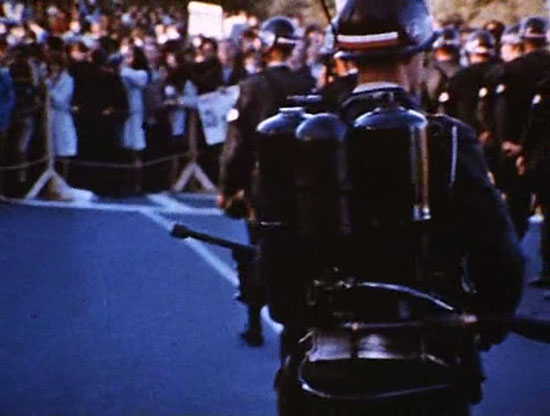
image

Either this was an early use of the electronic soundtracks that Marker would use in Sans Soleil and beyond, or the sound on my copy of the movie was pretty badly distorted. Or, more likely, both. The sound got worse during part two – there were some sections when I couldn’t make out any of the (English) dialogue.

image

Video and audio footage by: Pierre Lhomme (Mother and the Whore, Le Joli Mai, Army of Shadows), Etienne Becker (The Spiral, Le Joli Mai, Malle’s Calcutta), Michele Ray (Latcho Drom), Francois Reichenbach and his crew, Harald & Harrick Maury (The Owl’s Legacy, Day For Night, In the Year of the Pig), Théo Robichet (Band of Outsiders), Pierre Dupouey (Silence… on tourne), Raymond Adam (Jodorowsky’s Tusk), Paul Bourron of the Dziga Vertov Group, Willy Kurant (Far From Vietnam, Masculin-Feminin, Pootie Tang), Peter Kassovitz (Jakob the Liar), Paul Seban (Welles’s The Trial), Michel Fano (Rivette’s The Nun), Fernand Moskovitz (Last Tango in Paris), Yann Le Masson (Je t’aime moi non plus), Mario Marret & Carlos de los Llanos (À bientôt, j’espère), Jimmy Glasberg (Sans Soleil, Shoah), Robert Dianoux (Africa, I Will Fleece You), Jean Boffety (Thieves Like Us, Je t’aime je t’aime, Adieu Philippine), Robert Destanque (Joris Ivens’s The Threatening Sky), Hiroko Govaers (Terayama’s Fruits of Passion), Michel Cenet (Celine and Julie Go Boating), and an excerpt from Volker Schlöndorff’s The Lost Honor of Katharina Blum. That is quite a list of collaborators, though you never hear anyone talking about them.

image

English voices: Jim Broadbent (Brazil), Cyril Cusack (Fahrenheit 451), Robert Kramer (dir. Ice, Against Oblivion), Alfred Lynch (The Hill), and numerous British 1970’s TV actors.

“You can never tell what you might be filming.”

Quotes and other reactions:

Icarus Films calls it an “epic film-essay on the worldwide political wars of the 60’s and 70’s: Vietnam, Bolivia, May ’68, Prague, Chile, and the fate of the New Left.”
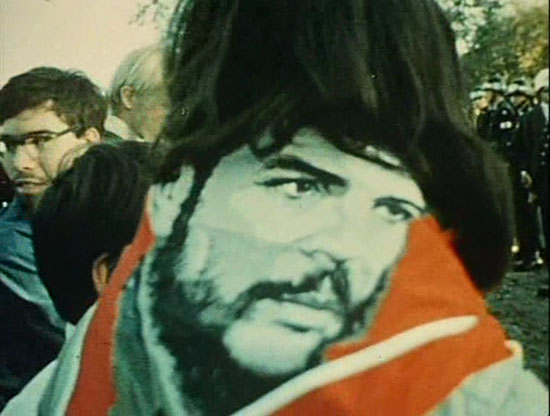
image

J. Hoberman: “Marker begins by evoking Battleship Potemkin, and although hardly agitprop, A Grin Without a Cat is in that tradition—a montage film with a mass hero. Unlike Eisenstein, however, Marker isn’t out to invent historical truth so much as to look for it. (The untranslatable French title, Le Fond de l’air est rouge, is a play on words suggesting that revolution was in the air but not on the ground.)”

Paul Arthur: “In its rhythms and editing structures, Grin tries to embody the very shape and textures of historical transformation, rendering the abstraction of change as an amalgam of rapid, plurivocal, uneven, and, at times, contradictory forces aligned in provisional symmetries encompassing past, present and future perspectives.”

image

Y. Meranda: “The editing de-emphasizes the narrative structure and instead stresses the poetical interrelationships of the sequences by putting almost all of them out-of-context. … Paralleling the visual editing, the sound editing is more based on poetical considerations than on intellectual ones. … Because there is very little attention paid to the intellectual arguments and because the style goes beyond making statements about a political ideology, A Grin Without a Cat becomes much more than a left wing documentary about the left: It achieves to be a poem about revolting against the system (and not just the political system), the conformity and the order. It suggests that it is an eternal struggle that is supposed to fail (as was in the case of the New Left) most of the times. This universality, achieved by Marker’s distinctive style, is what makes the film great.”
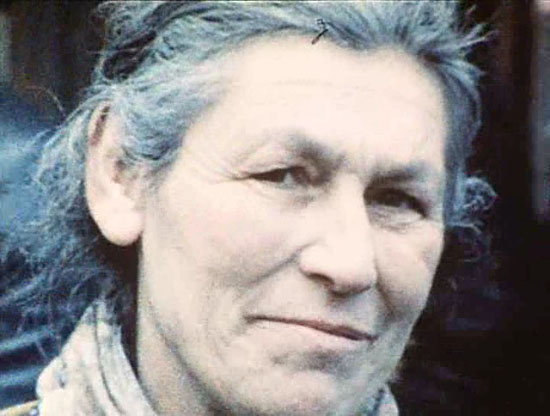
image

Excerpts from the Lupton book:

“Marker explicitly pitched the film against what he saw as the historical amnesia surrounding the period promoted by its treatment on television, where ‘one event is swept away by another, living ideals are replaced by cold facts, and it all finally descends into collective oblivion.'”

Movie is partially composed of outtakes from other projects. “Introducing the published script, Marker wrote that he had become curious about all the material that had been left out of militant films in order to obtain an idealogically ‘correct’ image, and now wondered if these abandoned fragments might not yield up the essential matter of history better than the completed films.”

“As a groundbreaking work of visual historiography, Le Fond attempts nothing less than to give cinematic form to the chaotic and contradictory movement of world history during the tumultuous decade that it covers.”

“The reappearance of cats, even in this thoroughly politicized context, is a signal that Chris Marker was beginning to re-emerge from the anonymity of unsigned militant productions and to reintroduce into his work the familiar tokens of his own distinct presence.”

image

Chris Marker:

Scenes of the third World War 1967-1977

Some think the third World War will be set off by a nuclear missile. For me, that’s the way it will end. In the meantime, the figures of an intricate game are developing, a game whose de-coding will give historians of the future – if they are still around – a very hard time.

A weird game. Its rules change as the match evolves. To start with, the super powers’ rivalry transforms itself not only into a Holy Alliance of the Rich against the Poor, but also into a selective co-elimination of Revolutionary Vanguards, wherever bombs would endanger sources of raw materials. As well as into the manipulation of these vanguards to pursue goals that are not their own.

During the last ten years, some groups of forces (often more instinctive than organized) have been trying to play the game themselves – even if they knocked over the pieces. Wherever they tried, they failed. Nevertheless, it’s been their being that has the most profoundly transformed politics in our time. This film intends to show some of the steps of this transformation.

More images:

image

image

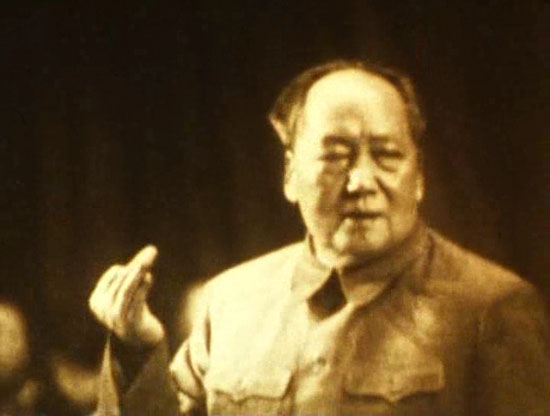
The Chairman:
image

Funeral in Prague:
image

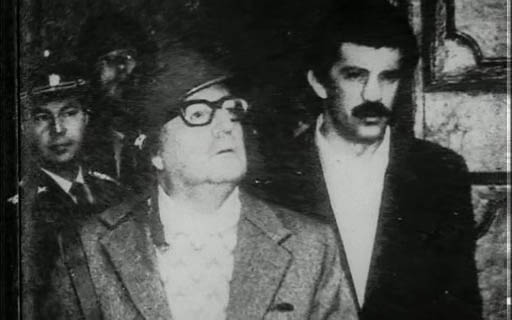
Last footage ever shot of Salvador Allende:
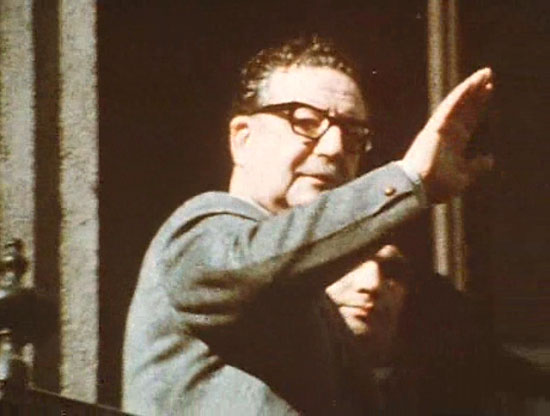
image

Allende’s daughter, who would commit suicide in 1977:
image

Fidel in Russia:
image

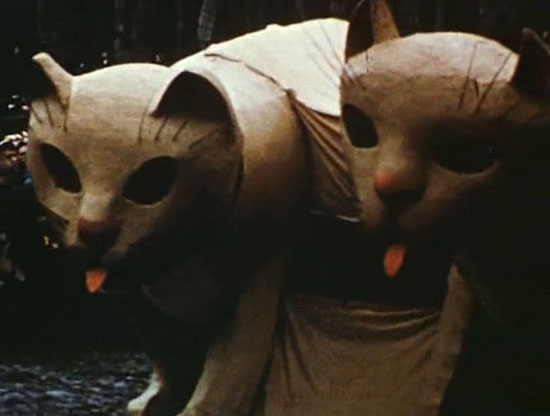
Enormous cats (no owls):
image

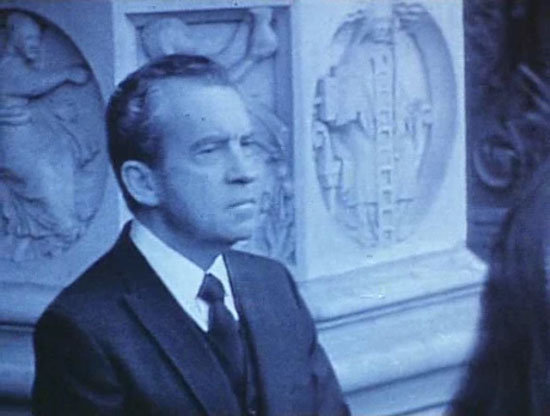
Nixon looks on:
image

“Popular unity against the criminal bourgeoisie!”
image

Other street protest chants:
“Bourgeois shit, the street belongs to the left!”
“We need an iron hand!” (?!)

I alternately see this referred to as an epic 1979 movie, a long two-parter with a third-part postscript, or three separate movies. I guess they were presented theatrically in different ways in different countries. The 2/1 split seems right to me, as I’ll explain.

Part one drops me into the middle of an election in March 1973, which I didn’t understand until towards the end of the movie. I wondered why nobody was saying Salvador Allende’s name – turns out it was a senate election, and either the pro-Allende party lost, or they just did not gain enough seats in congress to prevent the opposition from holding a majority. So for the rest of Allende’s short reign as president, the country’s senate is mostly against him, undermining his authority. Movie is on the street, taking opinions from everyone, kind of slow at the start since I don’t know what’s happening, but excitement is in the air, and things straighten out soon enough. Cameraman is terrific, patient but curious, always looking for the best thing to shoot even if it means wandering off the person talking. I can’t believe the sound guy can keep up with him, but he does.

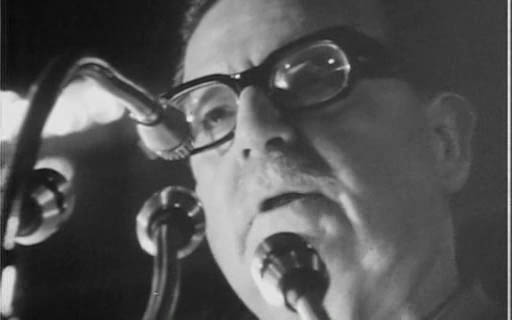
Salvador Allende:
image

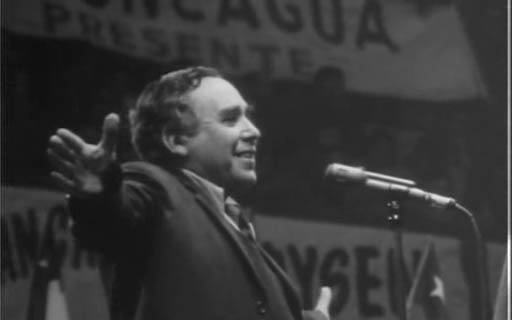
A politician:
image

image

image

Part two picks up right where the first one ends, with an attempted military coup on June 29 1973, and part two ends Sept. 11 1973 with the successful coup that killed Allende and instated General Pinochet as ruler. In between those dates, Guzmán covers everything that happens in the whole country, it seems, with access to the marches, the debates, worker meetings, everything but the secretive military that turns against its country (with help and provocation, it turns out, from the U.S. government). This is by far my favorite of the three parts, and could easily work as a standalone movie… I see the Film Forum in NYC thought so as well. The events themselves, a democratic country swerving communist then falling military-dictatorship, is the best movie material you could hope for and Guzmán and his crew make the best of it, watching from ground zero as history is made, producing one of the best docs I’ve ever seen.

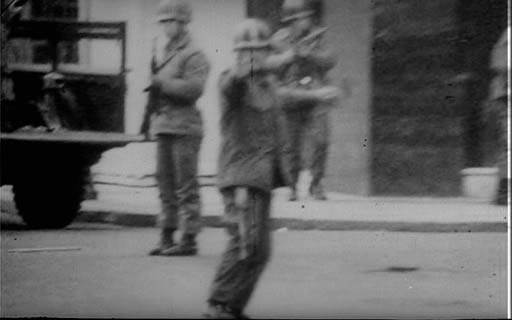
Military man who shot and killed Argentine cameraman Leonard Hendrickson at the end of part one:
image

Salvador Allende, file photo:
image

Bombing of the presidential palace:
image

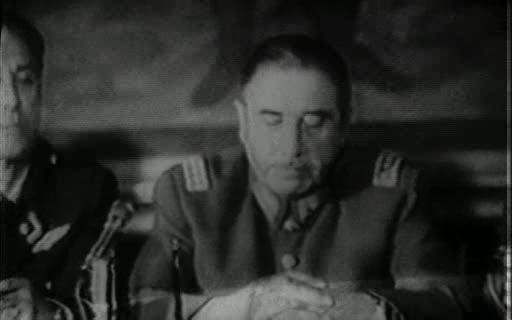
Pinochet addressing the nation on TV:
image

Military rule:
image

Pinochet: “After three years of support for the Marxist cancer we have been given a disaster that is economic, moral and social, that could not continue to be tolerated by the sacred interests of the mother country.” (or something like that – I think it’s all amateur-translated)

Guzmán: “From the 11th of September, all resources of the Chilean army are mobilized to repress the popular movement with the compacency of the North American government. The first armed resistance offered by some industrial cords, agricultural populations and student centers are squashed quickly in unequal fight. Thousands of people are killed and the main sport fields become concentration camps. The longest democracy in the history of Latin America ceases to exist.”

I don’t exactly wish I’d skipped part 3, but it would’ve made a nice recap six months later instead of watching it right after 1 and 2. Filmmaking in Chile wasn’t easy during Pinochet’s rule, since Pinochet was killing and imprisoning everyone who disagreed with him, including the cameraman of Battle of Chile (to whom the completed work was dedicated), so Guzmán backs up and shows further details of the workers’ movements during Allende’s presidency, not again mentioning Pinochet or the violence. The many worker meetings and the creation of multi-factory blocs and the attempted attack on Allende’s credibility by the “Christian Democrats” (his primary opposition) via a U.S.-funded transportation strike had all been covered in the previous films, but now we see them in greater depth… “depth” meaning lots of guys with sideburns talking into microphones at meetings. Since I’m not personally interested in creating a communist worker’s paradise in my own neighborhood, part three wasn’t of much use to me, but I’ll bet it’s exactly what Chris Marker was hoping for when he helped fund Guzmán’s efforts to document what was happening in the country. Marker’s own angry reaction to the coup is documented in his short Embassy, which I’ll have to watch again now that it’s on a new, clean DVD.

The transportation strike:
image

The people:
image

The sideburns:
image

The revolution:
image

Yay, a public screening, but boo, a DVD projection. The roller skating scene and the singing scene and the opening factory scenes will never cease to be funny and amazing. Charlie gets fired from his factory job after going completely mental from being treated like a machine, ends up in jail. Foils jailbreak high on coke that fellow inmate slips into salt shaker. Gets letter of commendation from the mayor, which gets him night watchman gig at department store. Meanwhile, orphan girl (dad died in workers’ protest) is stealing to eat and dreaming of a nice home and a nice husband, meets Charlie and they play at the store after hours. The store is robbed and Charlie and the girl are caught up in the plot. Then I forget a few things, but she ends up dancing at a restaurant and Charlie gets to be a singing waiter, then The Song…

edit 7/31/07: Katy finally watched last night. Liked it!

image missing

image missing

image missing