Funny how I’ve never watched this until now, and everyone else has. Even Katy has seen it more than once. So, moments that seem fresh to me are probably way over-discussed to everyone else. I mentioned the movie to Steve and he says “that sailor sure smashed the hell out of that plate, eh,” referring to one of my favorite bits, a decisive moment of minor rebellion which Eisenstein shows repeatedly, from multiple angles, like an explosion in a Die Hard movie.

Due to unrest over spoiled food, the ship’s captain decides to hang a bunch of crew members – a bad move, since the others have been simmering rage againt their superiors, and choose this moment to mutiny, their leader Vakulinchuk shouting “brothers!” as a rally cry – a shout that will be repeated at the end, when the other battleships descending on Potemkin, presumably to quash the rebellion, choose to join it instead. Before that, the State is shown as brutally repressive, mowing down innocent civilians (children! mothers!) pitilessly on the steps of Odessa, where the ship lands and becomes a heroic symbol to the locals.

An imagined, phantom hanging:

Such an impressive piece of filmmaking and propaganda for the working man, it was banned in Britain and France for fear of sparking revolution. I watched the restored high-def version and was glad to discover that it’s a vibrant, brilliant movie, not the dusty old piece of film history I feared it might be. The movement and editing are rightly acclaimed, but the photography of individual shots is spectacular as well – compares very favorably to those gorgeously-lit Sternberg films I’ve been watching, only this was shot on location.

I dig the the hand-painted red flag hoisted over the ship. The ship’s crazy-haired priest was portrayed as a villain with a cross he wielded as a weapon, on the side of the power elite against the people. A guy in Odessa tries to use the crowd’s fervor for his own purposes, yells out “smash the Jews” and ends up getting smashed himself, the first casualty on the shores.

Another splendid Sternberg movie with an Alloy Orchestra score – how Criterion spoils us. It’s hard to fully embrace a movie with the dialogue “From now on you are my prisoner of war… and my prisoner of love.” But once I accepted the melodramatic story elements, this was almost the equal of Sternberg’s great Underworld.

Supposedly based on a real person, Emil Jannings is a powerful Russian general who escapes the country during the 1917 revolution (between this, Potemkin and Mother, Russian revolutions have been coming up often) and scrapes by in the U.S. as a Hollywood extra. This is not portrayed as a glamorous career path – note that The Life and Death of 9413: A Hollywood Extra was made in the same year. We’re also shown a bunch of resentful bastards at the studio costuming department, as if Sternberg and his writer were out to de-glamorize the movie-making process.

Directed by Michael William Powell:

Back in Russia, General Jannings (after his three great movies with Murnau, so already a star) clashes with young idealist revolutionary William Powell (with perhaps a thicker, less refined mustache than he sports in the Thin Man films). I was glad to see Evelyn Brent (Feathers in Underworld) again, and Sternberg and his photographer light her as ecstatically as before. She’s attached to Powell until taken prisoner by Jannings, eventually warming to him and helping him escape once the tables are turned. Later in Hollywood, Powell plans to shame the former general by casting him in a film that re-enacts his defeat, but the general gets too caught up in his nostalgic fervor and dies of a heart attack. Powell seems to forgive him after that, seeing that they both loved their country, just in different ways – which helps explain Evelyn’s split loyalties as well.

Evelyn Brent, revolutionary:

A. Kaes for Criterion:

Von Sternberg seems to have been fascinated by Jannings’s acting style and persona and did not restrain them in The Last Command. Instead, he used the actor’s histrionic theatricality to explore the power of performance and filmic illusion themselves—a subject he would continue to mine for the rest of his career.

Dramatizes the 1905 Russian Revolution. Although I didn’t know that until I looked it up after the movie, because I know nothing of history or Russia. Apparently Battleship Potemkin is about a military uprising during the same time, and the 1905 events led to the 1917 revolution which took out the Tsars and formed the Soviet Union. So that’s why the ending, which seems tragic, is filmed as if it’s a great victory.

Full of great editing, a few cool overlapping images. Pudovkin worked under Lev Kuleshov, using his teacher’s montage theories to make grand works of propaganda, “far less ambiguously so than his rival Eisenstein.” I was in the mood for some Russian cinema, thought I’d watch a bunch of early features leading up to Emory’s presentation of I Am Cuba on 35mm, but I got busy, only watched this one and missed Cuba.

Brilliantly tense movie, vaguely similar to the other film called Mother I’ve watched recently in that both mothers try to free their sons from jail, becoming more like their sons along the way. In this one, she is partly responsible for his arrest, revealing a cache of weapons he was hiding after his group’s unionist revolt takes a bad turn. Later, she has turned against the state and teamed with the unionists, marching on the prison to free their comrades. Everyone we liked is dead in the end, but the individual is unimportant anyhow; the movement lives on.

J. Jones:
“The montage effects are different from those of Eisenstein, who believed editing was a way of achieving dissonance, making a jagged cinema of conflict. Pudovkin is more lyrical. His cross-cuts, while dramatic, do not break up but enhance the narrative.”

Also checked out:
Twilight of a Woman’s Soul (1913, Yevgeni Bauer)

Unfortunately, I found it a dullsville tableau drama, despite minor excitement over a mild camera move or two, a flashback and the presence of such a taboo subject as rape in a silent film. Seems like a good study film for an early-cinema class, but it’s not thrilling my current urge to watch quality Russian cinema. The film’s writer played the rapist, ha.

“You want to be happy. There are more important things.”

A woman (Domiziana Giordano of Godard’s Nouvelle Vague) is a faithless tourist in an italian church, cluttering its ancient traditions with her modern feminist ideas. An interesting, beautiful scene but I knew Tarkovsky wouldn’t have a female protagonist, so it turns out she’s the Italian translator for our Russian poet hero Andrei (Oleg Yankovskiy of The Mirror and The Man Who Cried). He’s visiting some ancient hot baths as research for a book he’ll write on an 18th-century Russian composer who spent some time there.

Andrei becomes fascinated with local madman Domenico (Erland Josephson of The Sacrifice and some eight Bergman films). Visits his rainy, ruined house and listens to his superstitions. Returns to the translator, who is leaving in a rage, says Andrei is so charmless and boring that he may not even exist. She acts like she’s breaking up their love affair, even though they didn’t have one. But later, safely back in Rome with her boyfriend (a humorless-looking businessman) she phones Andrei telling him to meet Domenico in Rome.

Instead, Andrei goes back to the baths and attempts to complete Domenico’s quest to walk from one side of the pool to the other holding a lighted candle, while Domenico himself gives a speech atop a statue then lights himself on fire. Andrei has two failed attempts and a single success in one mobile ten-minute shot, after which Andrei seems to collapse, leading to a long, crazy black-and-white shot of the poet with Domenico’s dog in front of a Russian house within an Italian cathedral.

Co-written with Antonioni/Fellini screenwriter Tonino Guerra, won three awards at Cannes. Can’t say I understood the movie’s intentions, but I enjoyed it for being a gorgeous bit of cinema. Some fun trick photography and lots of very long takes, plus imagery I recognized from other Tarkovsky movies, though it’s been a while since I’ve seen one – ruined houses in My Name Is Ivan and Stalker, plants waving underwater in Solaris.

Acquarello says he filmed it “in exile,” calls it a “symbolically obscure … cinematic abstract of spiritual hunger” that “mourns an irretrievable past and an uncertain future.”

Tarkovsky: “I do not harbor any particularly deep or profound thoughts about my own work. I simply have no idea what my symbols represent. The only thing I am after is for them to give birth to certain emotions.”

“I want to give expression to the impossibility of living in a divided world, a world torn to pieces.” In interviews, Tarkovsky says that his lead character is an architecture professor and Domenico a former math teacher. “Let us say that what I like the most in them is the confidence with which the madman acts and the tenacity of the traveler in his attempts at achieving a greater level of understanding. That tenacity could also be called hope.”

One more: Tarkovsky says he most values in this film “its almost unbearable sadness, which, however, reflects very well my need to immerse myself in spirituality. In any case, I can’t stand mirth. Cheerful people seem guilty to me, because they can’t comprehend the mournful value of existence. I accept happiness only in children and the elderly, with all others I am intolerant.” And when asked about his pessimism: “The true pessimists are those who continue to seek happiness. Wait for two or three years and then go and ask them what they have attained.”

Thanks very much to nostalghia.com for their collection of translated interviews and articles.

Marker’s most traditional, talking-head-style documentary since Le Joli Mai still has its fanciful Marker-moments, such as an intermission called “Cat listening to music,” which I believe is the same as the segment in his Petit Bestiare, and some graphics created in HyperStudio on his Apple IIGS

Guillaume-en-Egypte, dreaming images from Japanese television:

Computer camel:

Even though it’s mostly interviews on the topic of Alexander Medvedkin, and not Marker’s missive narration, the film is still structured with chapter headings “first letter, second letter,” etc. Aelita (the Queen of Mars) is shown watching scenes from Happiness. Marker visits Medvedkin’s grave, notes that he was born in 1900 and so his life can be used as a measuring stick for the century. But the metaphor is underused since his recorded life largely consists of the flurry of activity around the cine-train and Happiness, then a long silence until his rediscovery in France in the 70’s.

A.M.’s daughter:

Marker met Medvedkin while in Russia with Costa-Gavras and Yves Montand for The Confession, then Marker made The Train Rolls On, which he excerpts here. “He wouldn’t give people films; he would give them cinema.” The cine-train was fascinating, even if it didn’t ultimately lead to more efficient production and a communist worker’s utopian cinema of the people.

A camera that is aimed like a rifle – I WANT one:

“When Vertov was using studio lights on the extras he mixed with real mourners at Lenin’s funerals it was said he betrayed kino-pravda, film truth. But once you see the same kind of lights in the courtroom, you realize that life itself has become a fiction film, a film noir, filled with suspense, where some actors applaud their own condemnation in advance.”

Insight on Vertov and Eisenstein, giving context to Medvedkin’s work. He says Battleship Potemkin was not successful in its own country. “While European film buffs reveled in the sight of the Potemkin sailors, Russian audiences were dreaming of Mary Pickford and Douglas Fairbanks.” An interviewee tells us that Stalin used to watch every movie made in the country – impressive if true. Best of all is when Marker watches long-lost films from the 1920’s cine-train and finds the birth of moments in the 1932 Happiness – images and editing techniques discovered or invented on the train reused in the feature.

I wonder if interviewee Viktor Diomen was coached when he said A.M. is “outside time. On the one hand, his own time has left very distinct marks on him. He’s like a big tree with its growth rings and its bark marked by the carvings of passers-by.” One thinks of the Vertigo reference in La Jetee, the woman pointing off the edge of the tree, “outside time.”

“Only later did I understand his tragedy – the tragedy of a pure communist in a world of would-be communists.”

The movie gets increasingly interesting and freeform as Marker sets his rifle sights on Russia’s recent past – a very good final chapter, leading to the greatest final paragraph/shot of any Marker film.

Seems like a semi-remake of A Very Long Engagement. There’s a specific scene where Veronika says if she can count to fifty before the postman arrives at the door she’ll get a letter from Boris. Then there’s the overall story, a woman looking for her man who went to war, not even stopping after she hears that he’s died. Jeunet gave his film a happy ending, but Russia in the 50’s was still mourning the millions killed a decade earlier. So, not a simply fairy tale, Veronika does not get a letter from her Boris, because he did die in the war.

It opens with the two lovers happy together, and ends with her alone, smiling but heartbroken, handing out flowers to returning soldiers. In between it’s mostly her story. She loses her family in a bombing raid and stays with Boris’s parents, then is soon coerced into marrying his brother who dodged the war. Very impressively (for 1957) mobile camera, with always excellent, careful framing, none of the indifferent framing that characterizes most handheld today (ugh, I hate saying things like that). It seems like every shot in this film has more than one purpose, making the simple close-ups that much more powerful. No surprise that the director and cinematographer went on to make the great I Am Cuba, or that this won the golden palm (over Bergman, Satyajit Ray and Mon Oncle)

C. Fujiwara for Criterion:

The film is also exceptional in refusing to condemn Veronica for her involuntary infidelity to Boris while he is at the front. In Tatiana Samoilova, The Cranes Are Flying unveiled a magnificent screen personality: expressive, sexy, dynamic. Veronica is far from a traditional war-movie heroine (not only by the standard of Soviet war movies), and Feodor’s impassioned denunciation of faithless women is clearly meant to be taken as more than just the party line, but Samoilova makes her character completely sympathetic, down to her bittersweet apotheosis in the moving final sequence. The Georgian-born Kalatozov, who began his directing career in the silent era, spent several years in Los Angeles during the war on a diplomatic assignment, and seems to have been marked by Hollywood cinema. In The Cranes Are Flying, he treats melodrama with a formal complexity worthy of Frank Borzage, King Vidor, and Vincente Minnelli – finding, with no fear of excess, potent visual correlatives to emotional states.

Based on the works of 1700’s poet Sayat Nova, and in fact Sayat Nova was the film’s original title before the censors changed it.

Doesn’t look or play very similar to Parajanov’s also-amazing Shadows of Our Forgotten Ancestors.

My screenshots are all from the first six minutes. After that the laptop wouldn’t read the disc so I watched the rest on TV. EDIT: nope, all screenshots now replaced with 2018 versions.

Divided into sections, with the poet at different stages of his life. Little spoken dialogue.

In the middle section, both Sayat Nova and his girl are played by the same actress:

Just a first viewing. Will watch again (and hopefully again).

2018 UPDATE: This finally came out in a beautiful HD restoration, so now’s the time. I’d forgotten just how completely non-narrative this is. There are scenes from the poet’s life, but you wouldn’t know it without further research. Instead of a story, we get dioramas in front of an unmoving camera. The blu-ray includes a text commentary, since he wants to discuss the audio without obscuring it. He has access to the script and outtakes, so discusses what’s actually happening, in addition to the symbolism and shooting locations and historical context. It’s very helpful to know what’s going on, but I don’t feel like understanding the story makes me love the movie more.

Koko’s Earth Control (1928, Dave Fleischer)
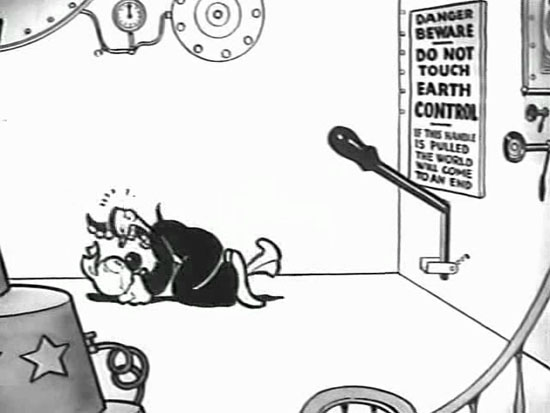
Koko the Clown walks the planet with his dog until they find the Earth Control station. The dog willfully and maliciously pulls the end-of-the-world switch and then acts all panicked when the world begins to end. What did he think would happen? Fun mix of live-action (tilt camera while people pretend to fall to the side, the dog skittering atop an animation table) and animation (earthquakes, volcanoes, the sun melts the moon).
image
image

Dutch Bird (2004, Kirk Weddell)
Ridiculous comedy – old man is sad and alone, so his friends convince him to go out again by pranking him with a story about drugged racing pigeons. On my TV the color was way off, which was really the main interest in the movie. In the below shot, everyone had green skin against a pinkish sky. It was eerie – as the 20 minutes stretched on and on, I liked to imagine that green-faced aliens had gotten a hold of The Full Monty and Waking Ned Devine and were producing Brit-com films of their own. Sadly, getting screenshots on my PC the color turned out normal.
image

Tale of Tales (1979, Yuri Norshteyn)
At least two jury competitions have named this the greatest animated film of all time. It is really good, but we all wished it’d been half its 30 minute length, and its symbolism was extremely obvious. Not that I ever get less-than-obvious symbolism, so that’s not something I ought to complain about. Wild Things are playing jump rope and a little dog kidnaps a baby, and there’s war and peace and what not. Supposedly the director has been working on his film of Gogol’s The Overcoat ever since – for 30 years. He must be the Jeff Mangum of Russian animated films.
image

Harpy (1978, Raoul Servais)
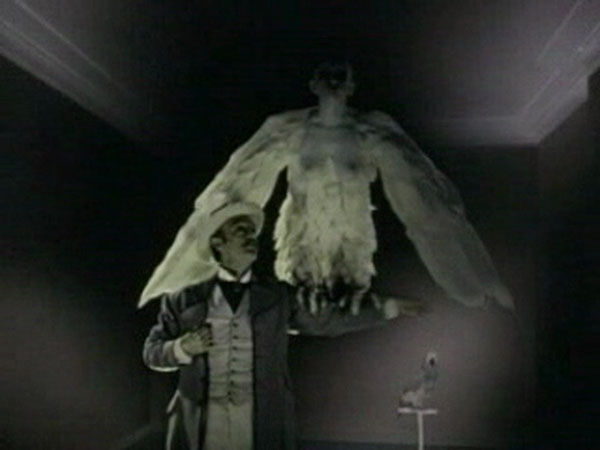
Kind of an absurd, funnier Tales from the Darkside episode. Guy saves a poor harpy from being beaten to death by an angry man and takes it home. But it keeps eating and eating and making his life hell. Finally it eats his legs off when he tries to escape, so he attempts to beat it to death, it gets saved by another man, etc. Same ending as Argento’s Jenifer, then. Mostly appealing for the crazy harpy visuals. The Belgian director has also made films called Siren and Pegasus, must find those sometime.
image

Grasshoppers (1990, Bruno Bozzetto)
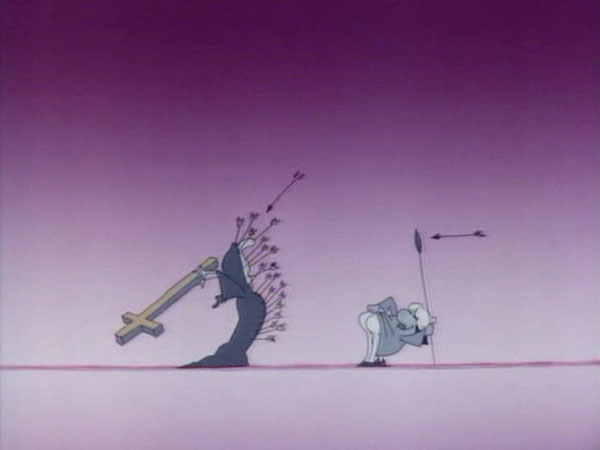
Cute, no-frills cartoon that looked like something out of Mad Magazine. Civilization rises out of the grass only to fight war after war after war, represented by a few dudes at a time, not by whole armies. The kind of thing that would’ve played on O Canada if it wasn’t Italian.
image

Out of Print (2008, Danny Plotnick)
A dude yearns for the days when cult movies were actually rare and you could only get crappy unwatchable dubbed versions if you knew a guy who knew a guy. As someone who enjoys being able to see cult movies easily and in relatively good quality, I don’t see the dude’s point.
image

World Cinema (2007, Joel Coen)
Llewelyn from No Country stops at an arthouse movie theater playing Rules of the Game and Climates. Gets advice from the ticket guy, watches Climates and likes it. Having seen Climates myself I’m not sure this is too realistic. Also not sure why it was cut from the DVD of To Each His Cinema.
image

This will sound awfully disrespectful, but you’d think the renowned master of montage Eisenstein, he who reinvented movie editing, could pick up the pace a little. This movie drags. Each shot has a wonderful composition, and each shot is held for a second or two too long. And to be more disrespectful still, I beg to differ with E. Von Mueller calling Prokofiev’s score the best in history. But maybe he’s kicking back at home with an LP of the full orchestral arrangement, not the weak bits on the film itself (Criterion essay on the director/composer collaboration calls the soundtrack on the film “like a chamber ensemble recorded over a telephone”). I’ve still got to hear the re-recorded score sometime. And I intended to… but after the movie and the DVD commentary, I didn’t feel like going through it a third time.

The bloodless battle on the ice wasn’t exactly choreographed by Sammo Hung… buncha overarmored guys clumsily smacking into each other with weapons. But I’ve made fun of the acclaimed classic film enough now. Composition-wise it is beyond reproach… some of the most amazing-looking shots of the 30’s. A beautiful movie and a swell piece of anti-German propaganda (which is why it was celebrated, then banned, then celebrated).

How you know the Germans are Bad Men: they toss naked babies into fire:
image

Russia is under Mongol rule, but this is mostly ignored. Nevsky kicked the asses of the Swedes or some other country previously, so he’s called on to protect Russia from the invading Germans, who have already conquered one major town and killed everyone in it, including babies. Meanwhile in another town, two tough guys are competing for the only pretty girl. She says she’ll marry whichever fights the most bravely. So off they go with Nevsky, the town armorer (who dies from being too generous, giving away his best armor and saving the leftovers for himself) and a hot warrior woman. Battle on the ice lasts some 30 minutes. Crowd scenes outdo most of your Braveheart / Lord of the Rings epic battles with lovely, artistic shots of actual masses of people (outdone later in Ivan The Terrible), but close-ups of battle are a little lame. After, one guy is dying, other guy generously tosses the pretty girl at him and goes after the hot warrior chick. The glory of Russia is restored (well, they’re still under Mongol rule) and Nevsky goes back to his humble fishing life, after issuing a stern warning to the Germans which is screamed across the screen in giant bold text!

Mr. Nevsky:
image