I hadn’t seen this since opening weekend, almost thirty years ago. I don’t recall it being good, and it has a poor reputation, but now I’m a seasoned auteurist cinephile with the keen ability to recognize David Fincher’s brilliant work within this studio disaster… oh ha, no I’m not, if anything the flaws were more apparent than ever.

Great opening, showing brief flashes of alien chaos aboard the ship full of sleeping soldiers, intercut with the quiet opening titles. The escape ship from part 2 crash lands on a prison mining planet, where Ripley washes up onshore burned and maggoty while the other cast is killed off via text on a computer screen. I try not to knock myself out keeping track of characters and personalities in these movies until half of them have died off – it was pretty doable in the last movie, gonna be harder here with this bunch of shaved-head barcoded space monkeys. Let’s start with Roc, the only actor I recognize (besides Pete Postlethwaite in a minor role), a sort of unionist preacher who doesn’t want women on his planet.

Ripley and Roc:

In this case I got what I deserved by watching the extended cut – it’s baggy and talky. So much of the movie is people floridly trying to avoid telling each other important things. Charles Dance (of Space Truckers, appropriately) is the soft-voiced medical officer. One of the other officials and also the scar-eyed psycho who teams up with the aliens against humanity are played by Withnail & I actors – lots of British accents in space jail. I forgot the scene where Ripley med-scans herself, proof that there were no new ideas in the prequels.

Spoiler alert:

It’s almost a really well-made movie, full of no-name actors who turned out to be really good at their roles, but it’s got some fundamental problems that good acting couldn’t overcome. It opens by squandering the goodwill of the second movie by killing off Newt and the others… it’s no fun for long stretches, and the last half hour is all aliens running full-tilt down long corridors, which is a visual effect they couldn’t manage. They followed up a great James Cameron movie with a film whose climax involves liquid metal… and the studio couldn’t pull off the effects… the year after Cameron’s Terminator 2 came out. They must have been so embarrassed.

Hundreds of years in the future, video cameras will look like this again:

In these uncertain times, sometimes I wanna watch some action movies I remember from cable TV. Rewatched the first movie (and Prometheus) five years ago, so it’s time to move this nostalgia trip along. It’s fine that the theatrical version still exists, for historical reference, but the auto-guns are neato, and more Aliens is a good thing, so I’m sticking with the extended cut.

da whole crew:

After drifting in cryo for fifty-some years, Ripley has outlived her daughter, as well as all the colonist families on the planet where she landed last movie. The company thinks she’s lying about the aliens, fires her, then wants to send her back as an advisor, along with droid Lance Henriksen (she doesn’t trust those things anymore, after last time) and a short-haired lieutenant who says he can guarantee her safety (didn’t catch his name, I think he died immediately).

Lots of science-nonsense and military-nonsense in the dialogue for the first hour, but the 80’s movie version of future-tech (which is supposed to be fifty-some years more advanced than the 70’s movie’s version of future-tech) feels so convincing that you have to keep reminding yourself that none of this stuff exists. They discover lone survivor Newt, lose some guys, bossman Paul Reiser starts to undermine their mission, calling the aliens “an important species” and saying “there’s a dollar amount attached.” By now, Lincoln NE’s own Michael Biehn (also of Terminator and Abyss) has taken charge of the soldiers, and seems competent. But it’s Weaver who takes the movie to new levels of badassery – I forgot the scene at the end where she duct tapes a machine gun to a flamethrower.

Every 15 min an eye-rolling line, usually a Jennifer Lawrence scene, until she’s killed, which breaks up the gang into defenders and revengers. Jean should’ve died in space, instead absorbs incredible alien solar-flare virus powers. Bad call casting Jessica Chastain as an emotionless alien, and letting Sophie Turner carry the film. A really promising first half hour before it gets bad… either that, or the global pandemic that swept the country between when I started this movie and finished it affected my mood.

Smurf love:

Real Star Wars 3 energy, dutifully connecting the dots between the original and the last prequel… haha, this was Kinberg’s attempted redemption for writing X-Men 3, also based on the Dark Phoenix books, and he botched it again. Generic dialogue, feels first-drafty, even though wikipedia says the last act was reshot after test screenings.

Jean vs. Chastain:

Series creator Singer was off winning oscars for Bohemian Rhapsody while having his production credits erased from this over child abuse charges. Still good, despite everything: Nightcrawler (Kodi Smit-McPhee: Let Me In, voice of ParaNorman), Quicksilver (Evan Peters, in 100 episodes of American Horror Story), Magneto (Fassbender!) and Storm (Alexandra Shipp was in Love Simon between the last movie and this one).

Jean starts turning people to dust, just like in part 3, which I thought we all agreed was bad:

At end of the last movie, the family was moving from seaside town Tocopilla to Santiago. Mom still sings all her lines, dad is still violent, but this time young Alejandro is the lead character, discovering art and poetry and breaking away from his parents. Just as the kid’s performance is starting to feel limited, we jump a few years so he can be played by Adan Jodorowsky, the filmmaker’s son and director of Echek, for the rest of the film.

The mix of realistic (and not) effects, JR-style retrofitting of modern buildings, dreamlike sets with visible stagehands rearranging furniture, Orpheus references, random nudity, shock color, head shaving, prankster poets, sad clowns and street parades, with the poetry and deaths and parental issues… it all worked for me.

Shot by Chris Doyle! The first I’ve seen from him since The Limits of Control.

A cute blue psychokinetic alien child crash-lands on the farm, and Shaun and the sheep have to avoid the farmer and his dog and a government alien detection agency to send the little fella home. Movie is fully charming, and just an explosion of bright colors – I watched on the plane where everyone around me was watching dirty, dull-looking movies like Joker and Tolkien on their 4-bit seatback screens, and felt that my movie’s color on the laptop seemed radioactive by comparison. The only note I took at the time was “argh, pop songs.”

Final movie watched in the 2010’s. I rewatched Orpheus near the beginning of the decade, and it took me this long to get to the next one. Meant to watch the trilogy closer together, then go through the Lucien Clergue book, but instead it took 15 years and I don’t have the book handy, think it’s in storage. I did find The Eagle Has Two Heads and The Human Voice and The Difficulty of Being, the last of which was written in 1957, so has no wisdom about the making of this film. But like this film, the 1957 book seems very precious and big-headed about the magic powers of Jean’s great poetry.

A semi-sequel, opening with a clip from the end of Orpheus with the dialogue silenced, Jean ends up stepping inside his own film and interacting with his characters Princess Maria Casares and her accomplice Heurtebise. They’ve put Jean on trial for something or other, and this conversation eats up 25 minutes of an 80-minute movie, erasing the memory of the beautiful silence of the opening scene with constant chatter. The underworld actors look terrific at all times, at least. Jean puts himself in the position of being defensive about his art – when you are this explicit about the nature and intent of poetry, it ceases to be poetic. When he first entered the world of his previous film, I thought this is some Beaches of Agnes / Simon Cinema stuff, but this centerpiece trial feels more like an Orpheus DVD extra.

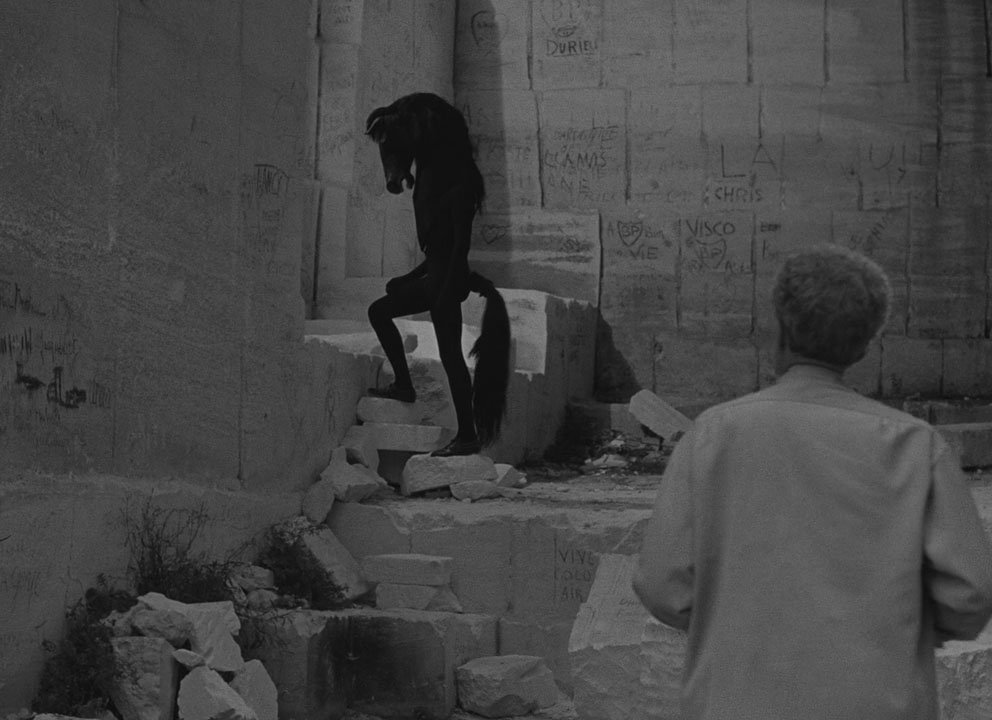
Before the trial, a bewigged time-traveling Jean visits a professor at four times in his life: as a schoolboy (Jean-Pierre Leaud! This played Cannes exactly a year after The 400 Blows), as a baby and a dying old man, and finally the active doctor he’s seeking. He follows a horse-headed man, rediscovers his Orphic character Cégeste, then to the trial, where he gives the best line to another character: “He is a poet, which makes him indispensable, though I don’t know what for.” I liked the lack of set dressing, shooting in an undressed studio and against ancient/timeless walls covered in modern graffiti. Into a Kafkaesque underworld ruled by Yul Brynner, where Jean is javelinned to death then reborn.

From Cocteau’s essay reprinted for the Criterion discs, it seems he intended Orpheus to be the narrative centerpiece between two less-narrative films. And more than those other two, this one was filmed on intuition:

Often, while making the film, I understood so little of what I was producing that I was tempted to call it absurd and to cut it out. At those times, I forced myself to condemn my own judgment and to tell myself that if the film wanted it that way to begin with, it must have had its reasons, or that reason had nothing to do with it.

The essay has one thing in common with The Difficulty of Being: shitting on French audiences, “where every member of an individualistic crowd puts up an instinctive resistance to what is offered him,” for not appreciating poetry and fantasy in cinema. Shot by Roland Pontoizeau, a Resnais associate who’d worked on Le chant du Styrène – the DP of Orpheus was off working with Melville and Rohmer.

John Wick Chapter 2 (2017)

A cigar-chomping, weirdly Jon Benjamin-looking drug lord awaits the return of Wick, who steals back his car and immediately totals it. Then Wick calls John Leguizamo to fix the car, and buries his guns under concrete – gonna be a peaceful movie!

“No one gets out and comes back without repercussions.” Oops, Wick is retired and refuses to honor some old blood oath with a dude named Santino (Italian Riccardo Scamarcio of Loro and Go Go Tales), so baddies blow up his house – but the dog survives this time! Back to the hotel, Cedric Daniels shows him to Ian McShane.

Off to Rome, which also has a Hotel Continental – the movie is expanding its mythology to Avengers-level proportions. Also, Wick is “the ghost, the boogeyman,” but wherever he goes everyone knows him by name. Sent to kill mafia boss Gianna (Claudia Gerini of an upcoming Diabolik remake), he gets new guns from Peter Serafinowicz and bulletproof suits, meets Franco Nero, then goes to a rock show (like a more chill Sleigh Bells) and follows Gianna to the hot tub, where she helps him execute her. This doesn’t go over well with her bodyguard Common, and after an exhausting fight where Wick videogames dozens of dudes, they end up back at the hotel.

Open contract on Wick, underground homeless anti-assassin league, a couple of boss fights with handheld weapons. I dug the silencer shootout, but the Lady From Shanghai hall of mirrors ending is really something special. Big news, Keanu getting (expensive) assistance from his Matrix costar Larry Fishburne. Finally, the movie’s mythology is strong, since the only time I felt shocked was when Wick shot the baddie on sacred Continental ground.

–
John Wick Chapter 3 (2019)

“We’re the same, you know.”

Wow, I’d just finished watching Chaplin shorts, and this opens with a Buster Keaton scene projected on the side of a building, which I suppose connects the ensuing motorcycle chase/crash to the slapstick tradition. Picks up exactly where the last one left off, a wounded Wick given an hour headstart before every assassin in the world comes after him. Ian and Larry and Cedric are gonna be fired for collaboration, but if Wick can complete a task for the Nomad King, his excommunication will be reversed… along the way we meet Derek, Halle Berry, Anjelica Huston, boss of bosses Asia Dillon (Billions), and one of the stars of Double Dragon.

I dunno, I was in a bad mood. It seemed like part 2 opened the Wickiverse further, then part 3 closed it abruptly, becoming a parody of itself (I also wrote “movie promotes fascism”). It’s more videogamey than ever – of course Wick teams with Ian and Cedric for a climactic shootout against faceless bureaucrat invaders, but the writers seem like they’re either making this out of contractual obligation or they’ve developed a bad drug problem since the last one. The lighting is the main thing it’s got going for it – super cool lighting.

Our three lead murderers were definitively killed at the end of The Devil’s Rejects, gunned down in slow-motion, so how will Zombie make a sequel? They’re not dead, they were just wounded, and all better now! Sid Haig, alas, didn’t stay better for long, so he gets a brief scene before being replaced by Baby and Firefly’s half-brother Midnight Wolfman.

A decade after the previous movie ends, Wolfman springs Firefly (they murder a cameoing Danny Trejo along the way), then they threaten the cartoonishly facial-haired warden into freeing Baby, and the three run off to Mexico. That’s about a half-hour’s worth of movie – the rest is them deciding to fuck with strangers, then murdering them, or getting in trouble because strangers recognize them, then murdering them. It’s not a bad movie, surely a step up from the terrible 31, but it’s pretty unnecessary, and there’s no tension – the stakes are always low in a movie where no lives matter. Zombie exercises his TV/film texture fetish in the news footage covering the escaped outlaws, and builds to a big showdown in Mexico when the son of Danny Trejo comes with twenty armed dudes.

The Howling star Dee Wallace plays the vindictive prison guard in chage of Baby (Sheri Moon Zombie, always good in these things). Richard Edson (Sonic Youth, Stranger Than Paradise) is the dude in Mexico who puts them up (and turns them in). Bill Moseley was in about 40 movies between Zombie’s Halloween and this, mostly crappy horrors, and Wolfman Richard Brake played the only person Cage doesn’t kill in Mandy.

Edson:

A feature-length TV season, so every characters gets their moment, and it all feels squished and irrelevant, all “okay that’s out of the way, now here’s this.” Still mostly enjoyable, even for charlatans like me who quit the series after season 3.

Branson (the Irish chauffeur-turned-family-widower) is the star here, saving the king from assassination by Claire Foy’s husband, helping the princess (Kate Phillips of Peaky Blinders) figure out her marriage, and possibly falling in love with an heiress (Sense8 star Tuppence Middleton), the secret daughter of Imelda Staunton (great, her addition to the movie helps offset Elizabeth McGovern being reliably awful).

Eight years ago I introduced the characters – but where are they now?

Branson played Queen’s manager in Bohemian Rhapsody. Lady Mary starred in the series Godless, and was in that Jim Broadbent movie Sense of an Ending with her barely-in-the-movie husband Matthew Goode. Maggie Smith, who anticlimactically tells Mary she’s dying, is keeping it classy – after the Harry Potter and Marigold Hotel movies, she appeared in Sherlock Gnomes. I saw McGovern in The Commuter and she’ll star in a War of the Worlds miniseries with Gabriel Byrne. Lady Edith (pregnant again) is in another British period royalty drama series, and big daddy Hugh Bonneville is following Paddington 2 with a Christmas movie about a magic toymaker. Shaun’s mom followed The BFG with a Ricky Gervais series.

Bates (Mary Queen of Scots) and Anna (Bob the Builder) trick the royal servants so the locals can kowtow to the king personally, recruiting Carson (con-man movie The Good Liar) and Hughes (starring in Girlfriends with Miranda Richardson). Daisy (Iannucci’s David Copperfield movie) flirts with the plumber, is set to marry some footman. Thomas (netflix horror The Ritual) discovers a gay bar and gets into a side plot with some thudding dialogue, Molesley (plays a “ghost detective” on a British series) says some dumb things, and Patmore (an India-set period drama) does the usual. I was hoping the king and queen would be someone exciting, but she’s from Little Britain and he played Arthur Dent in the original Hitchhiker’s Guide, so, nope. The same writer & director made the dull-looking Elizabeth McGovern movie The Chaperone earlier this year.