Extreme jumpcut cinema, making a dubby hash of its would-be monologues. Strobey, glitchy, overlapping audio and video, cutting against any sort of rhythm, like an Autechre album of a movie. Video, and videos of video. Much of what audio survives is soft-spoken poetry and college students having deep discussions about economic theory. Once I realized this wasn’t going to come together for me as a narrative, I wondered if it might’ve been a Begotten thing, where he made a film of his friends and relationship problems and it didn’t come out well so he destroyed it. But then, it was one of Cinema Scope’s top ten of 2015, so there must be more to it.

Phil Coldiron:

… each relationship available to the cinema must be rebuilt; nothing will be taken for granted within the frame. If there are narratives, they will not be simply given and accepted; they will appear as the product of careful study of the relations of the world, which Medina examines and expresses through the logic of rhythms.

It’s not just a restless critic reading too much into a semi-documentary Begotten breakbeat – in the interview, Medina is full of references and philosophy on the nature of his cinema, so I think I was too tired and undervalued the thing. They’re both mentioning the Lumiere brothers, who also come up in Dawson City and In The Intense Now. I cannot quote from the interview, because if I was too tired then to get what the film was going for, I’m definitely too tired now to get what these two are on about. I liked Michael Sicinski’s explanation of the thing:

There are fragments of an ostensible narrative. Or perhaps it is better to say, there are figures whose affect and experiences we observe across the running time of Medina’s film. They bob in and out of our view—a coterie of young Filipino-Canadian friends and lovers, given to creativity and anger and philosophizing and confusion. But 88:88 does not adhere to any given point of view. It hangs out, but in a jittery, caffeinated way, holding onto present moments without deadening them into connective tissue, mere “moving-towards.” Or, if there is a point of view, it’s that of “the digital image,” which is indiscriminate and regards a private breakdown with the same impassive fascination it affords greenish-yellow light through a treetop.

Decker has a new film at Sundance, so I checked out her debut… watched this 70-minute feature after work, floated off to dinner thinking about how much I loved it, then discovered the people I follow on letterboxd didn’t love it at all. Someone must’ve recommended it – Richard Brody, maybe. Anyway, everyone’s loving the new one to death, so I’m feeling ahead of the curve in my appreciation.

Starts out disorienting – Sarah gets a call from someone we haven’t seen, who has woken up in a strange apartment, and she’s yelling panicked orders into the phone. Then after a night clubbing, Sarah appears to be in the same situation herself. That’s the end of city life – the next scene has her meeting old friend Isolde at a Bulgarian folk music camp on the other coast, their reunion scene shot completely out of focus. Overall the camera and editing choices are completely bizarre, keeping me on my toes through what could’ve been a typical semi-improvised indie drama. The playfully strange filmmaking combined with a scenario where we never find out who anyone is or what’s going on reminded me of The Strange Little Cat. We also get slow focus pulls, cutaways to slugs, sudden witchy/culty flash-edits, a Blair Witch-like scene, and of course, much performance and dancing to Bulgarian folk music. Eventually Sarah starts drifting apart from Isolde as Sarah is falling for fellow camper Charlie Hewson, then she seems to drown him in the lake.

Sarah:

Isolde with the Dancing Woman:

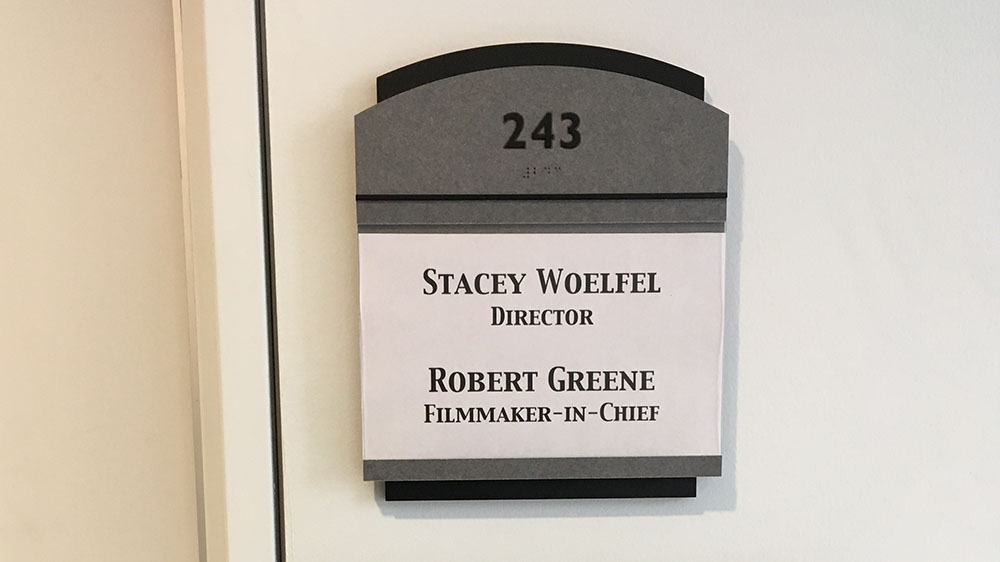
Watched right after Christine. I didn’t love Greene’s Actress (or Christine), but they made for good prep-work for this masterpiece whatsit. A sort-of documentary following Kate Lyn Sheil as she preps to play Christine Chubbuck, presumably in a feature along the lines of Christine, though we see few any details about the feature and nobody’s helping her with character prep.

The first movie I’ve seen to film its own crowd release notice:

Kate’s in Florida where it happened, and locals seem to have no memory of Christine or her fate. She goes through library microfiche, reads books about suicide, does some serious tanning and gets fitted for a wig, goes gun shopping and finally gets a peek at some archive footage of the real Christine. It all leads to a joke of an ending, Kate finally building up the nerve to shoot herself, but the entire process leading up to that was fascinatingly staged (or “staged”).

This came out the same time as Kate Plays Christine and was slammed, then I read some defenses of it, so thought it’d be instructive to watch both. And this one, the straight period-piece retelling of dead newswoman Christine Chubbuck’s final days, was worse than I’d feared, an unenlightening, 1970’s-fetishizing semi-drama leading to a foregone, unpleasant ending. Christine has a depressive history, has personal and family and work troubles, and tragically kills herself on air. Michaels Sicinski and D’Angelo argue that it’s not unethical, not exploitative – maybe so, but it struck a couple wrong notes with me. I kept thinking “sure, but what’s the point,” and then Kate Plays Christine was an entire feature about trying to find the point, and that played beautifully for me. Not a huge fan of Simon Killer either, I’ll be hesitant to watch another Campos joint (but damn, Sicinski says Afterschool is great).

The actors do an unusually good job with unexciting material, at least. Rebecca Hall is magnetic as Christine, despite the character being prickly and awkward. Tracy Letts, who’s wonderful in everything these days, is the boss, Timothy Simons from Veep is a coworker, and Michael “no relation” Hall (TV’s Dexter) a potential love interest.

Evan has a dying mom, is also a bit of an impulsive fuckup, and during his immediate post-mom depression he acts self-destructively to the point of having to flee the country. Off in Italy he meets a couple of drunken brits, takes a job with chill farmer Angelo, and hooks up with gorgeous local Louise (Nadia Hilker), who turns out to be an ancient cat-squid-beast, as shown through some dodgy CG.

Evan then spends the rest of the movie trying to convince Louise not to be reborn as a new identity, which is something that happens every generation or so, forcing her to disappear and make new ID documents and will herself possessions (shades of Highlander), but to remain mortal and live a normal life with a tourist loser. Someone described it as Before Sunrise as a monster movie, which is about right, and I enjoyed it even though it seems like I have nothing nice to say.

Evan is Lou Pucci, who looks like my neighbor Jared, but is actually the doomed nerd of Evil Dead Remake and bazooka kid of Southland Tales. The Moorhead/Benson duo also contributed a segment to V/H/S/3 and have made two other features which seem to be horror movies but aren’t, really. Count me in.

Manana is tired of her family, and one day walks out and gets her own apartment. Everyone tells her this is unacceptable and ridiculous and she’ll come crawling back, but she does not. She still sees her husband and kids and parents, reluctantly, but mostly keeps to herself even when home. Remarkably, the movie allows this to happen, doesn’t condemn or destroy her.

Michael Sicinski on letterboxd:

Nana & Simon’s choice to spatialize Manana’s rebellion allows them to literalize her movement away from the fold, a break which is then compromised by her older brother’s insistence that some dumb lugs in her building “keep an eye on her.” Unbeknownst to Manana, the patriarchy is everywhere. This is made even clearer, in far harsher terms, when some old friends of Manana’s divulge a secret about her past, something that she herself did not know.

That something is that her husband Soso (“ironically but accurately named”) had a long-term affair, something her friends assume Manana already knew, because why else would she have left. In fact, he has a son with this woman, and Manana meets him under the pretense of checking their gas meter. Meanwhile life goes on in the family she has left – one kid has a breakup, the other has a new (pregnant) girlfriend, and Manana’s parents and brother can never stop meddling.

Bilge Ebiri, whose review got me watching this in the first place:

The film unfolds as a series of long takes, as we follow characters in and out of rooms, staying close enough to register individual experiences while always making sure to keep the rest of the world in focus. But the camerawork isn’t that rough, handheld, vérité style we’ve become so used to; it’s fluid without being showy, immediate without being unbalanced.

Codirectors Ekvtimishvili and Gross made a previous feature called In Bloom, which is also about females in Georgia escaping their families. Soso starred in Aleksey German’s Under Electric Clouds, and I have no idea where Manana (Ia Shugliashvili) came from.

We didn’t want Downsizing to be our official final film of 2017, so we rewatched Inside Out on new year’s eve, then after a couple of attempts, managed to make this early Ghibli feature our first movie of 2018. The early ones are cool, but we’re more taken by their later works (Mononoke and everything after).

Pirates:

A couple of orphan kids from different backgrounds meet and end up saving the world by teaming with pirates to stop a power-mad government agent from harnessing the destructive power of an ancient and abandoned floating city called Laputa. The boy Pazu (pronounced POT-sue in the Disney dub) is from a factory town, and the girl Sheetah is descended from Laputa royalty, and that’s about all we learn about them before the movie erupts into battles, pirate humor, and tons of flying machines.

Every Miyazaki movie has a standout piece of character or vehicle design – in this one it’s long-armed bird-loving robots.

Stupid Matt Damon has money problems (you can tell because he stays up late at a cluttered desk frowning at an adding machine) so he decides to get small. His wife Kristen Wiig decides against the idea at the last minute, then he loses his palacial house in the divorce, moves into an apartment below hard-partying Christoph Waltz whose housecleaner is Vietnamese dissident Ngoc Lan (Hong Chau of Treme, Inherent Vice). These three hitch a ride with Udo Kier to the original small colony led by Dr. Rolf Lassgård (A Man Called Ove), which is retreating into a mountain to wait out the impending human-caused global catastrophes. Stupid Matt Damon decides to go with them, then decides not to, then convinces Ngoc Lan he’s in love with her.

Katy says it’s like they asked each actor what they’d like to play (“a sea captain!” “a hard-partying smuggler” “a one-legged humanitarian”) then wrote a script around it. It tries to be a bunch of things at once, not so successfully, and there are awkward and obvious bits, but I appreciate the ambition, and Christoph Waltz looks like he’s having the best time. Second movie we watched theatrically in a row to feature Laura Dern.

Opens with Etaix introducing the idea, explaining the sheer amount of film that was shot for this project, then being attacked by a giant flowing mass of unruly film stock. Unfortunately this turned out to be the best part.

The rest is an interview film, gauging the man on the street’s attitudes on sex and violence, entertainment and celebrity, TV and advertising, world events, personal relationships, and Pierre Etaix. Interviewees are French people on holiday, just after May ’68, which doesn’t really come up. He spends longer than necessary at some kind of open-mic festival. It’s all like the least interesting aspects of Chronicle of a Summer and À propos de Nice mixed together, with some fun/ironic editing, but not enough to make it worth sitting through all the amateur singing performances.