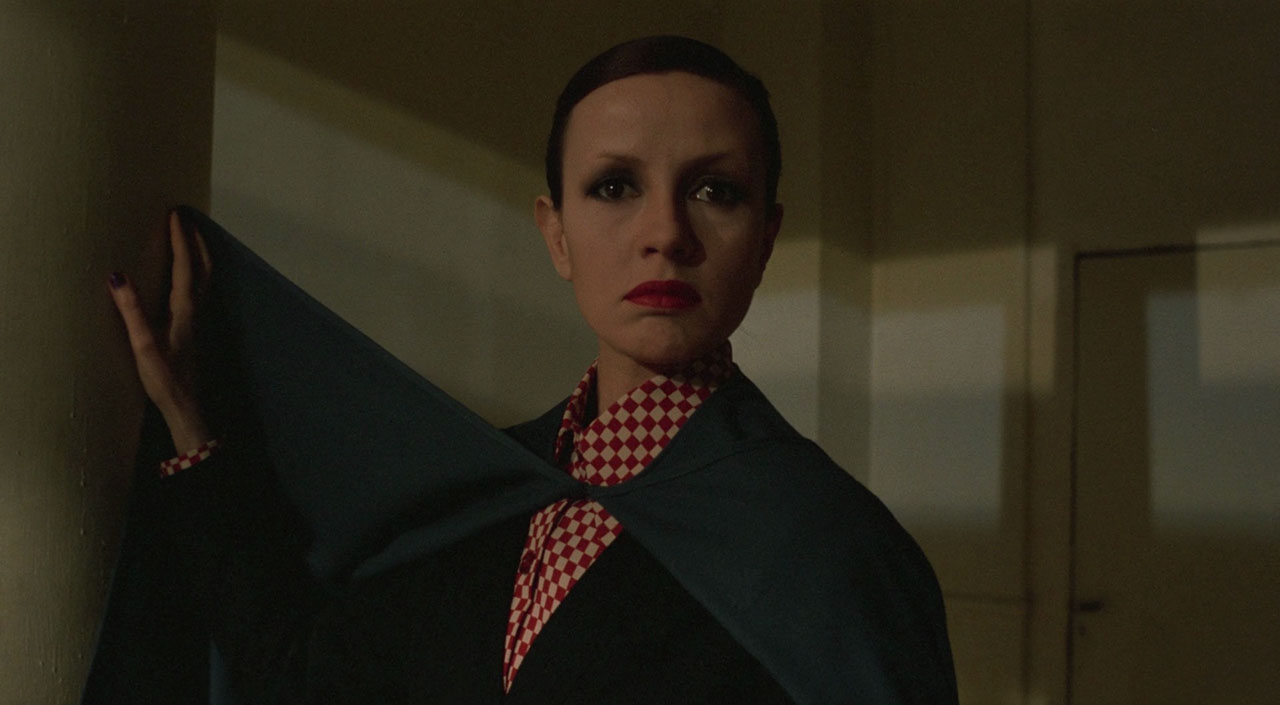
“Anything… so long as it’s bad.”

Billed as a long-lost feminist animation, as if viewers would be fooled – and some were. In the first ten minutes our heroine is gang-raped by nobles, who conspire to keep the townspeople desperately poor, then she sells her soul to the devil for revenge, and it only gets more grim from there. Yes, it’s nothing but pure punishment for the shining couple of Jean and Jeanne, introduced as some Christian ideal couple before Jeanne is repeatedly devil-raped, brings plague and orgies to the people and is ultimately burned at the stake and Jean becomes a hated tax collector and nobility puppet then gets murdered at his wife’s execution.

Jeanne getting hella raped:

Jeanne joking around with penis-satan:

It’s kind of a musical, making the most of very limited animation – mostly long pans across large still drawings. I appreciate the indie-animation ambition and the uniqueness of having so much sexual imagery, but the end result is dated and unpleasant.

Surely it’s not the movie’s fault for being so shitty to the people, and especially to women, for truly history was very shitty, especially to women, but after murdering our heroes the movie hastily tells us that women (ahem, topless women) led the French revolution so I guess that makes up for everything. The illustrations are pretty cool, anyway.

D. Ehrlich with context:

Strange even by the impossibly high standards of Japanese cinema, the wild and exhausting Belladonna of Sadness was conceived by Osamu Tezuka — the godfather of manga — as the third and final chapter of Mushi Productions’ Animerama trilogy (a series of explicitly adult animated films that also included erotic riffs on “Cleopatra” and “A Thousand and One Nights”).

Two more sections from the amazing-looking Lumière blu-ray:

Chap 3: Enfances

La Petite fille et son chat (1900)

A horrific film introducing early filmmakers to the problem of making movies with animals. The action is a girl in a preposterous hat hand-feeding a hungry cat, but the cat loses interest halfway, ditches the film and has to be thrown back into frame. The girl’s a much better sport – in the second half you can see the cat clawing her arm, but she continues to act through the pain, pushing further back in her seat in case the animal goes for her eyes next.


Premiers pas de bébé (year unknown)

Kid in wind-inflated clown clothes walks unsteadily down the sidewalk, then falls down – a comedy or a tragedy, depending whether you like kids.


Pêche aux poissons rouges (1895)

Mustache man works hard to get a kid in a diaper-hat to reach for the fish, which she does occasionally in between trying to keep a steady foothold and trying to pull the whole thing over – kind of a failed attempt at a filmed action, but maybe film was super expensive so they released it anyhow.


Petit frère et petite sÅ“ur (1897)

Boy and girl swing in circles until they fall down, what fun. The film hasn’t run out yet, so he picks her up and they start again, with the girl shooting a “what? I thought we were finished” look into camera.


Enfant pêchant des crevettes (1896)

Kids in increasingly ridiculous hats skim the water with shrimp nets while their parents hover nearby.


Le goûter des bébés (1897)

Two girls at either ends of a table while young Casanova sits in between feeding them grapes. According to google, the title translates as The Taste of Babies.


Baignade en mer (1895)

Older kids dressed as escaped convicts jump off a rickety diving board into the sea.
I’ve seen some of these before (and taken the exact same screenshots).


Enfants jouant aux billes (1896)

A game of marbles, at an unfollowable distance even in this beautiful HD edition. The dirty kids in their adorable period garb are still worth watching, though.


Défilé de voitures de bébés à la pouponnière de Paris (1897)

Long train of nannies with babies in buggies.


Chapter 4: La France Qui Travaille

Ateliers de La Ciotat (1899)

What is happening? Spinning gears and flywheels, as workmen carry large things about.


Chaudière (1896)

Men climb down a ladder, then remove the ladder. What is that thing? Ah, English title is Loading a Boiler, not so thrilling.


Ouvriers réparant un trottoir en bitume (1897)

Spreading what looks like black tar on the ground – looks hot and miserable.


Défournage du Coke (1896)

I’ve seen this one a bunch of times, and it’s fascinating… super-hot coal residue, sliding slowly out from whatever contraption this is, one guy hosing it down, others hesitantly attacking it with poles, finally increasing the pole action towards the end.


Laveuses sur la rivière (1896)

There was a laundry shed for ladies along the river. Nicely framed shot – my favorite part is the men standing lazily above watching the laundry get done.


Transport d’une tourelle par un attelage de 60 chevaux (1896)

Sixty horses towing a massive whiskey barrel (or a turret, acc. to google translate). This film has a cut, because obviously the Lumières wanted to see the line of the horses then the giant object wheeling into view but a supervisor holds the line, so it seems they stopped shooting until it resumed.


Pêche aux sardines (1896)

Untangling fish from the net, which goes slowly because the fishermen keep turning around to look at the camera.


Les pompiers I: passage des pompes (1896)

So cool, horse-drawn firetruck passing through, as street traffic moves aside for them.


Attelage d’un camion (1896)

More horse-pulling action, this time a smaller team than a few films ago, pulling a less interesting load (concrete blocks).

Sept. 2016:
Watched this again in the beautiful blu-ray restoration, along with Agnes Varda’s documentary. Of course, I take back the comment below that the music is unmemorable – I find no showtunes memorable until I’ve heard them a second time, and now I feel like I’ve known the twins’ theme song forever. Had completely forgotten that there’s a murder in this movie, a family friend who hangs around the café is arrested for chopping up a girl named Lola-Lola (Blue Angel reference?). Re: the English version of The Young Girls, it’s glimpsed in the Varda doc, but apparently nobody thought it worth restoring and adding to this box set, so that’s probably the final word on that.

Transporter Bridge, transport me away:

Oct. 2007:
Not a total musical like Umbrellas was, and no connecting characters between the two, just a brief mention of the town of Cherbourg. This one has the same longing tone as the previous film in parts, but mostly it’s a much sunnier film, a loving, colorful, musical tribute to Hollywood escapist classics.

At this point, Demy was far out of touch tonally with his French New Wave contemporaries. Umbrellas characters were at least affected by the ongoing war, but Rochefort, coming after the more politically-engaged Muriel and Paris Belong To Us and The War Is Over, is in its own insular world for the most part. A few years later, after the May ’68 riots and Godard’s and Marker’s hard turns to the left, after even Demy’s wife Agnes Varda had filmed Black Panthers and contributed to the Far from Vietnam project, Demy would continue to go his own way, filming a musical fantasy fairy-tale with Deneuve and Jean Marais in 1970. By that point, I gather that he was not well-liked by his New Wave filmmaker/critic contemporaries. I don’t think he is well-liked still… I’ve been reading that his career was pretty uneven, and only a quarter of his films are talked about regularly. I guess Demy’s films have had to be recontextualized to be appreciated, removed from the radical French 60’s and enjoyed as pure cinema.

Danielle Darrieux (star of Madame De… and the cheating wife in La Ronde, later in 8 Women & Demy’s Une chambre en ville) plays Yvonne, mother of Catherine Deneuve, her tragic real-life sister Françoise Dorléac (of The Soft Skin and Roger Vadim’s La Ronde remake) and young Boubou.

Yvonne regrets having left Boubou’s father Simon Dame (Michel Piccoli) ten years ago. Delphine (Deneuve) keeps missing her dream man, an artist/poet doing his military service, Jacques Perrin (of Donkey Skin, Cinema Paradiso, the Kieslowski-penned 2005 Hell). Solange (Dorléac) dreams of meeting famous American composer Andy Miller (Gene Kelly). And they all (more or less) meet up and fall in love at the end of the movie.

L-R below: Darrieux, salesman George Chakiris (West Side Story), Josette, romantic Perrin, George’s partner Bill, Gramps

Guess I’m not so musical-savvy, don’t know what to say about this one stylistically. I mean, it’s bright and colorful and fun, less sense of loss and longing than Umbrellas, but I kind of miss that. Gene Kelly is a cutie, fits in just fine.

Katy asks why the mother has to work all day at her diner to get by, while her daughters live high in their fancy apartment and pretty dresses from teaching song and dance lessons. Are the realism and the fantasy rubbing against each other uncomfortably, or is the mother paying for Boubou’s school and still helping to support the girls until they get married? If the latter, I’d hope they’d take a shift at the diner once in a while.

This and Umbrellas had a funny combination of set and location shooting, with Demy doing location shots in the actual towns, but repainting the storefronts to his liking. Nice music, nothing memorable for me, having heard it just once. The girls refer to Jules and Jim and composer Michel Legrand. The camera should count as a cast member since it is engaged by the other characters and dances around with them. A self-reflexive movie then, both in its use of the camera and its reference to musical convention. Bright, solid primary colors abound.

Jonathan Rosenbaum: “There are English-dubbed versions of both Umbrellas and Young Girls; I haven’t seen the latter, but the English version of Umbrellas is so unrelievedly awful that I’m happy to have missed the dubbed Young Girls.” Although if the IMDB trivia page is to be believed, Rochefort was fully shot in English as well as French, so it might be worth hunting down an English version if it still exists anywhere.

Varda cameo as the shortest nun:

Caroline Layde for Senses of Cinema:

However undemanding and lollipop Demy’s films may appear, they present some nuance and sophisticated intertext, and they share a certain charm, vivid and unified. His films inhabit worlds in themselves that may peripherally refer to social reality and the real world but remain content as alternate realities of poetry, color, and music … Demy’s consistency of vision itself justifies his inclusion among the “auteurs”, defined by André Bazin and François Truffaut and expanded by Andrew Sarris as distinguishing themselves with their salient visual language from mere metteurs-en-scène. Demy certainly created a signature style of poetry and innocence and clung to it. Yet this quality also has a sophisticated aspect, suggesting the dream worlds of the surrealists and of Demy’s inspiration, Jean Cocteau. It is fitting that the American critic Gary Carey has described Demy as “the Joseph Cornell of French cinema”.


The Young Girls Turn 25 (1993, Agnes Varda)

The town of Rochefort threw a party and screening for the 25th anniversary, invited Demy’s family, Legrand, the set designer, the producer and cast. Bittersweet memories for some, pure joy for others. Film and video of the festivities along with film clips and Varda’s excellent 16mm footage from behind the scenes.

“The memory of happiness is perhaps also happiness.”

Jacques on set:

A movie where nothing happens but with menace everywhere – cutting racism, teens with guns and machetes and driving cars, fistfights, drunkenness, people with bad eyes and extra teeth and covered in cuts, talk of affairs and killer rats.

I’m about a month behind on the movie blog, and this one has stuck with me really well – not the details and specific interactions, but the general atmosphere of doom and stasis, the sense of being stuck, and the one guy José who escaped to Buenos Aires, returns home then can’t seem to leave.

D. Oubiña:

There are too many characters in La Ciénaga (The Swamp, the name Martel gives to her fictionalized version of her hometown), and their relationships remain confusing even after we’ve finally managed to identify their family connections. It is difficult to tell what is central and what is secondary in each image, as the story avoids emphasizing any one situation over another. But that is precisely what is so distinctive about this stunning movie … La Ciénaga is precisely a movie about unproductive pursuits, wasted time, the dissipation of energy, inactivity … the story develops in a sly and calculatedly affecting way. She sets up these disturbing situations, then avoids and ignores the potential damage, as if the eventualities had never existed. But we remain unsettled by the accidents that seemed inevitable, and they stay with us as what could have occurred, or what could still occur at any moment.

There’s a side plot about virgin Mary appearances on the side of a building. Matriarch Mecha (Graciela Borges, in Argentine films since the 1950’s) drunkenly falls and cuts herself up at the beginning. I think Tali (Mercedes Morán, mother in The Holy Girl) is a neighbor or an aunt. Luchi is the boy who falls to his probable death from a ladder at the end.

Been meaning to watch this forever, then picked it on the night after it appeared on someone’s BBC list – someone who voted for Mysteries of Lisbon, Margaret and The New World in his top three, so can be trusted. This won an award in Berlin where it premiered with Fat Girl, Bamboozled, Traffic, Wit and winner Intimacy.

Maybe my favorite of the four Hosoda movies we watched. Katy complains that it conformed to gender norms, as the girl suppressed her wolf nature to fit in with other schoolkids, and the boy went full-wolf into the wilderness. And we both thought it odd that the kids’ mom makes love with their werewolf dad while he’s in wolf form.

But most of the movie is about the mom trying to raise two wolf children, with nobody she can confide in, and while I usually don’t go for all-sacrificing parent stories, the unique challenges here along with the kids’ gradually-developing personalities and the mom’s low-key perseverance added up to something special. The advantages of animation are more apparent here than in The Girl Who Leapt Through Time, as the kids transform into wolves and back at will (and unconsciously) in the middle of shots.

Mouseover for wolf children:
image

Adam Cook:

This is certainly the closest Hosoda has come to replicating the magic of Miyazaki. In fact, several scenes seem to deliberately reference the great man’s work, particularly the sequence where the children discover their new provincial home for the first time.

I was going to watch more of these, loaded a Borzage thing and a Lubitsch thing on the laptop, but for months I haven’t felt like continuing, so I’m pulling the trigger.

His Wedding Night (1917 Roscoe Arbuckle)

Roscoe is a soda jerk who also keeps an eye on the perfume counter and gas pump. Gags about Al St. John trying to steal his girl, Buster Keaton delivering a wedding dress, and Roscoe putting chloroform in a perfume bottle to prevent customers from over-sampling the expensive stuff all come together magically in the end. Arbuckle’s a strong dude, picks up romantic rival Al and hurls him across a room. Arbuckle also sexually harasses a woman and a donkey, and pretty quickly learns to use his chloroform bottle for evil. Very nearly cinema’s first gay marriage before Keaton is unmasked.

Modeling:


The Rough House (1917, Roscoe Arbuckle)

A psychotic chef (Fuzzy St. John), hapless grocery delivery boy (Keaton) and an idiot manchild (Arbuckle) destroy a house. Then the chef is fired and Arbuckle is the new chef. Friends are invited to dinner, one is a thief, cops arrive, many people fall down, and the house is pretty much destroyed again. Main value to be found in this pile of randomly-edited violence is Arbuckle’s dancing dinner rolls, apparently stolen (and perfected) by Chaplin for The Gold Rush.


Dreamy Dud. He Resolves Not to Smoke (1915, Wallace Carlson)

Finally I am watching the movie with the greatest title of all time, and it’s a bit of a let-down… pretty much a tame Rarebit Fiend episode with a pipe-smoking boy and his pervert dog, full of horrible slang.

Urban Dictionary is conflicted about what this might mean:

Sure it’s the cutest-ever story of an orphan mouse who befriends a hermit criminal bear, but it also has major subplots about teeth theft at the behest of a sinister orphanage.

Also there’s a family with a dentist mom who works across the street from her candy seller husband, which is funny and low-key cynical but they don’t seem to deserve the chaos Ernest wreaks upon their businesses.

Beautiful watercolor backgrounds, often fading away at the edges. According to the codirector the writing was influenced by Studio Ghibli (naturally) and Kikujiro (ha!).

I was crazy about it, but something seemed off with the English voices. After just having seen The Little Prince and feeling Jeff Bridges was just perfect as the inventor neighbor, I wasn’t feeling Forest Whitaker as Ernest. The movie is short, so I watched it again in French with original Ernest Lambert Wilson (the American in Not On The Lips), which was perhaps an improvement, perhaps not, but either way a joy to see twice.

The ultimate meta-storytelling, misfit-family, humans-vs-gods, origami-magic, epic-quest movie featuring the ultimate ass-kicking monkey.

My only complaint about the gorgeous stop-motion, which features a centerpiece sailboat battle that is possibly the best scene I’ve ever seen accomplished in animation, is that it’s all so perfectly executed that you often can’t tell it’s stop-motion.

We stayed through the credits to see my favorite armaturist’s name on the big screen – way to go, Spake!

J. Spiegel:

I was pretty much an emotional wreck for the last 25-30 minutes of Kubo. It’s not that I was surprised by the twists–very soon after we meet Monkey and Beetle (the former of whom voices Kubo’s actual mother), it’s pretty clear that they’re not just metaphorical stand-ins for his parents, but literal ones. It’s that the way the script handles the notion of accepting death and treating it as a fitting end to our “story” was unexpected and achingly humane.

D. Ehrlich:

The physical reality of their characters conveys an otherwise impossible sense of impermanence, and reveals stop-motion to be the perfect vehicle for a story about the beauty of being finite. The movies have explored the afterlife almost as thoroughly as they have life on Earth, but this one is so powerful because of the precision with which it articulates these immortal ideas of transience.

Lightning strike:

T. Robinson for The Verge:

One of Laika’s ideals is that only one animator should work on a given scene at a time … for instance, in a scene where Kubo stands in a wooded area and a wind blows through the trees, that’s the work of a single animator moving every leaf and branch separately. The process is incredibly laborious: On Kubo, 27 animators worked simultaneously on their own scenes, each trying to achieve the company goal of 4.3 seconds of animation per week, and more often, only hitting about three seconds per week.

2006:
The first time I was too blown away by how wonderful this movie is, so entranced by its beauty and mesmerized by the entirely-sung dialogue to quite believe what I was seeing and hearing. Knew I’d have to see it again soon to make sure the dream was true. Still a nearly perfect movie… even more so now that I understand the singing and the flow and the story, and can just get caught up in it.

2016:
Finally looking perfect on blu-ray – I wasn’t thrilled how some colors on the 1990’s film print restoration jittered like a Nintendo game with too many enemies onscreen. Also I’m watching this for the first time since seeing Lola, so that movie’s lead character Roland Cassard as the jeweler who marries Deneuve and his brief Lola-flashback scene are new sources of wonder.

Meeting Roland at Mr. Dubourg’s place – he’s back there quietly gazing at Geneviève.

Other things noticed: how depressed and sullen Guy is after returning from the Algerian war… the crazy wallpaper in the movie and how it clashes and blends with the brightly colored clothing… and the auto mechanic male lead, from Demy who grew up in an auto garage.

When visibly pregnant Geneviève breaks down and agrees to marry Roland: “If he refuses me as I am, it means he doesn’t have deep feelings for me. If, by some extraordinary chance, he accepts me, I’ll have no reason to doubt him, and I’d be a fool to turn him away.”

And on Guy: “I would have died for him…”

Rosalie Varda played the lovers’ daughter in the final gas station scene – I saw Rosalie again in Uncle Yanco the same day.

Didn’t expect to find a 1954 photo of Chris Marker and Alain Resnais holding a Fernand Léger print in the blu-ray extras: