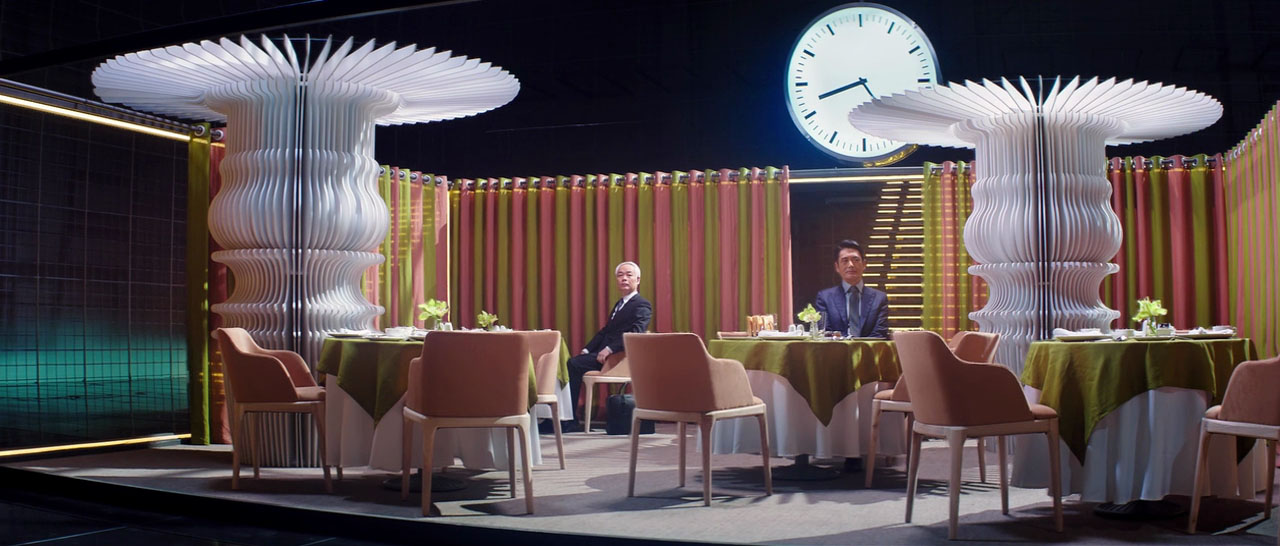
A comedy about how easily manipulable men can be. I think Lady Susan (Kate Beckinsale) ends up getting everything she wants, though her American friend Mrs. Johnson (Chloë Sevigny) helps her figure out exactly what that is. Susan knows she wants to be married to someone rich, knows her daughter Frederica (Morfydd Clark of the Mia Wasikowska Madame Bodary) needs to be set up as well, and Susan doesn’t exactly want to break off her affair with the married Mr. Manwaring.

Susan is lodging with her dead husband’s sister in the country: the suspicious (but not unfriendly) Catherine (Emma Greenwell of TV’s The Path), and her brother, eligible bachelor Reginald (Xavier Samuel of The Loved Ones). The daughter is being pursued by doltish Sir James (Tom Bennett of TV’s Family Tree). Sevigny is back in London, strictly prohibited from associating with Lady Susan by her older husband Stephen Fry, so there’s some running around.

Fun movie with great dialogue and performances, and a few stylistic flourishes (opening titles set to music, character introductions, text onscreen when letters are read). This is the only Kate Beckinsale movie I’ve seen except her very first movie, Much Ado About Nothing. Makes me wanna watch Last Days of Disco right now, but I’ve already watched one Whit Stillman movie without Katy so I should wait.

M. D’Angelo:

Whit Stillman adapting Jane Austen is almost too perfect—and that’s especially true of Lady Susan, whose title character is orders of magnitude more duplicitous and destructive than any of the heroines in Austen’s proper novels … It’s fun to watch Lady Susan bulldoze her way through 18th-century propriety, but an entire film of wry breeziness is a bit like a seven-course meal that’s all sumptuous desserts … still, it’s not as if movies today offer such a surfeit of wit and sophistication that one as purely pleasurable as Stillman’s Love & Friendship can be dismissed.

EDIT, SEPT 2016: Watched again with Katy who is concerned that the characters and language (was “anxiety” the misused word?) don’t represent Jane Austen’s point of view. I continue to believe the following frame is one of the best-ever uses of onscreen text.

In the vein of recent self-consciously faux-grindhouse movies like Machete and Hobo With a Shotgun, but this one’s a giallo imitation. Obviously brings to mind Berberian Sound Studio and Amer as well, but aiming for parody through extended reference instead of jokes. I smirked at the obvious dubbing and the Udo Kier cameo, but it comes off as a bad movie parodying bad movies. Writer/directors Brooks and Kennedy also star as the editor and the inspector, respectively, with giant mustaches, and Kennedy’s inspector throws off the balance of the acting. Most everyone plays it straight – or slightly-winking parody-straight – but the Inspector goes big, a dead ringer for Matt Berry’s cocky explorer Dixon Bainbridge on The Mighty Boosh.

Film director Francesco and the inspector:

Lot of straight razors (everybody in the movie has one) and black leather gloves and woman-slapping and flashbacks. Favorite plot point: the inspector’s wife Margarit is the first to discover the bodies of movie-in-the-movie actors Claudio and Veronica, and goes blind from the sight. Everyone makes fun of the editor all the time – he was formerly a renowned editor (there is such a thing?) but sliced off his own fingers in a rage, and now works on shitty movies with his fawning assistant Bella. Either of them would be a prime suspect for the murder spree, which soon claims substitute leading man Cesare. But could top-billed Paz de la Huerta (The Nude Woman in The Limits of Control) as the editor’s wife who is barely in the first half of the movie possibly be involved? Yes!

Didn’t play the pile of extras, just gonna appreciate the surface pleasures of the movie, like the editor beginning to see reel-change marks bleed into real life, and UDO KIER (less awesome than he was in The Forbidden Room but hey, it’s still Udo Kier).

The codirectors previously collaborated on Father’s Day, a Troma movie about a revenge-seeking man named Ahab.

World of Tomorrow is out on blu-ray!

I watched it again, along with the others.


The Meaning of Life (2005)

I was hard on this the first time I watched it, having expected another Rejected, and was dismissive the second time, but appreciating it more and more. Interesting visual effects illustrate Hertzfeldt’s nihilist meanderings, which would be explored from a more personal perspective in It’s Such a Beautiful Day and perfected in story and dialogue form in World of Tomorrow.


The Simpsons Open (2015)

I am simpson! I am simpson!

Give me your money. Give me your money.


World of Tomorrow extra (he teases a sequel in the interview):


Rejected (2000)

I didn’t mean to watch the movie that beat Rejected at the oscars on the same day, but that’s how it turned out.

Appreciate the paper effects in HD.


Lily and Jim (1997)

Been a good while since I watched this blind date story. “Women just don’t understand me! Come to think of it, this is a problem that a lot of women seem to have.”

“I really don’t like coffee… and actually I’m extremely allergic to the caffeine but, you know, I didn’t wanna ruin the evening or anything.”


Billy’s Balloon (1998)

Seen this a thousand times. The picture remaster isn’t revelatory because the miracle of the comedy is all in the audio and timing. Always worth watching again, tho.

Kind of a quiet, contemplative movie, with little of the grand emotion of Blue or the plot hijinks of White. Valentine (Irène Jacob: Kieslowski’s Veronique, also in the Laurence Fishburne Othello, Beyond the Clouds and Gang of Four) meets a reclusive ex-judge (Jean-Louis Trintignant of My Night at Maud’s and Z) via a lost dog. When she visits again, he readily admits he’s spying on his neighbors’ phone conversations. Rhyming shots and characters make this the most Veronique-like of the Colors trilogy.

G. Evans for Criterion:

What [the judge] unveils, above all, is a world of deceit and loneliness, which he observes with detachment, despite the fact that the people he hears are his immediate neighbors. Valentine seems to be no exception to this dispersed social existence, constantly dashing to answer calls from her boyfriend in England, who attacks her with paranoid accusations of infidelity. The secondary characters, whose stories interweave with those of the central pair, likewise suffer fractured relationships and troubled lives.

Auguste, the young judge:

In the opening sequence I realized what that is on the cover of the Criterion box – a Fincherian journey through phone cables. The series ends with the stars of the three colors films being the sole survivors of a sinking ferry, finally bringing them together – a cosmic coincidence, or as Dennis Lim suggests, the ending could have been a starting point, the reason for examining these characters in the first place. Evans again: “Kieslowski went so far as to say that the climactic scene of Red reveals that White had a happy ending. There is an expansiveness to this vision, in which everything may or may not be connected, in which fictional characters continue to have lives in times and places that exist beyond their filmic stories, that absolutely fits with the resonant quality of Red.”

Competed at Cannes with Queen Margot, Exotica, Through the Olive Trees, and at the Césars where it was no match for Wild Reeds and Isabelle Adjani.

The extras are very nice. Instead of presenting a disconnected gallery of deleted scenes, the film’s editor takes us through them, comparing to the final versions and explaining why they were cut. On Kieslowski: “I often saw him come out of Red very misty-eyed, very touched by his own film. For him, Red is a meditation on old age and youth.”

Dennis Lim:

With these innumerable rhymes and parallels, Red is rigged to trigger a constant sense of deja vu, an unexplained feeling of imminence. “I feel something important is happening around me,” Valentine says, articulating the nameless anticipation of the final passages.

You never know if a feature-length movie about an annoying character is gonna be a good idea, but this one erred on the side of delight. Not a very strong storyline, more a character study of Sarandon’s meddling mom, who has to find new people to interfere with after daughter Rose Byrne (Sunshine, Marie Antoinette) goes off to New York for work. Sarandon and her new friend J.K. Simmons (“playing a Sam Elliott twin with a stellar mustache” per April Wolfe) are more than charismatic enough to carry the movie.

Writer/director Scafaria also made Seeking a Friend for the End of the World, wrote Nick and Norah’s Infinite Playlist. Before I forget who everyone was… stand-up comic Jerrod Carmichael as an Apple Genius who Sarandon tries to help get back into school… Cecily Strong (The Boss, The Bronze) as a friend whose wedding Sarandon pays for… Michael McKean as a pushy single guy who’s into Sarandon… Jason Ritter (Gravity Falls, Freddy vs. Jason) as Rose’s movie-star ex.

MZ Seitz’s rave review nails the emotional center:

The Meddler is a diminutive and misleading title for such an affecting, often profound film … In its heart, it’s a story about the lived experience of grief. Marnie is still dealing with the death of her husband, and Lori with her father. This dear man, Joe, is seen only in photographs, but he is the absent presence looming over both women and driving many of their choices. The script is filled with details so expertly observed and so rarely seen in Hollywood films that you suspect they came from experience. And they did. Writer-director Lorene Scafaria based the film on her and her mother’s experience after her father died.

Les Joyeux Microbes (1909)

Similar to Transfigurations, but now it’s a scientist trying to get an overacting scarf fella to look at different microbes under a microscope, each of which displays a different transmogrifying animated scene, usually involving cranky old people. Towards the end, one of the drawings becomes 3D, a drunk character’s paper arms wrapping around a prop bottle. Another wonderful detail: the final second of the film was presumably supposed to have the scarf guy storm out of the room, but the set door (which was working in the opening shot) bends, doesn’t open, Scarfie mooshing up against it until the film quickly cuts.


Japon de fantaisie (1909)

I guess it’s stop-motion using Japanese props. An insect lays an egg, hatches into a mask, which spews forth rats. Doesn’t seem like a very positive view of Japan… or maybe it’s a prequel to the Mothra films.


Clair de lune espagnol (1909)

These are getting more difficult to summarize now that Cohl has discovered intertitles and I don’t know French, but it looks like a matador gets rebuffed by a fan lady, so he leaps out a window… but is saved by a space-bound vessel. The man angrily shoots the moon with a shotgun, is challenged to a duel by moon men, then thrown back to earth, where the fan lady is now impressed with him. I liked the prop star that shoots sparks.


Le Songe du garçon de café aka Hasher’s Delirium (1910)

Waiter falls asleep during his shift, has loony prop-and-cartoon-based dreams. From all the bottles that appear, we can assume he’s a drunk. His appalled-looking cartoon dream-body is subjected to the ludovico technique, watching names of alcoholic drinks alternate with demons and horrors. Then he’s made to kick his own ass. Then he’s awakened in the most predictable fashion, given that just before falling asleep he gave a table of identical hat-wearing men four seltzer bottles.


Le Mobilier fidèle aka Automatic Moving Company (1910)

Debt-ridden Mr. Dubois hugs all his furniture one last time before it’s all repossessed and auctioned on a street corner. Later, each piece of furniture torments its new owner and flees (serves ’em right for taking advantage of poor Mr. Dubois, who cries and wails all through the auction), returning to Chez Dubois where they belong.

A grim movie about the two kinds of people in this world: the horrible and the miserable. Our horrible lead is Min-chul, an aggressively foul drunk introduced returning home from prison and unrepentantly stealing his daughter’s college money. Seeking revenge against a businessman who sucker-punches him in a bar, Min-chul discovers that the businessman is building a fake Christian-cult led by patsy rapist Pastor Sung. Getting no help from the cops, Min-chul, who hates nothing more than he hates fakes, sets out to destroy it himself, burning down buildings and getting in bloody fights, finally coming home victorious to his suicided daughter.

For some reason, this story is told through Adult-Swim-looking animation, like Metalocalypse with less blood and worse music. The low framerate gives a marionette, videogame quality, damaging the movie’s illusion.

Why did I watch this? Can’t find reviews by any critics I follow, but somehow it ened up on my must-see list. Yeon has two zombie-virus train movies out this year: an animated feature and its live-action sequel Train to Busan (which opened last week at Cannes, earning Snowpiercer comparisons and a positive review from Twitch).

Stories don’t just lead into each other like in The Saragossa Manuscript – they melt and morph into each other, thanks to codirector Evan Johnson’s digital manipulations, which don’t replace Maddin’s usual bag of tricks, but join the choppy editing and texture fetish and everything else. Some of his early movies had somnambulist rhythms, but this one is ecstatic from start to finish.

Had to watch this a couple times before I could report in.

Second time through, I noted the order of stories:

How to Take a Bath, with Louis Negin

Submarine: Blasting Jelly and Flapjacks

Starring Negin again with Ukranian Greg Hlady, panicky Alex Bisping, Andre the Giant-reminiscent Kent McQuaid, and mysteriously-appearing woodsman Cesare (Roy Dupuis of Mesrine and Screamers).

M. Sicinski:

Like the men in the submarine, The Forbidden Room has an overall mood of anxiety and despair, in the sense that we are asked to grapple with its heady delirium of character trajectories and stunted arcs, all the while searching in vain for some absent center, the organizing “captain” who is supposed to pull it all together. In its endless ruptures and disconnections, The Forbidden Room brings us up short, placing us back in that capsule where the image is a form of confinement, a shortness of breath.

Cowardly Saplingjacks

Cesare sets out to rescue the kidnapped Margo (Clara Furey)

Cave of the Red Wolves

with lead wolf Noel Burton, bladder slapping and boggling puzzlements!

Amnesiac Singing Flowergirl

Margo again, with mysterious necklace woman Marie Brassard (sinister Jackie from Vic + Flo Saw a Bear) and patient Pancho (Victor Andres Trelles Turgeon)

The Final Derriere

with Sparks, Udo Kier (returning from Keyhole) as a man plagued by bottoms, Master Passion Geraldine Chaplin, and the Lust Specialist (Le Havre star Andre Wilms)

Red Wolves / Woodsmen / Submarine / Bath / Submarine

Quick return.

Squid Theft / Volcano Sacrifice

With Margo, squid thief Romano Orzari and Lost Generation attorney Céline Bonnier (The Far Side of the Moon)

D. Ehrlich:

The Forbidden Room may (or may not) be inventing narratives from thin air, but whatever history these abandoned projects might have had is completely supplanted by the present Maddin (and co-director Evan Johnson) invents for them. These stories belong to him now. The Forbidden Room may forego the hypnotically autobiographical thrust of recent efforts like My Winnipeg and Brand Upon the Brain!, but it feels no less personal for it.

Mill Seeks Gardener

With shed-sleeper Slimane Dazi and unpredictable runaway Jacques Nolot

Injured Motorcyclist at Bone Hospital

Caroline Dhavernas and Paul Ahmarani

Doctor kidnapped by skeleton insurance defrauders

Lewis Furey (Margo’s father IRL) as The Skull-Faced Man, and Eric Robidoux as the bone doctor’s long-lost brother who is also a bone doctor.

Psychiatrist and madman aboard train

Gregory Hlady again, Romano Orzari again, and Karine Vanasse (Polytechnique) as Florence LaBadie

Florence’s Inner Child

Sienna Mazzone as young Florence with crazy mother Kathia Rock

Parental Neglect / Madness / Murder / Amnesia

Bone Hospital / Insurance Defrauders
Mill / Criminal / Doctor
Volcanic Island / Squid Theft / Submarine / Bath

“I haven’t finished telling you: the forest… the snow… the convict… the birthday”

Woodsman Gathers New Allies

Kyle Gatehouse as Man With Upturned Face, Neil Napier as Man With Stones On His Feet and Victor Turgeon again as Listening Man – these are the same actors who played the Saplingjacks earlier, and again they don’t enter the cave with Cesare.

Margo and Aswang The Vampire

M. D’Angelo:

The Forbidden Room was shot mostly at the Centre Georges Pompidou in Paris, piecemeal, in front of a live audience, following which Maddin and Johnson artfully distressed the digital footage and added priceless intertitles. The project took advantage of whichever actors were available to it on a given day.

Elevator Man Unprepared For Wife’s Birthday Kills His Butler

All-star segment with Mathieu Amalric, Udo Kier and Amira Casar (Anatomy of Hell, Piano Tuner of Earthquakes).

D. Ehrlich:

[Amalric] gleefully indulges in Maddin’s pure and peerlessly florid sense of melodrama, which here becomes a mechanism for foolhardy and paranoid men to ruin their lives as they attempt to rescue, love, or murder the beautiful women who didn’t ask for their help.

Dead Butler Oedipal Mustache Flashback

Maybe my favorite segment, with Maria de Medeiros (Saddest Music in the World) as the Blind Mother and more mentions of flapjacks.

Ukranian Radio War Drama

With Stranger by the Lake star Christophe Paou as the prisoner

Mustache / Return of the Dead Father

Diplomat Memoirs of Cursed Janus-Head

M. Peranson:

Together, Maddin and Johnson have crafted a formal masterwork jolted by digital after effects, recreating the look of decaying nitrate stock, shape-shifting the image with multiple superimpositions and variegated colour fields (the general look resembling decayed two-strip Technicolor), and compositing swirling transitions that connect (or bury) one film within the other (and the other, and the other). To try and describe “what happens” in The Forbidden Room is both forbidding and beside the point, for the 130-minute film stands more as an interminable, (in)completed object on its own, like the work of one of its main influences, the French poet, novelist and playwright Raymond Roussel (from whom Maddin and Johnson borrow their technique of parenthetical asides); one comes to understand this object, and what it’s trying to accomplish, only while watching it.

Peranson’s writeup is from the Toronto Film Festival, after which nine minutes got removed from the movie. Since nobody at the festivals was able to exhaustively account for all the stories within stories, it’s impossible to track down what got lost. It seems, though, that any lost footage (and more) can be seen in the Seances.

Andreas Apergis and his fiancee Sophia Desmarais (Curling)

Night Auction Doppelganger

featuring LUG-LUG, hideous impulse incarnate!

Stealing Mother’s Laudanum

Charlotte Rampling as Amalric’s Mother, Ariane Labed (Attenberg, Alps) as his girlfriend.

Maddin (in an essential Cinema Scope interview) on the film’s 2+ hour length:

We could have easily had a 75-minute version … but viewers that like it, we wanted to feel like we’d broken their brains, really left a physical impression on them, left them exhausted. Hopefully exhilarated and exhausted, in a good way. We wanted “too much” to still be insufficient … it would be nice if it came out in one endless ribbon, that, like John Ashbery’s poetry, you just snip off for a beginning and an end, and just ask the audience how much they want.

Dead Father / Elevator Birthday Murder Plot / Margo and Aswang / Woodsmen
Red Wolves are Dead, Rescue is Cancelled
Submarine / The Forbidden Room / Book of Climaxes

Bath.


April 2022: watched the blu-ray – the ambient-morphy extras and the commentary. This included Once a Chicken, which I didn’t realize at the time is considered a short film, I thought it was more motion-posters… all overlapping images and no Louis Negin.

Guy: “I’ve long been … making movies about things I don’t know anything about and refuse to do research on.” This wasn’t shot on stage in front of an audience like I imagined, was shot “in public” in foyers and such. Each morning the actors were all put into a trance, I think I knew this. Maddin wants to go on a self-loathing party, as usual. “I think Udo is a real-life Bond villain.” Sparks wrote, recorded and delivered “The Final Derriere” in five hours. The lost movies they’re adapting-in-spirit include Allan Dwan’s 1915 The Forbidden Room, Greek musical The Fist of a Cripple, Chinese film Women Skeletons, a Blue Mountains Mystery from Australia, Murnau’s version of the Jekyll & Hyde story, and Alice Guy’s Dream Woman.

Dublin misfit kid sent to new school immediately sets to starting a band with schoolmates to impress a girl, aping styles of the hot mid-80’s music videos his older brother shows him. The girl is impressed, drops her string of unserious older boyfriends and hops a boat to London with the boy hoping to find burned-out record executive Mark Ruffalo who’s willing to take a chance on some gifted kids. Carney, who is in the news this week for an unfortunate reason, has a knack for this sort of thing – charming movie with terrific music.

Mike D’A.:

Had this placed even maybe just 25% more emphasis on Brendan living vicariously through his younger brother, it might have been one of my films of the year.

D. Ehrlich reminds me I should watch these other two young-musician flicks:

It lacks the wallop of Stuart Murdoch’s God Help the Girl and the reckless abandon of We Are the Best!, but the palpable sincerity of Carney’s personal vision allows his musical to spin a fresh melody from a mess of familiar beats.