A useful doc if you haven’t heard of raw foods, bovine growth hormone, solar energy, biodiesel, compact fluorescent lightbulbs, or Woody Harrelson. I’ve heard of these things, so it was just a pleasant entertainment.

Best part is Project Ruckus or Camp Ruckus, a protester boot camp.

Had animated bits between sections, but not as many as in Tales of the Rat Fink.

Recommended listening: Blade of Grass by the Asylum Street Spankers

Opens with the title “Are you for or against the abolition of the death penalty?”

image

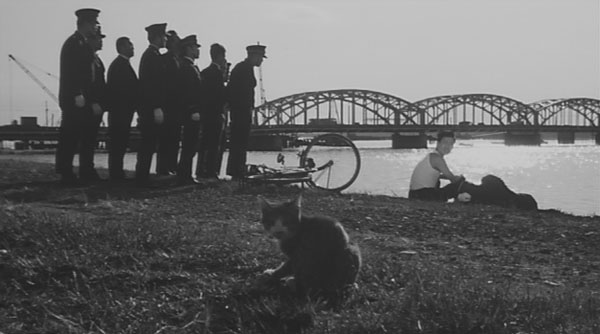
Movie gets straight to the point. After reading Tony Rayns say about In the Realm of the Senses that “there is no thing as the Oshima style,” I thought I’d check out one of his earlier films and see for myself. Sure enough, this has nothing in common with it or with Empire of Passion – it’s bonkers in its own particular way.

Oshima in 1964: “An artist does not build his work on one single theme, any more than a man lives his life according to only one idea. Foolish critics, however, want to think that works have just one theme running through them. Then when they find something that contradicts that one theme, they immediately say that they don’t understand the work. Our work has nothing to do with these foolish critics. We want to put into it everything we are thinking and experiencing now; if we didn’t, creative work would have no meaning for us.”

image

R., a rapist and murderer, is hung but seems unhurt. Since his body won’t die, they rule him demented – but now he can’t be killed because a demented man can’t realize his guilt and understand punishment. The surly chaplain says they can’t even pray for him because last rites have already been administered. R. seems to have amnesia, so the men in the room (prison officials, doctor and so on) act out his crimes to jog his memory. They tell him his history, convince him he is Korean, awaken his mind and memory in order to kill him again.

image

They get really into their re-enactments – the education minister (above) imagines that he has actually killed a girl on the roof of a building and the others think him hysterical – then one by one they begin to see the dead girl – then she’s not dead at all, rises up and starts to talk with R, says she’s his sister. The men are upset because R never had a sister, but that falls by the wayside, and eventually she and R are lying on the floor apparently naked under a sheet while the men all argue and cry and hallucinate around them. It’s that kind of movie. With its loooong shots and loose, imprecise framing, single location and shouty characters, it could’ve easily been done as a play.

Akiko Koyama, an Oshima regular, as the mysterious Korean woman:
image

Oshima 1964: “Unless you see people living in their own country, their true identity escapes you. The tragedy thus grows clear; the Japanese and Koreans have superficial and uncertain views of each other, and cannot see things in their true light.”

1968: “Death By Hanging had as its starting point the events set in motion by the criminal Ri Chin’u, perpetrator of the Komatsugawa High School incident. In my opinion, Ri Chin’u was the most intelligent and sensitive youth produced by postwar Japan, as demonstrated by the collection of Ri’s letter edited by Boku Junan, “Punishment, Death and Love.” Ri’s prose ought to be included in high school textbooks. Ri, however, committed a crime and was sentenced to death. I had been thinking of devoting a work to Ri ever since he committed his crime in 1958. … We created R, a character who did not die after execution.”

1974: “In ancient times, revolutions began with the destruction of prisons. No, history called the uprisings that were strong enough to destroy the prisons “revolutions.”

R (left) with the priest played by Toshiro Ishido, the writer of Oshima’s Night and Fog in Japan:
image

“Death only has meaning if we know it is coming.”

“I don’t want to be killed by an abstraction.”

image

Recommended listening: That Man Will Not Hang by McLusky

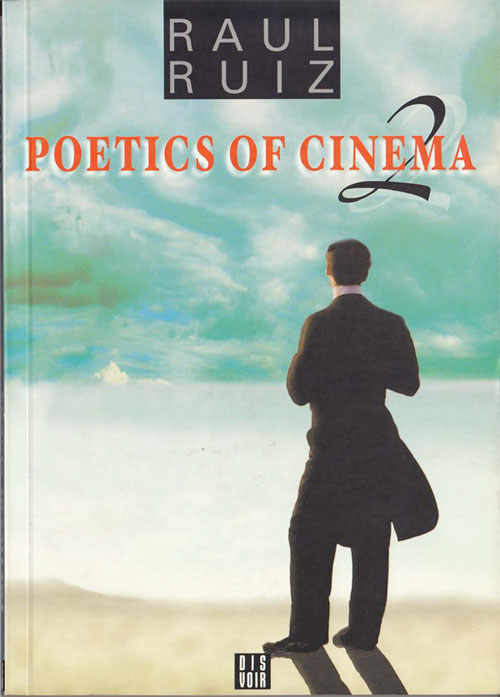
I don’t get 99% of his references, and I lose about 90% of his trains of thought, but I like these books anyway. Some good bits:

My goal is to show that certain germinal images or instant fictions are the best starting point for a film that wishes to have a poetic pretext.
On many occasions I have been asked whether: “All types of cinema must necessarily be poetic. Might a simply narrative cinema not be possible in our times? A type of cinema for which things are simply interesting as peripeteias?”
Yes and no.
I have already said this before: cinema is condemned to be poetic. It cannot but be poetic. One cannot ignore this aspect of its nature. For poetry will always be there, within out reach. If so, then why not use it?
Although it is true… that in most films poetry is incidental, more often than not it’s there partly due to the fact that it has been ignored; nor is poetry really found in so-called beautiful things: rivers, landscapes, mountains and sunsets. Rather, we find it in the haphazard intersecting of sequences, in the instances of narrative incoherence and in crossing sight lines.
Yet, it is there. It is.
From this point of view, poetry is endemic in cinema.

Describing the roles of different people on a movie set, “A lighting technician is above all a maker of shadows. Though nobody seems to notice.” He then suggests that movie studios could hire a philosopher “to destroy all that seems evident.”

Cinema ought to continually play with the harmony and lack of harmony that exists between narrative evidence and visual doubt (that which I have just seen- have I indeed seen it?)

Film is “a language, but composed solely of verbs.”

I don’t know what “this idea” refers to, and I read it twice.

In our field, in the practice of cinema, this idea… suggests the possibility of linking ideas, sequences and situations, which, though placed in different parts of the film, and despite what the distances between them may be (or rather, and I would be willing to say, the greater the distance the better), connect with each other, one reinvigorating the other. Not only because they participate in the same intensity, but also because they have the same ‘sequence of durations’. Five or six shots remind us of another five or six shots from another film and they feed each other by means of an effect that I call ‘mirrors of duration’. It’s not that these shots last the same amount of time. Rather, here we have two intensities, which I am tempted to call states of fascination, producing the effect of emotional detachment.

After beginning to describe the plot of an imaginary film:

Up till this point we’ve had a film about justice, about the act of judgment. A film about. And I seem to recall having mentioned that I find it hard to tolerate and, above all, to make films about … (We should remember that the first question that the average American viewer will pose when confronted by a film that perplexes him is: “What is this film about?”).

He swears the following is “not lacking in all good sense or reason as it might seem initially”:

A few days ago, together with some friends, we played with the following idea-situation: if we accept that what Hitler really wanted was to take possession of Vienna, then it would have been enough for him to stroll through the city’s streets, walk every now and then into one of the cafes, observe the people, breathe in the contradictory odours that escaped from the city’s chimneys. However, it seems that it was indispensable for him to be accompanied by an army and that he be worshipped by the dumbstruck masses. When we enter a film, we would like somehow to appropriate it ourselves, we wish to invade it, we would like for it to adhere to our expectations.

Oooh, a promised third volume:

In the third volume of the Poetics of Cinema, I will be much more explicit, more generous, regarding analyses of specific cases and in proposing exercises.

Ruiz notices his own book’s roundabout nature:

I would like to write: “Yet we shall develop this theme later”. But the translators, who at this very moment are rewriting my words into inadequate and foreign tongues, have already made me realise that each time I have said “but this theme will concern us later”, I have, in fact, forgotten it forever.

WTF:

How does one represent all men, Jedermann, as king of the world? As a lonely man? As the dictator who strolling through the palace of ten thousand mirrors confuses himself with his 200 doubles? Or as one who, smiling under the rain, is condemned to smile even in his coffin, for they are always filming him? The image-man, let’s say Tony Blair (NB A. Blair, the Prime Minister of Great Britain as the first edition of this book was in print, deceased two years later).

On metaphors:

Often, and at times immodestly, I have made use of metaphors in order to approach intuitively certain ideas; many of which could best be described as images and half-glimpsed visions. I hope that among them it is the angelic smile rather than the sardonic irony or the biting impetuousness that has the upper hand. ‘Metaphor’ is a word that has a bad reputation among theorists. To use it implies that one does not have clear ideas, and in that case, the best thing to do is to remain silent. That may be so and I regret it. Yet, in the present state of the arts: does anyone have clear ideas?

image

Some selections from the Treasures IV avant-garde set – just the ones from the 1950’s, so they’re all post-Desistfilm but pre-Mothlight.

Eyewash (1959, Robert Breer)
Flickers and movements, accurately titled. Saw this at the Anthology way back when. Think I prefer A Man And His Dog Out For Air over this. Includes a whole alternate version with (most of?) the same scenes in a different order.
image

Aleph (1956-66, Wallace Berman)
Berman isn’t a well-known filmmaker – this is his only film and it went unreleased (and even untitled) until now. A cool, unexpected addition to the set, instead of just focusing on known directors. Faces and jittery camerawork, bent and damaged and overlayed with filters and text, its jittery relentlessness (and John Zorn’s squealing sax) got me down after the first five of its eight minutes.
image

Odds & Ends (1959, Jane Conger Belson Shimane)
Stop-motion cut-outs and found footage and so on while a guy talks about jazz and poetry, this is supposedly an avant-garde spoof. If not for the jokey commentary, how can one tell serious experimental work from parody?
image

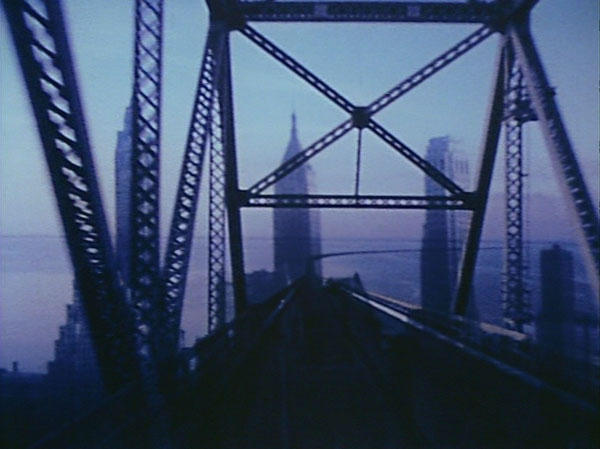
Bridges-Go-Round (1958, Shirley Clarke)
Have I seen this before, or only read about it? Looks familiar. A dance film with bridges, overlapping images like sci-fi architecture. Two scores – I prefer the Bebe Barron one.
image

Little Stabs at Happiness (1959-63, Ken Jacobs)
Just a dude with a grungy camera filming his friends and neighbors goofing around with props in a room and on a rooftop. Now that it’s less novel to own a camera, and the idea of releasing a film that isn’t a big studio production is nothing new, this seems to have lost its reason to exist. Then again, in Jonathan Rosenbaum’s Cinema Scope article he puts this in the “relatively familiar standbys” category, meaning cinephiles have been watching Jack Smith put balloons in his mouth for decades now, so maybe there’s something I’m missing. Some happy old records play over the start and end, but in the middle Jacobs narrates from ’63, telling us that none of these people shot in ’59 still talk to him, casting a mild bummer tone over the whole project.
image

Betty Boop in Snow White (1933, Dave Fleischer)
Just some animated shorts from the 30’s – but this one would fit in nicely with the avant-garde set because it is bonkers crazy and also one of the most excellent things ever. It’s vaguely SnowWhitey but the story comes second to wacky invention and Cab Calloway’s St. James Infirmary clown-ghost music video.
image

The Old Mill (1937, Wilfred Jackson)
This is Historically Significant, as the first film to use a multiplane camera. Won the oscar (same year as Torture Money) beating out something called Educated Fish and a dialogue-free animation of The Little Match Girl (sound familiar, Disney?). Animal life inside a battered windmill during an especially stormy night. Katy: “Aren’t owls supposed to be awake at night?”
image

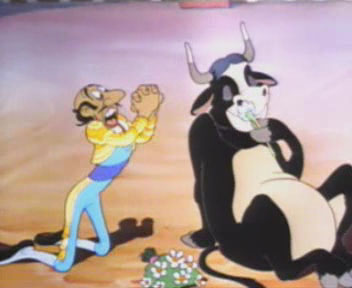
Ferdinand The Bull (1938, Dick Rickard))
Won an oscar against three other Disney shorts (including Brave Little Tailor, one of the only mickey cartoons I still remember) and a Fleischer short about two donkeys. Ferdinand is a pansy bull who wants to sit and sniff flowers all day. All the other bulls desperately want to be picked for a bullfight (seriously?) but our pacifist Ferdinand gets picked over them. He screws around and doesn’t fight and instead of killing him they send him back to the meadow to sniff flowers again. I don’t know what’s the moral here.
image

I’m behind on the ol’ movie blog, but nobody ever notices. If I watch a John Ford movie on video and I write about it a few minutes later, or four months later, nobody will know the difference. But posting on the Star Trek Remake three weeks after it came out seems like such ancient history. There’ve already been five or six blockbusters in theaters since I watched this – I’d be surprised if Trek is still playing.

Decent movie, anyway. Already one of thee greatest films of all time according to IMDB users, but I preferred Mission Impossible III. A bit wearying in its length and intensity, with an exasperating number of dialogue references to the original shows and movies (“dammit Jim I’m a doctor” was especially forced).

Good to see John Cho looking badass with a sword (his actual action is shot from so far away, it’s doubtful Cho went through months of fencing training to prepare for the role), and I enjoyed comic relief actors Charlie Bartlett as Chekov and Simon Pegg as Scottie. Eric “Hulk” Bana played the sneering Romulan (not Klingon) bad guy, and neither of us realized that Winona Ryder was Spock’s human mom. L. Nimoy is still a commanding presence, but his role amounts to being young Kirk’s destiny tour guide.

Movie gets its Kirk origin story out of the way (angry young man because of dead father at hands of time-traveling rogue Romulan, joins starfleet on a dare from captain Bruce Greenwood, happens to team up with random group of the best and brightest young crew in fleet history) before making Spock the focus of the movie. Future-Spock failed to save planet Romulus from black-hole destruction, so evil Rom wants Spock to watch him destroy planet Vulcan. Rom gets a 3-for-1 bonus, since both Spocks witness planet destruction and Spock’s mom dies in front of him, prompting a Wrath of Khan-esque action-revenge climax.

The filmmaking is super stylish but it’s not my favorite style… constant handicam motion, fast cutting, lens flare in every shot. Nice to watch planets implode and the torpedo fights and transporter effects. Pleasant enough diversion but I wouldn’t have felt bad to miss it entirely. Katy is annoyed that she had to watch this as a loyal Abrams fan and hopes he doesn’t make part 2.

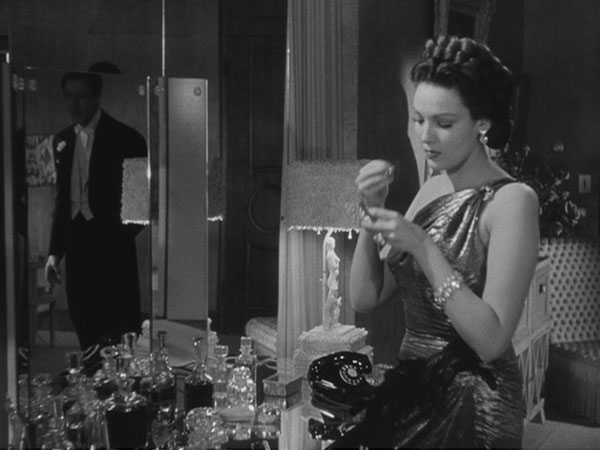
Rex “Henry Higgins” Harrison is a famed conductor. His brother-in-law (radio star and megaphone crooner Rudy Vallee, naive rich dude in The Palm Beach Story) hires a private detective to spy on Harrison’s wife (Linda Darnell, recently starred in My Darling Clementine), so Rex, against his own hatred of spying and his belief in trust, accidentally finds out that his wife may be cheating on him. While conducting that night’s three symphony movements, he has three fantasies in which he murders his wife (aided by a sound recorder gismo) and frames her illicit lover (Rex’s secretary) Tony, then he forgives her and writes her a giant check while making her feel small and unworthy, then he confronts the couple and kills himself in russian roulette. After the symphony Rex rushes home and bungles about in a painfully protracted slapstick sequence – he can’t make the recording gismo work, can’t find bullets for his gun, and spills ink all over his checkbook. Finally she casually explains away the circumstances that led detectives to suspect her of cheating, and we have our happy ending.

Recommended listening: Mad at a Girl by Robbie Fulks.

image

In the shot below, on right is secretary Kurt Kreuger (this must’ve been a relieving change of pace for him, after playing nazi flunkies all during the war), middle is brother-in-law Rudy Vallee, and left is Lionel Stander (Katy was appalled at his accent).

image

Caught some Sullivan’s Travels actors: valet Robert Grieg (here a butler, doing a different voice I think) and bus driver Frank Moran (here a fireman). There were more whom I didn’t recognize, but the standout scene was with a relative Sturges newcomer Edgar Kennedy (former Keystone Kop who starred in his own long-running shorts series) as the private detective who spied on the wife, confronted in his office by Rex. It’s one of my favorite scenes in any Sturges movie – beautifully written and acted, sharp dialogue becoming softer as the men bond over their love of music and hard truths they wish they hadn’t learned. William Demarest was around in ’48, acting in four films and voicing a cartoon character for Walter Lantz, so I don’t know why he couldn’t make it onto Sturges’s set.

Don’t think I ever realized that Sturges’s cinematographer is Victor Milner, who worked with Lubitsch in the 30’s and shot Trouble In Paradise. Both Paradise and this one have far more interesting camera work than your average comedy. This one is notable for the looooong zooms into Rex’s eye before each of the fantasy sequences.

Full of wordy dialogue like “August, what happy updraft wafts you hither?” and “You handle Handel like nobody handles Handel,” which enriches the movie to no end, but makes it wearying over its almost two hour runtime (and that’s after having a half hour cut by the producer).

Linda Darnell, unaware that Rex is behind her with a razor in his hand:
image

Nice DVD extras – Terry Jones says it’s a satire of the masculine self-image and Sandy Sturges tells of a romantic scandal involving a girl killing herself over Rex Harrison which made this movie impossible to promote. Commentary points out that this came out the year after Monsieur Verdoux, obviously similar in a few ways.

Meaning of Harrison’s line “my family’s product has kept England on time since Waterloo” is that the real conductor on whom the character was based inherited a family fortune from laxative pills.

This was a script from the early 30’s that Sturges considered as his directorial debut, but the studio didn’t want it at the time. It’s the subject of Sturges’s only remake to date, a flop 1984 version with Dudley Moore, Nastassja Kinski and Albert Brooks, scripted by the writers of And Justice For All.

The final film in one of the most enjoyable and satisfying trilogies of the decade, following the somewhat-rough Takeshis’ and the glorious Glory to the Filmmaker. Unfortunately, nobody else seems to enjoy these movies. When I searched online for info on this film, the most positive sentiments I could find were along the lines of “hooray, now that this nonsense is over, Kitano can get back to making movies worth watching.” And nobody I know personally will even watch them so discussion is nil… they are just my own private joy.

image

Totally different from the previous two, this one tells a linear story about a single character, Machisu, a painter. Constants in his life are a complete lack of critical or financial success, and people in his life dying (usually of head trauma), all of which Machisu tolerates silently with an impassive expression. Very self-deprecating (portrait of the director as a lifelong failed artist, a slack employee, a bad father), but I see some value in Machisu’s persistence, his single-minded refusal to stop painting, even the persistence in his suicide attempts at the end, which he finally combines with his painting. Maybe the movie was trying to show that this persistence is stupid, ridiculous, but I’m gonna read it my own way.

image

Starts out sometime post-WWII, maybe the 50’s, classically shot with your standard orchestral movie score, with Machisu the grade-school son of a rich banker father (Ren Osugi of MPD Psycho, Charisma, Fireworks) and his younger wife (Kanako Higuchi). Everyone from the parents to the teachers to the bus drivers indulges the boy’s painting whim and let him do what he likes. Bank crisis leads dad and mom to kill themselves (separately) and Machisu is shipped off to uncle Akira Nakao (of a buncha Godzilla movies) and aunt Mariko Tsutsui (of One Missed Call). Now uncle wants him to do housework, teachers want him to pay attention in class, and bus drivers won’t stop and let him paint them (as he’s leaving town, a bus kills a fellow painter, Machisu’s only friend).

image

Years later, Machisu is older and working at a newspaper press – now played by Yûrei Yanagi (of the Ju-on and Ring movies, but probably cast because he starred in Boiling Point, Takeshi’s first film as sole writer/director). Not sure how old he’s supposed to be – I’d assumed 20’s, but the actor is in his mid-40’s. Anyway, at his art dealer’s suggestion (he takes all his art dealer’s suggestions), he starts attending art school. He also hangs out with a group of over-enthusiastic classmates who try outrageous art projects, and dates a co-worker at the paper plant (Kumiko Aso, lead girl in Pulse). Two classmates die – one in a painting-by-car-crash experiment and one from suicide – and another goes on to fame (called “the Japanese Basquiat”, leading Machisu to study and imitate Basquiat). Machisu’s work is all imitation. He copies the styles of every artist he studies, one at a time, and if he manages to get a compliment on a painting he makes a pile of similar paintings. The dealer assures him none of this is worthwhile, and Machisu’s apartment becomes cluttered with his failed work. Meanwhile, some of his childhood paintings show up around town, sold by the dealer to gullible rich men as the work of unknown foreign master painters. It’s all a funnier and less shrill takedown of the art world than Art School Confidential.


image

image

In the third section, Machisu is finally played by our man Kitano, married with a daughter. His wife is an accomplice in his art projects, but the daughter is deathly embarrassed, finally leaves home and becomes a prostitute. People in general seem to have less patience for Machisu and his painting than ever before, and after the daughter’s death, his wife leaves him and Machisu attempts suicide – first by monoxide poisoning, then by sitting and painting in a wooden shack which he has set aflame. Rescued and bandaged from head to toe, he tries “found” art, picking a can off the street and trying to sell it until his wife comes by and picks him up.

image

image

The hundreds of paintings are by Kitano himself, which seems pretty monumental, even if they’re all supposed to be bad art. A cartoon intro (which explains the title) sets us up for disappointment, our hero never catching up with success because he’s always chasing it instead of setting his own path. The humor is dark when there is any. I think it’s a wonderful ending… just the sappy standard “walking into the sunset with girl on your arm” ending, but it’s a deserved bit of uplift after the last 15 minutes of failure and death that came before.

image

Kitano: “After my last two films, I’m approaching this one more seriously. Sometimes I want to make movies that pack audiences in.”

image

Recommended listening: Art Class by Superchunk

“Sympathy is the worst of the seven deadly sins.”

image

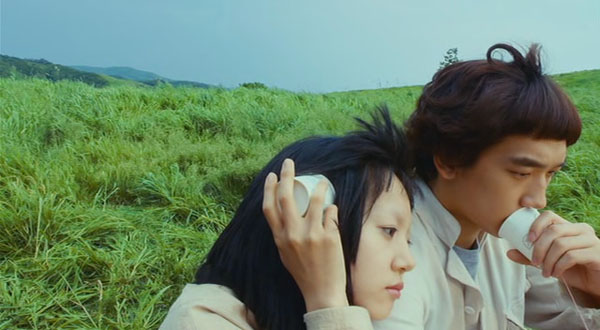
Title credits built into the opening scene shout: “I Know Where I’m Going!,” but the cartoonish situations, lively editing and bright colorful cinematography reply: “Amelie!” Maybe Park was afraid of being typecast as a grim downer of a filmmaker, a Korean David Fincher, and so like other grim young typecast filmmakers before him (Danny Boyle, Robert Rodriguez) he set out to make something light and lively to prove that he can – but maybe not as light as conceivably possible since it’s set in a mental institution.

image

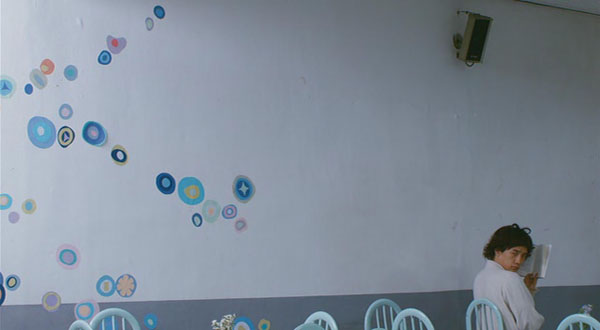
Our girl Young-goon is a bit of a sociopath and likes to talk to machines. Cute boy Il-soon is a thief, but steals intangible things: a ping pong serve, someone’s appetite, Thursday. Other colorful patients include a fat girl obsessed with her skin, a super-polite guy who walks backwards and spends all day apologizing, a girl who only looks at her hand mirror.

image

Park includes a violent kill-all-authority-figures fantasy into his light mental-illness comedy when the girl (who is, of course, a cyborg) fantasizes her hands becoming guns, blowing away all the nurses. She very nearly starves herself to death (cyborgs do not eat human food) but she’ll be okay in the end, thanks to the cute boy who truly understands her.

image

In true Amelie style this has got wonderful visuals so those who aren’t enchanted by the story and characters can delight in the cinematography (and accordian music, hmmm) – Park’s got all his bases covered. His filmmaking genre versatility proven, the typecast of dark sadistic violent films safely behind him, it sounds like Park has just turned in a dark sadistic violent vampire movie at Cannes 2009, heh.

image

Recommended listening: Become a Robot by They Might Be Giants

Set over one year in the mid-to-late 30’s, mostly follows high-school-aged Titta and his family but leaves breathing room for the rest of the town and its inhabitants. The rare ensemble movie that gives everyone a memorably distinct identity without resorting to stereotyping.

On one hand, it would be worth renting the Criterion DVD and poring over the hours of extras. On the other hand, there’s no outside explanation needed for Amarcord. Need to watch this again and again… I’m pretty sure Katy would like it.

The title is slangy for “I Remember.”

I can’t account for why this won an oscar one year (best foreign film) and was nominated for more oscars (writing, directing) the following year.

I always think of “fascism” as a bad word, an insult thrown at your government by foreigners, forgetting that once Italians were screaming their support of fascism in the streets. Nutty buggers.

I don’t think this was packed with movie stars. Red temptress Magali Noël had been in Satyricon, Titta’s mom would appear in Cinema Paradiso 15 years later, and mad uncle Teo would direct a parody of The Exorcist.

So, another great Fellini film, combining the circus-film group atmosphere of 8 1/2 with touches of the tragedy of La Strada, with fortunately no La Dolce Vita influence to be found. I didn’t let the dubbing get me down, but I’d thought a new print of a new restoration of an only 30-year-old film would have more vibrant color than it did.