



The Shooting (1967)
Awesome, mysterious western. Performances are understated except by Will Hutchins, who maybe tries too hard to be the stupid one, and Millie Perkins, who maybe tries too hard to be the unknowable badass.
Your comic relief: Hutchins of Merrill’s Marauders

Will is hanging out with friend Leland when Leland is shot to death by offscreen persons unknown. Later on, Warren “GTO” Oates rides up looking for Leland, and both of ’em get surprised by Millie, who hires ’em to come with her.
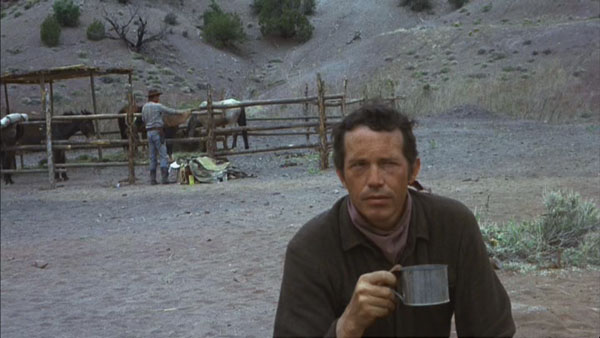
The movie never explicitly tells us that she’s looking for revenge on Warren’s evil twin brother and that the men are hired to help track him, and if it had told us it probably wouldn’t enjoy the same cult success. All the carefully hidden information keeps things exciting.
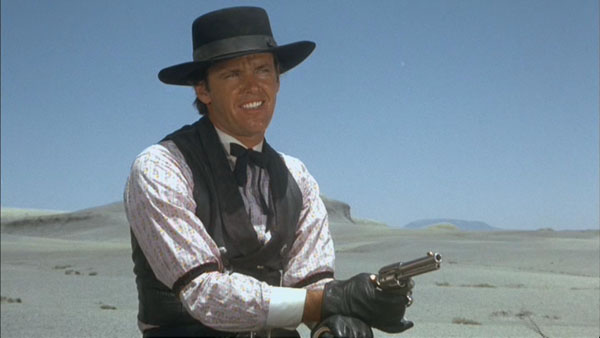
Fastest-gun-in-the-west Jack Nicholson trails them unseen for a long time, then rides openly with ’em after he’s discovered, just being a huge jerk. Starts to become clear that he and Millie are obsessed with something, and Warren and Will probably won’t make it home… then suddenly they’re hot on the trail of the brother, and a subliminal shootout leaves us wondering what just happened.
Kind of a haunting movie, well paced and shot by reliably weird cinematographer Gregory Sandor (Forbidden Zone, De Palma’s Sisters).

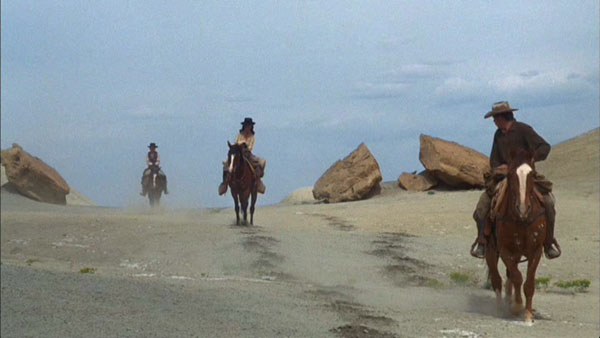
Ride in the Whirlwind (1965)
If you think about their relative effectiveness and beauty and straightforwardness of plot, this movie would seem like the cheapie add-on flick of the two (Hellman and Nicholson went into the desert to shoot a movie and exec-producer Roger Corman said “while you’re out there, why not shoot two movies”). But this one has more actors, more gunshots and more buildings burning down, so it was intended to be the real picture, and cult-classic The Shooting was the “aw hell, as long as we’re here” picture. Funny how things work out.
One of Harry Dean’s first credited movie roles:

Three plain ol’ regular-guy cowhands, not heroes or great gunfighters or brilliant problem-solvers, just plain-damn-ol’ guys, run into some bad dudes who just robbed a stagecoach. The bad dudes (led by eyepatch-sporting Harry Dean Stanton) concoct a story which our men see right through, but both decide to tolerate each other for the night. But oops, lawmen catch up with the baddies and assault their shack hideout assuming our fellas are part of the gang. Otis catches a bullet, so the other two, Vern (chewy Cameron Mitchell, then of Hell and High Water and House of Bamboo, later in Space Mutiny) and Wes (our writer Jack Nicholson, remarkably good at playing a regular guy) flee to the hills.
Otis (the good guy who gets killed) is played by the writer of sci-fi crap classic The Space Children.

The hills and the shack both prove hard to escape. Finally the shack is burned down, and the surviving criminals are hanged. Meanwhile, after some close calls with bullets and cliffs, our two guys find a ranch house populated by stump-choppin’ routine-livin’ dad George Mitchell (of Face of the Screaming Werewolf), his barely-there wife, and their daughter, 27-playing-18 Millie Perkins. Our guys hold ’em hostage planning to wait out the lawmen, trying not to offend or do harm while remaining threatening enough to be effective.
Rupert Crosse is credited as “indian joe” but I’m not so sure he’s Indian:

This is the best part of the movie, the tense waiting, since all the chases and gunfights are all pretty routine. Checkers are played, the horse stable is visited, and the family is told that our guys are gonna have to steal two horses to get away. When the lawman comes a-calling, George Mitchell tries to get sneaky, resulting in a final shootout which kills Mitchells George and Cameron (no relation?) and leaves Jack riding away (not into the whirlwind; there is no whirlwind).
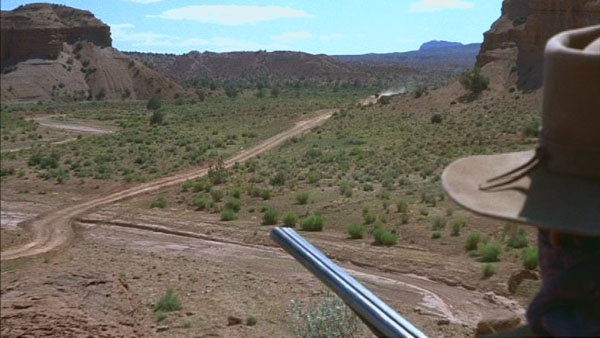
“I hope your midget doesn’t kill himself. Your dream sequence will be fucked.”
Kinda darker than I thought it would be, even knowing it’s about hitmen. Lotta killing of kids, midgets and likeable main characters. Funny dialogue… can’t compare to Hot Fuzz, but what can?
Gleeson and Farrell are hit men hiding out (cuz Farrell accidentally shot a kid while killing a priest), sent to Bruges by boss man Raifffiennes, who it turns out wants Gleeson to kill Farrell. Gleeson decides to let him go and face the consequences, which are death by shooting then falling off a bell tower. A Raifff/Farrell shootout results in four bullets in C.F., one dead dwarf, one Raifff suicide, and a parting shot by Farrell guessing that if hell is like Bruges, he wants to live.
Along the way Farrell meets a pretty girl, wounds her skinhead boyfriend (star of L’Enfant, didn’t recognize him without all the blond), offends the landlady, and befriends the dwarf (rad, it’s the guy who played Howard The Duck). Dwarf is appearing in a local film with lots of dream sequences, Raifff has buncha dialogue about Bruges being a fairy-tale place, there’s some afterlife/purgatory business, and apparently it’s all a homage to Don’t Look Now, which I haven’t seen. Anyway, very enjoyable flick.

49th Parallel (1941)
The Archers wouldn’t exist as a production company and Pressburger wouldn’t get a co-director credit until the following year’s One of Our Aircraft is Missing – he just contributed the story for this Powell-directed piece of WWII propaganda. Movie hammers home its points (nazis are bad; Canada is great) with a series of episodes, each of which further weakens the nazi force which is inexplicably (I was spacing out during the first ten minutes) invading Canada and making their way south to the USA.
The first, last and most effective attacks are made by our valiant troops, who kick off the fun by bombing the nazi sub which has just landed six advance soldiers to secure a trading post. Now these six guys (led by hardass Eric Portman, kindly given a role the next year as a loyal allied copilot as payback from P&P for being such an effective nazi) constitute the entire german force in Canada – if they can cause some damage and make it to neutral USA they’ll be hailed at home as heroes, so it’s of moral importance to stop them. Seems perverse to me that my flag-swingin’ nazi-hatin’ country was considered a legal safe haven for german troops in ’41.
There I am in Canada, right between Carberry and ASSMNBOINE:

First stop: the outpost. They hang out there for a while, steal some gear and shoot a whole pile of eskimos. Meanwhile, horror of horrors, who should be at the outpost but Lawrence Olivier playing a French-Canadian trapper just returned from a year expedition (so unaware that Canada’s at war). F-C Olivier joins Japanese Mickey Rooney from Breakfast at Tiffany’s and Blackface Bing Crosby from Holiday Inn in the Casting Mistakes Hall of Fame. If the movie was meant as a love letter to Canada, I can’t figure why Powell would want to start off with such a loud, ridiculous caricature of a Canadian. Maybe Olivier, recently in Rebecca, brought great publicity to the project so nobody wanted to risk insult by having him tone down the accent. Anyway, he quickly gets up to speed, decides what side he needs to be on, and makes a grab for the radio, getting himself killed. The nazis hail a plane, then kill the pilots and take off, getting one man shot by an eskimo.
What’s the only thing hammier than Laurence Olivier as a French Canadian? Laurence Olivier as a dying French Canadian. “Let me axe you one kestion.”

Plane crashes in the water – that’s another nazi down, four to go. They stumble into a group of religious commie idealists with german roots led by noble Anton Walbrook (ballet instructor in The Red Shoes), and thinking they’ve found kindred souls, Portman makes a big hitler speech which falls flat. Time to move on, but one nazi (Niall MacGinnis – not a very german sounding name – of The Edge of the World, later Zeus in Jason and the Argonauts) is inspired by the freedom of this community, decides to stay on and be a baker and be in love with hot local chick (Glynis Johns of The Sundowners, The Cabinet of Caligari), so other dudes execute him. Harsh segment, but also the most beautiful part of the film, visually and idealistically.
Germans always heil each other before going to bed:

Big city parade, the authorities are closing in on our men. They make an announcement describing the three germans – one cracks under pressure and gets captured. Last two nazis hide out in the woods, bust in on a society escapee, pacifist writer Leslie Howard in his teepee, enjoy his hospitality then tie him up and break all his stuff to settle a political disagreement. Our pacifist escapes, chases the guys down, and beats the shit out of one of ’em. I see Leslie Howard played Henry Higgins in Pygmalion – makes sense, he seems the Higgins type. He was killed in the war a couple years after this came out.
This was meant to be inspirational:

Last guy (Portman, natch) makes it to the border on a freight train, runs into an AWOL soldier (Raymond Massey of The Fountainhead, East of Eden) and takes his uniform. Soldier wakes up, realizes they’ve made it to the states, but convinces the train dudes to send ’em back over the border (still locked in their freight car) with the excuse that Eric Portman wasn’t on the manifest. Massey advances on Portman, giving one of the best final lines in cinema history: “I’m not asking for those pants… I’m just taking ’em.”
Edited by David Lean (which is why it’s over two hours long, ha) who’d start directing the following year, and shot by the future D.P. of Lean’s Lawrence of Arabia. Movie is too talky and obvious, but then, it’s a government-funded piece of propaganda. Given that fact, and the problems of filming during wartime, the movie is almost impossibly good – and at the very least it’s a nice tour through Canada.
–
I Know Where I’m Going! (1945)
Whew, a wonderful poem of a film, foggy and deadly romantic. Wendy Hiller (Eliza in that same Pygmalion with Leslie Howard, which now I must see; in Lynch’s The Elephant Man 35 years later) meets dashing Roger Livesey (the fat man in Colonel Blimp…!) on her way to meet her fiancee and falls in love with him instead.
Title is well explained in the elegant opening credits segment. Joan (Hiller) is obsessed with wealth and manages to climb higher and higher, finally gets engaged to super-wealthy guy who lives on a remote Scottish isle. One of my favorite-ever scene transitions, a puff of smoke from a top hat turns into the smokestack of a train engine, and she’s off to be married.

After a nuts dream sequence aboard the train (see above), Joan finds that she can’t cross to the island because of the fog, nor can anyone cross from there to pick her up. Stranded, she tries not to make friends with Torquil MacNeil (Livesey) but can’t seem to help it… hangs out on the mainland with him, his welcoming friend Catriona (Pamela Brown, Hoffmann’s silent companion), and local falconer Col. Barnstaple (an actual falconer, does a hilarious job in his only acting role).
Livesey and Pamela:

Barnstaple and Hiller:

Conflict arises because Joan is starting to like Livesey (an awfully likeable guy – friendly and handsome and a good dancer, plus it turns out, the laird of the island where her man lives). No longer knowing where she’s going (!), she panics, decides she must get to the island immediately. Praying for wind to lift the fog didn’t work, since now the wind is too high to sail, but she bribes the boatman’s son into taking her. That doesn’t work out, ship is almost wrecked, saved by brave Roger. The next day, she’s finally headed for the island, Roger staying behind. Roger strolls into an ancient castle to which his family has been forbidden entry for generations and, well, the ending is too wonderful to retell.

Adding to the spooky atmosphere is music by Allan Gray (protagonist of Vampyr). There’s more: falcons, a whirlpool, and a phone booth by a waterfall, plus glorious location photography, but I’ll be watching it all again soon.
Finally, since it’s awards season in the movie world, one of my three known readers David Cairns has awarded this site a Premio Dardos. David writes the only film blog I read, the tremendously entertaining Shadowplay, and he still finds time to contribute articles to The Auteurs. The Premio Dardos is a JPEG image of unknown origin (unless I bother to google it) that comes with a series of rules I might not follow, but it’s sorta like if your shitty local band gets paid a compliment by a nationally-touring rock act – still an honor.

Still not so sure I understand the auteur-stamp of Howard Hawks (some characteristics of which were discussed after watching His Girl Friday). But gosh does he make entertaining movies. Both of these built up tension and excitement, then came up with improbably happy endings for our heroes.
To Have and Have Not (1944)
A few years after His Girl Friday, same year as Wilder’s Double Indemnity. Novel by Hemingway, adapted by Faulkner – that’s some writing credentials. Bogart, so soon after Casablanca, is again trying to stay coolly neutral in a tense city occupied by wartime Vichy France (Martinique this time), falling for a girl who’s trying to skip town. This time the girl is smoky, deep-voiced Lauren Bacall (her first movie) and Bogie’s drunk friend and partner in his fishing boat business is triple oscar-winner Walter Brennan of Lang’s Fury & Hangmen Also Die. Clearly a great character actor, Brennan spiced up both movies considerably.
Bogie has been taking an obnoxious customer out fishing all week, catches Lauren picking the guy’s pocket before Bogie has been paid, but all is forgiven when guy catches a stray bullet during a police raid at their favorite hangout bar (a secret meeting place for the anti-Vichy free French underground). Now broke with no customer, Bogie takes a job ferrying a French couple in his boat, then helping the guy when he gets his stupid self shot. Suspecting Bogie’s involvement, the nazi collaborators hold Eddie (that’s Walter Brennan) hostage and refuse him alcohol until Bogie gives up the hostages. This is the point when I decided the movie is not trying to be grimly realistic. I hadn’t felt any sense of danger or suspense so far, not even when the boat was shot at, and now this kidnapping has hardly begun when Bogie shoots a guy through his desk, turns the tables on the baddies and escapes with the girl. He’s sort of an untouchable superhero version of his Casablanca character, and he’s got a sexier, younger and more independent woman.

Bacall sings with Hoagy Carmichael in the “Sam” role. Hoagy wrote “Georgia On My Mind” (for real, not in this movie).
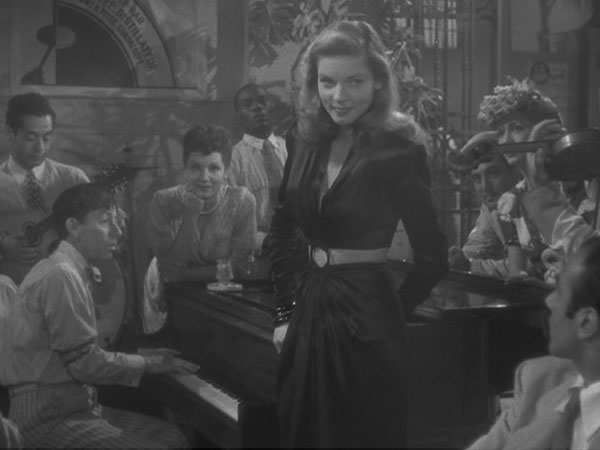
Frenchy – the clockwork-loving party host of Rules of the Game – works the hotel bar and helps protect and organize the resistance.

Johnson, Bogie’s customer, is rear-projection fishing. Looks like fun – and it’s six decades before the Nintendo Wii was invented.

Walter Brennan manages to be a funny drunk without being a typical W.C. Fields-ish classic Hollywood drunk. In fact, he’s the most believable guy in the movie.

–
Rio Bravo (1959)
I guess I’m spoiled, since the only westerns I’ve watched in five years are this one, The Searchers, and those Budd B. pics from last week – none of the standard-quality workman stuff which everyone watching this in ’59 would’ve seen, nor the 50’s hits this was supposedly reacting against (3:10 to Yuma and High Noon). The Searchers had a darker edge to it, while this one has a giddy, explosive shootout ending in which the heroes are hardly in any danger, just a buncha bonkers western fun. Wasn’t expecting that.
One of the last films by Hawks, less prolific in his old age. Six years after Gentlemen Prefer Blondes, same year as The Crimson Kimono, North By Northwest and Ride Lonesome. Apparently his beef with High Noon was that the sheriff runs around town asking everybody for help. Hawks and Wayne thought that wasn’t right, and wrote themselves a less wussy lawman, someone who’ll take on a hundred men if he has to, and won’t even accept help from most people, let alone ask for it.
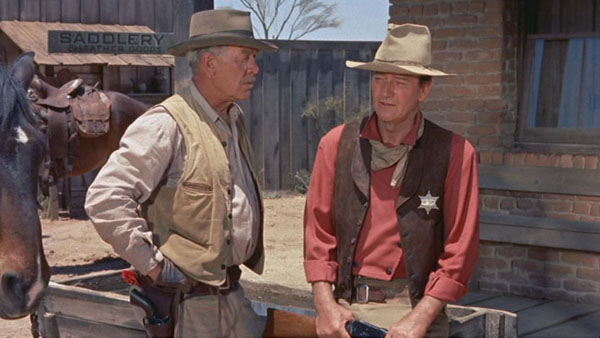
I liked this movie even better than the other. Wayne, wearing a series of colorful shirts, arrests the brother of a real badass for killing a guy in a drunken brawl, with the help of disgraced, drunken former deputy Dean Martin (best acting I’ve ever seen from him). A few years after Artists & Models, Dean had blown off Jerry Lewis and gone serious – but Ocean’s Eleven was just a year away, probably put a small dent in his perceived seriousness. Ol’ Walter Brennan from the other movie is a wacky deputy who minds the jail. Walter’s the life of the party, as usual.
Dean checks out Walter’s John Wayne impression:
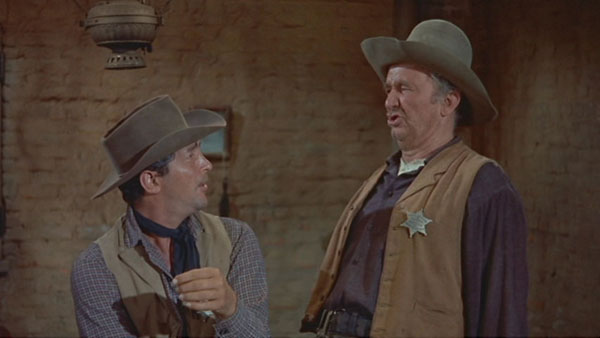
Now Joe’s in jail and every bad dude in town is angry about it. The stage rolls into town carrying Wayne’s old buddy Ward Bond (a John Ford regular), hot chick Angie Dickinson (China Gate, Point Blank, elevator victim in Dressed To Kill) and quickdraw Ricky Nelson (teen idol and TV star). Ward offers to help, Wayne turns him down but a few hours later Ward is shot anyway.
The late Ward, and Wayne who has a colorful shirt for every occasion:
Ricky and Angie:

Eventully badass Burdette (John Russell of The Sun Shines Bright) shows up to help his brother (Claude Akins of The Killers, Merrill’s Marauders). Plans to raid the jail are derailed when they hear Walter will happily blow away the brother if anyone tries anything.
L-R: Walter, a jailed brother, a badass

Action! Dean is kidnapped, Helpful hotel owner Carlos and his wife are kidnapped, shootouts on the street and in the hotel, Walter Brennan gets to use that shotgun, Ricky and Dean each sing us a song, movie ends with a suspenseless comic scene, our heroes all tossing dynamite at the building where Burdette has holed up, shooting and laughing – not the kind of grim, fateful finale you usually get in a violent western. So right, I don’t know what kind of Hawksian analysis the critics apply to scientifically prove this film’s greatness, but I sure thought it was a tootin’ good time.
Think this is one of those seminal films that make people foam at the mouth about the 1970’s being the best-ever movie decade. Usually I’m skeptical, but this one lives up to the rep. Can’t believe it took me this long to watch it. One of Altman’s scattershot ensemble pieces illustrating life, sex, violence, media and politics over one weekend in the mid-70’s, closer to the messy truthfulness of Short Cuts than the more conceptually-unified Prairie Home Companion. Plot, then, defies simple description, so here are a bunch of character sketches instead.
Solo Opry stars:
Tommy Brown and Haven Hamilton (Henry Gibson, suspicious neighbor in The Burbs) are the friendly male stars, while Connie White (Karen Black of Burnt Offerings, House of 1000 Corpses) and Barbara Jean (Ronee Blakley, Nancy’s fred-krueger-killin’ mom in Nightmare On Elm Street) are bitter rivals. BJ is recovering from exhaustion, acts slightly crazy throughout the picture.
The Trio:
Up-and-coming band “Tom, Bill & Mary” consists of relatively uptight Bill (Altman regular Allan Nicholls), Mary (Christa Raines of Ridley Scott’s The Duellists) who is married to Bill but secretly sleeping with Tom, and bearded free-spirit Tom (Keith Carradine of Street of No Return) who sleeps with near every girl in the movie.
Politicians:
Third-party candidate Hal Phillip Walker (inexplicably running in state “primaries” in a misuse of political language) is often heard but never seen. His campaign manager John Triplette (Michael Murphy of Tanner ’88, X-Men 3) is everywhere, trying to recruit music stars for a rally. Del Reese (Ned Beatty of Deliverance, Network, Stroker Ace) is a heavy dude assisting Triplette. Triplette basically tricks Haven and Barbara Jean into appearing at the climactic rally.
Media:
Off on her own is BBC journalist Opal (Geraldine Chaplin, the year before Noroît). I was happy to see her at first, but her character is so awfully self-absorbed and oblivious to the world and personalities that she’s purportedly researching, she soon became mere comic relief.
Crazies:
The ever-present magician-looking guy on a three-wheeled hog was Jeff Goldblum’s third movie role (California Split was his second). Shelley Duvall, in the middle of her Altman film streak (ended with Popeye) plays a flamboyant girl often explained away with “she’s from California.” A boarder at her house named Kenny shoots Barbara Jean at the rally in the final scene, and the guy who tries to stop him, army private Kelly (Scott Glenn, just played Rumsfeld in W.) has been stalking B.J. throughout the movie. Poor Sueleen Gay (a great name, played by Gwen Welles of California Split) is an enthusiastic red-haired waitress who wrongly thinks she can sing, reduced to strip-teasing at a pre-rally bar party.
The Rest:
Sueleen’s coworker Wade looks out for her. Sad Mr. Green (Keenan Wynn, guy leading the attack on General Ripper in Dr. Strangelove, also in Point Blank, Piranha, Laserblast, Parts: The Clonus Horror) is the California girl’s uncle; his wife dies in the hospital. Barnett (Allen Garfield of Brian De Palma’s early films) is Barbara Jean’s controlling husband/manager. And Lily Tomlin, in her first film, is campaign fella Del Reese’s wife, mother of two deaf kids, who sneaks away to sleep with former flame Tom of the trio.
Movie made piles of money. Won piles of awards except at the oscars (lost to Cuckoo’s Nest), baftas (Alice Doesn’t Live Here Anymore) and grammies (Jaws). Acting awards were difficult – Golden Globes gave it four nominations just for best supporting actress, surely a record. Lots of gossipy maybe-true bits online: Nashville was going to be two movies, the unused footage was to become a miniseries, and a sequel was written and cast before falling apart.
Shot in wide-ass cinemascope with no close-ups (by the D.P. of Coffy and Silent Movie), so screenshots aren’t much help. Would be reeeeal nice to see on the big screen someday. Did not play the DVD commentary by Robert Altman because I didn’t want to listen to him drift in and out of sleep for 2.5 hours.
“Time doesn’t matter, I’ve learned. It does as it likes.”
In the same week that I declared I wouldn’t watch any more French movies and then watched one anyway, I decided as long as I was transgressing I’d go ahead and watch another French movie and make it one which I’d actually like. And I did like it, but I didn’t exactly see what’s the big deal about it. The impetus for watching this now was the two articles on the film and director in this month’s Film Comment, so after watching, I read both of those and didn’t get a whole lot out of ’em. Now I’m thinking I shouldn’t have futzed about with High Art while I was sick, maybe just watched a zombie movie.
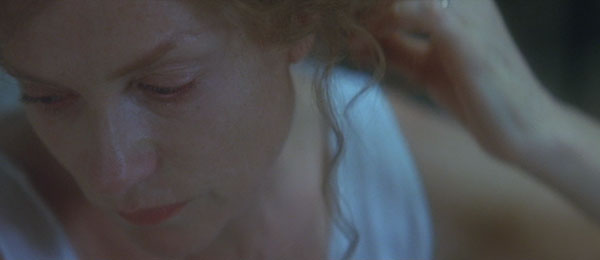
Gabrielle (Isabelle Huppert of The Piano Teacher and Time of the Wolf) leaves a note and walks out on her husband of ten loveless years.
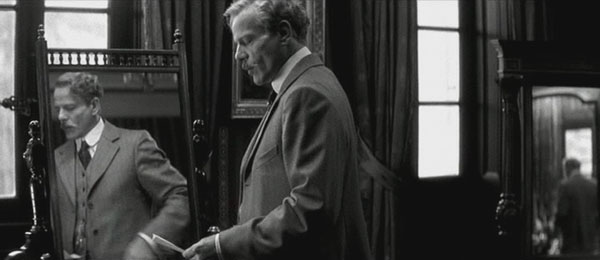
Husband (Pascal Greggory of Time Regained) reads the note, questions the servants, gets upset… but then she returns a few hours later.

They argue, sometimes quietly among themselves, sometimes loudly in front of servants and guests. She’s upset, but always seems to have the upper hand.
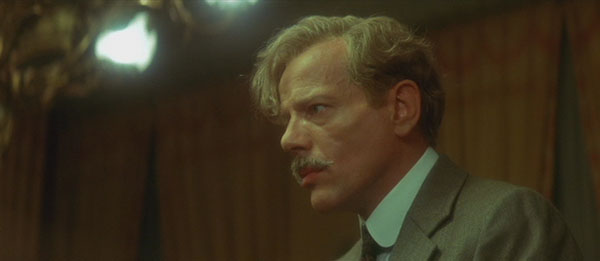
Finally he cries out for her love, and she says there was never any. He walks out defeated, to never return.

Her affair is with her husband’s editor (an employee, I think), Thierry Hancisse of the last Costa-Gavras film. Don’t remember him having any dialogue. He’s at the house for two parties at the beginning and end of the movie (I think action spans a week) nervously reacting to their looks and words.
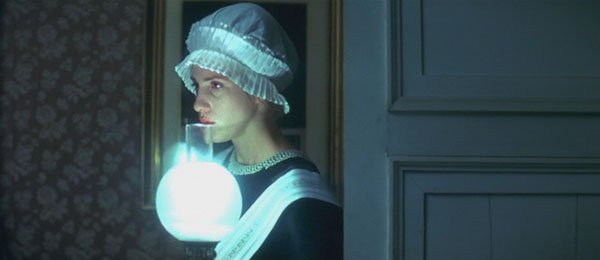
Gabrielle alternately confides in her servant Yvonne (Claudia Coli) and pretends to confide in her… acts cruelly superior to her and treats her with empathy. It’s an even more interesting balance than the one with her husband.
Based on Joseph Conrad. Same cinematographer as A Christmas Tale. Would’ve been nice to see this in theaters, all low light and heavy grain, switching between black/white and color. The three-review round-up on Indiewire/Reverse Shot says plenty about the film which I don’t feel compelled to repeat here. Nice batch of DVD extras which I might go through sometime.
Action of the movie spans 400 years, with title cards telling us when we are.
1600 – Death

Young Orlando is favored by Queen Elizabeth I (gay performer/activist Quentin Crisp – I must see his 70’s Hamlet), who orders him to never grow old.
1610 – Love

Orlando is smitten with a visiting Russian princess (Charlotte Valandrey). They ice skate together, O. pledges his undying love, and when she leaves the country he attempts a romantic rescue but gets his ass kicked.
1650 – Poetry
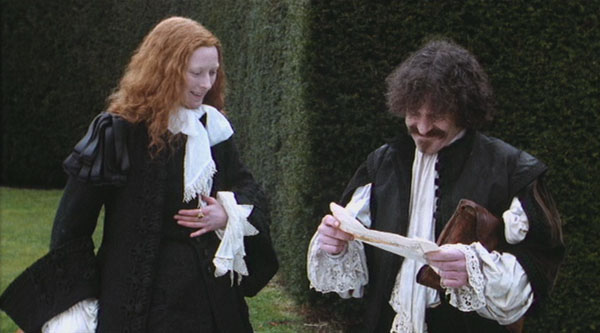
Orlando is obsessed with poetry, and decides to sponsor acclaimed poet Nick Greene (Heathcote Williams of Jarman’s The Tempest). O. tries his own hand at poetry, unsuccessfully.
1700 – Politics

Orlando goes to “the east” as an ambassador, hangs out with the Khan (Lothaire Bluteau of Jesus of Montreal), accidentally gets involved in a war. Filmed in Uzbekistan!
1750 – Society
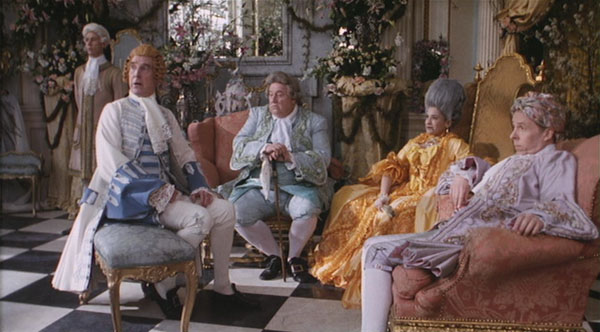
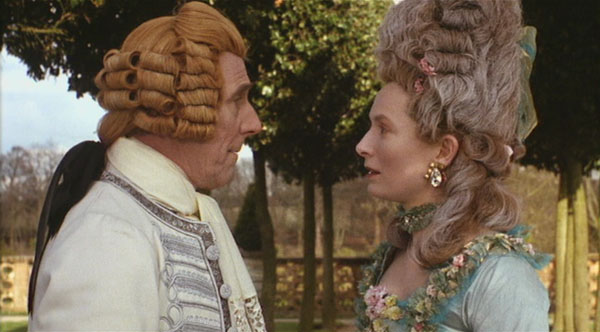
Back home, Orlando wakes up one day as a woman. She puts on the most massive gown she can find and goes out to a small party held by Archduke Harry (John Wood of Richard III). She’d met Harry in 1700 (he’s barely aged – the movie does not treat its timeframe very literally) and he is very intrigued… offers to marry her, then curses her when she refuses. Also at the party: high-haired Kathryn Hunter (who played a plot contrivance in the last Harry Potter), Roger Hammond (Demy’s Pied Piper), Peter Eyre and Ned Sherrin.
1850 – Sex

Orlando runs through a hedge maze straight into 1850, where she meets and falls for Billy Zane. I know, right? Billy Zane!
Birth
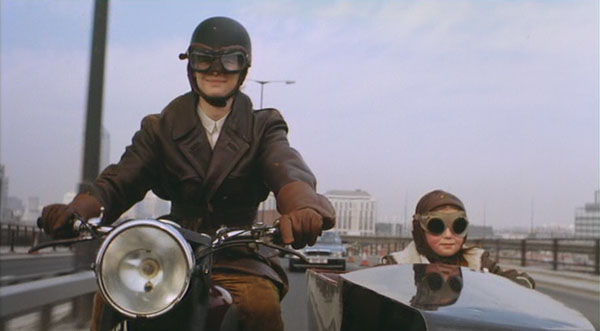
No date in this segment – set in the present. Orlando motorcycles to her publisher’s office, where they tell her they won’t publish the book she’s been writing for 400 years without some changes. She doesn’t take this hard, goes to the park with her daughter (played by Tilda’s daughter). Daughter has a video camera, they see an angel flying over the trees, segue from that totally nuts image into the closing credits.

Must say I had high hopes and this movie smashed them all Godzilla-like. The movie is a mighty masterpiece, scoffing at my insufficiently-high hopes! It has as much to say about life and how to live it, fleeting relationships and the nature of time as The Benjamin Buttons, but it says them more elegantly (I know I’ve been hard on The Ben Buttons lately – I actually liked it a lot). Plus it must be the most beautiful super-feminist film I’ve seen… I’ll bet college kids love to write theses on it (a google search reveals this to be true).
Potter says the movie is “about the claiming of an essential self, not just in sexual terms. It’s about the immortal soul.”
Music cowritten by Potter, has Fred Frith on guitar, mostly good, peppered with some late-80’s-sounding beats. Same cinematographer who shot Potter’s Yes. Movie was nominated for a buncha awards, incl. oscars, but lost to The Piano, Age of Innocence and Schindler’s List. Won some stuff in Venice and Greece and I feel pretty good about that.
Didn’t I read somewhere that this was pretty good? Do I have to make an index of all my film magazines (online and print) and what films they cover, so when I see something like this which I thought came recommended but after watching it I’m not sure why and want to find out if I maybe imagined the whole thing, I could pick up issue X and turn to page Y and see whatever someone wrote two years ago that had me adding this to my must-see list (4100+ titles and growing!)? Either way, this was on the list, but now it ain’t cuz now I seen it. What’s more, instead of sharing any of the three (!) masterpieces I watched this first week of 2009, I had Katy watch this with me (my fault, not hers). What’s more more more is that I just finished saying I wasn’t going to watch any French movies until I got through my language lessons, and now I’m watching one, but my excuses are that I was sick and I forgot.
A musical by Honoré (whose Ma mère might still be good) featuring actors with all wispy voices. I mean, better the wispiness than the psychoenthused camp of Mamma Mia, but better yet, let’s find some actors who can sing and cast them in our singing movies. It totally used to be done that way.

Star Louis Garrel (Dreamers, Regular Lovers) with his dark dreamy eyes and sullen expressions plays a dude who works at a small newspaper or maybe magazine. Ludivine Sagnier (peacock-butt from A Girl Cut In Two) is his girl, with whom he’s very much in love but they’ve been fighting lately.

Clotilde Hesme (also from Regular Lovers) is Garrel’s coworker. He was having an affair with her, and now they’re trying a threesome. That’s not going so well either. But oops, relationship woes are interrupted when Ludivine suddenly drops dead from a heart attack a half hour into the movie.

What follows, besides more forgettable songs, is a straight hour of brooding by professional brooder Garrel. His dead girl’s sister (Chiara Mastroianni of A Christmas Tale, my favorite performer here) continues to look after him. Clotilde helps as much as she can, but he doesn’t really want her in his personal life anymore. Movie is getting less and less romantic (and it didn’t start out all too romantic) and less musical, and yet it’s called Love Songs. I space out for a while and try to remember the name of that Michael Winterbottom sex movie (answer: 9 Songs) while Katy complains about Garrel. However will the movie pull out of this tailspin?

Of course! Clotilde’s ex-lover’s young gay brother has a crush on Garrel, keeps stalking him and calling him and showing up at work. Unaccountably, Garrel finally quits discouraging the lad, goes home and makes out with him. They actually end up together, which brings up all sorts of questions that don’t seem worth answering (but they will be answered if there’s a sequel, which Honoré has been threatening). Garrel’s final line is lovely though, “Love me less, but love me a long time.”
