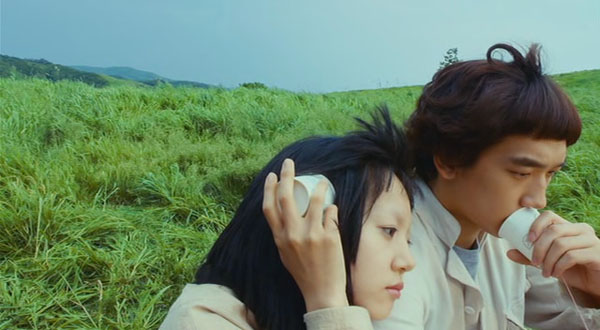
First, the bad. Was a slow afternoon and I forgot to bring candy. Movie was projected on DVD, all low detail. Lot of long shots, someone singing in back of the room so I can’t even make out his face. Starts singing reeeeal slow, so I read the subtitle then have to wait a minute for them to finish singing what I’ve already read, so I figure I can close my eyes for the rest of the shot, then when I open ’em something else is happening and I don’t know how much time has passed.

But other than this one glitch, the movie was incredible. Beautiful imagery, wild colors and costumes, amazing music, cool story. It’s an adaptation of an Indian legend about a woman who cheats with another guy when her husband is away, and when he returns the two men fight over her. The movie references the legend while retelling it (with different character names). Don’t know if the original ends with the husband killing his rival then stabbing his wife to death, ripping out her heart and singing to it, but the movie sure does. Overall an excellent way to spend a sleepy weekend afternoon. Only me and one other guy thought so, though. Will have to see again under better conditions – sorry, Cinefest, but screening blurry DVDs for paying audiences is Not Okay.

Writer/director Nugroho has won awards for a bunch of his movies, been working since ’91.

If I may borrow chunks of what C. Huber wrote for Cinema Scope:

Nugroho’s staggering Opera Jawa—presents the contradictions of society, its values and (resulting) problems, including the capacity for violence, in such a layered manner that it’s impossible to untangle the myriad levels of inspiration.

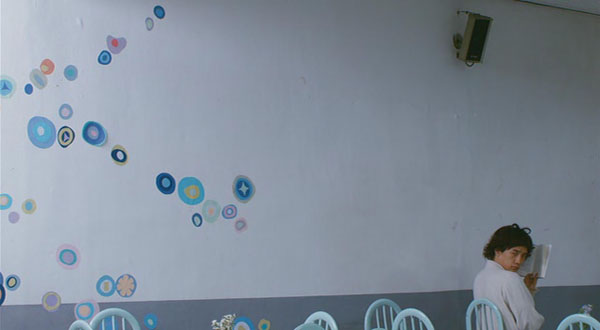
Alternating between the core drama, Brechtian commentary, and social crowd scenes, the film is played out in the palaces and temples and on the beaches of Yogkharta and Solo, two centres of Javanese culture crucial in the shaping of Javanese art. (Additionally, palace, temple, and beach represent the three pillars of government, religion, and culture.) Yet it also makes use of modern installations, including a barrage of golden and red waxheads (some of these are later hung over body models, lit inside and dripping red), hanging corpses made of white cloth, a metal sedan-creature whose helmet-head carries the inscription “Viva Lamuerte,” and a huge stretch of red cloth running through the village streets, connecting two main locations. Meanwhile, the style of singing and choreography keeps changing throughout; not exactly a juxtaposition, but no smooth merging either, despite the magnificent, measured flow of music and sound as well as the exuberant colours and symbols Nugroho orchestrates. Rather it produces a dazzling dialectic, perfectly expressing the conflicts of society as enacted on a daily basis, which are both classical and modern.

One of the least jokey of Sturges’s films (up there with Unfaithfully Yours), but makes up for that by being completely wonderful. Katy and I watched together for the first time. Even when I know it’s coming, I can’t help but jump when Sullivan says how much he wants to make O Brother Where Are Thou. No plot overview needed, watched it enough times.

William “Muggsy” Demarest, one of my favorites, plays the same type as always. More prominent in this movie are the butler and valet, Eric Blore and Robert Grieg, who were apparently professional butler-actors throughout the 30’s and 40’s. Veronica Lake was 21 when this was shot, looks younger. As famous as I thought she was, I’ve only heard of three of her movies (also The Blue Dahlia and I Married a Witch). Looks like after the 40’s, she switched careers from acting to drinking. I mainly know Joel McCrae from this, but apparently he was in a bunch of westerns. The poor “colored chef”, Charles R. Moore, has 100+ movie roles, all of them listed as porter, driver, bootblack, elevator operator or prisoner. Lot of in-film shouts-out to Capra and Lubitsch, who at this time were working on Meet John Doe and To Be or Not to Be.

image

Todd McCarthy calls Sturges “the first screenwriter to decisively break through as a director”… guess I never realized that’d never happened before 1940. Now it happens all the time (see Synecdoche New York).

The DVD commentary starts out funny, mostly a good time but sometimes one of them will resort to narrating and saying “that’s so great”. The Rise and Fall of an American Dreamer doc is better, with a full career overview of Sturges, going into the whole post-Conquering Hero part of his life which I had wondered about – it’s sad stuff.

Andy gave us some Jean Painlevé action from a different DVD than the one I’ve got. Love the “FIN” made up of stop-motion creatures at the end of most shorts. Love the octopus crawling through the mud, the way sea urchins walk with thin suckers that stick out past their spines, the umbrella dances of the acera, the camoflaged crabs, and everything about the sea horse. These are crowd-pleasers. Nice to hear the original music, which is actually really neat, especially the early electronic sounds.

Also saw something called Predatory Mushrooms by one of Painleve’s influences, Jean Comandon – microscopic mushrooms create three-cell nooses to ensnare and eat tiny worms. Sounds icky, but it looks bizarre and wonderful. Could’ve used some music (GBV’s “Mushroom Art”). And the 1898 The Separation of Siamese Twins by Dr. Doyen. It’s not the doctor sawing these two people apart that is most disturbing, it’s their inhumanly spindly legs. Also could’ve used music, maybe something by Ministry.

Always happy to watch Jean Vigo’s À propos de Nice again. I only said one sentence about it last time, which is not fair. Seems to be a humorous portrait of a rich, beach-side tourist town with thrilling associative editing and the occasional staged scene (guy gets super-sunburned, woman in beach chair changes clothing repeatedly). Watched on 16mm. For music I suggest some Luna, or a jaunty classical piece.

On a drunken socialite scavenger hunt, Irene picks up “forgotten man” Godfrey at the dump. He asks her for a job, and she hires him as the family butler. A shave and a new suit later, he shows up at the house, gets shown around by the maid Molly, introduced to dizzy & spacy Irene, mean & nasty sister Cornelia, their eccentric mother, frustrated father, and an artist named Carlo who just hangs around. Irene and Molly are hot for Godfrey, Cornelia wants to get rid of him, and he seems too smart to be a regular bum.

But aha, Godfrey is a Harvard business man who gave away all his money to live free, and after regaining his self-respect by being a good butler, he takes the jewels that Cornelia tries to plant to get him arrested, pawns ’em, makes a fortune on some stock deals, bails out the broke father (after dad hurls Carlo through a window), then gets Cornelia back her necklace. Godfrey opens a happenin’ joint called The Dump, hires his old dump buddies, Irene follows him to his office and marries him by force.

Plot description doesn’t sound amazing, but it’s a screwball comedy… the fun is in watching smooth pencil-mustached Godfrey (post-Thin Man William Powell) deal with daffy Irene (post-Twentieth Century Carole Lombard) and Cornelia (pre-Stage Door Gail Patrick), surrounded by the unflappable mom (post-Gay Divorcee Alice Brady), furious dad (big, frog-voiced Eugene Pallette, pre-Lady Eve), sadsack Molly (pre-You Only Live Once Jean Dixon), easily-spooked Carlo (pre-You Can’t Take It With You Mischa Auer) and their boring harvard friend Tommy Gray (John Ford regular Alan Mowbray) who doesn’t actually add to the fun, he’s just around as a plot contrivance. Other than Gray, everyone here is wonderful and the writing is super. The whole harvard-dump thing struck me a little wrong, but it’s a depression-era cheer-up madcap comedy so I let it go. Would happily watch this again. Katy liked it too but complained that it wasn’t one of the greatest comedies of all time, because she can’t just walk away happy from a movie for some reason.

Former cartoonist La Cava’s 160th movie, if IMDB is to be believed, and the co-writer worked on three Marx Brothers movies. I looked for Frank Tashlin-esque cartoony bits but couldn’t find any. Movie got acting nominations in all four categories, plus directing and writing at the oscars, but won nothing. Within a decade, Lombard and Brady were dead and Patrick, Pallette and Dixon were retired. Didn’t seem like a cast that was on the way out the door. Movie was remade in the 50’s with David Niven, June Allyson and Eva “Green Acres” Gabor.

M. Kennedy at Bright Lights: “Repeatedly, La Cava and company serve up the rich as silly, frivolous, childlike, and trivial, while the poor are strong, dignified, generous, and compassionate. Miraculously, he gives us these elemental distinctions without the torpor of penny-ante philosophizing or the goo of Capraesque speechifying.”

December 2022: Watched again – Katy is mad about the ending but agrees that the rest is good.

Last time I saw a filmmaker personally touring his film trilogy around the country it was Crispin Glover, whose new one is called It Is Fine! Everything Is Fine. Hertzfeldt’s first two are called Everything Will Be OK and I Am So Proud Of You. Similarities end there, though.

Kicked it off with The Meaning of Life, which I hadn’t seen in a while but didn’t remember liking. Removed from the post-Rejected anticipation and taken in context of his recent introspective films, it’s not bad at all, just a bit one-note. We all die, and we are only one step in the evolutionary chain, not necessarily the best and final form of life. Wotever, Mr. Hertzfeldt. Looks super-nice on 35mm. I said mean things last time I saw it.

He played Rejected and Billy’s Balloon, both of which I have memorized and I think most of the crowd has too. Broke up the next two movies with Intermission in the 3rd Dimension, a fluffy piece of ridiculousness which I think both Don and the crowd wish he’d do more of.

Everything Will Be OK and I Am So Proud Of You are the first two parts of a planned trilogy about Bill. The first section focuses on Bill’s unnamed illness, his inability to function in everyday life. The second flashes back and forth through time exploring Bill’s childhood, present, old age, and ancestors and all the awful ways they all died. They’re good movies, and I love the look of the peephole split-screens. I mostly feel they’re depressing midlife-crisis movies, but there’s just (barely) enough warmth and love in there to keep it from falling apart.

Interesting, very good movie but I didn’t love it as much as everyone else seems to. Swept the Cesar awards in non-acting categories (a war film called Le Crabe-Tambour picked up the rest). I’ll bet Dennis Potter enjoyed it, too.

Come to think of it, looking over my screenshots a few weeks after writing the above paragraph, this was a damned complicated movie, and showed more imagination than Je t’aime, je t’aime. Definitely have to see again (and maybe again).

image

A writer (John Gielgud who, at 73, still had 60-some movies left in him over the next two decades) lives alone (with servants) in his big old house (“Providence”), spends the first two thirds of the movie dreaming up sordid lives for his family members, including his late wife (Elaine Stritch, lately in Romance & Cigarettes), his astro-scientist son (David Warner of Time Bandits), his lawyer son (Dirk Bogarde of The Servant and a bunch of Visconti films) and the lawyer’s wife (Ellen Burstyn of The Exorcist). He re-casts them, giving the lawyer and wife a bitter, joyless marriage, having them hold affairs with the other two. Stritch becomes an older woman with a terminal illness and Warner becomes a free man unsuccessfully prosecuted for murder. Scenes are re-written halfway through – Gielgud’s voice will narrate the action, then rethink things and suddenly characters will leave the scene or change their mind or the whole thing will start over with a different ending. So very Resnais-like, eh? Meanwhile, the writer himself is stumbling around the house at night, drinking, shitting, falling down, breaking things and griping about his ill health.

In the morning, he’s outside, it’s his 78th birthday, and his two sons and the lawyer’s lovely wife have a happy family visit, with dinner and gifts and happy memories. There’s a little bitterness, mentioning the writer’s wife who killed herself after diagnosed with a fatal disease, but overall it’s happy and serene, leaving us to wonder how much of the family problems and awful behavior from the first half of the movie were completely invented by the writer, and how much is actually there under the surface.

image

I’d thought I would enjoy six-time oscar-nominee Ellen Burstyn’s performance more, but maybe it suffered a bit from having just watched Rivette’s ladies in Love on the Ground – she seemed like the weakest link here, speaking as if she’d just received a script. Watching with headphones, the sound mix wasn’t so good either, but then neither was the quality of my downloaded movie very good, so this wasn’t optimal viewing experience. Liked the movie, fun to watch a bitter old man provide amused commentary on his own nightmares and imaginations, just didn’t blow me away.

Denis Lawson, who played the imaginary footballer (David Warner’s brother), appeared later the same year as Wedge Antilles in Star Wars, the film that helped decimate the world market for fancypants French films such as this one. In 1977 subtitles hadn’t been invented yet, so those watching in France heard the dubbed-in voices of actors Claude Dauphin (Le Plaisir), Francois Perier (Stavisky), Nelly Borgeaud (Mon oncle d’Amérique) and Gerard Depardieu.

image

Gielgud speaks the director’s thoughts: “It’s been said about my work that the search for style has often resulted in a want of feeling. However I’d put it another way, I’d say that style is feeling, in its most elegant and economic expression.”

Some woman wrote an article arguing that the ending is a dream also, but I’d have to pay $12 to read the full thing online.

There are weird flashes to military police and concentration camps, maybe explained by this American Cinematheque quote: “A fascinating visual tour de force exploring the creative process, offset by references to the nightmarish political crackdown in Chile in the late 1970’s.”

Ellen Burstyn:
image

V. Canby for NY Times did not like it: “The old man, it’s soon obvious, has imposed on these perfectly decent folk all of his own fears and guilts about a lifetime spent in philandering, selfishness, disinterest in his family, while he enjoyed a reputation as a writer he never really deserved. The structure is complicated but sadly un-complex.”

J. Travers on the ending: “Yet there is something about this Resnais-esque view of Paradise that is even more unsettling than the Hell we have just experienced. Which of these two interpretations paints the more accurate picture of the world in which we live? Can we take seriously the saccharine-doused scene of marital fidelity, brotherly friendship and sweet father-son love? Isn’t it more believable that the two sons would be rivals, that the elder son would have a mistress and would bitterly resent his father’s slow and demeaning death? Surely the world shown to us in the first part of the film, the world apparently belonging in the mind of a solitary writer, is the world that is nearer to our own, a far more accurate portrayal of human nature? The second world, of calm, family harmony and stability, is surely an illusion, a distorted memory of a past that never was, could never have been. Which reality do we believe?”

image

The missing link between Celine & Julie and Marie & Julien (with some Gang of Four thrown in).

Jane Birkin (under a decade before La Belle Noiseuse but looking two decades younger) and Geraldine Chaplin (eight years after Noroît) are working as actresses with Silvano (Facundo Bo) in a play performed in Silvano’s actual apartment. Play was ripped off from famous/rich playwright Clémont Roquemaure (Jean-Pierre Kalfon of L’Amour Fou and some Philippe Garrel movies). One day he’s in the audience, invites the three to perform a new play in his house, based on the sordid love triangle of himself, hanger-on magician Paul (André Dussollier, the realtor from Coeurs), and the now-missing Beatrice.

G. Chaplin and Paul:
image

House-fellow Virgil (László Szabó of Godard’s Passion and Made in USA) doesn’t have much to do until the end, when he shares wacky scenes with Birkin. He spends his free time translating Hamlet into Finnish (predicting Hamlet Goes Business points out Glenn Kenny).
image

Third-wheel Eléonore – Sandra Montaigu of Hurlevent:
image

There’s not actually a ton of love here, but there are lots of triangles… the film is rich with triangles. And magic and mystery – the girls see visions and premonitions in mirrors and through keyholes. And the mansion is visually insane (D. Cairns calls that first screenshot the “streaky bacon” room). And the premise gives us enough of Rivette’s performance/identity motif for at least two movies… I mean, the actor characters are portraying the other characters in the film… it starts to fold in upon itself and collapse like Bjork’s Bachelorette video. That the movie even has a conclusion (public performance of the play culminating in Beatrice’s mysterious reappearance) seems moot. This is three hours gladly spent in Rivette Country… not his best movie, but one of his most Rivettian. Like his Wild At Heart.

image

This was the full three-hour version, happily out on DVD. Jonathan Rosenbaum says: “Rivette’s 1983 two-hour Love on the Ground is a minor work, but at a 1989 Rivette retrospective in Rotterdam I saw a superior three-hour version-the first I knew of its existence. Rivette told me on that occasion that it was the only version he believed in; he implied that the release version merely honored his original contract.” JR later echoed that even the three-hour version is a minor work, and others would agree. Senses of Cinema calls it “a mere footnote”, Slant says “precious, lifeless, and ultimately meaningless.” Ouch. But J. Reichert at Reverse Shot, G. Kenny and D. Cairns all liked it, and I’m throwing in with them.

I haven’t found any online mention that the two lead actresses are named Emily and Charlotte – the names of the two famous Brontë sisters. Rivette’s next film would be an adaptation of Emily’s Wuthering Heights.

Barbet Schroeder makes an appearance after spending 20 years producing French New Wave films. He’ll spend the next 15 directing Hollywood thrillers.
image

My first mid-30’s silent film. Chaplin’s Modern Times doesn’t count, and the Russian Happiness was two years earlier. Japan still had union narrators in theaters, so their cinema stayed silent longer than most.

Traveling actor Kihachi brings his troupe to the town where his ex-girl and illegitimate son live. K. has made himself scarce, sending money whenever he can, so the boy (Shinkichi, now 20) could grow up without the burden of a no-good father, and whenever Kihachi’s in town he stays with the mother and sees the boy.

Kihachi’s current woman in the troupe suspects something is up, finds out the story through bribery and sets up younger girl Otoki to go after the boss’s son. The two fall in love, and Kihachi tries to break it up, leading to the revelation that he is Shinkichi’s father. Meanwhile, constant rain means the troupe can’t perform, and finally they’re out of work long enough to have to sell off their stuff and break up. After an emotional climax, the young lovers stay behind, and Kihachi and his girl make up at the train station, heading off to form a new troupe.

Great movie, slow-building, ends up as emotional and true-feeling as the other Ozus I’ve seen. I ought to watch at least one per year. They are refreshing. Kihachi somehow stays sympathetic even though he hits everyone in the movie at some point. That’s just how he communicates, I suppose. Definitely different kinds of families here than in Tokyo Story or Equinox Flower.

This was something like Ozu’s thirtieth movie, and it’s said to be the beginning of his mature style. It’s an uncredited remake of Hollywood’s oscar-winning part-talkie The Barker from 1928, which was also remade twice in Hollywood (with Clara Bow in ’33 and Betty Grable in ’45).

Half these actors had been in Ozu’s Passing Fancy the year before. The kid had later roles in Kon Ichikawa and Seijun Suzuki movies, and his father appeared in Ozu’s own 1959 color remake Floating Weeds. Maybe Katy will watch that with me next year – Masters of Cinema’s N. Wrigley calls it the most beautiful Ozu film.

Don’t know why I assumed this was not a good movie. I’d seen screen captures from the DVD (some of the same ones I’ve got below) and somehow I still thought it was possible to make a bad movie using those images. It is not. This was astounding.

image

In a daring but successful shout-out to Feuillade, the story (set in 1910 or 20) is ridiculous. Plot threads do not weave together as in a tapestry of grand design. Each scene seems to have been thought up after the last one was finished filming. This is not a weakness, but adds to the movie’s dreamlike effect.

Master criminal Judex’s evil plans aren’t very broad-ranging in this story. He’s stalking rich guy Favraux acting as his servant, sends a letter demanding Favraux surrender half his fortune or he will die the next night. Next night at the costume ball (seen above), Favraux does die.

But he’s not dead! Imprisoned by Judex!

image

Daughter Jacqueline is left alone in the house!

image

She is easy prey for Marie, the swinding ex-governess of the house who returns to steal Favraux’s valuable papers and kidnaps Jac. when she interferes.

image

But Jac. is rescued by Judex’s dogs!

image

There’s a private eye named Cocantin (seen below reading Fantomas), originally hired by Favraux, and somehow still involved.

image

Can he stop Marie?!? Who can??

image

Judex!

image

Ha, not really. Marie has captured Jac again, has her tied up atop a building along with Marie’s accomplice, a man who found his long-lost father earlier after Favraux tried to have the father killed, but that’s another story. Highlight of the movie here, Cocantin is wondering how to get atop that building when a circus caravan rolls past. Why, it’s the circus of his old friend Daisy, an acrobat who easily climbs the building!

image

Rooftop fight! Marie grabs the gutter! Will she fall??

image

Yes!

image

I think the only actor I knew was Edith Scob as Jacqueline – just saw her as Mary in The Milky Way. Sylva Koscina (Daisy) was in some MST3K-approved Hercules films. Francine Bergé (Marie) was later in Mr. Klein, Rivette’s The Nun and Roger Vadim’s La Ronde remake. Channing Pollock (Judex) was a magician with only a few other film roles. René Génin (Pierre Kerjean) had appeared in Renoir and Carné films in the 30’s. This movie was co-written by Feuillade’s grandson, heh.

G. Gardner with Senses of Cinema:

Franju sought in particular to recapture Feuillade’s sense of documentary and his playfulness. He reproduced with as much exactitude as possible the costumes and settings which Feuillade filmed in scrupulous detail. Feuillade’s street-scapes are now an invaluable documentary record, but Franju also paid particular attention to reproducing the elaborate interior designs and furnishings of the day, resulting in settings of quite extraordinary detail and clutter. Franju also sought, despite the playfulness, to avoid any camp satire of these elements by over-emphasis or any special attention being paid to them.

In the title role, Franju pulled off his most brilliant coup by casting the master prestidigator of his day, near godlike in his handsomeness, Channing Pollock. Pollock’s skills as a magician were employed to produce a dazzling array of apparent magical occurrences involving, most particularly, disappearing doves, a plot device that Feuillade uses to enable the regular rescue of the heroine and others by Judex. Franju’s Judex is a far livelier, less sombre, more inventive and more mysterious character than that of Feuillade.