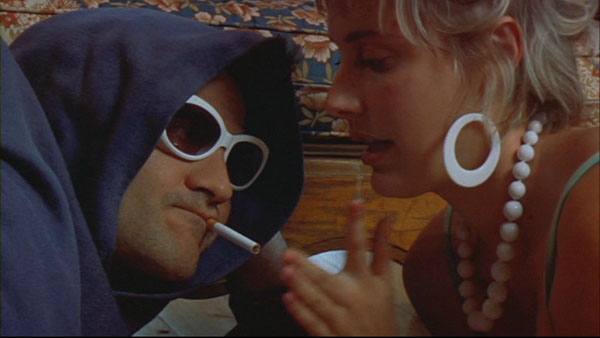
It took me two or three years to finally watch The Golden Coach and then I loved it to pieces, so anticipation was unreasonably high for this one. At first it’s just another Renoir movie, light and magnificent even when being grim and serious, but as the plot threads started to mirror those of The Golden Coach (woman deciding between three lovers) it built to a similarly wonderful ending. So no, not up to Golden Coach standards, but close!

Jean Gabin:
image

This was Renoir’s big return to France, his first French movie since the distrastrously received Rules of the Game, so he made a nationalistic crowd-pleaser with lots of dancing girls, just to be safe. In the late 1800’s, Jean Gabin (fresh off Touchez pas au grisbi) is having financial trouble with his high-class variety theater, decides to buy a new place and revive the low-class can-can dance as a popular middle-class spectacle. Calls it the Moulin Rouge, ho ho. Recruits and trains non-dancers including washwoman Nini and gathers old favorite companions including hot-tempered star dancer (and part-time girlfriend) Lola, famous whistler Roberto, and singing assistant Casimir, and gains financial assistance from a visiting prince.

Trouble: Nini is fooling around with Gabin, also has longtime boyfriend Paolo, and is also being courted by the prince. Paolo tells her it’s over if she dances the cancan in public, and she breaks up with the prince (leading to his suicide attempt), so she tries to stick with Gabin, under the condition that he see no other girl but her. His reaction:
image

So now, boyfriendless, she throws herself joyously into the dance, choosing art over a steady love life, the same ending as The Golden Coach but in exhuberant dance instead of a solemn speech. Wonderful! Can’t believe Katy didn’t want to watch this back when I kept suggesting it in the apartment. Anyway, I’ll gladly watch again when she changes her mind.

Color and sound and costumes are all brilliant. Acting is usually great, and when it’s not, Renoir keeps things moving fast enough that you can’t tell. I was surprised when Gabin wakes up in bed with Lola – I’d forgotten that you could do that in 1950’s Europe. His scene at the end is great, sitting backstage tapping his foot, imagining the action on stage, knowing all the steps and smiling without having to see. The Criterion essay (or did I read it somewhere else?) points out that this scene lets us know that he choreographed the dance and practiced it with the girls over and over without showing us the actual practices… very effective.

Françoise Arnoul (Nini) had previously appeared in Antonioni’s “I Vinti”, is still acting today
image

María Félix (jealous Lola) was a huge star in Mexico. Giani Esposito (the prince) starred six years later in Rivette’s Paris nous appartient.
image

Franco Pastorino (Paolo) died a few years later, only appearing in one more film.
image

This is the earliest Michel Piccoli appearance I’m likely to see (his earlier films are quite obscure). That’s him in the blue.
image

Cameo by Edith Piaf:
image

Movie took some adjusting. Firstly I’d heard this was a marvelous best-of-year movie, so when I saw the shaky-cam cinematography I thought “seriously?”. Then I’d been selling it to Katy as romantic comedy, and it turned out very dramatic, not so funny or romantic. But once I straightened out that I was watching a shaky-cam unromantic drama I’d say it was a very good one of those.

Kim (Anne Brokeback Hathaway) gets a weekend leave from rehab for the wedding of sister Rachel (Rosemarie Dewitt) and beau Sidney (Tunde Adebimpe). While out, she raises all sorts of hell with her sister, mother (Debra Winger of early-80’s prestige pics) and father (Bill “Mr. Noodle” Irwin). Comes out that Kim killed their little brother in a drug-binge car accident, and now that she’s sober for the first time in a decade, they can talk to her about it. Wedding goes off, party is much fun, Kim returns to rehab.

Acting (especially by Hathaway and Irwin) is very good, and Kim’s character is strong – one of those deep writer/director/actor character-study things like Happy-Go-Lucky, I’d suppose. The family thing is strong overall, but groom Tunde Adebimpe, having just blown me away at a TV On The Radio concert a week earlier, didn’t do hardly anything in this movie. He came to life during what is probably the longest dishwasher-stacking scene in cinema history, but otherwise he was background, and his family existed as a friendly mass of people, not as a bunch of distinguishable individuals. Not a single scrap of racial-relations dialogue. Critics are chalking that up to unrealistic liberalism on Demme’s part, but apparently it’s because the groom was gonna be a white actor so there was no race in the script, heh.

Written by the granddaughter of the good witch in The Wiz. First fiction feature I’ve seen from Demme in 15 years (Philadelphia), wow. Robyn Hitchcock got a song and a half, including some close-up shots, nice, and Tunde sang Neil Young’s “Unknown Legend” acapella at the ceremony, also nice.

Trouble: this would be a nice movie to watch again sometime, since I was falling asleep and not paying close attention, but it’d be a nice movie to not watch again since I didn’t enjoy it much. What to do, what to do?

Lorenz Lobuta is a regular doof, a failed poet with a rich aunt, until one day he is run over by a carriage carrying a gorgeous rich woman. After that, he’s fixated on the rich woman, vows to find and marry her, but he never does, never even speaks to her again. During this time he becomes a huge asshole and a naive nutbag and we’re expected to sympathize with his obsession, I think, but after he gets in league with a scummy dude, rips off his own aunt, then gets caught breaking into her house and sent to jail, all I could think was “good” and “finally!” Oh also he meets a girl who looks just like the rich woman (same actress) but that part confused me – I must have nodded off when they explained she was two different people. Whole thing sits inside a framing device, but not one as worthwhile as in Tartuffe. Lorenz eventually (after prison) marries the bookstore girl who always pined for him and stuck with him through his stupidity, and the main story represents the journal he writes to ease his past-haunted mind.

German star Lil Dagover (Tartuffe) plays the wife. Lorenz is Alfred Abel, who appeared in Murnau’s comedy The Grand Duke’s Finances and Lang’s Dr. Mabuse The Gambler. Rich aunt Schwabe, Grete Berger was in some Lang movies as well, and the phantom double-role girl was in Murnau’s Burning Soil.

Watched the DVD bonus that explained how Murnau and his crew pulled off the weird visual effects (ghostly carriage knocks our man down, buildings’ shadows seem to follow him, one crazy dream sequence). Not a lot of trickery in this movie, but what trickery it had was very finely done. Just checked to see what wonderful things D. Cairns said about this, but I forgot he doesn’t have a copy, damn.

I watch all of Clint Eastwood’s recent movies and I always feel they are High Quality Films, but that’s not always my thing. They are oscar-friendly, but not really affecting (exception: Million Dollar Baby) and don’t have anything fascinating to contribute in content (exception: Flags of Our Fathers) or form. But I definitely like ’em enough to keep watching (possible exception: Gran Torino).

We’ve got a true-story historical drama here, with awesome period street scenes of 1928 L.A., nice cinematography, great music (by Eastwood himself!) and very good acting. In her first good movie role since Sky Captain and the World of Tomorrow, A. Jolie plays Christine Collins, a mom whose kid disappears. She reports him missing among mass public distrust in the L.A.P.D., a mistrust led by crusading radio preacher John Malkovich, using his staccato vocal delivery to good effect. Police find kid, but it’s the wrong kid, then when Jolie reports it they intimidate and finally imprison her in a sanitarium to keep people from finding out the truth. Malkie helps get her out, and meanwhile a kid escapes from a rural psycho-killer and reports the murder of twenty kids. Jolie and Malkie lead court fight against the cops, simultaneously kid-killer is prosecuted, she wins, cops go down, killer is found guilty, two years later she watches him hang still unsure whether her own kid was killed or not. In postscript scene, mother of another kidnapped kid finds her son returning home after seven years away, but Jolie still never gets her closure. Saaaad movie.

Manipulative cops include Colm Feore of Titus and TV’s Jeffrey Donovan. Oscar-nom Amy Ryan, who I often see but never recognize, is a prostitute imprisoned with Christine in the sanitarium. Writer J. Michael Straczynski kept me entertained in the 80’s with episodes of He-Man and The Real Ghostbusters, and moved up from there to sci-fi channel to showtime to oscar-nominated films. Good going there, guy.

I passed up seeing The Scarlet Empress in 35mm for this, but it was probably worth it [later note after having finally watched The Scarlet Empress: nope].

Meshes of the Afternoon (1943, Maya Deren)
One of the great poetic movies of the 40’s. Love when she’s climbing the stairs, bouncing off the walls as the camera twists from side to side. Love the multiple Mayas sitting at a table in the same shot (technically impressive, too). Love the movement, the plot (avant-filmmakers take note: an actual plot), the look, that iconic shot of Maya at the window.

Fuses (1967, Carolee Schneemann)
Fairly rapidly-edited shots of director having sex with James Tenney, with other scratched and weathered colored filmstrips superimposed over it. The editing and content are exciting for about ten minutes, but the movie is twenty minutes long, and silent. Girl in front of me tried reading from the reflected light of Tenney’s alarmingly red-tinted penis on the classroom wall, then texted people for a while. I sat wondering why there were so many shots of her cat staring out the window. Maybe it was supposed to be boring, and that was the point. Worth watching on pristine 16mm, glad I saw it, just saying it felt long. Schneemann has few film credits, but they’re in collaboration with Andy Warhol, Yoko Ono and Stan Brakhage. The Brakhage influence can plainly be seen here, and the film process work makes for some wonderful images. This was apparently a reaction to the objectification of women in movies, with Window Water Baby Moving named as an example. The director: “I wanted to see if the experience of what I saw would have any correspondence to what I felt – the intimacy of the lovemaking… And I wanted to put into that materiality of film the energies of the body, so that the film itself dissolves and recombines and is transparent and dense – as one feels during lovemaking.” Won a special jury prize at Cannes.

Reassemblage (1982, Trinh T. Minh-ha)
Black with ambient sound. Then shots of a rural scene in Senegal with silence. More shots with narration. More shots with ambient sound. More narration. Eventually, more black. The sound is rarely commenting directly on the visuals, and even the ambient sound rarely seems to line up. Shots of bare-breasted African women, daily chores, kids (two albinos!), youth playing in the river, and so on, with comments about ethnography. The commentary might make sense written down, but as we heard it, all scattered and edited (the sound editing was pretty poor), it seemed to circle around some points without managing to make any. Got nothing against the film, was fine to hang out in Senegal for a while. L. Thielan: “By disjunctive editing and a probing narration this ‘documentary’ strikingly counterpoints the authoritative stance typical of the National Geographic approach.”

Reassemblage:
image

First Comes Love (1991, Su Friedrich)
Pop music by the Beatles, James Brown, Willie Nelson and more, but someone please get this woman a cross-fader – it’s all so abruptly edited. The songs sometimes work really well with the images, though. Image is of four wedding ceremonies, astoundingly woven together into an ethnographic study of heterosexual marriage ceremony, interrupted by a text crawl of all the countries in which homosexual marriage is prohibited (every country but Denmark). Bell & Zryd: “This simple strategy, which contrasts the lush life of heterosexual ritual with the stark legal and constitutional realities of gay and lesbian relationships, reframes the anthropological text with political rigor.” Rigor isn’t something I look for in a movie, but avant-critics love to proclaim it. What rigor! Anyway, would like very much to see more of her work.

Girlpower (1992, Sadie Benning)
I hear the intro feedback of a Sonic Youth song and all is right in the world. Even though this movie (the shortest of the bunch, I expect) is a half-res crap-quality videotape, the music and narration are clear. About the narration – sounds like either a petulant girl or a woman in performance-art mode… an impressionistic video diary of disaffected youth, comfortable with herself but not with society. Aha, Benning was 30 at the time. Lotta shots of the television. Punk film, but with nicer sound editing than the Friedrich, weird. Short, enjoyed it. Ooh, she’s James Benning’s daughter.

Thanks to TCM for showing this rare cult film written, directed, produced and even distributed by goofball character actor Timothy Carey (of The Killing, Paths of Glory, One-Eyed Jacks and East of Eden – later of Head and two Cassavetes films).

Carey, with all the power he can muster, plays an insurance salesman who tires of the game, has an internal moral/religious/political crisis and decides that anyone can be God. He gets his name changed to God, affixes a fake goatee, hires his Mexican gardener as his number-two man, gets sponsored by a shadowy political figure, and runs for high office. He names his group the Eternal Man’s Party, says his followers can be “super-human-beings”, it sounds like a dangerous cross between naziism, self-help dianetics, and The Holy Mountain. Plenty of people follow God Hilliard’s clearly sacrilegious message until late in the campaign newsmen start asking if he’s maybe an atheist. Atheists don’t get elected, but people calling themselves God do? Clarence has sent his wife and kids away so he can have sex with 16-yr-old groupies and live the decadent life of the rich and powerful, but amongst the atheism allegations he starts defying God to show Himself, wanders into a church and steals those holy biscuits that Catholics are so nuts about, starts stabbing one with a needle. Ha, nothing, he leaves the room, comes back, a trail of blood, miracle, movie busts into crazy color.

Coming out around the time of X: The Man With X-Ray Eyes and Carnival of Souls, and only a year before Shock Corridor, it’s not like it was the only weirdo movie in Hollywood those days, but its weirdness is still pretty damned impressive. Roughly edited with a cheap look but a good eye, clearly a personal movie.

Assisted by Ray Dennis Steckler (Wild Guitar, The Incredibly Strange Creatures…). Music composed by a 21-year-old Frank Zappa, four years before Freak Out. The title song ended up on the Cucamonga comp. Wife is played by Betty Rowland, who has very few credits, but one is a doc called Striptease: The Greatest Exotic Dancers of All Time, so we can guess where Carey found her. His Mexican gardener/assistant Alonzo turned up twenty years later in Scarface. Paul Frees, the professional voiceover guy who did the snake/narrator, was writing/directing The Beatniks around the same time… crazy.

Even in a year of crazy films like The Wicker Man and Touki Bouki, ain’t nothing crazy enough to sit with The Holy Mountain. This was the last of Jodorowsky’s fully-realized features until Santa Sangre (nobody, AJ included, seems to like The Rainbow Thief or Tusk).

Third shot of movie: Director/Alchemist with women who will soon be shaved:
image

First half-hour is free-flowing. A Thief (who I didn’t realize never speaks) wanders with a deformed dwarf, getting beaten up and attending a toad-and-chameleon circus, while around them dissidents are executed, riot police hold a dead-animal parade, and priests pick up underage prostitutes. Finally the thief breaks into a mighty tower occupied by The Alchemist (Jodorowsky himself) who cleanses him, turns his shit into gold, and then introduces our other characters and their corresponding planets:
– Fon/Venus – narcissist who runs fashion & cosmetic companies, slave to his dad
– Isla/Mars – major arms manufacturer
– Klen/Jupiter – sex-obsessed artist
– Sel/Saturn – makes war toys to prejudice kids vs. countries we plan to invade
– Berg/Uranus – murderous bureaucrat
– Axon/Neptune – ruthless mohawked police chief with testicle collection
– Lut/Pluto – futuristic architect, designing sleep-chamber apartments
(I had to look some of those up – movie is sensory overload, I forgot stuff)

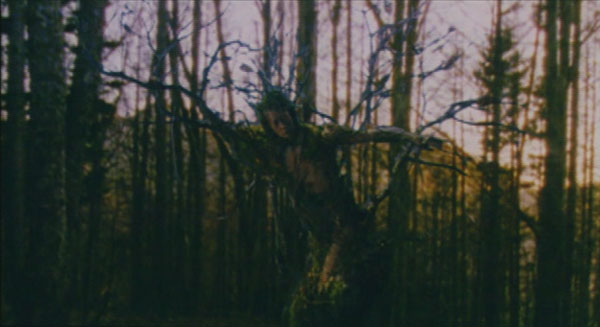
Three chameleons prepare to defend Mexico from the toad invasion:
image

Kind of a Jesus/disciples thing, but is the Thief Jesus or is the Alchemist? They go through intensive spiritual training, then Alchemist leads them to the Holy Mountain atop which nine ancient immortals control our planet, with the goal of deposing them and becoming immortal themselves. Each traveler has a dream of their own bizarre death, but they continue to the table at the summit, where they find dolls in the seats. Sitting down, camera pulls back to reveal Jodorowsky’s lighting and sound crew, and he proclaims the truth: “We are images, dreams, photographs,” freeing them from the film itself.

Atop The Holy Mountain:
image

Haven’t checked out the commentary yet (tried to listen at work, but of course it’s in Spanish), but in a modern interview online, Jodorowsky says he never killed animals for his movies – not even the rabbits in El Topo. That’s surprising, but I’ll take the guy at his word. He also says he became a feminist during the making of Holy Mountain, and indeed it’s hard to think of movies less feminist than his previous two. He’s a fan of Lynch, Cronenberg and Starship Troopers, and I wish him luck with his long-delayed Lynch-produced next movie.

Alchemist & Thief in chamber of mirrors:
image

Cinematographer Rafael Corkidi shot The Mansion of Madness the same year. A few of the actors have popped up elsewhere… Lut/Pluto had a small part in The Exterminating Angel, Axon/Neptune was an Oliver Stone collaborator throughout the 90’s, and Fon/Venus plays the lead girl’s dad on the show Rebelde.

Our director:
image

After Calvaire and Frontier(s), it’s the third movie this week with a hair-shaving scene.

Allures (1961, Jordan Belson)
I don’t know Belson very well, but this reminds me of my favorite parts of Norman McLaren and Len Lye, abstract animation set to music. Not frenetic, slow swirls and twirls, overlapped colored light patterns set to sparse music with dark electronic manipulation (composed by Belson and Oscar-nom musician/humorist Henry Jacobs). Must see again.
image
Allures (c) Jordan Belson

Finger-Fan (1982, Linda Christanell)
Austrian title is FINGERFÄCHER so I thought I’d get something racy for my lunch hour, but no, we’ve got some hands fanning out some fabric on a table… a finger-fan. Synopsis says “objects tell a random story – objects are bearers of obsessions-issuing energy as fetishes,” which might be badly translated or it might not… with the avant-garde it is hard to tell. Camera shoots some objects and photographs, a mirror re-directs part of the frame, there are some basic stop-motion and optical effects, and I remain unimpressed but lightly amused.
image

La Cravate (1957, Alejandro Jodorowsky)
Glad it was short, I couldn’t have taken much more of that accordian score. Goofy mimes swap heads at the head-swap shop while a guy with a silly tie tries to land a girl. Strong, bright colors. I guess the concept of swapping heads can be kind of dark, but otherwise this is like a kid’s fairytale compared to El Topo. Fun movie.
image

The House With Closed Shutters (1910, DW Griffith)
A Dixie-loyal young girl runs a message to the confederate front lines after her supposed-to-be-messenger brother comes home drunk and afraid. When she’s killed (because she was playing like a kid in no man’s land), their mother covers it up by acting like her son was killed and forbidding her “daughter” to ever leave the house or open the shutters. Decades later his old friends walk by the house, he swings the shutters open and dies from the shock.

Dead guy on chair (left) while his mother orders the friends to leave
image

Suspense. (1913, Lois Weber & Philips Smalley)
After the servant quits and leaves the key under the mat, a vagabond takes the opportunity to enter the house, eat a sandwich and stab the woman and her baby to death with a knife. Or he would – but she calls her husband who races home from work in a stolen car followed closely by the cops (who, as cops do in silent movies, shoot their guns constantly not worrying about the casual damage they might cause – not to mention that it hardly seems fair to shoot a guy dead for stealing a car). Worth watching for the titular suspense, and the reaction of the guy whose car the husband stole when he finally catches up and sees the wife & baby safe: a big “well whattaya know” shrug to camera and a pat on the husband’s back. Co-director Weber played the wife.

Sweet split-screen:
image

Return of Reason (1923, Man Ray)
Whirling carnival lights at night, nails and tiny beads exposed directly on the film, a tic-tac-toe structure twirling on a string, all in stark black and white. Ends with negative image of a topless woman with psychedelic light patterns on her body.
image

The Starfish (1928, Man Ray)
A reputedly beautiful woman is shown behind distorting glass. A man holds a starfish in a jar. Terrifying close-up of starfish. Mirrors, split-screens and superimpositions. This is nice – how come poets don’t make movies anymore? Adaptation of a poem by Robert Desnos.

image

image

Emak-Bakia / Leave Me Alone (1926, Man Ray)
Twirling, swirling light patterns, spinning prisms, a girl with painted eyelids (paging Mr. Cocteau), broken dice, a tad of stop motion. The notes say Ray uses ‘all the tricks that might annoy certain spectators,’ and eighty years later he has annoyed me. Or maybe I’ve just watched too many of his movies in a row. I’d seen no films by Man Ray, then poof, I’ve seen half of them. Good stuff.

image

Oooh look, her painted lids are half-closed so you can see all four eyes:
image

The Life and Death of 9413: A Hollywood Extra (1928, Robert Florey & Slavko Vorkapich)
Far and away the greatest of these shorts. Intense shadowy miniatures interspersed with close-up photography of actors tells the story of a young hopeful actor defeated by the ruthless Hollywood star system. After he dies, he rises to heaven, where there is always open casting. A predecessor to Mulholland Dr.? Incredible-looking homemade film, very expressionist-influenced. Florey went on to direct 60+ features before moving to television, Vorkapich edited montage sequences for Hollywood films in the 30’s, and assistant cinematographer Gregg Toland shot Citizen Kane.

image

image

Rhythmus 21 (1921, Hans Richter)
“generally regarded as the first abstract animated film”, wow! Squares of light and dark get bigger/smaller, more complex patterns start to appear, pretty slow movement, never gets outrageously intricate, but if it’s the first film of its kind, it’s a great start.
image

Christ almighty is it ever dangerous out in the countryside. Jeez. Frenchman Alexandre Aja pointed out that it can be damned dangerous in the countryside with Haute tension (and similarly, in the American desert with The Hills Have Eyes) and now everyone wants to join in. So I’ve just watched French horrors Them (it’s damned dangerous in the countryside because of murderous children), Calvaire (it’s extremely dangerous in the countryside because of insane rural folks) and now Frontier(s) (it’s sure-as-shit dangerous in the countryside because of crazed, torture-happy, inbred, cannibalistic nazis). I am leaving 2007 French horror Inside on the shelf this year, because I get the point already.

An actress conveys trauma:
image

A Paris heist goes wrong, four thieves split for the country after dropping one off at the hospital to die. Yasmine, the dead guy’s sister, is traumatized. Two guys arrive at a country inn and are seduced by the hotties who work there then turned upon, captured by some sadistic dudes. The others arrive, are fed then turned upon, captured by sadistic dudes. Movie goes all Hostel on us now, with chains and power tools and horrific deaths. Yasmine’s boyfriend is killed and fed to her – she is traumatized. She’s discovered to be pregnant so they keep her around to breed new nazis – she’s cared for by a girl who seems too young to already have four deformed monster children but somehow does. Traumatized! Then comes the bloody revenge part of the show, where Yasmine goes allll ultraviolent on the nazis, fighting and chopping and sawing and chewing and shooting her way out of the compound, driving away extreeeemely traumatized and getting picked up by cops, haha.

At right: girl with four mutant children
image

Awfully bloody, and just short of being bloody awful, movie is full of flash action-editing and overwrought music. Bunch of actors I don’t know (the bulky simple guy was Samuel Le Bihan from Red, also star of Brotherhood of the Wolf). Director Gens was already working on his first Hollywood action movie Hitman (IMDB reviewer says “Guns, Blood, Boobies”) when this came out. Seems like a good match for him. New York Times gave this a passing grade because of references to France’s recent political strife – nazis vs. muslims! But as far as I could tell, only one of the thieves was muslim (and he got killed), and the nazis had German names/accents, not French, so I’m not seeing a cutting indictment of French society here, just more rural paranoia.