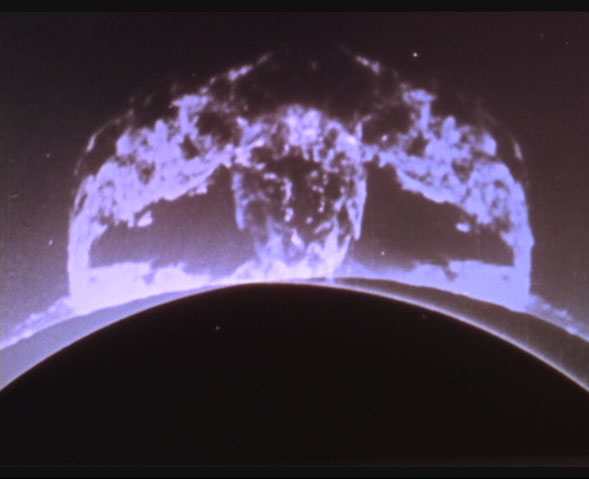
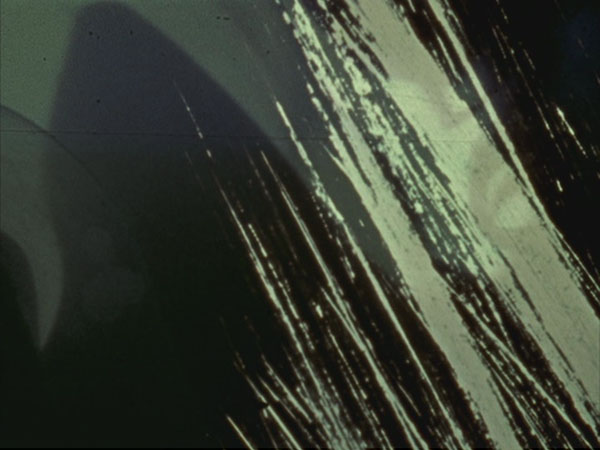
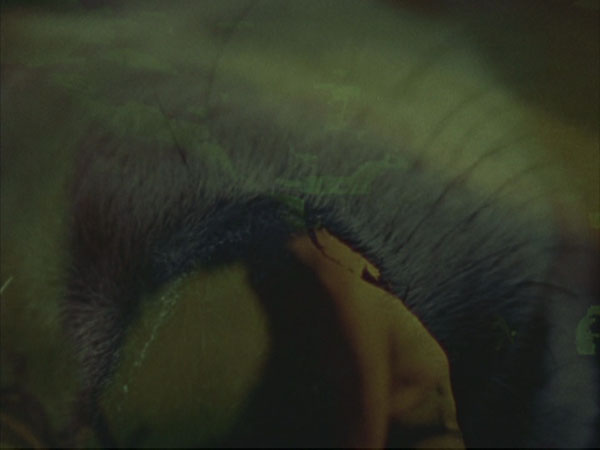
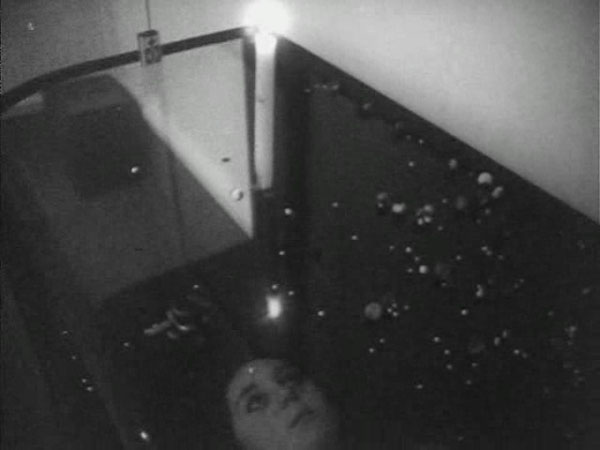
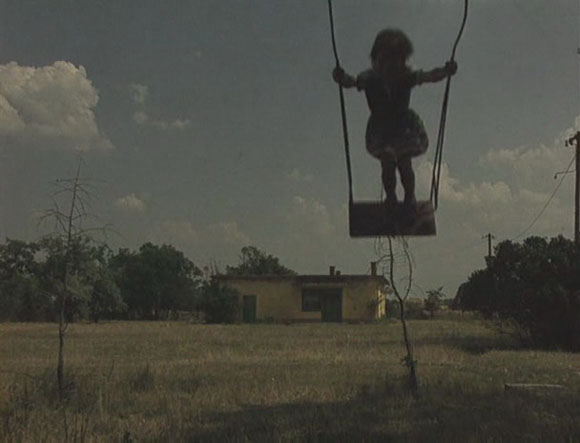
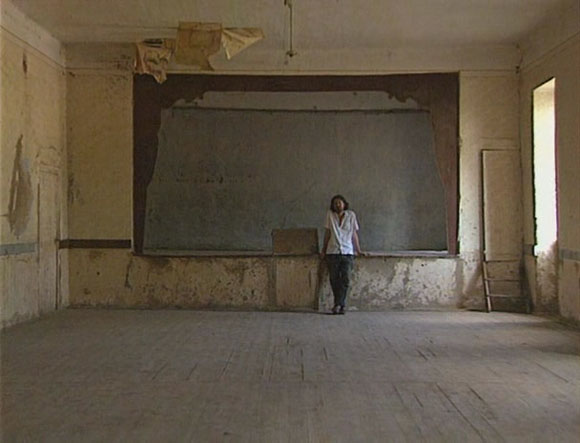
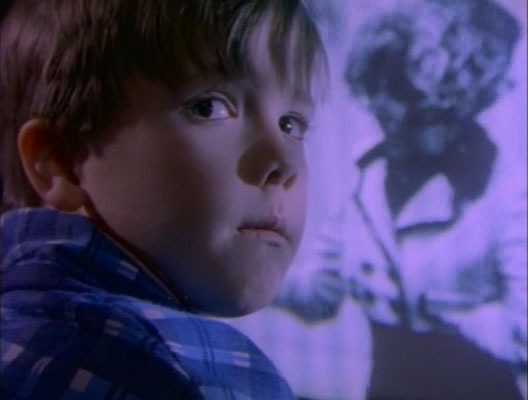
Allures (1961, Jordan Belson)
I don’t know Belson very well, but this reminds me of my favorite parts of Norman McLaren and Len Lye, abstract animation set to music. Not frenetic, slow swirls and twirls, overlapped colored light patterns set to sparse music with dark electronic manipulation (composed by Belson and Oscar-nom musician/humorist Henry Jacobs). Must see again.
image
Allures (c) Jordan Belson

Finger-Fan (1982, Linda Christanell)
Austrian title is FINGERFÄCHER so I thought I’d get something racy for my lunch hour, but no, we’ve got some hands fanning out some fabric on a table… a finger-fan. Synopsis says “objects tell a random story – objects are bearers of obsessions-issuing energy as fetishes,” which might be badly translated or it might not… with the avant-garde it is hard to tell. Camera shoots some objects and photographs, a mirror re-directs part of the frame, there are some basic stop-motion and optical effects, and I remain unimpressed but lightly amused.
image

La Cravate (1957, Alejandro Jodorowsky)
Glad it was short, I couldn’t have taken much more of that accordian score. Goofy mimes swap heads at the head-swap shop while a guy with a silly tie tries to land a girl. Strong, bright colors. I guess the concept of swapping heads can be kind of dark, but otherwise this is like a kid’s fairytale compared to El Topo. Fun movie.
image

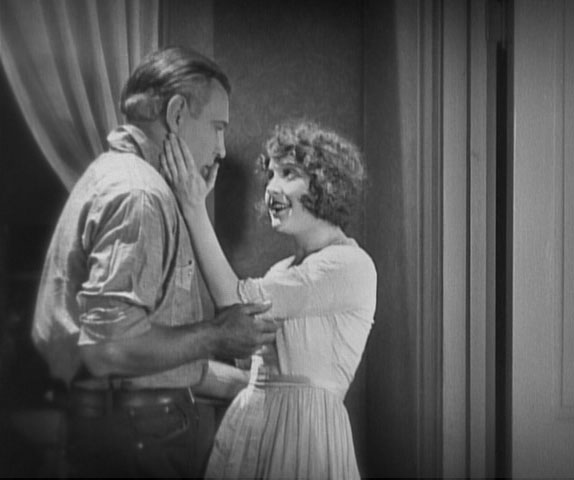
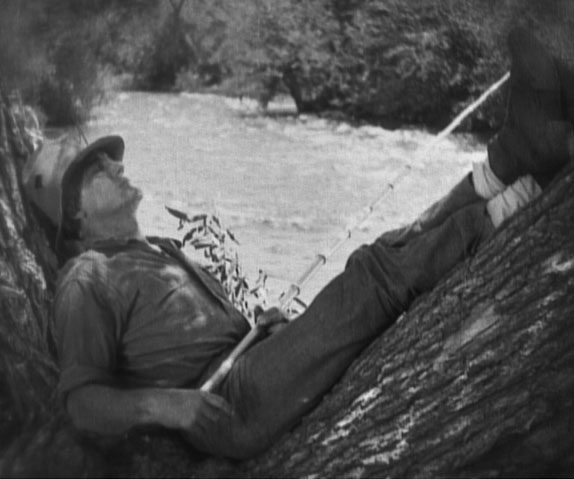
The House With Closed Shutters (1910, DW Griffith)
A Dixie-loyal young girl runs a message to the confederate front lines after her supposed-to-be-messenger brother comes home drunk and afraid. When she’s killed (because she was playing like a kid in no man’s land), their mother covers it up by acting like her son was killed and forbidding her “daughter” to ever leave the house or open the shutters. Decades later his old friends walk by the house, he swings the shutters open and dies from the shock.

Dead guy on chair (left) while his mother orders the friends to leave
image

Suspense. (1913, Lois Weber & Philips Smalley)
After the servant quits and leaves the key under the mat, a vagabond takes the opportunity to enter the house, eat a sandwich and stab the woman and her baby to death with a knife. Or he would – but she calls her husband who races home from work in a stolen car followed closely by the cops (who, as cops do in silent movies, shoot their guns constantly not worrying about the casual damage they might cause – not to mention that it hardly seems fair to shoot a guy dead for stealing a car). Worth watching for the titular suspense, and the reaction of the guy whose car the husband stole when he finally catches up and sees the wife & baby safe: a big “well whattaya know” shrug to camera and a pat on the husband’s back. Co-director Weber played the wife.

Sweet split-screen:
image

Return of Reason (1923, Man Ray)
Whirling carnival lights at night, nails and tiny beads exposed directly on the film, a tic-tac-toe structure twirling on a string, all in stark black and white. Ends with negative image of a topless woman with psychedelic light patterns on her body.
image

The Starfish (1928, Man Ray)
A reputedly beautiful woman is shown behind distorting glass. A man holds a starfish in a jar. Terrifying close-up of starfish. Mirrors, split-screens and superimpositions. This is nice – how come poets don’t make movies anymore? Adaptation of a poem by Robert Desnos.

image

image

Emak-Bakia / Leave Me Alone (1926, Man Ray)
Twirling, swirling light patterns, spinning prisms, a girl with painted eyelids (paging Mr. Cocteau), broken dice, a tad of stop motion. The notes say Ray uses ‘all the tricks that might annoy certain spectators,’ and eighty years later he has annoyed me. Or maybe I’ve just watched too many of his movies in a row. I’d seen no films by Man Ray, then poof, I’ve seen half of them. Good stuff.

image

Oooh look, her painted lids are half-closed so you can see all four eyes:
image

The Life and Death of 9413: A Hollywood Extra (1928, Robert Florey & Slavko Vorkapich)
Far and away the greatest of these shorts. Intense shadowy miniatures interspersed with close-up photography of actors tells the story of a young hopeful actor defeated by the ruthless Hollywood star system. After he dies, he rises to heaven, where there is always open casting. A predecessor to Mulholland Dr.? Incredible-looking homemade film, very expressionist-influenced. Florey went on to direct 60+ features before moving to television, Vorkapich edited montage sequences for Hollywood films in the 30’s, and assistant cinematographer Gregg Toland shot Citizen Kane.

image

image

Rhythmus 21 (1921, Hans Richter)
“generally regarded as the first abstract animated film”, wow! Squares of light and dark get bigger/smaller, more complex patterns start to appear, pretty slow movement, never gets outrageously intricate, but if it’s the first film of its kind, it’s a great start.
image

Christ almighty is it ever dangerous out in the countryside. Jeez. Frenchman Alexandre Aja pointed out that it can be damned dangerous in the countryside with Haute tension (and similarly, in the American desert with The Hills Have Eyes) and now everyone wants to join in. So I’ve just watched French horrors Them (it’s damned dangerous in the countryside because of murderous children), Calvaire (it’s extremely dangerous in the countryside because of insane rural folks) and now Frontier(s) (it’s sure-as-shit dangerous in the countryside because of crazed, torture-happy, inbred, cannibalistic nazis). I am leaving 2007 French horror Inside on the shelf this year, because I get the point already.

An actress conveys trauma:
image

A Paris heist goes wrong, four thieves split for the country after dropping one off at the hospital to die. Yasmine, the dead guy’s sister, is traumatized. Two guys arrive at a country inn and are seduced by the hotties who work there then turned upon, captured by some sadistic dudes. The others arrive, are fed then turned upon, captured by sadistic dudes. Movie goes all Hostel on us now, with chains and power tools and horrific deaths. Yasmine’s boyfriend is killed and fed to her – she is traumatized. She’s discovered to be pregnant so they keep her around to breed new nazis – she’s cared for by a girl who seems too young to already have four deformed monster children but somehow does. Traumatized! Then comes the bloody revenge part of the show, where Yasmine goes allll ultraviolent on the nazis, fighting and chopping and sawing and chewing and shooting her way out of the compound, driving away extreeeemely traumatized and getting picked up by cops, haha.

At right: girl with four mutant children
image

Awfully bloody, and just short of being bloody awful, movie is full of flash action-editing and overwrought music. Bunch of actors I don’t know (the bulky simple guy was Samuel Le Bihan from Red, also star of Brotherhood of the Wolf). Director Gens was already working on his first Hollywood action movie Hitman (IMDB reviewer says “Guns, Blood, Boobies”) when this came out. Seems like a good match for him. New York Times gave this a passing grade because of references to France’s recent political strife – nazis vs. muslims! But as far as I could tell, only one of the thieves was muslim (and he got killed), and the nazis had German names/accents, not French, so I’m not seeing a cutting indictment of French society here, just more rural paranoia.

Gardner: “Forest of Bliss is intended as an unsparing but ultimately redeeming account of the inevitable griefs and frequent happinesses that punctuate daily life in Benares, one of the world’s most holy cities. The film unfolds from one sunrise to the next without commentary, subtitles or dialogue. It is an attempt to give anyone who sees it a wholly authentic though greatly magnified view of the matters of life and death that are portrayed.”

Gorgeous doc from American anthropologist/filmmaker Gardner assembles this “day in the life” through many days of shooting (either that or he’s the most efficient filmmaker in history), with beautiful artistic shots and editing. There’s a clear plot/progression, as he shows fragments, actions, people, with no indication of who they are or what they mean, then it all gets woven together. The “ladders” being built are stretchers for the dead. The shipful of timber is for funeral pyres. The stone courtyard being washed down is where bodies are prepared. The man bathing in the river is a priest who performs funeral ceremonies. Some shocking images (bodies get dumped right into the river!) but for the most part it’s an awe-inspiring ecstatic film.

Andy opened with Den of Tigers (2002, Jonathan Schwartz), a decent Gardner-influenced short doc from West Bengal featuring people speaking to us in English (so it wasn’t too Gardner-influenced).

There’s a traffic jam on the movie-blog because I couldn’t think of anything to say about Happy-Go-Lucky. I liked it though! Katy kinda liked it too. Happy teacher Sally Hawkins tries to infect everyone around her with happiness, meets a stone wall in her paranoid, misanthropic driving instructor. There’s also trouble with an unresponsive store clerk, a mentally disturbed homeless man, her picture-perfect pregnant sister, and a young school bully with abuse issues at home. Through the kid Sally meets a cute boy, a child counselor with whom she goes boating at the end.

I don’t remember Sally Hawkins from Vera Drake. I don’t remember driving instructor Eddie Marsan from any of his eight movies I’ve seen in the last five years, poor guy. I’ll look out for him playing John Houseman in Linklater’s new movie.

People who called this movie the flipside to Leigh’s Naked were right on (though Leigh himself doesn’t think so). It’s one of the few movies I’ve seen theatrically lately which I would gladly watch again right now.

D. Denby: “Leigh surrounds her with a realistic social world—workplace, family, students, a variety of grumpy and dissatisfied people. She greets them all with such frothy benevolence that you fear for her. Yet the movie, shot on sunshiny, light-filled days, feels joyous and loose-limbed, and the audience learns to relax and go with it.”

Three Little Pigs (1933, Burt Gillett)
Musical short feat. “Who’s afraid of the big bad wolf” song. Great sound work by Carl Stalling. Uncle Walt did the voice of the brickhouse pig, one of only a couple credited non-Mickey voice roles. OMG, inside the brick house there’s a framed picture of sausage links on the wall with the caption “father”.
image

Mirror of Holland (1951, Bert Haanstra)
Greeeeat movie. He shoots reflections of Holland on the river, then flips the camera so they’re rightside-up. Looks for cool subjects and cool effects off the water. All woodwind and harp music, no narration, gorgeous. Didn’t know there was a golden palm for shorts at Cannes, but this won it.
image

Quiet As Kept (2007, Charles Burnett)
“That little-ass FEMA check sure don’t go very far”
Actors are real actorly, especially the kid (he’s in Ned’s Declassified). Video is real videoey. Script is real good, a sketch about a family of black New Orleans ex-residents post-Katrina, but the movie is ehhh. Oops, All Movie Guide calls it a documentary – bozos. Can’t find anyone talking about this online, probably because when Killer of Sheep came out on DVD, everyone got in line to praise it and didn’t want to look out-of-touch by talking about the not-great shorts it was packaged with.
image

Mr. Frenhofer and the Minotaur (1949, Sidney Peterson)
Distorted film of actors, string music, and voiceover, none of which has anything to do with the other. “To pose, or not to? I love him, I love him not? Or rather, since I love him less already, why not? An old man mad about paint, Frenhofer…” Yep, definitely from the same source as La Belle Noiseuse. “Once upon a time there was an old man who had been painting one painting for ten years. His name was Frenho… for what? … He started looking for a model to compare. All he wanted was the most beautiful woman in the world to prove to himself that his painting was more beautiful than any possible woman.” It’s all in here: Marianne’s man (also a painter) offering up her modeling services, Porbus the art dealer.

The script/narration is pretty swell but I wouldn’t be following if not for having seen the Rivette, and the visual is just nothing to me… a clock, a fencing match, cats, blurry nonsense, movie would be just as good with a black screen. Sorry, Sidney Peterson. Hmmm, at the end a fencer stabs the painter.
image

Eurydice – She, So Beloved (2007, Bros. Quay)
Very underlit ballet. Kinda dull. I preferred The Phantom Museum (and Dracula: Pages from a Virgin’s Diary).
image

Victory Over The Sun (2007, Michael Robinson)
Weirdly shaped monuments and the whispering wind. Would probably help if I could understand what the chanting people are saying. There’s some abstract 3D Animation thrown in. Towards the end goes into sound from some cartoon… Transformers? Some very familiar symphonic music. Pretty nice… I didn’t love it by any means, but I like it better than the disappointing Light Is Waiting.

Waaait, I looked this up online and found all sorts of stuff about it, something about being shot on the former sites of Worlds Fairs, but now I can’t find where I wrote that down.
image

The Wizard of Speed and Time (1979, Mike Jittlov)
Oh My God. This is three minutes of pure joy. Now that I have found this movie, I will watch it always. It’s my new The Heart of the World, using jaw-dropping stop-motion to express pure cinema love. The look is dated, but the music is swell, and Mike is a grinning god.
image

Thee Autopsy Movie. I’ve had the Brakhage set for over five years and have proclaimed it the single best thing on my DVD shelf, but have never even attempted to watch this particular short before. I assumed it’d be just like Window Water Baby Moving, but using dead bodies instead of Stan’s pregnant wife, which seemed like the worst idea in the world, or at least something guaranteed to make me physically upset upon viewing. But on this particularly slow week in Shocktober, I gave it a go. Fortunately it turned out to be more stylistically tame, less jittery than WWBM, Stan not trying to horrify us, just to filter what he’s seeing through his always intense camera eye. I’m glad this exists, and I’m somewhat glad I saw it, but I might not want to ever see it again.

A high-quality euro-arthouse movie like Roman de gare (but probably better), more subtle than its subject matter would seem to warrant. Chabrol’s rep as the French Hitchcock is either exaggerated or based on his movies that I haven’t watched yet, because this and L’Enfer and Le Beau Serge aren’t so Hitchcockian.

Gabrielle (Ludivine Sagnier of Love Songs and 8 Women) falls for rich old guy Charles (François Berléand of the Transporter trilogy and Au revoir les enfants). Charles has an unexplained antagonistic relationship with young flamboyant rich guy Paul (Benoît Magimel, the young lover in The Piano Teacher). Paul falls for Gabrielle and wants to marry her, take her away from Charles.

Paul looks dangerous; is dangerous
image

This isn’t all happening at once like the trailer implies, though. First G. has a long impassioned affair with lying, married, sexually deviant Charles, who often acts cold towards her and pretends he doesn’t want her anymore. Girls love that, so she keeps coming back. Then after he’s left her for good and she’s super-heartbroken, she finally agrees to go out with Paul, who arrives screaming with crazy hair, all Written on the Wind, being held in check by his chauffeur. He cleans up his act so G. will go out with him, but sometimes he loses it and tries to strangle her. Girls love that, so she keeps coming back, and a year later they get married. Then at a ball, Paul shoots Charles to death, goes to jail, and disowns Gabrielle, who goes on to act as the beautiful assistant that gets cut in half in her uncle’s magic show.

I liked, but didn’t love it. Fun ending, great acting. I thought Caroline Sihol as Paul’s mom looked familiar, but I haven’t seen anything else she’s been in (some Truffaut and Resnais and La Vie en rose). Based on a true story in 1906 New York, but transplanted to modern Europe. Movie contains a conspicuous mention of Woody Allen, who himself is from early-1900’s New York and transplanted to modern Europe.

Gabrielle with peacock tail (washed-out color courtesy of online trailer)
image

There’s no shortage of online reviews for this… I liked best the one by K. Mitsuda in Reverse Shot:

Serving as both subject and object, Gabrielle is a deliberately confusing amalgam of striking dualities. […] The appeal Gabrielle holds for Charles and Paul in particular is symbolized in the shorthand of her last name: Snow. Attracted foremost to her youth and naivete – signifiers of virtue – the competing suitors often affectionately describe her as either “innocent” or an “angel.” […] Chabrol ingeniously suggests that the inability of the men to accept her complexity results in a reductive worldview that inexorably leads to a violent ending.

And S. Tobias:

The film takes the form of a thriller, but it doesn’t have the pace of one. Still, all that careful, deliberate table-setting allows Chabrol to establish the complex dynamic between the three characters and underline the role that money and privilege plays in sabotaging Sagnier’s life.

AKA The Ordeal. A single young dude, Marc Stevens, is a traveling, singing showman for old folks’ homes. His van breaks down somewhere (movie was shot in Belgium, France and/or Luxembourg) and he stays with Bartel, the Paul Giamatti-looking innkeeper. But Bart is way crazy, destroys Marc’s van, dresses Marc up as his ex-wife Gloria and threatens bloody revenge if “she” ever runs off again. Marc runs off, gets caught by villagers (sharing the delusion that Marc is Gloria) who rape him, gets re-caught by Marc who crucifies him, escapes again and gets his leg caught in an animal trap, and so on. It’s tough going for Marc until the townsfolk attack Bartel’s place and Bart is killed by a just-as-crazy Malcolm McDowell-looking guy. Marc runs off, pursued by Malcolm who sinks into the swamp. The end, although Marc is far from safe and sound, all hurt and hungry in a swamp with villagers possibly still looking for him. Also, as a side-suspense, a man named Boris is looking for his dog.

Marc watches Malcolm drown
image

This one goes less for sustained tension/suspense than Them did, more for bizarre WTF-horror. It’s an ugly, somewhat effective little film… good enough that I could give his next movie, another rural-horror starring Emmanuelle Béart and Rufus Sewell, a shot. No music except for a piano tune played during a Bartel’s visit to a Bela Tarr tavern. I guess the message here is “don’t stray outside the city and get lost in rural areas”, a message that has been well hammered home by previous horror movies.

Bartel seems like a nice guy deep down
image

Laurent Lucas, who did a fine job as terrorized Marc (except that when he’s most afraid, he kinda looks like he’s drunkenly grinning) was in mysterious films Pola X and In My Skin. Boris, who finally finds his dog, was in Luc Besson’s Taxi 4 last year. The dangerously deluded innkeeper appeared in Olivier Assayas’s Cold Water. And the cinematographer shot suspense films Joshua, Day Night Day Night and Irreversible.

Interviewer: “How do you think female viewers will react to Calvaire?”
Director: “Well, I realise my film could go over badly, even very badly. Though personally, I really think the film is feminist. It is a brutal work, like Deliverance or Straw Dogs, for example.”

WTF
image

Andy: “Since the early 1960s, Nathaniel Dorsky has been one of the great practitioners of meditative cinema. Projected at the non-standard rate of eighteen frames per second (which he refers to as ‘sacred speed’), Dorsky’s films are an explicit invitation to increase our awareness of moment-to-moment existence and experience a sense of reverence for the visual world.”

Nice program with perfect-quality 16mm prints of four silent twenty-minute shorts. Gotta remember to attend all of Andy’s screenings from now on.

Alaya (1987)
The first one was just shots of sand. Just sand (one special appearance by an insect). No camera movement, but the sand is always moving, blowing in the wind. Goes from wide, wide shots of a huge desert (Death Valley) to extreme super-closeups, the sand crystals looking like boulders on the screen (but boulders that flit about in the breeze). An intensely beautiful movie, my favorite of the bunch.

Triste (1996)
Variations (1998)
The next two were similar to each other, and reminded me of Warren Sonbert (though I couldn’t remember Sonbert’s name until Andy announced that they reminded him of Warren Sonbert). Shots of varying length (8-45 seconds), extremely well-composed, of almost anything Dorsky came across: people, nature, the city. Second one was more exciting, with more quick bursts of shorter shots, and seemed to have a visual theme of seeing, looking, through glass and mirrors. Halfway through the first film the ceiling fan stopped making its rhythmic knocking sound which had made me think of the editing sounds in Zorns Lemma, so I had to imagine my own soundtrack (’twas TV On The Radio for a while). Fun and difficult to try to figure out relations between the shots while watching.

The Visitation (2002)
Then came a discussion, during which Andy talked about film stocks (these were all made on a Bolex, just like Sonbert) and mentioned that of course the second movie was called Triste, which means “sad”, which is why it felt like a lull, edit-wise, between exciting films. There’s all this hidden meaning in these films which the simple likes of ourselves can never understand. I don’t like being made to feel stupid by avant-garde filmmakers so I was determined to assign meaning to every last shot in the bonus fourth movie The Visitation, and I succeeded easily. Visitation = alien invasion. Lots of shots of light from above, and representations of alien bodies (mostly tentacles, via cords and long plant leaves). Aliens have many eyes – we see the eyes, and their view of our world. Ends with a gorgeous shot representing their planetary invasion, two low waves approaching each other over sand, the alien wave easily covering the human wave, but the human wave slowly fighting back at the end, regaining victory. A lot like War of the Worlds.

“A gradual unfolding, an arrival so to speak. I felt the necessity to describe an occurrence, not one specifically of time and place, but one of revelation in one’s own psyche.” -N.D.