2016/17: Watched the new blu-ray and updated the 2008 writeup below.

Juliet Berto and Bulle Ogier are rival goddesses, only on Earth for a short time unless they can possess a magic stone. Juliet hires Hermine Karagheuz (Marie in Out 1) to track some people connected to her brother Pierre (Jean Babilée, a dancer not in a lot of films) – first an acquaintance named Sylvia who dies at the aquarium, then Pierre’s on-again girl Elsa (Nicole Garcia of Mon oncle d’Amérique, now a director). Poor Elsa has a key role in the middle half of the movie, then gets killed trying to defeat Bulle and is barely mentioned again. Pierre himself has been possessed by Bulle and also infected by the stone, which he hands off to Hermine, who figures out how to use it to banish the two goddesses, Hellraiser-style, at dusk.

Juliet Berto in her serious vengeance suit:
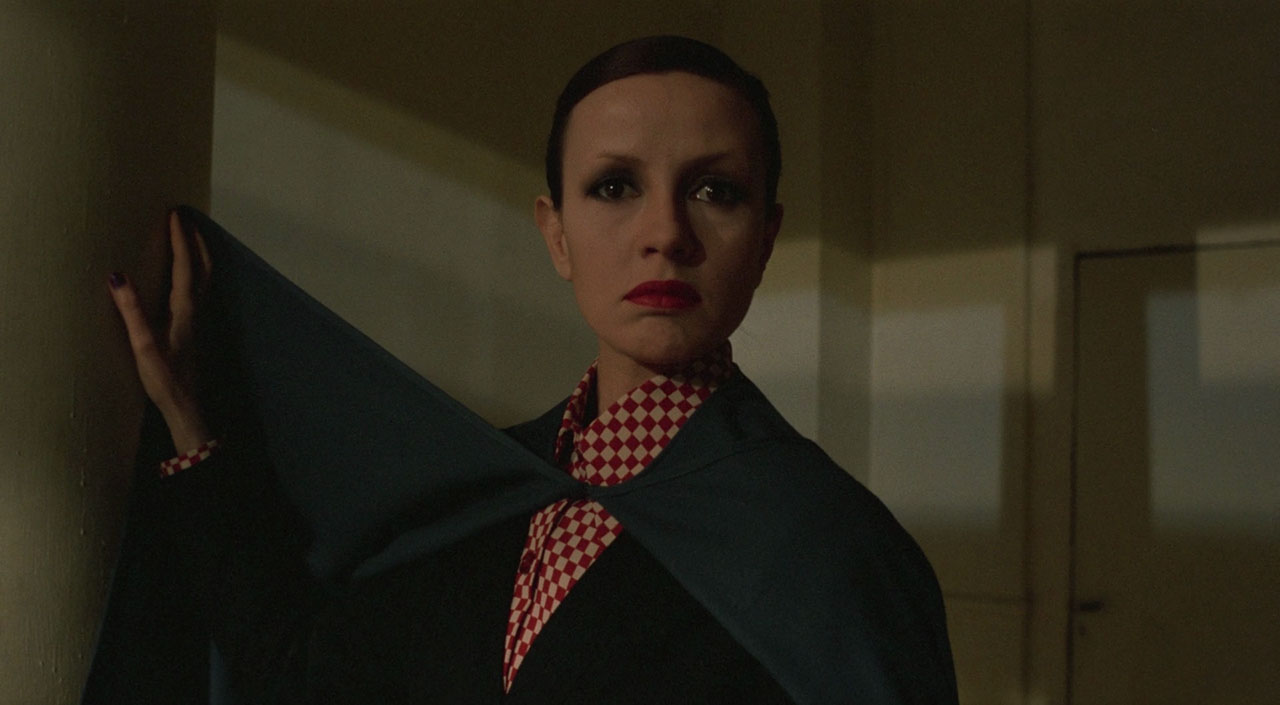
So much camera movement, most of it (per Rosenbaum’s set-visit notes) on tracks, which seems too complex to be possible. Music is improv piano and pianist Jean Wiener is on set, in the shot, even in places where he obviously does not belong. Bulle has an accomplice, Elisabeth Wiener (daughter of the pianist) who disappears a few scenes into the movie.

Bulle and Elsa go for a walk:

David Ehrenstein has the inside scoop on literary and filmic references: “Our innocent heroine (Hermine Karaghuez instantly recalling Betty Schneider in Paris nous appartient) recites lines from Cocteau’s play [Knights of the Round Table] as a kind of incantation, much as Geraldine Chaplin reads lines from Cyril Tourneur’s The Revenger’s Tragedy in Noroît.” Rivette screened The Seventh Victim for the cast, and D.E. also mentions Bresson’s Les Dames du Bois de Boulogne as an influence.

Frederique Fatale: Juliet Berto at the aquarium

Hermine discovers Sylvia dead:

David Cairns puts it best:

Lots of creaking in this film! As the dolly trundles over wooden floors, a cacophony of straining wood announces its presence. Since the film has a very live soundtrack, there was obviously no way to eliminate these extraneous sounds, so they kind of make a mild virtue of them. The camera movements, coupled with the moves of the actors, are extremely elegant and elaborate, and the symphony of sounds that accompany them all can be seen as atmosphere … Jean Babilée is an amazing physical presence, not just when he does his acrobatic feats, but just in his general movements, which are all like dance, even when maybe he’s just moving around so you can’t see how short he is next to the women.

Showdown: Elsa and Juliet…

vs. Bulle and the fabulous Babilée

Rivette discussed how each of the four planned films (this was written as part two) would be set during the same forty days of Carnival, two cycles from new moon to full.

During shooting, each “unit” (each block-sequence) will be subjected to a method designed to break down not only conventional dramatic techniques but also the more recent conventions of improvisation with all the prolixities and cliches it entails (hesitations, provocations, etc.), and to establish an ecriture based on actions, movements, attitudes, the actor’s ‘gestural’, in other words. The ambition of these films is to discover a new approach to acting in the cinema, where speech, reduced to essential phrases, to precise formulas, would playa role of ‘poetic’ punctuation. Not a return to the silent cinema, neither pantomime nor choreography: something else, where the movement of bodies, their counterpoint, their inscription within the screen space, would be the basis of the mise en scene.

In order to enable us to make a definitive crossing of this frontier which separates traditional acting from the kind we are looking for: the constant presence during shooting of musicians (different instruments and styles of music according to each film) who would improvise during the filming of sequences, their improvisation dependent on the actors’ playing, the latter also being modified by the musicians’ own inventions (recorded in direct sound along with the dialogue and the “stage noises” properly speaking).

Showdown: knife-wielding Bulle…

vs. gem-wielding Hermine

G. Adair reporting from the set:

Whatever else it may be, a film is also the record of its own tournage. In Rivette’s case, the film set becomes a theatre of imponderables, which shape the result much as a sleeper’s movements will govern the nature of his dreams; and from the evidence of interviews one realizes that the only guidelines of a Rivette film are those of tournage, the idea of a definitive form, at least until editing begins, being a nonsense. In the past (L’Amour Fou, Out 1) his overriding concern as a director has been to record the work’s gestation, which tempts me to suggest that, though the ‘legendary’ 13-hour version of Out 1 may indeed be extraordinary, it must be less so than the six-week version, i.e. the tournage. From [Duelle], whose camera movements are plotted out in advance but whose dialogue is written the evening before, whose actors have specific things to do but whose music is improvised, one can have no idea what to expect.

Hermine triumphant:

“We live three times as long since man invented movies.”

First movie watched in 2017. Interweaving life stories of family members during the year grandma spent in a coma, with mirrors of behaviors and situations across generations.

NJ and daughter Ting-Ting with the happy couple:

NJ is Nien-Jen Wu (cowrote Hou Hsiao-Hsien films including City of Sadness and The Puppetmaster). He’s a reasonable, middle-aged, frowny-faced guy disillusioned with his job. He bumps into an ex, Sherry, at the wedding, then arranges to meet her in Japan while courting software developer Ota (Issei Ogata, the emperor in The Sun) for work. Having casual conversations with Ota about music and spending his days with Sherry (Su-Yun Ko also played a lead male character’s Tokyo ex in Taipei Story) gives him nostalgia flashbacks of first love, while his daughter Ting-Ting is home dealing with similar issues firsthand.

Ting-Ting starts the movie feeling guilty that she might be responsible for grandma’s stroke, and soon adds more typical teenage problems into the mix, as she picks up her new neighbor Lili’s barely-ex-boyfriend Fatty, but the two of them are nervously unsure how to be in a romantic relationship (and incidentally, he later murders the neighbor’s mom’s boyfriend).

The neighbor with Fatty, who is not fat:

Min-Min is the mom of the family (Elaine Jin, also a mom in A Brighter Summer Day), has a breakdown while trying to talk to her comatose mom then disappears to a meditation retreat for the rest of the movie. And young son Yang-Yang is a slightly offbeat kid (spotted in his room: Astro Boy, Mickey Mouse, Batman, Pikachu… and the Hindenburg) who takes photos of the backs of people’s heads (a naïve, questioning photographer/observer who shows people things they can’t see for themselves, named after the film’s director, hmm).

Yang-Yang couldn’t deal with the wedding reception food:

Newlywed astrology nut A-Di is Min-Min’s brother, can’t keep his financial or romantic act together, with his longtime ex-girlfriend Yun-Yun showing up at the wedding and baby shower and making scenes. His wife Xiao Yan threatens to leave then comes back thinking A-Di has attempted suicide – he says he just fell asleep in the tub with the gas on. And I think A-Di’s money is stolen by business partner Piggy (yes, there’s a Piggy and a Fatty).

Yang won best director at Cannes, and died of cancer seven years later without producing a follow-up, which was rumored to be an animated Jackie Chan feature.

Kent Jones:

The New Taiwan Cinema was a predominantly urban phenomenon, the better to dramatize the rapacious speed of cultural upheaval. And Yang, Hou, and the slightly younger, Malaysian-born Tsai have employed, each in his own unique way, the sights, textures, rhythms, and social configurations of city living to devastating effect … Yang has set his city symphonies in a variety of emotional keys — the doleful lament of Taipei Story, the gridlike coolness of The Terrorizer, the comic hysteria of A Confucian Confusion, the carefully modulated fury of Mahjong. In Yi Yi, he brings all of these moods together, never allowing any one of them to take precedence over another. Which is to say that this is a grand choral work, with a panoptic majesty.

The back half of our New Year’s Eve classic movie double-feature. It doesn’t have the naughty thrills of Baby Face, but it’s a good western in beautifully-restored technicolor.

Our lead cowboy Logan (Dana Andrews, star of Night of the Demon, had postwar rage issues in The Best Years of Our Lives) is aggressively growing his pack mule business, gets chastely paired up with British Caroline (Patricia Roc). His banker buddy George (Brian Donlevy, Dr. Quatermass and the great McGinty) has a fine mustache but also has gambling problems, is stealing from the bags of gold dust in his vault to pay his debts, and after he eventually gets killed, Logan is free to steal his girl Lucy (Susan Hayward, Veronica Lake’s love rival in I Married a Witch), who is more Logan’s adventurous type.

Bragg (foreground) and Logan:

George and Lucy:

In between, a bunch of serious stuff happens. A young couple marries, gets a cabin built by the townspeople, then gets slaughtered by indians who attack after large-faced baddie Bragg (Nebraskan Ward Bond of Johnny Guitar and Rio Bravo) probably rapes/kills an indian woman. Logan’s friend Hoagy Carmichael (famous singer/songwriter, also of To Have and Have Not) and decent-enough local dude Lloyd Bridges testify against George, who is freed from jail by Logan only to be gunned down off camera. Logan’s business burns to the ground, and even Andy “Friar Tuck” Devine is killed. Of course there’s a chase/fight at the end, and Bragg is left for the indians. Them were hard times, but that’s a fine supporting cast. Rose Hobart was in there somewhere too, but I’m not sure where.

Lloyd and Hoagy:

Devine and Caroline:

TCM:

Under the familiar trappings of cabin raisings, poker games, saloon brawls and frontier combat is a remarkably dense drama where the tensions between individual enterprise and communal good are often strained and the line between hero and villain is not a matter of black and white, but shades of gray.

Barbara Stanwyck is great as ever, and maybe the movie itself isn’t great, but it’s something we didn’t think ever existed. You hear that the 1930’s pre-codes were edgy, and you see Mae West‘s bawdy humor, but you never expect to see Barbara – pushed by a Nietzsche-quoting crank – to screw her way up the ladder of a bank, finally getting the president to marry her and inspiring two suicides along the way.

Barbara has mixed feelings watching her dad burn up:

Predicting another of her movies, eight years early:

Barbara’s dad Robert Barrat is a crabby bartender, pimping out his daughter until his stillhouse explodes with him inside, so Lily (heh) moves to the city with her buddy Theresa Harris (of Thunderbolt and I Walked With a Zombie) in tow. She doesn’t actually advance her career, because women in banks were secretaries, but she starts as secretary to lowly John Wayne in the filing department and quickly becomes secretary to men higher up the organization. There’s leering Mr. Brody, then the upright guy who tries to get her fired Mr. Stevens (Donald Cook), then his crazy-haired boss Carter aka Fuzzy Wuzzy (Henry Kolker, Katharine Hepburn’s dad in Holiday), and finally the fancy young president (George Brent), who she sideways-seduces by pretending to be reformed and uncorruptable. In the end she either finds her president-husband dead in his office, or she’s so happy he’s still alive that she renounces her riches – your choice.

Barbara ignoring John Wayne:

Cozying up to Brody (Douglass Dumbrille of Mr. Deeds Goes to Town):

With wild scarf, sleeves, and Donald Cook:

Rewatched this in less-than-optimal conditions (not on my fucking telephone, at least), but I’ve seen it so many times already. It’s hard to watch without the fan theories I read online in 2002 popping into my head… can’t let the mystery of it all wash over me when my mind keeps fitting the pieces into a puzzle. Granted, the theories work pretty well. And each scene is fantastic whether it makes narrative sense or not.

Classic Hollywood: landlady Coco is Ann Miller of Kiss Me Kate and On The Town, and the ranting woman wandering the apartment halls is Lee Grant of Detective Story and Shampoo. Betty’s new friend at the airport is Mary’s mom in Eraserhead. Since this came out I’ve seen Naomi Watts in a few things (none of them very good except Eastern Promises), Laura Harring in nothing, and Justin Theroux in Wanderlust and Charlie’s Angels 2. Most upsetting is when Patrick Fischler, the scared guy in the diner, shows up in a movie or TV show, as he does more regularly than his Mulholland costars.

Learned from the interview extras: Lynch says the title Mulholland Dr. was originally for a cancelled Twin Peaks spinoff, and The Cowboy is wearing Tom Mix’s original clothes.

2500th post!

I wasn’t thinking of anything when I rewatched Mulholland Dr. the same week we saw La La Land, another movie with great songs in which a girl follows her dreams to Hollywood. Emma Stone’s Mia eventually becomes the star that Betty only dreams of being, after a casting agent sees her one-woman show. Her man Ryan Gosling sets aside his own dreams of running a jazz club to tour with his friend John Legend’s band Jazzhammer. Everyone acts like this is a tragic move on Ryan’s part, but he was broke, so how was he gonna afford his own club without building up cash from those lucrative Jazzhammer tours? Either way, Emma thinks he’s selling out his dreams, and their jobs mean they have to spend months apart, and there’s a fight, and suddenly it’s five years later and Emma and her husband duck into Ryan’s successful new club for a bittersweet Umbrellas of Cherbourg-style ending (noticed a suspicious Parapluies shop on the studio backlot, too), but not before indulging in a (shared?) musical fantasy of how their relationship might have worked out.

Nice to see a strong musical with dancing and singing and Rebel Without a Cause references on the big scope-letterboxed cinema screen. Katy thinks all couples should always end up together at the end of movies, but otherwise she liked it.

J. Rosenbaum:

If the movie’s opening and closing production numbers are by far the most impressive and powerful, this is because they’re both responses to realities perceived as unbearable — which becomes all the more unbearable in the latter case by being disguised as a phony happy ending … La La Land is far more about the death of cinema and the death of jazz than it is about their rebirth or survival. It’s about boarded-up movie houses, antiquated analog recordings, and artistic aspirations that can only be fulfilled (as well as fueled) by fantasy.

Reviews of the long, long-awaited new Phantasm sequel are in, and they’re all negative. The digital effects are so bad, you guys. The spheres have no sense of physical reality and move in perfect straight lines. The plot is bizarre, the sets and cameras are cheap, the trailer was better, and so on. These things are true, but I’ll gladly take this Phantasm sequel over no Phantasm sequel.

New characters: Dawn Cody is the hottie who gives Reggie a ride to her house then gets killed, showing up later under a different name. Chuck is an anti-sphere militant short enough to masquerade as one of the robed beastie creatures. Old characters: they bring back the Lady In Lavender from the graveyard in part one, of all the crazy things, and also nunchuck-totin’ Rocky from part three in a cameo. Speaking of cameos, that’s all Jody’s role amounts to – a couple minutes driving the digitally-souped-up Barracuda before it recedes into the sphere-dominated wastelands.

The movie has its fan-service showdowns, apocalyptic hellscapes and bloody sphere-killings, but it’s a proper Phantasm movie, which means it is properly unusual. I don’t think fans were clamoring to see Reggie losing his marbles in a rest home or dying peacefully in a hospital bed. At the end of part one Mike is told that there were no spheres or tall man, that Jody died naturally, and this one doubles up on the reality-questioning, with Reggie flashing between the rest home and different horror/adventure scenarios (along with The Tall Man, Reggie’s rival and/or roommate). The ball implanted in Mike’s head is referenced, Reggie and the others warp between dimensions through the usual portals, plus via mini torture-chamber mind-control portal, plus unwillingly by insanity or chance. None of this gets quite explained in a way that privileges one reality over another, and the parts are shuffled just enough to leave the series on unsteady ground, letting us write our own version of the ending. That’s all you can ask of a series as strange as this one – to take the characters on one more ride, and leave things just as mysterious as they began.

I thought I heard that this was the kid-friendliest of the post-Mononoke Ghibli movies, and maybe so, but it’s also one of the most unexpectedly bizarre. A magic fish-princess flees her underwater bubble-hatted environmentalist mad-scientist Liam Neeson-sounding dad and befriends a five-year-old boy, turning herself human to stay with him on land during a major flood.

After the flood, octopi and trilobites and eels and jellyfish waste no time moving in:

Most of Neeson’s activities are never explained:

Ponyo running on watery waves of blue fishes is some magical animation:

Human boy Sosuke and his mom meet Ponyo’s ocean-goddess mom:

Not an exceptionally good-looking movie thirty years later, and not usually fun enough to justify the dull dialogue and tired plotting (amnesia leads to mistaken identity) but it comes alive whenever Madonna is onscreen. It was on Linklater’s list of the best 1980’s movies, and has been appearing on lists of women-directed films lately, but the thing that stuck in my mind and always made me want to see it was hearing it was inspired by Celine & Julie Go Boating. Apparent Rivette influence – one woman (Rosanna Arquette of Crash and After Hours) starts following another (Madonna in her first major film role), identities get mixed up, and a magic show is involved. There’s no Fiction House, sadly.

Roberta is married to spa king Mark Blum, wears appalling 80’s clothes and big glasses, follows the hookups of the cool and mysterious Susan and her man Jim (Robert Joy of Atlantic City, a mutant in The Hills Have Eyes Remake) in the classifieds, builds up the nerve to follow Susan around and buy her pawned jacket. Roberta’s knocked on the head and mistaken for a prostitute by NYPD, then rescued by Jim’s projectionist friend Dez (Aidan Quinn of Benny & Joon, The Handmaid’s Tale) who thinks she must be Susan.

A neighbor plays saxophone, seen backlit through a window, and I thought “1980’s, New York, saxophone, it’s probably John Lurie” and was right! Also appearing: Richard Hell (Madonna’s boyfriend who gets killed in prologue, setting off the chase), Steven Wright (dating Roberta’s sister[?] Laurie Metcalf) and John Turturro (manager of the magic club). Writer Leora Barish also did a Chantal Akerman movie and Basic Instinct 2, a weird career. Seidelman also made Smithereens and a movie about a robot John Malkovich, and directed some Electric Company reboot episodes which means I’m technically her collaborator and shouldn’t be talking smack about her most famous movie. Good acting and a pleasantly goofball flick, I’ve got no hard feelings.