“Help me. Rats are eating me.”

Rose (not shown here because I didn’t think to get screenshots until after she’d died) lives in a spooky “New York” apartment building above a rare book store run by cat-hater Kazanian. She reads his book about The Three Mothers (which is not such a rare book since he has a few copies in stock). Bumbles around the basement, drops her keys into an underwater room with a portrait of a Mother and some floaty dead bodies, then recovers from that only to be stabbed in the neck.

Kazanian hating on some cats:
image

How to die in this movie, in three steps:
1. a hand injury
2. (optional) animal attack
3. stabbed in the neck

Rose’s mustachioed brother Mark is in Rome studying music with his buddy Sara, when he gets a mysterious letter from Rose referencing the Three Mothers book.

Mustachioed Mark, seen here whispering into a hole:
image

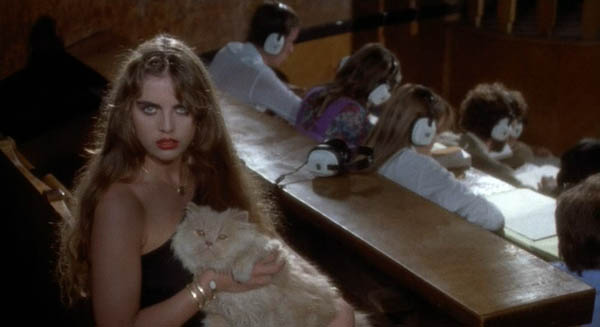
Mark runs off, freaked out by a cat lady who appears in class, so snooping Sara reads the letter.

Cat Lady, seen here in music class:
image

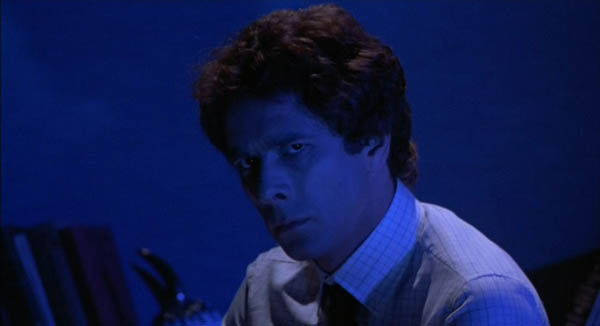
Sara picks up a copy of the not-at-all-rare book in Rome, and stumbles immediately upon another of the three evil buildings that the book mentions. She runs away from an evil alchemist and befriends a man in the elevator who soon gets stabbed in the neck.

Sara’s elevator buddy, seen here under a heavy blue filter:
image

A monster catches Sara and dispatches her with a broken window to the neck. I am not kidding.

Snooping Sara shortly before getting her stupid self stabbed:
image

Mark goes to “New York” to find his sister, meets her hot neighbor Elise. Elise helps get him caught up on the mystery, then she gets tormented by having stagehands throw cats at her from off-camera, and stabbed to death.

Elise on the set of INFERNO:
image

Also in the apartment are an evil nurse who wheels around an evil old man, a nondescript woman (not shown), and a loyal butler.

Mark hassles poor Kazanian, who is later tormented by cats in his bookstore. Kazanian loads the cats into a bag, takes it to the river to drown them, falls down and is nibbled by rats before being stabbed in the neck. His own fault, really.

Back at the mysterious apartment building, the butler is probably evil (aren’t they always?) but I don’t remember for sure… anyway, his eyes are gouged out, breaking the knife-to-the-neck rule set forth by INFERNO in order to keep the “an eye must always be gouged out” general law of Italian horror.

Butler near a birdcage:
image

If the butler isn’t the mastermind behind all this evil, it must be the old man, who lives like Phantom of the Paradise in the cellar with his listening devices and his robot microphone.

Phantom of “New York”:
image

Wrong again! It’s the nurse who wheels him about! I think the movie is saying that she’s one of the Three Mothers and that she is very evil, but I’m not sure how far her evil extends, or if it’s even dangerous to people who don’t live in this apartment or attend music class or hate cats. But oh my god, when Mark goes downstairs to face her, the movie’s theme song plays with lyrics sung in Latin, and that is great.

One Evil Mother:
image

The nondescript woman sets the place accidentally on fire (it’s an “inferno”, if you will), and the Mother is either delighted or horrified by this, hard to tell since at this point she is wearing a rubber skeleton mask, but anyway she throws her hands in the air and Mustache Mark escapes, the end.

My favorite part of the whole affair is the interview on the DVD, where a weary-looking Argento talks about what a difficult and personal film this was, and how he and assistant director Lamberto Bava (dir. DEMONS and DEVIL FISH) and his father Mario Bava (dir. Black Sunday and Diabolik) struggled over this effects shot where a woman dramatically crashes through a mirror and comes out wearing a fakey skeleton costume. Yep, it took the three greatest minds of Italian horror to come up with that one. If only they could’ve got Lucio Fulci (Zombi 2, The Beyond) and Umberto Lenzi (Cannibal Ferox) to make her a better rubber suit.

The underwater bit isn’t bad, which is the same thing I said about Zombi 2. Maybe the Italians should make a whole horror movie underwater.

At least I was so busy marvelling at the silliness of the whole thing that I didn’t notice the dubbing.

Implications of this movie:
– women (or maybe actors in general) are just set dressings to be put in pretty poses and then threatened and stabbed.
– there is something evil, and it’s been around forever, and it is easily defeated by unknowing incompetents, though honestly it’s better off being left alone since it’s not much of a threat to anyone.
– alchemists are scary, cats are evil, architecture is evil

I think Eyes Wide Shut was based on this movie. The atmosphere and pacing, the camera zooms, the drowsily agitated characters, the fake New York, the singing in Latin… it all adds up.

Total Film mag and the They Shoot Pictures List call this one of the best horror movies of the ’80’s, but those people are tripping.

This is a semi-sequel to Suspiria, and Dario Argento’s brand new film Mother of Tears is a sequel to this one starring his daughter Asia (as a woman in trouble) and Udo Kier. Mustache Mark never amounted to much… Rose appeared in Puppet Master and Watchers II… Sara was in something with Marcello Mastroianni and Tom Berenger… Elise has been in all the big Italian horrors and will appear in Mother of Tears… the nurse was in The Beyond… Sara’s blue-tinted friend dubbed the title character in the Italian release of V For Vendetta… the old wheelchair man appeared in The Seventh Victim in 1943… and Kazanian was the husband in Last Year at Marienbad!

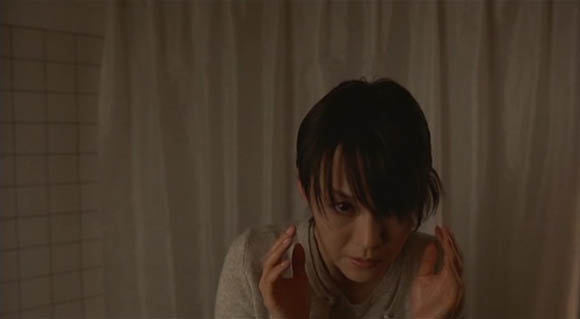
Don’t know why I’m frustrated by this, but the movie seems VERY Kiyoshi Kurosawa in themes, plot, pacing and look. It’s nice to see auteurist consistency, but Kurosawa’s not injecting his personality subtly into a studio picture, he’s writing all his own films, so maybe he could stick these themes somewhere else than another supernatural detective story. Those complaints aside, going through the screenshots I was struck again by what a nice looking movie it is… probably superior to the rest of the now decaying J-horror genre, which is again why I wish he’d break out of that genre for good instead of coming back to ghost stories after showing his depth with Bright Future and Charisma. Although, maybe Kurosawa was requested to write this kind of picture by his producers, who have done a whole ton of J-Horror, including the Ring and Grudge series, Reincarnation and Cross Fire… yeah, I’ll go with that.

image

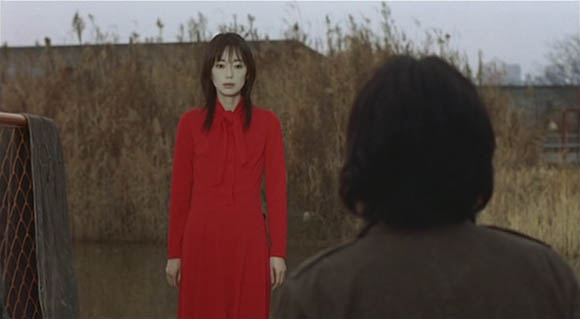
Kurosawa fave Kôji Yakusho plays Noboru, an unremarkable detective with a cute girlfriend he sees off and on. A murder is committed, a woman in a red dress drowned in salt water, and the clues point to Noboru. His partner Miyagi suspects him and he begins to suspect himself, but soon there are two other murders to distract them. A high-school kid and an office worker are also found drowned in salt water, but Noboru, playing on a ghostly intuition, quickly finds the murderers: the boy’s father Dr. Takagi, upset at the boy’s out of control behavior, and the man’s secretary with whom he was cheating on his wife.

image

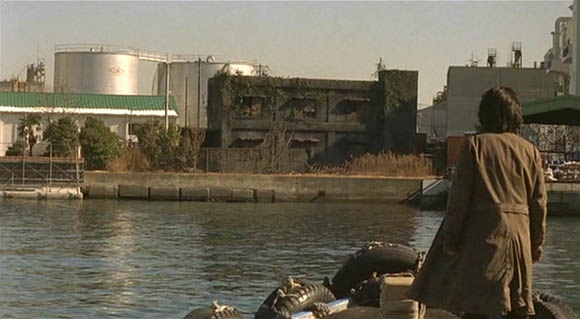
The two (three?) are unlikely people to be murderers, but they are all apparently driven to kill by the ghost of the red dress lady, who has been haunting our detective. I think she was either a former inmate at a black asylum on the river or a passer-by who got lost there. The ferry used to pass that building a decade ago, and our hero would see her in the window. The killings are her revenge for being ignored and left behind. “I died, so everyone else should die too”. She’s the collective conscience of the ferry riders, or the guilt of a civilization.

image

I’m not sure if our detective killed the woman in red, but he is revealed to have killed his girlfriend. In the end, he alternates between seeing her (ghost) and being able to hold her, and seeing her dead decayed body on the floor, drowned in a pan of salt water. He goes to the black building and confronts the woman in red, who is grateful to be recognized, but carries on her quest to drown everyone in salt water. The final scene is our man wandering the empty city streets, once again (as in Pulse) the survivor of a ghostly apocalypse brought on by loneliness and neglect (and revenge [let’s not forget the title of the film], another of Kurosawa’s very favorite topics).

image

Kurosawa reveals the ghost in different ways. Sometimes the detective is haunted in his dark apartment (the usual way to be haunted by a ghost), but sometimes he sees her in broad daylight, disturbingly composited into the shot to give her an otherworldly appearance, and sometimes (as in a great long-shot interrogation scene with Dr. Takagi) she’s in the room with a group of people, but only visible to one (and not to the audience).

image

The movie is not too scary as horror (just a few jumpy moments), and it’s only okay as a detective story or a parable about society, but Kurosawa brings his usual mastery to the plotting and camera work, making it the most worthwhile movie I watched this week anyway. It’s not nearly as complicated / incomprehensible as reviews seem to indicate… jeez, are these people playing video games during the movie that they can’t ever follow a story, or am I some sort of narrative expert that I can? The movie portrays Tokyo as a crumbling metropolis besieged by earthquakes, and scenes are set in decayed abandoned buildings and over landfills.

H. Stewart at Film School Rejects writes:

Retribution’s greatest defiance of horror convention is that despite the identical M.O.s of the murders, there is no serial killer afoot, as the police suspect; Kurosawa’s cultural commentary, vaguely similar to that found in Mario Bava’s Bay of Blood, hints that the sorry state of our global society is not the result of one bad individual, one rampaging murderer of the Michael Meyers variety, but as a result of all of our combined actions; nearly everyone in the film is a killer, implying that we are all collectively culpable, not only for the things we do but for the things we don’t do that nevertheless manage to have a pernicious effect on others, even though we might not be conscious of it. … Retribution, coming in the era of the Iraq War, serves to show the devastating result of an unquenchable need for vengeance, and how we’re all responsible.

Our guy and his partner:
image

Interestingly, the working title for Rob Zombie’s new remake was Halloween: Retribution, so I just saw two movies in a row named Retribution.

The cinematographer previously worked on K. Kurosawa’s Loft as well as Fatherfucker and Splatter: Naked Blood. Dr. Takagi starred in Princess Raccoon and Kurosawa’s Bright Future. The woman in red starred in Parasite Eve. Detective Toru Miyaji (above, right) was the horse-riding Baron in Letters From Iwo Jima and starred in the first of the 90’s Gamera movies. Harue starred in Udon, which I just missed at Emory last week. Kôji Yakusho (our star Noboru) starred in Cure, Charisma, Doppelganger, Seance, Eureka, The Eel, Shall We Dance, Babel, Memoirs of a Geisha, and appears at the end of Pulse.

One article on this film refers to Loft as a “ghost story/mummy film”. Can’t wait.

I meant to go through the commentary and other material this time, but didn’t get to it, so I remain stupid to all the symbolism. Doesn’t change that I love this movie, one of my favorite films of the 90’s.

Plot follows the aftermath of Juliette Binoche’s car accident that kills her husband and kid… her initial reaction (attempted suicide), denial (withdrawing from all human contact) and acceptance (returning to music and her ex-lover). The camera work is sooo beautiful – cinematographer later did Veronique and Gattaca, but not White or Red. That along with the sound design (sudden symphonic bursts as the picture fades out and in mid-scene) are what blow me away, but Katy got me paying more attention to character details as well (K. doesn’t buy most of Juliette’s behavior).

Juliette is currently starring in Hou’s Flight of the Red Balloon. Her on-again lover Olivier (whose attempts to finish the husband’s millennial composition AND cluing in Juliette to the husband’s affair help return her to civilization) plays the dangerous and mysterious “Thomas” in Rivette’s Gang of Four. Lucille, the friendly stripper neighbor who lends Juliette her cat in the apartments, has been in at least two Eric Rohmer films. And Sandrine, the husband’s mistress whom Juliette invites to move in with her at the end, has been in nothing else I recognize.

Kieslowski on the color significance: the principle behind the trilogy is “how the three words liberty [Blue], equality [White] and fraternity [Red] function today – on a very human, intimate and personal plane and not a philosophical let alone a political or social one”.

The movie took a bunch of awards, including the Venice Golden Lion, but lost the French César to Alain Resnais’s Smoking / No Smoking. Katy’s not the only one who didn’t love it, though. Vincent Canby’s NYT review calls it dead, absurd, pretentious euro-art.

Derek Jarman’s Blue also came out in 1993. I’m sure the two are not very similar.

A Halloween remake (ugh: “re-imagining”) directed by Rob Zombie could not POSSIBLY be bad, could it? No, but it could be average/unnecessary, and that’s unfortunately what it turned out to be. Zombie doesn’t bring his super-gritty foul drive-in approach down here, just serves up a pretty straightforward horror/slasher with maybe a good cast and some good violence, but with no strong artistic stamp or reason to exist.

Malcolm McDowell is at least better than the awful Donald Pleasence as Myers’ psychiatrist, Tyler “Sabretooth” Mane is a fine Michael and regular TV guest-star Scout Taylor-Compton does no harm as Laurie Strode. All the fun is with the side characters: Danny Trejo as the asylum’s janitor, Sheri Moon Zombie as Mrs. Myers. I missed a ton of cameos (Ken Foree, Mickey Dolenz, Udo Kier, Clint Howard, Sid Haig – what was I looking at??) but at least I recognized Dee Wallace (of The Frighteners and The Howling) even if I didn’t know from where. I’ve gotta pay more attention to Sheriff Brad Dourif – he’s been in a buncha movies I’ve enjoyed.

Tons of added back-story about Michael as a troubled young man does not help. I’m sure Zombie has seen plenty of horror sequels along with the originals, and so he oughtta know that eventually every monster gets a humanizing back story (Hellraiser 3&4, Elm Street 6, Phantasm 4, etc) and it never helps – it’s just an excuse to make another movie, a lure to fans that dilutes the mystery of the original concept. Not that the back story segments here are bad exactly, or that the Halloween series could be hurt by them. I’ve considered it to be one of the very worst horror series from part 4 onward, so this movie only helps the series as a whole. It’s just a shame to see the filmmaker behind “The Devil’s Rejects” doing uninspired junk like this in the first place, throwing down with the ceaseless-remake crowd with a dull entry like this one, not even hitting as high or as hard as “The Hills Have Eyes”, or making the Halloween franchise fun and interesting and inventive again like “Bride of Chucky” and “Freddy vs. Jason” and “Alien Resurrection” did. I thought the best, most thrilling part of Halloween was the use of the original theme music written by John Carpenter. Let’s hope that “The Haunted World of El Superbeasto” fares better.

Romantic comedy about baseball starring cute Drew Barrymore (of Curious George, hopefully not of the Grey Gardens feature remake) and not-so-cute Jimmy Fallon (of Doogal). I failed to recognize Ione Skye (of Girls In Prison), JoBeth Williams (of Poltergeist), Andrew “Future Man” Wilson and Stephen King.

So we’ve got a writer I like (Nick Hornby) being adapted by the screenwriters of “Robots” and “Mr. Saturday Night”, run through thirteen different producers and directed by the Farrelly brothers… whole thing comes out as a passably watchable baseball-themed romantic comedy that didn’t hurt at all. Fallon is a cute guy whom career-minded Drew kinda likes, but then he reveals his utter obsession with the red sox and their relationship threatens to unravel, culminating with his attempting to sell his season tickets and her running across the field mid-game to stop him, because if he cares enough to do that for her, then she cares enough not to let him. Cuteness. Katy likes it.

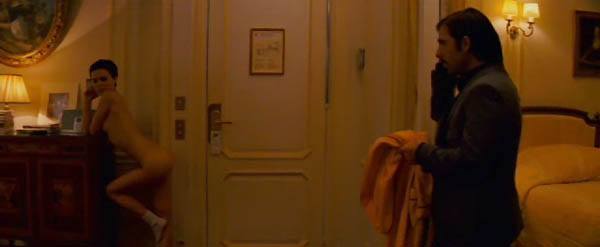
Jason Schwartzman is a sad man who has exiled himself to a Paris hotel after breaking up with his girlfriend. Natalie Portman is the girlfriend who finds him and comes to visit.

The main reason to watch this short:
nudie portman

Jason has his personal artifacts very carefully littering his room and he plays a specific song on his iPod speaker system when he hears Natalie coming upstairs. He’s got the typical Wes Anderson sadly introspective male performance, and she delicately shows off her quirky side by brushing her teeth with his brush as soon as she arrives. The camera compositions are meticulous and familiar.

So… why? I know it’s a back-story bit for The Darjeeling Limited, but why? Is it a marketing gimmick? It’s not a deleted sequence from the film itself – was shot separately. Does Anderson now think of it as part of the Darjeeling film? Does he wish it’d been included? No, because the short is on iTunes but won’t be included with the film release in U.S. theaters. So maybe I’m being a jerk about this, but a short should stand on its own as a short, not be a clever taster for the new theatrical product or a bonus to sell more DVDs. That’s an advertisement. This one doesn’t really hold up as a short. If there was no Darjeeling Limited and this was just released on its own, it’d just be a further downhill slide in quality after the crowning peak of The Royal Tenenbaums, and even that great movie threatens to get sullied each time Wes makes another sad dysfunctional-family-with-father-issues comedy with his now-trademarked music and visual style. Hopefully Darjeeling ends up having a reason to exist, and can provide this short with one, too.

The last movie Katy and I watched together in our old apartment.

A small-town nostalgic escapist flick, the inspiration for the monorail episode of The Simpsons, which we watched afterwards. Unfortunately they’re not all that similar. For one, Music Man is two and a half hours long. Writers of musicals seem to write full-length movies and then add the music, making all their movies two and a half hours long. It’s a shame that there are so many non-musical movies that seem way too long at 90-120 minutes. When that happens, the producers should really chop out the boring bits and add some musical numbers, sort of the opposite of what happened to “I’ll Do Anything”. Ah, in a perfect world.

Sham salesman Harold Hill (Robert Preston) moves in on a small town and convinces them that all their problems are due to not having a boy’s band. Coincidentally, Hill can solve these problems, because it just so happens that he is a salesman of musical instruments and uniforms, and he soon signs everyone up, with the help of his local ex-partner Buddy Hacket. But Hill falls for Marian The Librarian and decides to stay in town instead of running off with the money. Songs that I can still remember include “76 Trombones”, “Gary Indiana”, “Wells Fargo Wagon” and “Till There Was You”.

Really quite a good movie, one of the better musicals we’ve watched. The music is written cohesively, all flows very nicely with the themes from one song showing up in the next song and in the incidental music.

Music Man Robert Preston was a 40’s actor who popped back up in ’62 for this and “How The West Was Won” then disappeared again. Shirley Jones was in John Ford’s “Two Rode Together” the year before. Buddy Hacket voiced the seagull in the Little Mermaid movies, and little Ronny Howard grew up to direct “Ed TV”, “How The Grinch Stole Christmas” and “The DaVinci Code”.

Earlier I wrote: “Movie was good. Not holy-wow-mindblowing, but Cronie knows how to shoot a movie, so despite any narrative failings the whole thing was a raw pleasure to watch.”

And it’s not a “failed” narrative, but everyone seems to agree that there isn’t much there. Cronenberg seems to have bought a barebones nothing-special script about the Russian mafia in London (written by nothing-special author Steve Knight of Dirty Pretty Things and Amazing Grace) and given it a few Cronenberg touches (an extreme fight scene, heavy focus on tattoos), then directed the hell out of it. Ever since re-watching Existenz recently I’ve been thinking about how watchable his films are, how I feel a high-quality tension from them that I never think to analyze in terms of camera placement and shot length, but just relish and enjoy. So while it’s no History of Violence in his overall career, it’s not a disappointment either. The guy does not know how to disappoint.

The great acting doesn’t hurt, either. Viggo Mortensen is back from HoV, playing a deep-undercover cop infiltrating the Russian mob. Naomi Watts (remember King Kong?) is an overly concerned hospital midwife trying to find a family member of the young girl who died giving birth so it won’t go up for adoption. Armin Mueller-Stahl (X-Files, 13th Floor) is the mob head and secret father of the baby. In the intense-unstable-closeted role is mobster son Vincent Cassel (Blueberry, La Haine, Brotherhood of the Wolf), and as Naomi’s racist russian uncle is Jerzy Skolimowski, a Polish 60’s filmmaker (who also acted in Before Night Falls and Mars Attacks) currently shooting his first film in 17 years with Isabelle Huppert and Dennis Hopper [edit 2011: this was cancelled and he made Four Nights With Anna instead].

At the center of the story is the dead girl’s diary which implicates Armin and Vincent but is written in Russian. Jerzy translates it, so Viggo has to kill him (actually sends him to a hotel, being a cop and all). In the end, presumably Armin is locked up on a rape charge, with Vincent in charge of the family (he gets to live despite almost murdering a baby) and Viggo about to take it down from the inside, Naomi’s family happily together again.

As for Cronenbergian script touches, you’ve got your naked sauna knife fight, your life written on your body in tattoo form, your finger-chopping body-disposal man and three other big bloody scenes. And since, despite all my writing online I still haven’t learned how to analyze and discuss a movie, I can’t put my finger on why (couldn’t be empty boosterism of my favorite directors, could it?), but I feel it’s a quality movie, exquisitely filmed and paced, and thrilling to watch.

Interestingly, in Reverse Shot’s review, Andrew Tracy directly addresses the question I ask above, saying it is boosterism, and that it’s hurtful to the world of film criticism to pretend that Eastern Promises is a good movie. He says “unequivocal praise or panning is the unfortunate rule of these latter days of criticism”, then aggravatingly calls it “a failed film”. I don’t know that anyone considers it a masterpiece, and by the AV Club rating system I’d only give it a B or B+, but I reserve the term “failure” for a D-grade or below. “Failed film” sounds like “if it isn’t great, it’s rubbish”, and a good B+ thriller with some great acting and a few outstanding scenes isn’t rubbish. Rather it’s a movie I’m very glad I saw, instead of going to The Brave One or Shoot ’em Up or Halloween, all recent additions to my endless to-rent list.

Nice one from Reverse Shot:

With the aid of Mortensen’s granitic face and body—which is not simply a given quality but an acted entity—Cronenberg depicts flesh as armour, the shell of a man who lives entirely through his outward gestures. Mortensen’s impeccable overcoat, suit, gloves, and slicked-back hair are further layers of a constructed identity that begins with the skin, which itself is covered with the tattoos relating the story of his life to his underworld masters. The progressive stripping, both literal and metaphorical, of Nikolai throughout the film reveals not the person beneath the artifice, but the meticulously constructed series of artifices which constitute the person himself.

There were two goals here. I nervously wanted to revisit one of my favorite movies from the 80’s and see if it still holds up for me personally (it did), and I wanted to show it off to Katy and see if she’d like it half as much as I do (she doesn’t).

Reverse Shot deconstructs:
“Though it’s hard to outright accuse Oz of actively perpetuating racism… his insistence on exaggerating the Motown aspects of the three girls and the svengali qualities of Audrey II seem a light mask for the white fear of a black threat ready to corrupt the safe American dream. When weighing Audrey II and the doo-wop girls against the cartoonishly antiseptic suburbia about which the protagonists fantasize, the fight against the plant takes on epic proportion, and an unpleasant metaphorical cast.”

I still dig the music and the movie, campy and racist though it may be. James Belushi, John Candy and Bill Murray are kind of wedged in there, but Christopher Guest’s wide-eyed easily-impressed rose-buying customer slides in perfectly. One of the doo-wop girls played Chris Rock’s mom (?) on “Everybody Hates Chris” and another was on “Martin” and a recent Damon Wayans show. Mr. Mushnik, who died in 1992, was in the 1978 “Heaven Can Wait”. Ellen Greene was Mathilda’s Mother in “The Professional” and appears these days on Heroes and Pushing Daisies. I don’t get why Rick Moranis didn’t outlast the 80’s – he does voices for Disney cartoons now.

EDIT: Dec 2011
Katy likes it better now, thanks to some soundtrack exposure. Maria enjoyed the songs. I dig the fake skies and long shots (with some subtle off-camera costume changes and transformations), but now that I know the ending was changed after test screenings, I can’t help but see the cheap, last-minute alterations (like Audrey 2’s stock-footage explosion) when the whole movie had been meticulously composed up until then. Gotta look up the deleted ending on youtube some time.

EDIT: Sept 2021
This time we showed it to Katy’s mom, who liked it so much that she wants to watch the Roger Corman version next, against my advice. Went with the theatrical version since it was $4 to rent and the director’s cut was $20, but maybe someday.