Delicate drama mostly shot in shallow-focus close-ups – so delicate that it has pretty much flown right out of my head. I remember some actors rehearsing Shakespeare, a girl with a pirate video delivery service, chance meetings and a dream sequence. And I remember really, really liking it. Katy did not.

Quintin has a great Cinema Scope article about the Argentinean writer/director:

The films take Shakesperean promiscuity to the limit: in the end any actor can play any character—including sex changes—as if all the bodies, the names, and all of Shakespeare’s and Piñeiro’s characters are impossible to distinguish. In Viola, María Villar plays a character named Viola who—in principle—has nothing to do with theatre. But then she meets a girl who is acting in a production of Twelfth Night who asks Viola to be her replacement. In the second act of Twelfth Night, Viola disguises herself as a man called Cesario, but in the play within the film he is called Bassanio, a character from The Merchant of Venice. Any multi-talented member of this magic sect can act, write, or even play music, as is clearly shown at the end of Viola. These endless confusions and exchanges continue on and on in the film. Piñeiro has declared that he doesn’t want to make the kind of film where characters’ paths intersect due to the cleverness of the script, but rather one that allows people to live as they want or as they can. But, in that way, all of these individualists living like monads, trying to succeed in love and art, end up mixing into a symbolic orgy, where film and theatre, men and women, music and literature, work and leisure, dating and talking, are molded into a single entity.

Great to see this again, although maybe I should’ve sprung for the high-def version to see if it looks much better than my old letterboxed DVD. Katy agreed that the movie seems long, and opted not to teach it in her dystopian fiction course.

I’ve seen people call Brazil the centerpiece of Gilliam’s dream trilogy – Time Bandits being the dreams of youth, Brazil of adulthood, and Baron Munchhausen an old man telling dream-stories to children. It’s a lovely thought, but then what is the rest of Gilliam’s career full of dreams and visions?

Don’t think I knew who Jim Broadbent was the last time I watched this. He plays Sam’s mom’s plastic surgeon: “Snip snip, slice slice, can you believe it?” Jack Purvis of Time Bandits is rival doctor “the acid man”. Sam’s mom’s friend getting acid treatments (“my complication had a little complication”) is Barbara Hicks of Britannia Hospital, and her daughter is Kathryn Pogson, recently of The Arbor. Mrs. Buttle (I’d forgotten how good she is) was Sheila Reid (Felicia’s Journey, Lady Rawlinson in Sir Henry at Rawlinson End). I haven’t recognized Kim Griest in anything else but I see she was in Manhunter and CHUD. Mr. Helpmann (‘ere I am, JH) was in some Ken Russell films and Mountains of the Moon. Sam’s useless first boss was Ian Holm and his decisive, always-walking boss in Information Retrieval was Ian Richardson (later Mr. Book in Dark City).

Final theatrical film of the two Bergmans (since Fanny & Alexander was shot for television), and each Bergman got an oscar nomination (as did two unrelated songwriters named Bergman that year), but were no match for Hal Ashby’s Coming Home. Began shooting three days after I was born. First Bergman film I’ve seen shot in color, except for Saraband which I barely remember.

Opens with Liv Ullmann’s pastor husband narrating to us about her. Later Ingrid will speak aloud as in a play. There are flashbacks (either remembered or imagined) and a nightmare scene, all more theatrical and artificial than the other Bergmans I’ve been watching. It makes sense to watch this right after The Silence, which is also about two family members revealing their hatred for each other over the course of a night and day. However, I’d heard The Silence was one of Bergman’s top masterpieces, and I liked this one better – thought the conflict had a better and more explicable build-up.

So Ingrid plays the famed concert pianist mother of Liv, who has a more modest life in the country with her husband. Unbeknown to Ingrid, Liv is also housing her disabled younger sister Helena (Lena Nyman of I Am Curious), whose presence shakes Ingrid, reminding her of her failures as a mother, which Liv reminds her more and more about until Ingrid is driven from the house for what seems like the final time, riding home on a train alongside Winter Light‘s Gunnar Bjornstrand. It’s all very intense and poisonous and makes you wonder about Ingmar’s obsession with family members’ simmering hatred for each other. Looks absolutely splendid, though.

Watched some of the extras – played through the commentary but didn’t have the stamina for the full 3.5-hour making-of, right after watching the similar full-length doc about Winter Light.

Silly setup becomes more serious as it goes along. Jean Arthur (post-semi-retirement, in her second-to-last film role) is a buttoned-up U.S. Representative (from Iowa) visiting wrecked post-war Berlin to assess the morale (and morals) of the occupying troops. John Lund (of High Society) is a shady Iowan captain with a sharpie-drawn mustache who is playing the black market, drinking at nightclubs and covering for his girlfriend Marlene Dietrich. So soon after WWII, we know even the cynical Wilder won’t let Dietrich off the hook after Jean is shown films of her cavorting with Hitler himself. So Jean enlists Lund in her undercover operation to discover which American troop is covering for Dietrich. He’s now attempting to protect himself and his girl from the no-nonsense Arthur, so he pretends to fall in love with her as a distraction.

Dietrich sings “The Ruins of Berlin” (I know the Dex Romweber version), and man are the ruins impressive. There’s hardly a non-bombed-out building seen in the opening aerial shots and the scattered location shots from the ground. The contemporary NY Times review calls Lund “disarmingly shameless.” For some guy I’ve never heard of playing against two of my favorite actresses, he comes off surprisingly well.

Bright Lights says Wilder pitched the film’s concept as propaganda to the U.S. military in Germany, describing “an entertainment film with Rita Hayworth or Ingrid Bergman… with Gary Cooper if you wish… and with a love story — only with a very special love story, cleverly devised to sell us a few ideological items.” The military found the finished film unsuitable to be shown in Germany, believing that a movie which stars a morally compromised U.S. soldier sleeping with an eroticized nazi mightn’t be in their best interest.

A real stinker of a bland-looking generic 1980’s movie, starring Natasha Richardson (Mary Shelley in Gothic) as a “handmaid” in the future whose job is to get pregnant for rich barren women (Faye Dunaway, two years before Arizona Dream) by their husbands (Robert Duvall, between Colors and Newsies). But of course she falls for house servant Aidan Quinn (who’d play evil twins the following year in an Isabella Rossellini movie) and gets involved with a troublemaking friend (Elizabeth McGovern, the mom of Downton Abbey). So it’s surprising that with all this star power around, the only good scene was with a doctor played by Rawhead Rex star David Dukes.

I just found out!

Bing & Bela (2010)

Bing Crosby and Bela Lugosi.

Buried side-by-side.

Red lips. White wolf.

She is film critic Kim Morgan, who married Maddin after filming.

Lilith & Ly (2010)

A one-minute vampire short.

Udo Kier aims to steal a vampire woman’s necklace.

Is it supposed to be silent or is my browser messed up?

These last two were part of a shorts series called Hauntings.

It’s a Wonderful Life (2001)

Music video for Sparklehorse.

Silent actors on rotating sets.

Shot in peep-hole-vision!

Berlin (2008)

Footage from Berlin, Ontario in 1916.

Remixed to doom-music.

Sighs & Bosoms (2014?)

Literally that, in a single sepia-toned shot, with strings.

One Minute Louis Negin (2014?)

Single shot of Negin close-up

Perhaps from the rushes of something Keyhole-related?

Spanky, to the Pier and Back (2008)

Spanky is a small dog.

He walks to the pier and back, the camera frantically recording the experience.

Lullaby (or Funerailles) (2013?)

Takes exciting or upsetting moments from films and tracks back and forth over them obsessively, almost Martin Arnold-style. Intense and wonderful. Includes Santo, Tales of Hoffmann, a zeppelin disaster, Dracula, gladiator battles, more.

Sissy Boy Slap Party!!! (2004)

Louis Negin goes off to the store to buy condoms and the sleepy heap of sissy boys he leaves behind immediately commence with some major slapping, while drummers drum and women stand aside unimpressed.

Also on there:
– a trailer for Archangel with the most edits per second of any Maddin work (yes!)
– a bog in Victoria shot on lo-fi color camera
– a bunch of silent 8mm reels I didn’t watch

“Mommy, what’s language?”
“Language is the house man lives in.”

Seems like a game-changer for Godard. His features just previous – Masculin Feminin, Pierrot le fou, Alphaville – have character-driven stories bursting with related (and unrelated) ideas. For this one, the ideas finally overwhelm the story, and it ends up more an essay film than a narrative, moreso even than the later Weekend (with which 2 or 3 Things shares a color/visual scheme). I haven’t seen Made In USA or La Chinoise, released between this one and Weekend, but it seems this marked the beginning of a new period, a brief fascination with social and economic issues before politics took total hold instead, but either way leaving behind the manic film-love of the first half of the 1960’s.

Nice of commentary-guy Adrian Martin to explain what is happening in what little narrative remains: a day in the life of a consumerist woman (Marina Vlady of Chimes at Midnight) coming from new high-rise suburban apartments to Paris to work as a prostitute. She speaks in nonsequitur inner thoughts and philosophies, often addressing the camera (as do the other characters), and Godard whispers narration, throws up title cards and takes total sidetracks (incl. pillow shots of road construction). Red/white/blue colors are prominent, as are images from commercial products.

Vlady: “Something can make me cry, but the cause of my tears can’t be found in the traces they leave on my cheeks. By this I mean you can describe everything that happens when I do something without necessarily indicating what makes me do what I do.”

The universe in a cup of coffee:

Vlady at left, with Anny Duperey of Stavisky:

Interminable sidetrack to a cafe where Juliet Berto and some dude have ineffective conversation, a couple of guys quote randomly from huge stacks of books, a prize winning poet converses with a young fan, and a woman ceaselessly plays a clattering pinball game.

Movie posters seen: Keaton’s The General (hung upside down), Ugetsu.
Mentioned: Nanook of the North.

The universe in a cigarette end:

A. Taubin says it’s also about “the city of Paris, which in the mid-1960s was at the center of de Gaulle’s project to modernize France. 2 or 3 Things depicts the violation of both the city and Juliette, who has bought into the Gaullist economy.”

The trailer has scenes interspersed with titles (“Her: the cruelty of neocapitalism… Her: the modern call girl… Her: the death of human beauty”), and is completely silent.

“Beer has its own way of sorting things out.”

Julian Barratt (Mighty Boosh’s Howard Moon) seeks Whitehead, is looking for a field, then abruptly dies. Whitehead (Reece Shearsmith, a lead in The League of Gentlemen series) will be our movie’s lead coward, joining with some companions in a field in the midst of a filthy war in search of his dead master’s nemesis O’Neil, who stole some papers I guess.

Companions: hood-wearing Friend (that’s his name, took me all movie to figure it out) played by Richard Glover (minor role in Sightseers) with a great low voice, wide-hatted Cutler (Ryan Pope of TV’s Ideal), Jacob (Peter Ferdinando of serial killer movie Tony). They finally find O’Neil (Michael Smiley, the lead guy’s co-hitman in Kill List) at the end of a long rope (?) and a struggle ensues.

The point is less the war, the companions, the stolen papers and struggle than the weird ride. There’s a game of tug-o-war vs. mystical forces, poop humor, many mushrooms are consumed, Whitehead fasts then vomits runestones and the dead don’t stay dead. Maybe it’s Jodorowsky-influenced, seeming mythical without making any proper sense.

Set during the English Civil War, 1650ish, which reportedly caused some trouble coming up with period-appropriate words. The dialogue is great when you can make it out, which we couldn’t on my dad’s surround system (was fine in headphones). Writer Amy Jump and cinematographer Laurie Rose also worked on the other two.

A twisty triple-cross murder thriller, sleek and sexy and fun while it’s playing, with very good performances, but pretty instantly forgettable. Too bad, I was hoping for another Femme Fatale. American remake of Alain Corneau’s final film Crime d’amour which starred Ludivine Sagnier and Kristin Scott Thomas.

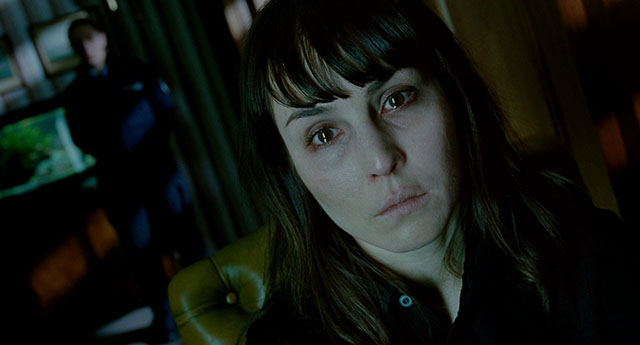
Rachel McAdams (To The Wonder) steals credit for her employee Noomi Rapace’s successful advertising idea, is in line for a big promotion, and is dating hottie Paul Anderson who is stealing from the company on the side. Noomi (also great in Prometheus) does all the work while Rachel enjoys being rich and powerful, repeatedly humiliating Noomi until she murders Rachel in the midst of a downward spiral of pill addiction with blue-toned noir lighting.

But wait! After being arrested Noomi manages to prove her innocence with some belated evidence and pin it on the boyfriend instead. And she’s secretly dating her hot red-haired secretary Dani (Karoline Herfurth of We Are The Night, not We Own The Night). The ending gets confusing, since Rachel is apparently alive again (Wikipedia says it’s her twin sister but whatever) and poor Dani gets murdered by either Noomi, Rachel, Rachel’s sister or maybe a ghost or it didn’t happen at all, I dunno. I figured it as a twist on the twist ending, not actually revealing how the final murder happened.

De Palma’s still got the smoothest moving camera in the business (shot by veteran DP José Luis Alcaine, who did at least six Almodovar movies), an excellent looking and sounding movie. I feel like I should’ve liked it more – not that anyone else did (A. Tracy’s takedown in Cinema Scope is the most amusing of the bunch).