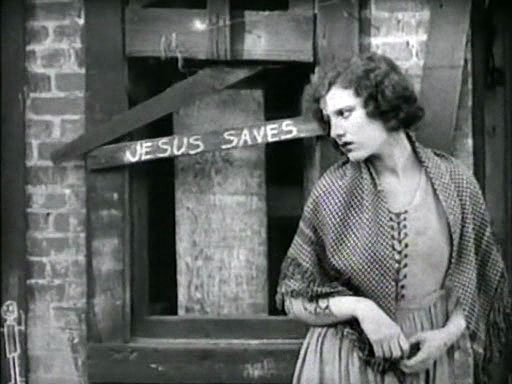
After watching Henri-Georges Clouzot’s Inferno, which documents the director’s experiments with visual effects and attempts to integrate them with his stories via dream sequences, then reading at the end that he later used all these effects in The Prisoner, what could I do but run straight out to watch The Prisoner.

And boy did he ever put those effect experiments to use. It is full of light and color and lines and boxes, reflections and refractions. Real tight framing and editing, very clockwork in a wonderful way, with outstanding music, acting that seems unexceptional at first, but gets better. I’ve liked all the Clouzot movies I’ve seen, but have heard nothing about this one, so figured it’d be a dull late-career entry (it was his final released film), but no, he went out with a bang.

Gilbert (Bernard Fresson of Z and Street of No Return) is an artist who specializes in mass-produceable objects with geometric patterns that cause optical illusions when you spin them round. Stan (Laurent Terzieff of The Milky Way) runs a gallery where Gil and other guys are putting on a show. And Josée (Elisabeth Wiener of Duelle) is Gil’s girl, who jealously spies her man Gil talking to a reporter in a hall of mirrors, and so strikes up a chat with leering Stan, going back to his place to look at photos of “handwriting”.

The only thing I remember of Josée’s day job is that she spends some hours looking at interview films on an editing table, commenting that she can’t understand submissiveness and masochism in women. Of course this is a setup, and when she’s at Stan’s place she “accidentally” spies a slide of a naked girl in chains, which fascinates and excites her. Oh of course, it’s just another thing Stan dabbles in, photographing nude bondage sessions, but Josée is now obsessed, insists on attending the next one. Maguy (Dany Carrel, returning from Inferno) poses, Stan photographs and Josée watches anxiously.

Josée soon agrees to be photographed herself, and starts a heated affair with Stan. This was one year after Belle de Jour (and given Clouzot’s pacing, he might have written this film before Buñuel even dreamed of his). Clouzot’s picture is both less and more extreme than Buñuel’s – it’s surely more passionate and less clinical, when considering two directors I would’ve expected the opposite. The photographic sessions, even Maguy’s first one with minimal nudity, are erotic as hell, the height of sexy editing. It may be ultimately more tame than Belle de Jour though, with overall less to say about societal norms and sexuality.

Husband vs. lover, splendidly shot through a half-reflecting window:

Stan has a more poetic penchant for suicide than did the desperate, more tragic Dominique in La Vérité:

Interesting to watch this in the same month as Lady of Burlesque (1943), From Here to Eternity (1953), Monika (1953 but released in the U.S. in ’56), The Apartment (1960), Knife in the Water (1962) and even The Girlfriend Experience (2009). Half were (or at least were intended to be) sexually progressive films when released, all seem very of-their-time, and only The Apartment and this one still seem capable of shocking anyone today.

I loved the camerawork – mobile, but always with a specific goal, a plan to paint a picture through time. Clouzot, 60 years old, a widower with heart trouble, doesn’t seem quite up to the task of smashing a complacent society and visual expectations to bits with his camera, but he has no trouble smashing his lead actress to bits with a train, something he attempted earlier in Inferno.

D. Cairns:

And as a final note of strangeness, the film ends with a woman in a hospital bed calling for the wrong man—the very same ending as Richard Lester’s seminal Petulia, released the very same year. No possibility of one film influencing the other. Instead, both films must be hooked into something, something out there in the ether. Cinema can do that.

Very good doc on the film Clouzot almost made between La Vérité and La Prisonnière, starring Romy Schneider (of Welles’ The Trial) and Serge Reggiani (just off Le Doulos and The Leopard). The couple is on their honeymoon, or maybe just on vacation, in a small town shot in black-and-white, and Reggiani becomes increasingly wildly jealous of everyone his wife has contact with, his state of mind represented with color fantasy sequences and optical-illusion effects. Decades after the film fell apart (mainly because the writer/producer/director’s overreaching ambition clashed with his own perfectionism for details, wasting time and money and tiring the cast and crew) the script was filmed in the 90’s by Claude Chabrol, which I believe was the first of Chabrol’s movies I ever watched, too long ago for me to compare the finished movie with the Clouzot fragments.

Clouzot got some great cinematographers and effects people, including Claude Renoir, Rudolph Maté (The Passion of Joan of Arc) and Andreas Winding (Play Time). It was also the first credited film work by William Lubtchansky, who is one of the main interview subjects. The documentary is very excellent, showing much of the never-finished film (the color footage in particular looks amazingly vibrant, like it was shot yesterday), and not getting into irrelevant sidetrack stories. Interiors (and therefore most of the dialogue scenes) were never shot, and there’s no surviving sound recording from set, so two actors read from the script on a black stage, providing missing context.

Brigitte Bardot is woken up for court, checks herself in a broken sliver of mirror, and goes to stand trial for murdering her boyfriend Gilbert, who also turns out to be her sister’s fiancee. They discuss her past suicide attempts, which the prosecution dismisses as theatrical, then the Walter Matthau-looking prosecutor (Charles Vanel of Wages of Fear and Diabolique) carries on attacking not only her crime and her entire way of life, but the entire youth culture.

Deadly mirror:

Incriminating photo:

They criticise her for being loose, then they criticise her for NOT being loose with Gilbert (Sami Frey, in Godard’s Band of Outsiders the year after Bardot was in Contempt). “Mademoiselle, you are not exactly virginal. Why did you put off the only man you claim to have loved?” But it’s the proc’s job to attack her character, since it’s not in question whether she committed the crime, only whether it was a crime of passion, which carries a lesser punishment than premeditated murder.

Through flashback stories, Gilbert emerges as selfish, using the hot girl for sex while he’s a student, promising her marriage while he’s too broke to marry, then wedding the proper sister (Marie-José Nat of Anatomy of a Marriage) once his boat comes in.

Love triangle:

Creeping around an Alexander Nevsky poster:

“For seven months, all he offered her was his bed, and that only for fleeting moments, not to upset his routine. For months she goes hungry, begging, even prostituting herself. Did he reach out a helping hand? No, and you call that love?” This from the defense, which upsets her even more than the prosecution, the thought that Gilbert may not have loved her. Her suicide note, when she finally does herself in with the broken bit of mirror from the first scene, says “He loved me, but we didn’t love each other at the same time.”

Has its share of slow courtroom drama scenes, Bardot motionless, looking like a cardboard cutout of a pouty blonde and its share of less-than-thrilling backstory, but it’s a sharp looking movie and the plot comes together satisfactorily (for the viewer if not for Bardot’s character) at the end.

Bardot’s sister isn’t about to testify on her behalf, so Bardot’s friends come out to give character references, probably lost on the court which already declared them to be lowlifes. Above at left is Ludovic, André Oumansky (Burnt by the Sun). Could the middle man be future director Claude Berri? He was 26 when he appeared in this, and is credited sequentially with the other two, so it might be. [NOTE: not Berri, see comment below] Michel (Jean-Loup Reynold) gives the most impassioned and coherent defense, dismissing the court just as the court dismissed Bardot’s way of life. “Dominique is here because she rejected hypocritical conventions. We’re different. Young people should judge her.”

Hitch’s quickie, less extravagant follow-up to the great Rebecca. He didn’t quite get the cast he wanted, ending up with Joel McCrea (just before Sullivan’s Travels), the poor man’s Gary Cooper, and Laraine Day (of the Dr. Kildare movie series), the poor man’s Barbara Stanwyck. A wartime spy flick, rather stiff with loose and uninteresting parts but a few great thriller setpieces to balance them out. Katy and I started it for being a TCM Essential, but only I saw the second half.

Joel, Laraine, and returning from Hitch’s Rebecca, Mr. George Sanders:

Take it away, TCM:

Official U.S. policy was still one of strict neutrality. Despite the fact that the British government urged their most famous native, Alfred Hitchcock, to remain in America during this time, the director desperately wanted to contribute to the British war effort so he sought out a property that would allow him to make a pro-Britain statement. The subsequent production, Foreign Correspondent, is the story of an American correspondent in Europe who becomes committed to the fight against fascism during his investigation of a kidnapped Dutch diplomat, a situation that requires him to travel from London to Holland.

I’d say Joel was more committed to following a hot story than to fighting fascism, but he certainly gets caught up in it, leading to a fantastic Great Dictator speech into a radio mic at the end as air-raid sirens howl, possibly the most thrilling last-minute ending to a Hitchcock film I’ve seen.

Van Meer, an Armin Mueller-Stahl-looking diplomat, knows a secret clause within a peace treaty that could help the other side when war breaks out, a macguffin that I never fully understood, but that’s why he’s kidnapped and tortured by baddies. Joel is present for VM’s assassination (my favorite scene, above), but smells a rat because the old man, usually very sharp, doesn’t recognize Joel although they shared a cab the previous day. In fact, a lookalike was murdered so nobody would search for the real VM. Joel follows the killer to a windmill for a fantastic sequence of hide and seek, then escapes from killers sent to his hotel room by first crawling out the window then using a comic room-service gag, is later assigned a bodyguard who tries to push Joel off a high building but falls off himself, and finally I was tuning out and didn’t follow exactly what led to the climactic plane crash, a miniature version of Lifeboat.

I read through D. Cairns’ post on the film looking for a great quote to steal, but they’re all great quotes, so I must instead link to the full article.

Roman’s other three-actor feature besides Death and the Maiden, and this one truly has only three actors. There isn’t another soul so much as glimpsed in the background. And it’s an amazing film – don’t know how I didn’t appreciate it the first time I watched, but that maybe I wasn’t paying enough attention. Polanski has his actors pulling shapes, as the British say, posing to form geometric patterns across the screen at all times, like a suspense flick made by Maya Deren.

Married couple who seems more bored-and-businesslike than sweetly-in-love picks up a third wheel young hitchhiker and takes him along on their overnight boat cruise. Why would they do such a thing? Because the husband has an overwhelming urge to prove himself over other men and a penchant for playing mind games, and detects similar traits in the young man. Splendid ending: husband thinks the hitcher has drowned, swims to shore while the wife finds the hitcher still alive and has sex with him, nonchalantly confessing later to the husband. The husband drives away with her, reaches an intersection… turn left to go home, believing his wife cheated, or turn right for the police station, believing himself a murderer.

“Polanski was given a proposal to remake the film in English with some known Hollywood actors, but he turned it down as he didn’t want to repeat himself.” Maybe Michael Haneke has heard this bit of trivia, seeing how his own remade family-interrupted psychological drama has similarities to this one.

Cinematographer Jerzy Lipman (of Wajda’s A Generation) wouldn’t work with Polanski again after this film, possibly because he dropped the camera into the lake at one point. Movie failed to win an oscar for coming out the same year as Fellini’s 8 1/2.

“The rules have grown stronger than those who made them.”

Bob Dylan’s fabled hero Anthony Quinn is a mexican eskimo (MEXIMO). Eskimo culture in the far north is apparently a whole racial melting pot, with eskimos from Japan and China and Singapore and Guyana, and even white eskimos with skin makeup.

Peter O’Toole, in his first year in the movies, already knew how to behave like a star, insisting his name be stricken from the credits upon learning that he’d been dubbed.

Opens unpleasantly with a swimming polar bear getting speared. Later we’ll see more hurt or killed animals, not always sure which are real. A narrator condescendingly fills us in on eskimo culture: “in the age of the atom bomb they still hunt with bow and arrow … they are so crude they don’t know how to lie.” Then Quinn shows up, a giggling simpleton with a short temper, a strong hunter without a wife. At first he’s too cartoonish, overplaying the cultural differences, but it’s a charismatic film and you get used to the movie version of the eskimo way of life, so that halfway through when guns and white men first appear, it’s startling. And then the movie gets to its point, or at least what I assume Ray felt was its point since he loves to hide bunches of social commentary in his action-packed dramas, which is best represented by Quinn’s great line: “When you come to a strange land, you should bring your wives and not your laws.”

Narrator plays it like a Nanook educational film at times. Quinn has a friendly fight with a buddy, smashing his head through an igloo wall, but while returning home after an uncomfortable encounter with modern civilization (guns and swing music) he busts the skull of a white missionary because he refuses to eat their old wormy marrow. “One did not intend to kill … his head was too soft.” Peter O’Toole and some guy who freezes to death after falling into water chase Quinn, arresting him for the murder, but finally O’Toole lets Quinn go, using exactly the same method as John Lithgow did in Harry and the Hendersons.

Hits from the DVD commentary by Krohn and Ehrenstein:
Technically an Italian movie (hence the dubbing). Opens with plain white nothingness, a little bit of Antonioni creeping into Ray’s work already. “Swingin’ and swappin’ in the great white north.” Ray was in the arctic for a long time getting all these shots. Released in 70mm. Marie Yang plays the mother of Quinn’s bride, is not Anna May Wong as frequently miscredited, but another actress calling herself Anna May Wong (not the famous one) also appears. Refusing to sleep with someone’s wife can get you killed, just as [sleeping with someone’s wife] can here. All of ray’s movies are about “the impossibility of communication.” Quinn is a rare Ray hero who is not neurotic. Ray’s trademark anguish is missing. The Four Saints song “Don’t Be an Iceberg” plus second song “Sexy Rock” heard in the distance then over closing credits, because movies had to have theme songs back then. And Krohn recommends the John Landis movie The Stupids.

This post has been released under the Movie Journal Amnesty Act of March 2011, which states that blog entries may be posted in an unfinished state, since I am too busy to write them up properly.

Katy and I did not know they made this kind of movie in the 40’s. It’s a wonderful bummer of a post-war drama dealing with the problems ex-soldiers faced upon returning home. Won every male-centric oscar that year (sorry, actresses), wiping It’s a Wonderful Life and Brief Encounter off the board.

Myrna Loy (between Thin Man 5 and 6) is first-billed for being the most famous person in the cast, mother of Peggy (Teresa Wright, star of Shadow of a Doubt) and husband of Al (Fredric March of I Married a Witch, Seven Days in May), who suffers from psychological trauma and chronic comic drunkenness (a common affliction in the 40’s).

Homer (Harold Russell, my favorite actor in the movie despite having never appeared in films before) has hooks for hands, thinks he is no longer worthy of his longtime sweetheart Wilma (Cathy O’Donnell of Side Street, They Live By Night) so spends all day hanging out with his bartender buddy Hoagy Carmichael (a rare film role for the songwriter, who also appeared in To Have and Have Not).

Fred (Dana Andrews of Laura and Canyon Passage) is underemployed now that all the fighting men are back to work, gets along fine with new wife Marie (Virginia Mayo of White Heat, The Flame and the Arrow) at first, until her love for fast dudes and fancy duds outpaces his salary.

What does happen to Fred? Does he get divorced? I remember he has anger management issues and gets fired from his job for tossing an anti-military sumbitch through a glass display, but it’s been a couple weeks now since we watched this and Fred is starting to slip my mind. He was a bombardier in the war and wanders into a new job when he’s spotted by a deconstruction crew while visiting decommissioned planes. Al is a banker, promoted to loan supervisor by the higher-ups who think it’s prestigious to have a war officer in their employ, but they aren’t too happy when he starts approving loans for trustworthy-seeming but collateral-lacking young soldiers. Homer’s main conflict is that he’s comfortable with the hooks physically but not socially, figuring himself an unlovable outcast. They’re all mighty good roles, and the movie has an epic feel despite being about three small families in a small town. Katy and I found it quite deserving of its reputation.

Not the Mickey/Fantasia/Nic Cage Sorcerer’s Apprentice, but based on a novel called Krabat: The Satanic Mill, recently filmed again as a post-Twilight live-action feature. Second-to-last film by Zeman, who died in ’89. I’ve only seen one of his earliest shorts, though I’ve been meaning to watch his Baron Prásil for a long time now.

A poor kid named Krabat ends up at an enchanted mill run by an evil one-eyed wizard, with a staff of boys. Every year the wizard challenges the oldest to a duel, beats him by cheating, and then buries him in the grave the boy dug earlier that day. But Krabat has found a reason to live, an enchanting young girl whom he secretly visits, so he teams up with another boy to learn the magical secrets to defeat the evil wizard.

I was not bowled over by the animation at first, which looked like cut-outs with hinged joints, but as the story sucked me in and I started noticing subtle details, like the odd timing of the transformation scenes and the apparently live-action smoke, fire and water effects, I gained a greater appreciation for the movie by the end.

“Commerce shuns a sentimental accountant”

I don’t know what to expect from an Oliveira movie. This one is only an hour long, but not because it’s in any great hurry to tell its story, a fairly simple one which moves at a leisurely pace. Definitely a well-made film, with a respectable look to it, not a work of madcap genius, not tired or haphazard. Mildly enjoyable throughout, then at the end I’m not sure what it all meant.
Adapted from a story by famous novelist Eça de Queirós but set in modern day, so there’s a scene at a literary society with a bust of the author among other displays of his work. Narrated by the lead character to a stranger on a train, played by Leonor Silveira, star of A Talking Picture.

Macario (Ricardo Trepa, the bartender who chats with Piccoli in Belle Toujours) is an accountant for his uncle, sees beautiful Luisa (Catarina Wallenstein of Ruiz’s Mysteries of Lisbon) across the street and falls in love. Conspires to marry her, but his uncle will have none of it, so he sets out on his own, makes a small fortune working in Cape Verde then returns, only to lose it all by vouching for a friend who leaves town with another man’s wife. So he’s about to go back to Cape Verde but his uncle decides to take him back, says he can marry the girl. So they go out ring shopping, she is caught stealing a ring, he tells her to go away, roll credits. In an earlier scene, he lost a poker chip (during a poetry reading by Luis Miguel Cintra, who played the malignant uncle in Pedro Costa’s O Sangue, as himself) which rolled towards Luisa and disappeared, so he must realize she’s a habitual thief. Still, it’s an odd little story.

Trepa and Silveira:

J. Reichert

[The story] occupies the filmmaker’s by-now familiar nether-Lisbon, in which lives are lived simultaneously in 1609, 1909, and 2009. Oliveira’s a filmmaker at which the adjective urbane could be lobbed equally as praise or slight depending on your tolerance for his scarily coherent (especially of late) body of work. …If this tale weren’t so endearing and well told, it’d be more akin to one of those lengthy jokes told by aged uncles lacking in point or punchline.

Luis Miguel Cintra:

NY Times searches for clues:

As his story begins, the landscape outside the train window is snow covered; by the time it ends, it is green. Other tiny mysteries deepen the film’s enigmatic, gently surreal mood. … Macário encounters a strange, agitated man looking for his hat, left at the spot where Macário is standing. Periodically the movie returns to the same long shot of Lisbon but always filmed in a different light. At various points chimes ring from a tower whose clock has no hands. Everything is framed. Macário’s story is framed by the train trip. His dream girl, a full-lipped sensual beauty whose ash-blond hair tumbles over one eye, is glimpsed while standing at a window, seen through another window, waving a fringed Chinese fan. Even when she retreats behind a thin curtain, her silhouette is visible. Behind her is a framed portrait. Art not only seems to watch over life but to preserve it.

A blond-haired girl:

The DVD holds a press conference with the director and lead actors which is longer than the movie itself… might watch that another day.