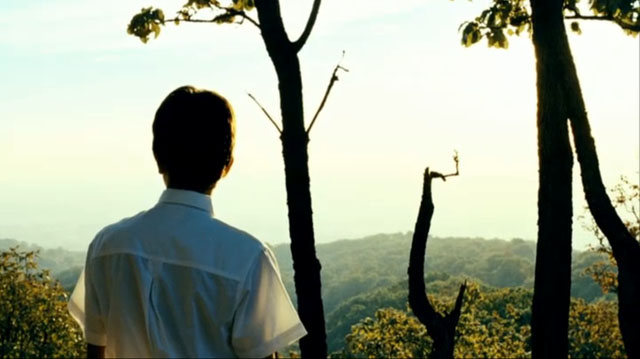
Katy said let’s start holding theme months again – perhaps Westerns Month, or Robert Altman Month. To delay making a decision, I played a Robert Altman Western. She said it wasn’t bad, but please no more movies like that, so Westerns it shall be.

Foolish me, I actually thought this wouldn’t be so Altmanesque. He made it right after MASH, but I’ve seen Images from the following year, so I’d convinced myself that he didn’t pick up the ensemble overlapping-dialogue thing again until ’75 with Nashville, making a few movies with a distinguishable soundtrack there in between. But no, this one was extremely ensembley and each noisy scene seemed to have been recorded with a room mic placed a couple rooms over. Katy points out that it may have exploded Western conventions in ’71, but now that they’ve been exploded for so long, we don’t see this as a very daring experiment, just a mushmouthed dialogue-heavy flick full of Leonard Cohen songs with a great chase/shootout ending.

McCabe:

Another disappointment: when Julie Christie finally showed up I was expecting a force of nature a la Joan Crawford in Johnny Guitar, but she doesn’t do much more than build a bath house and take over the whoring at Beatty’s new pub. As an article in The Guardian points out, our protagonists are “nothing like as confident as they would have us believe.” Recognized Shelley Duvall in a pretty small role as a mail-order bride and Michael “Tanner” Murphy as a businessman who fails to negotiate with Beatty over the sale of his land, leading to a snowy hide-and-seek shootout throughout the town, Murphy replaced by a gang of thugs who do not negotiate. I’m slowly learning my Carradines – a fresh-faced Keith (star of Fuller’s Street of No Return) played a doomed vacationing cowboy.

Mrs. Miller:

Mostly I liked the look, the feel, the light, the editing and pace. I wouldn’t say it had a documentary feel, but it felt like the scenes were happening on their own and the cameras were struggling to keep up (*). Has a good reputation these days, voted one of the greatest-ever westerns by some group or another. At the time, Christie lost her oscar to Jane Fonda, for something called Klute, and Vilmos Zsigmond’s hazy cinematography was only honored at the Baftas, where he was also nominated for Images.

(*) I thought that was a pretty neat thing I’d thought/written there about the movie, but when I went looking for articles I found that everyone else had thought it already. For instance, C. Taylor for Salon:

Mrs. Miller (Julie Christie), is a hard-headed madam with dreams of her own, the ones emanating from her opium pipe. The movie feels as delicate, as lulling, as Mrs. Miller’s drug-induced visions, and yet the life it shows us, the town and its people, are so real and sturdy we seem to have stumbled on them. The life the movie shows us is already being lived by the time we turn up. And everything we encounter evolves naturally — the setting, the characters, the story and most of all the mood.

A. Danks for Senses of Cinema:

McCabe and Mrs. Miller follows the coordinates of the most rudimentary of westerns; full of archetypal and cliched characters and situations such as the loner/stranger who shakes up a frontier town and the whore-with-the-heart-of-gold. But these classical or archetypal elements are undermined by the film’s opaque view of its characters, its foregrounding of atmosphere and place (including the ‘atmosphere’ of place, weather), and a technique which captures characters (both their bodies and voices) within pictorial tableaux that emphasise their relativity to the unfolding drama. In this respect, parts of, and indeed images within McCabe and Mrs. Miller resemble a painting by the sixteenth century artist Pieter Bruegel; broken up into interlocking tableaux and brought up to date (i.e. into cinema) by the deployment of favourite Altman devices like the zoom, the pan and multi-tracked sound – these devices serving to distance the events and characters from the viewer while opening up the frame, and the relationship between frames, to the scrutiny of the spectator.

I think I liked it better than Katy did, but then, she’d seen The Princess and the Frog so I had lower expectations – the most recently-produced Disney animated movie I’d seen was Atlantis (and before that The Lion King). Didn’t find it as edgy and Shrek-like as the poster and trailer promised (which is a Good Thing), just a perfectly-paced, well-animated classic adventure story.

Backstory: the kingdom’s magical rejuvenating flower is used to heal the pregnant queen, so her daughter’s hair takes on the flower’s powers. Evil stepmom witch kidnaps the young princess so that the hair will keep her forever young (by that logic, why doesn’t Rapunzel’s own hair keep her from growing past the age of five?) but Rapunzel yearns to escape in order to see up close the lanterns released in the kingdom each year in memory of the missing princess. That accounts for the classic fairy-tale part, then the thief, a royal guard’s white horse, Rap’s pet chameleon, and the tough bar patrons who wish to be mimes represent the hyperactive post-Aladdin Disney.

Actors: I didn’t recognize Southland Tales star Mandy Moore as Rapunzel, nor the Voice of Chuck as the thief, nor Doc Ock’s wife in Spider-man 2 as the old witch, nor Ron Perlman as the thief’s twin thug associates, nor Pixar regular Brad Garrett, nor Jeffrey Tambor, etc, etc.

Pedigree: One of the directors did Bolt, the writer worked on Cars, and supervising animator Glen Keane (the Family Circus author’s son), who sounds like the main man behind the look of the film, has been a Disney guy since the 70’s.

Shot by Mike Leigh’s buddy Dick Pope (also The Illusionist), all widescreen and colorful (except for a fun sepia-toned postcard backdrop standing in for 1937 New York). He and Linklater seem an overqualified group to shoot a minor teen coming-of-age thing with Zac Efron. I wouldn’t have minded if the movie had more of that Newton Boys energy, but I didn’t think it came to life until the final third, and even then I was more impressed by the recreations of Welles’s Julius Caesar production than anything Zac and Claire Danes were up to.

Zac, based on the character of Arthur Anderson (who went on to voice Lucky Charms commercials), stumbles into the ramshackle Mercury theater group on charm (heh), then is fired after the opening performance for trying to act noble instead of shutting up while the boss was trying to sleep with his girl. I hope this whole project was Richard Linklater’s attempt to make Welles’s family unleash The Other Side of the Wind and whatever other projects they’re preventing from being released. How do you fight back when your father is being portrayed on screen as a tyrannical sex-crazed egotist? Release his unseen works to remind the audience of his artistry! If it works, we each owe Linklater a fiver. Professional Welles impersonator Christian McKay does a good job, not going into hysterics like Angus Macfayden in Cradle Will Rock (the only detail in which this film improves on the great Cradle Will Rock).

Ben Chaplin (private Bell in The Thin Red Line) was my favorite as George Coulouris/Mark Anthony, though I didn’t recognize him and suspected him all along of being a young-looking Ciaran Hinds. Eddie Marsan, the foul driving instructor from Happy-Go-Lucky, was a flustered John Houseman. Zoe Kazan (Elia’s granddaughter, currently appearing in Meek’s Cutoff) is Zac’s savior from the theater crowd – he meets her shortly before getting involved with them, sees her again in the thick of it, then goes off to have a date with her after bittersweetly giving up on theater life. Decent enough movie, but if instead of joining Orson Welles’s Mercury Theater, Zac Efron was part of Kriminy Krafft’s Fiction House Theater or some other thing, I don’t think I would’ve bothered to continue after I paused halfway through to get some pie. Take away the Welles interest and there’s nothing here for me.

Masters Coppola and Scorsese, who dedicate much time and money to the worthy cause of film preservation, restored this 1960’s Polish film and brought it to the States, where I’m sure a sparkling, freshly-subtitled 35mm print enjoyed an acclaimed week at the Film Forum. Then these giants, pleased with their accomplishments, went off to watch Tales of Hoffmann at George Romero’s house, while some fly-by-night company bought the rights to a video release, made a middling transfer and issued an interlaced DVD.

Alphonse is so goofy and weak-looking, even next to the flamboyantly-feathered Uzeda. I assume from the actor’s Polish James Dean reputation that this was an unusual character for him.

Rebecca Uzeda: Beata Tyszkiewicz also played Edith Piaf’s mom in a 1983 Claude Lelouch movie

I’ve just finished reading the book by Jan Potocki. The movie wisely cuts out the last half of the book and skips to the final couple pages, missing the Wandering Jew and about a month’s worth of the gypsy chief’s stories within stories within stories. And since it is all stories within stories, composed mainly of meaningless sidetracks (Bunuel was a big fan, and I’d like to think he had this in mind while writing The Phantom of Liberty), I won’t go on forever with plot summary.

Alphonse being told his cousins are pregnant:

The first person Alphonse meets at the haunted inn:

The whole thing seemed to have a more comic, amused tone than the novel – noticable from the first framing story (the titular manuscript, being read together by enemies during wartime, in the midst of a battle). Zbigniew Cybulski (star of Ashes and Diamonds, killed by a train a couple years after this) is our hero Alphonse, constantly having his honor tested by ghosts and servants, heathens and temptresses. He teams up with cabalists Pedro and Rebecca Uzeda and mathematician Don Pedro Velasquez (Gustaw Holoubek, also of Wojciech Has films The Hour-Glass Sanatorium and A Boring Story), hooks up with his cousins Emina and Zibelda, meets Zoto and his hanged brothers, and spends not so much time with the gypsy chief (whose name I’ve forgotten at the moment).

Young Lopez Suarez and his outraged father:

Pasheko (Franciszek Pieczka) was my favorite actor:

Good looking movie, straightforwardly filmed without stylistic excess or ghostly effects. The rumbling electronic music sometimes does the movie a disservice. I’m sure the cinemascope-shot film looked a hundred times better in theaters than on my laptop – fingers crossed for another revival.

I’m guessing Alain Robbe-Grillet liked this shot:

A Zoto brother:

This story (stories) was remade as a miniseries a decade later in France – nobody seems to know much about that version (not in English, anyway). The only other Jan Potocki adaptation was by Raoul Ruiz in the 80’s. W. Has doesn’t immediately seem like a filmmaker I must seek out, but his Hour-Glass Sanatorium does sound good.

What was initially announced as Auteur Completion Month is now the longer-term Auteur Completion Project (because it can’t be “completion” if I give up when the month changes). I don’t especially aim to watch everything Mel Brooks has been involved with (never saw Dracula: Dead and Loving It because his previous two were so bad) but I noticed that his one classic-era comedy feature (oops, besides The Twelve Chairs) I’d never seen was the one Jonathan Rosenbaum placed on his 1000 favorite movies list. And now that I’ve seen it, I must conclude that it was a half-remembered nostalgic favorite for JR, not one that received much recent, critical thought.

Starts off unpromisingly, with a jokey Orson Welles voiceover (the year before Slapstick; maybe the great man should’ve hired an agent) and a hokey caveman sketch starring 50’s comedian Sid Caesar (whose last movie to date was Stuart Gordon’s The Wonderful Ice Cream Suit). Catalog of human innovation (“the first artist… the first art critic!”) like one of those punny water-treading late Tex Avery shorts, or a sub-Mr. Show sketch (“man’s greatest achievement: the wheelbarrow”).

Some biblical business follows (including my favorite gag, the 15… 10 Commandments). Next: waaay too much time (over half the movie?) spent in Rome running away from Emperor Dom DeLuise, Empress Madeline Khan and 50’s comedian Shecky Greene.

L-R: possibly Ron Carey (Silent Movie, High Anxiety), maybe Mary-Margaret Humes (of an upcoming Michael Madsen/Roddy Piper horror film), definitely Gregory Hines (in his first film), and grimacingly Mel Brooks. I didn’t take very good notes.

Making up for the overlong Roman piece is an extended, extravagant musical version of the Spanish Inquisition, which could’ve stood on its own as a great short film. By now, narrator Welles has wandered away from the movie, off to film some Moby Dick closeups of himself.

Then Brooks is King Louis XVI of France, and also the piss-bucket boy chosen to replace him in event of a revolution. He helps the daughter of a deranged, imprisoned Spike Milligan free her father and… hell, I can’t remember the storyline, but it involves Harvey Korman (Lord Love a Duck, voice of the Great Gazoo on The Flintstones) as a character named Count De Monet, and in my second favorite joke of the movie, Brooks tries to run down a forced-perspective hallway.

Bunuel did it first:

“Coming attractions” finale features a cute Jews In Space trailer, a premonition of Spaceballs.

Cameos by Moon Over Parador director Paul Mazursky, Diner director Barry Levinson, Hugh Hefner as himself, freshly Oscar-nominated John Hurt as Jesus, Jackie Mason, and an uncredited Bea Arthur.

A flimsy, superficial story about a family with a history in showbusiness provides an excuse to put on a series of old-fashioned showtunes, including the title number, You’d Be Surprised, the best-forgotten A Sailor’s Not a Sailor (‘Til a Sailor’s Been Tattooed) and a seemingly hundred-minute version of Alexander’s Ragtime Band. Yet somehow it got a best-story oscar nomination, beaten out by a Spencer Tracy western.

The women were good in this, at least. Ethel Merman (more of a stage actress, only her second movie since the 30’s) plays the mom. I see she did an early version of Anything Goes and a movie called Alexander’s Ragtime Band – remind me not to rent that one. She and Dan Dailey (It’s Always Fair Weather, My Blue Heaven) play vaudeville performers who weather out the decline portrayed in Cradle Will Rock, start performing at movie theaters, and gradually expand their act as they have children who grow into Donald O’Connor (couple years after Singin’ in the Rain), Mitzi Gaynor (Donald’s gal in Anything Goes), and a horribly wooden Johnnie Ray, in just about his only movie role.

Drama (barely): Donald falls for young upstart Marilyn Monroe then he and Mitzi follow her on tour instead of sticking with the parents, Johnnie leaves showbiz entirely to become a priest, and they all happily reunite for a revival show at the end. Katy and I were not impressed. The same group – director Lang, writers the Ephrons, cinematographer Leon Shamroy – made Desk Set a couple years later.

The Wrong Trousers (1993, Nick Park)
Endlessly amusing, and full of curious references to unknown kinds of cheese. The baddie is a jailbroken diamond-snatching chicken with a rubber-glove rooster hat and some electrical skills. Some serious dejected Gromit sadness when the tenant chicken takes his place and he leaves home… why must funny cartoons also make me sad?


Dizzy Dishes (1930, Dave Fleischer)
A Bluto-type orders roast duck, but our blandly Bosko-like hero dances around the kitchen instead of preparing the meal professionally. He makes a half-hearted attempt to serve the duck (shaved – not roasted) when he’s distracted yet again by a dog-eared proto-Betty Boop, leaving Bluto so hungry that he eats the dishes and table (see also: Jan Svankmajer’s Food). Finally Bosko, a true villain, assaults the poor customer and leaves with the dancing girl.


Direction of an Actor by Jean Renoir (1968, Gisele Braunberger)
What to do when your father is a famed film producer? Hire Jean Renoir to give you acting lessons. Gisele is told to read lines to Renoir completely flat with no hint of affectation, and he stops her many times if he detects even a hint of predetermined acting style, saying that first she must read the lines bringing nothing to the table, and then the character’s voice will come from the lines. Sounds like good advice. I watched this short doc thinking it was connected to the ones Rivette made with similar titles, but I guess not. Shot by Edmond Richard (Discreet Charm of the Bourgeoise, Welles’ The Trial) – can’t see how exactly it counts as a film by Giselle, but I guess it was her idea.


The next four are from Revolución (2010), a Mexican omnibus film that I didn’t finish watching when it was briefly available online.

La Bienvenida (Fernando Eimbcke)
Armancio the tuba player sacrifices all his family time practicing for the big welcome song, then the guest of honor never shows. All the other orchestra members go home but the tuba stays and plays his rehearsed part solo for nobody. Non-moving camera, low lighting, black and white. It must be a comedy, since tubas indicate comedy, but why am I not laughing? True, the final shot was nice.


Beautiful and Beloved (Patricia Riggen)
A dying man’s wish to his U.S.-born daughter is that he be buried in Mexico, where she’s never been. There’s talk of selling her grandfather’s pistol from the Mexican Revolution for funeral expenses, but instead she gets a deal by sleeping with some sleazy guy, which I believe is seen as a victory for the revolution.


Lucio (Gael Garcia Bernal)
Lucio’s weird cousin comes to visit, refuses to participate in religious rituals and removes the christ-on-a-cross from the bedroom wall saying he doesn’t believe in images. Lucio has some sort of epiphany from all this, as seen by his running to the top of a mountain and gazing at the horizon.


The Hanging Priest (Amat Escakanate)
A couple of kids (who say they’re engaged to be married even though they’re ten – is that a Mexican thing?) come across a priest in the desert. They share their water, walk for a while, and end up at a McDonald’s.

The series has a new director, one who likes to edit so quickly as to barely let you catch the meaning of action scenes, but with an admirable energy, not the seemingly random cutting of Transformers. I’m not trying to champion or justify this, as some film critics did, calling Greengrass the best filmmaker of the 2000’s and all that, just saying it wasn’t as annoying as I figured it would be.

Felt like the obligatory sequel, bringing back all main characters from the last movie and giving each a big scene, tying up narrative loose ends, and giving lord baddie Brian Cox the death he deserved. I’m hoping part three can be more free with the plot and character. Bourne conveniently half-remembers certain things from his past, a good plot device.

Since Chris Cooper is gone and Brian Cox has gotten so desperately evil he’s shooting people in the hallways now, we get a new FBI (or is it CIA, or some made-up agency – I forget) person: Joan Allen (the same year she starred in Yes). Lola Potente is killed off in the early scenes. Julia Stiles is still in the movie for some reason. Damon’s big moment is discovering in his memory that he killed some respectable foreign politician and his wife for nefarious reasons, faking it as a murder-suicide, so now years later he finds their daughter and apologizes for killing their parents.