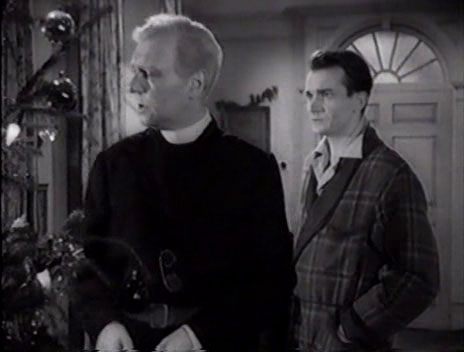
Kinda like Rio Bravo in the sense that you’ve got good, tough characters who team up against serious odds, but the ending leaves me less with the sense that I’ve seen an epic drama or action flick than a buddy comedy. It’s too darned happy to be a Western, gives the same sense of companionable fulfillment as a Renoir movie.

Bigetsu Skyogatari:

Colorfully narrated (“Jim seed somethin’ in the trees, and Jim were the curious sort”) by elder fur trapper Zeb (Arthur Hunnicutt, baddie in The Tall T), who we don’t even meet for twenty minutes. Starting in 1832 Kentucky, the movie mainly follows Jim (Kirk Douglas, year after Ace in the Hole) and Jim’s new buddy/Zeb’s nephew Boone (Dewey Martin of a couple other Hawks movies). They’re both going west, searching for freedom and profit, Jim more aimless and easygoing, Boone seeking his uncle and hoping to revenge his brother’s death by bagging a few native Blackfoot.

Jim, Boone, Zeb:

The three men meet in jail after a bar brawl, then join an ambitious trapper named Frenchy (Steven Geray of Verboten!), who hopes to bypass the monopolistic fur company headed by frilly-shirted top-hatted MacMasters (voiceover man Paul Frees). Frenchy’s secret to being able to trade with the Blackfoot, who won’t deal with MacMasters’s people, is that Frenchy has one of the chief’s daughters Teal Eye (Elizabeth Threatt, in her only film), is escorting her home. After we’re introduced to the strong, stereotype-defying Teal Eye, the movie compensates by hiring along the drunk, buffoonish Poordevil (Hank Worden, a marshall in Forty Guns).

Noble Indian:

Nutty Indian:

I think it takes months to go up the river, the men mostly pulling the boat upstream with ropes. MacMasters’s muscle man Streak kills a couple men, and more are killed by the Blackfoot’s rival Crow tribe hired by Streak, but Jim, Zeb and Boone, hired for the trading group’s protection, finally wipe out the lot of the sneaky sonsobitches. Meanwhile, both of the younger guns have fallen for Teal Eye, and there’s some drama over that. Zeb was once in the same situation, left a girl behind and she killed herself – and he was lying to Boone about the whole murdered brother thing. Boone is told none of this, because apparently it’s better for a man to make his own uninformed decisions, but opts to stay behind with the Blackfoot at the end anyhow.

My new favorite method of torture: having a strong fellow squeeze two baddies’ heads together

Tag G.: “Action is only an extension in character, and character, like the action it ignites, is biological, zoological. Vast events in many Hawks films are pushed by character.” So he analyzes their characters, answering why Zeb is telling his story about Jim instead of about himself or his own nephew Boone, when Jim gets lost and injured, has no particular goals, and doesn’t get the girl. Jim and Zeb are men of talk and whiskey, while Boone is a man of action. At the end of the trip, Frenchy and Boone have destinations – Jim and Zeb just have each other.

The first major studio film in the sound era to be shot all on location – I watched the long/original version, not the contentiously cut-down theatrical release.

In one of the extras on the War Trilogy DVDs, somebody mentions the progression of location-specific titles in Rossellini’s films – from a city in Rome Open City, moving out to multiple cities in Paisan, to a country in Germany Year Zero, to an entire continent in Europa ’51. I had that in mind, also thinking of it as Ingrid Bergman’s followup to the island-landscape picture Stromboli, so was surprised that Europa goes smaller-scale, starting with a single upper-class family and ultimately focusing on one individual. It seems to be about compassion in modern society, which makes it more properly a follow-up to RR’s Flowers of St. Francis than Stromboli.

Irene (Bergman) and George (Alexander Knox, blacklisted in the US, later in Losey pictures) are wealthy enough to not have to deal directly with their sensitive son, leaving his care to teachers and housekeepers. George is sort of a motherfucker in general, won’t listen to anyone but himself, but he seems alright in small doses. Anyway, their son is tired of the constant neglect and throws himself down the stairs, dying soon after.

Unhappy couple:

Irene’s friend Andrea (a male name in Italian, played by writer/director Ettore Giannini) tells her the fatal fall was probably on purpose, and she reacts violently: “Oh George, we should change everything in our life!” Everyone else moves on, and it doesn’t take long before they’re chastising Irene for her manners instead of understanding her grief. She asks Andrea how she can help other children and he leads her to the slums, where the Galli family has a sick child who needs money for medicine.

She spends more time down there, meets local prostitute Ines and poor but joyous mother (and adoptive mother) Passerotto (La Strada star Giulietta Masina). Irene covers for a day at Passerotto’s new factory job, comes home angry, saying factory work is “an horrendous condemnation. And to think they want to raise work to a godlike status,” argues about it with communist Andrea, then goes back out in her mission to help humanity and atone for being a poor mother.

Dying Ines:

Giulietta Masina won’t stop talking long enough to take a screenshot:

Comes across Ines on the street, very sick with TB, takes her home and stays with her. But when Ines dies, Irene finds herself in the middle of a new neighborhood crisis, helping a criminal escape and getting rewarded with prison, then an asylum. Here the movie comes across as slightly obvious, when the psychologists decide to keep her locked up indefinitely because they can’t comprehend her selflessness, saying their mission is to “defend society as it is,” the last word on the subject being yelled outside the gates by Passerotto: “She’s a saint!”

Science vs. Compassion:

I was going to call it The Passion of Ingrid Bergman, forgetting that a couple years later, Rossellini and Bergman would make an actual Joan of Arc film. Instead, TCM confirms my thoughts about St. Francis with a Bergman quote (paraphrasing RR speaking to her): “I am going to make a story about Saint Francis and [Francis is] going to be you. It was just how we would behave in ’51 if a woman gives up a rich husband, a rich life, all her friends, everything, and goes out into the street to help the poor.” I guess critics have called it uneven, but I found it so much more interesting and less grating than Stromboli that I didn’t notice.

“The change from a human being with dignity to a helpless worm takes but a second.”

Completely unexpected movie from Sternberg, his final film as writer/producer/director (and now narrator and credited cinematographer). Made in Kyoto with a Japanese cast and crew, speaking their own language. Instead of dubbing or subtitling their dialogue, Sternberg adds voiceover (returning to the flowery poetic style of his earliest film The Salvation Hunters) to explain and comment on the action, removing dialogue from the list of things that may distract viewers from his lighting and camerawork, which here seems less extreme and artificial than in some of the Dietrich pictures.

But he still loves to use shadow-patterns from nets and leaves:

P. Demonsablon in Cahiers: “He wrote the commentary and it is his own voice that speaks to us for an hour and a half over the images, not in order to clarify the dialogue, but to comment on the actions, thus introducing a shift between the spectacle and the reflection on it.”

Near the end of WWII, an army ship is bombed and the survivors wash up on the abandoned island of Anatahan, “halfway between Japan and New Guinea”. They set to figuring out survival tactics and soon meet the island’s two inhabitants: Keiko (the “queen bee” in the titles) and the man they think to be her husband, Kusakabe.

I liked Kusakabe best:

After military order breaks down, the ship’s captain mans their single machine gun alone, but after a U.S. warship passes by, announcing the war’s end and looking for island inhabitants to surrender, the men smell a trap and hire their captain back to lead them. He stays behind during the final rescue, “I will never go back to a defeated Japan.”

Years go by, WWII ends, and no enemy or rescue comes. It’s all based on a true story – the single woman on the island causing jealous murders, the survivors fighting over homemade coconut wine, the final rescue accomplished when the government contacted the survivors’ families and had them write letters to their men, insisting that the war had ended and they should surrender and come home.

balding Kuroda has no family, so Keiko wrote his letter:

“How could we know that we had brought the enemy with us in our own bodies, an enemy that would attack without notice?” There’s often an anthropological tone to the voiceover, but it’s never racially condescending, all about human behavior and the results of organized, military society being gradually replaced by instinct and greed.

Yananuma and Nishio, first to find the guns:

Kusakabe’s killer, Yoshiri:

A couple years into their stay on the island some men come across a crashed plane containing two guns and a pile of bullets. From then on, whoever held the guns held the power. Meanwhile Keiko, who was never actually married to Kusakabe, “goes into circulation.” A few men are killed over her, as power continues to change hands, until Kusakabe is dispatched by a guy with a sailor hat and neptune fork. Keiko has had enough, shoots the neptune fellow herself then throws the guns into the ocean. She eventually flags down a passing ship and escapes before the others.

Near the start, arms raised in celebration:

Near the end, arms raised in surrender:

Amazing ending – Keiko secretly watches at the airport as the men return, seeing them walk down the runway one by one, the living followed by the ghosts of the dead.

Producer Kazuo Takimura would follow up with the Samurai trilogy, and Keiko was Akemi Negishi, later of Kurosawa’s Lower Depths and Red Beard.

Sternberg:

My best film – and my most unsuccessful one… it is most probably an error to assume that human beings will pay admission to inspect their own mistakes rather than the mistakes of others.

Two interpreters were needed, one to translate into Japanese what I had said, and the other to translate back into English what the first translator was saying so that I could check whether my meaning had been correctly transmitted… To make certain that my ideas were being transferred correctly, I engaged an artist to draw pictures of each scene as we proceeded. I also made a graphic chart of the emotional involvements of each player, so that all of them could clearly see the kind of emotion required and the degree to which it was to be used.

Half of my crew had been trained as kamikazes, and the other half had been guerrilla fighters in the Philippines, though this had not prepared them for the ordeal of working with me.

A very light-hearted, beautiful, episodic film about a group of monks who follow St. Francis. I didn’t know Rossellini was capable of humor and lightness – this comes as pleasantly surprising as Smiles of a Summer Night. The monks look silly running everywhere they go, and they take in a village idiot who never quite gets the hang of things, so I thought for a while that this was a religion-mocking predecessor of Life of Brian, but the underlying seriousness about their faith and Francis’s lessons on humility come through by the end.

Rossellini:

“As the title indicates, my film wants to focus on the merrier aspect of the Franciscan experience, on the playfulness, the ‘perfect delight,’ the freedom that the spirit finds in poverty and in an absolute detachment from material things. . . . I believe that certain aspects of primitive Franciscanism could best satisfy the deepest aspirations and needs of a humanity who, enslaved by its greed and having totally forgotten the Poverello’s lesson, has also lost its joy of life.”

I. Francesco returns from Rome with his companions, having been given the Pope’s permission to preach. Someone has taken over their old hut, so they wander off in the pouring rain to build a new one.

II. Brother Ginepro gave away his clothes to a beggar. Francesco tells him not to do this anymore.

III. Francesco talks to birds. Wrinkled ol’ Giovanni The Simple is given permission to join the group. I can’t remember where I read this, but it said the actor who played Giovanni was too drunk to learn any lines, so they’d shove him in front of camera to improvise his scenes. He’d played a monk earlier in L’Amore.

Francis with bird:

IV. Sister Chiara comes to visit, has dinner with Francesco. It’s said that she first became a nun in their chapel, but I thought they just built the chapel in the middle of nowhere. Guess not.

V. Troublesome Ginepro cuts off the foot of a neighboring farmer’s pig to offer to a sick comrade. The farmer gets understandably angry. Ginepro tries to apologize.

VI. A wordless section: “How San Francesco, praying in the forest at night, met the leper.” Francis silently commisserates.

VII. Ginepro again, makes enough stew to last two weeks so the guys don’t have to stop preaching to cook. Francesco is impressed, gives him permission to go preach, but he must always begin by humbly saying “Baa, baa, baa, much I say, little I do.”

VIII. Ginepro “baa baa”s his way into a violent village of warrior-thugs, who beat the shit out of him and play jumprope with his body. He gets a private conference with heavily armored warlord Aldo Fabrizi (the priest of Rome Open City – I didn’t recognize him in the mop wig and fake mustache) who finally figures out that Ginepro is obviously not a threat.

IX. Francesco is sad because he sees a bandit killed. He and brother Leone try to preach at a house but get tossed out into the mud. He explains that this suffering is “perfect happiness.”

X. The group breaks up. Francesco has everyone spin in circles until they fall down dizzy – whichever city they’re now facing is where they must go preach.

M. Porro: “Rossellini said that his film was a humble and austere work, realistically describing the spirit of the story. … In the cinema, biblical and evangelical subjects took the form of big American films. Think of a film like The Bible by John Huston, The Robe, King of Kings, The Greatest Story Ever Told. The rhetoric of these films interferes with the spiritual message.”

I watched this and The Naked Spur building up to Emory’s 35mm screening of Mann’s T-Men, which I then missed. Oh well. These were excellent, so I’ll have to catch up with T-Men and the others eventually.

A perhaps less-wooden-than-usual Gary Cooper gets a train ticket, is asked his name and destination by two different people and gives them different answers. So we know something is up (turns out he’s a still-wanted ex-badman). But Gary has reformed, is now the inordinately earnest Gary we all know and love, so he’s not lying to talky card-shark Arthur O’Connell when he says he’s headed to Fort Worth with cash raised by an entire town to hire a schoolteacher. Arthur introduces him to saloon singer Julie London, says she’d make a fine teacher, but then the train is robbed, Gary’s money is stolen, and Gary, Julie and Arthur find themselves on foot.

Julie and Arthur in happier times:

Fortunately, this all took place a short walk away from Gary’s old hideout, where his half-crazy uncle Lee Cobb (baddie of Thieves’ Highway) still reigns over a crude bunch of dangerous dimwits, including Gary’s real asshole cousin Jack Lord. Gary is treated as a prisoner/possible-accomplice, Julie as a sex slave, and Arthur is finally just shot (so is Jack Lord).

Cooper, trapped by Lord (left) and Dano:

Gary talks his way into helping with a bank heist, but mute Royal Dano (the Kid’s henchman in Johnny Guitar, later Gramps in House II) comes along and gets himself killed – so now Gary’s got to pick off the rest of the gang as they come for him (that’d be John Dehner, who played Pat Garrett to Paul Newman’s Kid the same year, and Robert Wilke, the foreman in Days of Heaven) before facing off against his uncle Cobb, who I’m surprised was able to leave the house and ride into town.

Cooper vs. Cobb:

Gary’s got his money back, and rides off with Julie London. But besides the money and the schoolteacher plan, Gary was also not lying about having a wife and kids back home. So they can’t be together, but Julie says she’s happy with the unrequited thing, and they get their unique doomed-romance version of the ride-into-sunset.

J. Rosenbaum:

Man of the West is shot in CinemaScope, yet it’s initially hampered by the shallow dramatic space associated with television. This effect is made worse by the casting, which pairs the stagiest of stage actors (Cobb) with the most cinematic of movie actors (Cooper). But Mann is canny enough to turn these limitations to his advantage whenever he can, offering sly notations about Link’s physical discomfort on the train and using a long, tense scene inside the farmhouse to create claustrophobia before sending the characters outdoors for virtually the remainder of the picture. Once again, the hero is a dialectical contradiction, both regressing toward an unbearable past and making an anguished effort to break free from it — the struggle ultimately engendering hatred, violence, pain, and humiliation, and revealing boundless evil.

Royal Dano vs. the ghost town:

Great, tense western thriller with just a few (white) characters and an unusual philosophical ending. “He’s not dead if you take him back. He’ll never be dead for you.” Shot by William Mellor (Giant) in academy-ratio color. I noticed some cool secret-revealing camera moves – from a quick one during the opening titles to a slow traveling shot later on showing a guy hiding behind a rock. Overall great performances except that I wished Jesse Tate had been played by Rio Bravo‘s Walter Brennan – Millard’s voice wasn’t quite right.

Jimmy:

Jimmy Stewart (the year before Rear Window) comes at friendly ol’ prospector Jesse (Millard Mitchell of Thieves’ Highway and Winchester ’73), says he’s looking for lawman-slayer Robert Ryan. Jesse hasn’t seen Ryan since Clash By Night, so offers his assistance. In wanders Kiss Me Deadly star Ralph Meeker as a disgraced ex-soldier, and between them, the men take down Robert Ryan over the protest of his gal Janet Leigh (four years after Holiday Affair).

Everyone but Jimmy:

But Ryan pretty easily turns the men against each other by revealing that he’s got quite a bounty on his head, and Stewart is after him for the money, not as a lawman. This works better than Janet Leigh’s appeals that poor Ryan is innocent – and if we’d ever considered believing her, Ryan loses all sympathy when he wears down the men to the point that he’s allowed to escape, then he shoots ol’ Jesse. Meeker goes down next, but takes Ryan with him, and Stewart recovers the body. But apparently Janet Leigh can make a man fall in love with her pretty much instantly, so…

B. Lucas:

Howard drags Ben’s body to his horse in a final paroxysm of fury, but then turns to Lina and sees in her face the light of unconditional love and a new beginning, and at last relents. The tears and cracking voice of Stewart in close shot are a high moment of this great actor’s career, perfectly complemented by the softer yet no less vibrant playing of Leigh. . . As the camera moves up into the sky, then follows a dissolve to come back to the two characters moving through dead trees within an open expanse, one sees in these images that there is a spiritual rhythm within life, and that “choosing a way to live” can happen even in the roughest passage.

Another look at the face that turned Jimmy’s life around:

Bonus: lots of Indian-slaying and horse-injuring action when Meeker declares war on a passing tribe, and some Jimmy Stewart backstory, narrated to Leigh while he’s injured and raving. Jimmy uses his spur to help climb a cliff at the end (then throws it in Robert Ryan’s face), which I guess is where the weird title came from.

A straightforward rebellious-youth/romantic drama. Should’ve watched this with Katy, but I didn’t think Masumura would be her style. It’s one of Masumura’s earliest films, from the writer of Mizoguchi’s Story of the Last Chrysanthemums.

Hiroshi Kawaguchi and Hitomi Nozoe would also star together in Giants and Toys:

Moody Kinichi’s dad is accused of election fraud, will need 100k yen in fines. While visiting dad in jail, Kinichi runs across Akiko who’s also visiting her dad, also needs 100k. Their moms aren’t around – the boy’s wants nothing to do with the family anymore, is a jeweler or something, and the girl’s is in a sanatorium with TB. Akiko’s family friend, a famous painter, has a playboy son who sees his chance to buy her (even blatantly phrasing it that way) now that she’s in need.

Kinichi with mom: Aiko Mimasu, in Street of Shame the previous year

So it sounds like the movie could be a sordid drama about sad poor people, but it’s not that at all. Mostly it’s a light romance between the two heavy-hearted kids – at the racing track, the beach, a piano bar. Kinichi seems somewhat reckless at first, but he’s a good, responsible kid, finally gets the money from his mom, tracks down the girl (there’s extra drama when he loses her address) and gives it to her.

In smaller roles, the boy’s jailed dad (“Lawmakers are the crooks. Until the law changes, I’ll go to jail after every election”) is Eitaro Ozawa of Assassination and The Crucified Lovers, and the girl’s sad, sick mom is Sachiko Murase, star of Kurosawa’s Rhapsody in August.

Bengali movie with a couple of red herrings. Starts out following a man and his idiot nephew on their way to the nephew’s wedding. They hopped the wrong train and have to take a taxi – the worst, forty-year-old beat-up jalopy, full of holes and loose parts, which manages to get them to their destination safely. But instead of following them to the wedding, the movie stays with the cab driver, the real protagonist. His car is the laughing stock of town, and the movie laughs with them, adding kooky sound effects, having the car respond and telegraph its mood via headlights-as-eyes facial expressions when the owner speaks to it. The comic trappings are another red herring – the movie is a realist social drama in a comedy’s clothing, about the cab driver’s attachment to the car, his financial and emotional struggle to keep it running in spite of its obvious imminent collapse. And I’m so glad it wasn’t the story of the uncle and nephew going to their wedding – looked like The Hidden Fortress all over again.

Not the stars of the film:

The stars of the film (man and car):

Taxi driver is called Bimal, and he calls his car Jagaddal (I can’t figure out the meaning of that name or the film’s title). A boy named Sultan is his friend/assistant/hanger-on, who helps get him fares. The only recurring fare is a young woman who runs off with her boyfriend, then gets a ride some days (months?) later to the train station, alone and ashamed. Bimal judges her, but makes up by buying her train ticket.

I fell asleep in the middle, continued the next night. But first I watched an episode of The Story of Film which gave away the ending – thanks a lot. The only time I’ve ever seen Ajantrik mentioned anywhere, and it’s right in the middle of my watching it. It’s a good ending – the car (which was Bimal’s best friend, making him a local laughing stock) finally gives up the ghost, sold for scrap metal, but Bimal smiles again seeing a child playing with the horn.

This came out the year after Aparajito and Guru Dutt’s Pyaasa, all part of the Indian New Wave or “parallel cinema” movement. Wikipedia claims it influenced Ray’s Abhijan (and therefore Taxi Driver) but also the Herbie series, a mixed distinction.

This Just In: an old issue of Film Quarterly gives the English title as Non-Machine.

“They talk too much to be happy.”

Descriptions of this film focus on the blank-faced young married couple in crisis, visiting the fishing town where he grew up, debating whether they should stay together. But the couple seems to appear in about one third of the movie. The rest is about the town itself and its residents – daily fishing, problems with the law and health board, a teenage couple who want to start dating, a jousting competition in the river. Since most of the movie defies plot summary, the married couple gets more attention than they maybe deserve.

He says something like “you change your mind so much, I’m always a day or two behind.” And I’m so glad I never finished watching this with Katy (she made it about 20 minutes in), because most of their conversation is about their failing relationship, whether or not they’re in love and should break up. Katy will take this personally and think I’m trying to ask these questions indirectly myself. Also any movie containing any sadness makes her sad. Best to stick with Hello, Dolly!

Resnais-style camera moves (he was the film’s editor – the same year he made Toute la memoire du monde), some highly posed, French-poetic shots of the couple, which are all the more arresting against the reality of the small fishing village. But Varda doesn’t shoot it like reality. The sea, the clotheslines and nets, the shacks and neighborhood cats all look like an expensive set, arranged for the pleasure of her camera. An unbelievably accomplished debut.

Of the two actors, Silvia Monfort was in a couple movies with Jean Gabin, also a Robert Bresson movie I’ve never heard of, and Philippe Noiret was the uncle of Zazie dans le metro, also in Topaz and Coup de Torchon.

Ydessa, The Bears, and etc. (2004)

I like documentaries with twist endings. There’s a shocker at the end of artist Ydessa’s gallery display of thousands of framed photographs of people holding teddy bears: a bare-walled third room containing only a mannequin of Hitler, kneeling as if in prayer. Ydessa’s parents were holocaust survivors, and some of their family members didn’t survive – the exhibit is dedicated to them. I didn’t warm up to Ydessa very much, but I like the layout of her exhibit, the photos themselves and the film.

Nice Varda-esque touch: Ydessa says she’s created a fiction that looks like documentary: that everybody is happy and has a teddy bear. “Reality and fiction – I’m somewhere in between.” And of course in her montage of photos from the exhibit, Varda sneaks in a photo of herself as a child.

7 P., cuis., s.de b… (1984)

I think the title is real-estate shorthand for “seven bedrooms, kitchen and bath.” Shot in a former hospice during an exhibition created by Louis Bec, who played the older father. So I’m not sure which of the visual ideas came from Bec and which from Varda, but it’s a remarkable little film. Unseen realtor is showing this property to unseen doctor, the doctor moves in, starts a (large) family which grows up fast. They go through a couple maids and their oldest daughter gets a boyfriend and rebels against her father. Older yet, and the father has died. The rooms go from bare to slightly dressed to crazy – the bathroom totally covered in feathers at one point. Characters speak through each other, repeating phrases like in Marienbad.

Yolande Moreau, who’d play a chef in Micmacs:

You’ve Got Beautiful Stairs, You Know (1986)

A celebration of the Cinematheque and its front steps, intercutting with famous film scenes set upon steps. Some semi-re-enactments – I liked the buggy tossed down the steps, Potemkin-style, and the mildly concerned man at the bottom who leaned over to check that nobody was inside.