Miyazaki’s first non-series feature, and the movie that spawned Studio Ghibli. It’s a surprisingly huge-looking feature for a startup/indie flick. Watched the well-dubbed English version on day one of the Belcourt’s retrospective, a weekday matinee populated by children and die-hards. Voices I recognized: just Patrick Stewart as Lord Yupa. Voices I Did Not Recognize: Alison Drag Me To Hell Lohman as Nausicaa, Shia LaBeouf as enemy gunfighter-turned-friend Asbel, Tress MacNeille (Babs Bunny, Principal Skinner’s mom) as the blind old woman, Mark Hamill as the warlord leader of Pejite, Uma Thurman as the warlord leader of Tolmekia, and Chris Jack Skellington Sarandon as Kurotowa, Thurman’s power-hungry buffoon assistant.

Nausicaa is the uniquely smart and capable princess of the wind valley, introduced scavenging in the toxic forest and helping her uncle Yupa escape from giant marauding bugs known as Ohm. Their village is invaded by Thurman’s Tolmekians, who aim to resurrect a giant mythical warrior and annihilate other tribes. While everyone else worries about becoming the dominant human force on a dying world, Nausicaa is aiming to make peace with the insects and discover why the world’s plants have turned poisonous. In the movie’s Planet of the Apes reveal, she and Asbel learn that civilizations past fatally polluted the soil and that the plants adapted to gradually purify it. Showdown between giant warrior (not fully recomposed, it melts), hordes of undefeatable insects, and prophet Nausicaa, who brings peace to the land.

This is the fifth post-’68 Godard movie to put me to sleep, after Letter to Jane, Histoire(s) du Cinema (in installments), In Praise of Love and Notre Musique (in a theater). In this case, I was tired and angry at the movie and fell asleep on purpose, to make the movie feel bad about itself (assuming Godard doesn’t take it as a compliment when you sleep through his movies, like Guy Maddin does).

techno-rasta godard:

Tried to watch it without paying heed to the stories surrounding its production, which turn out to be more interesting than the film itself. Godard signed the “contract” on a bar napkin, over a year later got calls from the “producer” asking where’s our film?, JLG read the first few pages of King Lear and got bored with it, hired a bunch of overqualified actors and pissed them off. Writer/actor Norman Mailer walked out after one day, and Godard put this and his voicemails from the producer into the final cut. Something like that, anyway – I can’t be arsed to look it up.

Shakespeare Jr. or whatever:

Burgess Meredith (in his follow-up to a Dudley Moore Santa Claus movie) is apparently the King, talking some nonsense with Molly Ringwald (her inexplicable follow-up to Pretty In Pink) in a hotel room. Downstairs in the restaurant, a wiry, spike-haired Peter Sellars (dir of something called The Cabinet of Dr. Ramirez) is real interested in what everyone else is doing. As I drifted awake again later, Godard (with RCA cables wound through his hair and indecipherable English speech) and Woody Allen caught my attention for a few moments each. Might be a nice-looking movie – the DP had shot the last couple of Eric Rohmer movies – but you can’t tell from my VHS copy. And I doubt it, anyway.

Molly:

from Canby’s original NYTimes review: “a late Godardian practical joke . . . as sad and embarrassing as the spectacle of a great, dignified man wearing a fishbowl over his head to get a laugh. . . . After making what is possibly the most lyrical film on language in the history of the cinema (Le Gai Savoir), Mr. Godard has now made the silliest.”

Rosenbaum would disagree: “It may drive you nuts, but it is probably the most inventive and original Godard film since Passion,” and he talks about the complex surround-sound mix, which again, I’m sadly missing on my VHS version.

Typically, JR has put more thought into the film than anyone else, his analysis revealing the film’s fundamental link to the spirit of the play.

Excerpts:

Sellars “introduces himself offscreen as William Shakespeare Jr. the Fifth, and roughly describes his job as restoring what he can of his ancestor’s plays after a massive cultural memory loss was brought about by Chernobyl.”

As the film proceeds . . . we get snatches of Shakespeare’s Lear, snatches of what appears to be Mailer’s Don Learo, and snatches of what appears to be an earlier, unrealized Godard project, The Story, about Jewish gangsters Bugsy Siegel and Meyer Lansky in Las Vegas. (Three Journeys Into King Lear, as one printed title puts it. But does “King Lear” in this case refer to the play, the character, or the Cannon Films project?)

For Godard, it’s a legitimate source of pride that he won’t film anything to illustrate a scriptwriter’s point or provide continuity; his disdain for ordinary filmmaking practice becomes a creative challenge, and, in terms of his limited capacities for story telling, a calculated risk. . . . This originality often seems to be driven by hatred and anger, emotions that are undervalued in more cowardly periods such as the present, just as they were probably overvalued 20 years ago. It is a source of energy that remains crucial to much of the avant-garde.

“When I say the word Antwerp, you are going to have an effective dream about overpopulation.”

Opens with skinny Bruce Davison (xenophobic senator in X-Men, the original Willard) as George Orr, dreaming an atomic bomb. Takes himself into a psychotherapy clinic because he keeps having “effective” dreams which change reality – and history, so that nobody else remembers the original reality. Instead of focusing on the bomb, he tells them (via b/w flashback) how when he was a kid he kissed his Aunt Ethel, then out of embarrassment, wished her into the cornfield. No, he actually dreamed that she had never lived with him, and died far off in a car crash.

Orr’s case draws the attention of Dr. Haber (Kevin Conway, reminiscent of Oliver Reed), who hooks him up to dream-monitoring machines. It’s not clear if Haber can remember the shifting realities but he seems to believe in Orr’s effective dreams, and starts suggesting topics for him to dream about. He starts with just about the most dangerous subject you can suggest to someone with massive powers to alter reality: overpopulation.

Unsurprisingly, when Orr wakes up, there are considerably fewer people on earth thanks to the plague he dreamed up. Further experiments result in war with aliens, then peace with aliens (earth being colonized), all races being turned gray (no more racism!), not to mention Haber moving from a small office into the massive “Haber Institute”.

Not a bad alien, considering this was PBS’s first original movie:

Davison is nervous and unhappy for most of the movie, but adopts this carefree stance around the psychiatrist, making the exciteable Haber seem like the crazy one by proximity. And Davison turns out happier, hooks up with his lawyer (Margaret Avery, oscar-winning for The Color Purple) while Haber loses his mind trying to fix the world’s problems.

Haber with Avery:

Ursula says in interview that she was skeptical of the book’s filmic possibilities because “nothing happens in it”. On Haber: “He’s not evil. He means well all the way through the book. But he’s doing it wrong.” … “Of course this was a daoist book … Daoism says you do things by not doing things, and all attempt to do and to set things right and make things happen eventually backfires”

Remade with James Caan in the 2000’s. Not many of Le Guin’s stories have made it to the screen – just this and a couple recent adaptations of her dragons-and-sorcerors Earthsea stories. One of the screenwriters went on to create the celebrated hit series Murphy Brown; the other created Porky’s II. The co-directors had previously collaborated on a version of Vonnegut’s Between Time and Timbuktu.

After false-starts with Flowers of Shanghai and Goodbye South, Goodbye, I figured out how to get on Hou’s wavelength with his Red Balloon and Three Times, so now trying something from his acclaimed 1980’s period. I liked it, and could follow reasonably well despite 90% of my knowledge of Taiwan’s post-Japanese-occupation history coming from a blurry bootleg of A Brighter Summer Day. Wikipedia, help us out with context here:

It tells the story of a family embroiled in the tragic “White Terror” that was wrought on the Taiwanese people by the Kuomintang government (KMT) after their arrival from mainland China in the late 1940s, during which thousands of Taiwanese were rounded up, shot, and/or sent to prison. The film was the first to deal openly with the KMT’s authoritarian misdeeds after its 1945 turnover of Taiwan from Japan, and the first to depict the 228 Incident of 1947, in which thousands of people were massacred.

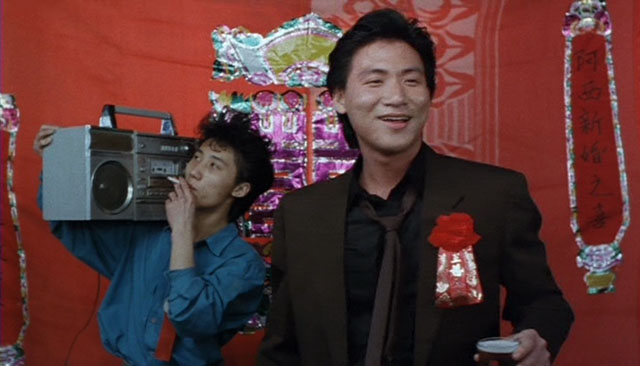
“On August 15, 1945 Japan announced its unconditional surrender. Taiwan was liberated following 51 years of Japanese occupation. The wife of older brother Lin Wen-heung gave birth to a son. They named him Kang-ming, which means Light.” Brief introductions (Wen-heung is a stocky fellow) and a photo shoot, then suddenly a woman is narrating from the mountains, introducing W-H’s brother Wen-ching as a friend of her brother. W-C (Tony Leung 1 of 2046) is deaf/dumb (this was supposedly added to the script because Leung couldn’t speak the dialect convincingly, heh), a professional photographer who communicates to customers with gestures and to our new narrator (Hinomi) with pen/paper. W-C has other brothers besides stocky eldest Wen-heung – one disappeared in the war, and the other, Wen-leung (Jack Kao of a bunch of Hou’s films), came back mad.

W-C: happy, deaf

W-L: mad

But Wen-leung gets over his condition, joins organized crime, gets himself arrested and gets the straight Wen-heung in trouble. Eventually, W-H is killed and W-L terribly beaten, other characters disappear or escape to the mountains, and W-C ends up with Hinomi – but in the epilogue, after showing him with new wife and baby, even he is arrested again, and the titles tell us “December 1949. Mainland China is lost,” when the ROC moved to Taiwan (maintaining martial law, torture and execution for 40 years) and communist PRC formed in mainland China. So the movie takes place over four years, during which it doesn’t always seem like such sadness, but it sure turns out that way in the end.

IMDB:

As revealed in scriptwriter Chu Tien-Wen’s book, the original premise of this film is the reunion of an ex-gangster (which Hou Hsiao-Hsien intended to cast Chow Yun-fat for the role) and his former lover (supposedly played by Yang Li-Hua, the top Taiwanese Opera actress in real-life) in the 1970’s. Hou and Chu then extended the story to involve substantial flashbacks of the calamity of the woman’s family in late 1940’s (where the woman was the teenage daughter of Chen Song-Yong’s character). They then abandoned the former premise and instead focused on the 1940s’ story.

from an excellent essay by K. Lee for Reverse Shot:

Any given scene in City of Sadness has its own internal history informing the logic of its characters’ behaviors. Hou’s sense of dramatic conflict—one that’s unique in cinema—arises when the recurring presence of the past collides against an unfolding present unknown to both the characters and the viewer. …

City of Sadness envisions a massive shift in a tiny island’s social fabric caused by forces well beyond the scope of any person, or even a community. Everyone is overwhelmed. No less than five languages are spoken in the film: Japanese and four forms of Chinese. Even Chinese viewers require subtitles when watching this film. … Perhaps due to being the first movie to deal openly with the “2-28 Incident,” or perhaps because of the Golden Lion it won at Venice, City of Sadness was the top grossing domestic film of its year. Nonetheless, there was public dismay at the oblique nature of Hou’s storytelling and the fact that the atrocities of the “2-28 Incident” are never depicted directly onscreen (despite that there are more fight scenes and onscreen killings in City of Sadness than in all of Hou’s other films combined). …

Scenes pass like clouds, loosely connected, the overall story arc not clearly in sight, and only in retrospect, with a final shot of an empty room that once held scores of family and friends, does the sum total of the film materialize, narrative, historical, emotional. Hou’s aim is nothing less than to enact how people live history—not as something happening right in front of them, but around them and beyond them, the same way then as now. In City of Sadness the horrors of the world occur almost always out of view, but it makes their presence all the more unsettlingly palpable.

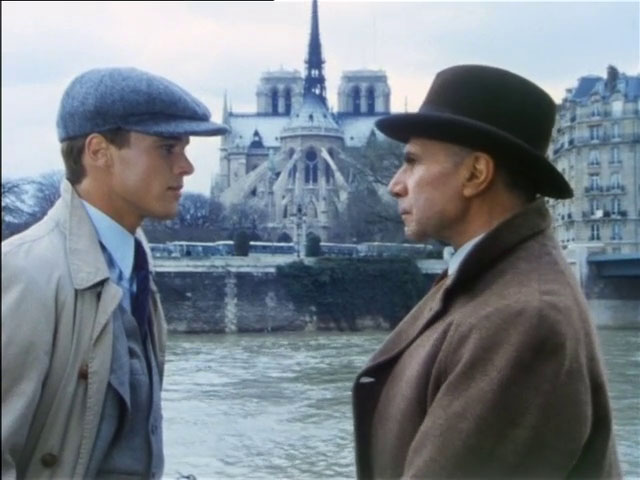
Cool adaptation, with fine visuals by Radford (Il Postino) and the great Roger Deakins (pre-Coens), and a wonderful John Hurt performance. Hurt is not killed at the end (at least not explicitly), and the phrase “Big Brother is watching” never appears. Surprisingly good/subtle musical score by Eurythmics, which the director hated. Hmmm, or is it subtle because we heard the Dominic Muldowney score instead? Watched on netflix, so it’s hard to tell.

Hurt (in The Hit the same year), a government newspaper revisionist, falls for Suzanna Hamilton (of the Sting version of Brimstone & Treacle), dreams of escaping control of the party and finding a place where love is still possible. Richard Burton (of Exorcist II, argh) is on to their plan, and subjects Hurt to torture until he comes to truly love Big Brother. Katy didn’t much like it, putting a damper on the beginning of Dystopia Month.

After a funeral, Natasha is angry with everyone alive, quits her job and pisses off people in the street. After forty minutes of this, the movie-in-a-movie ends and Olga, its lead actress, comes on stage to complete audience indifference. “I’m already sad and tired from work. I’d like to have fun, listen to some music instead of watching such movies.”

Destructive tendencies in the film-in-a-film:

Narcoleptic Nikolai is in the audience. He’s a schoolteacher along with round, blonde Irina. To be truthful, that’s about all I can be sure of. Plenty else happens in the movie, but I’m not sure to whom, and for what reason. It’s kind of a comedy, but seems to be serious underneath. The title seems appropriate (asthenia: abnormal physical weakness or lack of energy). You could also have called it Everybody Is Unbearable. Very talky, with wall-to-wall chatter in half the scenes, languid in others.

Nikolai:

Irina attempts “strangers in the night”:

Won a prize at Berlin. The distributor calls it an “impressionistic portrait of the USSR reaching the end of its tether.” Senses calls it a “demented masterpiece,” and goes on to note: “it is interesting to note that while the rest of the world celebrated the fall of communism, the reaction of the people actually living under Soviet rule wasn’t as simple; people felt very confused, and their overall behaviour was – and still is – reminiscent of the asthenic syndrome of the film, alternatively violent and repressed. Even though Asthenic Syndrome was made during the period of glasnost, Muratova once again managed to alienate the authorities. It had the dubious honour of being the only film banned during that period.”

J. Rosenbaum:

It’s a film that alternately assaults you and nods off — usually without warning and often when you’re least expecting it. Mean-spirited and assertive one moment, narcoleptic and in complete denial the next, it bears an astonishing resemblance to the disconcerting rhythm of contemporary public life.

D. Auerbach:

If you don’t know that perestroika is seen as the source of millions of deaths stemming from deregulation, corruption, and crime, the melancholy and despair that fill The Asthentic Syndrome seem disconnected from a particular cause: what is Muratova critiquing, exactly? . . . Knowing the context reveals the emotion behind the puzzling surface.

Not an actual movie, but an admirable simulacrum. Abrams imagines a mid-80’s Spielberg adventure, complete with teenage protagonists each with a couple sympathetic personal details, aliens and intrigue (“Do not speak of this or else you and your parents will die,” says Glynn Turman, who was also the first casualty in Spielberg-produced Gremlins), likeably honest small-towners and evil shadowy government conspiracy. That’s actually the thing I liked most about the movie, watching it the same week as the politically shady Contagion. Abrams puts his unique directorial stamp on the material (just kidding – he simply floods it with lens flares).

I found a shot of the kids without lens flare:

Glynn Turman:

Kid named Joe is helping made a zombie movie with friends, who recruit his crush Alice (Elle Fanning, tiny Cate Blanchett in The Benjamin Buttons). With names like Joe, Alice and their buddy Preston, sometimes it seems like this was written as a 1940’s movie then changed at last minute. Joe’s mom died in a factory accident caused indirectly by Alice’s dad, Joe’s dad (Kyle Chandler of Katy’s football show) is the town cop, Charles (the super-8 director) has a thing for Alice – these are our token character details, the Stand By Me half of the big-budget action movie. Seems that a vindictive alien escaped from gov’t captivity when Turman drove his pickup truck onto train tracks causing an outrageously overdone crash, which throws train cars into the air like in a Transformers flick but doesn’t kill Turman or fully destroy his truck. Shadowy gov’t agent Nelec will finish the poor guy off before being dispatched by the alien, who proceeds to loot the area of all wiring, engines and other metal bits to construct a vessel home, finally turning the town water tower into a Katamari Damacy electro-magnet.

Runaway dog map:

The kid’s sentimental locket is Katamari-bound:

Great little indie movie, don’t know why I remember disliking it. Tracy Johns (her only other role was New Jack City) is Nola Darling, who strings three guys along without committing to any, finally dumps them all to stay independent. Tommy Hicks (Daughters of the Dust) is Jamie, who’d seem like a perfect man except that he keeps trying to make her settle down. John Terrell is an arrogant rich guy, and Spike (Mars Blackmon, great character names) is an immature joker, and Nola’s lesbian friend Raye Dowell is after her as well. Spike’s relatives make appearances (Bill plays Nola’s dad, Joie is her roommate).

Spike’s feature debut, with nice b/w cinematography by Ernest Dickerson, except when Tommy gives Nola a musical dance number for her birthday, shot in color.

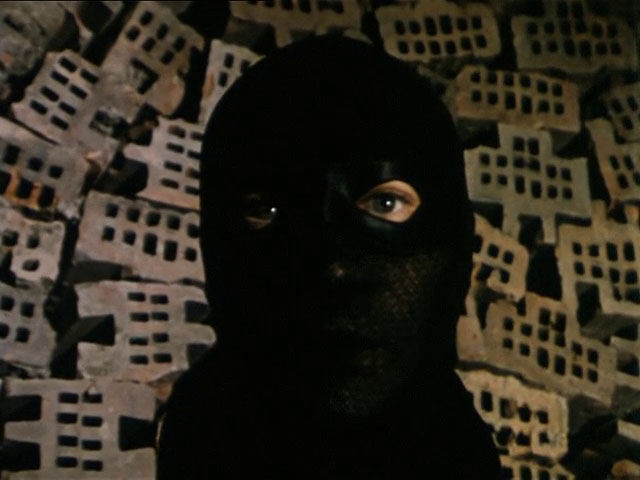
Terayama worked with the same cinematographer and musician as the shorts plus old-school Renoir and French New Wave producer Pierre Braunberger, who included this along with shorts by Just Jaeckin and Walerian Borowczyk in a sleazy anthology, accounting for its odd 40-minute runtime.

Akira combs deserts and towns searching for the lyrics to a children’s song. He recalls life with his single mother – how she protected him from the nymphomaniac next door by writing Kwaidan-like spells on his body, how the mother tormented and attracted him and may have died with her lover before he was born. It’s a dreamlike film, then. The Internet says it’s a companion piece to his feature Pastoral.

Nice color treatment – one pan starts in full color and turns to sepia-tinted monochrome by its finish. The movie starts to get nuts in the second half, with costumes, drawings and mysterious symbolism, tons of nudity, colorful theatrical performance and imaginary ball-bouncing. On his quest, Akira meets Juzo Itami of Sweet Home, but finds no answers, or at least none that he shares with us.

I haven’t seen much writing on Terayama – here is a good piece by Tony Rayns for Sight and Sound:

Two experiences in Terayama’s childhood and adolescence were formative. He was born … in the foothills of Mount Osore – a ‘haunted’ mountain which has attracted ghosts and shamanists for centuries. He soaked up local myths and legends throughout his boyhood. And then he spent what should have been his student years confined to a hospital bed in Tokyo’s Shinjuku district, struck down by the nephritis which eventually killed him in 1983. Outside the window of his ward the alleys of Shinjuku were increasingly alive with student protests, street theatre and art happenings, plus the odd yakuza skirmish. (Shinjuku became the epicentre of Japanese counter-culture in the mid-1960s: see Oshima’s 1968 movie Diary of a Shinjuku Thief for details.) Stuck in the hospital, Terayama conceived a parallel between the ghost traffic on Mount Osore and the street-life of Shinjuku. This perception gave him a vein of imagery which fed into much of his later work.