When someone in the film world dies I don’t always run out and watch one of their movies – only when it’s someone meaningful to me, like Claude Chabrol, Dennis Hopper and Eric Rohmer. I once considered holding a monthly “death of cinema” screening, inviting people over to watch the work of whoever had died that month (there’s always someone), but as with all my plans to watch movies in groups, it fell through – nobody liked Rohmer’s final film, so Katy suggested I not do that anymore. But Maria Schneider warrants a memorial screening because she starred in one of the few Jacques Rivette films I haven’t yet seen, and I happen to have a nice subtitled copy of it handy.

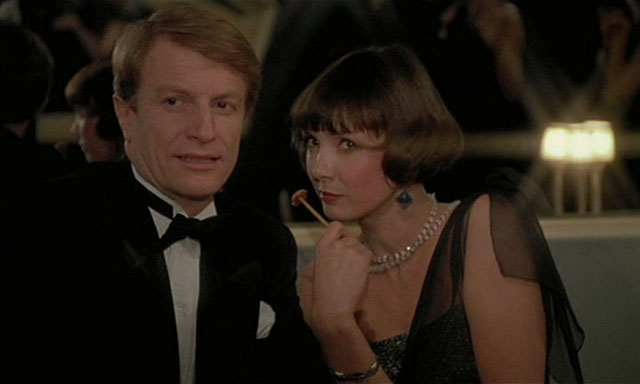
Maria Schneider at dinner:

Schneider was allegedly exploited in Last Tango in Paris, backed out of Caligula, fired from That Obscure Object of Desire, and not up to the task of leading a Rivette picture, which probably explains her replacement in certain sequences by a different actress. But she’s still revered for her part in The Passenger and for being so naked in the early 70’s. This was actually Schneider’s second movie titled Merry-Go-Round – the first was in 1973, a (West) German remake of La Ronde.

Schneider’s costar is Warhol actor Joe Dallesandro, the houseboy/lover in Blood For Dracula. Yes, this is weird casting for a Rivette movie. But production-wise we’re in familiar territory, with the Out 1/Duelle team of Schiffman, de Gregorio, Tchalgadjieff and Lubtchansky (X2). By the end we’ve got triple-cross conspiracies, psychics, secret weapons, assassinations and meetings in the park, so the Rivette touchstones are all there. It’s also surprisingly good-looking (if not up to Duelle/Noroit standards) for such a reputedly troubled film.

Joe and Maria:

The story goes that Maria’s father is presumed dead and some four million dollars left in his care are unaccounted for. Maria’s elusive sister Liz (Danièle Gegauff, a producer on Out 1 and star of a single Chabrol film) summons Maria and Joe (Liz’s boyfriend) but fails to show up herself, so these two meet and go on an adventure together. Liz shows up briefly, along with a bunch more characters, each of whom want to help either Maria or her possibly-alive father, or more likely, want a share of the money. Most suspicious is Shirley (Sylvie Matton, whose husband directed her and Udo Kier in his adult horror Spermula), who is possibly either Liz’s best friend, the father’s ex-lover, Joe’s sister or none of the above,

Maria’s sister Liz with Suspicious Shirley:

The movie seems to fits neatly in the Rivette filmography, with on-camera musicians like predecessor Duelle, and a couple of characters chasing around the country trying to solve a possibly imagined mystery a la follow-up Pont du Nord. But there are some wrinkles. The grasp on the mystery is soon lost and Joe and Maria ramble, their relationship growing increasingly unpleasant, then the plot returns with a puzzling vengeance in the last half hour. Plus there are unexplained fantasy scenes, with Joe and a suspiciously Maria-like girl (played by Hermine Karagheuz, Marie in Out 1) chasing each other through forests and deserts, with appearances by snakes, rifles and a mounted armored knight.

Marie/Karagheuz:

Jean-Francois Stevenin (“Max” in Le Pont du Nord) is in an early scene with the two sisters, and seems to kidnap Liz (cue Walter: “the girl kidnapped herself”). Seemingly trustworthy lawyer-type Renée (Francoise Prevost of Vadim’s segment in Spirits of the Dead) and the mysterious Shirley put our duo up to collecting the key and combination/location of the father’s safe in order to retrieve the money (this is never done, as far as I could tell). Psychic Mr. Danvers (Maurice Garrel, Philippe Garrel’s father, played Emmanuelle Devos’s dying father in Kings and Queen, also amusingly in a movie called Noli Me Tangere) pretends to be the post-plastic-surgery father of the sisters. Liz is rescued (or “rescued”, depending if we believe Walter) by Maria with Renée’s associate Jerome (Michel Berto, Honeymoon in Out 1, also in a Robbe-Grillet film) armed only with a pipe. In the end it either all goes wrong, or all goes according to plan, as Liz is shot by a sniper and Maria unloads a pistol into poor Mr. Danvers.

Mr. Danvers, we hardly knew thee

Whenever the movie just doesn’t know where to go, it cuts to either the live musicians or the fantasy scenes. I wasn’t sure what to make of them, but they grew on me. I liked the bass-and-clarinet soundtrack, the colorful, mobile cinematography. The physical action, fist-fighting and such, were pretty inept, especially coming right after Duelle starring the sprightly Jean Babilée. Movie was made to fulfill contractual obligations after the collapse of the proposed four-part series that yielded Duelle and Noroit, but then was a huge failure itself, so I’ll bet the exec producers wished they’d just left Rivette alone.

The musicians: Barre Phillips at left worked on the Naked Lunch soundtrack with Ornette Coleman, and John Surman at right has put out 20+ albums and hopefully changed his hairstyle:

Cinema-Talk:

It just has the right amount of disregard for plot that nothing seems remotely forced. This is almost unheard of in Rivette’s world. For as great as his other films are, they (almost) all seemed to be dragged down by unnecessary elements that were thrown in at the last minute. Here, everything is so completely natural (one cannot stress this enough!) that the 150-minute running time feels fairly short.

The two sisters, plus friendly assistant Jerome:

Rivette:

We started work with the two actors, and after 8 days, things were going very badly. It was like a machine that, once set in motion, must continue running despite changing regimes, forced or arbitrary accelerations, until the energy was all burned up, exhausted. That’s not at all how we filmed L’Amour fou, even if there too, the spectator feels he’s witnessing an encounter. … It’s an exaggeration to say that we placed Maria and Joe together in front of the camera and waited to see what would happen. We had a starting point of course, and then we made up the beginning of a story, with a father who had disappeared, but all along we told ourselves, this is just a pretext for Maria and Joe to get to know each other. I like that idea: two people get together because a third, who has arranged to meet them, does not show up. There have no choice but to get to know each other. It’s a situation I imagined in the context of the Resistance. Thinking about it again later, I think it was the subject of Robert Hossein’s Nuit des espions. And since I didn’t feel like making a film about the Resistance or the terrorist underground, it became that more banal situation, two people convoked by a third who is only the sister of the one and the girlfriend of the other. But since the relationship between Maria and Joe rapidly became hostile, we were forced to develop the story-line; from a mere pretext it took on a disproportionate importance. Maybe that gives the film a certain vagabond charm, I don’t know, but it really is a film with a first half-hour that’s quite coherent, and then it searches for itself three times, three times searches for a way out.”

Renée:

E. Howard:

The bulk of the film consists of Ben and Léo wandering around the French countryside, ostensibly searching for clues to Elisabeth’s disappearance or the safe combination needed to get their hands on the missing money. What they actually do is mope around a lot, wander through abandoned houses, and joke and fight and patter, improvising goofy bits like the one where Ben mocks the conspiratorial obsession with the number three by counting off increasingly lengthy numbers consisting entirely of threes. In the film’s best scene, the duo takes a break for dinner at an abandoned house whose refrigerator is improbably well-stocked: they crack open cans of sardines and make salads and drink the juice from jars of cherries, sitting across from one another at a long table with candelabras in the center. Léo jokes that it’s a bourgeois meal, and the two of them have fun playing hide and seek from behind the candle flames, and soon the conversation turns into a lighthearted seduction where it’s obvious that the actors are having as much fun as the characters.

Our heroes, looking tired and frumpy in the morning light:

Rivette again:

I like a film to be an adventure: for those who make it, and for those who see it. The adventure of this filming, I must admit, was a bit fitful: the course which was established at the outset was corrected many times, in response to contrary winds, lulls, or gentle breezes. I only hope that the finished film, with all its detours, keeps something of the dangers of the crossing, of its uncertainties, of its unclouded moments-even if, at the end, one notices that perhaps the voyage has been circular: like a “merry-go-round.”

“You want to be happy. There are more important things.”

A woman (Domiziana Giordano of Godard’s Nouvelle Vague) is a faithless tourist in an italian church, cluttering its ancient traditions with her modern feminist ideas. An interesting, beautiful scene but I knew Tarkovsky wouldn’t have a female protagonist, so it turns out she’s the Italian translator for our Russian poet hero Andrei (Oleg Yankovskiy of The Mirror and The Man Who Cried). He’s visiting some ancient hot baths as research for a book he’ll write on an 18th-century Russian composer who spent some time there.

Andrei becomes fascinated with local madman Domenico (Erland Josephson of The Sacrifice and some eight Bergman films). Visits his rainy, ruined house and listens to his superstitions. Returns to the translator, who is leaving in a rage, says Andrei is so charmless and boring that he may not even exist. She acts like she’s breaking up their love affair, even though they didn’t have one. But later, safely back in Rome with her boyfriend (a humorless-looking businessman) she phones Andrei telling him to meet Domenico in Rome.

Instead, Andrei goes back to the baths and attempts to complete Domenico’s quest to walk from one side of the pool to the other holding a lighted candle, while Domenico himself gives a speech atop a statue then lights himself on fire. Andrei has two failed attempts and a single success in one mobile ten-minute shot, after which Andrei seems to collapse, leading to a long, crazy black-and-white shot of the poet with Domenico’s dog in front of a Russian house within an Italian cathedral.

Co-written with Antonioni/Fellini screenwriter Tonino Guerra, won three awards at Cannes. Can’t say I understood the movie’s intentions, but I enjoyed it for being a gorgeous bit of cinema. Some fun trick photography and lots of very long takes, plus imagery I recognized from other Tarkovsky movies, though it’s been a while since I’ve seen one – ruined houses in My Name Is Ivan and Stalker, plants waving underwater in Solaris.

Acquarello says he filmed it “in exile,” calls it a “symbolically obscure … cinematic abstract of spiritual hunger” that “mourns an irretrievable past and an uncertain future.”

Tarkovsky: “I do not harbor any particularly deep or profound thoughts about my own work. I simply have no idea what my symbols represent. The only thing I am after is for them to give birth to certain emotions.”

“I want to give expression to the impossibility of living in a divided world, a world torn to pieces.” In interviews, Tarkovsky says that his lead character is an architecture professor and Domenico a former math teacher. “Let us say that what I like the most in them is the confidence with which the madman acts and the tenacity of the traveler in his attempts at achieving a greater level of understanding. That tenacity could also be called hope.”

One more: Tarkovsky says he most values in this film “its almost unbearable sadness, which, however, reflects very well my need to immerse myself in spirituality. In any case, I can’t stand mirth. Cheerful people seem guilty to me, because they can’t comprehend the mournful value of existence. I accept happiness only in children and the elderly, with all others I am intolerant.” And when asked about his pessimism: “The true pessimists are those who continue to seek happiness. Wait for two or three years and then go and ask them what they have attained.”

Thanks very much to nostalghia.com for their collection of translated interviews and articles.

Another freewheeling Rivette film, with its 16mm look and protagonists running throughout the city of Paris in the midst of a game with ill-defined rules, seeking to unveil a conspiracy, like a scaled-down Out 1.

Two girls meet on the street, run around a Paris that seems to be populated only by themselves and various conspirators, and get caught in a game, possibly of their own making. There’s more energized music than usual for Rivette, with drums and accordion and strings. Whirling camera, 360-degree pans, many shots of local monuments also recall Out 1, specifically its final shot. But this film has a lighter touch, also bringing to mind Celine & Julie Go Boating, with its playfulness and our heroines’ mysterious bond to each other. The dialogue is a bit new-age, the actions are somewhat improv-theater, it seems to have been shot entirely in real locations, and perhaps in a hurry, since I caught the boom mic a few times.

Films in the film:

Knife-wielding Pascale vs. Kurosawa’s Kagemusha:

The Silent Scream, a spooky mansion flick:

The Big Country with Gregory Peck – in French it’s called “Wide Open Spaces”, as Pascale leads the claustrophobic Bulle into the theater for the night, to sleep close enough to the screen that she can’t see the walls

And on the way out of the theater…

Bulle Ogier stars in her fifth Rivette film along with Pascale Ogier, Bulle’s daughter, who also starred in a Rohmer movie and something called Ghost Dance before dying of a heart attack at age 26. Bulle, just out of prison, has a crippling claustrophobia and cannot step indoors, not even into a glass-enclosed phone booth, without feeling ill. Pascale, apparently homeless, hears Bulle’s story of getting caught up with the wrong crowd and sets out to keep it from happening again, tailing Bulle’s boyfriend Julien (Pierre Clementi of The Conformist, The Inner Scar).

Pascale seems to be on to something – they steal Julien’s briefcase and discover all sorts of newspaper articles about kidnappings and killings, and also a map of Paris that has been sectioned off in a spiral pattern which reminds Bulle of a “very frightening game” she used to play called the Goose game. They find a sort of key to the map on a murdered man in a cemetery and start to identify the “trap squares” in the game, beginning with places they’ve already been: Prison and the Tomb, then they proceed to play Paris like a game, hoping to survive all the trap squares and win the game.

Besides Julien, they keep running into a balding man (Jean-Francois Stevenin, the teacher in Small Change), who sometimes seems to be a companion of Julien’s and sometimes schemes with the girls independently of Julien, warning Bulle that the people responsible for sending her to prison are after her again. Pascale calls this man Max, her name for all the city’s conspirators. For example, when Bulle wonders about the explanation for the dead map-carrier in the cemetery, Pascale responds “The Max had a bullet in his guts – that’s the explanation.”

Discovering the murdered, bewigged Max

Each “trap” location presents a new challenge. At one, Pascale, who has a compulsion to carve the eyes out of advertising posters, is faced with a whole wall of those. At another, Pascale is in a fight with a white-haired Max who leaves her in a giant cobweb until rescued by Bulle, and at a third Pascale has to defeat a giant dragon, played by some sort of amusement-park ride with an added flamethrower.

While Pascale lives in this fantasy Paris, Bulle’s adventure seems more real and dangerous – she’s given a gun by Julien and keeps having to figure out whose side she’s on. Of course once a gun is introduced into the movie, someone has to get shot. Pascale kills a Max and seems unrepentant, and then Julien kills Bulle, telling her “I loved you.” But the movie’s sympathies have turned towards the inner life of Pascale – she meets Max on a bridge over the river, and they spar together, appropriately practicing “Katta – a combat against imaginary enemies.”

I was tempted to see the sparring scene above as evidence that Pascale was working alongside the Maxes all along, but no, I think she’s just an erratic character. Anyway, it wouldn’t have taken a city-wide conspiracy including Pascale to defeat the fragile Bulle.

Good one by F. Ziolkowski:

Marie’s belief in a great love with Julien, the real at the end of her quest, will eventually be fatal for her. It is Baptiste’s ability to “roll with the punches” which will perhaps save her, but at what cost? As one of the Maxes puts her through a karate exercise and tells her to fend off “imaginary enemies,” the cross-hairs of a surveillance device (a rifle scope? a camera?) appear on the screen. “They” are now being watched by others, perhaps simply by us. That is, it may be that the answer to the riddle of the labyrinth — its last door — is simply the screen on which the actors’ shadows appear.

The movie got a hateful review in the Times, and was even dismissed by Senses of Cinema. Fortunately it’s not my job to analyze its quality in relation to other Rivette films, or even other films in general – I was just along for the ride, which I enjoyed.

Insight from J. Rosenbaum:

The file of clippings concerns specific scandals of the Giscard d’Estaing regime, and the locations refer to various municipal corruptions associated with that period (e.g., the ruins of slaughterhouses in La Villette which were built and then demolished before they could be used, due to safety hazards). Rivette has indicated that the film was made prior to the French elections and with the pessimistic expectations that the same regime would remain in power; so the unexpected election of Francois Mitterand obscured and blunted part of the film’s intended impact. Rivette conceived of Marie as a continuation of the anarchist character played by Bulle Ogier in Fassbinder’s The Third Generation (1979), after she gets out of prison. Her claustrophobia was occasioned by the film’s cut-rate budget, which led to the decision to shoot the film exclusively in exteriors.

Ziolkowski again:

[Paris] for the Surrealists was not only a magical place, it also became a living organism, a protagonist in its own right, complete with motivations, deaths, rebirths, etc. … The group’s fascination with the myth of the labyrinth led them to name their most prestigious and influential review Le Minotaure. … All the elements of Surrealism are here once again: the double, the lions of the Place Denfert-Rochereau which seem ready to spring to life at any moment, the mysterious stranger who crosses one’s path in the middle of the night.

Follow the gun.

From Julien…

… to Bulle …

… to Pascale

Julien again (different gun)

Rivette: “The idea was to refer to Don Quixote and Sancho Panza. Passing from the Parisian quartiers outward to the peripheral areas, within those zones that are slightly uncertain, but without ever leaving Paris. We also wanted to show everything that was in the process of being transformed, under construction.”

Bulle and Julien atop the Arc:


Paris s’en va (1981)

“Paris Goes Away,” a half-hour movie made from scenes and outtakes from Le Pont du Nord. A narrator tells us about the Goose Game, often repeating as the images also double back on themselves. It’s a mini-Spectre version of the feature, more lightweight, with more lingering shots of monuments and less danger and conspiracy. The narration seems to imply that Bulle’s flask is her game token. Rivette’s only other short that I’ve seen, Le Coup du berger, also referenced games, if that means anything.

Le Lion Volatil:

Pascale:

Bulle:


Jacques Rivette, Le Veilleur (1990, Claire Denis)

“Artists have a portion of basic villainy, even the greatest of them.”

Agnes Godard (still Denis’s cinematographer two decades later on 35 Shots of Rum) shoots critic Serge Daney (he took over Cahiers after the Bazin/Rohmer era) in conversation with Rivette, in Parisian cafes and fields. Divided into two parts, “I – Day” and “II – Night.”

“Do we see his painting or not?” Jacques discusses preliminary thoughts on Le Belle Noiseuse before he had worked out the story or approach. Le Pont du Nord gets the most discussion time, strange, since he’d made three movies since then (Love on the Ground doesn’t get a single mention). I wasn’t crazy about the music in Le Pont du Nord so I’m glad to hear that he spent very little time selecting it.

Rivette with Serge Daney:

I wouldn’t call it a great film (sorry, Claire Denis) but it’s a great interview/conversation, worth watching again, not like a throwaway DVD extra. Loooong shots include the silences between questions, perhaps in deference to Rivette’s own long-take style. He tells of his early years, first arriving in Paris, meeting up with Rohmer, Truffaut and Godard and going to work for Cahiers with Bazin. He discusses duration in a “post-Antonioni world,” saying movies used to have pre-determined beginnings and endings and filmmakers were free to fill the middle with events, but now it seems there are fewer rules and everything takes longer to say. When asked what he’s enjoyed lately in theaters he highly recommends a Sandrine Bonnaire film called Peau de Vache.

“I don’t want to separate, to split things up. I know a lot of filmmakers, whether consciously or not, who have this notion of splitting the body into bits. Not just the face, it can be the hand or any part of the body. I always want to see the body in its entirety. I don’t have the temperment, the taste or the talent to make heavily edited films. My films focus more on the continuity of events taken as a whole.”

Time out for an interview with Le Pont du Nord’s Max, Jean-Francois Stévenin, including his entire scene as Marlon in Out 1.

Rivette again: “My feeling is these people who have been affected [by his films], and who have these individual ways of showing that, they constitute a kind of widespread secret society. We’re obviously not talking about lots of people, unfortunately for the film producers!” He talks with his hands, striking wonderful poses.

In part 2, Bulle Ogier is along for the ride, interjecting a word or two, only getting the camera to herself for a few minutes.

Serge: “When you came back to earth with Pont du Nord in the early 80’s, it was with the feeling that we adapt to things as they are, we stop tempting fate or playing Prometheus and we come back to the real world. And we remember that the beginning of the 80’s were roaring, euphoric, entertaining – very explosive, in fact. And your film takes that on board. We can feel something quite intentional in the processes which make up Le Pond du Nord and allow you to tackle the 80’s.”

Rivette’s vogue poses:

Rivette:

It’s a time when we feel such a decision has been taken. Just as Bulle said at the end, ‘I’m alive.’ As far as I’m concerned, and I have the impression that, strangely, it concerns – I won’t say everyone, there are always exceptions – many filmmakers of my generation and subsequent generations. After Out, it seemed impossible in my films to talk about the contemporary world, what we call the real world, and at that time I wanted more than anything to work on fiction, fantasy fiction films. I didn’t shoot them all because the first project was, after Out and Celine & Julie, was a film we wanted to do with Jeanne Moreau [Bulle: “Phoenix.”] and Juliet Berto and Michel Lonsdale, which was a story based on the Sarah Bernhardt myth loosely mixed up with Gaston Leroux’s Phantom of the Opera. And what came next were stories that were all different with one thing in common: the total refusal of France in the seventies. It was something I suddenly didn’t want to see anymore. And after a series of events, more or less successful films – some were far from being completely successful, unfortunate films, at least Noroit and Merry Go Round were, that were hardly seen anywhere. They were shaky films, it’s true. When I went to see Bulle and said ‘We have to do another film together and I want to do it with you,’ it was the idea that we hadn’t put these bad times behind us, that they may well continue, and we had to come to terms with it but in order to do that we had to turn it into fiction, to put it in a film. And that’s why, in Pont de Nord there’s this insistence – that may appear anecdotal ten years after – on the affairs or scandals at the end of the seventies, such as the Debreuil affair or the suicide or non-suicide of Boulin or the killing of Mesrine, that sort of stuff. As symptoms, but strong symptoms. And we shot the film, at least from my point of view I began the film, not in this atmosphere of eighties euphoria we mentioned but with the impression of being in a country – France – that was stuck. Stuck, because of a lot of things we won’t go into here – everyone remembers. But it so happened that this feeling of being stuck was so strong that it brought about a certain unblocking.

It has some drowning, and some numbers, but I guess Greenaway hadn’t ramped up to his full obsession with categorizing and enumerating things (or perhaps he was taking a break – I haven’t seen earlier feature The Falls yet). Fox Lorber did a lousy job with the DVD, but some of the nice candlelight photography and PG-esque controlled compositions came through. I enjoyed it, though it’s not as sneaky a mystery or as delightful a script as it thinks.

Neville with Mrs. Herbert:

Mr. Neville is the titular draughtsman, hired to draw architectural sketches of the Herbert gardens while the master is away. But will the master ever return, or has he met with misadventure? As part of Neville’s fee, he gets to have his way with Mrs. Herbert, while her daughter makes a separate sexual agreement with Neville, suspected by her snobbish German husband Mr. Talmann. Any sense of suspense fizzles out as everything becomes increasingly obvious (young Mrs. Talmann is trying to get Neville to father her child, since her husband is impotent – and yes, Mr. Herbert has been killed). Everyone is trying to frame everyone else, but the grand loser is Neville, set upon at the end by the society types, who cut out his eyes then drown him in the same pool where Herbert was found.

Mr. and Mrs. Talmann:

As usual with British period society comedies, most of the fun is in the bitchy cleverness of the sniping dialogue. Not the only movie Greenaway has made about finding murderous evidence in a painting – isn’t that what the recent Nightwatching & Rembrandt J’Accuse were about? Perhaps PG was traumatized by a youthful viewing of Blow-Up. I also liked the camoflaged naked guy creeping around the garden (doesn’t seem like a realistic occupation – maybe he is independently wealthy)

The director would go on to bigger and better things, but his cast would not. Neville was Anthony Higgins (Merchant/Ivory’s Quartet), currently in something called Malice in Wonderland. Mr. Talmann (my favorite for most naturally wearing the ludicrous period clothes/wigs) was Hugh Fraser, not German at all, appears in Agatha Christie TV series. His wife: Anne-Louise Lambert (Picnic at Hanging Rock), her mother: Janet Suzman (apartheid movie A Dry White Season), and the wicked estate lawyer who works out the contracts was Neil Cunningham of Jarman’s The Tempest.

A catalog-style entry for…

Initiated by Shadowplay

Not just a late film, but a whole compendium of late films: a catalogue of works by Orson Welles during his last twenty years, assembled with stylish fun by Silovic and Oja Kodar, very entertaining and informative. All these years I’ve read Jonathan Rosenbaum championing the late, unreleased works of Welles, I still haven’t been clamoring to see them – I figured I’ve got enough things to watch. But now that I’ve had a taste, the clamoring begins.

It starts, naturally, with magic and stage shows – this wonderful bit of duck hypnosis which I played again and again.

Then Orson’s 1975 acceptance speech for his AFI lifetime achievement award, at which he presented scenes from The Other Side of the Wind.

P. Bog as actor:

Oja introduces herself, says she wants to combat the public opinion that Orson idly spent his time doing voiceovers and liquor commercials, but she only fuels the opinion that he couldn’t finish projects at the end because he was easily distracted by newer, shinier projects. Sure, some of it was sheer bad luck, mostly finance-related, but also the negatives of Merchant of Venice going missing.

That unlabeled can holds the original cut of Ambersons:

Scenes from Filming The Trial are shown, a good opportunity for Welles to speak for himself out of character (or, more accurately, in character as himself).

Oja discusses the great trailer for F For Fake (his final completed feature) and shows half of the trailer, then rifles through paintings and sketches he made.

Monologue readings from Moby Dick: filmed solo performance of select scenes before water-shadowed backdrops. Supposedly the rushes have been edited together and screened in Germany and New York. Please feel free to send them here next.

Don Quixote, which he spent 30 years trying to complete. I haven’t seen Jesus Franco’s version, but despite all the public whining about it, it’s probably better than nothing. Franco had no access to some of the footage, which has since aired on television (and therefore on youtube).

A Winston Churchill-related comedy sketch piece in silhouette, and an embarrassing bit at a hammy tailor shop – these are possibly part of the compilation piece known as London, also edited in Germany. I wonder if the Germans would care to release a DVD.

With tailors Charles Gray (of Dearden’s Man in the Moon and a couple of Bond movies) and Jonathan Lynn (director of Clue, My Cousin Vinny):

A trailer for The Deep, a thriller set on a couple of boats in the middle of the ocean, featuring Jeanne Moreau.

Footage shot for Merchant of Venice. The film was almost completed when part of it went missing.

A desperately lonely-looking Welles performing the missing monologue outdoors on a windy evening.

“I think acting is like sculpture, in other words it’s what you take away from yourself to reveal the truth of what you’re doing that makes a performance … There is no such thing as becoming another character by putting on a lot of makeup.” – spoken by Welles, but similar to what Renoir says in that short with Gisele Braunberger.

More projects: The Orson Welles Show (featuring The Muppets, and available on video):

The Dreamers, which I know little about:

Overall a very useful little doc, which unsurprisingly got me fired up to watch more Welles movies (and to finally read that recent Welles book by Rosenbaum). Unfortunately my follow-up feature, Linklater’s Me and Orson Welles, was much less enlightening.

Afterwards I scouted around online, having a Late-Welles scavenger hunt. I came up with a couple interesting bits. First, a piece of Vienna, as it aired on the Arte channel – a segment of the 1969 One Man Band project. Seems like an unexceptional travelogue, featuring a man who feeds birds, a montage of quick zoom-ins on different cakes (also shown in the Silovic/Kodar doc). A caped and hatted Orson walks through the city scenery, visits a ferris wheel and comments on the Third Man soundtrack, then he and Mickey Rooney perform a magic trick with Senta Berger (of Major Dundee, The Terror of Dr. Mabuse).

Ten minutes of silent screen tests and still photography in preparation for Merchant of Venice, compiled by the Italians – not especially enlightening except to get another look at those long-nosed Eyes Wide Shut masks. I wonder how these tests got out while the film itself remains under wraps:

Another entry for…

Initiated by Shadowplay

There’s classic Jimmy Stewart (The Philadelphia Story, Shop Around the Corner and those Capra flicks), mid-life Hitchcock/Preminger Jimmy Stewart, and the ripe-for-retirement late Jimmy Stewart of Airport ’77 and The Magic of Lassie. But this film stands alone in featuring a post-retirement Jimmy Stewart.

IMDB trivia page says:

James Stewart said that he and his wife were vacationing at a game preserve in Kenya when they came across the filmmakers shooting this picture. He said he was persuaded to make a short appearance, speaking a few lines, because he thought it would help to promote wildlife conservation. “Never did understand what it [the film] was all about”, he said. “I did it on a whim.”

Jimmy Stewart feeds a hawk

And he does only speak a few lines, but that makes him a pretty major character in a movie where nobody speaks more than a few lines. Early on, the filmmakers announce their intention to feature a narrative, introducing a man (Philip Sayer of a couple British miniseries, who managed to die eight years before Stewart) in search of help after his plane crashes in the desert, but then they let us watch a girl named Maya romp with wild animals for another thirty minutes before anything else happens. Worryingly, the slender story wasn’t improvised by some actors who stumbled into a wildlife shoot, as it seems to have been, but was rather written by Hana’s old collaborator, legendary avant-garde filmmaker Terayama Shuji (Grass Labyrinth, Emperor Tomato Ketchup). Also worryingly, the “special effect” used to show Sayer’s plane crashing into a tree seemed to have been achieved by actually crashing a plane into a tree. It’s hard to tell if the dialogue was improvised, or if it was written for children, or if everything got simplified because of language barriers: a Japanese crew in Kenya with American, British and Italian lead actors, plus “Kathy” as Maya, no idea where she’s from.

(to be read flatly with a vague smile, revealing no emotion)
“Grandfather, the zebras and the gazelles are having babies again.”
“Ah, that means you’ll have a lot more friends now.”
“Yes, I have so many animal friends now, and I’ve got you, grandfather.”

But enough about story and dialogue. The filmmakers don’t care about it, so why should we? If you remove your expectations of “a Jimmy Stewart movie” or even “a decent film that makes a lick of sense,” it has its own pleasures. Stewart and his granddaughter Maya live in a thatched house with no doors or windows (a rhino wanders inside at one point) and spend their days playing with the wildlife and caring for their adopted pets, including a monkey and a grey thing I don’t even know what to call (they named it Tiki), which makes a “sknt!” noise that cannot be real. These two pets are treated as major characters. We get a better sense of Tiki’s personality than Jimmy Stewart’s (notice I don’t use his character name – I’m not sure that he has one). And I could think of worse ways to spend two hours than watching the beautiful Maya prance about, intercut with wonderfully shot Kenyan nature footage.

Tiki and his monkey friend:

But if Maya’s playful solo scenes recall the early Pocahontas scenes in Malick’s The New World (unfortunately set to what sounded like electro-symphonic versions of Abba songs), the effect is lost when she opens her mouth. It’s very possibly the directors’ fault (you never know), but she and Sayer and his fiancee Eleonora Vallone sure come out looking like lousy actors. Stewart, however, gets showcase scenes for his acting skills – a couple of raging anger moments, and a climactic emotional story told to Sayer about the accidental death of his son, Maya’s father, in a mine explosion. He also really comes to life, with a warm glow in his eyes revealing the depths of his love for nature, during a short speech about dung beetles. Since Stewart isn’t in the movie long enough to get to know him, these scenes don’t mesh well with his other personas in the film (benevolent nature-loving grandfather/mean old curmudgeon), lending credence to Stewart’s claim that he never understood the plot.

An actor, acting:

Oh yeah, the plot. So, since Sayer has amnesia after his plane crash, there’s nowhere he needs to be, so decides to stay with the hot (but chaste in a children’s-movie way) Maya, gaining the family’s trust by braving a snake-cutaway to rescue some cute creature from a hole it had fallen into, and comforting Maya after Jimmy Stewart’s easily-predicted death (actually I thought it was just as likely he’d wander off set and return to his vacation as stay long enough to shoot the death scene). Then, over an hour into the movie it switches to unsubtitled Japanese and I’m lost for a while. Lions behead some gazelles, tens of wildebeest and zebras drown on-camera in a horrible flood (making me pray it was not a children’s movie), some guy is killing “koala birds” with explosives, and there is a montage of animals yawning. Then rich fancy-girl Erika, the fiancee of the crash victim, sets out in her own plane to find him. Sayer somehow gets caught in a brush fire and a native (the movie calls them “the nomads”) walks him out safely. Erika catches up with the young couple and shoots Sayer with a dart gun in frustration when he won’t join her, then pisses off, leaving him in peace with Maya.

Erika at left, with the worst jumpsuit/upholstery combination in human history:

The movie doesn’t have a wildly good reputation online. J. Sharp:

With this overly precious would-be epic the director seems to be so cowed by his subject, the raw beauty of the Kenyan savannah and its denizens, that the end result resembles little more than a protracted holiday slide-show display. … It seems strange that Hani seems so content to dwell on such superficial trimmings, not only given his impressive track record in the 60s, but also that he’d previously been in Kenya to film The Song of Bwana Toshi shortly after the country had achieved independence from Britain. Bwana Toshi had dealt with the cross-cultural encounters of a Japanese geological engineer with the local community in which he is sent to work, and at least addressed such issues as expatriate-local relationships and the misunderstandings that arise due to the cross-purposes of the parties involved. In Africa Story there’s barely a black face in sight.

This was last fiction film to date by Susumu Hani, a Japanese New Wave director of the 50’s and 60’s. Co-director Simon Trevor specializes in camerawork for films shot in Africa – he worked on Gorillas in the Mist, White Hunter Black Heart and Out of Africa.

Midnight Eye has the scoop:

Susumu Hani’s career began with documentaries about youth and shifted into pseudo-documentary dramas, climaxing with Nanami, one of the greatest masterpieces of Japanese film. Although his work proves he had a profound understanding of human psychology, Hani was becoming increasingly disillusioned with humanity, which may explain why he abandoned human subjects in favor of making nature documentaries for NHK. It’s best to keep that in mind while watching this film, because at this late stage in his career, Hani seems to be completely uninterested in human drama. Instead of focusing on developing the characters, Hani chooses to simply incorporate more nature footage than the story will allow.

The vertical lines were supposed to be slimming:

What was initially announced as Auteur Completion Month is now the longer-term Auteur Completion Project (because it can’t be “completion” if I give up when the month changes). I don’t especially aim to watch everything Mel Brooks has been involved with (never saw Dracula: Dead and Loving It because his previous two were so bad) but I noticed that his one classic-era comedy feature (oops, besides The Twelve Chairs) I’d never seen was the one Jonathan Rosenbaum placed on his 1000 favorite movies list. And now that I’ve seen it, I must conclude that it was a half-remembered nostalgic favorite for JR, not one that received much recent, critical thought.

Starts off unpromisingly, with a jokey Orson Welles voiceover (the year before Slapstick; maybe the great man should’ve hired an agent) and a hokey caveman sketch starring 50’s comedian Sid Caesar (whose last movie to date was Stuart Gordon’s The Wonderful Ice Cream Suit). Catalog of human innovation (“the first artist… the first art critic!”) like one of those punny water-treading late Tex Avery shorts, or a sub-Mr. Show sketch (“man’s greatest achievement: the wheelbarrow”).

Some biblical business follows (including my favorite gag, the 15… 10 Commandments). Next: waaay too much time (over half the movie?) spent in Rome running away from Emperor Dom DeLuise, Empress Madeline Khan and 50’s comedian Shecky Greene.

L-R: possibly Ron Carey (Silent Movie, High Anxiety), maybe Mary-Margaret Humes (of an upcoming Michael Madsen/Roddy Piper horror film), definitely Gregory Hines (in his first film), and grimacingly Mel Brooks. I didn’t take very good notes.

Making up for the overlong Roman piece is an extended, extravagant musical version of the Spanish Inquisition, which could’ve stood on its own as a great short film. By now, narrator Welles has wandered away from the movie, off to film some Moby Dick closeups of himself.

Then Brooks is King Louis XVI of France, and also the piss-bucket boy chosen to replace him in event of a revolution. He helps the daughter of a deranged, imprisoned Spike Milligan free her father and… hell, I can’t remember the storyline, but it involves Harvey Korman (Lord Love a Duck, voice of the Great Gazoo on The Flintstones) as a character named Count De Monet, and in my second favorite joke of the movie, Brooks tries to run down a forced-perspective hallway.

Bunuel did it first:

“Coming attractions” finale features a cute Jews In Space trailer, a premonition of Spaceballs.

Cameos by Moon Over Parador director Paul Mazursky, Diner director Barry Levinson, Hugh Hefner as himself, freshly Oscar-nominated John Hurt as Jesus, Jackie Mason, and an uncredited Bea Arthur.

“This is my story, or, part of it.”

Yes, there’s a narrator, and it’s in color – two unexpected things from a Jarmusch film. Follows Allie (Chris Parker) for a few days as he bums around New York meeting a few characters and ultimately decides to leave. A practice run for Stranger Than Paradise, with Jarmusch exhibiting plenty of his spare urban cinematography.

Leila:

Allie lives with Leila, but will quietly leave her at the end. At least she’s forewarned, as he tells her his “born on a train” philosophy. Allie meets crazed Vietnam vet Richard Boes (he had small parts in JJ’s next five films), visits his mentally ailing mother in a hospital, spies on a woman being vocal behind her apartment, converses with Frankie Faison (one of the three curbside shit-talkers in Do The Right Thing) at a theater playing an anachronistic Nick Ray film, then steals a car from a clueless woman (my favorite scene) and fences it.

Allie with mother:

Frankie:

He ends up at the pier, about to flee to Paris for a change of scenery. First he runs into another disaffected young man, a Parisian who fled for New York – a cheerful example of Jarmusch’s dry sense of humor.

I don’t know for sure that this is Sara Driver below, since two women are credited as “nurse.” She worked on most of Jarmusch’s movies, pulling two titles (production manager and assistant director) on this one. Funny enough, Driver was in the Times the day after I watched this, since a quality print of her long-lost first film You Are Not I was just discovered in Tangier.

Jarmusch, from 1980-81 interviews:

The story was inspired by how Chris actually lives his life … About half the things that happen to him in the film actually occurred to him, and the other half I made up for him. I thought up situations and placed him in them. … It’s more about accidental connections that move the audience than about dramatic action.

The question is how to treat social problems. A lot of people criticize my film politically; they say it’s an art film, it’s harmless, and does not take a clear stand. But whenever I watch a film – even if I almost completely agree with its political aims – it will still lose my interest as soon as I notice that the conclusions are self-evident, because then there is nothing left to discover.

“Maybe his head just got loose and fell off.”

Shitty scat-singing pianist turned incompetent diamond thief Jimmy Quinn stumbles across the nest of a winged monster that has been terrorizing New York, snatching up rooftop sunbathers and window washers, and tries to use this knowledge for profit. As in God Told Me To, Cohen shines in picking up crowd scenes seemingly out in public and not on a closed set. I like that Cohen casts skilled but unattractive actors – lead cop David Carradine (Kill Bill, Boxcar Bertha) and thief Michael Moriarty (The Stuff, Pick Me Up) don’t seem much like movie leading men, but they’re perfect for this story.

Moriarty is dwarfed by the city:

Murderous cultist takes a volunteer:

Moriarty is the fascinatingly doomed, black center of the movie, on the run from his partners in the jewel heist he botched, but Carradine and his partner Richard “Shaft” Roundtree kill time trying to solve a series of grotesque murders, apparently committed by a cult trying to appease the beast. I have to question the skills of the investigators when Moriarty is brought into the station for beating a security guard who works at the top of the Chrysler building, and they continue to bargain with Moriarty, offering him a million (which he never gets) to tell them which tall building hosts the monster. Besides that little plot hole, it’s a pretty great movie.

“I can’t imagine that the monster would want to kill YOU, Richard Roundtree.”

The monster, just after crushing Richard Roundtree’s spine and dropping him 200 stories: