Pol Pot’s Birthday (2004, Talmage Cooley)
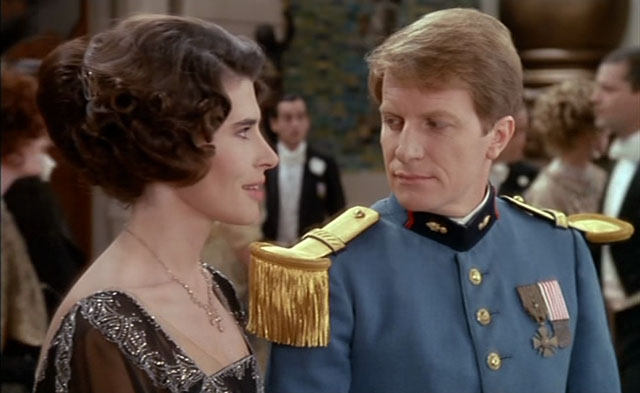
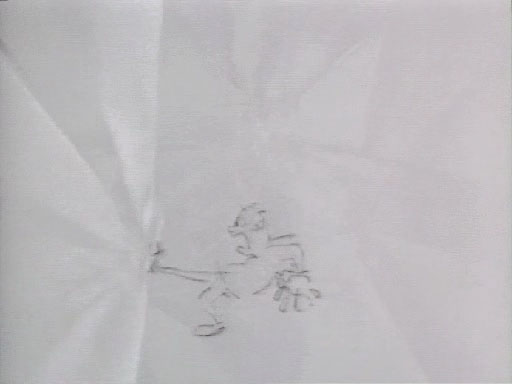
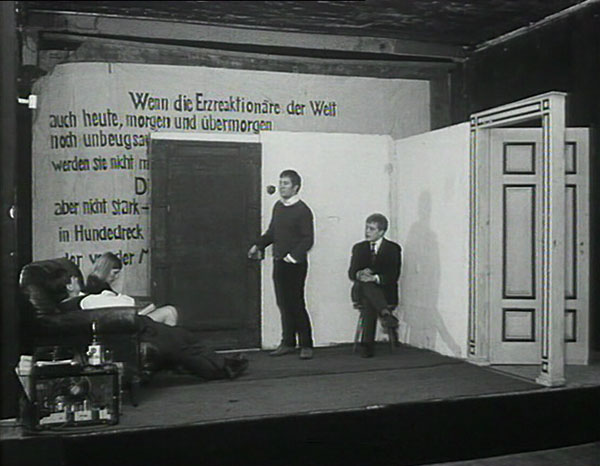
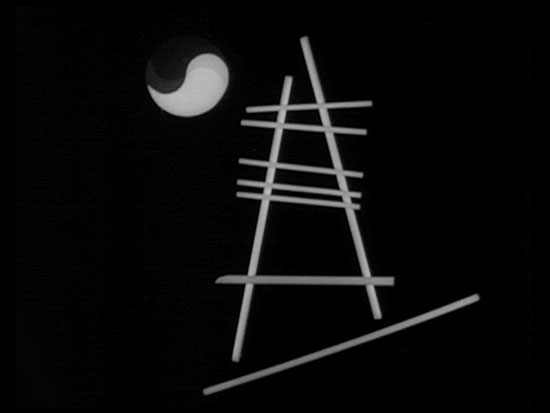
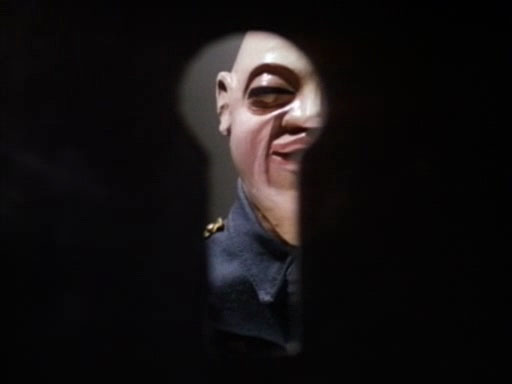
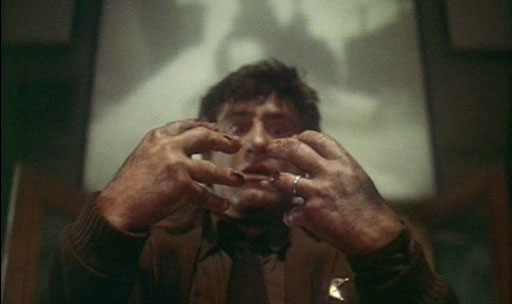
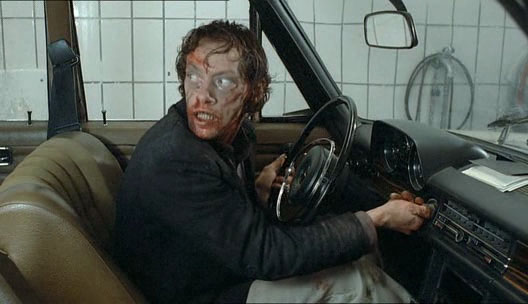
In 1985, the scrappy dictator’s men throw him a super-weak budget surprise birthday party, with grey cake and music on an old tape player. Awkward conversation ensues… P-P gets peed on by a dog and “Walking On Sunshine” plays over the credits. Kim Rew got paid?
image

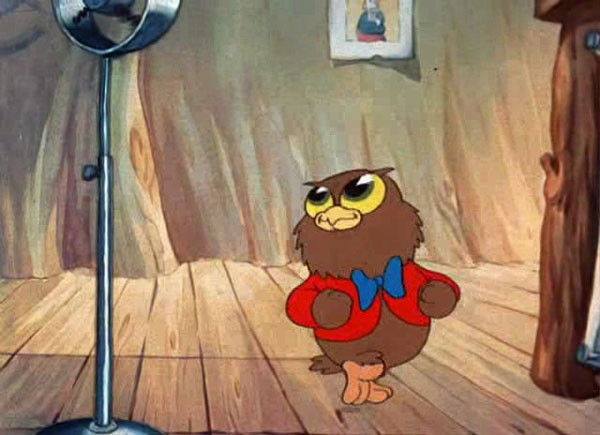
Meet King Joe (1949, John Sutherland)
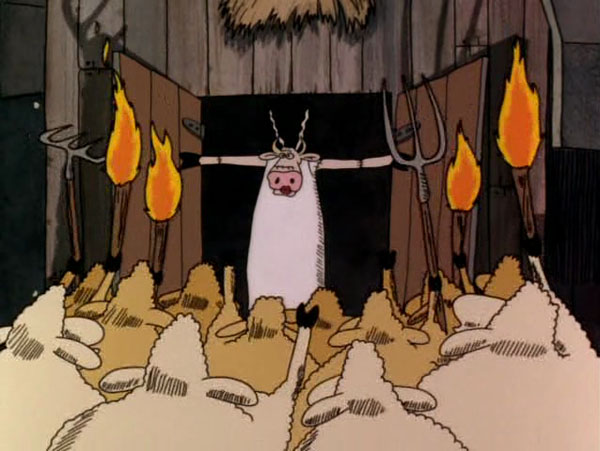
More generic propaganda with no direct sense of purpose. Joe is “the king of the workers of the world” because here in America, competition and investment in infrastructure make our jobs easier with more disposable income than anywhere else. Take that, dirt-poor chinaman! Statistics to be proud of: “Americans own practically all the refrigerators in existence. Bathtubs? We’ve got 92% of them.”
image

Hymn to Merde (2009, Leos Carax)
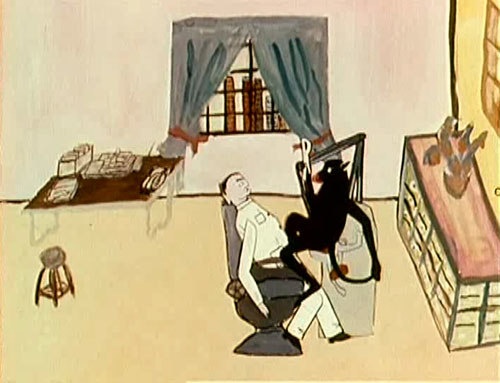
I agree that Merde/Lavant is wonderful to watch, but Carax doesn’t seem to know what to do with him. Protracted death-sentence courtroom drama wasn’t it, nor is a lo-res music video of him singing a Kills song translated into his own head-slapping language.
image

.tibbaR (2004, Leo Wentink)
Eerie music and nervous sound effects accompany time-remapped footage of lab rabbit breeding. I never know why anything is happening in short films anymore.
image

Go! Go! Go! (1964, Marie Menken)
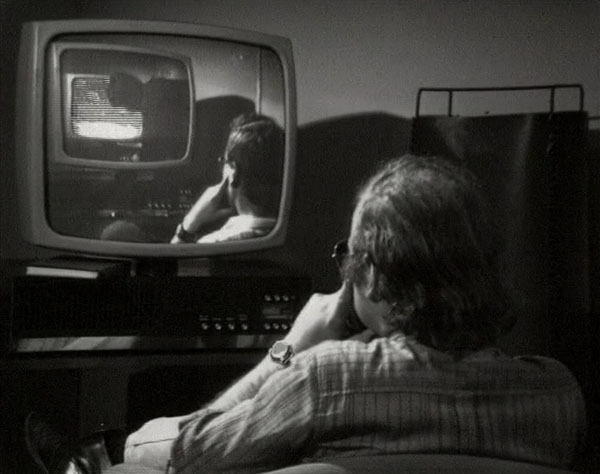
So damn jittery it gave me an eye-ache, exactly what I was getting away from the computer in order to avoid. All nervous time-lapse footage shot around the city. Some real nice high-angle shots of construction sites and traffic patterns, superimpositions on a wedding, lots of boats and bridges. Color/picture looked perfect on my tube TV.
image

The Spook Speaks (1940, Jules White)
Not-at-all-good short full of corny sound effects and sub-stooges gags, but it’s better than the others I’ve watched on these DVDs since it has a roller-skating penguin. Buster’s costar Elsie Ames (she was in most of these shorts, then showed up 30 years later in Minnie & Moskowitz for some reason) is terrible, but then, Buster is terrible too. Thanks Sony for slapping warnings and disclaimers and legal shit before every short on the disc. They must’ve known it wouldn’t get tiresome because we’d only watch one before quitting.
image

Who Am I? (1989, Faith Hubley)
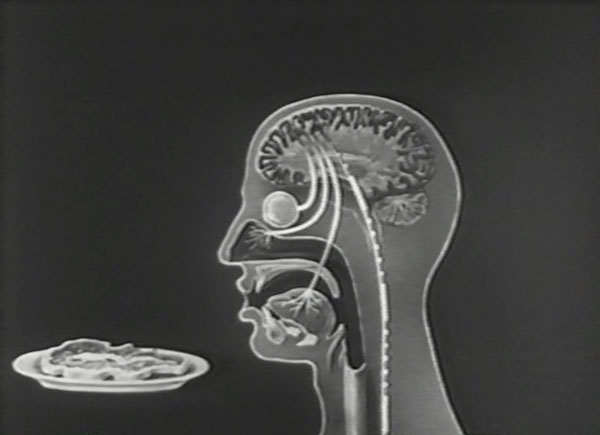
Things morph into other things, illustrating the five (or six or seven) senses. Short!
image

Blake Ball (1988, Emily Hubley)
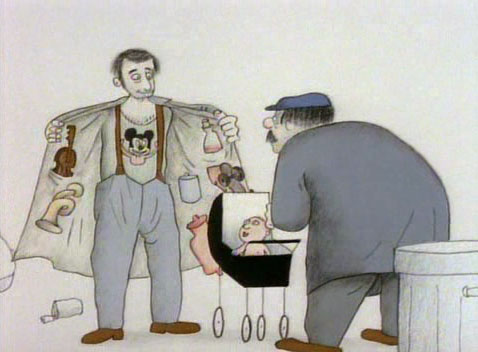
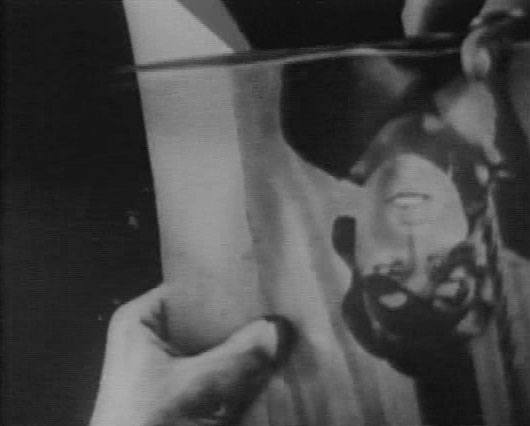
Didn’t love the narration in this one. The woman who says “some are born to sweet delight/some are born to endless night” (without the preceding lines) has got nothing on Nobody. I guess all the lines are the words of William Blake, but they’re not making much of an impact, and I never figured out Blake’s connection to all the baseball stuff. There’s more five senses stuff anyway. A bit too laboriously new-agey, but some great moments (like below).
image

O Dreamland (1953, Lindsay Anderson)
Boy did I ever botch the Free Cinema box set, buying it then deciding I didn’t want to watch it after all and letting it sit on the shelf for years. Finally checked this out and I kinda really like it. Could do without the evil laughing clown all over the soundtrack. Kind of like Jean Vigo’s À propos de Nice which, given If….‘s resonance with Zero For Conduct, proves Anderson saw a Vigo retrospective at some point.

I’ve become obsessed with this since watching it again at the Fox. Found a book about the making-of, which I’ve just begun to read. The post-film Q&A with Spike and Joie and fellow Atlanta college grad Radio Raheem was nothing earth-shattering, but it’s an honor to be in the same room as Spike Lee. Learned about the cast: Ruby Dee is still alive and working, Richard Edson (Turturro’s friendly brother Vito) was Sonic Youth’s original drummer, one of the shit-talking guys on the corner is Commissioner Burrell on The Wire, and Martin Lawrence’s comic-relief role cracks people up more than it probably should. Looked beautiful on the big screen. Must watch again soon and show to Katy.

Poyraz (2006, Belma Bas)
Rural people sure live quaint and handsomely photographed lives!
Nuri Bilge Ceylan was thanked in the credits

Why Play Leapfrog (1949, John Sutherland/MGM)
Let’s hear it for capitalism! Clever cartoon describes why inflation is okay and raw material costs don’t mean much. A boring explanation of why America is so darned great that ends by telling factory workers to be more efficient and come up with smart cost-saving ideas which will lead to greater pay increases.

Balance (1989, Christoph & Wolfgang Lauenstein)
Ominous stop-motion – five mute guys with numbers on their shirts and telescoping fishing poles in their shirts are on a balanced platform suspended in space. One catches a sort of music box and the others get greedy, leading to a fight which ends with one guy on the far end of the platform from the box.

Broken Down Film (1985, Osamu Tezuka)
It’s a popeye-like cowboy cartoon except that the film’s projection problems (hair in the gate, scratches, countdown leader, etc) are part of the story. Cute.

and a few from the Unseen Cinema box set…

Paris Exposition Films (1900, James White)
Some one-minute films at the Eiffel Tower a decade after its construction. Best part is this guy on the left side of the screenshot. People were walking up to the camera and this guy saw his chance for stardom, so he prepares himself for some manuever (maybe a backflip) but blows it, stopping instead to shake hands with an acquaintance offscreen as the film runs out.
image

Captain Nissen Going Through Whirlpool Rapids, Niagara Falls (1901, Edison Co.)
It takes longer to type the title than to watch the film, which is of some submarine-looking craft bobbing in a river. Found a wonderful tale online of Nissen’s stupid death four years later, but unsure if it’s true.
image

Down The Hudson (1903, Frederick Armitage & AE Weed)
Much more interesting than the submarine thing – New York riverfront over a hundred years ago. I assume lots more of this stuff will be on disc five.
image

The Ghost Train (1903)
Oooh, someone learned to invert the black/white image AND to matte a moon into the upper corner. This is one of my favorites because it is neat-looking and twenty seconds long. If only you could say the same for Transformers 2.
image

Westinghouse Works, Panorama View, Street Car Motor Room (1904, Billy Bitzer)
Long factory tracking shot reminds me of the beginning of Manufactured Landscapes. Unlike in ML, all the workers stop and look at the camera.
image

In Youth, Beside the Lonely Sea (1925-ish)
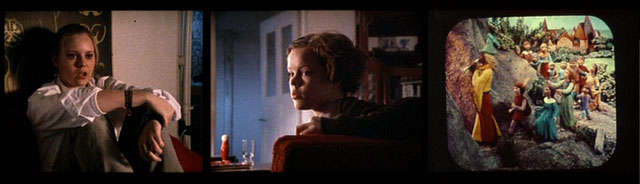
Crazy three-panel layout illustrating the poem told with text above and below the picture. Lots of ghostly superimpositions. This was so damn cool I had to lay down for a while.
image

image

It’s fun to see the pre-Awful Truth days when every corporate headquarters didn’t have an Official Michael Moore Policy and when Moore was thrown out of an event not because of who he is but because one of Ralph Nader’s relatives was with him. It’s also fun to see what a good movie Moore can make when he devotes all his time and energy to a single cause instead of bouncing from one populist hot topic to the next (Columbine, Fahrenheit) or tackling issues that are too large to fit in a movie (Sicko). He stays (mostly) in Michigan, covers a couple years’ worth of plant closings, visits and revisits local people (the eviction deputy, for one) and tries to get answers from (and stir up debate against) the corporate overlords and policies seen to be the cause of the problems. We’d been meaning to watch this for a long time, and thought the week of G.M.’s collapse (and Moore’s latest email about it) made for good timing.

Katy and I each saw this movie when we were little. She has always hated it because it gave her nightmares, and I have always loved it because it seemed weird and awesome and had Corey Feldman in it. Watching it again, it seems neither love nor hate is appropriate… it’s a pretty good movie. Pretty well made, pretty funny, with pretty good acting and a pretty satisfying ending. As a Joe Dante fan I was cheering for another Matinee, but it seems I got another Explorers instead.

Tom Hanks (between Big and Joe vs. the Volcano, on his way to permanent movie-stardom) is a listless suburban dad with wife Carrie Fisher and nosy neighbors Bruce Dern (manic, scuzzy, Busey-esque – he should be in every movie), fat Canadian comic Rick Ducommun, and still-cool Corey Feldman (I don’t know if he lives on the block or has just been hired to paint somebody’s porch). They get into comic situations trying to spy on new neighbors the Klopeks, suspicious that they have kidnapped or murdered toupee-wearing little-dog-toting neighbor Walter (1960’s TV star Gale Gordon). Finally they break into the house when the Klopeks are away, accidentally blowing it sky high by activating the overpowered furnace in the basement. Hanks thinks they’ve proven nothing except how smallminded they’ve been, but in an incredibly unsurprising twist ending, it turns out the Klopeks were murderous evildoers after all and Hanks’ gang is off the hook.

Dante throws in some cartoonish visuals, has Feldman talk into camera at the end, but it’s not as stylish or fun as his other movies, feels more tied to the obvious script. The story seems like a mystery, then starts developing into a satire of suburbia, making the suspicious neighbors look crazy and the weird reclusive family seem like the victims, culminating in a speech by Hanks (who barely comes alive in the movie otherwise) – but this is undercut by the ending.

A good Jerry Goldsmith score – in fact that might have been the best thing about the film. Robert Picardo (theater manager in Matinee, lead in 976-EVIL) and the wonderful Dick Miller cameo as garbagemen. Besides the ever-hungry comic-relief Rick Ducommun and our blank lead Hanks and his wife, the other characters are all exciting and worth watching, especially gun nut Bruce Dern and the Klopeks. The diminutive doctor is Henry Gibson of Nashville, inbred-looking young Hans is Courtney Gains, five years after playing a lead corn kid in Children of the Corn, and horrible mean uncle Reuben is Brother Theodore, who I hear was “one of America’s most respected humorists and monologists.” Dante, or whoever was responsible for casting, put an excellent enough group together to compensate for any script problems.

I read that the ending of the script had Tom Hanks getting killed at the end, leading to the same studio-mandated rewrite that Gremlins got. Wasn’t until the Masters of Horror episodes that Joe could finally execute all his main characters at the end of the movie, just like he’s always wanted to.

FITZCARRALDO (1982, Werner Herzog)

Klaus Kinski (the year after starring in Terayama Shuji’s Fruits of Passion) acts less crazy than usual as Fitz, though he’s still got that hair. And of course, his crazy actions speak for themselves. Fitz loves opera, especially the singer Caruso, whose records he collects (which places the action somewhere 1905-1915ish) and wants to build an opera house where he lives in Iquitos, Peru, but investors won’t be convinced.

image

So Fitz decides to make a fortune as a rubber baron, and build his own damned opera house. Gets his brothel-running girlfriend Claudia Cardinale (over a decade after her heyday in Once Upon a Time in the West, 8 1/2, The Leopard) to front him a steamboat and claims an unharvested plot of riverfront land in the jungle. It’s unharvested because nobody can reach it… it lies upstream from dangerous rapids. But even further upstream, another river veers within half a mile of the river in question, so Fitz plans to sail up THAT (dangerous-native-infested) river, drag his boat onto land across into the other river and harvest his rubber.

Claudia Cardinale:
image

Along with a half-blind but navigationally-keen captain, a drunken chef, and a mechanic (Miguel Ángel Fuentes, fresh from playing the mystical indian sidekick in Puma Man) who’s openly spying on Fitz for his competitors, Fitz makes it to the crossing and with the help of hundreds of natives, drags his 30-ton ship over a damned muddy mountain and into the other river. That night, after the drunken celebration party, the natives cut the ship loose as a sacrifice to the rapids, undoing months of work. In a wonderfully bittersweet finale, with what’s left of his capital Fitz hires the opera to come to Iquitos and perform from the ship.

image

Shot realistically, naturally taking its time to unfold. Herzog’s/Fitz’s ambition is immeasurable, and so a mere two hours cannot contain it. Movie doesn’t seem long so much as… huge. Actors speak English, dubbed into German and subtitled back into English.

image

Hey wow, it was shot by the guy who did Orson Welles: One Man Band, which is the other movie I considered watching tonight. He also shot bunches of Alexander Kluge films.


WERNER HERZOG EATS HIS SHOE (1980, Les Blank)

“I’m quite convinced that cooking is the only alternative to filmmaking”

image

Oh man, this was great… first of all because Werner is my hero, here being smart and funny and provocative, and second because Les keeps it lively with a circus atmosphere, bringing in clips of Herzog movies, The Gold Rush, and a Gates of Heaven outtake. Fitzcarraldo was in pre-production, and Les would follow Werner into that venture, filming…


BURDEN OF DREAMS (1982, Les Blank)

“If I abandoned this project I would be a man without dreams, and I don’t want to live like that.”

One of the most amazing docs I have seen, and essential viewing with Fitzcarraldo. Shows and tells the factors that made that film define “troubled production”, making Terry Gilliam and Francis Ford Coppola look like pansies in comparison. Attacks and intimidation by natives (their camp is burned down, a spear attack injures three), losing both stars of the film (post-Melvin and Howard Jason Robards and pre-Tattoo You Mick Jagger) and the actual pulling of a 30-ton steamship over a mountain by natives doesn’t even cover the whole story.

Burden of Dreams:
image

Fitzcarraldo:
image

On-set tantrums by a bored Klaus Kinski aren’t in this film (presumably they’re covered in My Best Fiend). This doc itself is wonderfully well-paced and shot, and Les gets choice interviews with Herzog, including his oft-quoted bit about how the jungle birds don’t sing, “they just screech in pain.” Taken as a package, Fitz and Burden are the rare cult films which exceed their reputation.

image

From Paul Arthur’s Criterion essay:

When production stalls, as it often does—Herzog claims his film is “cursed,” admitting that “the jungle is winning”—Blank filters in lively scenes of the Campa extras’ quotidian routines: food preparation, clothes washing, the blending of a local alcoholic drink made from yuca plants. It is significant that most activities are “women’s work,” a realm that Herzog’s masculinist vision rarely acknowledges. Later, Blank constructs a touching vision of cross-cultural identification by juxtaposing the sound of a Caruso aria coming from a record player in an earlier shot with loving close-ups of native women, as if they are responding to the beauty of this alien voice. The moment recalls an archetypal collision staged by romantic adventurer Robert Flaherty in Nanook of the North (1922), when the titular Eskimo marvels at a phonograph record (then jokingly decides to bite it). Unlike either Herzog or Flaherty, Blank clearly prefers the rhythms of collective effort, of sensuous community, over Eurocentric ideals of heroic individualism. In essence, he has crafted a film about the interaction of premodern tribal existence with European modernity, epitomized by a movie narrative about the invidious clash of brute nature and a singular ego bent on his own, ultimately delusional, mission of cultural enlightenment.

Batrou is a cute student, the privileged daughter of a hardassed military governor/colonel with three wives. His youngest wife is strong-willed and troublesome (aren’t third wives always?) and close to the daughter’s age. The daughter is in love with Ba, and they hangs out with friend Seydou, studying for exams.

I’m not sure exactly what happens with the third-wife plot, or why the boys’ failing their exams helps to launch a student protest against the government (maybe the protest was already in place, and the boys just joined it), but the result is that Ba and Seydou are arrested and sent to hard training camp, where Seydou dies from the stress, and even Batrou is arrested by the unapologetic colonel.

Suddenly we’re back in familiar Cissé territory when Ba’s grandfather hears of his arrest, puts on his tribal garb and heads for the trees to make sacrifices and wish for supernatural assistance in overthrowing the colonel’s evil plans. Walks out of the trees into the colonel’s backyard and threatens him – colonel reponds as we’d expect by shooting grandpa in the back, but the bullets have no effect.

Bulletproof robes are all the ghosts of grandpa’s ancestors can provide, though – when he gets home he finds the house has been burned down and Ba is rumored to have been killed, so grandpa burns his ceremonial outfit and joins the people’s march against tyranny, which shakes up the government enough that the colonel is ordered to release Ba, who’s now free to run off with the colonel’s daughter.

This preceded Yeelen, which featured two of the same actors (the grandfather and the colonel). It lacks much of Yeelen’s striking imagery and unhinged craziness but it’s still a good movie (I liked it more than Xala) and oughtta be more readily available than it is.

N.F. Ukadike: “Ironically, Finye was partly financed by the military government of Mali. Tolerance and maturity prevailing, the government demonstrated that it is capable of listening to constructive criticism.” Kino’s promo copy plays up the romance and compares to Romeo & Juliet, says it “casts a critical eye on both the ancient and modern values.”

M. Dembrow: “In reality, young Malians would have to wait ten years after the making of Finyé for the military regime of Moussa Traoré to crumble. But with this film—and with Yeelen as well—Souleymane Cissé gave them powerful images of hope and resolve.”

“Every girl is beautiful… until they kill somebody.”

Wowie wow wow, the acting (or the dubbing) by our two leads is terrrrible. But I’ve seen this once before so I knew that and could focus on other things this time. Nice title music by Ennio Morricone, decent camerawork and good shot choices. Ultimately a stupid movie though, not half as good (or half as ludicrous) as Dead Pigeon on Beethoven Street. Worth watching only for Fuller completists like myself, or possibly for Claude Chabrol’s loony performance.

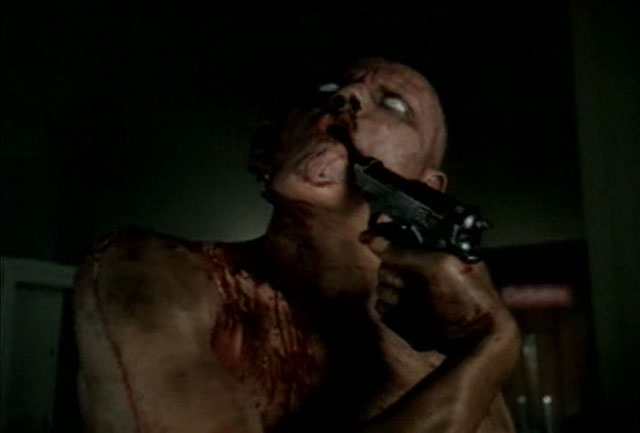
Bobby’s silhouette getting nabbed backstage:
image

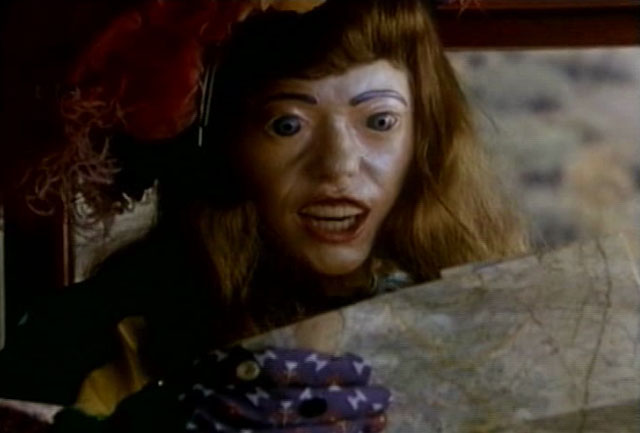
Bobby Di Cicco, who I don’t remember being completely horrible in The Big Red One, is a loser wannabe musician who sneaks into the orchestra every night and watches from backstage. He meets Véronique Jannot at the unemployment office and they decide to take revenge on the agents there who humiliate the two while failing to find them work. First up is a mustache-grooming woman they call Mussolini, then a pervert they call Tartuffe played with campy hilarity by Claude Chabrol.

C.C. wearing funny gloves:
image

But when Tartuffe falls out the window (in an incident of neighborly peeping gone wrong) our two hero losers are on the run, assisted by Bobby’s music-shop-owning ex-con buddy and a girl they met while breaking into her dad’s house. These two accomplices (whom our heroes seem to barely know, but are willing to assault cops to help them get away) are nearly as awful actors as our heroes, but they have better voices… his is low and TV-cop-show-like, hers is small and airy.

Oh yeah, here’s Bobby:
image

And what’s her name, Veronica:
image

Presumably (or hopefully) the accomplices are arrested for being horrible liars. Our couple goes on the run. In a snowy small town rest stop en route to Spain, a loose-cannon ex-cop is introduced only moments before pulling out his gun and blasting away, killing Veronica. Bobby is wounded, somehow makes it back to Paris only to sneak into the orchestra, con his way onstage and die mid-performance… nice.

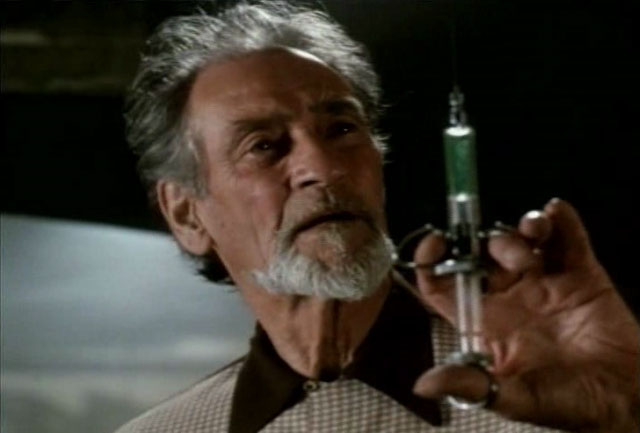
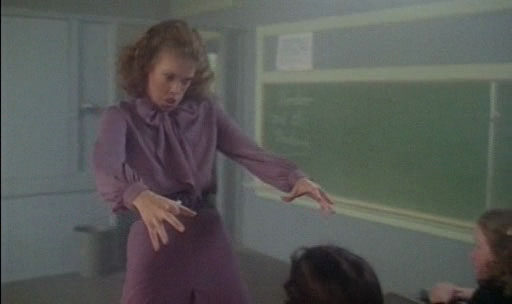
Movie isn’t a total waste of time – there are a few nuts scenes… some pretend-incest that seems to repulse/turn on landlady Christa Lang… Sam Fuller as “Zoltan” a jewelry fence and death-scene enthusiast with an eyepatch concealing a magnifying contact lens… the outer-space sound effects over Ennio Morricone’s score on the final scene.

Christa:
image

Sam:
image

Cameo as a brothel madam by Micheline Presle of some Demy movies, The Nun, I Want To Go Home and American Guerrilla in the Philippines:
image

NY Times called it “a rather mediocre crime story about a Bonnie-and-Clyde couple.” The video box calls it a tribute to the French New Wave. I’m not sure how, exactly… unless the final shootout in the snow is in memory of Shoot The Piano Player.

First we watch a Christmas movie from the writer of the Lethal Weapon series, now here’s one from the director of the Lethal Weapon series. Next year we’ll have to simply watch Lethal Weapon, which the internet tells me begins with the song Jingle Bell Rock.

Funny how I can convince myself that something I loved when I was twelve is still worth renting. Sorry, Katy and Jimmy! This was lame, overlong, cheap-looking and not all that funny anymore. Eventually I’m gonna rewatch other beloved 80’s comedies like Big, Three Amigos, Midnight Run, The Money Pit, Innerspace, Real Men, Moon Over Parador, and Max Max Beyond Thunderdome, and I hope at least some of them hold up.

Bill Murray, in between Ghostbusters flicks, is just fine as the soulless corporate TV exec who gets schooled by various ghosts of christmas. Some funny bits involving a live TV special he is producing featuring Mary Lou Retton, Buddy Hackett and John Houseman (this is one of six movies Houseman did the year he died at age 86). As ghosts we’ve got New York Doll David “Poindexter” Johansen (just breaking into movies this year) and Carol Kane of Annie Hall and Transylvania 6-5000. These two are the life of the film, not Murray, love interest Karen Allen (some years after Raiders), or the future ghost played by a robed dude with muppets in his guts.

Robert Mitchum (almost 40 years after Holiday Affair!) had been biding his time for a decade on remakes, miniseries and horror flicks before appearing in this. John Glover as a hot young exec moving in on Murray’s job played the same sort of corporate go-getter role as the building owner in Gremlins 2. And Alfre Woodard has the Kermit The Frog role as Murray’s assistant.

Nothing says Christmas Spirit like Bobcat Goldthwait with a shotgun.
image

Cameo by Anne Ramsey, the Oscar nominated (she was beaten by stupid Olympia Dukakis) title character from Throw Momma From The Train.
image

Frozen homeless man, about whom Bill Murray somehow gives a shit. I think this is Logan Ramsey, Anne’s husband, who was in the Monkees movie Head 20 years earlier. (nope, CORRECTED in the comments)
image