I get conflicting messages on Rossellini: either he can do no wrong or he did only wrong, either his early stuff was groundbreaking then he dried up or he did his best work late in his career, either he told the ultimate truths in cinema or he was a deceitful opportunist. Fortunately, the exhaustive Criterion box of his early “war trilogy” went on sale, so now I shall see for myself. I watched Germany Year Zero on Turner Classic a decade ago, and it stands out as one of the most affecting (depressing) movies I have ever seen, so I’m inclined to think I’ll like the trilogy – and so far, so good.

Not an incredibly “neorealistic” movie – as the DVD commentary ceaselessly points out, it’s “far closer to the traditional melodrama or suspense film than to any realistic documentary.” But RR shot (partially) on the streets and at real locations, with (some) non-actors, using borrowed and stolen film stock for a (somewhat) newsreel-like texture, and so a movement was born. Visconti’s Ossessione was shot earlier, but wasn’t distributed outside Italy and its story didn’t have Open City’s sense of post-war rebirth.

Pina (the great Anna Magnani of The Golden Coach) is to marry Francesco. After F’s friend Manfredi goes on the run, the resistance descends on Pina’s apartment. The sympathetic, somewhat comic priest who is to marry her, Don Pietro (Aldo Fabrizi, later in Flowers of St. Francis) volunteers to help. But the nazis are hot on Manfredi’s trail, with help from his poorly-chosen girlfriend, a drug-addicted dancer named Marina who betrays him. They round up Francesco before his wedding, leading to the famous scene where Magnani is gunned down chasing after the truck that holds him.

I’ve seen that scene a bunch of times out of context, never realized it’s not the end of the movie, just of the first half. In the second half, Francesco is immediately freed from the prison truck by resistance fighters (making his fiancee’s death that much more pointless, as the commentary points out), but in a subsequent raid the priest and Manfredi are arrested, along with an Austrian deserter who Don Pietro was helping. There’s some scripty business among the nazis to point out the general weakness of their cause. After the deserter kills himself in his cell and Manfredi dies under torture, having never revealed the resistance secrets, Don Pietro is shot in front of the children he used to play with, little resistance fighters themselves, who will survive the nazi occupation that had just barely ended when this movie went into production.

When the movie’s lead nazis invite the weak, drugged-up Marina to their palace, show off her tortured-to-death boyfriend then steal back the fur coat they’d given for her cooperation, I realized the nazis’ names are Ingrid and Bergman – crazy, since a few years later Rossellini would fall for Ingrid Bergman. Bergman (stage actor Harry Feist) is effeminate and Ingrid (Giovanna Galletti, later in Last Tango in Paris) is butch, lounging on a sofa with Marina in a sinful opium haze, say the commentary, “underline how closely audiences of Rossellini’s time associated sexual deviancy with evildoing.”

Bergman:

Written with veteran screenwriter Sergio Amidei and young Federico Fellini, this wasn’t Rossellini’s first movie, just the earliest one that anyone pays attention to. Earlier he’d worked directly with Vittorio Mussolini, son of the country’s dictator, who describes Rossellini in the DVD extras (he lived through the 1990’s) as neither fascist nor anti-fascist at the time, just an energetic filmmaker.

The commentary by Peter Bondanella spends much of its time explaining why the movie shouldn’t count as “realism” at all, and does not make a sharp break with fascist cinema styles. But while downplaying the movie’s groundbreaking status, he also praises its story and technique endlessly:
“Much of the dramatic force of Open City resides in the lessons of humanity the main characters learn from each other. As Manfredi the Marxist revolutionary discovers, a priest is not so different from a worker, or even a partisan leader. In Open City we are asked to examine the common humanity that always transcends idiological or confessional labels.”

Don Pietro:

RR: “I’ve always advocated finding this ease of expression and demythologizing the camera and filmmaking, tackling it in a much simpler way, without worrying too much about perfect shots and images. The important thing was to get your point across.”

Hmm, neorealism was said to be a “reaction to the films of the Fascist era dominated by ‘white telephone’ films, which depicted ladies of leisure lounging on satin sofas, telephoning their lovers.” But isn’t that a precise description of Cocteau’s Human Voice, filmed by Rossellini four years later?

Francois Truffaut: “Rohmer once said that Rossellini’s genius lay in his lack of imagination, and it’s true. He didn’t like fabrication or artifice, or flashbacks or any kind of clever trick. He left behind the personal and specific to move ever toward the general. His first postwar film is Rome Open City, about a city. The next is Paisan – six stories about Italy from south to north. After that comes Germany Year Zero and then Europa 51 – at that point he needed an entire continent. … He was a very intelligent man. I’m not saying filmmaking is for idiots, but fiction requires a certain naivete that he didn’t have, so he worked with larger concepts.”

Walter Huston (John’s father, in his final role) is a slightly less grotesquely comic version of Egbert in Ruggles of Red Gap, a rich, eccentric cowboy. His extremely strong-willed but beloved daughter Barbara Stanwyck (soon before Clash By Night) argues with him over practically everything, finally scheming to swindle him out of his land as revenge for an argument taken too far. She has a brother (John Bromfield) who is introduced at the beginning but practically disappears from the movie, since he’s a decent, unassuming fellow and Stanwyck and Huston are commanding our attention at all times.

Complicated, exquisitely shot and acted movie, obviously based on a novel (I can’t explain – it just smells novelistic). Stanwyck and Huston have a near-incestual rivalry. She loves Juan (Gilbert Roland, who played bandit The Cisco Kid in six movies) who lives illegally on Huston’s land, and Huston marries gold digger Flo (Judith Anderson, sinister housekeeper in Rebecca). But after Stanwyck stabs her new stepmother in the face with scissors (!), Huston has Juan killed. Katy and I lost track of exactly how Stanwyck then claimed possession of her father’s land. She cozied up to rich gambler Rip (Wendell Corey, Janet Leigh’s dull boyfriend in Holiday Affair) then bought up her father’s outstanding I.O.U.s around the country and used those as payment when he sold off his animals, but then how did that prevent the bank from repossessing the land?

This is the first movie I’ve seen by Mann, who made three other movies in 1950, at least two of them considered great classics. That’s just how it used to work.

R. Wood for Criterion:

All of Mann’s westerns—unlike, for example, John Ford’s—suggest deep psychological disturbance, but those currents never again manifest themselves as blatantly and explicitly as they do in The Furies. Mann’s westerns … show little interest in history or in mythology; they are grounded in a fallen world of existential struggle in which the villains often become the heroes’ dark shadows. Typically, when he shoots down his enemy, the Mann hero experiences not triumph but exhaustion, almost prostration, as if he had forfeited a part of himself, his manhood.

“This is my story, or, part of it.”

Yes, there’s a narrator, and it’s in color – two unexpected things from a Jarmusch film. Follows Allie (Chris Parker) for a few days as he bums around New York meeting a few characters and ultimately decides to leave. A practice run for Stranger Than Paradise, with Jarmusch exhibiting plenty of his spare urban cinematography.

Leila:

Allie lives with Leila, but will quietly leave her at the end. At least she’s forewarned, as he tells her his “born on a train” philosophy. Allie meets crazed Vietnam vet Richard Boes (he had small parts in JJ’s next five films), visits his mentally ailing mother in a hospital, spies on a woman being vocal behind her apartment, converses with Frankie Faison (one of the three curbside shit-talkers in Do The Right Thing) at a theater playing an anachronistic Nick Ray film, then steals a car from a clueless woman (my favorite scene) and fences it.

Allie with mother:

Frankie:

He ends up at the pier, about to flee to Paris for a change of scenery. First he runs into another disaffected young man, a Parisian who fled for New York – a cheerful example of Jarmusch’s dry sense of humor.

I don’t know for sure that this is Sara Driver below, since two women are credited as “nurse.” She worked on most of Jarmusch’s movies, pulling two titles (production manager and assistant director) on this one. Funny enough, Driver was in the Times the day after I watched this, since a quality print of her long-lost first film You Are Not I was just discovered in Tangier.

Jarmusch, from 1980-81 interviews:

The story was inspired by how Chris actually lives his life … About half the things that happen to him in the film actually occurred to him, and the other half I made up for him. I thought up situations and placed him in them. … It’s more about accidental connections that move the audience than about dramatic action.

The question is how to treat social problems. A lot of people criticize my film politically; they say it’s an art film, it’s harmless, and does not take a clear stand. But whenever I watch a film – even if I almost completely agree with its political aims – it will still lose my interest as soon as I notice that the conclusions are self-evident, because then there is nothing left to discover.

It’s been a pretty outstanding SHOCKtober over here. I did well to avoid the usual direct-to-video garbage of the last few years and watch stuff I’d actually heard would be good. So I figured I was due for a disappointment when I popped in Kwaidan, another period Japanese piece where everybody moves too slowly – another Ugetsu, in other words. But though it’s definitely true that everyone moves too slowly (and the more rich and upper-class, the slower they move) it’s an awesome looking movie, and even the stories I liked less were a pleasure to watch. I don’t know much about Kobayashi, but easily figured out that he had a background in painting. Watched the full-length version from Masters of Cinema.

1. The Black Hair
Rentaro Mikuni (The Burmese Harp, Vengeance Is Mine, Teshigahara’s Rikyu) is a samurai who has fallen on hard times. He has a good wife, Michiyo Aratama (Sword of Doom, The Human Condition, Ozu’s The End of Summer) but he “could not understand the value of love,” tells his wife “for men, advancement is the most important” and walks out on her, moves away and marries the daughter (Misako Watanabe of Youth of the Beast) of a rich man. But he finds himself unhappy, misses his first wife, so one day he throws it all away and returns to her, finding his property decrepit and run down, but her still sewing quietly in a corner. Or is she? After he pledges he’ll stay with her forever, she’s revealed to be a ghost. He ages about fifty years in the span of a minute, in a pretty awesome scene, then falls to the ground.

2. The Woman of the Snow
This one has the most remarkable images, which is good since I already know the story, first from Tales from the Darkside: The Movie but it also has similarities to The Crane Wife tale. A woodcutter (Tatsuya Nakadai, star of The Human Condition and The Face of Another, played the old king in Ran) is caught in a storm with an older man and witnesses a sort of Jack Frost woman freezing the man to death. She lets him live if he promises to never tell what he’s seen. Soon after, he meets a girl (Keiko Kishi of Early Spring, Sydney Pollack’s The Yakuza), falls in love, gets married, has kids, and one day laughingly tells her about that day in the snow, at which point his wife turns back into the snow demon and leaves him, saying if their children ever have reason to complain about his parenting she will return and kill him. The sky is a series of colorfully painted backdrops, often with an eye in the middle, always watching the woodcutter.

3. Hoichi, The Earless
I assumed for a while that the subtitles had missed a letter in “Fearless,” but no. This was the longest and best story. Set in a monastery near the site of an ancient sea battle, with head priest Takashi Shimura (the older detective in Stray Dog and star of Ikiru) and blind errand boy Hoichi (Katsuo Nakamura of Demons, Sad Vacation). Ghosts of the defeated army appear at a shrine and send a warrior to fetch Hoichi to sing them the story of the sea battle. He secretly performs for them all week, until the priest finds out, and tells him he’s in great danger. The priests write scripture across Hoichi’s skin – but miss his ears. The warrior comes and can’t find the singer, “I will take these ears to my lord to prove his commands have been obeyed.” The ghosts leave, and from then on, people come from all over and pay to hear the famed Hoichi the Earless play his music.

4. In a Cup of Tea
Kan’emon Nakamura (Mizoguchi’s 47 Ronin and Miyamoto Musashi) is a very serious warrior, a guard I think. He sees another man’s smiling reflection in a cup of tea, but drinks it anyway. The ghost (Noboru Nakaya, husband of the Woman in the dunes) appears “in person” with his retainers, challenging the warrior, who finds he cannot fight them since they can disappear at will. But all this is a story being written by an author (Osamu Takizawa of Fires on the Plain) who goes missing until his reflection is seen inside a pot of water – the weirdest of the four stories, and a good one to end on. Kobayashi made 20-some other movies, all of which I must see immediately.

Watched again with Katy, three years after buying the DVD intending to show it to her – and she liked it! Watched by myself April 2006, and wrote as my fifth entry for this blog: “Total children’s fantasy with brilliant colors except for the occasional harsh violence (beheading talk, arrows shot into the bad guys’ skulls). Nice to see a British/American movie set in Iraq with good guys named Ahmad and Abu who praise Allah every few scenes. Of course the effects are great and of course the princess falls in love way too easily. Our hero was sorta goofy, but Abu the thief is wonderful. Neat how it begins in the middle (blind Ahmad) then hits the full backstory before proceeding.”

Holy cow. Shot over two years. Remake of a Fairbanks movie. Shot like a silent film, conceptualized as a musical, and directed by six different people. Interrupted by the war, so it was put on hold to make propaganda piece The Lion Has Wings. Constant script revisions. Whole segments excised a few weeks before release. Early scenes with Sabu unusable because he grew so much during the hiatus. Shot in two countries with a relatively new color process and an unprecedented array of special effects. Could have ended up an unsalvagable mess instead of the beautiful-looking smoothly-edited story it is.

I love this giant foot. Of the stars, Sabu was Indian and genie Rex Ingram was black, “born on a riverboat on the Mississippi River,” making this an unusually multicultural film for 1940 Britain.

Young Sabu never gets to be a romantic hero, but the romantic hero is boring. Sabu shoots the villain in the forehead with a crossbow (Jaffar’s mechanical horse then falls to pieces mid-air, a startling scene) and escapes his appointed pink-clothed life as John Justin’s vizier, flying away on the magic carpet in search of adventure.

Princess June Duprez was in other Korda pictures The Four Feathers and The Lion Has Wings, and a Rene Clair movie.

Jaffar was Conrad Veidt. Good at playing a villain, he’d portray the chief nazi in Casablanca the year before he died, and in the silent era he starred in The Hands of Orlac and Cabinet of Dr. Caligari (as the somnambulist). Miles Malleson, the old toy-obsessed Sultan, wasn’t really so old – he acted for the next 25 years, including in Kind Hearts and Coronets, Stage Fright and Hammer’s Hound of the Baskervilles. Cheese-headed stage actor (obviously) John Justin became a Ken Russell regular in the 70’s.

“Some day you’ll wiggle that bottom of yours just once too often”

Aw, this wasn’t much of a horror movie. I guess the idea of surgery without anesthesia is pretty horrific, and the local innkeeper is killing homeless people for fun and profit, and it costars two Frankensteins (Boris Karloff and Christopher Lee), so you could definitely call it a horror movie, but it didn’t much feel like one – more of a dark medical drama. Preston Sturges’ The Great Moment comes to mind. I’ve never seen it, but I thought it was also an invention-of-anesthesia drama. IMDB’s summary makes it sound like more of a patent-infringement thriller, so maybe it’s Corridors of Blood meets Flash of Genius (that intermittent-windshield-wiper-invention drama). Of all the horror movies in the world, why did Criterion pick this one?

A tale of two Frankensteins:

Anyway, it wasn’t bad, for what it was. Lee, in only his third horror movie after Hammer’s earliest Frankenstein and Dracula movies, was deliciously sinister, and Karloff is a surprisingly great actor (guess I’d only seen him as Frankenstein before). Greatly enjoyed the scene where he invents laughing gas and goes on a rampage of hilarity, smashing up his lab. So he overdid it there, but usually he’s quite good.

Karloff is powerless before Black Ben:

While Karloff spends the whole movie experimenting on himself, being mocked by his peers and ultimately becoming a useless opium addict tricked into signing false death certificates for the evil innkeeper, the movie blows some time on our romantic young couple (every movie needs one!): his son Jonathan (Francis Matthews of Terence Fisher’s Revenge of Frankenstein and Dracula: Prince of Darkness) and the housekeeper Susan (Betta St. John of The Robe and Horror Hotel). A haughty white-haired fellow at the hospital (Finlay Currie, who played a man with unpronounceable name in I Know Where I’m Going!) mocks Karloff at every opportunity, with a pinched-mouth arched-eyebrow movie-villain expression on his face.

Finlay Currie to young Jonathan: “your tie is ridiculous.”

Karloff dies in the end (Lee might die also – someone threw “vitriol” in his face) but his son picks up his papers and proves him right, demonstrating the importance of anesthesia in a scene which was probably funnier in the Preston Sturges version. Additional players: the evil innkeeper Black Ben is Francis De Wolff (Hound of the Baskervilles, Under Capricorn) and his even-more-evil wife is Adrienne Corri, who went from playing the neighbor girl in Renoir’s The River to a gang-rape victim (not the one killed with a giant phallus) in A Clockwork Orange. As far as anyone knows the director is still alive. His last theatrical feature was 1980’s The Man With Bogart’s Face, which has a hilarious VHS cover.

Something like my tenth Suzuki movie. They’re always so reliably entertaining – except to Katy, who still hasn’t forgotten how much she hated Kageroza four years later. Maybe she’d like these earlier, more straightforward films over the late, poetic, bonkers ones.

This isn’t stylistically bonkers, but it’s got a super-twisty plot compared to A Colt Is My Passport, or even to a similar disgraced-cop detective story like Stray Dog. Lead character Tamon (Michitaro Mizushima of Underworld Beauty) isn’t even a cop, just a prison security guard, but he does as well connecting the dots as Mifune in Stray Dog. He was on duty when a sniper took aim at the police van, and now that he’s suspended from duty he spends his free time trying to solve the case independently.

Tamon with his Underworld Beauty costar Mari Shiraki:

Shadowy suspicion:

Dancing girls:

No U Turn:

Finally checking out that Nikkatsu Noir set. I liked this, a cool little hit-man flick, but it didn’t jump up and grab me, so afterwards I watched Take Aim at the Police Van, which did.

Chipmunk-cheeked Joe Shishido (Branded to Kill, Youth of the Beast, Fugitive Alien), whose face never fails to amaze and confuse me, is a hit man for the __ family. Joe assassinates the head of the Shimazu family, gets paid, and is making his company-assisted getaway with junior partner Shun (Jerry Fujio of Masumura’s A False Student). But Shimazu’s son is now in charge, and he partners with __. One last piece of old business: he wants the hit-men dead.

Shun, who sings us a song halfway through the movie:

We still need a girl in our movie, so they meet Mina at their laying-low hotel. She doesn’t want to spend the rest of her life in this dead-end town, so she plots to escape with our (anti)heroes. But of course the now-teamed-up gangsters know exactly where everyone is, since they sent ’em there, so Shun is kidnapped, and noble old-school Joe offers himself in exchange, shipping Shun off to escape with Mina. Kind of amazing how honorably the exchange takes place, that they release Shun without any plan to recapture him, and Joe meets them at the appointed time. He never said he wouldn’t come armed, though – blows away four guys then explodes the baddies’ car (you should never put all your gang leaders in the same car) by jumping in a ditch and tossing up a homemade magnetic time-bomb. Joe, surprisingly, stays alive up to the final credits, though he’s probably mortally wounded.

Mina and her employer:

C. Stevens for Criterion:

Opening with the moans of a haunted harmonica, a sudden gunshot, and the florid, Morricone-oni twanging of an electric guitar, Colt begins by practically begging to be seen in the light of the spaghetti westerns that had been sweeping the globe since 1964. And much of what follows—in mukokuseki terms, anyway—remains true to that already distinctly hybrid Euro-American form, as triggerman Joe Shishido and his guitar-strumming sidekick, Jerry Fujio, go on the lam after a job Joe’s done too well incurs the wrath of the very mobsters who hired him.

Dragging a golf bag filled with guns and a freshly crafted time bomb through a dust storm on some barren wasteland, Shishido prepares for the film’s astonishing climax by digging a hole in the dirt: Is that his own grave? Is that tiny, skittering fly in the rubble a measure of his own mortality? The answers arrive in the sudden shapes of marksmen materializing from the swirling silt all around him.

I love that the cars screech whenever they move. Lot of zooms, and guns pointed right at the camera. Ends with six hundred gunshots in 20 minutes. What is not to like?

Joe’s cheeks might make me laugh, but he is still a badass:

Impressive revenge flick, building slowly to an excellent conclusion. Mostly static camera, no music at all, but these things don’t call attention to themselves like they do in, say, In Vanda’s Room, because of the propulsive drama.

Alex, a mustache ‘n sideburns-wearing ex-con who’s not as tough as he acts (according to his boss, who runs a brothel) has a secret love affair with Ukranian prostitute Tamara. Things are heating up, both of them are in debt and her boss is trying to move her to an apartment to cater to politicians and others who consider themselves too important to visit a brothel. When the boss hires a guy to beat up Tamara it’s the last straw, and Alex scoops her up to leave town, stopping in the small town where his grandfather lives to rob a bank he’d “staked out” (located an alley as an escape route, not very careful planning). But a cop notices the car and asks questions, then shoots as Alex drives away, killing Tamara.

Thus begins the revenge portion. The cop, Robert, is depressed over the death and only gets worse as he gets suspended from work while they investigate the shooting. They’ve got no leads, so Alex is safe, stays in town chopping wood for his grandfather and plotting how to kill Robert, eventually having an affair with the cop’s wife and deciding not to kill the guy after all. Oh and the wife has been trying to get pregnant but can’t manage with Robert, so guess what happens. Kinda sounds cheesy when you write it down, but I liked it an awful lot.

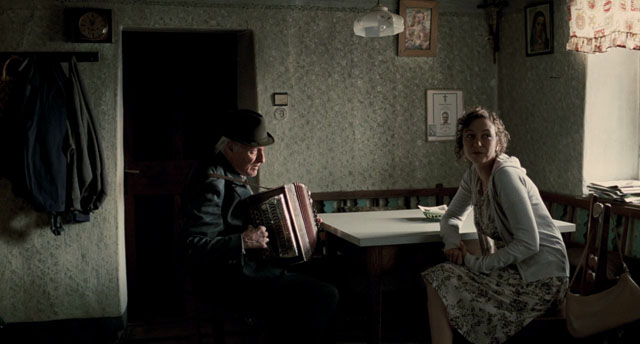
Accordian lover Hauser with Robert’s wife Susi:

A rarely moving camera, and zero music. The brothel meister was in Fassbinder’s Querelle, otherwise cast and crew are unknown to me. The combination of the young cop and the lead guy’s relationship with his decrepit father reminded me in flashes of Hunger, and the backlit wood-chopping scenes recalled flashbacks in Cache.

Criterion scares up comparisons to Kieslowski, Antonioni and Bergman in reviews.

A. White:

Although Revanche is Spielmann’s first film to be released in the United States, it is actually his fifth overall, so his style and tone come to us fully developed. He began his career as a playwright, yet Revanche is thoroughly cinematic in story, look, and pace.

Spielmann’s arrival on the American film scene is exciting for the way Revanche opposes the contemporary trend toward dark pessimism with a vision that contemplates light and, conditionally, belief. At one point, a repentant character is asked, “What would your God say?” and she answers, “He’d understand.”

White quotes the director: “Loneliness is probably an inextricable part of our modern lives, and yet I consider it an illusion. We always think of ourselves as being separate from the world, and in this way we deceive ourselves. This separation is just an invention of our imagination; in many ways, we are constantly and directly interwoven in a larger whole. Loneliness is an attribute of our limited awareness, not of life itself.”