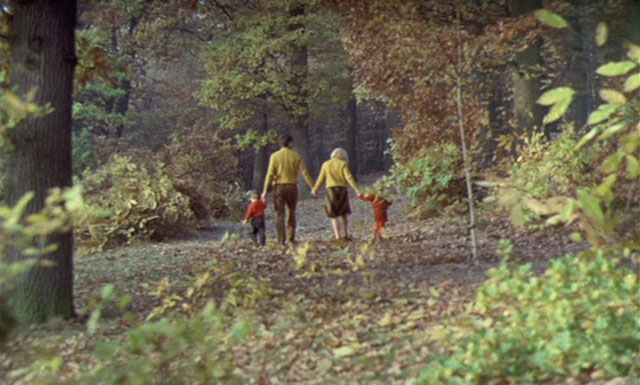
Seems like a semi-remake of A Very Long Engagement. There’s a specific scene where Veronika says if she can count to fifty before the postman arrives at the door she’ll get a letter from Boris. Then there’s the overall story, a woman looking for her man who went to war, not even stopping after she hears that he’s died. Jeunet gave his film a happy ending, but Russia in the 50’s was still mourning the millions killed a decade earlier. So, not a simply fairy tale, Veronika does not get a letter from her Boris, because he did die in the war.

It opens with the two lovers happy together, and ends with her alone, smiling but heartbroken, handing out flowers to returning soldiers. In between it’s mostly her story. She loses her family in a bombing raid and stays with Boris’s parents, then is soon coerced into marrying his brother who dodged the war. Very impressively (for 1957) mobile camera, with always excellent, careful framing, none of the indifferent framing that characterizes most handheld today (ugh, I hate saying things like that). It seems like every shot in this film has more than one purpose, making the simple close-ups that much more powerful. No surprise that the director and cinematographer went on to make the great I Am Cuba, or that this won the golden palm (over Bergman, Satyajit Ray and Mon Oncle)

C. Fujiwara for Criterion:

The film is also exceptional in refusing to condemn Veronica for her involuntary infidelity to Boris while he is at the front. In Tatiana Samoilova, The Cranes Are Flying unveiled a magnificent screen personality: expressive, sexy, dynamic. Veronica is far from a traditional war-movie heroine (not only by the standard of Soviet war movies), and Feodor’s impassioned denunciation of faithless women is clearly meant to be taken as more than just the party line, but Samoilova makes her character completely sympathetic, down to her bittersweet apotheosis in the moving final sequence. The Georgian-born Kalatozov, who began his directing career in the silent era, spent several years in Los Angeles during the war on a diplomatic assignment, and seems to have been marked by Hollywood cinema. In The Cranes Are Flying, he treats melodrama with a formal complexity worthy of Frank Borzage, King Vidor, and Vincente Minnelli – finding, with no fear of excess, potent visual correlatives to emotional states.
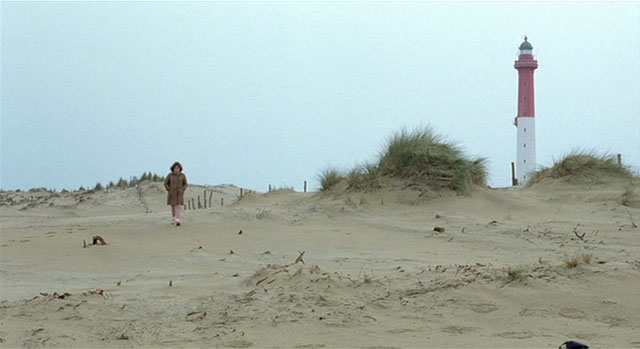
There’s a reason why this is the first Kurosawa movie on this site (and therefore the first I’ve watched in almost four years). After excitedly renting The Hidden Fortress, which I didn’t like, and Ikiru, which I did, I decided Akira was overrated and instead focused my attentions on Kiyoshi Kurosawa (no relation). Lately I’ve been greatly enjoying celebrated studio auteurs like John Ford, who make slow-paced movies without any spider-people, doppelgangers, magic trees, computer-virus apocalypses or killer jellyfish at all, so maybe it’s time to revisit A.K.

IMDB plot:

Murukami, a young homicide detective, has his pocket picked on a bus and loses his pistol. Frantic and ashamed, he dashes about trying to recover the weapon without success until taken under the wing of an older and wiser detective, Sato. Together they track the culprit.

A.K. follows his protagonist around the city, meeting shady characters in seedy parts of town, taking the camera out of the studio and bringing it along, influenced by the incompatible styles of film noir and neorealism. It’s a similar approach to The Naked City, and in a similar timeframe. I’d say Naked City was more successfully scenic, showed better city views, but Kurosawa did more with his less-than-stellar scenery. His mastery of camerawork, if not of pacing, shows up here.

At least the title character, the “stray dog”, is clearer than in The Thin Man – it’s Yusa, a small-time thief turned murderer with the help of detective Murakami’s pilfered pistol. The point is made again and again that Y. & M. came from similar backgrounds and befell similar fates until M. turned cop and Y. turned robber, leading to a climax of the two men fighting in the mud, dirty and interchangeable (not really, since Y. is wearing an unmistakable white suit by then). The other parallel is between M. as idealistic young cop with the weight of the world on his shoulders and elder cop Sato, with his burned-out black-and-white view of humanity. None of this is anything new by 2010 standards, but it may have seem fresh in ’49, and Kurosawa presents the ideas as if they’ve just occurred to him. By the end I couldn’t keep up my “ho-hum, Kurosawa” stance, was hooked by the style and story of the final third, featuring cross-cutting between Murakami’s bizarre interrogation of Yusa’s girl Harumi (with her mother in the room trying to help the cop) and Sato tracking down the killer in a hotel, as the oppressive heat of the last few days broke into a rainstorm.

Thanks to Emory for showing this on 35mm, though it features the kind of harsh, blaring music that always sounds better softened by my TV or laptop speakers than it does cranked loudly in a theater. Only the 7th listed film with superstar Toshiro Mifune (Murakami). Elder cop Takashi Shimura, with his giant Edward G. Robinson lips, was in 200+ films from Mizoguchi’s 1936 Osaka Elegy to Kurosawa’s 1980 Kagemusha, with some Zatoichi and Godzilla films thrown in, plus Kwaidan, Life of Oharu, and the lead role in Ikiru. Stolen-gun-toting Yusa is Isao Kimura in his first film – he’d appear in a bunch of Kurosawa films, the Miyamoto Musashi trilogy, Naruse’s Summer Clouds and Fukusaku’s Black Lizard. Harumi, Keiko Awaji, was in When a Woman Ascends the Stairs, and her mother Eiko Miyoshi would play scores of mothers in Japanese films, finally a grandmother in Ozu’s Good Morning. Movie was remade in cinemascope in the 70’s with the stars of Tokyo Drifter and Red Angel. I tried to draw comparisons with the missing-police-gun stories in Magnolia and The Wire but could not manage to do so.

C. Fujiwara:

Through the constant unfurling of interposed surfaces (multiple superimposed images, the strips of mesh and garlands down which the camera cranes at the Wellesian Blue Bird club), Kurosawa evokes a world in perpetual motion.

The sequence in Stray Dog in which Murakami goes undercover in the streets of Tokyo to look for the gun lasts slightly over nine minutes—much longer than necessary to advance the plot and convey that his search goes on for some time. The feeling of excessive length comes from the lack, or the randomness, of variation: the viewer’s main impression is the ever-dawning awareness that the sequence has nothing new to give. Kurosawa’s intention is to heighten our identification with Murakami as he slogs through the lower depths. By immersing us in the world’s chaos so thoroughly, the director makes us rely all the more on Murakami’s obsession as a potential source of meaning and order, while at the same time showing how inadequate it is to pose the problem of this chaos in the specific terms of a missing gun.

T. Rafferty:

Murakami poses as a down-and-out veteran, which turns out to be an uncomfortably thin disguise: he is a veteran of the recent war, and as he wanders through the ravaged city, in an elaborate montage sequence, we sense that he’s experiencing a life he might have led—that these mean streets are, for him, a collective image of the road not taken. That sequence, which incorporates a fair amount of documentary footage shot by Kurosawa’s assistant Ishiro Honda (later famous as the director of Godzilla and Rodan), is much longer than it needs to be, but it’s the key passage in Stray Dog because it sets in motion the film’s real story: Murakami’s growing identification with the man who now possesses his gun.

Wow, for years I thought I would hate this movie, but it popped up on best-of-decade lists so I gave it a shot and enjoyed the whole thing. It’s even a genre I dislike, the youth coming-of-age story, but this one’s aimed at adults (creepy adults maybe, all NC-17 for underage sex).

image

Anaïs (henceforth Anais) is the fat girl (French title was something like To My Sister!) on vacation with her parents and hot older sister. After some frank sex chat (younger Anais: “If I meet a man I love I’d want to be broken in. The first time should be with nobody.”) the girls meet roguish Italian Fernando, who’s making out with older sister Elena in a restaurant within minutes. Anais barely seems to pay attention, kills time the whole movie singing and talking to herself, imagining multiple boyfriends, chanting about being bored.

image

First-time sex scene follows between Elena and the boy. She tries to back out, but he counters, not about to give up. “All the girls take it the back way. That way it doesn’t count. It’s a proof of love.”

image

image

Excellent, unique in its shots and pacing and general outrageousness. I’d watch more Breillat for sure. I get the feminist label for the most part – it’s told completely from girls’ perspectives. The ending worries me, where the older sister and her mom get killed by a maniac who then rapes Anais. Doesn’t seem too feminist, that. Maybe the very end is feminist – Anais insisting to the cops and medics that she wasn’t raped. She can’t mean she wanted it, so maybe she’s making comparisons to her sister’s experience (Anais was in the room at the time). All sex is/isn’t rape, that sort of thing.

image

The most interesting part is really the relationship between Elena and the boy. He steals a ring from his mother and gives it to Elena, leading to parental intervention and the abrupt end of the vacation. The boy tricked Elena into having sex, but it didn’t ruin her life; she’s still crazy for him. The director doesn’t talk plot in the DVD features, just metaphor – pressing forth, climbing mountains, doing something that is beyond me. Film should be a tormenting experience! She presents herself as an actor-torturing sadist, but the actors all seem happy in behind-the-scenes footage. Breillat seems the stereotype of an arty Euro filmmaker, but her great movie proves otherwise.

Older sister Roxane Mesquida later starred in two more Breillat films. Mom Arsinée Khanjian is Atom Egoyan’s wife so she’s in all his movies as well as Code Unknown and Irma Vep. Dad Romain Goupil is a director, has worked with Chantal Akerman. Our D.P. Giorgos Arvanitis shot films for Theo Angelopoulos, and Breillat made the movie Romance (X), which I skipped in Barcelona to see either Wild Wild West, Happiness or Judas Kiss.

Aw, crumbs. I thought I’d written a whole lot about The Naked City already, then I click over here a couple weeks later and find a blank page. I did watch it twice (once with commentary) and check out all the DVD extras, but I didn’t write anything. So I’ll be brief.

Katy and I were impressed by this crime scene sketch:
image

Single-handedly created the police procedural, the idea that a single Sherlock Holmes/Sam Spade detective doesn’t solve a case, but rather a large team, labs and research and lots of hard work. So it’s an ensemble cast, led by young cop Don Taylor (of Stalag 17 and Flying Leathernecks, also directed Planet of the Apes 3, Omen 2 and The Final Countdown) and older wiser Irish cop Barry Fitzgerald (The Quiet Man, Bringing Up Baby). A girl has been killed, so her friend from work (Dorothy Hart), her slimy, mysterious buddy (he’s also the work friend’s fiancee: House Jameson, later appearing in some episodes of the Naked City TV series) and her doctor Howard Duff (A Wedding, While the City Sleeps) are all questioned. Turns out the buddy is a thief but no killer – real bad guy is pugilist/harmonicist Ted de Corsia (Lady from Shanghai, The Enforcer), who gets a boffo chase scene down and up the Williamsburg bridge at the climax.

Our two heroes:
image

A remarkable movie, better than I was expecting. Works as a sordid crime investigation drama, and somehow with all that complicated/groundbreaking location shooting they found the time to produce some excellent shots. From Luc Sante’s Criterion essay: “Hellinger chose as his cinematographer William Daniels, a great craftsman – once known as Garbo’s cameraman – whose career demonstrates how brief the history of the movies has been: he shot Greed (1925) at one end of it and Valley of the Dolls (1967) at the other.”

image

The producer (who also narrates) was a former newspaper man who would work on city crime scenes. He died a week after the first sneak preview of Naked City.

Jameson: a real loser
image

J Hoberman:

“The Naked City,” an otherwise conventional police procedural that, like Brute Force, was among its year’s top-grossing movies, was distinguished mainly for its Lower East Side locations and what the critic James Agee called the “majestic finish” of its chase across the Williamsburg Bridge. The cameraman William Daniels won an Oscar, but the movie was heavily re-edited before release, in part, Dassin said, because one of its screenwriters, Albert Maltz, was by then part of the blacklisted Hollywood 10.

Can’t remember the corny line the narrator said over this image:
image

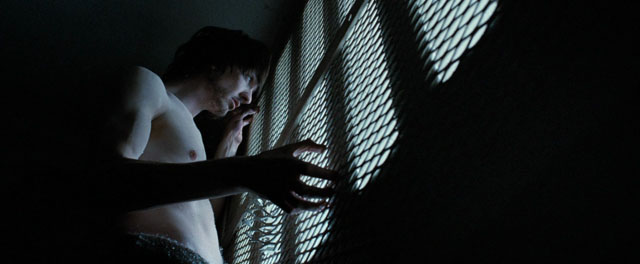
That’s Steve McQueen the artist who everyone pretended to have heard of when this came out, a naked Warholian who recreates Buster Keaton stunts and projects them onto art gallery walls, not Steve McQueen the actor who everyone has actually heard of, who jumped a nazi barbed-wire fence on a motorcycle.

image

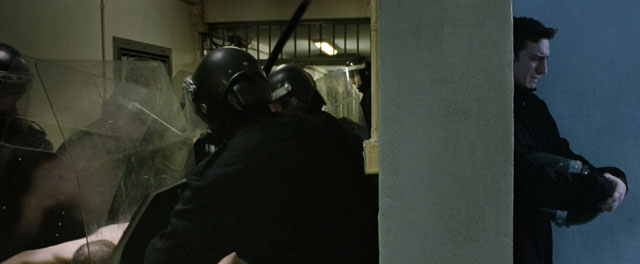
For a director who talks up innovation and rulebreaking, he’s made a rather classic-looking film, with much attention paid to capturing beautiful shots in what should be an ugly story – a hunger strike unto death by physically abused political prisoners inside the shit-smeared walls of a British prison. I expected more subjective views, more filmic art-stuff a la Diving Bell and the Butterfly (also by a former art-gallery sensationalist) but it seems most of the experimentalism was narrative, and who knows if that’s due to McQueen or experienced co-screenwriter Enda Walsh.

I ultimately got less, narratively and emotionally, than from the more conventional IRA/prison flick In the Name of the Father.

Extremely-long-take centerpiece, in which priest Liam Cunningham (Wind That Shakes The Barley, The Mummy 3) fails to talk Bobby (Michael Fassbender, the Inglorious Basterds brit who gets shot up in the basement bar):
image

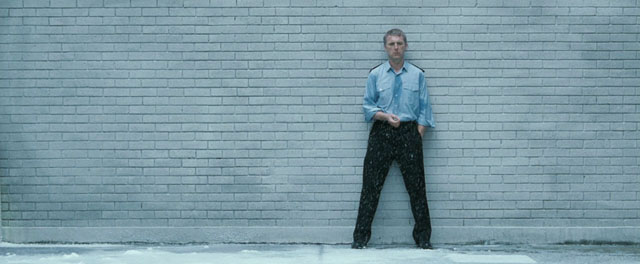
Prison guard who gets his own arc, ending with execution in his senile mum’s lap:
image

Another prison guard, who does not enjoy beating prisoners:
image

Secret messages:
image

Katy said it didn’t feel very JohnFordian, but it did to me, because two thirds of my previous John Ford experience consisted of Judge Priest and The Sun Shines Bright. Takes place in a small town in the south – there’s mob violence and a courtroom climax, and along the way we hear “Dixie” more than once. Sounds extremely Fordian to me. In fact I’m thinking Atlanta-born writer Lamar Trotti, who also cowrote Judge Priest, could stand to vary his game.

Two simple men and their simple mother (Alice Brady, the mom in My Man Godfrey, in her final film) were enjoying simple pleasures in town when they got in a fight with a blowhard and he ended up dead. Blowhard’s buddy Ward Bond (John Wayne’s old friend in Rio Bravo) says they stabbed the blowhard, so off to jail they go. Fortunately, hat-wearing slave-freeing superhero Abe Lincoln (Henry Fonda with a fake nose, looking spookily Lincolnesque in the occasional profile shot) stops the angry lynch mob by picking on them one at a time (a la Sun Shines Bright) and agrees to defend the kids, in between watching his girlfriend (Pauline Moore) die and meeting a new girlfriend (Marjorie Weaver, the lady in The Cisco Kid And The Lady). It’s all based on a completely true story! Except that it was a blunt weapon, not a knife, and the accused men weren’t brothers, and one of them (the one not defended by Lincoln) was convicted of manslaughter and imprisoned for six years, and Lincoln got the other guy acquitted but there was no sneaky buddy to take the fall instead.

Movie slides along peacefully and slowly builds. Very pretty in parts. I’d need to read more or study further to figure why this was one of Sergei Eisenstein’s favorite films… missing something, as usual.

I’m glad I got to see this in a theater, since I don’t know if I could’ve sit still for it on video. Also fun to observe the number of walkouts, probably from the half of the audience who hadn’t read the description beforehand and gasped loudly when Andy mentioned its 3.5-hour length in his introduction (AKA the half that wasn’t receiving class credit for attendance). But surprisingly I didn’t like it very much, never got the sense that all the elements (formalist experiment + weight of duration + story or lack thereof + static, careful camera compositions + subtle lead performance) congealed into a singular, great experience.

So, as I already knew, the film portrays Jeanne going about her routine for three days: making coffee, awakening her son and sending him to school, shopping, sleeping with some guy, making dinner, eating with her son, going to bed. Towards the second half her routine isn’t going as smoothly. Potatoes are overcooked. She walks into the wrong room. She can’t comfort the infant she watches while her neighbor shops. Then on the third day she stabs her guy to death with scissors. I’m still thinking about language since watching Pontypool. IMDB and Criterion descriptions say she “turns the occasional trick,” but most viewer descriptions outright call her “a prostitute.”

Delphine Seyrig was already a star (see: Last Year at Marienbad) and would remain one. Jan Decorte (her son) would only be in one more film (also by Akerman). The first two (non-murdered) men are both directors, the middle being Jacques Doniol-Valcroze. He played Etienne, whose letters get stolen and ransomed, in Out 1.

I. Magulies:

The perfect parity between Jeanne’s predictable schedule and Akerman’s minimalist precision deflects our attention from the fleeting signs of Jeanne’s afternoon prostitution. They nevertheless loom at the edge of our mind, gradually building unease. Jeanne Dielman constitutes a radical experiment with being undramatic, and paradoxically with the absolute necessity of drama.

Helping explain the movie’s feminist reputation:

Aunt Fernande, Jeanne’s sister, living in Canada, only appears in the form of a letter, read in litanylike monotone by Jeanne to her son; the neighbor, heard by the door (and played by Akerman herself), describes how, shopping for her husband’s dinner, and still undecided, she ended up getting the same expensive cut of meat as the person in front of her on line. Never casual, each of the film’s uniquely strange and long-winded monologues expresses some form of gendered pressure: they refer to Jeanne’s marriage, the son’s Oedipal thoughts, each breathing a sexual anxiety, each a drawn-out, wordy attempt to mitigate the “other scene” we never see, the elided afternoon trysts.

“Count Dracula may not seem like the ideal husband. … Of course he’s deadly pale, but then he’s a vegetarian and they all seem to look like that.”

image

The director admits the film is slow, even uses the word “boring,” but says they figured it’d be more poetic that way. He also claims little familiarity with the original Dracula story and vampire mythology, but says he’d try to respect it whenever a crew member would point it out (“hey Paul, Drac can’t walk out in sunlight like that”).

On the plus side, it has very nice piano music, decent well-lit cinematography by Luigi Kuveiller (who shot Avanti! and is as fond of zooms as Brian De Palma), Udo Kier acting off his nut, a humorous array of atrocious accents, and the longest blood-vomiting scene I’ve ever watched. Morrissey’s got the right idea about horror movies drawing in the viewer through slow buildup, but he misses the creepy horror atmosphere. Udo Kier’s Dracula is a pale weakling who gets ordered around by his enthusiastic German servant (Arno Juerging) and is eventually, humiliatingly killed by a loser rapist houseboy wielding an axe. Without the horror, or the over-the-top 3D humor of Flesh For Frankenstein, this one just sorta drags along.

Arno Juerging with Maxime McKendry:
image

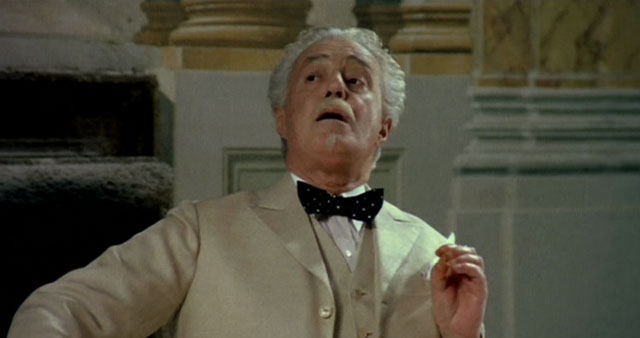
Dracula is sent from Romania to Italy to find virgins, since Romania is fresh out. Stays at a house run by the shabby, formerly wealthy couple of Maxime McKendry (seems like the best actress here, but never in another film) and the great Vittorio De Sica, below.

image

Drac is interested in the family’s four girls and tries to figure which is a virgin so he can drink her bl… I mean marry her. Unfortunately, the oldest two are having kinky sex regularly with beefcake houseboy Joe Dallesandro (Rivette’s Merry-Go-Round, a hitman in The Limey), the middle one has been engaged before so Drac writes her off (turns out she’s still a virgin so Joe kindly rapes her to save her from becoming vampire food) and the youngest is 14 (so unmarryable, but Drac is chasing her at the end).

Milena Vukotic:
image

Stefania Casini (Suspiria, a hitwoman in Bad, 1900, Belly of an Architect):
image

Not pictured: Fellini/Bunuel/Tarkovsky actress Milena Vukotic, and youngest Silvia Dionisio. It was a bitch to figure out the above screenshots since all four sisters look the same. See comment below for some clarification/corrections (thanks Jenna).

“What about your sister? What does she do all night? I’d like to rape the hell out of her.” “She’s only 14!”

image

The reason I watched this in the first place, kicking off an early start to SHOCKtober on the 29th, is Roman Polanski. During all the controversy while he sits in a Swiss jail I thought I’d watch myself a RoPol movie, but I can’t find my copy of Knife in the Water so I went for this instead. Apparently Udo Kier needed to take a day off for reshoots on another film, so they hurriedly wrote a scene in which Arno Juerging gets scammed by Roman (on left with the mustache) in a tavern.

image

Udo is as fun to watch as always (well, maybe less fun than always), but he’s surrounded by the usual sordid 70’s misogyny of a Morrissey/Warhol production. Dracula comes to a sad end, limbs all chopped off like the Black Knight and then staked by the gross houseboy. Better luck next time…

image

“I have enough joy for both of you. Happiness works by addition.”

image

Francois is so happy, because he has a wife (Therese) who cares only for him and their two lovely kids. He has a rewarding job as a carpenter, and a good relationship with his brother. One day he meets lovely postal worker Emilie and starts an affair with her, and now he’s even happier. Francois has so much joy that he can’t contain it all, so he tells his wife how happy he is to have two lovely women in his life, and an hour later she goes off and drowns herself. A few months pass before Emilie moves smoothly into the role of wife/mother, and Francois’ happiness continues as before.

Explaining the situation to the wife:
image

The movie, with its bright colors, prominent music, and unsettling focus and editing tricks, is amazing – probably my favorite Varda movie so far. I’d heard it was a deeply ironic, very unhappy movie but I don’t think that’s true, despite the death (not explicitly a suicide). Varda’s got happiness (in feeling and appearance) on her mind, but isn’t cutting it down or saying it doesn’t exist.

Fade to red:
image

Varda: “I imagined a summer peach with its perfect colors, and inside there is a worm. And impressionist paintings, which emanate such melancholy though they depict scenes of everyday happiness. I listened to Mozart, I thought of death’s preponderance. I wrote the film fast, and shot it fast, like the vivid brightness of our short-lived summers. At the time, it provoked much commentary. I said: ‘In a world full of prefabricated images of happiness, it’s interesting to take apart the cliches.'”

Agnes says at the time she hadn’t seen another film called Happiness and she liked the word. I guess Marker didn’t get the Medvedkin reissued until a few years later.

image

Lead actor Jean-Claude Drouot would go on to appear in Chabrol’s La Rupture and Klein’s Mr. Freedom, and his wife would continue not to be an actress, never appearing in another film. Marie-France Boyer (Emilie) had a couple starring roles after this, but fades away after 1970.

A few film references: they go to see a Louis Malle comedy (not giving the title or director, so it took some sleuthing), and watch a scene from Renoir’s Picnic on the Grass (an appropriate title, and another impressionism reference) on television. Then there’s the poster below, advertising Wilder’s Irma la Douche, John Wayne in McLintock, and is that Wyler’s 12-year-old Detective Story?
image

Movie got a silver consolation prize in Berlin after being beaten to the gold by Alphaville.

The New York Times didn’t get it (and called it Varda’s second feature – I guess if La Pointe Courte didn’t play NYC it doesn’t exist).

image

I want to quote the entire Amy Taubin essay because it’s great, but I’ll restrict myself to this bit about the final shot: “When we return in the last scene to this same patch of countryside, it is already late autumn. All that’s left of the sunflowers is their dry stalks. Just as François has replaced one wife with another, Varda replaces the late woodwind quintet with an even later and darker Mozart chamber work—a transcription for strings of the melodic themes of the original piece. The dirgelike sound suggests that as the family, holding hands, walks away from the camera, into the shadowy recesses of the forest, it is already entombed.”

image

The DVD extras are all by Varda herself – only other director I can think of who does that is Peter Jackson. Includes an interview between the two lead actresses and Varda’s daughter, which looks like it was edited by a crazy person. Short interviews with the people of Fontenay about their ideas of happiness. Writers’ quotes on happiness (“He who speaks of happiness always has sad eyes” – Aragon), interviews with two people with the last name Bonheur, a doc of lead actor Jean-Claude Drouot visiting the town of Fontenay and talking with locals about their memories of the film shoot, a 1964 documentary of Agnes on the film shoot (below, with husband Demy)
image

And four intellectuals discuss the film and its ideas of happiness, from which the following:

Michele Manceaux:
“If [the death] was an accident, it was psychosomatic. I think we can say it’s suicide. But it’s hard to fathom how something as serious as suicide could be treated in a story which is like a fairy tale.”

Frederic Bonnaud:
“Max Ophuls made a wonderful film called Pleasure, not Happiness. And the last line is ‘Happiness is not gay.’ That’s it, someone says, ‘But sir, happiness is not gay.’ And I think Agnes’ film is pretty much an analysis of that line.”