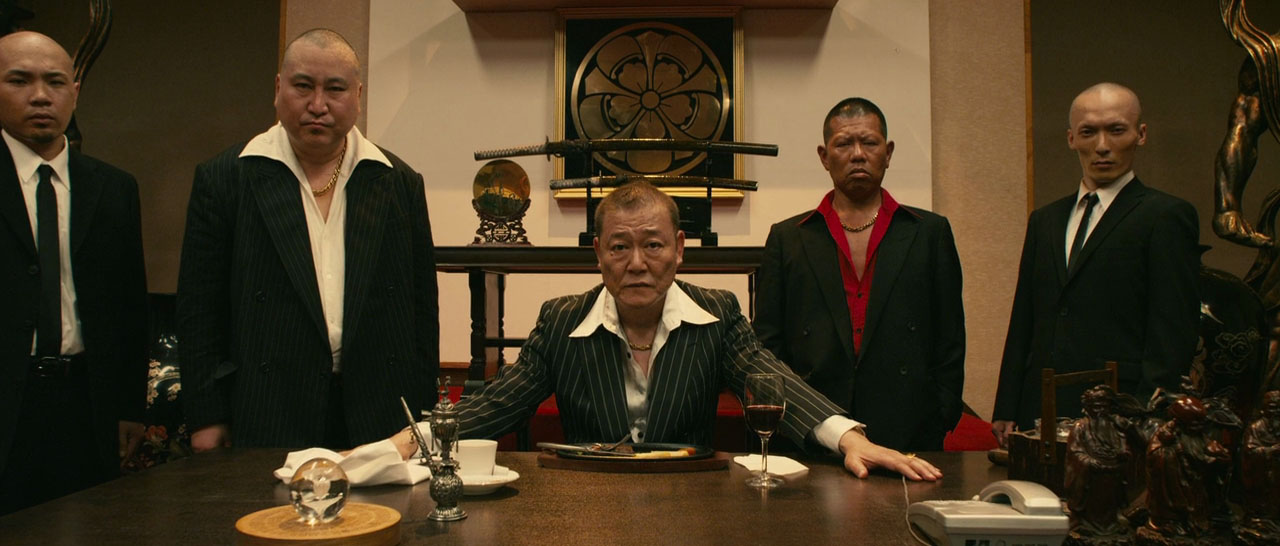
“We’re realists while they’re fantasists!”
“Realism will lose!”

I always watch the wrong Sion Sono movies. I heard either Love Exposure or Guilty of Romance was good, so somehow I got the idea to watch this instead – and I hated it, so now my chance of ever watching those others is lower.

Okay, I didn’t hate it. You can’t hate a movie where a group of young, failed filmmakers called the Fuck Bombers end up choreographing an actual gang war, and where stuff like this happens:

But it feels like Sono has cult-ready ideas, good-enough execution, and little sense of timing. Endless hours of build-up, and everything gets repeated to death by the time the end finally comes. Maybe it feels different at a midnight screening with a giddy audience, and at least it’s an improvement on Noriko’s Dinner Table (which I just realized has similar plot points to Alps).

Lead gangster is Jun Kunimura, who I just saw playing the devil, probably, in The Wailing. His daughter, a former advertisement star and the rainbow swordsman above, is Fumi Nikaidou (Lesson of Evil). Rival leader Ikegami is Shinichi Tsutsumi of One Missed Call. Hirata (Shin Godzilla star Hiroki Hasegawa) is the lead Fuck Bomber, and his Bruce Lee-prototype star is Sasaki (Tak Sakaguchi, star of Versus).

C. Marsh in Cinema Scope:

When Hirata dreams of filmmaking, he dreams of the practice’s classical conception, romanticized with the rigor of a hardcore purist: he envisions rack lighting, metres-long camera dollies on steel rails, a trained crew of hundreds, and, above all else, the sprocketed hum of rolling celluloid. In the end that’s what he gets, and it costs him everything. Sono seems sympathetic to the sentiment – he relishes the physicality of the traditional film equipment as much as Hirata does – but he ultimately undermines it. The form itself is a joke. The movie was shot digitally, on Red Epic: and though his characters would be doubtless loathe to admit it, the results look more than fine.

Margherita Buy (the pope’s analyst in Habemus Papam) is in the middle of a difficult film shoot (“a lame social drama about workers occupying a factory,” per Cinema Scope) with attention-hog lead actor John Turturro while her mother Ada’s health is failing. Involved in the family crisis are Margherita’s daughter Livia, her brother Giovanni (played by the director) and two exes (I think Federico and Vittorio).

Not a straightforward crisis-drama. There are dreams and flashbacks, which aren’t always clearly defined. The emotional build is consistent, but the scenes are allowed to stand alone, not necessarily progressing narratively from each other. A standout moment was Giovanni quitting his job without real explanation or plan of what he’ll do next, just an example of the grief and confusion in the family’s lives. Apparently made as a tribute to Moretti’s own mother (a Latin teacher like Ada) who died while he was working on Habemus Papam.

Ehrlich:

It’s not just the work/life balance that this film gets so right, but also — and more crucially — how you can never master your own life to the point where a personal hardship can’t make you feel like an utter amateur.

Won a prize at last year’s Cannes, was Cahiers’ pick for film of the year, and won Buy her fifth Italian best-actress award. It’s really good.

Great collection with the best liner notes, borrowed from a coworker and watched piecemeal.


The Original Movie (1922, Tony Sarg)

Silhouette animation imagining what moviemaking was like in early days (a mashup of eras from the dinosaur age forward). Nice use of Flintstonian animals as machines (like a long-necked dinosaur as camera crane), but Lotte Reineger it ain’t. Seems an in-joke gag about how producers have always ruined the work of screenwriters. Nice Muybridge reference. The notes say Sarg was a famous puppeteer who created the first Macy’s parade floats.

Producer (left) with his editing goat, receiving a pitch:

It’s a mark of how quickly the division-of-labor production system overtook Hollywood that already in 1922 The Original Movie can find its satiric “moral” in the inability of writers to recognize their work by the time it reaches the screen. The puritan-cloaked censors who contribute to the caveman filmmaker’s breakdown would have been on everyone’s mind. Nineteen twenty-one witnessed the Fatty Arbuckle scandal and brought New York’s new censor board as well as a hundred bills in state legislatures to curb perceived Hollywood excess.


The Confederate Ironclad (1912, Kenean Buel)

I guess an ironclad was a hideous, armored boat. Fifteen-minute action flick about confederate soldier Yancey, the Southern girl who loves him, and beautiful Union spy Elinor who easily cons ol’ Yancey into giving up military information. I didn’t realize the movie would take the confederate side, though – their gunboat rips up the union army, and noble Yancey allows Elinor to escape. Unusually, the original music score has survived, and was used in this restoration.

Wounded Yancey with his Southern Rose:

Yancey was married to the spy, Anna Q., who was a superstar in the 1920’s. Rose was Miriam Cooper, who had a lead role (“the friendless one”) in Intolerance.


Early Films from the Edison Company

Blacksmithing Scene (1893) – blacksmiths take turns banging on iron, drinking, banging on iron… sure enough, this is the original film the Lumieres remade.

The Gay Shoe Clerk (1903) – a decidedly not-gay shoe clerk kisses a flirty female customer.

Three American Beauties (1906) – a rose, a girl, a U.S. flag, all hand-tinted.

The liners on the first two films:

Because the three “blacksmiths” are impersonated by Edison employees, this is not a documentary but the first instance of screen acting. It is also the earliest surviving complete motion picture on film … Of course, at the time “gay” referred only to his devil-may-care impetuousness. The modern meaning gives unintended irony to The Gay Shoe Clerk, whose “young woman” was played by one of Edison’s male employees.


Spies (1943, Chuck Jones)

The Looney Tunes staff with writer Dr. Seuss illustrate a “loose lips sink ships” scenario, as Snafu thinks he’s keeping his mission secret but lets enough pieces of information slip for the enemy to put it all together. I thought Snafu had a rather Bugs Bunny voice, though Mel Blanc says he meant for him to sound like Porky. Amazing work, need to find and watch all of these.


OffOn (1968, Scott Bartlett)

Like the 2001: A Space Odyssey eyeball voyage scene, but homemade with newfangled late-1960’s video technology. Some other indescribable weirdness ensues, funhouse-mirroring and Rainbow Dance techniques. Impressive. Features the kind of grating horror soundtrack in fashion with the avant-garde, though it chills out into some pulsing tones at times.

Speaking in the 1960s at the time he made OffOn, his second film, he saw a technology on the horizon that would make his innovations simpler for future media artists: “With video plus computers you could do it even better,” he said of his imagery of metamorphosis.

I’ve watched this before, and both times I knew the general idea (documentary footage is being faked, people involved in real events are restaging them for the camera), but I was noticing this time how in some movies Kiarostami never tips his metafictional hand. We know from interviews and DVD extras that the movie theater (and the movie) never existed in Shirin, that the drivers and riders of Ten were never in the car at the same time, and that everyone in Close-Up is performing the role of themselves, but you can’t necessarily tell these things when watching the films.

Farazmand is a reporter who hears about a man (Sabzian) impersonating Mohsen Makhmalbaf, receiving money from a middle-class family while acting like he’s prepping a film shoot. He arranges to get Zabzian arrested for this, after which AK visits the man in jail and records his court date, discussing his intentions in pretending to be a filmmaker.

When Sabzian is interviewed by Kiarostami, realizing AK knows the real Makhmalbaf:

In the commentary, Rosenbaum calls it “a film about impersonation” right as Farazmand is telling the taxi driver and policemen that he aspires to be a famous journalist while he’s clearly unprepared (can’t find the house, not enough cash for the cab, didn’t bring a tape recorder). They discuss how the film is called Close-Up when Kiarostami loves to film in long-shot.

Asking directions from turkey man while looking for the Ahankhah house:

They also discuss the dead time and story distractions, how the film spends time in turn with almost every character.

JR: “Most people would agree that the members of the family come off overall less sympathetically than Sabzian does … they’re more defensive.” His co-commentarian Mehrnaz Saeed-Vafa says the rumor is the family originally did not withdraw their complaint against Sabzian, but later agreed to do so for the film. She also says that Sabzian points out that because of Close-Up, the family did in fact get to be in a film as he promised them. Even these experts don’t know whether the filmed trial is real or staged.

The Complainants:

I get the two sons confused, but can you blame me?

JR: Many of Kiarostami’s films from here on are “about the unequal relationship between filmmakers and the people they’re filming who are much poorer and are relatively powerless”.

Two Makhmalbafs:

JR: “I think the real subject of this film … is not impersonation or fraud, it’s the social importance of cinema and how it affects everything – how it affects things socially, how it affects people’s sense of power, their sense of ethics, their sense of identity … and their sense of truth, and perhaps truth is the thing that gets the most severe unpacking in this film.”

Right in between the fade-out of Cannes Month into my Crime & Punishment Marathon, and the kicking-off of Criterion Month, a bunch of last year’s acclaimed auteur art masterpieces became available, so I watched the new Malick, Cosmos, Francofonia and Anomalisa all in the same week. It’s a lot to take in, so I’m thinking it would be wise to watch all four of them again, but I’m probably not gonna do that right now.

Very mixed reviews from my regular critics. It’s telling that the most positive (3.5 stars) review on Letterboxd comes from David Ehrlich comparing it to the Entourage movie. Mixed reviews from me as well. Especially for the first hour, the minute-to-minute thrill of watching a Malick movie is all there, the expressive camerawork and experimental editing. But in the past we’ve had stories to hang these effects upon, and Malick is getting less narrative with every movie. I wasn’t sure that a soul-searching screenwriter played by an expressionless Christian Bale would be the greatest Malick avatar, and I was right. And I had to watch the ending a second time a week later just to make sure I’d even seen it the first time, thinking maybe I’d fallen asleep, but no, it’s just that it doesn’t feel like an end. After Bale is done talking with his father Brian Dennehy he flashes again on his lost loves Cate Blanchett and Natalie Portman (even less fleshed-out than the lost loves of To The Wonder), says “begin,” then two shots of cars rushing down highways. Either you just need to be receptive enough to mood and character to properly feel the thing, or I need a long, enthusiastic, well-researched article explaining what I was supposed to get out of it.

Cate at the beach:

Natalie at the beach:

These feel more like symbols, or apparitions, than characters. But then again, so does Rick: As Bale plays him, he alternates between hedonistic abandon and forlorn wandering; we get little insight into his specific needs or worries.

B. Ebiri’s article is helpful, pointing out connections and influences but ultimately saying the surface-level dreamlike seduction of the thing is the whole point. “You don’t reason your way through a film like this.”

Premiered in Berlin over a year ago, with a bunch of interesting looking movies that never played here but are beginning to come out on video, like Queen of the Desert, Eisenstein in Guanajuato, The Club, Victoria, Endless Night and The Pearl Button.

Fourth of July memorial screening for the great Abbas Kiarostami.

As mentioned before, the rosetta stone document that kicked off my art cinema craze was Jonathan Rosenbaum’s top-ten of the 1990’s article, including his thoughts on The Wind Will Carry Us. In 2004 and 2005 I watched every Kiarostami movie I could scrounge from the Videodrome shelves on DVD and VHS. I can’t say I loved them unconditionally and wanted to watch them again and again, but I can definitely say that I shared some of AK’s fascinations, that Close-Up and ABC Africa expanded my ideas of what cinema could do, and I was increasingly impressed by his artistry. In the past year or so, we’ve lost three filmmakers from Rosenbaum’s list of ten: Akerman and Oliviera, and now Kiarostami.

R. Koehler:
[Kiarostami] frequently stated in interviews that his open endings — most starkly experienced in the dense blackness of the final moments of Taste of Cherry — are his invitation to the audience to work at finishing the film for themselves.

He doubles down on the idea of viewers finishing the film for themselves in Shirin, a film visually composed of close-ups of women watching a film, which we hear in its entirety on the soundtrack.

J. Naremore in Film Quarterly:

The result is a metafilm of considerable richness, giving us the opportunity to “see” a movie in our minds as we watch the play of emotion across women’s faces and become conscious of our own role as cinematic spectators.

Opened out of competition in Venice with 35 Shots of Rum and The Beaches of Agnes, but too experimental to get a full theatrical run here. I’ve previously watched Kiarostami’s Cannes short Where Is My Romeo, made from this same material (but with a different soundtrack).

The DVD extra was made by Shirin producer Hamideh Razavi and lacks the artistry of 10 on Ten, but it’s fascinating to see how exactly Shirin was assembled – first each actor was filmed separately, looking at placeholder images lit with handmade flickering effects, then the “film” was created in an audio booth. Kiarostami talks about capturing natural expressions, but he also gives detailed direction for these non-performances. By the time we get to the editing phase, the short doc runs out of steam and the subtitlers quit early.

“It is up to you to define the movie for yourself.”

Other times, he suggests what the women might be watching.

“Those of you who are more experienced know love is always threatened by disappointment, that’s why you don’t show your joy much. Like most classic love stories, it has a tragic end, a certain disappointment which is itself a kind of satisfaction.”

Rosenbaum on Shirin:

One might even say that Kiarostami, an experimental, non-commercial filmmaker par excellence, is perversely granting the wish of fans and friends who have been urging him for years to make a more “accessible” film with a coherent plot, a conventional music score, and well-known actors.

AK:

I think I’ve come very late to this exploration of women’s issues… Leaving women out of my films was not a very intelligent decision. I made this discovery rather late, but there it is, I have made it.

Not gonna run through the whole cast on IMDB, but just limiting to actors with headshots, I see Taraneh Alidoosti (an Asghar Farhadi regular, title role in About Elly), Golshifteh Farahani (Paterson, Chicken With Plums, Rosewater), Leila Hatami (star of A Separation), Behnaz Jafari (Blackboards) and Juliette Binoche (Certified Copy). Good to see that at least one woman in the audience also worked on the soundtrack, so was “watching” herself.

Maybe Taraneh Alidoosti:

Maybe Leila Hatami:

AK quoted by Rosenbaum:

I believe in a cinema which gives more possibilities and more time to its viewer — a half-fabricated cinema, an unfinished cinema that is completed by the creative spirit of the viewer, [so that] all of a sudden we have a hundred films.

Also watched:
Roads of Kiarostami (2006)

Road photos, crossfaded, the camera moving along the photos to trace the paths of the roads. Soft music for the most part, with some AK VO explaining that he mostly takes photos of roads and paths, and reading us road-related poetry.

Roads was part of a festival commemorating the anniversary of the WWII atomic attacks.

Kiarostami, speaking with B. Ebiri:

Many of my photographs, they tell stories in a way: They’re fictional, as far as a photo can be. In my films, though, I’m the opposite; I try to get farther away from narrative and try to bring an experimental, visual art element to it. And the poems are very often evocative of image or atmosphere. So there’s definitely interaction between the different forms. And at any rate, they’re all products of the same mind — even if sometimes it doesn’t show on the surface.

Back to Shirin, and Kiarostami’s work in general…

Rosenbaum, from his Taste of Cherry article entitled Fill in the Blanks, one of his all-time greats:

Much of what’s been called innovative in the art of movies over the past half century has at first been seen by part of the audience as boring or as representing a loss — usually because it has somehow redefined the shape and function of narrative … If the major additions to film art offered by Antonioni, Bresson, Godard, Rivette, and Tati — as well as by Chantal Akerman, Carl Dreyer, Hou Hsiao-hsien, Abbas Kiarostami, Andrei Tarkovsky, and Bela Tarr — are at times perceived as subtractions, this is because we tend to bring old habits with us when we go to movies. New habits are unlikely to be formed without some conflict, during which various kinds of seduction and frustration will vie for supremacy … Lately I’ve come to realize that what I regard as the most wondrous thing to happen in cinema in many years, Kiarostami’s movies, strikes a few friends and colleagues as boring and empty, even predictable … I’ve gradually come to think that these disagreements revolve mainly around the issue of why what seems to be essential information in Kiarostami’s narratives is missing. Parts of the sound track in some of the latter portions of Homework and Close-up, for instance, have been suppressed (openly in the first case, and surreptitiously — by faking a technical glitch — in the second). Audience expectations about where the camera goes — and what it finds — are deliberately flouted in Close-up, Where Is My Friend’s House?, and Life and Nothing More. And we’re kept so far away from pivotal bits of action in the closing sequences of Life and Nothing More and Through the Olive Trees that we have to imagine part of what’s taking place — the sound as well as the images. In each case, we’re forced to fill in the blanks as best we can — an activity that isn’t merely part of Kiarostami’s technique but part of his subject. In the most literal and even trivial sense, we are what Kiarostami’s movies are about.

R. Koehler with context:

I would argue that it’s the immensely powerful minimalist features of his contemporary, Sohrab Shaheed Saless — especially A Simple Event and Still Life – that imprint the most visible stamp on the features and shorts that Kiarostami went on to make in the ’70s, ’80s and ’90s. Like never before among Iranian directors, Saless’ storylines and images are stripped away to their essentials, fixed shots are extended to produce the effect of lived-in experience, and ironically sly humor pokes its head up when you least expect it. It was a particularly rigorous modernism, which Kiarostami embraced and adapted to suit his own ends.

D. Ehrlich:

Arguably modern cinema’s most provocatively self-reflexive auteur … his films are so widely cherished in part because they encourage audience participation where lesser directors might simply punish casual spectatorship … For such a committed gamesman, Kiarostami’s films are imbued with a rare emotional lucidity, and yet they still steadfastly undermine the traditional dynamic of film acting, so that any outward show of emotion is first a representation of that emotion before it can be received as an expression of it.

The Film Stage reported at the end of last year that Kiarostami’s next film, composed of tableaux blue-screen shorts, was almost finished. The movie after that, to be named after his own book of poetry, was supposed to be shot in China a month or two before his death, but I suspect that didn’t happen.

Reminder that AK was denied access to the US to present Ten in New York.
In protest, Aki Kaurismaki didn’t attend either, via the Times:

If the United States authorities do not want “an Iranian, they will hardly have any use for a Finn either,” he wrote. “We do not even have the oil.”

Kiarostami, on filming outside of Iran:

“I consider cinema a universal language, and I consider human beings as universal beings,” he says. “So there’s no reason why people should not be able to relate to a film, or we shouldn’t be able to make films, in different languages and different cultures than our own.”

B. Ebiri:

The Iranian director Abbas Kiarostami was 76 years old when he died, and his last feature was 2012’s Like Someone in Love — so why does it feel like he’s been taken away from us at a moment of such creative promise and vitality? Perhaps because his cinema always seemed to be in mid-mutation, forever testing the limits of film to convey great complexity and humanity. He was the shape-shifter of modern cinema, a man whose restlessness spoke through the constantly refracting nature of his work.

G. Cheshire:

Beginning with Taste of Cherry, each new film confounded my expectations. It took days, weeks, months or even years to process and finally get a fix on the latest Kiarostami, to feel I had a grasp on what it was about that at least satisfied me. Close-Up was multi-layered in its meanings, but I felt I got it on first look. Taste of Cherry and The Wind Will Carry Us, on other hand, I came to regard as masterworks equal to that film, but on initial viewings they befuddled me — and demanded that I revamp my understanding of Kiarostami yet again. For critics, who are increasingly pressed to deliver cogent judgments within an hour or two of seeing a film, such bafflements are as valuable as they are awkward. What if the greatest artists ultimately are the ones who require time, patience, thought, and perhaps above all, an awareness that views their work as an organically evolving whole rather than one consumerist nugget after another?

Related: I updated my entry on Like Someone In Love this week with a link to a valuable Glenn Kenny article.

P. McGavin:

How do you even begin to assimilate this work? His great skill was taking moments — scenes or images — that feel familiar and transforming them into something charged, poetic, mysterious and finally quite beautiful.

T. Hassannia:

Kiarostami’s films are easy to watch because they’re visually resplendent; they’re challenging to watch because they seem to contain a hidden puzzle. But the more familiar you become with his work, the less you’re sure those puzzles are meant to be solved. They’re not. They’re meant to be explored. If the ending of Where is the Friend’s Home? is any indication, Kiarostami believed in the experiential; to use a cliche, he preferred the journey to the destination. He revelled in the digressions of life, and thanks to the temporal features of cinema he was able to serenely express that vision.

A.O. Scott:

To an extent that we have only begun to grasp, movies invented a new way of thinking, and Abbas Kiarostami’s movies are among the clearest and most challenging applications of cinematic thought.

K. Phipps:

He and other filmmakers of his generation also provided — and continue to provide, alongside their successors — a window into the world of Iran at a time when such windows weren’t always widely available, or created by the country itself. But it’s hard to think of any country as a collection of faceless enemies when you’ve wandered their streets, seen their children, and felt their desires and pains. Kiarostami captured that, and he did it brilliantly with a sense of playfulness and profundity.

I’ve previously written up McCay’s Little Nemo (aka Winsor McCay, the Famous Cartoonist of the N.Y. Herald and His Moving Comics) and How a Mosquito Operates and The Sinking of the Lusitania, and Bill Plympton’s restoration of The Flying House. Well, I got my hands on the Master Edition DVD, so now I’m watching (in most cases rewatching) the rest.


Gertie The Dinosaur (1914)

Similar to Lusitania, the full movie is more than the animation – it opens with a documentary account of the cartoon’s inspiration, with intertitles explaining to audiences unfamiliar with animation how work-intensive the process was. Per the commentary, the shorter version of this film lacks the intro and titles and was played in a live show with McCay on stage interacting with his dinosaur, giving commands and having conversation. I like how the commentary says Emile Cohl and J. Stuart Blackton were McCay’s primary influences, but that McCay also publicly claimed to have invented the animated film.

Gertie attacks the camera/presenter:

Guess what’s about to happen to that stack of original Gertie drawings:


The Centaurs (fragment)

Because you can show topless women if they’re half horse. A weird, slow-moving little piece that Canemaker imagines may have been part of McCay’s vaudeville act a la Gertie.


Gertie On Tour (fragment)
Gertie torments a trolley then dances for a crowd of dinosaurs. Animation scholars today don’t know why.


Flip’s Circus (fragment)

Little Nemo character Flip performs a stage show with a mini-Gertie, which finally eats Flip then vomits him out. Serves him right, really, since Flip spends half the movie beating the thing with a club.


Bug Vaudeville (1921)

Sketches of insects doing circus-like stunt routines on a stage, each one lasting about twice as long as it could. All this is being dreamt by a hobo under a tree (his head appearing MST3K-style watching the insect action) who frustratingly ate some cheesecake, not rarebit.


The Pet (1921)

Cute little creature walks into a house where a woman feeds it. It grows visibly larger while eating. As as it grows, it eats increasingly large things, from food to dishes to household decorations, finally to buildings and airplanes, until the army blows it to bits. Favorite scene: the pet drinks from a hose, then slurps up and eats the hose like spaghetti. Of course this is all just a rarebit dream by the man of the house, who eats dinner at “the club” and resents his wife for wanting a pet. Plympton’s redo of The Flying House is great and all, but I think this was my favorite of the rarebit fiend shorts.

The included documentary, Remembering Winsor McCay (1976) by John Canemaker, is cool for providing first-hand accounts of McCay’s life and work by his younger assistant John Fitzsimmons. But since the films are silent, I’d already played them with Canemaker’s commentary, which reuses all of Fitz’s stories and comments.

In the vein of recent self-consciously faux-grindhouse movies like Machete and Hobo With a Shotgun, but this one’s a giallo imitation. Obviously brings to mind Berberian Sound Studio and Amer as well, but aiming for parody through extended reference instead of jokes. I smirked at the obvious dubbing and the Udo Kier cameo, but it comes off as a bad movie parodying bad movies. Writer/directors Brooks and Kennedy also star as the editor and the inspector, respectively, with giant mustaches, and Kennedy’s inspector throws off the balance of the acting. Most everyone plays it straight – or slightly-winking parody-straight – but the Inspector goes big, a dead ringer for Matt Berry’s cocky explorer Dixon Bainbridge on The Mighty Boosh.

Film director Francesco and the inspector:

Lot of straight razors (everybody in the movie has one) and black leather gloves and woman-slapping and flashbacks. Favorite plot point: the inspector’s wife Margarit is the first to discover the bodies of movie-in-the-movie actors Claudio and Veronica, and goes blind from the sight. Everyone makes fun of the editor all the time – he was formerly a renowned editor (there is such a thing?) but sliced off his own fingers in a rage, and now works on shitty movies with his fawning assistant Bella. Either of them would be a prime suspect for the murder spree, which soon claims substitute leading man Cesare. But could top-billed Paz de la Huerta (The Nude Woman in The Limits of Control) as the editor’s wife who is barely in the first half of the movie possibly be involved? Yes!

Didn’t play the pile of extras, just gonna appreciate the surface pleasures of the movie, like the editor beginning to see reel-change marks bleed into real life, and UDO KIER (less awesome than he was in The Forbidden Room but hey, it’s still Udo Kier).

The codirectors previously collaborated on Father’s Day, a Troma movie about a revenge-seeking man named Ahab.

Slower and weirder than it seemed from the trailer, which sets up a madcap comedy.
Katy was disappointed.

Mid-1950’s Hollywood: Josh Brolin is a hard-working studio employee who keeps the stars in line and keeps the press (Tilda Swinton) away from the more damaging stories. Period epic star George Clooney is kidnapped by commies, is curious and agreeable, doesn’t seem to realize he’s being held hostage until rescued by cowboy actor Alden Ehrenreich. Those two and Brolin are great, but they’ve got nothing on Channing Tatum as a dancing sailor who’s secretly the commie group’s leader. Ralph Fiennes plays a frustrated director, and we get quite small roles for McDormand, Johansson and Jonah Hill, and reeeeally small roles for Alex Karpovsky and Dolph Lundgren.

Slant:

On the flipside is a cell of communist screenwriters who abduct mega star Baird Whitlock (George Clooney) to bleed the studios, only to let slip that their ideals of upending the means of production stem from bitterness over not getting the back-end points they think they deserve. In perhaps the only subtle joke in the entire film, the warped prosperity politics that Hollywood communists bring to the cause is tacitly positioned as a precursor to Scientology, another faddish, extreme cause that the Hollywood faithful would frame in terms of making more bank.

G. Kenny:

The movie makes light of the dialectic as explained to Baird by Marcuse, but it also, in its tricky way, continually invites/compels the viewer to use it. Eddie Mannix is a good man who is very good at his job — but his job seems to be manufacturing schlock. People enjoy schlock, but schlock is arguably an agent of The People’s oppression, so… anyway, one needn’t go on. Suffice it to say that in the cosmology of the delightful Hail Caesar!, regardless of the conclusions to which dialectical thinking may lead, acceptance is the key, and Hollywood, while “problematic,” is more a force for good than the military-industrial complex can ever hope to be. And, finally, doing the right thing is an instinct shared by both company men and singing cowboys, for whatever that’s worth.

F. Cardamenis says the movie “reveals a striking ambivalence about [Hollywood], finding magic in its products but malice in its motives.”

D. Ehrlich’s article in Slate was my favorite, even if I did a sorry job condensing its points below:

[Hail Caesar and The Grand Budapest Hotel] shift through several different aspect ratios and feature Ralph Fiennes, Tilda Swinton, and — wait for it! — Fisher Stevens. Both films bake their darker underpinnings beneath a frivolous screwball glaze. More crucially, both films probe the ultimate value of storytelling, and leverage their findings into lucid summations of their creators’ entire career and creative worldview. Hail, Caesar! takes one of the diverse back catalogs in American cinema and forces its various components into a reluctant conversation that changes them all, like strangers who are forced into small talk at a cocktail party only to realize that they have the whole world in common.

[the sailor musical sequence] convincingly argues the value of filmmaking to a universe of indelible characters who are struggling to understand it for themselves. It’s a truth they could see if only they had faith. And that, ultimately, is what Hail, Caesar! argues with greater clarity — if not always greater force — than any of the Coens’ previous films. There is no meaning but that which we convince ourselves. It doesn’t matter if you adhere to communism, religion, or movies: The only way you can believe in yourself is if you believe in something bigger. Who wouldn’t want to be a lobby boy at the Grand Budapest hotel, sir? It’s an institution.