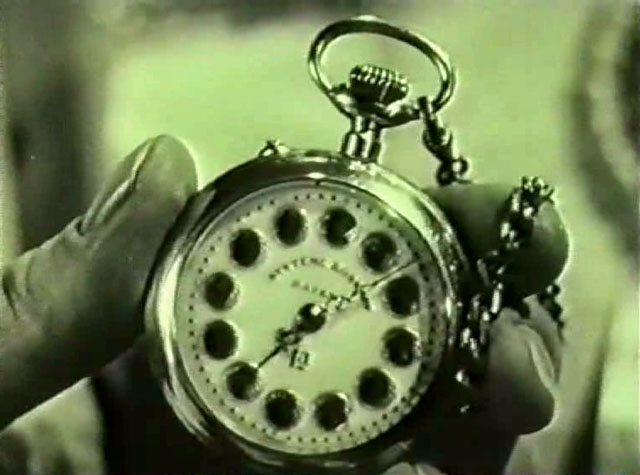
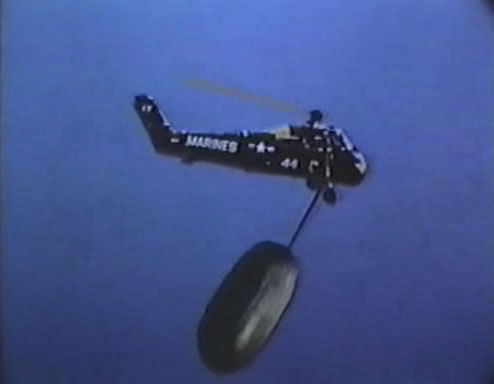
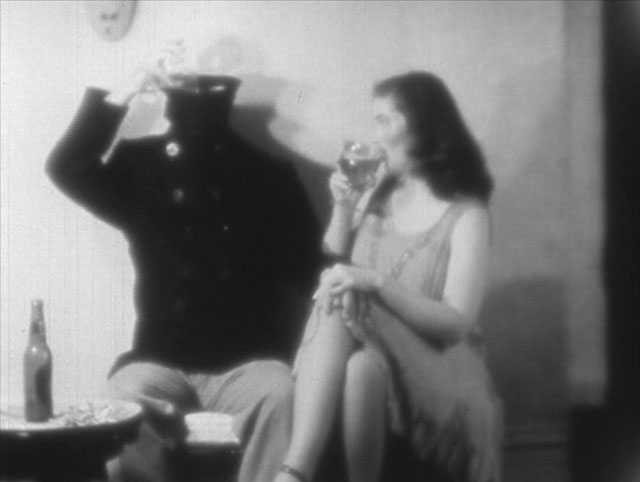
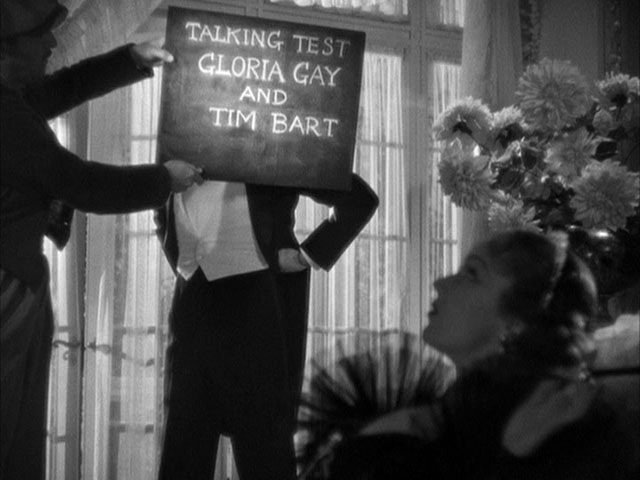
This was unexpectedly awesome. Between this, Regen and A Valparaiso, it’s time to consider adding Ivens to my list of favorite people. Sort of a Beaches of Joris, but less confessional to camera, shot more like an allegorical feature film starring himself. Always playful and never loaded with dialogue, with the occasional film reference, fable flashback or appearance by a prankster tiger-monkey.

Joris sets out to film the wind, goes to China. He trades a print of one of his films (“my first love story in 1930”) for a wind-creating mask. He sets up an array of microphones in the desert. He gets carried over mountains and enters political negotiations to film at a cultural landmark (the Terracotta Army), then gives up and recreates the landmark using models bought from street vendors.

At one point when he walks up to a massive Buddha statue which watches with a thousand eyes, closeups cutting from an eye to the camera lens, I thought strongly of Antonioni’s short Michelangelo Eye to Eye, also made by a director in his 90’s. But while Antonioni has always seemed associated with monuments, this was just a leisurely sidetrack for Ivens before returning to the matter of the wind, sixty years after he filmed the rain in Regen.

Senses of Cinema:

This is an unusually personal account of his lyrical rather than his political obsessions, largely directed by Marceline Loridan-Ivens, his wife and collaborator since the Vietnam films. … Joris Ivens died in 1989, only days after joining protesters against the Tiananmen Square massacre in Paris.

Mango Grove:

Ivens originally planned to use two crews; Ivens’s crew would film the wind, while Loridan’s crew would film Ivens’s crew filming the wind. Complications arose. Ivens was sick and, in a particularly serious incident, required on-the-scene surgery. … Thus the two crews became one. The Wind became Loridan’s film.

Speaking of Loridan, this also sounds good (from ivens.nl):

With La Petite Prairie aux Bouleaux, Marceline Loridan-Ivens made her feature film debut, at the age of 74. … She had agreed with Joris Ivens after A Tale of The Wind, their last project together in which documentary and fiction are mixed together, that she would make the tale of the fire. For a long time she dared not return to Birkenau, but finally she succeeded where Steven Spielberg and Roberto Benigni failed, she got permission to film on the premises of Birkenau. … It is a film about the pain and illusive character of the memory.

Rosenbaum:

The film is clearly addressed to the West and not to China … and the overall message is to listen to all that China has to say. … Both poetic essay and meditative fiction, A Tale of the Wind has certain affinities with movies as different as Jean Cocteau’s The Testament of Orpheus, Chris Marker’s Sans soleil, and Souleymane Cissé’s Brightness, but it is too proud to owe its vision to any source beyond Ivens’s own far-reaching experience and research. Part of the film’s inspired thesis appears to be that cinema and history, fantasy and documentary, have a lot to teach each other.

Very good doc on the film Clouzot almost made between La Vérité and La Prisonnière, starring Romy Schneider (of Welles’ The Trial) and Serge Reggiani (just off Le Doulos and The Leopard). The couple is on their honeymoon, or maybe just on vacation, in a small town shot in black-and-white, and Reggiani becomes increasingly wildly jealous of everyone his wife has contact with, his state of mind represented with color fantasy sequences and optical-illusion effects. Decades after the film fell apart (mainly because the writer/producer/director’s overreaching ambition clashed with his own perfectionism for details, wasting time and money and tiring the cast and crew) the script was filmed in the 90’s by Claude Chabrol, which I believe was the first of Chabrol’s movies I ever watched, too long ago for me to compare the finished movie with the Clouzot fragments.

Clouzot got some great cinematographers and effects people, including Claude Renoir, Rudolph Maté (The Passion of Joan of Arc) and Andreas Winding (Play Time). It was also the first credited film work by William Lubtchansky, who is one of the main interview subjects. The documentary is very excellent, showing much of the never-finished film (the color footage in particular looks amazingly vibrant, like it was shot yesterday), and not getting into irrelevant sidetrack stories. Interiors (and therefore most of the dialogue scenes) were never shot, and there’s no surviving sound recording from set, so two actors read from the script on a black stage, providing missing context.

“You can’t trust cinema” – Straub

Costa brings his In Vanda’s Room minimalist shooting style into the editing room where Straub and Huillet are working on Sicilia!. I thought it sounded like a bore, but liked it a lot, surely more than Vanda itself. Guess I was interested in the process of it, and in rethinking Sicilia and learning about the filmmakers – the documentary aspect more than Costa’s aesthetic work, though seeing something so similar in look to Vanda made me reconsider Costa’s style too. So, a lot to think about, though I’m not sure about it being “maybe the best movie ever made about making movies” (Senses of Cinema possibly quoting Thom Andersen).

Huillet (below) is the quiet one, doing her work while Straub showboats and pontificates, talks about destroying truth, calls a matching shot “the most idiotic thing in filmmaking,” and quotes favorite films of his (of theirs). They take their editing job very seriously – Costa says they completed five cuts a day. They stop to screen and introduce some films, including The Chronicle of Anna Magdalena Bach, for a meager group of students, part of the deal they made to get free editing time at a university. Seems to be a documentary made for and by people who need no introduction to these filmmakers; an advanced course in their methods and personality. Funny that Costa points out his own sound design in this doc as “completely fake, anti-Straubian.”

More choice Straub quotes:

“Some people have the impression – because we reject verisimilitude and TV-style cinema, Dallas and all that shit, and even Woody Allen and Cassavetes, etc., that there is no psychology in our films. But that’s not true. All this is psychology. There is no psychology in terms of the performance of the actor because there is a dramatic abstraction that goes deeper than so-called verisimilitude. But it’s there, in between the shots, in the very montage and in the way the shots are linked to each other, it is extremely subtle psychology.”

“When you make films, you try not to say stupid things. You work hard to avoid them. You destroy cliches, go back, correct, abandon or add things. And then, in real life, you do talk nonsense. You end up destroying some of the work you do and the films you made.

“You cannot expect form before the idea.”
“First there is the idea. Then there is the matter and then the form. And there is nothing you can do about that. Nobody can change that!”

image

From Sam Fuller’s autobiography:

[Writer/producer Myles Connolly] and I started throwing around ideas for his picture. It was supposed to be about a character based on Tom Mix, the cowboy star of silent films who’d made scores of Westerns. Then came the talkies, and Mix didn’t make the transition successfully. Myles and I came up with a story about a silent cowboy star who doesn’t want to play a gangster role in a talkie because he wants to be loyal to his fans. He doesn’t want to disappoint the kids who are crazy about his Westerns. We called it Once a Hero, but after the movie went into production, they gave it the more commercial title of It Happened in Hollywood.

Harry Lachman, who’d been a successful painter in Paris, directed the picture. Lachman is forgotten today, but he made over thirty movies before he stopped directing in the early forties. Fay Wray played the female lead. This was after King Kong distinguished her from all the pretty blondes of the day as the one who could scream the best. the Tom Mix character, Tim Bart, was played by Richard Dix. It Happened in Hollywood was my first real credit on a picture.

Fay Wray, the one who could scream the best:
image

The name wasn’t changed soon enough – the Once a Hero title card made it onto the film. Celeb cowboy actor Bart is introduced screening his latest movie to sick kids, a real white-hat good-guy honest friendly lunkhead. He and his leading lady Gloria are called back to Hollywood for sound tests – she makes it but Bart, dressed in a silly period suit and made to speak out-of-character flowery dialogue, gets cut. Gloria later gets him a bit part as a gangster but he walks when the script is changed to make him a cop killer.

“The day of Westerns is over. We have to make the pictures indoors from now on.” Recalls The Naked City, which we watched the same week, finally making the pictures outdoors again.

Bart in gangster getup with his director:
image

Out of work and unpopular when a young fan comes to visit, Bart throws a party and invites all the stars’ doubles and stand-ins to delight the kid – the highlight of the picture. Some stand-ins do the voices better than others – Chaplin’s and Harold Lloyd’s have no problem since they don’t speak.

This is not W.C. Fields:
image

The improbabilities pile up… a realtor, after Bart to repossess his mansion while the party is being held, is kidnapped. Bart and Gloria tearfully confess to each other that they’re broke. The boy falls ill and the doctor says he can’t be moved. Tim hits his low point, about to reenact the bank robbery for real, ends up foiling a more serious bank robbery and shooting the criminals. Now a hero in the papers, he’s hired back by the studio, Westerns make a comeback and Tim opens a ranch for sick kids. That’s a better ending than Tom Mix got, touring with a circus after leaving the movies, marrying for the fifth time then dying when his car plunged into a ravine.

Did anybody realize that Blake Edwards made a movie in which Tom Mix (Bruce Willis) teams up with Wyatt Earp to solve a murder at the Academy Awards? It came out three months before Die Hard.

A boy in trouble:
image

Decent movie. I liked Richard Dix (who’d really been a silent film star, and not exclusively in Westerns) but Fay Wray made more of an impression. It all confused Katy, who knows Sam Fuller is some kind of badass and didn’t follow his connection with this movie. I didn’t either, honestly – assuming Power of the Press and Scandal Sheet will show off more of his style (I already know that Shockproof does).

Camille: “Can I come during the day, from 5 to 7?”
Marcello: “The magic hour for lovers.”

image

Simon Cinema (Michel Piccoli) isn’t doing too well, confined to his mansion-museum with his butler (Truffaut/Duras vet Henri Garcin) and best friend Marcello Mastroianni (as himself, sort of). Film student Camille (Julie Gayet, the girl with the giant gag vase in My Best Friend) is hired to talk with Simon about movies for 101 nights, and her boyfriend (Mathieu Demy) takes advantage of her position to cast the legendary Mr. Cinema in his student film.

Michel and Marcello:
image

Garcin and Gayet:
image

But the plot is just an excuse for some fun. Every star of French cinema shows up, major films are mentioned (nothing is discussed in any depth – no time). Anouk “Lola” Aimée, Catherine Deneuve and Robert De Niro take a boat ride. Sandrine Bonnaire appears as both her Vagabond self and Joan of Arc. Piccoli drops the Simon shtick and the white wig for a minute and compares cinematic death scenes with Gérard Depardieu (“that old devil Demy!”) before a poster of their co-starring Seven Deaths film…

Gerard and Michel:
image

Sandrine d’Arc:
image

Hanna Schygulla (Fassbinder films, Passion) and Jeanne Moreau (Jules and Jim, The Lovers) play Simon’s ex-wives. There are seven dwarfs. There’s a conspiciously Bonheur-looking sunflower shot. Alain Delon arrives by helicopter (reminiscent, though it maybe shouldn’t be, of the out-of-place helicopter in Donkey Skin).

Gayet with Alain Delon:
image

Jeanne and Hanna:
image

It’s all very light and playful. I’m sure I missed a thousand references, but it keeps many of them obvious enough to remain accessible (if you didn’t catch the meaning when a bicycle is stolen outside the mansion, someone cries “italian neorealism strikes again!”).

Mathieu Demy meets Fanny Ardant:
image

The credits list how many seconds and frames were used from each featured film – impressive – and also all the stolen music cues.

image

tour bus guy: “Glad to see you on form.”
Simon: “Form of what?”
“Why, you seem content.”
“Form and content, a debate even older than I am.”

At Cannes:
image

NY Times: “While covering so many bases, Ms. Varda never makes more than a glancing allusion to anything, and at times the film is such an overloaded grab bag that it grows exasperating. Or even baffling; for unknown reasons, Stephen Dorff turns up in a pantheon of great Hollywood stars.”

image

LA Times: “Michel Piccoli plays Monsieur Cinema, who embodies the history and spirit of film, and in particular, that Fabulous Invalid, the French motion picture industry itself. (Since Varda is such a playful director, Piccoli is sometimes simply himself.) Monsieur Cinema may have been inspired by the director of the landmark Napoleon, the late Abel Gance, whom Piccoli resembles when he puts on a long silver-white wig.”

Lumiere brothers:
image

Doctor Belmondo and Jack Nance:
image

image

image

I was expecting that this would be very bad, and was hoping to find a few inspired moments or some cool animation to pick out of the wreckage, but then I liked the whole movie so now I don’t know what to write. I don’t get why Brendan Fraser has to be in every single live/animation hybrid flick, but he and Jenna Elfman were just fine in this. Lotta jokes at the expense of movie studios, the Warner Brothers (played by Don & Dan Stanton from Terminator 2 and Gremlins 2), Brendan Fraser, product placement and movie conventions.

image

Timothy Dalton plays the star of a suspiciously James-Bond-like franchise, and is just-fired studio security guard Fraser’s father. Fraser heads to Vegas with also-just-fired Daffy Duck while studio exec Elfman in league with Bugs looks for them. Note Dick Miller as Fraser’s security coworker.
image

Tim Dalton turns out to be an actual spy, working against the evil Acme corporation (headed by Steve Martin, who is acting strangely Mike Myers-like in this screenshot.
image

Good to see Joan Cusack as a secret government scientist (not to mention Robbie the Robot).
image

Roger Corman cameos, believably enough, as a film director.
image

Kevin McCarthy reprises his Body Snatchers role – in black and white!
image

Of course the plot is a thin excuse for a thousand gags and highlight scenes for every major Looney Tunes character. Yosemite Sam and Wile E. Coyote work for Acme, Tweety and Sylvester are Fraser’s neighbors, Marvin Martian is captive in Cusack’s lab, Pepe Le Pew appears in a sidetrack to Paris (where there are Jerry Lewis movie posters all over). Super fun movie… I’m actually so impressed that this was so good, after I’d heard everywhere what a failure it was. Even Dante seems to be making excuses for it in recent interviews (I’m guessing the terrible Scooby/Shaggy cameo is one of the last-minute studio changes he complains about).

Some highlights: a split-screen phone call where the screen effect smashes Daffy:
image

And a romp through famous paintings at the Louvre… here’s Elmer as Munch’s The Scream:
image

Turns out the movie wasn’t as universally hated as I’d thought. According to Slate, writer and director were fed up with the studio by the time the movie came out, and neither them nor any of the stars participated in the DVD extras. The NY Times and AV Club sure disliked it, but good reviews were posted by J. Rosenbaum (“I had a ball”) and G. Kenny (“comedy of the year”). After reading a couple appreciations I am anxious to rewatch and look for some of the hundreds of gags I missed. I guess it comes down to how much fun you’re willing to have with it. For instance, some reviewers cringed at Steve Martin trying to be funny again, and called him out as a fraud (as if he’s Robert De Niro in Rocky & Bullwinkle), while others bothered to notice that Martin completely succeeded… David Edelstein:

Steve Martin, moreover, is a miracle. Determined not to be upstaged by his flamboyant Warner costars, he has concocted a “supertwit” that is at times at least their equal. His red hair parted in the middle, he staggers around the set in sneakers and an ill-fitting suit, jerking his torso, windmilling his arms—stopping his gyrations only to saunter up to one of several repulsed women, convinced that he is catnip to the ladies. This is the old Steve Martin, the whirligig genius of The Jerk (1979), The Man With Two Brains (1983), and All of Me (1984). To see him this way after at least a decade of domesticated dreck is to love all the more the liberating influence of Warner Bros. cartoons.

One of those long-discussed greatest-films-ever which upon first glance (and second glance) actually does seem to be one of the greatest films ever. It’s a super story with an incredible character for Gloria Swanson and boy, she nails it, but it also helps that I am a film nerd. Swanson helped destroy Erich von Stroheim’s directoral career 20 years earlier and now Wilder casts Swanson as a washed-up super-eccentric former silent actress and Stroheim as her tragic manservant. Enter William Holden and his young friends, all wannabe writer/directors, and a cameo by Cecil DeMille and Wilder’s got room to skewer damn near everything in Hollywood. And he manages to keep the mood comical while preserving a film noir (the commentary calls it monster-movie) atmosphere, without letting anybody’s flaws go unpunished.

image

Opens with William Holden dead in a swimming pool, as he introduces his own dead body then narrates his story. Sound familiar, American Beauty?

image

A dead-end screenwriter, he’s trying to avoid getting his car repoed when he pulls into a faded mansion just in time to see Swanson and Stroheim preparing to bury her pet monkey. She is pleased to meet a hot young screenwriter, hires him immediately to work on her monstrous script of Salome, which is to be her long-awaited return to the silver screen.

image

Holden had no clear prospects as a screenwriter, he’s got no cash and no girl and he dreads the shameful return home to the local newspaper he left to pursue his Hollywood dreams, so he hangs out working on her futile script for a clueless Cecil B. DeMille, realizing too late that he’s becoming her kept boy.

image

Was up for bunches of oscars but got its clock cleaned by All About Eve at the awards. Still came away with writing, art direction and music (beating Samson & Delilah, the actual film DeMille is seen shooting on the Paramount set). I don’t know if Golden Globes were important then (or if they are now) but it got picture/director/actress over there.

DeMille and Swanson:
image

Immediately preceded Ace in the Hole, a dark time for Wilder. Stroheim would only be in seven more films before his death. Holden would play Audrey Hepburn’s object of affection in Sabrina. Swanson had profitably retired from acting and did not use this as a springboard back in, though she did make quite a few TV appearances.

image

Apparently was turned into an Andrew Lloyd Webber musical in the 90’s.

image

IMDB trivia page is packed. Among the actors who turned this movie down: Double Indemnity star Fred MacMurray, Red River star Monty “Raw Deal” Clift, Mae West (who was not in silent films), early Lubitsch star Pola Negri and Greta Garbo.

image

Erich von Stroheim hadn’t directed in 20 years… Queen Kelly with Gloria Swanson having been his downfall. Norma Desmond says DeMille directed her twelve times – he actually directed Swanson six times. Love interest Nancy Olson went on to Disney flicks in the 60’s and Jack Webb (her fiancee Artie) would spend the rest of his career writing and acting for Dragnet.

Holden with Webb and Olson:
image

Norma’s “Waxworks” (her bridge partners): H.B. Warner (DeMille’s Jesus in King of Kings, later a Capra regular), Buster Keaton (who was actually doing alright in ’50 with his TV show, in between film roles In The Good Old Summertime and Limelight) and Anna Q. Nilsson (not pictured, who costarred with Warner and worked with DeMille).
image

Film/dialogue moment #1: “There was a tennis court… or rather the ghost of a tennis court, with faded markings and a sagging net.” We see the court already, but our screenwriter/narrator feels the need to fill spaces with dialogue and also tell us about it.
image

Film/dialogue moment #2: Norma Desmond wordlessly brushes away a microphone.
image

Ready for her close-up:
image

If we are to become mighty auteurist film scholars, there are worse hazards than having to declare Public Enemies the greatest film of the year when it’s clearly not; we must also face up to people who question our devotion to the less acclaimed directors working in commercial cinema – specifically, girlfriends who frown incredulously, asking “Snake Eyes? The Nicolas Cage movie? I thought you hated him” and co-workers who say, mockingly, “De Palma isn’t even an auteur… he sucks!”

True, Cage is known for being goofy/awful, but I’ve got a soft spot for his early goofy/awesome roles in Raising Arizona and Wild At Heart (and even Bringing Out The Dead), and I still fancy a good Cage cameo in Grindhouse or his less-crazy role in Lord of War. De Palma seems to have been too concerned with his own gigantor-budgeted bag of tricks to worry about Nic’s wild, yelling performance in the opening scenes. After that, he and best friend/worst enemy Gary Sinise calm down to the standard cop-investigation double-cross game.

The quickly-forgotten Round 7 Girl who’s hot for Cage and his pretend hollywood connections, with the assassin above her to the right.
image

Back to Brian’s bag of tricks: we’ve got cameras through walls and ceilings, split-screen, playback, point-of-view, and long, long shots (the opening sequence, awesomely filmed as it is, has plenty of hidden cuts). It’s bravo filmmaking, but the story dies so hard at the end it seems like Brian has just been giving a turd unprecedented amounts of polish. Everyone online seems to know that a massive sfx tidal-wave-flooding-the-casino ending was cut and replaced by the WTF ending of Sinise shooting open the door where informant Carla Gugino (mom in the Spy Kids series, also in Watchmen) is hiding just as the storm rips the outer wall off the building so an arriving police car can catch him, but why? The current ending (and unnecessary epilogue where Gugino catches up with Cage months later) sucks so hard that throwing a giant tidal wave at the movie could only have improved it. No deleted scenes on the disc, so those of us who don’t buy copies of scripts on L.A. street corners will never know what ending was deemed even worse.

Even if Femme Fatale outdid this one in audacity of plot, this has got plenty to recommend it from a purely De Palma geek-out standpoint.

De Palma takes the split-screen next-level, showing simultaneous actions at one moment, and present-tense Cage split with his recreation of past events at the next:
image

Ends with a cheesy theme song – what is this, a Bond movie? Batman? Nobody does that anymore.

From the director of Hitchhiker’s Guide To The Galaxy. It seems that after British directors make flop sci-fi epics, they then crank out a life-affirming children-starring film-fest pic to make up for it. Oooh, Jennings also made Blur’s “Coffee & TV” video. That makes up for a lot.

The movie, with cinematography by Jess Hall (Hot Fuzz), was very, very small, all 2.35 letterboxed on our little hotel TV way across the room. But what we managed to see was pretty good, a fun little movie totally worth the rental. Katy says I said it was better than the trailer, which I think is a weird thing to have said but I suppose is true.