This is more a collection of music videos broken up by vignettes (words by Somali poet Warsan Shire) than a feature film or any sort of documentary. After the Nick Cave movie I thought perhaps I’d watch this and Frank Ocean’s Endless, the three 2016 albums which were released as movies, but the Ocean is still a store-exclusive (for future study: Let England Shake, Centipede Hz and Beyoncé’s previous album).

Pray You Catch Me:

Hold Up:

Sorry:


But oh, what music videos – some of the best photography and movement and costume/makeup design of the year, illustrating the greatest concept album of the year.

Daddy Lessons:

Love Drought:

Forward (Michael Brown and his mother):


Cinematographers include Malik Sayeed (He Got Game, Clockers), Reed Morano (Vinyl, Kill Your Darlings) and Khalik Allah (Field Niggas), and codirectors include Kahlil Joeseph (The Reflektor Tapes) and Mark Romanek (Never Let Me Go).

Formation:

The best possible way to experience an album for the first time: as a one-night-only feature film, with some halting interview footage and rehearsals and home stuff, but also the songs played in full, with a different magnificent visual scheme for each.

J. Bleasdale:

Cave is someone who is stronger when he is singing. Likewise, the film becomes more cinematic at this point, creating essentially standalone footage of the songs, swooping through chinks in the studio wall to sail over the city.

It’s good to know a couple basic details of the Traumatic Event beforehand since the movie doesn’t spell it out – nobody’s here to talk about that, just about the process of getting through the aftermath, through the music and otherwise. Having some knowledge of the Event makes certain conversations, song lyrics and performances unbearably moving. That feeling seeped into the album when I first played it the next day, but I’m feeling it less as time passes since watching the movie version – maybe I need to stop listening to the album for a while.

J. Kiang:

Cave wrote the songs which appear on the new Bad Seeds album Skeleton Tree before Arthur’s death but recorded them afterward, and Dominik’s film is a document of that recording … The “event,” in Cave’s own words, instantly made him into another person, into “someone else inside my skin.” So the Cave we see singing is not the same Cave who wrote the words in his mouth, and yet the songs are all, every one of them, about dread and loss and love so sharp and yearning it feels like hurt. The uncanny resonances that the lyrics contain — and always contained — can be ascribed to the fact that Cave’s songwriting has always tended toward the doomy, but he suggests, with typically matter-of-fact mysticism, it’s also partly because his songs have elements of prophecy. That thought, of tragedy foretold, might be enough to drive another person mad, but like everything else in the jetstream of an unimaginable horror, the logic of the old you, the way you think you would behave if such-and-such occurred, is simply obliterated. It’s one of the reasons, Cave explains at the start of the film, why he’s moved away from narrative in his songwriting: he just doesn’t believe any more that life happens neatly, one thing then the next, the way it does in stories.

Dominik seems interesting. I vaguely recall watching his Chopper on DVD (to check out that Eric Bana guy before his Hulk movie opened), and IMDB says he did uncredited camera work on The New World.

G. Kenny:

As it happens, Cave himself commissioned the film on realizing that once the record was to be released, he would be obliged to promote it. He is still so seared by his trauma that he can’t bear the idea of being asked by journalists about it repeatedly; so this, then, is his communiqué, albeit a communiqué mediated by another genuine artist.

Oh man, what an idea – take a story of office politics during the 2008 banking crisis and turn it into a heightened musical on stylishly artificial sets, directed by master of spatial composition Johnnie To. I loved this.

Company IPO, new partnership and financial audit are all happening at once. Chairman Chow Yun Fat (first movie I’ve seen of his since Curse of the Golden Flower) and CEO Ms. Chang (film writer Sylvia Chang, also of Eat Drink Man Woman) run the company and are having a not-so-secret affair.

Cheatin’ David (HK McDonald’s spokeman Eason Chan) also has something going with Ms. Chang but starts warming up to Heartbroken Sophie (Tang Wei of Lust, Caution) in finance so she’ll help him hide a bad trade.

Energetic new guy Wang Ziyi (who introduces himself to people by mentioning Ang Lee, who has directed films starring half this movie’s lead actors) bounces around the office, falling for new girl Lang Yueting, who nobody realizes is the chairman’s daughter, covertly getting to know the company she’ll soon be running.

S. Kraicer:

Wong Kar-wai’s inspired art director William Chang has concocted a highly stylized vision of a postmodern office setting: a theatrical, open-concept, multi-storied abstraction of a contemporary financial firm, complete with lobby and adjoining metro station. As fundamentally structuralist as ever (though he hides it well), To stages the complex romantic and financial-scheme-devising interactions of his stellar cast with a fluency that dazzles.

Probably would’ve dazzled even more in 3D, which is how it was presented in theaters.

D. Kasman:

This abstract pleasure of dashing lines and depth-play is at the service of an ebullient imagining of the corporate world in unparalleled transparency, one which the contemporary architectural trend of glass-scape monuments and faux-communal interior layouts insincerely aim at evoking. But what Chang’s screenplay reveals through this radical transparency is that Office is very much another Johnnie To film about killing: the killing of the soul within the corporate workspace, the killing of romance within a culture of materialism, and the killing of brother- and sisterhood within the machine of corporate capitalism. Its deadly thrust is naked for all to see. It joins To’s triptych drama Life Without Principle and the Don’t Go Breaking My Heart skyscraper romcoms to make for a series of blistering, cynical, and ruthlessly analytic portraits of the luxury-slick surfaces and corrosive-sick structures of global urban capitalism.

Sept. 2016:
Watched this again in the beautiful blu-ray restoration, along with Agnes Varda’s documentary. Of course, I take back the comment below that the music is unmemorable – I find no showtunes memorable until I’ve heard them a second time, and now I feel like I’ve known the twins’ theme song forever. Had completely forgotten that there’s a murder in this movie, a family friend who hangs around the café is arrested for chopping up a girl named Lola-Lola (Blue Angel reference?). Re: the English version of The Young Girls, it’s glimpsed in the Varda doc, but apparently nobody thought it worth restoring and adding to this box set, so that’s probably the final word on that.

Transporter Bridge, transport me away:

Oct. 2007:
Not a total musical like Umbrellas was, and no connecting characters between the two, just a brief mention of the town of Cherbourg. This one has the same longing tone as the previous film in parts, but mostly it’s a much sunnier film, a loving, colorful, musical tribute to Hollywood escapist classics.
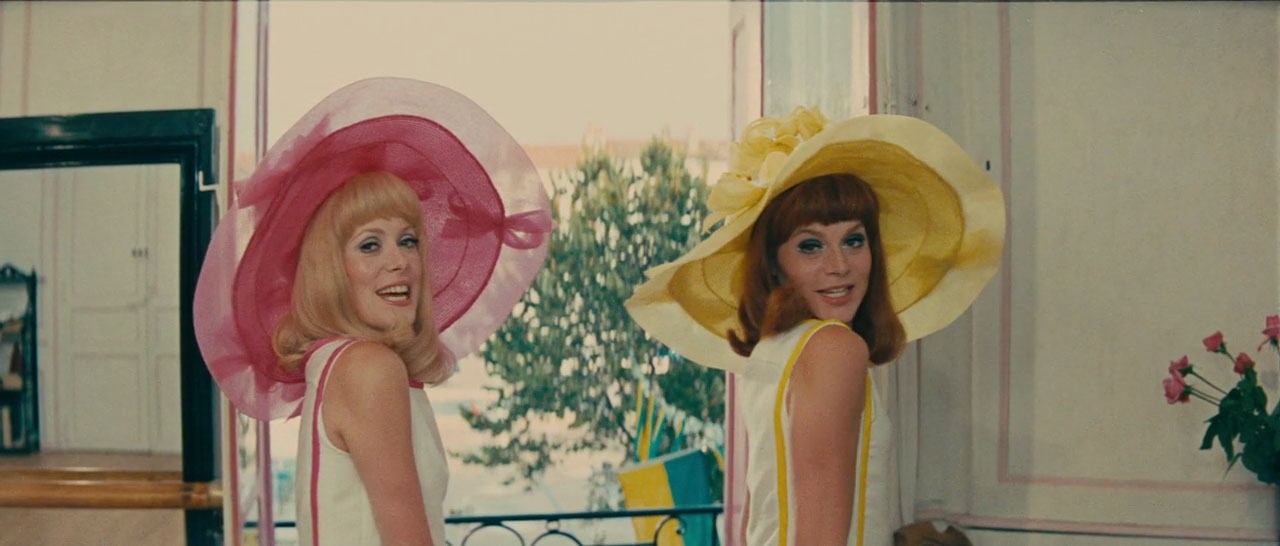
At this point, Demy was far out of touch tonally with his French New Wave contemporaries. Umbrellas characters were at least affected by the ongoing war, but Rochefort, coming after the more politically-engaged Muriel and Paris Belong To Us and The War Is Over, is in its own insular world for the most part. A few years later, after the May ’68 riots and Godard’s and Marker’s hard turns to the left, after even Demy’s wife Agnes Varda had filmed Black Panthers and contributed to the Far from Vietnam project, Demy would continue to go his own way, filming a musical fantasy fairy-tale with Deneuve and Jean Marais in 1970. By that point, I gather that he was not well-liked by his New Wave filmmaker/critic contemporaries. I don’t think he is well-liked still… I’ve been reading that his career was pretty uneven, and only a quarter of his films are talked about regularly. I guess Demy’s films have had to be recontextualized to be appreciated, removed from the radical French 60’s and enjoyed as pure cinema.

Danielle Darrieux (star of Madame De… and the cheating wife in La Ronde, later in 8 Women & Demy’s Une chambre en ville) plays Yvonne, mother of Catherine Deneuve, her tragic real-life sister Françoise Dorléac (of The Soft Skin and Roger Vadim’s La Ronde remake) and young Boubou.

Yvonne regrets having left Boubou’s father Simon Dame (Michel Piccoli) ten years ago. Delphine (Deneuve) keeps missing her dream man, an artist/poet doing his military service, Jacques Perrin (of Donkey Skin, Cinema Paradiso, the Kieslowski-penned 2005 Hell). Solange (Dorléac) dreams of meeting famous American composer Andy Miller (Gene Kelly). And they all (more or less) meet up and fall in love at the end of the movie.

L-R below: Darrieux, salesman George Chakiris (West Side Story), Josette, romantic Perrin, George’s partner Bill, Gramps

Guess I’m not so musical-savvy, don’t know what to say about this one stylistically. I mean, it’s bright and colorful and fun, less sense of loss and longing than Umbrellas, but I kind of miss that. Gene Kelly is a cutie, fits in just fine.

Katy asks why the mother has to work all day at her diner to get by, while her daughters live high in their fancy apartment and pretty dresses from teaching song and dance lessons. Are the realism and the fantasy rubbing against each other uncomfortably, or is the mother paying for Boubou’s school and still helping to support the girls until they get married? If the latter, I’d hope they’d take a shift at the diner once in a while.

This and Umbrellas had a funny combination of set and location shooting, with Demy doing location shots in the actual towns, but repainting the storefronts to his liking. Nice music, nothing memorable for me, having heard it just once. The girls refer to Jules and Jim and composer Michel Legrand. The camera should count as a cast member since it is engaged by the other characters and dances around with them. A self-reflexive movie then, both in its use of the camera and its reference to musical convention. Bright, solid primary colors abound.

Jonathan Rosenbaum: “There are English-dubbed versions of both Umbrellas and Young Girls; I haven’t seen the latter, but the English version of Umbrellas is so unrelievedly awful that I’m happy to have missed the dubbed Young Girls.” Although if the IMDB trivia page is to be believed, Rochefort was fully shot in English as well as French, so it might be worth hunting down an English version if it still exists anywhere.

Varda cameo as the shortest nun:

Caroline Layde for Senses of Cinema:

However undemanding and lollipop Demy’s films may appear, they present some nuance and sophisticated intertext, and they share a certain charm, vivid and unified. His films inhabit worlds in themselves that may peripherally refer to social reality and the real world but remain content as alternate realities of poetry, color, and music … Demy’s consistency of vision itself justifies his inclusion among the “auteurs”, defined by André Bazin and François Truffaut and expanded by Andrew Sarris as distinguishing themselves with their salient visual language from mere metteurs-en-scène. Demy certainly created a signature style of poetry and innocence and clung to it. Yet this quality also has a sophisticated aspect, suggesting the dream worlds of the surrealists and of Demy’s inspiration, Jean Cocteau. It is fitting that the American critic Gary Carey has described Demy as “the Joseph Cornell of French cinema”.


The Young Girls Turn 25 (1993, Agnes Varda)

The town of Rochefort threw a party and screening for the 25th anniversary, invited Demy’s family, Legrand, the set designer, the producer and cast. Bittersweet memories for some, pure joy for others. Film and video of the festivities along with film clips and Varda’s excellent 16mm footage from behind the scenes.

“The memory of happiness is perhaps also happiness.”

Jacques on set:

2006:
The first time I was too blown away by how wonderful this movie is, so entranced by its beauty and mesmerized by the entirely-sung dialogue to quite believe what I was seeing and hearing. Knew I’d have to see it again soon to make sure the dream was true. Still a nearly perfect movie… even more so now that I understand the singing and the flow and the story, and can just get caught up in it.

2016:
Finally looking perfect on blu-ray – I wasn’t thrilled how some colors on the 1990’s film print restoration jittered like a Nintendo game with too many enemies onscreen. Also I’m watching this for the first time since seeing Lola, so that movie’s lead character Roland Cassard as the jeweler who marries Deneuve and his brief Lola-flashback scene are new sources of wonder.

Meeting Roland at Mr. Dubourg’s place – he’s back there quietly gazing at Geneviève.

Other things noticed: how depressed and sullen Guy is after returning from the Algerian war… the crazy wallpaper in the movie and how it clashes and blends with the brightly colored clothing… and the auto mechanic male lead, from Demy who grew up in an auto garage.

When visibly pregnant Geneviève breaks down and agrees to marry Roland: “If he refuses me as I am, it means he doesn’t have deep feelings for me. If, by some extraordinary chance, he accepts me, I’ll have no reason to doubt him, and I’d be a fool to turn him away.”

And on Guy: “I would have died for him…”

Rosalie Varda played the lovers’ daughter in the final gas station scene – I saw Rosalie again in Uncle Yanco the same day.

Didn’t expect to find a 1954 photo of Chris Marker and Alain Resnais holding a Fernand Léger print in the blu-ray extras:

Cannes Month isn’t over until I say it is. Michaël Dudok de Wit’s The Red Turtle premiered two weeks ago to absolute raves (an A+ from indiewire) so I’m checking out his shorts.

The Monk and the Fish (1994)

A monk goes out of his damn mind trying to catch a fish. Great motion and poses, and this movie does one of my favorite things, having the main character always move to music. I believe it ends with the monk reaching a spiritual oneness with the fish. Won the César, nominated for the oscar.


Tom Sweep (1992)

Found in low quality on streaming sites – a proto-Monk/Fish short, with beleaguered bin-man Tom’s garbage-collecting movements set to music.


Father and Daughter (2000)

A terribly beautiful story about a girl whose father sets off in a rowboat and doesn’t return. Won the Oscar and the Bafta and the BAA and the Annecy and the Zagreb and deserved them all, although I certainly didn’t think so on oscar night when I was rooting for Don Hertzfeldt’s Rejected.


The Aroma of Tea (2006)

A dot moves rhythmically through painted patterns, again set to music. Aha, it was painted with tea.

Strong feminist single-mom “Mme Brouette” Mati (Price of Forgiveness star Rokhaya Niang) is trying to get by with her wheelbarrow business, inspiring her friend Ndaxte to leave her own abusive husband. Mati meets friendly and attentive young policeman Naago and falls for him. Unfortunately he’s actually a drunkard whose hobbies include chasing every woman in sight, shaking down local businesses for protection money, and hanging out with his trashy loanshark buddy. Now Mati is trapped and pregnant, turning to crime (smuggling) to open her own cafe, which I think Naago burns down at the end – he surely burns down something, to repay his shitty friend. Mati doesn’t initially have the nerve to just shoot the guy, but her daughter does.

Mati/Brouette is arrested for murder, the end, Kinda a depressing movie, flashing between the climactic murder scene and backstory, enlivened by musical numbers – what Time Out calls an “Afro-Brechtian griot chorus.”

Played the Berlin Fest in competition with 25th Hour, Hero, Soderbergh’s Solaris, Alexandra’s Project, Twilight Samurai and winner In This World.

Thought I wrote this up already, but can’t find it. Must be thinking of The Philadelphia Story. Yuk yuk, but no, really. I recall saying that everything felt like an imitation (and it doesn’t help that they’re reading the exact same dialogue) with a few unnecessary songs added… that even the most well-loved actors of the 1950’s have unenviable positions playing roles originated by Cary Grant (here Bing Crosby), Jimmy Stewart (Sinatra) and Katharine Hepburn (Grace Kelly). Kelly even seems to be impersonating Hepburn, or maybe they’re both just doing generic upper-class east-coaster, but Hepburn did it first, and for longer. Of course it’s still a hell of an enjoyable movie – you don’t remake The Philadelphia Story and end up with an unenjoyable movie. Best addition: Louis Armstrong!

Junun (2015, P.T. Anderson)

Cool music documentary with emphasis on the music – no narration or explanation, only a few titles and stories. The best story isn’t even related to the album, but a guy who feeds birds from the roof of the fort where they’re recording, and whose family has done so for countless generations.

Shot with a camcorder and a drone. Shye Ben Tzur is a singer, composer and organizer, then there are bunches of great musicians playing great instruments, then there’s Jonny Greenwood of Radiohead sitting engrossed in his guitar/laptop world. Engineer Nigel Godrich comes out regularly to knock noisy pigeons off the sound baffles.

Baffled pigeon:

Drone’s-eye view of bird feeding:


Oddsac (2010, Danny Perez)

Psychedelic imagery with a paint-splatter wash of colors and great music by Animal Collective.

Does it turn into a horror movie at the end, or was it one all along?

Coincidentally the day after I watched this, Perez’s first narrative feature was announced (premiering at Sundance this January). Sign me up.