My taunting of Katy for complaining about long movies (“long” > 105 minutes) bit me in the ass today. After an hour delay the movie started, and after 2.5 hours I was the first to moan about how LONG that damned movie was.

The project may have been initiated by the country of Namibia, but it says Burnett wrote and directed, so I’m laying the blame at his feet. So what went wrong? The other Burnett movies I’ve seen centered around small communities, so maybe his style can’t support stretching out to epic scale with ten countries and a hundred characters. Katy points out that Danny Glover had the only character with any depth, and Burnett said in an interview that Glover’s character was fictional, a blending of three or four real people, so maybe Burnett has problems with writing history and his strength is in fictionalization. After the recent reissue of Killer of Sheep, every film critic fell over himself to declare Burnett an American treasure, so maybe the combined weights of feeling like he has to live up to his reputation and deliver a high-quality picture, and feeling like it’s his duty to truthfully deliver the story of Namibia to the rest of the world led to too much compromise.

Plot: Young Sam Nujoma grew up in “South West Africa” (aka Namibia), a country governed by nazi… i mean Germans and occupied by South Africa. Sam always dreamed of a free Namibia. He met some guys who also wanted that, and started a political/guerrilla movement called SWAPO. He went to church and met minister Danny Glover. Then he pissed off to the United Nations and stayed there for twenty years, finally returning as president of his newly-independent nation. Yay!

I didn’t realize that Carl Lumbly (who played grown-up Sam Nujoma in a series of fake beards) was also the easily-manipulated slacker Junior in Burnett’s To Sleep With Anger.

Quoting myself in an email:
Movie feels long, and yet each scene feels too short. Tries to tell the *entire* story of Namibia AND of [Nujoma] without leaving anything out, so it’s an epic and a biopic crammed into 2.5 hours. Script feels like a wikipedia article. And story problems aside, it’s full of traditional epic-sounding music, and traditional cutting and camerawork… doesn’t feel like the idiosyncratic artworks that the other Burnett films I’ve seen (Sheep, Wedding, Anger, the shorts) felt like. Disappointing. BUT it’s got some great shots and some fine acting, and the stories of Namibia and Nujoma are interesting, so it was at least worth sitting through. It’s not total crap (like Amazing Grace), just not the great movie I was hoping for.

Watched this the same month as Trouble In Paradise, not having guessed how connected the two would be – the book/script of Stavisky even mentions that they stole shot ideas from Paradise. This one seems like a correction to the other, set during the same year with some of the same reference points (such as Trotsky) but here the upper-class gentleman thief is revealed to be a sham, and rather than escaping at the end to start over with his true love, the thief ends up dead, his widow in prison. The final shot is the chauffeur (of the period Rolls they drive everywhere) placing a bouquet of white flowers for her outside the prison.

Bright and lively music by Stephen Sondheim (who had already won three Tony awards in the 70’s) kept the doomed inevitability away until it was too late. Sondheim had already won three Tony awards in the 1970’s by the time Stavisky came out. It’s one of the very few times he’s written music (more than one song, anyway) for films – the other cases were Warren Beatty’s Reds (another movie featuring Trotsky!) and Dick Tracy.

image

Another story by Jorge Semprún, who wrote the exile-themed The War Is Over. One of Stavisky’s associates (Juan Montalvo, a slimy guy who hits on Arlette but can provide Serge with lots of money) was funding the attempted coup in Spain which led to the Spanish Civil War. In researching the film Semprun found that the same police inspector (named Gardet in the movie) assigned to watch over Leon Trotsky in France was also assigned to report on Stavisky, so Trotsky’s exile was written into the movie, as witnessed by a kid named Michel Grandville. The movie is bookended with Trotsky – first arriving in France, beginning his exile from Russia, and at the end after the Stavisky scandal, being moved further into exile, far from Paris, his political influence feared by the conservatives. Stavisky himself is a Russian Jew in exile – so there are a few connections to the previous film.

The paperback book says it “represents the final scenario” for the shooting of the film, and the intro by Richard Seaver addresses something I had wondered about after reading The War Is Over and believing that Semprun’s script was shot word-for-word with very little added by Resnais: “Once the subject is established, the writer does an initial draft, or treatment, after which writer and director discuss it scene by scene, often line by line, in excruciating detail, until the distinction between writer and director blurs or disappears.” So in fact the books by Semprun represent the collaborative vision of he and Resnais – my beloved auteur is no longer in peril.

The real Serge Alexandre Stavisky was involved in ever-larger finance fraud and was connected with people high up in French government, and when this was made public in January 1934 it led to riots, deaths (incl. the semi-suicide of Stavisky himself), trials for his friends and widow (all acquitted the following year) and political upheaval. Not knowing much about French politics, the Wikipedia articles are hard to follow, but it seems the ultra-conservatives tried to overthrow the leftists in power – eventually one leftist resigned, a conservative replaced him, and somehow socialists ended up in power.

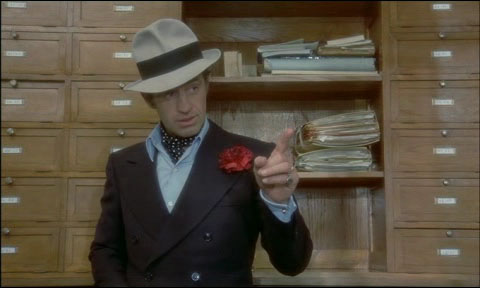
Belmondo, a decade after Pierrot le fou and still looking the same:
image

Jean-Paul Belmondo as Stavisky/Alexandre is dazzling, a con-man with absolute confidence in himself. Arlette is his glamorous wife, and he’s surrounded by associates, some complicit in his underhanded dealings like assistant Borelli and Serge’s in-pocket doctor (Michael “Thomas” Lonsdale) who keeps declaring Stavisky unfit to stand trial for a six-year-old fraud offense… and some are just content to spend time with Stavisky, enjoying his company and not asking questions, like friend Baron Raoul (an outstanding Charles Boyer).

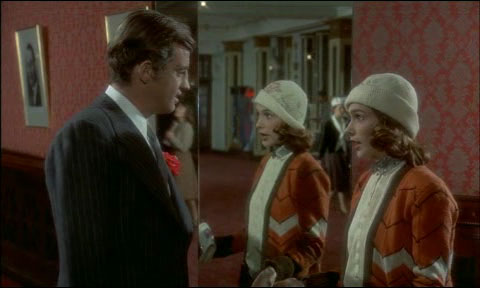
Arlette: Anny Duperey’s debut was seven years earlier in Godard’s Two or Three Things I Know About Her.
image

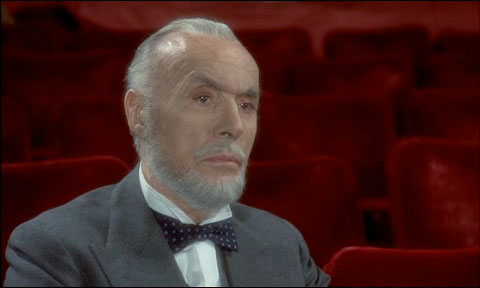
The book says “Barol Raoul’s looks, gestures, diction and bearing are those one would expect a baron to possess in those films where barons play a part.” That’s hilarious… I hope those are the character notes they gave to Charles Boyer.

This was French superstar Boyer’s second-to-last film. I saw him as the star of Fritz Lang’s not-so-good Liliom. He is the second actor I’ve seen lately (after Maurice Chevalier) claimed to be the inspiration for Pepe le Pew.
image

As Stavisky’s right-hand man, beloved character actor Francois Périer of Nights of Cabiria, Orpheus, Le Samourai, also narrated some Chris Marker films. From the book: “Albert Borelli’s face is impassive, but he has a sharp eye. He is a man of few words but not of few thoughts.”
image

No wonder I had trouble with inspectors Bonny and Boussard – it’s complicated. Boussard arrested Stavisky years ago, and a couple years afterwards Serge became Boussard’s “informant” – actually Serge pays Boussard to keep an eye on things inside the police department, and the informant thing is just a front so they can meet. Bonny has it out for Serge, hires the blackmailer who comes to the theater during auditions to extort money from Stavisky by threatening to expose his past, and later engineers the police raid during which Stavisky shoots himself. Plus I always have to look hard to tell which Inspector is which, since they look and dress the same.

Inspectors Boussard (left, Marcel Cuvelier, also played an inspector in The War Is Over) and Bonny (right, Claude Rich, star of Je t’aime, je t’aime):
image

Bad Boy Bonny:
image

Michel Grandville (Jacques Spiesser of The Man Who Sleeps and Black and White in Color) and Erna Wolfgang (Silvia Badescu), who auditions for a part at Stavisky’s theater (he reads with her, playing a ghost – see quote below):
image

Lonsdale, after “Serge Alexandre” tells him to get rid of Stavisky and his problems: “The person he once was has become someone else: a ghost he despises. But a ghost who worries him.” And later: “To understand Stavisky sometimes you have to forget files. You have to dream of him and to imagine his dreams.”

Dream doctor Michel Lonsdale:
image

Gérard Depardieu got his break as a star just two months earlier. Here he has one scene as an excited young inventor trying to get Stavisky to invest in his product:
image

And back to Erna Wolfgang. I just liked this shot.
image

One more look at Thomas:
image

I wasn’t in love with the movie after I watched it, seemed like a really well-done portrayal of a controversial man with great acting and an over-complicated plot, but reading the book afterwards cleared up all the characters and the structure of the whole thing, and thinking back on the story, acting and photography, I’m now liking this better than The War Is Over. Nobody here is a good guy – not even Bonny, who goes against police corruption but for personal & political reasons – but the movie doesn’t judge them, or go into the details of the scandal. It just gets inside their characters and shows where the scandal came from, how one guy’s belief that he could fake his way into the upper echelon ended up shaking the country.

image

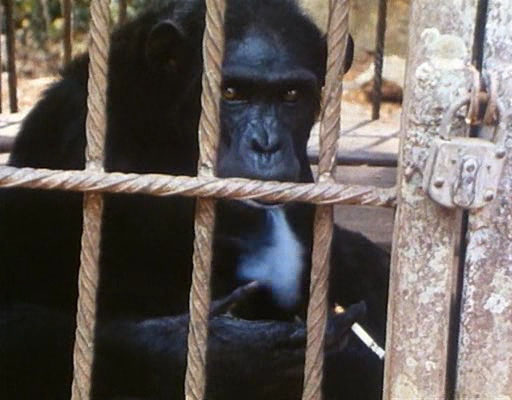
Not very Herzogian – the great man doesn’t interject any commentary of his own, letting his narrator (journalist Michael Goldsmith) do all the leading and interviewing, and not cutting away when Goldsmith follows up interview subjects’ stories of being imprisoned and tortured for years by order of Central African Republic dictator Jean-Bédel Bokassa with Goldsmith’s own oft-repeated story (“you know, I was imprisoned for a month myself”). Gives the feeling that it is the journalist’s film and Herzog is a director-for-hire, which is probably not true. The movie does, after all, end with a caged monkey smoking a cigarette, which isn’t a typical way to end a journalistic interview-doc. And it opens with Herzog himself reading a letter from Goldsmith over beautiful, otherworldly shots of migrating crabs. It’s just the bulk of the film in between those animal bookends that seems kind of typical.

Bokassa, fallen dictator:
image

Bokassa himself seems sadly typical – a military leader of an African country who took over the government, becoming more corrupt, horrible and bizarre as his rule progressed. We talk with a couple of his (many) wives and some kids, including one who was involved in a fraud/mistaken-identity comedy which led to her having a sister with the same name who got married on the same day as her.

image

Goldsmith survived torture and imprisonment in Central Africa, and returned safely from Liberia (where he had gone missing at the time of this film’s completion), only to die of a hemorrhage in late ’90, shortly before the film premiered.

Fascinating movie. I think Katy liked it too, though we were both a bit upset after she vetoed my triple-feature short-doc selection at the last damned minute.

image

“Why sometimes do images begin to tremble?”

From the film:

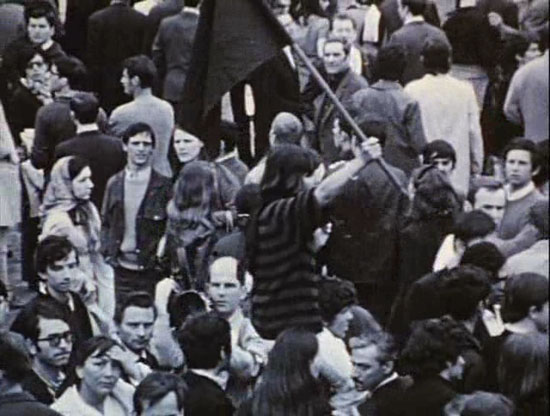
1967 saw the arrival of a rather peculiar breed of adolescents. They all looked alike. They would immediately recognize each other. They seemed to posses a silent but absolute knowledge of certain issues but to be totally ignorant about others. Their hands were unbelievable skillful at pasting up posters, handing paving stones, spraying on walls short and cryptic messages which stuck in the memory, all the while calling for more hands to pass on the message they’d received but had not completely deciphered. Those fragile hands have left us the mark of their fragility. Once they even wrote it on a banner. “The workers will take the flag of struggle from the fragile hands of the students.” But that was the following year.
image

Watched the 3-hour 2008 edit with English narration. There are so many versions of this out there… maybe next time I can watch the 2008 or 1977 French with subtitles.

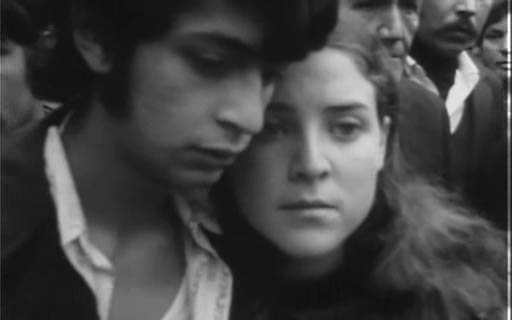
I thought I’d have more to say about it… three hours’ worth of Chris Marker’s most celebrated film, but I don’t really. Marker is mainly credited as an editor here, arranging others’ footage to show a bigger picture. There’s no wall-to-wall narration, just pops up occasionally. And I’m starting to notice a real sadness beneath many of Marker’s films… the same feeling in Chats Perches is present here. Glad I prepped a little by watching Sixth Side of the Pentagon and Battle of Chile, but I still had to check on wikipedia to see what exactly happened in Bolivia (Che Guevara killed Oct. 1967) and Prague (Jan-Aug 1968, attempted reform of Czech socialism led to 30 years of Soviet military occupation). The movie isn’t here to teach basic history of revolution – assumes you know something already, and since I quit reading The People’s History of the United States before it reached the 1900’s, I do not. Still, was able to follow the movie, thought lots of the footage was excellent, enjoyed watching and learned a little. Some segments have little gems of Marker wit in their editing or narration, but much of it is making connections between different scenes of revolution, both real and wishful, and thinking about what has been achieved, what might have been achieved. Really have to watch again sometime.
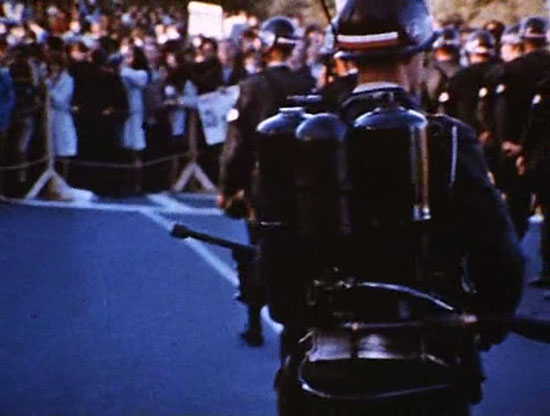
image

Either this was an early use of the electronic soundtracks that Marker would use in Sans Soleil and beyond, or the sound on my copy of the movie was pretty badly distorted. Or, more likely, both. The sound got worse during part two – there were some sections when I couldn’t make out any of the (English) dialogue.

image

Video and audio footage by: Pierre Lhomme (Mother and the Whore, Le Joli Mai, Army of Shadows), Etienne Becker (The Spiral, Le Joli Mai, Malle’s Calcutta), Michele Ray (Latcho Drom), Francois Reichenbach and his crew, Harald & Harrick Maury (The Owl’s Legacy, Day For Night, In the Year of the Pig), Théo Robichet (Band of Outsiders), Pierre Dupouey (Silence… on tourne), Raymond Adam (Jodorowsky’s Tusk), Paul Bourron of the Dziga Vertov Group, Willy Kurant (Far From Vietnam, Masculin-Feminin, Pootie Tang), Peter Kassovitz (Jakob the Liar), Paul Seban (Welles’s The Trial), Michel Fano (Rivette’s The Nun), Fernand Moskovitz (Last Tango in Paris), Yann Le Masson (Je t’aime moi non plus), Mario Marret & Carlos de los Llanos (À bientôt, j’espère), Jimmy Glasberg (Sans Soleil, Shoah), Robert Dianoux (Africa, I Will Fleece You), Jean Boffety (Thieves Like Us, Je t’aime je t’aime, Adieu Philippine), Robert Destanque (Joris Ivens’s The Threatening Sky), Hiroko Govaers (Terayama’s Fruits of Passion), Michel Cenet (Celine and Julie Go Boating), and an excerpt from Volker Schlöndorff’s The Lost Honor of Katharina Blum. That is quite a list of collaborators, though you never hear anyone talking about them.

image

English voices: Jim Broadbent (Brazil), Cyril Cusack (Fahrenheit 451), Robert Kramer (dir. Ice, Against Oblivion), Alfred Lynch (The Hill), and numerous British 1970’s TV actors.

“You can never tell what you might be filming.”

Quotes and other reactions:

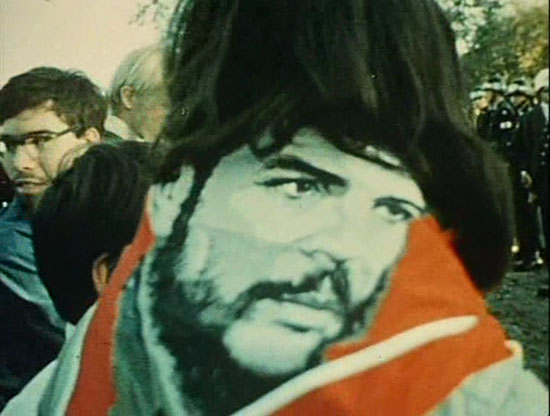
Icarus Films calls it an “epic film-essay on the worldwide political wars of the 60’s and 70’s: Vietnam, Bolivia, May ’68, Prague, Chile, and the fate of the New Left.”
image

J. Hoberman: “Marker begins by evoking Battleship Potemkin, and although hardly agitprop, A Grin Without a Cat is in that tradition—a montage film with a mass hero. Unlike Eisenstein, however, Marker isn’t out to invent historical truth so much as to look for it. (The untranslatable French title, Le Fond de l’air est rouge, is a play on words suggesting that revolution was in the air but not on the ground.)”

Paul Arthur: “In its rhythms and editing structures, Grin tries to embody the very shape and textures of historical transformation, rendering the abstraction of change as an amalgam of rapid, plurivocal, uneven, and, at times, contradictory forces aligned in provisional symmetries encompassing past, present and future perspectives.”

image

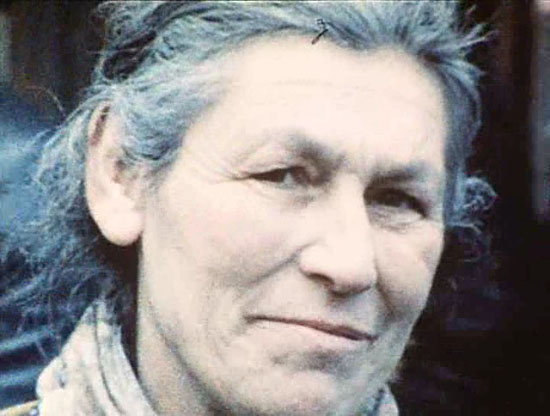
Y. Meranda: “The editing de-emphasizes the narrative structure and instead stresses the poetical interrelationships of the sequences by putting almost all of them out-of-context. … Paralleling the visual editing, the sound editing is more based on poetical considerations than on intellectual ones. … Because there is very little attention paid to the intellectual arguments and because the style goes beyond making statements about a political ideology, A Grin Without a Cat becomes much more than a left wing documentary about the left: It achieves to be a poem about revolting against the system (and not just the political system), the conformity and the order. It suggests that it is an eternal struggle that is supposed to fail (as was in the case of the New Left) most of the times. This universality, achieved by Marker’s distinctive style, is what makes the film great.”
image

Excerpts from the Lupton book:

“Marker explicitly pitched the film against what he saw as the historical amnesia surrounding the period promoted by its treatment on television, where ‘one event is swept away by another, living ideals are replaced by cold facts, and it all finally descends into collective oblivion.'”

Movie is partially composed of outtakes from other projects. “Introducing the published script, Marker wrote that he had become curious about all the material that had been left out of militant films in order to obtain an idealogically ‘correct’ image, and now wondered if these abandoned fragments might not yield up the essential matter of history better than the completed films.”

“As a groundbreaking work of visual historiography, Le Fond attempts nothing less than to give cinematic form to the chaotic and contradictory movement of world history during the tumultuous decade that it covers.”

“The reappearance of cats, even in this thoroughly politicized context, is a signal that Chris Marker was beginning to re-emerge from the anonymity of unsigned militant productions and to reintroduce into his work the familiar tokens of his own distinct presence.”

image

Chris Marker:

Scenes of the third World War 1967-1977

Some think the third World War will be set off by a nuclear missile. For me, that’s the way it will end. In the meantime, the figures of an intricate game are developing, a game whose de-coding will give historians of the future – if they are still around – a very hard time.

A weird game. Its rules change as the match evolves. To start with, the super powers’ rivalry transforms itself not only into a Holy Alliance of the Rich against the Poor, but also into a selective co-elimination of Revolutionary Vanguards, wherever bombs would endanger sources of raw materials. As well as into the manipulation of these vanguards to pursue goals that are not their own.

During the last ten years, some groups of forces (often more instinctive than organized) have been trying to play the game themselves – even if they knocked over the pieces. Wherever they tried, they failed. Nevertheless, it’s been their being that has the most profoundly transformed politics in our time. This film intends to show some of the steps of this transformation.

More images:

image

image

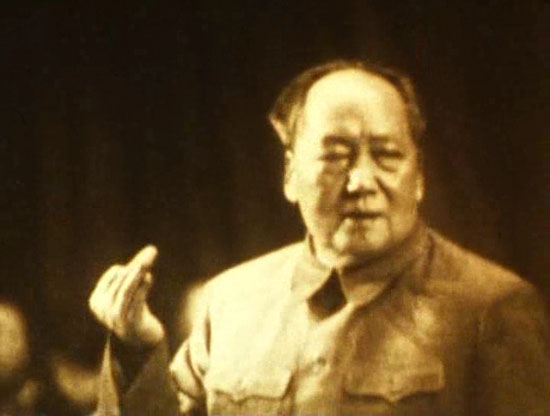
The Chairman:
image

Funeral in Prague:
image

Last footage ever shot of Salvador Allende:
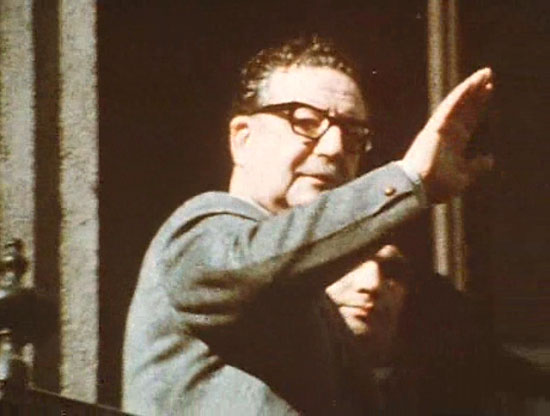
image

Allende’s daughter, who would commit suicide in 1977:
image

Fidel in Russia:
image

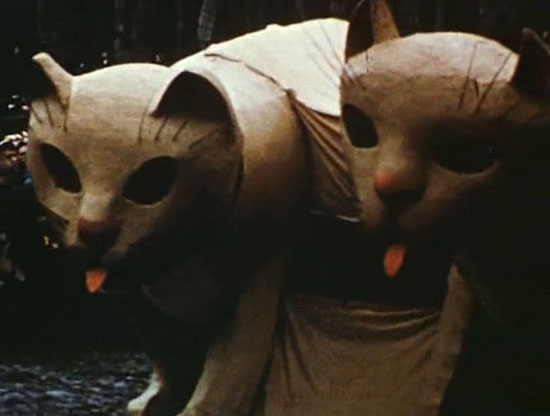
Enormous cats (no owls):
image

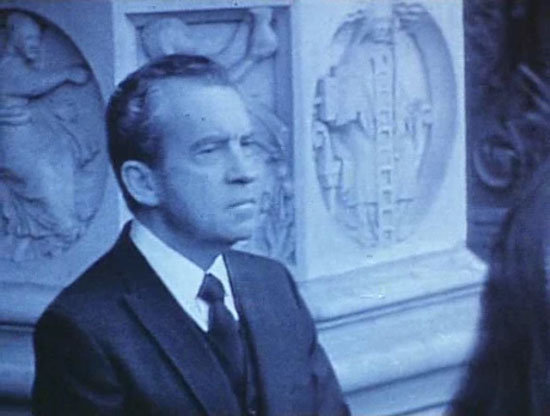
Nixon looks on:
image

A different kind of movie than the other Marker works I’ve seen. Really this is what I’d been waiting for: the politically-engaged street filmmaking of the 60’s and 70’s combined with the travelogue gaze and personal essay style (with distancing commentary) of Sans Soleil. Didn’t fill me with joy like most of Marker’s movies do, however… more contemplative and sadder, takes more time to think about each section and let them all sink in. Uses public artwork of cats to weave from Sept. 11th reactions to political situations in France to the death and imprisonment of friends and entertainers in such a way that, like Sans Soleil, I don’t realize what the film is about until I watch it again. Two versions of the film… first time I played it with English narration, then a couple weeks later I ran the French version with live sound and no narration, just scattered intertitles. Shockingly (since I usually love Marker’s narrations) I liked the second way better. But then, I got more out of it having just seen the English version. So I’d recommend both as a double-feature!
image

Quotes below are from the English commentary.

Opens with a flash mob in Paris. People mill around opening and closing umbrellas, to music from Alfred Hitchcock Presents.
image

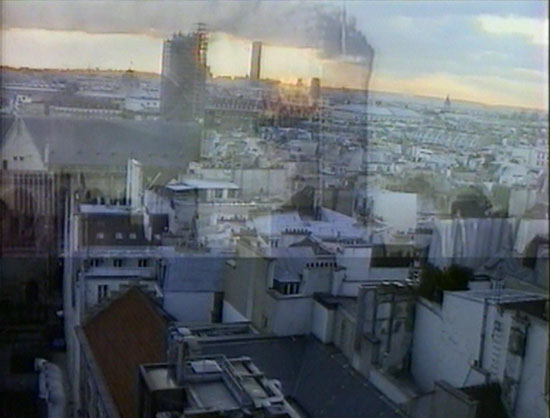
November 2001 Paris. September 2001 New York.
image

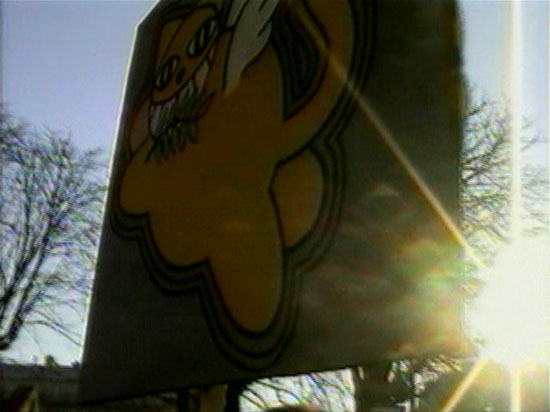
Cats on a roof, on buildings high and low, hidden in a tree.
image

The metro, a bridge, signs of Paris from long ago. Presidential election at the end of year… the left is split, so the far-right candidate Le Pen comes close to challenging the incumbent Chirac, who is defensively re-elected after protests in the streets against Le Pen.
image

“Let’s face it: these girls with their war paint are lovely, but the fascist legions are not besieging our gates. And if Le Pen is a dictator, it’s mainly against his own people. Yet what we see here coming onstage is an entire generation that was spoken of as being apolitical.”
image

More about the cat, appearing in the evening news and all over the internet.
image

March 19th, Bush (backed by Blair) declares war on Iraq, but UN inspectors find no weapons. More street protests in Paris, but as with the American protests of the time, they’ve splintered into hundreds of mini-demonstrations. “Why should the streets of Paris be less chaotic than the rest of the world.”
image

The plundering of Iraqi museums in April, a “die-in” for the victims of AIDS in June. “In these times, we the people gathered to watch eleven billionaires kicking a ball. What about the French team? Stalinesque-sized posters, as we had never seen the like of in Paris – and not one goal recorded.” More about street demonstrations with “a certain fuzziness in the symbols.” “It’s a great asset in life, not to know what you’re talking about. Marker follows political and popular developments with great interest but without total enthusiasm, removed from it all. Seems like he’s either saying “it’s nice that they’re trying, but their struggles are shadows of the struggles I lived through” or “this is what I was once like, with the same futility and wasted energy.”
image

Sees a personal friend (below) in a street crowd, then records news footage relaying that friend’s death at age 79 soon afterwards. Flashback to 1999, at a concert benefitting a cause that same activist friend had supported, Marker had filmed a young singer, who five years later had become famous for accidentally killing his actress girlfriend. “And you wonder why the Cats abandon us?”
image

What if they left us for good?”
‘We were the Freedom Cats. If you didn’t catch the message, just move on!’
And then – comes a sign.
The same unknown hand has painted circles of Cats on the sidewalk, to watch over our sleep.
Thank you, Cats.
We will badly need you…
…wherever we go.

image

This film is dedicated to M. Chat and those who, like him, are creating a new culture.
image

“Popular unity against the criminal bourgeoisie!”
image

Other street protest chants:
“Bourgeois shit, the street belongs to the left!”
“We need an iron hand!” (?!)

I alternately see this referred to as an epic 1979 movie, a long two-parter with a third-part postscript, or three separate movies. I guess they were presented theatrically in different ways in different countries. The 2/1 split seems right to me, as I’ll explain.

Part one drops me into the middle of an election in March 1973, which I didn’t understand until towards the end of the movie. I wondered why nobody was saying Salvador Allende’s name – turns out it was a senate election, and either the pro-Allende party lost, or they just did not gain enough seats in congress to prevent the opposition from holding a majority. So for the rest of Allende’s short reign as president, the country’s senate is mostly against him, undermining his authority. Movie is on the street, taking opinions from everyone, kind of slow at the start since I don’t know what’s happening, but excitement is in the air, and things straighten out soon enough. Cameraman is terrific, patient but curious, always looking for the best thing to shoot even if it means wandering off the person talking. I can’t believe the sound guy can keep up with him, but he does.

Salvador Allende:
image

A politician:
image

image

image

Part two picks up right where the first one ends, with an attempted military coup on June 29 1973, and part two ends Sept. 11 1973 with the successful coup that killed Allende and instated General Pinochet as ruler. In between those dates, Guzmán covers everything that happens in the whole country, it seems, with access to the marches, the debates, worker meetings, everything but the secretive military that turns against its country (with help and provocation, it turns out, from the U.S. government). This is by far my favorite of the three parts, and could easily work as a standalone movie… I see the Film Forum in NYC thought so as well. The events themselves, a democratic country swerving communist then falling military-dictatorship, is the best movie material you could hope for and Guzmán and his crew make the best of it, watching from ground zero as history is made, producing one of the best docs I’ve ever seen.

Military man who shot and killed Argentine cameraman Leonard Hendrickson at the end of part one:
image

Salvador Allende, file photo:
image

Bombing of the presidential palace:
image

Pinochet addressing the nation on TV:
image

Military rule:
image

Pinochet: “After three years of support for the Marxist cancer we have been given a disaster that is economic, moral and social, that could not continue to be tolerated by the sacred interests of the mother country.” (or something like that – I think it’s all amateur-translated)

Guzmán: “From the 11th of September, all resources of the Chilean army are mobilized to repress the popular movement with the compacency of the North American government. The first armed resistance offered by some industrial cords, agricultural populations and student centers are squashed quickly in unequal fight. Thousands of people are killed and the main sport fields become concentration camps. The longest democracy in the history of Latin America ceases to exist.”

I don’t exactly wish I’d skipped part 3, but it would’ve made a nice recap six months later instead of watching it right after 1 and 2. Filmmaking in Chile wasn’t easy during Pinochet’s rule, since Pinochet was killing and imprisoning everyone who disagreed with him, including the cameraman of Battle of Chile (to whom the completed work was dedicated), so Guzmán backs up and shows further details of the workers’ movements during Allende’s presidency, not again mentioning Pinochet or the violence. The many worker meetings and the creation of multi-factory blocs and the attempted attack on Allende’s credibility by the “Christian Democrats” (his primary opposition) via a U.S.-funded transportation strike had all been covered in the previous films, but now we see them in greater depth… “depth” meaning lots of guys with sideburns talking into microphones at meetings. Since I’m not personally interested in creating a communist worker’s paradise in my own neighborhood, part three wasn’t of much use to me, but I’ll bet it’s exactly what Chris Marker was hoping for when he helped fund Guzmán’s efforts to document what was happening in the country. Marker’s own angry reaction to the coup is documented in his short Embassy, which I’ll have to watch again now that it’s on a new, clean DVD.

The transportation strike:
image

The people:
image

The sideburns:
image

The revolution:
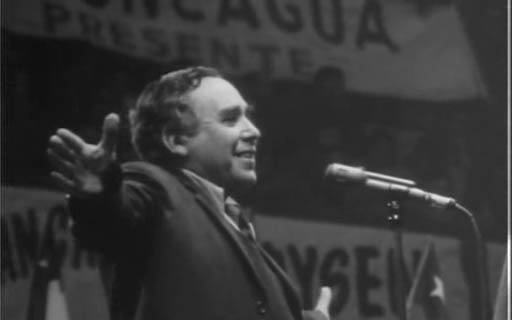
image

Edit, one week later:
I unexpectedly got to see this again, in the theater in Nashville when Phantom Love was postponed. The festival guy described it as an “experimental documentary”, and that got most of the packed theater to walk out right there. A few more left immediately after the subtitled berry-mashing chant that opens the picture, and more shuffled out gradually until around the 1920’s there was only me and the two other people who stayed till the end. Movie makes me extremely happy, glad I saw it again. Was on video, though, so not real different from my home viewing, only larger.

——–
Apr 14:
I was nervous about this one, and wouldn’t have rushed to watch it if not for the Hidden in Plain Sight connection. On one hand, it made top-ten lists last year and was featured on the front cover of Cinema Scope, a magazine that hardly ever steers me wrong. On the other hand, it’s an hour-long narration-less tour of gravesites, which sounds less than exciting.

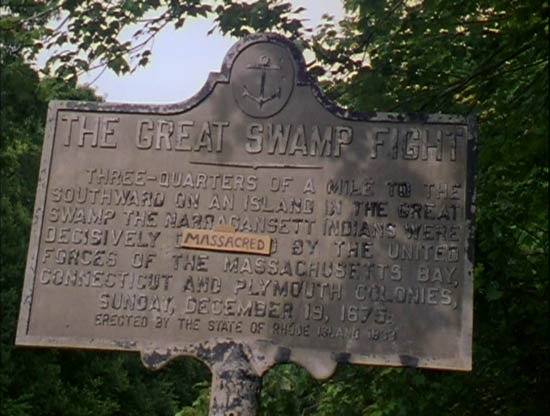
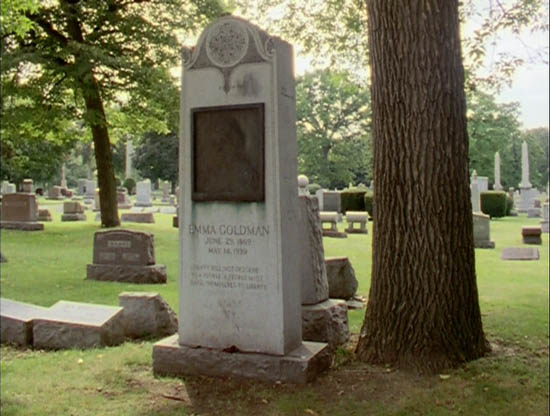
Cinema Scope was right. A moving, beautiful film which I now want to show to everybody I know. Peaceful and contemplative, with shots of trees and fields to break up the reading of gravestones and historial markers. The graves include people I know of (Frederick Douglass, Malcolm X, Emma Goldman, Paul Robeson), people I SHOULD know but don’t know very well (Mother Jones, Sacco & Vanzetti), people whose social relevance is explained by the text on the markers (the founder of the first all-female labor union) and people and events I was inspired to look up on wikipedia (Philip Berrigan: a pioneering Vietnam War protester, Lucretia Mott: women’s rights advocate in the 1800’s, The Ludlow Massacre, when the Colorado National Guard murdered the children of striking mine workers in 1914).

image

Felt good to watch, moving and energizing, not morbid despite the cemetery locales and mentions of massacres and executions. Shows these past people & events, triumphs and defeats, from today’s perspective, mostly a natural perspective with no living humans in the shot, but sometimes an Exxon will be seen across the street from a cemetery, cars will be whizzing by a historical sign, a marker will be located in the parking lot of a PetCo (!). Closes with some recent protest footage with lively editing. The struggle continues.

CScope: “In addition to forging a radical remapping of the American terrain, Gianvito’s film provides its audience with the rare opportunity to pay our respects by proxy.”

image

JG: After September 11, 2001, “I found myself re-reading stretches of Howard Zinn’s A People’s History of the United States, re-encountering some measure of what is admirable in this country’s past, the words and deeds of so many, known and unknown, who contributed to the historical struggle for a more just and egalitarian society. In time the idea took root to pay homage to this significant history, as well as to this book which continues to mean so much to so many of us, and by so doing, the hope was to draw sustenance from the sacrifices and efforts of those who came before us. Profit Motive and the Whispering Wind was intended to be a small poem to this progessive past.”

Won best screenplay at Cannes, nominated for the golden palm. I was startled to recognize the lead guy from Werckmeister Harmonies as the German bookshop owner. Didn’t notice that his aunt Tunde in Werckmeister played Mrs. Straub, through I knew she looked familiar so I should’ve figured that out.

Well shot, edited, scored, etc., with no real attention-grabbing technical aspects. VERY well written and acted – focus here is on story and character. One of those interweaving-narratives things, but not annoyingly so. Emotional human story, multilayered, examining freedom and moral decisions and parent/child relationships, but subtly. When Ayten is spit upon by her former comrades as she abandons their cause in prison to go home with her girlfriend’s mother, there’s just that moment to think about later, not a whole conversation about the relative importance of family, love, freedom and politics. It’s a moral tale.

Prostitute Yeter Öztürk is estranged mother to young rebel Ayten. Ali Aksu is father to German professor Nejat. Susanne Staub is mother to student Lotte. The parents are all widow(er)s, the kids all unattached, until Ayten, in hiding after a political rally gone bad, stays with Lotte and they fall in love. Ali “rescues” Yeter from her prostitute life, but later he drunkenly strikes her, she dies and he goes to prison. Nejat disowns his father and moves from Germany back to Turkey, settling in Istanbul to find Ayten, tell her about her mother’s death and offer to fund her studies. Those two never connect, even though Lotte (and eventually her mother) stays with Nejat. All of the characters end up staying with each other, and not counting Ali’s attempted ownership of Yeter, it’s all out of love, compassion, generosity. Ali is the worst of the six, but he’s not a monster, and the film ends with Nejat (and us) going to Ali’s hometown to reconcile with him as Lotte’s mother Susanne works on forming a bond with her murdered daughter’s lover Ayten. Ayten is abandoning her rebel cause, which has good values at heart but also had an obsession with guns and violent protest that indirectly led to Lotte’s death, so you feel that Ayten is doing the better, more human thing by leaving, that by living her life (with or without new mother-figure Susanne) and holding onto her values she can do far more good than she could imprisoned in solidarity. Ends on such a spiritual high that it made my face hurt from wanting to cry. A beautiful movie, rivaling Paranoid Park as the best thing I’ve seen in theaters this year.

Set in the near-future of summer 2008, which would’ve worked better had the film played more than a couple film festivals in its intended release year of 2006.

image

I could go on and on summarizing plot strands and talking about story bits like Liquid Karma being harvested from the center of the earth and injected into Iraq war soldiers to give them psychic communication powers, TV ads that feature cars fucking each other, multiple sets of identical twins, triple-crossing double-agents in an undercover war between government spy corporations and the neo-Marxist underground… but it’s not worth recounting, really. I find the following bits more interesting:

1. The casting choices. Are they meant ironically, humorously, or meta-post-something? Admittedly some of these people are good actors, but it seems like stunt-celeb casting akin to Steve Guttenberg dancing in a reality show. These people actually appear in this movie:
– teen idols The Rock, Buffy, Seann William Scott, Mandy Moore & Justin Timberlake
– TV comedy vets John Larroquette, Jon Lovitz and Will Sasso
– SNL comics Nora Dunn, Cheri Oteri and Amy Poehler
The Princess Bride‘s Wallace Shawn
– Christopher “Highlander” Lambert
– The ghost expert from Poltergeist (now in her 70’s)
– Donnie Darko’s uptight teacher, but with an unpleasant fake accent
– Donnie’s dad Holmes Osborne
– Janeane Garofalo (somehow I did not recognize her)
– Kevin Smith in heavy old-man makeup
Mulholland Drive‘s Rebekah Del Rio (below)
– 80’s movie nerd Curtis Armstrong (Cusak’s wired friend in Better Off Dead)
– Miranda Richardson of Spider and Sleepy Hollow
– Bai Ling of Dumplings and Sky Captain

image

2. Apparent product-placement for Bud Light in both the movie and the comic, and empty references/namechecks of Robert Frost poems and Robert Aldrich films and Philip Dick novels. A location called “Fire Arcade” could fit in this category as well.

3. The post-modern fractured storytelling aspect, complete with lots of internetty technology business in plot and presentation. Doesn’t work as well as it did in Redacted, and it remains to be seen whether this concept will ever work completely in any movie (a fixed-length linear medium) or whether movies should simply not try to emulate DVDs, CD-ROMs and websites. At least the story was told in chronological order (as was Redacted).

A scarred and blood-drenched teen idol, who must’ve shot a lot of scenes that got cut out of the picture since he never quite seems to fit in:
image

4. The gall of this thing to exist, with its bad acting, big budget and mishmash story. It truly feels like Kelly was afraid that this might be his last film (it won’t – his Cameron Diaz and Cyclops starring follow-up with hardly any stunt casting is in post-production) and wanted to make it about every single idea he’d ever had all at once. Global warming! Internet privacy! Individual identity! The US perpetual war machine! Fart humor! Religion! If you want to be unkind you could say the fractured storytelling wasn’t even purposeful but just reflects Kelly’s total lack of focus on a single story or concept.

5. Commonalities with Darko (Kelly’s continuing obsessions with pop songs, 80’s culture, time travel and memory).

Parts of the comic, like the rapidly-growing baby and the bit about certain people evolving beyond the need to defecate are missing from the film except in coded messages. You poo too?
image

But these are the most interesting aspects of a kinda uninteresting movie. I’d have to say the whole enterprise was a waste of time, time better spent watching Stephen Chow kick stuff in Royal Tramp II. At the end there is an explosion, a young guy who goes through a rift in the space-time continuum, and someone who is shot in the eye. Why would a studio pay $17mil for a crappy remake of Donnie Darko? Then there’s a line about the messiah being a pimp. This is the way the movie ends. This is the way the movie ends.