Porky’s Romance (1937)
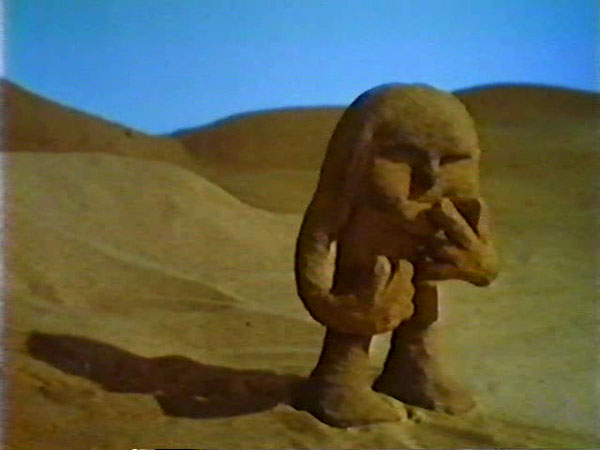
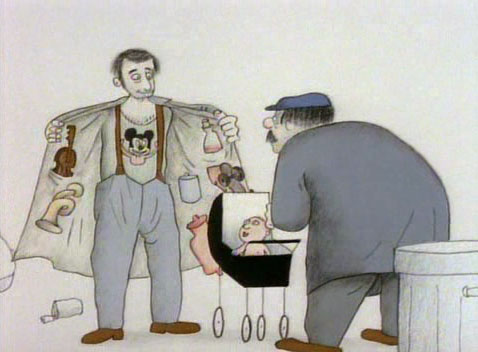
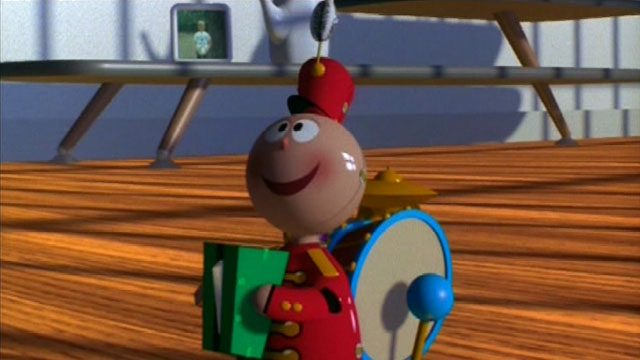
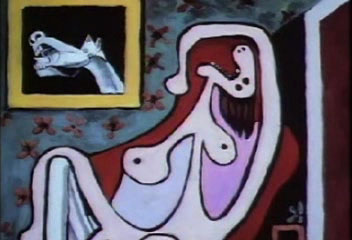
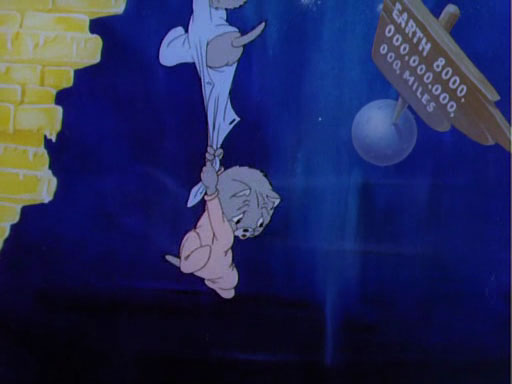
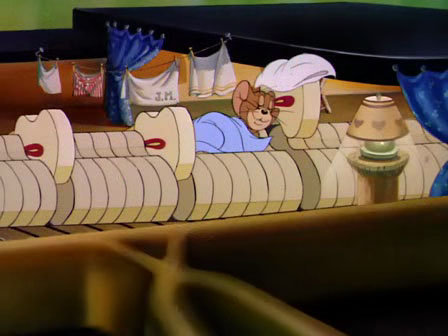
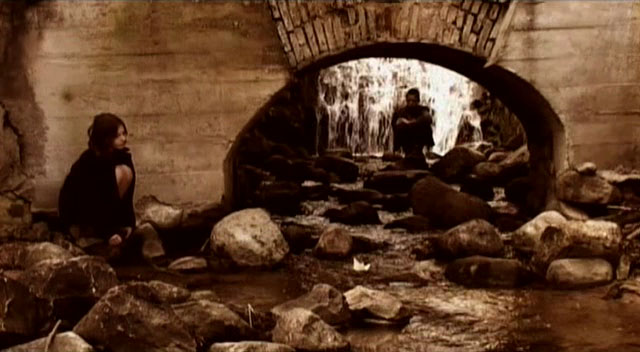
Porky has barely been introduced and he’s already attempting suicide. First Petunia Pig short – she’s stuck-up and candy-obsessed, with a fancy dog – rejects our man, changes her mind, then in a dream daze he predicts a miserable life with fat, lazy Petunia and flees. Some character introduction… no wonder Petunia didn’t take off. Song “I Wanna Woo” is featured. Don’t know much about 30’s music (despite once replaying the Singing Detective soundtrack for a whole month) but I suppose the Looney Tunes series would showcase popular songs onscreen, the Grey’s Anatomy of its time.
image

Porky’s Double Trouble (1937)
An escaped con looks just like Porky, kidnaps him and replaces him as bank teller for easy money. Two surprises: meek Porky kicks some criminal ass in the finale, and Petunia drops Porky to lust after the killer even as he’s being arrested.
image

The Case of the Stuttering Pig (1937)
The local lawyer takes Jekyll-and-Hyde Juice, calls the audience a bunch of softies and creampuffs, goes after Porky and Petunia’s family to steal their inheritance, defeated by having a chair thrown at him by a guy in the audience.
image

The Woods Are Full of Cuckoos (1937)
Hooray, more owls. Also, the word “esophogi.” The rest isn’t so amusing, all caricatures of 30’s personalities who I mostly don’t recognize.
image

Have You Got Any Castles? (1938)
Opens with a cuckoo – nice continuity. Another collection of caricatures, but this time it’s book titles and characters, something with which I’m more familiar. More excitedly animated and sung than Cuckoos as well. Named after the Johnny Mercer tune.
image

Porky’s Road Race (1937)
More celebrity caricatures, including a parody of the scene where Chaplin goes nuts with his wrenches in Modern Times. Hard to imagine, but that was a current film at the time. The plot is minimal, but among all the film references Porky manages to beat Borax Karloff in a car race. Future head writer Tedd Pierce voices W.C. Fields and Mel Blanc makes his debut.
image

Speaking of the Weather (1937)
Another musical caricature piece, this time with magazines come to life instead of books – even the exact same Thin Man gag. This one has more of a story – a criminal sentenced to Life (heh) escapes and a team of mag covers helps bring him in. Castles has guns firing from All Quiet on the Western Front and Weather has scout troops from Boy’s Life – same idea. Each seems to have been named after a song featured for only half a minute and having nothing to do with the rest of the picture. At least The Woods are Full of Cuckoos is set in the woods. Maybe it’s some contractual co-branding with the music companies, if they had such a thing in the 30’s.
image

Porky at the Crocadero (1938)
P.P., with a music degree from the Sucker Correspondence School becomes band leader at a jazz club, probably imitating other bandleaders of the time but the only one I recognize is Cab Calloway.
image

Porky the Fireman (1938)
Ooh, an animated (and multiplied) Keaton gag, circus tricks, smoke and ash turning frantic white people into lackadaisical black people, murder and mayhem. In the end, the fire wins.
image

Wholly Smoke (1938)
I can’t tell what nationality Porky’s mother is supposed to be: “nix on the mud-playing-in.” An anti-smoking ad with Porky as a stooge conned into trying a cigar by a tough kid. Cameos by the Three Stooges and I think Bing Crosby.
image

Porky Pig’s Feat (1943)
Porky and Daffy are broke, try unsuccessfully to escape from an absurdly high hotel bill. References to Dick Tracy and to other Looney Tunes, including a Bugs punchline at the end. Joe Dante commentary: “By the time he passed away, his career had falled on hard times with bad vehicles for actors of waning popularity.”
image

Swooner Crooner (1944)
Porky’s wartime egg factory is endandered when the hens’ attention is captured by a crooning rooster, leading to a Crosby/Sinatra showdown. Is it naughty that the crooners’ voices make the girls all lay eggs? Also the third Al Jolson caricature I’ve seen today. Oscar-nominated, beaten by a Tom & Jerry.
image

Hare Remover (1946)
I take it Tashlin didn’t do many Bugs cartoons. Elmer (looking a little primitive) is a wannabe mad scientist who recruits Bugs to test a formula which doesn’t seem to do more than taste awful (and explode when thrown).
image

Also watched a short doc on Tashlin’s career. Sounds like his comic strip Van Boring was the Dilbert of its time. Would’ve been great if they had clips from the live-action films instead of just a few stills.

The Bridegroom, The Comedienne, and the Pimp (1968, Straub/Huillet)
Four minutes in, it’s just been a long car ride in the rain with opera music playing (there was no sound at all for the first two minutes) and I am very suspicious.

Five minutes in, cut to a stage set, with German words on the wall and a clattering wood floor. Rivette (or Michael Snow) would be pleased. A fast-paced stagey farce follows. Blackout, next scene but the camera hasn’t moved, hasn’t even cut for all I know. Actors include Fassbinder regular Irm Hermann, composer Peer Raben, and future superstar Hanna Schygulla (who I’ve recently seen in The Edge of Heaven, Werckmeister Harmonies and 101 Nights of Simon Cinema).

Bang, cut, new location, and back out on the street. An action scene. Jimmy Powell is marrying Lilith Ungerer (star of a couple Fassbinder films). They go home, the pimp (Fassbinder himself, early in his career) is there, she shoots him and gives a speech as the music returns. All affectless acting.
image

So, what was that all about? Well the title refers to the cinematic drama in the third section, that much is clear. And the actress and the pimp were in the stage play in the middle. IMDB fellow says “The film has its roots in a theatre production of a play by the Austrian playwright Ferdinand Bruckner which Straub had been asked to direct by a German theatre company. He considered the play too verbose and cut its length from several hours down to just ten minutes, and it is the production of this play which forms the centrepiece of the film.” As for the beginning, the same guy says it’s a “Munich street frequented by prostitutes.” F. Croce calls it a “mysterious, structuralist gag” and notes that “filmic subversion can prompt political revolution, and transcendence.” No revolution or transcendence here – I just thought it was a weird little movie made by an overacademic sweater-wearing type. Was only Straub’s fourth work – let’s check out his tenth, which is half as long.
image

Every Revolution is a Throw of the Dice (1977, Straub/Huillet)
It’s in French this time. Actors sit in a half-circle near the memorial site for the Commune members and recite a poem. I’m mistrustful of the English subtitle translation of the poem, and there’s not much in the movie besides the poem (the recitants are as expressionless as in the previous film, maybe even more so), so there’s not much of value for me here. Actors include Huillet herself, Michel Delahaye (the ethnologist in Out 1) and Marilù Parolini (writer of Duelle, Noroit, Love on the Ground), shot by William Lubtchansky and dedicated (in part) to Jacques Rivette.
image

Mongoloid (1977, Bruce Conner)
Music video for a Devo song using (I’m assuming) all found footage (science films, TV ads and the like).
image

Mea Culpa (1981, Bruce Conner)
Dots, cubes, light fields and… whatever this is. Conner goes abstract! The music sounds like 1981’s version of the future. Aha, it’s Byrne and Eno, so it WAS the future. I didn’t know that Conner died last year, did I?
image

(nostalgia) (1971, Hollis Frampton)
of a photo of a man blowing smoke rings:
“Looking at the photography recently it reminded me, unaccountably, of a photograph of another artist squirting water out of his mouth, which is undoubtedly art. Blowing smoke rings seems more of a craft. Ordinarily, only opera singers make art with their mouths.”
image

So far I really like Hollis Frampton. His Lemon and Zorns Lemma were brilliant, and now (nostalgia) is too. Anyway this is the one where Frampton films a photograph being slowly destroyed on an electric burner while Michael Snow reads narration describing the next photograph that we’ll see. It’s important to know that Snow is the uncredited narrator for a humorous bit in the middle. The movie also has a funny twist ending that I wasn’t expecting. This would be part one of Frampton’s seven-part Hapax Legomena series. I have the strange urge to remake it using photographs of my own, but I lack an electric burner and a film/video camera.

Gloria (1979, Hollis Frampton)
Remembrance of a grandmother, Frampton-style, meaning annoyingly hard to watch and strictly organized. Clip from an ancient silent film, then sixteen facts about gramma (“3. That she kept pigs in the house, but never more than one at a time. Each such pig wore a green baize tinker’s cap.”) then a too-long bagpipe song over an ugly pea-green screen, and the rest of the silent film. Or as a smartypants would put it, he “juxtaposes nineteenth-century concerns with contemporary forms through the interfacing of a work of early cinema with a videographic display of textual material.” I prefer my version.
image

Prelude #1 (1996, Stan Brakhage)
I don’t think that I enjoy watching low-res faded videos of Brakhage movies. I’ll wait for the next DVD set to come out (or the next Film Love screening). As a side note, I cannot believe that Raitre plays stuff like this. Just imagine: art on television. Picture a single TV station anywhere devoted to showing art. Can you? Can you?!? I feel like screaming!!
image

NYC (1976, Jeff Scher)
Shots of the city sped-up, rapidly edited, reverse printed and hand colored, two minutes long with a jazzy tune underneath. Super, and short enough to watch twice (so I watched it twice).
image

Milk of Amnesia (1992, Jeff Scher)
I’m thinking it’s short scenes from film and television, rotoscoped, with every frame drawn in different colors, with some frames drawn on non-white paper (a postcard, some newspaper). Warren Sonbert is thanked in the credits. I would also like to thank Warren Sonbert.
image

Yours (1997, Jeff Scher)
An obscure musical short from the 30’s or 40’s overlaid with rapidly-changing patterns and images from advertisements. Descriptions and screenshots can do these no justice.
image

Frame (2002, n:ja)
Black and white linear geometry illustrating a Radian song. I can’t tell if it’s torn up by interlacing effects or it’s supposed to look that way. Give me Autechre’s Gantz Graf over this any day. Between this and Mongoloid and the Jeff Scher shorts, I’m not sure where to draw the line between short-film and music-video. Not that it’s a dreadfully important question, but I’m in enough trouble tracking all the films I have/haven’t seen without adding every music video by every band I like onto the list. Although maybe videos should be given more credit… I’m sure Chris Cunningham’s video for Squarepusher’s Come On My Selector would beat 90% of the movies I watched that year.
image

Zweigroschenzauber (1929, Hans Richter)
The intertitle says “Twopence Magic: a commercian in picture rhymes.” Movie shows us a thing, then crossfades to a similar-looking thing. Much better than I’ve made it sound.
image

Dada (1936, Mary Ellen Bute & Ted Nemeth)
Shapes in motion, quick.
image

Synchromy No. 4: Escape (1938, Mary Ellen Bute & Ted Nemeth)
A Bach music video, with black bars perversely imprisoning the viewer away from the orange and blue color geometric spectacle beyond.
image

War, etc. (1983, Leo Schatzl)
Crude drawings of planes, horizontal scratches give the appearance of speed, sound fx from old arcade games. Mix it up with some TV interference. Part of an installation which surely annoyed many (unless the sound was turned down).
image

OXO Wonder Vision (1996, Leo Schatzl)
Looks/sounds like the window of a plane flying through a cloud. Then the plane slowly sinks into a giant coffee pot. It must be endless fun to be an avant-garde video installation artist.
image

The Endless Sandwich (1969, Peter Weibel)
Pretty much this shot, a guy watching a guy watching a guy, until the TVs start staticking from the inside out, until our own TV statics, closing with a quote by the filmmaker.
image

Imaginare Wasserplastik (1971, Peter Weibel)
Meta-video-art using “television as a time-space switch,” only a minute long. Not great, but so far I like this guy better than Leo Schatzl.
image

Fluxfilm 1 (1964, Nam June Paik)
“pranksters”, “playful artists”, “ephemeral humor”: the Fluxus movement sounds like fun. But then the first film I watch is a pure white screen and silent soundtrack. What’s worse, someone has punk’d my DVD player so the clock is moving at half-speed.

Fluxfilm 2 (1966, Dick Higgins)
Still silent, closeup of a man’s mouth chewing. Okay, I’m done for now.

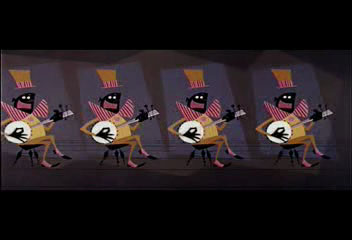
Allegretto (1943, Oskar Fischinger)
All colored diamonds and circles, so lovely. In close sync with the music, where in Motion Painting #1 the music seems an afterthought.
image

Motion Painting No. 1 (1947, Oskar Fischinger)
Like it says, a motion painting – oil on glass, all small rectangles and big spirals. In The Mystery of Picasso the tension was in figuring how the painting would be finished, where he was heading, but in this the fun is in getting from one intermediate step to another. The process is the destination. There should be more of these!
image

Franz Kafka (1992, Piotr Dumala)
Is the movie supposed to be making that sound of a cat in heat beneath the music, or is my laptop freaking out? Dark and scratchy and slow-moving, nothing actually happening. Oh wait, there’s some sex. Fulfills almost all of the Robyn Hitchcock holy keywords: sex, food and insects (what, no death?). I’m sure it’s very technically accomplished but I found it dreary and ponderous. The filmmaker made a plaster-scratch version of Crime and Punishment eight years later (or more likely he worked on it for all eight years).
image

Tales from the Far Side (1994, Marv Newland)
Very inessential, slow-paced animated half-hour of Far Side cartoons. Really the most interesting bit is seeing Marv Newland’s name, 25 years after his seminal Bambi Meets Godzilla. Either he’s no longer a master of timing, or there was too much Gary Larson interference… or maybe you just can’t turn a single-panel comic strip into a 30-minute TV special. Doonesbury worked out, but that was talky and story-driven to begin with.
image

Mr. Prokouk Shoots a Movie (1948, Karel Zeman)
Czech short, part of a whole series of Mr. Prokouk adventures.
image

Prokouk is pointing at us, telling us to get off our asses and join the workforce!
image

The Monkey’s Teeth (1960, Rene Laloux)
Intro is a three-minute doc of a group-therapy institution for depressed people, what follows is an animation of the film they wrote together. Sad man has a toothache, goes to a dentist who steals his teeth to sell to rich people (I wouldn’t think the teeth of the poor would be worth much, but maybe in France everyone practices excellent dental care). When the monkey wizard bicycles by, I figured the dentist would be put in his place and the stolen teeth returned, and that’s just what happens but first the sad man gets chased into a high school by some cops who get turned into children. Hmmm.
image

Dimensions of Dialogue (1982, Jan Svankmajer)
It’s been too long since I’ve watched my Svankmajer shorts. This is an all-time fave. Faces made of identifiable objects consume each other, becoming smoother until they resemble human heads. Two clay humans make love, create an unwanted clay baby then destroy each other. And so on. Not one for brevity, J.S. takes everything to its conclusion and explores all permutations of his object manipulations – this is what makes his features seem so tedious, but his shorts seem so excellently complicated.
image

Flora (1989, Jan Svankmajer)
A clay person tied to a bed and covered in rotting fruit and veg tries to reach a glass of water. Only a few seconds long, made for MTV (that’s czech for WTF).

Food (1992, Jan Svankmajer)
Oooh I love stop-motion using live actors. Guy enters a room facing a paralysed robot guy, reads instructions hanging on his neck (which are actually an MTV entry form: “Entrant must send a VHS or U-Matic, etc.”), manipulates the guy (puts money in his mouth, receives a sausage and mustard from chest, utensils from ears), then the robot guy leaves and the eater takes his place. Two guys sit at a restaurant, can’t get service so they eat their own clothes and the table. Finally, people are made gourmet meals of their own severed body parts. A classic, obviously.
image

I Love To Singa (1936, Tex Avery)
“Enough is too much!” An old favorite. Owl Jolson is of course a parody of The Jazz Singer, which I’ve still never seen. Jazz and owls: a combination you don’t see often enough.
image

Point Rationing of Foods (1943, Chuck Jones)
An extra tucked away on a Looney Tunes DVD, explaining the wartime canned food rationing system to the public through cheap quickie animation. Helpful to me, since I never bothered to learn how rationing worked before. Also tucked away is the Tashlin-penned The Bear That Wasn’t, probably not because of its unworthiness but because it was made at a different studio.

I Haven’t Got a Hat (1935, Friz Freling)
A variety show of children performers, with hijinks. Porky’s first appearance – the studio intended for a more generic troublemaker character (below, right) to take over, but the public demanded a shy stutterer instead. The title song is catchy, anyway.
image

Roof Sex (2003, PES)
Stop-motion of chairs having sex. The cat is blamed.
image

Methuselah (1927, Jean Painlevé)
The title character is a dog-masked shoe-obsessed megalomaniac. Painlevé himself plays Hamlet, and surrealist poet Antonin Artaud found time to appear in this between Abel Gance’s Napoleon and The Passion of Joan of Arc. Doesn’t really make sense on its own – five filmed episodes that were projected during a stage play, strung together here with a stereotypical silent-film piano score.

The Vampire (1945, Jean Painlevé)
Portrait of the South American vampire bat set to happy jazz. They put a bat and a guinea pig in a cage and let the one eat the other. Don’t think I’ll be showing this one to Katy.

Bluebeard (1938, Jean Painlevé)
An opera version of Bluebeard, comically told with awesome and elaborate claymation.

The High Sign (1921, Keaton & Cline)
Buster steals a cop’s gun, runs a shooting gallery, becomes a rich guy’s bodyguard and becomes the same guy’s hired killer. Gags involving ropes and dogs and a house full of traps – one of BK’s funniest and most complicated shorts. So many film scraches I thought it was supposed to be raining. Features Al St. John (the clown who would one day be known as Fuzzy Q. Jones in a hundred westerns) and the gigantic Joe Roberts.
image

One Week (1920, Keaton & Cline)
Opens with the same calendar we just saw in The High Sign and Buster getting married… nice transition from the last movie except that it’s a different girl. The one in which he builds a house. More acrobatic stunts than the previous movie – the two make a good pairing. Ooh, a meta camera gag and some near-nudity. I think more work went into this than all of Go West.
image

A Wild Roomer (1927, Charley Bowers)
Charley (who not-so-subtly calls himself an “unknown genius” in the intertitles) makes a God Machine which creates self-aware puppets.
image

Actually I’m not sure what that was about, besides being an extended stop-motion demonstration – the machine is supposed to take care of all your household chores. As with both of the other Bowers films I’ve watched recently, he has unquestionably made an excellent machine, so the conflict comes from the complications from having to show it off to others (in this case a cranky saboteur uncle with an inheritance at stake).
image

Zooming in further one finds… a baby exterminator??
image

Fatal Footsteps (1926, Charley Bowers)
“If there were a tax on idiots, Tom would send his dad to the poorhouse.” Well that makes up for the “unknown genius” line. Charley is trying to learn the Charleston to win a contest in the very house where the Anti-Dancing League (motto: “mind thy neighbor’s business”) is meeting. Just when I thought it was gonna be that simple, he invents some mechanical dancing shoes – stop-motion ensues. The shoes get mistakenly worn by Charley’s relative who offends his fellow Leaguers, then Charley wins (and escapes) the contest.
image

Even fish are learning the Charleston:
image

Haunted Spooks (1920, Hal Roach/Alfred Goulding)
The girl is first introduced kissing baby birds, so she’s got my sympathy.
image

Her grandfather dies – she gets the house and inheritance if she lives in it for a year with her husband – but she has no husband! I thought I’d be in for 25 minutes of haunted-house hijinks, but the husband problem has to be solved first (Harold Lloyd is rejected by his rich dream girl, picked up by our girl’s lawyer while attempting to commit suicide) so we don’t get to the house until minute 17. After introducing some superstitious-negro stereotypes, the girl’s crooked uncle proceeds to “haunt” the house to drive her away and steal the inheritance.
image

image

Cute movie, but what I liked best were the illustrated intertitles.
image

Chess Fever (1925, Vsevolod Pudovkin)
Fever has gripped the whole town. Chess breaks up a relationship, drives two people to attempted suicide, then happily reunites them. I guess from important-sounding Pudovkin, with his grim-looking video covers, I wasn’t expecting a comedy, but this was light (despite all the suicide) and wonderful. Wikipedia says it includes documentary footage of the 1925 Moscow chess tournament.
image

Charleston (1927, Jean Renoir)
A scientist from central Africa (a white guy in blackface and a tuxedo) flies in his aircraft (a marble on a string) to post-apocalyptic Paris, runs into a sexy Euro-girl and her pet monkey. The girl (Catherine Hessling, Renoir’s wife) teaches him the Charleston, filmed in cool slow-motion. Maybe this wasn’t as surreal in ’27 as it is today. The first (credited on IMDB anyway) film produced by Pierre Braunberger, who would go from Renoir to Resnais/Rivete/Rouch to Truffaut/Godard to Shuji Terayama.
image

The Little Match Girl (1928, Jean Renoir)
New year’s eve, a poor girl (Catherine Hessling again) can’t sell any matches, starves/freezes to death on the street after hallucinating a better life. The first Renoir film I’ve seen with stop-motion (there’s only a tiny bit) but not the first to focus on clockwork machines. Also reverse and slow-motion and a horse race through the clouds – much more ambitious than Charleston. In her fantasy she plays at the toy store, shrunk to toy size herself, and meets a handsome soldier who looks suspiciously like the handsome cop who was nice to her in the snowy street. It’s all fun and games until Death comes and wrestles her from the soldier. Both these shorts were shot by Jean Bachelet, who would be cinematographer on three separate films of The Sad Sack including Renoir’s.
image

November was Shorts Month! All shorts were watched at home on video, except for an outing to the November edition of Bizarro Saturday Morning, at which I fell asleep during the only theatrical short, tired out by episodes of Casper, Ultraman and Rocket Robin Hood, so it’s sadly not represented here.

The Policemen’s Little Run (1907, Ferdinand Zecca)
Tedious, undistinguished little romp, wherein cops chase a dog for stealing food, then the dog chases the cops. Fakey backgrounds ensue. Ferdinand Zecca, director of Kissing in a Tunnel (not the 1899 original or the 1899 remake, but the 1901 remake), later co-directed one of the first feature-length (well, 45 minutes) films.
image

Troubles of a Grasswidower (1908, Max Linder)
The Mr. Mom of its time. Dude is an asshole so his wife leaves him, goes home to mother. Dude then fails to do the simplest household tasks until everything is in ruins and his wife returns to shame him. Terrible! Well, it’s slightly more bearable than the cops chasing the dog. Linder must’ve played the widower; he wrote and starred in plenty more shorts, such as Max’s Hat, Max Takes Tonics and Max and Dog Dick (?!)
image

Winsor McCay, the Famous Cartoonist of the N.Y. Herald and His Moving Comics (1911)
Now that’s more like it. Winsor announces he’s going to make an animated moving picture, some blowhard dudes laugh at him, then he damn does it and it’s brilliant. One should never doubt the author of Dreams of a Rarebit Fiend.
image

Winsor at work:
image

Dream of a Rarebit Fiend (1906, Edwin S. Porter)
Most of the movie is the guy drinking, eating and going home, with finally some actually dreaming there at the end. His shoes fly off on strings, some stop motion, some Exorcist bed-bucking and Little Nemo bed-flying. The best part, with little devils beating him from above, looks like a Melies-lite advertisement for headache powder. One assumes he’s speaking the punchline at the end, but there’s no intertitle. Comic strip was better!
image
Winsor would later create his own animated Rarebit films, and Melies would make the probably unrelated Dream of an Opium Fiend in 1908.

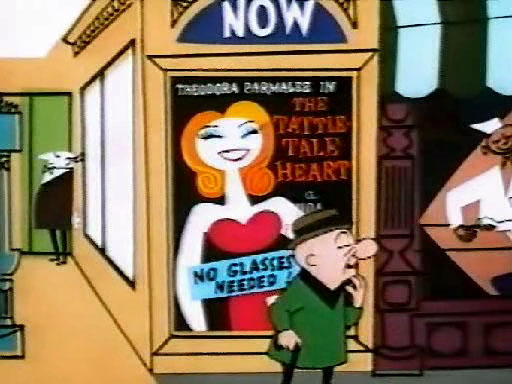
The Telltale Heart (1928, Charles Klein)
I love total Caligari-ripoff expressionism in cinema, and there isn’t enough of it so I was happy to find this. Completely excellent, probably my favorite Telltale Heart yet. I don’t mean to disparage the recently-watched Ted Parmelee animated version and I do miss the rich voice of James Mason, but everything works here – the Caligari sets and fonts, the acting of the lead fellow, his crazy-POV version of the inspectors and the montage and effects (overlays and mirrors).
image

Depending who you believe, this was either directed by Klein (a writer/director up to the 40’s) or Leon Shamroy (cinematographer through the 70’s who worked with Fritz Lang, also shot The Robe, Caprice and Planet of the Apes).
image

Fall of the House of Usher (1928, James Watson & Melville Webber)
Every version of Telltale Heart re-tells the story with narration or titles, but this film tells the Usher story through mystifying visuals… and since I’m not familiar with the story I still don’t know exactly what happened, but boy was it awesome.
image

What if cinema had ended up looking more like this? What if poets were directors? The mind boggles. I’ll bet Cocteau loved this (or despised it since he didn’t think of it first).
image

dream sequence from When The Clouds Roll By (1919, Victor Fleming)
A semi-remake of Rarebit Fiend! Douglas Fairbanks eats some Welsh rarebit (melted cheese on toast) along with mince pie, lobster and an onion. Not a drunken fool like the original rarebit fiends, DF is conned into eating the nightmarish midnight snack by a mad doctor. He then runs around doing stunts on horses, trampolines and camera-trick houses, pursued by ghosts, a party of society women and giant costume versions of the foods he ate. I am definitely dressing up as rarebit next halloween.
image

Oramunde (1933, Emlen Etting)
Woman in a too-long white dress dances on the rocks to express her sadness. Made me sad so I guess it’s pretty good.
image

Hands (1934, Ralph Steiner & Willard Van Dyke)
Hands, falling, against black, doing stuff. Montage of hands doing stuff on location. Hands getting money for doing stuff. Hands buying stuff, taking vacation, getting married to other hands. Counts as propaganda somehow.
image

More 16mm screenings from Clay, Halloween-themed this time. Clay showing seasonal shorts reminds me of Robyn Hitchcock’s halloween show where he joked that since he’s only playing songs about ghosts and death, nearly half his catalog is disqualified.

The Skeleton Dance (1929, Walt Disney) was the first in the Silly Symphonies series, with good music-visual sync, but too much repeated animation. No spoken/sung dialogue, wordless skeletons playing in a cemetery until the sun comes up.

Runaway Brain (1995, Chris Bailey) is an excellent, fast-paced Mickey Mouse short with a mad scientist voiced by Kelsey Grammer, beaten for an academy award by Wallace and Gromit. Seems like nobody around me had heard of this before.

The Tell-Tale Heart (1953, Ted Parmelee), animated with some abstract imagery, overlapping shots and sharply-drawn characters. Has a deservedly high reputation, but beaten for an oscar by Disney’s Toot Whistle Plunk and Boom.

Betty Boop’s Hallowe’en Party (1933, Dave Fleischer) – always great to see a Betty short. Her party is pretty tame – kids bobbing for apples and singing like the birdies sing (tweet, tweet tweet) – until a bully shows up and she attacks him with her secret cache of ghostly evils. Full of amazing animation and visual ideas, beautifully synched to the music. I gotta get me a whole pile of these cartoons someday. I asked Wikipedia when the apostrophe disappeared from “hallowe’en” but it didn’t know.

Naturally the show was also full of TV episodes and classic commercials – Count Chocula vs. Franken Berry, of course, also a kids vehicle that looks suspiciously like the Wacky Wheel Action Bike (“you can’t ride it! you can’t ride it!”) and an awesome PSA warning kids to stay away from blasting caps.

Of the TV shows, we’ve got a Popeye the Sailor episode where an evil robot-popeye robs banks, the adventures of Goodie the Gremlin, who helps people invent the steam engine, airplanes etc. instead of tormenting people like the other gremlins want, a Spider-man episode where Green Goblin gets his hands on a book of voodoo spells, and a hilarious, surreal episode of Ultraman (featuring benign fluffy chattering Pigmon monster in a recording studio, giant plumed lizard monster with heat-seeking feather missiles, and the usual bonkers dialogue). Then the lower-tier corny garbage shows: a cartoon Sinbad the sailor, some dimwit monster who shoots smoke out of his head, Beany and Cecil meet the invisible man (1962, produced by a post-Warners Bob Clampett) and a Hal Seeger-created short called Batfink, in which BF and his dim pal Karate fight a magician.

Plaisir d’amour en Iran (1976)
An expanded version of Pauline and Darius’s trip to Iran in L’Une chante, l’autre pas. Pauline and a narrator comment on the sensuality of Persian architecture. I would’ve liked it if the feature had been edited more rhythmically like this short (or if the picture quality had been as good).
image

image

Du Coté de la Côte (1958)
Fun, half-hour exploration of tourism along the coast, more gentle than Vigo’s À propos de Nice and simpler than a Marker travelogue.

image

“These parks, overpopulated with merry people attracted by the Latin shore, foreshadow the dead people seeking eternal rest there. In both cases, space is limited because of its good quality. It is a well-rated coast.”

image

image

Les Fiances du pont Mac Donald (1961)
The short within Cleo from 5 to 7 is apparently considered its own little film. “I wanted to provide a little relief for Cleo. … So I thought at the beginning of the third part of the film, where films often have a lull, a weakness, a slow-down … I would introduce something uplifting. My other goal was to show Jean-Luc Godard’s eyes. At the time, he wore very dark glasses. We were friends, and he agreed to this little story about glasses in which he must take them off and reveal his big, beautiful eyes, like Buster Keaton’s.”
image

Ulysse (1982)
This was fantastic. Varda finds an old photo of hers, taken in 1954, and investigates. What was she thinking about at the time? What were the models in the photo thinking? She looks them up and asks. Agnes: “This almost painful investigation taught me so much about what an image says, what it says to each of us, and what it cannot say. It merely represents.”
image

AV: “How does she see her own goat image? Without making animals talk, like in American cartoons, or defining memory as a rumination of mental images, may I suggest that there is an animal ‘eatingmagination,’ a self-predatory imagination?”
image

Salut les cubains (1963)
Months after Cleo from 5 to 7 opened, Varda went to Cuba to photograph the country’s inhabitants for an exhibit which opened in Havana (introduced by Raul Castro!) before it moved to Paris. She also made this film out of the photos, narrated by Michel Piccoli. Subjects include the Castros, famous national artists, workers, dancers, posters and drawings and artworks. She creates action sequences, animating the photos, best of all with this guy dancing for the camera.
image

Mentions Marker’s Cuba Si, which came out a couple years before. In her introduction, Varda says twice that “we must place it in the context of 1962,” since the Cuban dream society didn’t turn out the way the French leftists hoped it would. Interesting that she made such a happy, idealist film as this, then her next feature would be the happiness-breakdown of Le Bonheur.
image

These last two were reissued in the 2004 collection Cinevardaphoto with a third, current short about a teddy bear collector, but somehow I didn’t have subtitles for that one. If Cleo from 5 to 7 and L’Une chante, l’autre pas revealed Varda’s kinship with the filmmaking of husband Jacques Demy, these shorts represent a definite (and oft-mentioned) kinship with Chris Marker, and either of them could stand alongside his best documentaries. The commentaries are more personal, less consciously witty. The images are wonderful, and the sense of investigation, of images and memory, the psychology of the films puts them on the Marienbad and La Jetee side of the new wave fence… my favorite side.
image

Elsa la rose (1965)
A portrait of Elsa in the words of her husband Aragon, who has spent their entire relationship writing and publishing poems about her. Varda calls them a “famous couple and fervent communists.” Elsa is filmed as Aragon imagines and remembers her, says she repeated the exercise with her own husband for Jacquot de Nantes. In voiceover, Piccoli reads the poems as fast as he can, a hilarious idea. First movie Lubtchansky and Kurant shot for Varda.
image

Elsa: “The readers of these poems expect me to be 20 years old forever. As I cannot satisfy this need for beauty and youth that the readers have, I feel guilty and it makes me unhappy. That’s what’s terrible, they’re not just for me.”

Réponse de femmes (1975)

“Women must be reinvented.”
image

Agnes has a few minutes to state the case of all women, socially and politically. Lots of nudity, which she points out is not exploitative unless used to sell a product or titillate viewers.

Coming attractions (when I’ve got subtitles): Black Panthers (1968)
image

Static (mostly) shots of outdoor junk sculptures near San Francisco, 5 minutes long. Shot with a guy who IMDB knows nothing about, and a guy who worked on Wenders’ Hammett as well as Ice Cube actioner xXx 2.

image

This was titled “Shorts watched September 2009 (on land),” as opposed to “on the plane“, but I only ended up watching the one.

Dude who named his domain after the film says: “The film was shot in Emeryville, near the east section of the Bay Bridge, but unless I’m mistaken the co-ordinates in Marker’s intertitles appear to be for somewhere in Redwood City.”

image