Faith Domergue is a gorgeous scientist of the type you’re not likely to find in a real science lab, smirks Robert Osborne in his TCM intro. How would he know? His intro sounded like a description of Godzilla, and sure enough, a serious newsman-sounding voiceover at the very beginning invokes the atom and prepares us for the worst.

First off, there’s a stiff young fellow named Griff (which makes up for the lack of Griffs in Sam Fuller’s submarine movie one year prior) and hunky Kenneth Tobey (Thing From Another World, later a Joe Dante cameo regular), who doesn’t generally act much like a military commander. Disturbances are detected, people are disappearing – what could it mean? Enter marine biologists Dr. Carter (Donald Curtis of Spellbound) and Joyce (Faith Domergue, of This Island Earth the same year, with heavy-looking eyelashes – she can barely keep her eyes open) who excitedly study evidence and declare it might be a giant octopus. Finally, 20 minutes in, we get to see a real octopus, and after another ten we see the real prize, Ray Harryhausen’s giant animated tentacles.

The narrator returns frequently, and he is welcome since not much else is happening, to make statements like: “In the weeks that followed, the North Pacific was closed.” After explaining to the audience what octopuses are, in typically patient cheapie science-film fashion, the marine biologists, who should’ve really been sent home by now, start ordering the military around. Between lessons about cephalopods we get an instructive speech about how women can be as capable as men, proven when biologist Joyce invents a new kind of torpedo. In California they meet local plaid-jacketed sheriff Harry Lauter (Escape from the Planet of the Apes) who is killed by the monster minutes later.

“The coastal waters of the Pacific were mined,” declares the narrator. I hope the Navy plans on cleaning those up later. Needing a device to keep piling on the exposition, the Navy is surrounded by inquisitive reporters, culminating in a LOL moment when a short newsman asks Joyce a question she doesn’t know, so he follows dramatically with: “If you don’t know, who does?”

When the radio announces the ferries are closed then a mob of peeved suit-and-hat wearing men rush down, elbowing past police to assert their rights to ride the ferries, I am just rooting for them all to be eaten by giant fish. Tentacles crawl aground, looking like giant tongues, but only grab a few people, falling upon them Blob-style. Disaster flicks had disappointingly low body counts in the 50’s. Old Dr. Carter gets in trouble as the monster attacks the Golden Gate bridge, in the first scene really worth watching, and I thought he was a goner for sure. After all, the commander and Joyce have shared a hot beach-love scene, so it’s time to kill off the elder third-wheel… but surprisingly, he makes it back.

As we began in a submarine, so shall we end, as the navy takes the battle down below (not too far – the octo stays about 50 feet down). Unexpected meta-humor when the octo grabs their sub and Tobey says “this is where we came in.” Of course, now it’s personal, so he and Dr. John grab scuba gear and harpoons to finish the thing off. I don’t think Tobey ends up with Joyce, dedicated as they are to their careers, but I was sleepy and can’t be sure.

The only sci-fi flick made by Robert Gordon, a former actor (played Al Jolson as a boy in The Jazz Singer). I’m hoping he’s the younger brother of MST3K “fave” Bert I. Gordon. I can find no proof of that, but this film’s writer George Yates wrote five of Bert’s films (the other writer, Hal Smith, was a major voice actor in 1980’s cartoons).

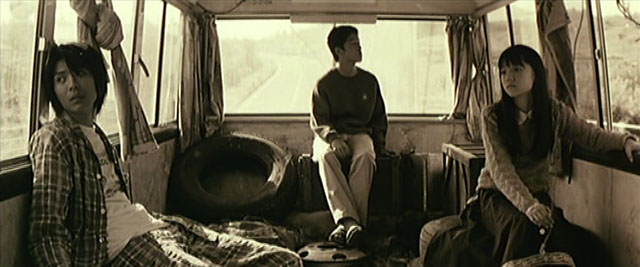
A long, strange trip. Well, not that strange compared to other Japanese movies I’ve seen, but didn’t go in any direction I expected. The beginning (which I’ve watched before) shows a hijacker killing off hostages before getting taken out by the police, leaving only the bus driver (the great Kôji Yakusho, who himself played a kidnapper in Tokyo Sonata) and two kids alive. Now we’ve got over three hours left to follow these three depressed individuals as they do nothing much. Oh, and it’s all b/w sepia-toned, which I thought was supposed to correlate to the survivors’ sense of distance from the world around them, the current moment already seeming like a faded postcard, confirmed when it turns to color as the girl lightens up in the final scene.

image

Anyway, after the incident bus driver Makoto is disappearing for months at a time and working low-ambition jobs, while the children (Kozue and her older brother Naoki) are on their own after one parent leaves and the other dies… so Makoto moves in with them, soon joined by the kids’ older cousin Akihiko (Yôichirô Saitô of The Mourning Forest) on summer break from classes. Nothing happens, so Makoto buys a bus and the four tour the countryside where nothing continues to happen. Except young women are getting murdered wherever they go. Makoto is suspected, but he catches Naoki red-handed and turns him in. Akihiko, pretty much the only one of them who ever says anything, says that past traumas always cause people to contemplate murder (a dubious theory), but he makes M. angry and gets kicked out of the bus. Cathartic ending, Kozue speaking for the first time in ages, turn to color, etc.

image

Weird, the young girl Aoi Miyazaki seems to play the same character in Aoyama’s Sad Vacation, as do a couple other actors. After watching this and the director’s made-for-TV Mike Yokohama flick, I don’t think I’ll be renting Sad Vacation in a big hurry. Got nothing against long, slow, monochrome movies about sad people (hello, Bela Tarr), but Aoyama’s particular sad people aren’t doing it for me.

image

“Beloved be the one who sits down.”

image

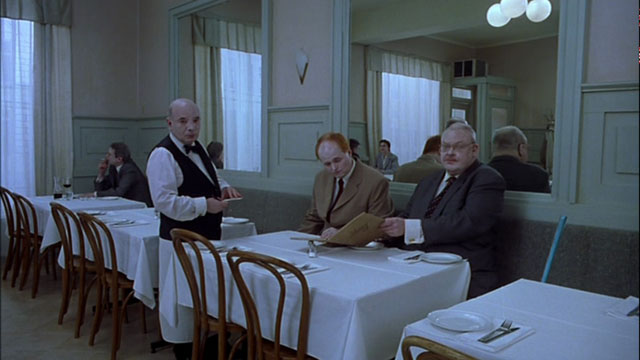
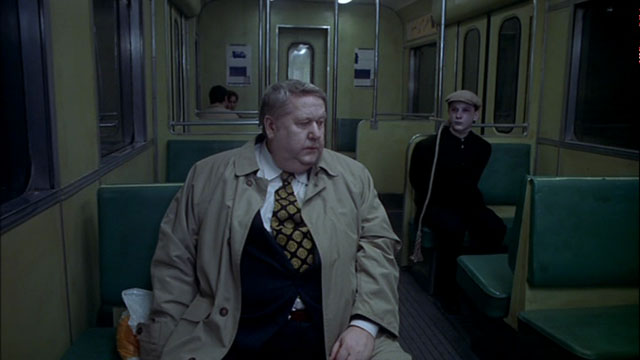
I heard this was a Scandinavian deadpan comedy, so half expected something in the Kaurismaki/Jarmusch vein, tempered by my recent memory of the unexpected Holocaust content in Andersson’s short World of Glory. At first I found this understated to a fault, and not funny at all, but I was fascinated by the composition and content of each scene. Seemed like a depressive view of various social ills (including religion, ha). But I spun the disc again with commentary and caught on to the humor and overall themes. Really, if I had the time and inclination, I should watch EVERY movie twice before talking about it. Ultimately, Songs gets closer to the first half of Playtime than anything else I’ve seen, in terms of directorial obsession with sets and compositions in what’s supposed to be a comedy. But unlike Playtime, this one seems more admirable than enjoyable. Has its moments of pleasure, but when dude is fat, broke, unloved and literally haunted by ghosts at the end it doesn’t send ’em out laughing.

image

A magician performs the ol’ saw trick poorly, sending a man to the hospital and leaving him unable to do anything without pain. Government finance ministers lose their paperwork and instead peer into a crystal ball. A young girl is ritually sacrificed at a quarry in front of a thousand spectators. At the airport there’s a slow-motion oversized-luggage exodus. Best of all, military leaders visit the country’s former commander-in-chief in a rest home on his 100th birthday, and the senile man responds to the official-looking activity with a smiling nazi salute, embarrassing everyone in the room.

image

Eventually a central character emerges: Kalle, with two sons, one of whom “wrote poetry until he went nuts.” Kalle has burned his business down for the insurance money. He doesn’t seem to have a goal until, pursued by the ghost of a man he owed money, he joins a friend’s doomed business selling Jesus crosses for the millennium. At the end Kalle stands facing us before a Jesus-cross dumping-ground as the ghost plus a hundred others rise from the ground and slowly approach from behind. Andersson definitely has a knack for striking images.

image

Andersson, from the commentary:

“This movie is about power, the abuse of power and highhandedness.” I love filmmaker quotes that begin with “this movie is about…”

“I want a scene or a film to surprise the viewer,” he says, exactly as a nude housewife walks into the room.

image

“People have wondered how to classify my film. Absurdism or surrealism… what the hell is it? This film introduces a style that I’d like to call ‘trivialism’. Life is portrayed as a series of trivial components. My intention is to touch on bigger, more philosophical issues at the same time. Life is full of trivia, after all.”

image

On one hand, I thought this was a bad movie.

image

The script seems to have been written for fourth graders, and every camera shot is from a helicopter so you start to get the feeling that all the slow gliding movements are on purpose and you’re watching a giant slow-motion Bollywood video. Narrator Glenn Close throws huge numbers and statistics at us until they become meaningless.
“faster and faster…”
“billions and billions…”
“There’s no time to be a pessimist.”
The slow pace, lingering on each beautiful helicopter shot, and precious repetition-heavy voiceover stinks of pretentiousness, as does the stereotypical music (the kinds of howling African female singers that Martha Wainwright listens to). Sometimes the music turns new-agey, and the voiceover says stuff like “The earth is a miracle. Life remains a mystery,” I’m thinking as a concession to hippie-minded creationists. I wasn’t sure if the doc advocates vegetarianism as part of its packaged hippie agenda or because meat is actually worse for the earth than veggies. And in the length between cuts, I had time to reflect on the irony of a conservationist riding over the whole globe in a helicopter. Maybe their copter ran on biofuel, but more likely they paid a farmer in bolivia a dollar fifty to plant some trees then declared their film “carbon-neutral” in the credits.

image

But speaking of the credits, jeez, this was shot in twice as many countries as The Fall, and there’s no doubt that the visuals are amazing, especially in the high-def version that I watched. And the point of the movie is to keep the viewer hooked with these visuals while impressing upon us how severely we have destroyed the earth (for people like me who missed that Al Gore doc), and what consequences we will soon face. Glenn Close tells me that “humanity has no more than ten years to reverse the process,” then I turn off the movie and, no shit, read the headline “global warming skeptics growing in numbers,” along with the usual business about war, politics and health care. A few windmills in Florida are not gonna be enough to forestall the wrath of Glenn Close’s global-warming pandemic.

image

We are severely screwed. Movie ends up being scarier than Collapse, Wolf Creek and Martyrs combined. I bought ice cream.

image

First Minnelli movie I’ve watched since Meet Me In St. Louis (and his 13th since then – I must catch up). Writers of Singin’ in the Rain (and it shows, with all the behind-the-scenes crossover) but different songwriters. I didn’t know much about it, besides its position on some lists of great films, but was still impressed at how great it was, in direction and dancing and music (in that order) more than anything else. Katy enjoyed, too.

Fred Astaire, a decade after Holiday Inn, is looking more alive and alert than ever, despite being in character as a has-been showman. He’s paired with (eventual love-interest, natch) young Cyd Charisse of Singin’ in the Rain by two enthusiastic show writers. They bring the project to an overbearing actor/director, but he turns their comedy into a dreary version of Faust, so after the investors have given up the writers reclaim the play and undo the director’s pretentious changes, touring to eventual acclaim. It’s all in fun.

Nanette Fabray (of not much else, but still alive, so there’s time) as a writer of the play holds her own in the singing and dancing scenes, but her comic foil partner Oscar Levant (a composer and pianist, also of An American In Paris and Humoresque) I found more hammy and grating. Maybe it was more his big clown face than his acting, but there’s something unpleasant about him. Jack Buchanan, as the director (who is good-natured enough to stay with the play after the rewrite), is far better here as a noisy, self-obsessed Orson Welles caricature than as the fey hero of Lubitsch’s Monte Carlo. The one scene with a major dancer who’s not one of our stars is when Astaire dances through an arcade with Leroy Daniels. It’s a wonderful dance, and even more wonderful that Daniels is apparently playing himself, known around Hollywood as a rhythmic shoe-shiner who had a hit country song written about him.

No Oscar nomination for the song “That’s Entertainment” – I guess it wasn’t considered an original song. I liked all the songs pretty well, though Katy notes they didn’t try to make any sort of unified sense out of them. We get Astaire and pals in baby clothes dancing on their knees to “Triplets,” country Nanette in “Louisiana Hayride,” and Cyd’s big-drama “New Sun in the Sky”. As the cast regains control of their play and starts to turn it back into an entertaining piece, these songs get added seemingly at random. It adds to the comedy that we never remotely see how these bits connect in the finished play.

Months after the entire Internet had already posted its lists of best films of the decade, my favorite print magazines, Cinema Scope and Film Comment, added a hundred more lists to the mix. Here are about seventy more titles that should probably be on my “movies to watch in 2010” page. But they missed their chance, so they’ll have to stand alone over here instead.

13 Lakes
À Travers la forêt
Alumbramiento
Assassination of Jesse James
Batang West Side
Birdsong
La Blessure
Bluebeard
The Bridesmaid
Cafe Lumiere
La Captive
Chunhyang
Come and Go (monteiro)
Cosmetic Emergency
Crank / Crank 2
Crying Fist
Demons (mario o’hara)
Deux (werner schroeter)
Dog Days
Dor (kukunoor)
Dying at Grace
Election/Triad Election
Evolution of a Filipino Family
Faceless Things
Flame and Citron
Flying with One Wing
Footnotes to a House of Love
The Garden (wiseman)
Greendale
Gulabi Talkies
Harmful Insect
In Vanda’s Room
An Injury to One
Jimmywork
Last Days in a Lonely Place
La Libertad
The Long Holiday
Lot 63, Grave C
Manderlay
Margot at the Wedding
Medicine for Melancholy
Memories of Murder
Mid-Afternoon Barks
Phantom Limb
Phoenix Tapes
Pine Flat
The Pool (chris smith)
The Rebirth (masahiro)
Secret Sunshine
Shara
A Short Film about the Indio Nacional
Sleep Dealer
The Sky Crawlers
Space Disco One
Sweetgrass
The Taste of Tea
Textism
To Die Like a Man
Todo Todo Teros
Triple Agent
Turning Gate
Twentynine Palms
We Want Roses Too
When It Was Blue
Who Is Bozo Texino?
Wild Blue, Notes for Several Voices
Workingman’s Death

I’d heard that the first four or five Thin Man movies were almost equally good, but to me they seem to be getting weaker. This one wisely lets up on the drunk jokes and doesn’t give Asta any solo scenes. One would think from the poster (and the finale of part two) they’d be making a big deal over Nick & Nora’s new baby, but not really – Nick Jr. factors into the first few scenes and the last one, but not much in between. There’s more detective work going on, Nick solving the crime rather than gathering all the suspects and waiting for one to slip up. And of course the film is just cluttered with characters. It’s a very watchable 90 minutes, I’ll give it that.

Katy & I figured out how to spot the killer in a Thin Man movie, anyway – it’s whoever is least likely to have done it, on whom there’s no suspicion whatsoever. That means here it’s the innocent young girl Lois (Virginia Grey, later of The Naked Kiss and All That Heaven Allows) whose dad the Colonel (blustery cowboy C. Aubrey Smith of The Scarlet Empress – he’s Nora’s lawyer, I think?) was killed, presumably by revenge-seeking neighbor Phil Church (Sheldon Leonard of Guys & Dolls).

There are a hundred more red-herring characters including a creep named Creeps, large-faced Nat Pendleton as a cop, Ruth Hussey (Jimmy Stewart’s photographer friend in Philadelphia Story), a love interest, a secretary (Tom Neal of The Brute Man!), an overly suspicious nanny, Abner Biberman as “The Cuban” (Katy points out it’s not a very Cuban-sounding name), and apparently Shemp Howard. Otto Kruger (bad guy in Power of the Press) plays lead cop Van Slack. I didn’t get a good bead on this guy because our disc skipped during his entire scene in the middle of the movie. Convoluted murder scheme involves laying a gun on the ground and covering it with a wet newspaper. Lois has a secret identity, kills Phil Church, and would’ve gotten away with it if not for those two meddling society detectives.

Seems like a semi-remake of A Very Long Engagement. There’s a specific scene where Veronika says if she can count to fifty before the postman arrives at the door she’ll get a letter from Boris. Then there’s the overall story, a woman looking for her man who went to war, not even stopping after she hears that he’s died. Jeunet gave his film a happy ending, but Russia in the 50’s was still mourning the millions killed a decade earlier. So, not a simply fairy tale, Veronika does not get a letter from her Boris, because he did die in the war.

It opens with the two lovers happy together, and ends with her alone, smiling but heartbroken, handing out flowers to returning soldiers. In between it’s mostly her story. She loses her family in a bombing raid and stays with Boris’s parents, then is soon coerced into marrying his brother who dodged the war. Very impressively (for 1957) mobile camera, with always excellent, careful framing, none of the indifferent framing that characterizes most handheld today (ugh, I hate saying things like that). It seems like every shot in this film has more than one purpose, making the simple close-ups that much more powerful. No surprise that the director and cinematographer went on to make the great I Am Cuba, or that this won the golden palm (over Bergman, Satyajit Ray and Mon Oncle)

C. Fujiwara for Criterion:

The film is also exceptional in refusing to condemn Veronica for her involuntary infidelity to Boris while he is at the front. In Tatiana Samoilova, The Cranes Are Flying unveiled a magnificent screen personality: expressive, sexy, dynamic. Veronica is far from a traditional war-movie heroine (not only by the standard of Soviet war movies), and Feodor’s impassioned denunciation of faithless women is clearly meant to be taken as more than just the party line, but Samoilova makes her character completely sympathetic, down to her bittersweet apotheosis in the moving final sequence. The Georgian-born Kalatozov, who began his directing career in the silent era, spent several years in Los Angeles during the war on a diplomatic assignment, and seems to have been marked by Hollywood cinema. In The Cranes Are Flying, he treats melodrama with a formal complexity worthy of Frank Borzage, King Vidor, and Vincente Minnelli – finding, with no fear of excess, potent visual correlatives to emotional states.

I think I get Ten, that it’s a discussion between everyday people about their real problems, somewhat politically charged but mostly a realist drama minus much of the drama, with two digital cameras bolted inside a car. He says the story could be anyone’s story, and that anyone’s story would be worth filming for a movie. I didn’t dislike it, but I prefer Kiarostami’s other work, or the kind of scripted social dramas that Jafar Panahi makes (or made, since he’s currently in prison).

At the center of the movie, a mother gets in terrible arguments with her son who resents her for divorcing his father. We also have scenes (exactly ten total, each with countdown leader) with the woman’s sister, a prostitute who accidentally hops into the car (the most contrived part of this realist experiment) and an old woman hitching a ride to pray (the least contrived – reportedly she was really hitching a ride, and had no idea she was appearing in a movie).

image

Better is the documentary 10 on Ten, or I should say it’s better to watch them both together, as A.K. explains in-depth his thoughts on filmmaking, actors, writing and so forth. The doc opens where he shot the end of Taste of Cherry, the hill with winding paths and the distictive trees, which overlooks the streets of Tehran, where he shot Ten. He talks about the immediacy of video, its portability and ability to capture natural performances, which he used by accident in Cherry after the final scene was botched by the film lab, then halfway on purpose in ABC Africa. “This camera allows artists to work alone again.”

He no longer writes screenplays, just sketches his movies over a few pages. “I only remain faithful to the original idea of the film, and even that is not something you can be sure of. When I write a full and accurate screenplay, I’m no longer interested in making it, and usually hand them over to colleagues.” Hence Crimson Gold the year after Ten came out. The shocker is the last chapter of 10 on Ten, a miracle of an ending involving ants in a hole in the road, reviving my faith (shaken by Ten) that A.K. can make cinema out of anything.

image

E. Hayes:

Ten centres on a divorced woman and her relationship with her son, Amin. The actress Mania Akbari is herself a divorcee, and Amin is her own son. We watch the son, without inhibition in the way today’s children can be with parents, caught between his separated mother and father in their battle for possession, self-possession and respect. Through the mother’s struggles with the child, a little tragedy is played out. Pride and possessiveness make communication hideously painful. Meanwhile, various aspects of womanhood are embodied by the women who catch a lift with Akbari. This is a drama of the deferred nature of human fulfilment – a tragedy most people in any audience are all too able to identify with, in any country.

lead actress Mania Akbari:

This film, in my opinion, talks about how relationships today are empty and distant from love. All women in the world, and men for that matter, thirst for love. This film isn’t anti-men. Relationships have become transactions, have become materialist. I think this is what the film shows.