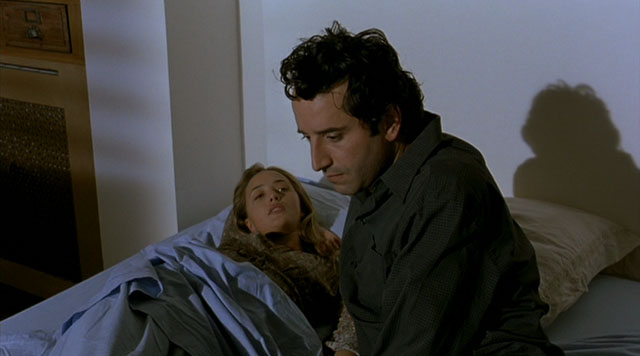
I read very little about this, conscious of spoilers, but certain things, as with Antichrist, were unavoidably overheard (or given away in the trailer). So I knew it was set near the start of WWI and that the evil children in the trailer represent the birth of fascism, but I didn’t realize how subtly that point is made. There are unexplained events, the children increasingly seem responsible, then some major characters disappear and the narrator leaves town, with no ends neatly tied up.

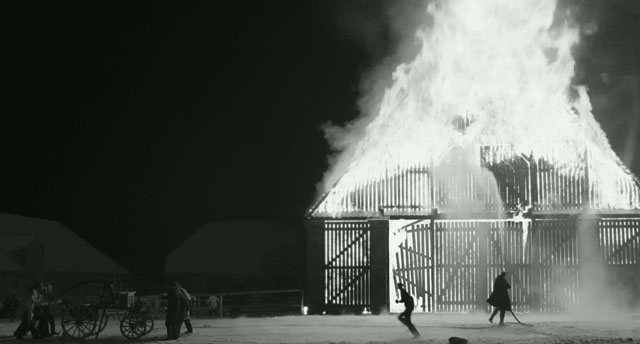
Two things for sure: it’s an excellent movie and the camerawork (DP Christian Berger, his fifth with Haneke) is perfect, beating Cache by a mile. Apparently was shot digitally, in color, then post-processed. Very classic feel to the entire production, except to the acting, especially of the children, which is better than anything from the WWI or WWII eras (sorry, Wild Boys of the Road). Won awards almost everywhere (the BAFTAs preferred A Prophet and oscars preferred something from Argentina), beating out Basterds, Antichrist and Wild Grass at Cannes.
image

Interesting to have a non-omniscient narrator, schoolteacher Christian Friedel, who goes on long sidetracks from the town mysteries to chase after a girl, nanny of the baron’s young twins. Town authority figures are painted as corrupt. The doctor (Rainer Bock, small role in Inglorious Basterds) is abusive and perverse to his daughter and to his girlfriend (Susanne Lothar, lead in Funny Games). The pastor (Burghart Klaussner, was just in The Reader) is a tyrannical father. The baron (Ulrich Tukur, The Lives of Others) exercises his power to throw families into poverty at will. The children don’t exhibit the usual responses of sullenness, fighting and petty power games, but band together to commit acts of planned vengeance, terrifying the town. Their crimes go officially undiscovered and unpunished at the end, Haneke’s point, I suppose, being that they grew into fascists and nazis.

image

There is, of course, an absolute ton written about this movie already. The Times says “it lacks the intellectual and emotional nuance that would make this largely joyless world come to life,” but that’s just the common criticism that Haneke’s films are cold and unfeeling, which applies less to this film than to his others so I don’t see the point in bringing it up.

Indiewire: “With this detailed exploration of anonymous retribution, Haneke returns to the haunting terrain he last explored in Cache, although in this case, the retribution expands from a personal level to a larger critique of religious zealotry. … However, these events remain notably off-screen. Absence in The White Ribbon is the quality that makes it a harrowing work of art, rather than a historical soap opera.”

Salon: “It definitely can’t be reduced to a fable about the roots of fascism. The White Ribbon is a dense account of childhood, courtship, family and class relations in a painfully repressed and repressive society, which seems to channel both early Ingmar Bergman and the Bad Seed/Children of the Corn evil-tot tradition.”

image

Haneke:

The film opens with the narrator saying, “I’m not sure if the story I’m about to tell you corresponds to what actually took place. I can only remember it dimly. I know a lot of the events only through hearsay.” So both those elements, then, raise mistrust in the audience as to the accuracy of what they’re going to be seeing, and the reality of what they’re going to be seeing. Both the black-and-white and the use of a narrator lead the audience to see the film as an artifact, and not as something that claims to be an accurate depiction of reality.

It’s only in mainstream cinema that films explain everything, and claim to have answers for anything that happens. In reality, we know so little about what happens. It’s far more productive for me to confront the audience with a complex reality that mirrors the contradictory nature of human experience.

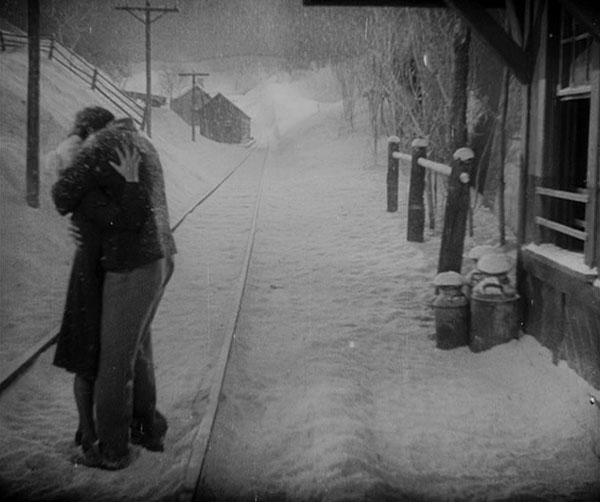
I remember with my first film that was shown in Cannes, The Seventh Continent, there was a screening and afterward we had a discussion. The first question came from a woman who stood up and asked, “Is life in Austria as awful as that?” She didn’t want to accept the difficult questions being raised in the film, so she tried to limit them to a specific place and say, “That’s not my problem.” You could make the same mistake with this film, if you see it as only being about a specific period.

image

Scenes with kids in town and school, episodic with a couple more-central characters (I’m thinking of the poor boy with abusive parents who gets rescued by social services at the end). Katy’s favorite part was the girl whose parents went out for dinner without her so she yelled “I’m hungry, I’m hungry” through a bullhorn out her window until the neighbors sent a picnic basket to her window using ropes and pulleys. I liked the double date at the movies, where the meek boy loses out and his friend takes both girls. Also wonderful, an Antichrist-recalling scene with a toddler chasing a cat slooowly out a tenth-floor window, finally falling and bouncing harmlessly upon the ground. It’s frightening at first until I realized (and assured Katy) that Truffaut doesn’t kill children, especially not in a comedy. Ebert liked “the painful earnestness that goes into the recitation of a dirty joke that neither the teller nor the listeners quite understand.”

Ebert again: “He correctly remembers that childhood itself is episodic: Each day seems separate from any other, each new experience is sharply etched, and important discoveries and revelations become great events surrounded by a void. It’s the accumulation of all those separate moments that create, at last, a person.”

Of all the kids, how many went on to further acting careers? Only Eva Truffaut, unsurprisingly. More unexpected is that only a few of the adult actors have any other acting credits. Hairdresser Mrs. Riffle (Tania Torrens) was in The Lover, Lydie Richet (Virginie Thevenet) was in Chabrol’s Cry of the Owl, and new father Mr. Richet the schoolteacher (Jean-Francois Stevenin) played Marlon in Out 1 and more recently appeared in The Limits of Control. Same cowriter (Suzanne Schiffman) and cinematographer as Out 1, too.

Oddly, the U.S. poster I found online says “Roger Corman presents…”

Should’ve been called Pocket Money (French is L’argent de poche) but the name was taken by a Lee Marvin/Paul Newman flick a couple years before. The Truffaut movie plus the Tom Waits “Small Change” album released the same year (the two are unrelated; nobody in the film gets rained on with his own thirty-eight) effectively wiped the Lee Marvin film’s title from the English language… now we wouldn’t dream of naming a movie Pocket Money.

Nominated for a Golden Globe (remember those?) but beaten by Bergman. It’s nice to see shouts-out to Bergman and Truffaut in a year when every actress in Freaky Friday was nominated.

I’ve enjoyed all the Frank Borzage movies I’ve seen so far, so this week I watched all three that he released in 1929. Not only in the same year, but according to IMDB they all came out within a two-month period – can that be right? I’ve only seen seven feature-length movies from 1929, so now 43% of them are by Borzage.


Lucky Star

image

Hunky, brave Tim (Charles Farrell, of course) meets a cute girl (Janet Gaynor, of course), then goes off to war in France and gets his legs blown off delivering food to the troops in a crappy horse carriage whilst his old boss at the telephone company takes the proper army truck to meet girls. There is no such thing as subtlety!

Chuck and Big Boy fight atop a telephone pole:
image

Janet watches, impressed:
image

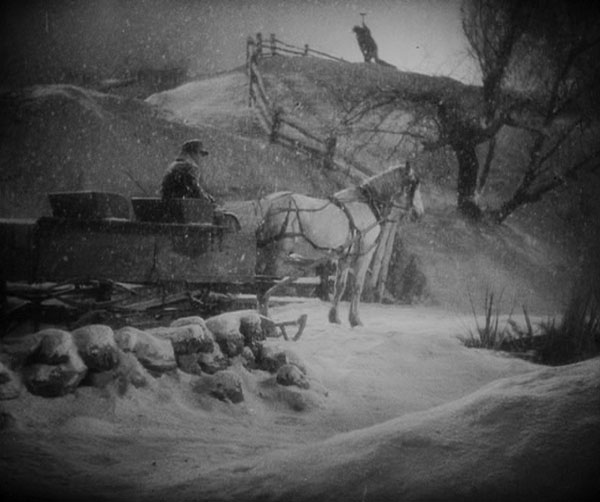
Back home, Tim’s boss (Guinn “Big Boy” Williams of a couple Lang and Renoir movies) is passing himself off as a brave sergeant in town and wheelchair-bound Tim is making friends with the dirty, savage young girl (TOO young, as Tim eventually finds out, backing away slowly). But the girl’s parents promise her to Big Boy. Can Tim rise from his wheelchair for the first time since the war and crutch-walk into town (in the snow) in time to stop the marriage and claim the girl as his own, publicly revealing Big Boy to be a war coward along the way? Yes!

Big Boy and Janet’s mom Hedwiga Reicher:
image

Paul Fix (After the Thin Man, El Dorado, Red River), who sadly never worked with Tom Mix, is a buddy of Tim’s, his only human contact besides the girl. That’s probably him driving by, as Tim leans on a crutch at top of the frame.

image

Shot as a part-talkie with dialogue and effects, but that version has been lost, leaving behind a silent masterpiece. As silly as the plot can be, I got caught up in the (melo)drama of it all and the glorious visuals. Also loved how the film is sped up to make Tim look more wheelchair-proficient than he actually was.

image


They Had To See Paris

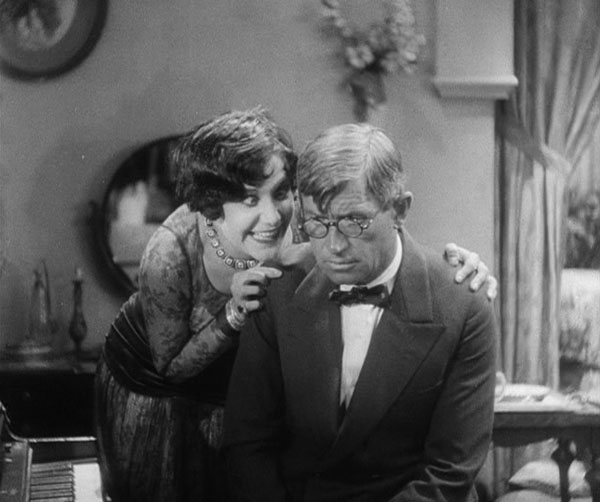
Good ol’ down-home mechanic Will Rogers (I liked him better as Judge Priest) strikes it rich as an investor in the town oil field. His wife acts just like Effie in Ruggles of Red Gap, packing up the family (unattached older son Rod, and daughter Opal who’s in love with a hometown boy) and heading to Paris to get them all fine clothes and high culture.

Rod with Christiane Yves, probably:
image

What would a Borzage movie be without beautiful cinematography, fluid camera movements and heartfelt performances? Well, it would be this one. Sound pictures were in their clunky infancy, and even a prestige director like Frank couldn’t make much of a talkie in 1929. No music, but could’ve used some – full of stagey, awkward, staticky silences in the dialogue. It’s also his first comedy that I’ve seen, and I wouldn’t say it exactly had the Lubitsch Touch. But it’s not late-Keaton bad, just disappointing.

image

Poor Will is saddled with increasingly unlikable wife Irene Rich (Lady Windermere’s Fan, The Champ, Fort Apache), aristo-dating daughter Marguerite Churchill (Dracula’s Daughter) and wannabe-bohemian son Owen Davis Jr. (All Quiet on the Western Front). Will raises some hell, wearing a suit of armor to a party and having a non-genteel, drunken conversation with guest of honor Grand Duke Mikhail (above), but eventually his family has him depressed so he fakes an affair with tedious slut Fifi (below) to horrify his family into returning home.

image

Unfortunately this wasn’t a career-killer for the grating Fifi D’Orsay. She appeared in They Just Had To Get Married, then in Joanna’s favorite film What a Way to Go. TJHTGM isn’t a sequel to this (though it sounds like one) but apparently They Had To See Paris was enough of a hit to engender follow-ups, first the semi-sequel So This Is London then the full-on sequel Down to Earth, both of which starred Will Rogers and Irene Rich (and Grand Duke Mikhail even returns in Down to Earth). This is some corny flick, and with Borzage (and let’s also blame the writer Owen Davis Sr., young Ross’s dad) unable to hide his cheesy melodrama behind the artifice of title cards and artful silent cinematography, it just sits out stinking.

Family reunion:
image


The River

Another gorgeous Borzage silent about simple-minded youth in love, ho-hum. This one is a different viewing experience because it’s incomplete, reconstructed with stills and titles a la the TCM version of Greed. Something else that’s different: Charles Farrell plays opposite Mary Duncan, not Janet Gaynor. Duncan (also of City Girl, 4 Devils) lived till the 90’s but only acted through ’33, and was obviously better-suited to this part than Gaynor, since the character is not at all the innocent sweet girl.

image

Farrell, polite and capable but so dumb, builds a riverboat to see the country but stalls at a dam for the winter. There are six more trains into the city where he plans to spend the season, but busying himself with skinny-dipping and wood-chopping, he can’t seem to manage timetables and misses them all. Now it’s just Farrell and somewhat cruel sexpot Duncan. Finally she stabs him and he proposes to her, in that order, but she laughs off the proposal until he almost dies in the cold.

image

Take it, D. Callahan:

The fragment ends with an extraordinary sequence that stands with Borzage’s best work. Allen John has chopped wood all night in the snow, trying to prove that he’s man enough for Rosalee, and he falls deathly ill. Snow is rubbed all over his bare chest in an effort to break his fever, but his heart stops beating. Desperate, realizing how much she loves him, Rosalee climbs into bed with Allen John and tries to warm him alive with her body. Borzage films their faces in close-up with a religious intensity reminiscent of Dreyer, lingering on Farrell’s beatific eyes as his soul slowly seeps back into them. The communion of bodies here is both a rebirth and a renewal, of Allen John’s life and Rosalee’s hopes.

image

Just then, Mary Duncan’s old boyfriend, the murderer Marsdon (Alfred Sabato, who directed the first talkie in Italian) escapes from prison to reclaim her from the weakened Farrell, but fortunately hulking deaf-mute Sam (Ivan Linow, of the Unholy Three remake, who has played characters named Rako, Red, twins Loko and Boko, Tossilitis, Slumguillion and Heinie) appears just in time. The closing titles are outrageous:

image

image

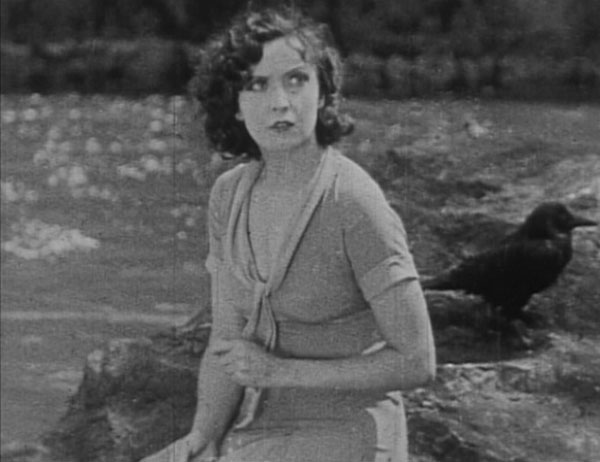
IMDB mentions lost characters The Miller and Widow Thompson, but the fifth lead of the surviving footage has got to be Marsdon’s pet crow, left behind to watch the girl while he’s imprisoned. I’m always glad to see a bird as a major character.

Mary Duncan with crow:
image

Supposedly the first Japanese film shot in 24p digital video, which accounts for its unique look, esp. the wild color in outdoor scenes, but also its annoying handheld shakiness which would become widespread by the end of decade. The middle/high-school kids are obsessed with pop singer Lily (according to shady IMDB trivia, inspired by Faye Wong), are also incredibly shitty to each other. Prime focus is on two boys, Hoshino and Hasumi, former friends but now tormentor and tormented. Each has his own problems at school, but is secretly (and online, hidden behind screen names) deeply moved by Lily’s music. At the end, I think (nothing is quite clear, at least not to me) the bullied Hasumi, denied entrance to Lily’s concert by Hoshino, knifes the bully to death after also discovering that Hoshino is junior member “blue cat” on the forum. And I’m thinking young Hasumi is forum admin “philia,” but again, not sure.

Hoshino with Hasumi over his shoulder:
image

Forum posts appear in the middle of the movie screen, sometimes overlapping the scene but usually just white text over black. This should get tiresome (it did for reviewers, I see) but I never got sick of the texting conceit or the length of the movie (hello, Noriko’s Dinner Table), just of the brutality between/among the kids. Just as I’m never visiting Italy after watching Gomorrah, I am never attending middle school in Japan after watching this

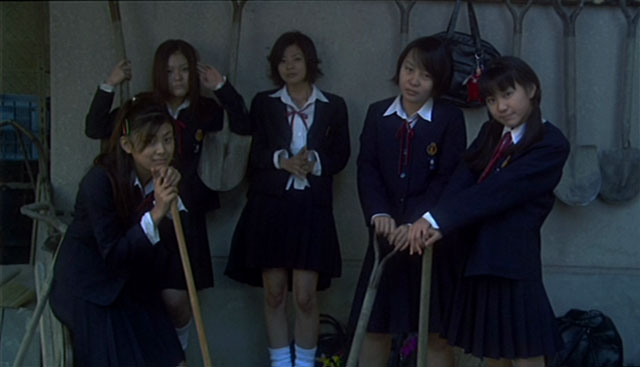
Bad girls:
image

I love that outdoor night scenes are shot with big green spotlights on the actors, complete with obvious shadows. It’s stylish and effective. In the middle of the movie, Hoshino and friends use stolen money to go on vacation to Okinawa, leading to a lengthy, punishing overuse of the handheld aesthetic.

image

Movie had a few beautiful moments, a few embarrassing ones (middle school was terrible, and I used to talk that way about music I loved), but mostly I felt like I’m about ten years too old to be watching it and wondered if the people putting it on their best-of-decade lists weren’t all 17 in 2001.

Suicidal Shiori Tsuda:
image

Older boy Hoshino: Shugo Oshinari was in Battle Royale II. Other boy, Hasumi, Hayato Ichihara stars – stars! in Miike’s new God’s Puzzle. The girl who’s raped and shaved bald (did I mention it’s a cruel movie?), Kuno, is Ayumi Ito of nothing else I’ve heard of, and the girl who’s coerced into prostitution, Shiori Tsuda, played a title character in the director’s follow-up, Hana and Alice. After that, I lose track of which kid was which, and, in fact, what happened and when. Reviewers mention the jumbled timeline of the story, and I thought it was linear so I obviously missed more than I realized. I did like it overall, but I don’t think I’ll ever be watching it again to get my facts straight.

Shaved Kuno:
image

Reverse Shot:

Iwai returns to the image of students standing alone in glowworm-green fields, attached to headphones. It’s risky, a consummate music-video image, especially with Iwai’s phosphorescent digital palette, and I’m not even sure it ever entirely escapes that. But with its repetition after the murder at the end of the movie—one of the students standing and listening is Shugo, killed a few minutes earlier—these Elysian fields come to replace the traditional blackout’s “return” to reality out of the dream life of cinema. As the text of credits are superimposed, the uniquely personal experience of these lonely bucolic listeners becomes inseparable from the chat rooms and concerts, where they are unified with that pop-culture infinite—the fan base. As if communing with an angel across great distances but with special intimacy, the students and Lily Chou-Chou contain one another as they share that experience with millions.

image

Rouge:

What is interesting, however, is that the film not only does not proffer to give answers but, intentionally or otherwise, feeds into our bafflement, in two ways. Firstly, the world in Lily is presented as one in which not only are its teenagers behaving as such, but its adults are also, at best, powerless, ignorant and, at worst, in complicity. Witnessing the ostracising of the class pianist, the teacher capitulates to the persecution by entreating the bullies to perform and promising that the pianist will play no part. A female teacher’s only response to the assaulted Kuno (Ayumi Ito), now also shaven, is to offer her a wig.

All About Lily Chou-Chou transforms into a mood piece, self-consciously eschewing account and explanation, less concerned with analysing our bafflement than it is with simply our bafflement itself, as if with the detached curiosity of an observing alien.

Story by the HJNTIY team, screenplay by the creator of some show called Army Wives and directed by the dude behind The Other Sister, so there was no guarantee of quality here, but the movie safely occupies the competent, innocuous middle ground between piece-o-shit HJNTIY and surprisingly-good Love Actually. Light and predictably happy, with a cameo from Kristen Schaal of Flight of the Conchords which I enjoyed far too much compared to its surrounding scenes.

So. Ashton Kutcher (Butterfly Effect) runs a flower shop with happily married George Lopez (Sharkboy & Lavagirl). Ashton proposes to career girl Jessica Alba (Love Guru) instead of longtime friend Jennifer Garner (Invention of Lying), who has fallen for a married guy (AK & JG end up together). Jamie Foxx (Miami Vice) is a sportscaster whose boss Kathy Bates (The Waterboy) assigns him to cover valentine’s day, during which he meets Jessica Biel (Elizabethtown) who throws an anti-val-day party every year because she is lonely. Shirley MacLaine (Artists & Models) tells 50-year husband Hector Elizondo (Georgia Rule) that she cheated on him decades ago, but he forgives her at a park screening of Hot Spell (a movie with Shirley and Anthony Quinn which nobody remembers). Patrick Dempsey (McThingy on Katy’s shows) is in the movie but I already can’t remember why. Topher Grace (Spiderman 3) likes Anne Hathaway (Becoming Jane), finds out she works as a kinky phone sex operator but learns to deal with that. Eric Dane (McThingy on Katy’s shows) is a sports star who is gay, managed by Queen Latifah (Stranger Than Fiction) who I think works with Jessica Biel and is Anne Hathaway’s boss and there are other connections that aren’t important. Lastly, Julia Roberts (Duplicity) is on a plane flying home on military leave to see her son for a day, sitting next to Bradley Cooper (Midnight Meat Train) who is gay for Eric Dane. Then there are some 18-year-olds whom we can safely ignore, including a pop idol or two.

“Too much science too soon would drive you insane!”

Baldwin is still creating new fictions out of old film clips, a sort of Adam Curtis possessed by Guy Maddin, but now he’s filming new clips of his own. Lots of truth in the fictions, as he recounts (through less-than-convincing actor narration) the stories of his cultist heroes: sci-fi author L. Ron Hubbard, rocket scientist Jack Parsons and new-age goddess Marjorie Cameron, with side characters Aleister Crowley and Lockheed Martin. All except L.M., who only exists as a corporate entity, were connected in the 40’s and 50’s, and Baldwin tries to throw in some way-out truth-stranger-than-fiction to blow our minds. I’d rather hear the pure paranoia of Tribulation 99, since there’s nothing new to say about L. Ron and Crowley (though I hadn’t heard Jack’s story before).

image

It’s some goofy fun. Some of the match cuts are fantastic. A couple’s conversation in a room is represented visually by tens of couples in different rooms. No sync sound, so the actors voices don’t match their mouths any more than those of all their stock-footage doppelgangers. I wish Marjorie’s dialogue didn’t consist mostly of movie titles, an idea that works better on paper than in practice. I enjoyed seeing so many clips from X: The Man With X-Ray Eyes. Rick Prelinger, Guy Debord, Ray Milland and Peter Lorre are all listed as production assistants, heh. “Lockheed Martin is a pastiched character but is still a very evil reality.” I sampled the director commentary, in which he struggles to keep up with his own movie, naming all the footage sources.

I liked this. From the plain look (courtesy of Mike Judge’s cinematographer) to the relaxed line deliveries to the dated mid-tempo pop songs it seems like they set out to make a lightly pleasant comedy and have succeeded there. I liked the comedian supporting characters (Louis CK, Jeffrey Tambor, Tina Fey) and the comedian cameos (Jason Bateman, John Hodgman… Ed Norton?). I like how they presented religion as an outright lie and didn’t back down from that. I wouldn’t say it’s a great movie, but I wouldn’t say there are more than two studio romantic comedies a year worth watching, so this is in rare company, probably higher up than the Will Ferrell thing with the Spoon soundtrack

image

But most of all, I’m sorry I watched this without Katy. I’d had a bad day, there was no heat in the house, and as night fell and I got colder, I thought a comedy was in order. This was on my laptop, and I watched it. Without Katy. Sorry!

image

All the IMDB knows about Ricky’s codirector is that he’s from L.A., younger than me, and married to a nude singer.

Second in the series, with Van Dyke returning. Whereas the first one had Brenon & Borzage cinematographer James Wong Howe, the sequel has Lubitsch & Wellman cinematographer Oliver Marsh. I am guessing nobody noticed. Only Jimmy Stewart’s second year in the movies. He obviously didn’t have his Capra persona down yet if he’s playing a murderer. Oh yeah, Jimmy Stewart is the murderer – that’s the twist ending in this one! If he’d have been played by anyone else, I might’ve seen it coming.

Wait, getting ahead of myself… so Nick and Nora are in the movie from the beginning this time, which is nice. They’re going to visit her rich family, who disapprove of her drunken detective husband. The movie reeeally plays up what a drunk he is this time. It’s intended for comic effect, but gets increasingly disturbing. There will have to be an intervention by movie four… if those had been invented yet. Nick is still retired but gets convinced to do one more job, Nora once again wants to get involved in the detective work but “ohhh no you don’t,” Nick won’t let her. It’d be tired and repetitive if it wasn’t so light and charming. One bit of weirdness that didn’t work for me: their dog Asta gets his own solo scenes. He visits “Lady Asta” from behind a fence and chases another dog who has been visiting her, and apparently getting her pregnant. The dog scenes correlate nicely with all the other couple-infidelity in the human world of the film, but there’s no real resolution to these scenes, and they kinda made me sad for Asta.

Just as many characters as in the first one (and again, they’re all invited to a dinner party in order to determine guilt). I quote an IMDB review: “My favorite is Aunt Katherine, the battle ax to end all battles axes, played by Jessie Ralph (The Bank Dick); and Henry, the rickety old butler played by, would you believe, Tom Ricketts.” Nora’s cousin Selma (Elissa Landi, Count of Monte Cristo) is upset when her lying, cheating husband (Alan Marshal of Hunchback of Notre Dame, House on Haunted Hill) goes missing, then even more upset when he’s found and says he’s leaving her for showgirl Polly (Penny Singleton: Blondie Bumstead and the voice of Jane Jetson). Also involved: club owner Joseph Calleia (Touch of Evil), an asian thug who seems to be a hat-throwing prototype for Oddjob, Selma’s psychiatrist (George Zucco of The Pirate, House of Frankenstein) and a cop (Sam Levene of The Killers, Brute Force, a cop-assisting beardy cultist in God Told Me To).

Cute movie with no apparent quality drop from part one (except for the overdone dog scenes). Judging from the booties-knitting ending, there will be babies in part three.

An unusual Rivette film. First thing I noticed was that it’s strange to see an in-film performance of a finished play in front of an actual, paying audience. I thought none of his plays-within-a-play ever made it past their planning stages. The characters go about their business in a straightforward way. Minor mysteries from the past crop up, some coincidences seem almost magical, but the weight of the drama never sets in. Even the lighthearted Celine & Julie felt weighty. Finally towards the end (during the drinking duel in the rafters) I accepted that Va Savoir is purely a comedy, and a very fine one.

image

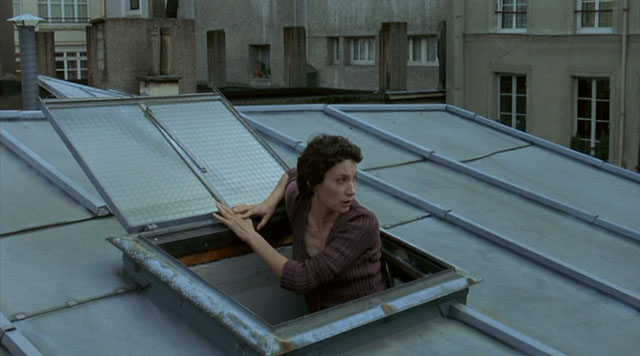
From the shot above, which is used in the poster art, I’d assumed there’d be more Feuillade influence. People upon Paris rooftops conveys Feuillade, and with Rivette’s ever-present sense of mystery I thought a feature-length homage would be wonderful, but that’s not what we get. Oh well, there’s always Franju’s Judex.

image

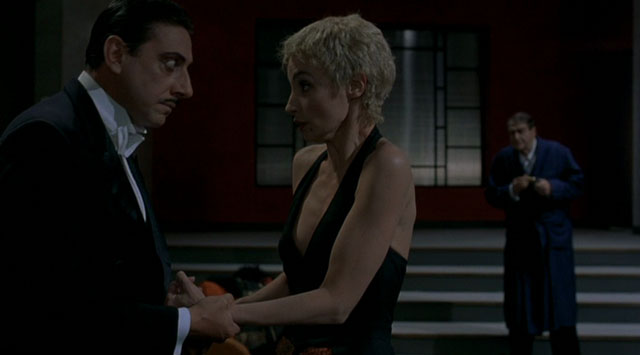
The play performed is the Italian “Come tu mi voui” by Luigi Pirandello, being performed (in Italian) in Paris for a week. I think we see a scene from each night’s performance, each time a different scene, and not in chronological order. They’re probably arranged to comment emotionally upon that day’s off-stage action, but I’ll have to watch it again to be sure (I also missed the on/off-stage connections in Rivette’s previous film Secret Defense). That’s Camille (the lovely, angular Jeanne Balibar, of Don’t Touch the Axe and Comedy of Innocence) in the middle with her lover/director Ugo (Sergio Castellitto of Around a Small Mountain) at left. Their relationship is strained with her return to Paris after three years away, now closer than ever to her long-term ex Pierre, but ultimately they’re good together.

image

I’m getting out of order here, but Pierre (Jacques Bonnaffé, at right, of Lemming and Prénom Carmen) ultimately duels Ugo over Camille. I was never quite sure if Ugo is a nice guy, since he acts like such an ass when first meeting Pierre, but this clears it up. His dueling method of choice is heavy drinking while standing high in the rafters above the stage, but he repeatedly tells Pierre not to look down because there’s actually a safety net below them. This scene made me extremely happy.

image

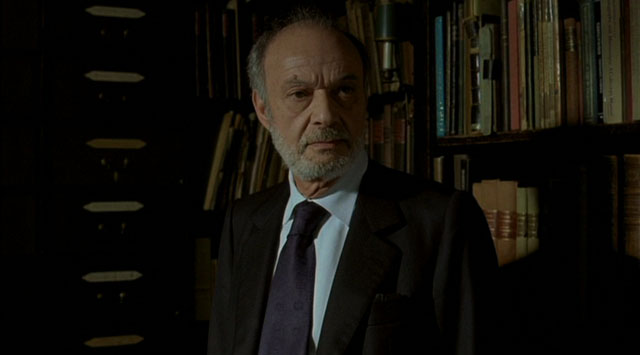
While in Paris, Ugo seeks a lost play by Italian author Goldoni. He checks with an autograph/letter collector (filmmaker Claude Berri), but to no avail. Funny casting a filmmaker in this role, since thirty years earlier Rivette had Eric Rohmer playing a specialist librarian in Out 1.

image

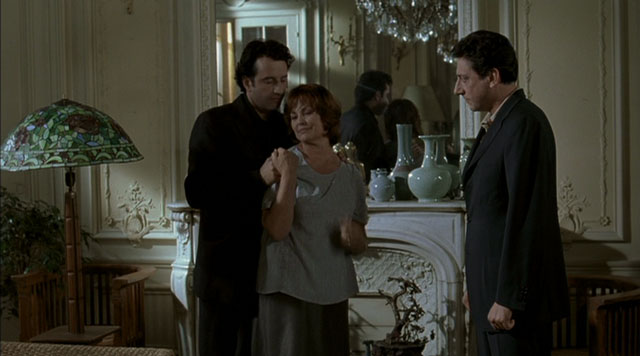
Ugo bounces to this family, descendants of a friend of Goldoni’s who maintain a library of the playwright’s works. The woman (Catherine Rouvel – oh my god, she’s the always-nude girlfriend of the scheming guy in La Rupture) invites him to stay as long as he likes, but after he can’t find the unpublished play all week, he suspects it was secretly sold by her thieving son Arthur (Bruno Todeschini, at left, of Code Unknown and Haut bas fragile)

image

Arthur is also meeting secretly with Sonia (Marianne Basler, who costarred with Gabriel Byrne in a WWII drama), coincidentally the live-in girlfriend of Camille’s ex, Pierre. The affair would be harmless but that Arthur steals a precious ring from Sonia, which Camille sleeps with him in order to steal back.

image

Finally, there’s Arthur’s sister Do (Hélène de Fougerolles of Innocence, maybe in the scene with Edith Scob in Joan the Maid). She helps Ugo search for (and ultimately find) the play, getting ever closer to him as Camille gets closer to her ex (before he locks Camille in a closet). Peace is restored in the end with everyone happy and dancing, the viewer comforted in knowing that the only really crappy character, Arthur, in debt trouble, will soon find out that his stolen ring is gone.

I only noticed this because of the similarly oval-shaped mirror near the end of Out 1:
image

Reportedly there’s an extended cut called Va Savoir+, but little is known about it besides that it had a one-week run in Paris. A message board posts claimed it “wasn’t even an official director’s cut, just an alternate cut Rivette put together for a few screenings, mostly for himself and the other actors,” so I’m not going to worry too much.

Trounced at Cannes (along with decade-faves Mulholland Dr., I’m Going Home, What Time is it There?, In Praise of Love and The Piano Teacher) by a Nanni Moretti film. That must be a good one!

image

Filmbo:

In Va Savoir we are spectators instead of participants. And while there are moments when this pays off rather humorously — take for instance the detective work of finding the missing ring in the flour jar or the duel between the rival male suitors — it falls short of being a top-notch Rivette experience. … there was also the more palpable concept of a theater company producing works that only a few are interested in seeing, accompanied by a quest to find a lost work by an obscure writer… should we be thinking of the oeuvre of anyone in particular?