Set in Paris but I don’t think there’s a single Parisian (character or actor). Stiff lunkhead footballer Randolph Scott (Ride Lonesome), looking convincingly awkward on the delicate Paris sets, is tagging along for some reason with Fred Astaire (here winningly named Huck Haines) and Fred’s band of musical entertainers.

Randolph looks to his rich aunt Roberta (Helen Westley, who also appeared with Irene Dunne in Show Boat) for a place to stay while Fred negotiates with blustery “Russian” Luis Alberni (hotel owner in Easy Living, chef in The Lady Eve) for a place to work.

Enter Fred’s love interest Ginger Rogers. Where did she come from again? I don’t remember, but she’s somewhat hindered here by her awful fake accent and by Fred’s fancy for solo tapdances. Fred’s got no humility – this was only his third film (between Gay Divorcee and Top Hat) and something like Ginger’s 30th. The two dances she participates in are wonderful, especially the first where she wears pants so we can see what she’s up to.

Aaand enter Irene Dunne (pre-Awful Truth, same year she was in John Stahl’s Magnificent Obsession) as Randolph’s love interest. I hate to see a dumb American dude being fought over by a European princess (Dunne, who has also been secretly designing Roberta’s all-the-rage fashions) and an aggressively rich American (Claire Dodd), but maybe Randy is more handsome than I realize. Irene is also secretly (?) the sister of the building’s doorman (Victor Varconi: Pontius Pilate in DeMille’s King of Kings), which leads to misunderstandings. Hmmm. Ultimately what matters is we get some oscar-nominated songs, some Fred/Ginger dances, and some comedic running-around. I like Irene Dunne whenever she’s not singing (she’s fond of the piercing Jeanette MacDonald style, which would thankfully die after the 30’s).

Remade in the 50’s with Red Skelton and Zsa Zsa Gabor. Lucille Ball appears in a fashion montage at the end. IMDB trivia gives clues how to spot her, but I guess my laptop DVD drive is dying so I can’t get screenshots.

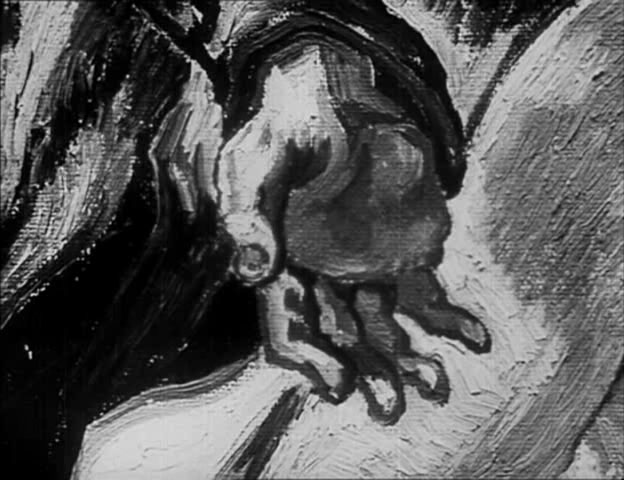
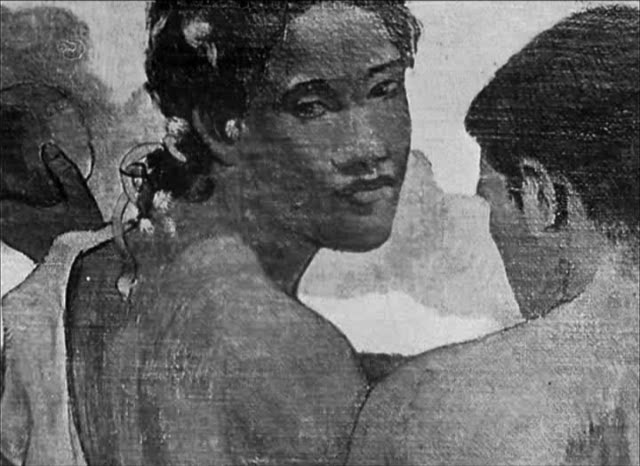
Based on the works of 1700’s poet Sayat Nova, and in fact Sayat Nova was the film’s original title before the censors changed it.

Doesn’t look or play very similar to Parajanov’s also-amazing Shadows of Our Forgotten Ancestors.

My screenshots are all from the first six minutes. After that the laptop wouldn’t read the disc so I watched the rest on TV. EDIT: nope, all screenshots now replaced with 2018 versions.

Divided into sections, with the poet at different stages of his life. Little spoken dialogue.

In the middle section, both Sayat Nova and his girl are played by the same actress:

Just a first viewing. Will watch again (and hopefully again).

2018 UPDATE: This finally came out in a beautiful HD restoration, so now’s the time. I’d forgotten just how completely non-narrative this is. There are scenes from the poet’s life, but you wouldn’t know it without further research. Instead of a story, we get dioramas in front of an unmoving camera. The blu-ray includes a text commentary, since he wants to discuss the audio without obscuring it. He has access to the script and outtakes, so discusses what’s actually happening, in addition to the symbolism and shooting locations and historical context. It’s very helpful to know what’s going on, but I don’t feel like understanding the story makes me love the movie more.

“Let’s see ’em top this on television.”

image

Sequel to a flick where clueless Bob Hope goes west to make his fortune, kills some Indians and causes some chaos. Now Hope plays his own son, a Harvard-obsessed goofball out to claim his dead dad’s missing wealth and escape town without being scalped by vengeful Indians or the townsfolk, their hands full of I.O.U.s from Hope’s father. More importantly, Frank Tashlin is in charge of his first live-action pic, which he treats like one of his cartoons, paying no respect to laws of reality.

image

image

Jane Russell is gold-robbing outlaw Torch by day, nightclub owner and star Mike (?) by night. Straight-arrow do-gooder undercover-lawman Roy Rogers either knows or does not know that they’re the same person. Hope wants nothing to do with Roy, but plots to marry Jane (once he realizes his inheritance amounts to an empty chest) in order to be rich enough to pay his debtors and leave town alive. Torch kidnaps him to get at his loot, his dad’s ol’ prospector friend finds where the actual Paleface loot is hidden (then gets hisself killed by Torch’s badman sidekick), Roy and Trigger do some stunts and sing a song, Jane agrees to marry Bob, and it ends with plenty of unashamed injun-killin’. Who would ask for more?

image

“That cowboy has no eyelashes”
image

Just as much cartoon-anarchy as I was promised from the Tashlin book, so I was pleased. Katy found out she doesn’t much care for Bob Hope, and we agreed the story was full of holes, but to please me she said she also liked the cartoony bits and she thinks Roy Rogers is neat but wishes he had eyelashes.

image

Joke cameo by Cecil DeMille, who was making The Greatest Show on Earth at the time. Looks like the cast of each movie played extras in the other. Jane Russell, returning from the original Paleface, starred in Gentlemen Prefer Blondes the next year. Hawks must’ve seen her in this – she was awesome. This was one of the few times Roy didn’t play “Roy Rogers.” He’d been starring in films for fifteen years, and this was his last (along with horse Trigger, who deservedly won an award for his performance) before moving on to television. Paul Burns (the ol’ prospector) had been in movies since the tender age of 58, appearing in Renoir’s Swamp Water along the way, living just long enough to portray “bum in park (uncredited) in Barefoot in the Park. And handsome baddy Lloyd Corrigan would appear in Tashlin’s followup Marry Me Again before following Roy to TV Land.

image

image

Seems safe to call this a screwball comedy. Cary Grant, a famous painter of Americana whose work we never see, gives a lecture before lovestruck Shirley Temple’s class a couple hours after being dismissed by Temple’s judge sister Myrna Loy for taking part in a bar brawl. An older-sister-younger-sister-Cary love triangle follows, complicated by serious man Rudy Vallee (guy with the constantly-broken specs in Palm Beach Story) who likes Myrna. Anyone who’s seen a romantic comedy before knows that two serious people should not end up together, so Myrna eventually warms up to the reputedly wild (we never see him misbehave much) Grant.

Cary, Shirley’s own-age love-interest Johnny Sands, and Rudy:
image

Shirley is too good for the bellboy:
image

Won a well-deserved oscar for writing, beating out Monsieur Verdoux and Shoeshine. Super enjoyable overall, and Shirley Temple is excellent. Can’t think of any other 18-year-old who would’ve equalled her performance. That’s the upside of being a child star. The downside is that the following year at 19, with a kid and an abusive husband (MST3K target John Agar), her film career was over.

Myrna Loy is not amused:
image

Also good: the girls’ uncle (Orson Welles regular Ray Collins) as a meddling, unethical psychologist, and grumpy oldster Harry Davenport (Meet Me In St. Louis, You Can’t Take It With You). Written by Sidney Sheldon (Anything Goes, Pardners, Annie Get Your Gun) and energetically directed by Reis, who’d be dead from cancer six years later.

How everyone in the 40’s saw Cary Grant:
image

It’s not hard to find a Shakespeare play I haven’t read/seen/acted, but that never stopped Katy from exclaiming “really???” whenever I claimed total unfamiliarity with Midsummer, so we finally rented her favorite version. I liked it… of course, it’s no Much Ado About Nothing with Emma Thompson, but what is? Less zany and complicated than I’d expected. Shakespeare could’ve learned something about comedy from Howard Hawks – or maybe it’s Hoffman, director of dullsville drama Game 6 who could learn something. Fortunately he keeps things much more animated here, seems to do a good job with the so-wide-it’s-squintingly-small-on-my-TV cinematography, though there’s mysteriously no participation by Kenneth Branagh or Michael Keaton (at the time they were busy filming Wild Wild West and doing nothing whatsoever, respectively).

Elf Ritual:
image

Ally, Bale, McNutty, Friel:
image

Okay, Dominic West (The Wire‘s McNulty) loves Pushing Daisies star Anna Friel (who doesn’t?) but her fun-hating parents insist she marry boring Christian Bale (toning things down after Velvet Goldmine) who is being stalked by Calista Ally McBeal Flockhart. Unconnected to any of that, Kevin Kline’s cheesy theater group (including Sam Rockwell) is preparing a play to be performed at the royal court. And all of this would probably end badly if not for the meddling of elf king Rupert Everett (Dunston Checks In) who sends puckish Stanley Tucci to prank fairy queen Michelle Pfeiffer, and along the way he turns Kline into a half-donkey and screws with the four lovers. Mud fights and bicycle rides ensue.

Rockwell is a woman, Kline is a ham, the guy behind them is a wall:
image

Convincingly elvish elf Tucci with mopey Rupert:
image

In the end everything is sorta normal except that Kline’s play is a hit, McNutty is allowed to be with his girl, and Bale magically loves Ally. I was surprised that McNutty and Ally gave the best performances of the four, even edging out all the magical beings (well maybe not Stanley Tucci), and Kline is excellent, bringing a touch of sadness to his mostly ridiculous comic-relief role. So where’s he been hiding this decade? Prepping for a comeback, hopefully.

Donkey-Kline and Queen Pfeiffer:
image

Spike has turned a beloved ten-page kids book into a dark, psychological grown-up divorce drama acted out by a confused kid and large, brown, dangerous puppets. We’re not sure how we feel about this. I’m pretty sure I like the movie. It’s different as hell, seems a ballsy move to have made it at all. Don’t know how much of Spike’s (or co-writer Dave Eggers’) vision made it intact, vaguely recalling rumors of delays and studio-mandated CG puppet-enhancement. Whoever meddled in whose affairs, the monsters came out looking great.

Trouble: handheld camerawork provides no sense of composition most of the time, and fantasy world and characters are all painted in shades of brown. The filmmakers are creating a ten-year-old’s escapist fantasy realm, and all we get is brown? Suppose it’s a natural-environment thing, since he’s fleeing civilization for the wilderness. The music is alright, but the quiet version of Arcade Fire’s “Wake Up” on the trailer was so beautifully suited to the imagery, I’m tempted to say I liked the preview better than the film.

Young (imaginative, loner, duh) Max and his older sister live with beleagured mom Catherine Keener. Divorced dad isn’t in the movie, except once by phone, but mom is dating a guy, probably third-billed Mark Ruffalo who I didn’t recognize for the 45 seconds he was in the film, when Max goes on a rage, runs away in his monster pajamas and dreams a perfect world where he gets to be king of the monsters and have fun all the time.

Just kidding – Max dreams up monsters who are as moody as himself, always quarrelling and splitting up like his parents or going off to hang out with their cool friends like his sister, building beautiful things then destroying them in temper tantrums, hurting each other accidentally or on purpose, and often threatening to eat Max up. After an hour of this, nothing is resolved and Max goes home… just like real life, but not much like the hollywood spectacle we were all expecting.

“What we need is a flamethrower.”

image

Apparently this played in one theater for one week before going to “VOD” (whatever that is). I don’t know anyone who has this “VOD,” which was also the rumored resting place of Maddin’s My Winnipeg, and where all Soderbergh’s movies are said to be sent the same day as their theatrical releases. Is it something you watch on those portable playstation games? Is it a website? Can I get an invite? Not willing to buy a satellite dish or a fiber-optic link to hollywood or whatever I’d need, I borrowed a copy of the movie from a connected friend to close out this year’s successful SHOCKtober season. Sorry, Mr. McDonald, but rest assured I’ll be buying the movie and the book as soon as I figure out how.

“Mrs. French’s cat is missing” says a sinister voice as a blue waveform bounces across the wide screen, before the title breaks through in a blue vortex, each letter appearing from the inside out until it spells TYPO a few seconds before PONTYPOOL. What with the movie’s play with language, that can’t be accidental.

image

Next half (or more) of the film has fallen big-city talk-radio DJ Grant Mazzy in his sound booth, with his producer Sydney Briar (great names) and assistant Laurel Ann sitting in the main room. It’s snowing and damn cold outside, it’s early morning, and Grant is trying to show off his “take no prisoners” attitude and start rumors. The camera is always gliding at a constant speed, which kinda bugs me though I can’t think of a more pleasing alternative offhand. Gradually we start to hear of a disturbance in town, “herds” of people banding together and murmuring, breaking into buildings and tearing residents apart. The descriptions get weirder, until Grant is saying things like this on the air: “That was our own Ken Loney interviewing a screaming baby coming from Mary Gault’s eldest son’s last dying gasps.”

The actions outside are so disturbing and unbelievable, that by this point characters and viewer are dying to break out of the radio station and walk around – but we never do. Instead the herd tries to break in, preceded by the slightly loopy Dr. Mendez who may know how the whole thing started (he tells us it’s a virus infecting words in the English language) but is never given enough time to explain himself because Laurel Ann becomes infected. They stay in the sound booth, depriving her of language to feed off, until she explodes.

image

More word games, and then Grant (who, as a popular talk radio host, may have been helping spread the virus all morning) comes up with a cure that doubles as a last-minute romantic ending, defamiliarizing the infected word, changing its meaning. “Kill is kiss, kill is kiss” makes me think of Killer’s Kiss.

I wasn’t aware of Stephen McHattie though I’ve seen him before. He went from playing James Dean in a 70’s TV biopic, to Canadian thrillers in the 80’s, to a ton of TV and voice (no surprise) acting, to A History of Violence and The Fountain to major roles in Hollywood action flicks (300, Shoot ’em Up, Nite Owl in Watchmen). McDonald is known for a handful of cult road flicks and the interesting-sounding The Tracey Fragments, and also directs a ton of TV. I’d only seen his short Elimination Dance, but will be seeking out more.

image

McDonald: “Zombies are undead and these people are not. They’re people who have difficulty expressing themselves. It’s a very common, very modern virus.”

AV Club:

Primarily though, the film works as a tour de force for McHattie – a veteran character actor making the most of his character’s long, fluid monologues – and as a sly commentary on journalistic responsibility. At first, McHattie seems to enjoy anchoring a broadcast that’s drawing international attention, but throughout, his conscientious producer Lisa Houle pesters him about whether it’s really appropriate for him to be goosing the drama, as when he urges the station’s field reporter to get closer to the monsters. There’s a lot of subtext in Pontypool (and some of it isn’t so “sub”) about how meaningless conversation can be a kind of plague. Yet the greater evil may be the words that sound meaningful, but are really just diverting.

from D. Cairns short but essential interview with the director:

DC: The very idea of a “war on terror” is a very Pontypool idea, the war against an abstract concept or word.

MACDONALD: Right. So our ideas naturally come out about the manufacturing of fear by the American media […] the co-opting of certain words by the media, to label people or things. And it’s in a very sly and damaging way, often. “Pedophile” is a popular word, as a weapon, you know. To suddenly hint at that, you could destroy somebody. With something as simple as “You know, I heard he was a pedophile…” It just shows how powerful certain words are. Language is so loaded with great shit, it’s almost an embarrassment of riches for us, to know how to place some of these things. And there’s kind of a cultural thing too, like when the BBC guy comes on, everybody’s like, “Oh my god, we’ve got the real guy on!” you know? It’s like these backwoods colonial guys listening to the real deal. It’s such a cultural thing, with the French-English in Canada. And suddenly these sovereigntists or separatists become “terrorists,” that easy slip, how easy that is… “Oh, I’ve never heard the French ‘Quiet Revolution’ referred to as ‘terrorists’ in Quebec.” But you could…

DC: And a violent riot becomes an “insurgency.”

MACDONALD: Yeah yeah. So you start to see how just choice of words, there’s a certain WAY that the media talks, to create a drama, to create an ongoing story. … Myself having worked in the media for so long, you have an inside view of how these things go on.

Good news:

May 16, 2009
Acclaimed director Bruce McDonald returns to the director’s chair with Pontypool Changes, a sequel to his highly anticipated psychological thriller Pontypool. Producer Jeffrey Coghlan confirmed rumors in Cannes today that the Pontypool sequel is scheduled to lens in early 2010, reuniting McDonald with Pontypool screenwriter Tony Burgess, who adapted the original from his book “Pontypool Changes Everything”.

Author Tony Burgess shares a name with the author of A Clockwork Orange, another sci-fi novel interested in language.

From Bruce’s interview with Twitch:

– Let’s talk about the after the credits scene, the cookie.
– That used to be end of the movie, but before the credits. And people thought, what? What? Too much confusion. There is a tradition now where you have something at the end of the credits where you have an outtake, or hint of a sequel. The existence for it is sort of buried in there, well the title of the book sort of suggests it, Pontypool Changes Everything, and one of the things I’ve always love about the notion of this, is that the virus could affect something as abstract as the English language. It can leap into reality itself, change the fabric of how reality is perceived.

OCT 2017: Watched again in HD, still the best.

Puppetmaster

“Full Moon Productions presents…”

According to IMDB, this was Full Moon’s first feature. They’d go on to make some of my favorite direct-to-video absurd low-budget semi-horror movies of the early 90’s, including Stuart Gordon’s Pit and the Pendulum, the Louisiana sex/devil cult story Netherworld, and many Puppet Master sequels, plus movies that screamed “rent us” from the new-release shelf with names like Trancers, Subspecies and Dollman, but never quite seemed worth the three bucks.

image

“A David Schmoeller film”

Or more accurately, a David Schmoeller VHS tape (were any Puppet Master movies released to cinemas?). He wrote and directed a Klaus Kinski torture film called Crawlspace, which I meant to watch last week instead of Pin… but foolishly did not.

“Puppetmaster”

Titles were re-capitalized to Puppet Master for the sequels, maybe to avoid confusion with Hsiao-hsien Hou’s acclaimed drama The Puppetmaster (whose runtime is longer than any two Puppet Master sequels put together).

“starring Paul Le Mat”

One could argue that Le Mat is an actual star, having played a title role in Demme’s Melvin and Howard and third-billed in American Graffiti. I didn’t find him photogenic, hence no screenshot… oh wait, this might be him screaming:

image

“and introducing Robin Frates”

This was pretty much the last time anyone heard from Robin Frates, except those who saw Schmoeller’s follow-up film The Arrival (not the Charlie Sheen one), which sounds appealingly like a sort of alien vampire Benjamin Button.

image

“special appearance by Barbara Crampton”

Star of Re-Animator and From Beyond! You’d think if her appearance was so special, she could’ve been given a better role than “woman at carnival.”

The theme music is nicer than this movie deserves.

Budget tip #1: Low-to-ground POV shots require no actual puppet effects, and are fun to watch. These are just great, the camera running behind feet and cars, jumping over suitcases and across piano keys.

William Hickey (Wise Blood, Prizzi’s Honor) is Toulon, the inspecifically-foreign-accented titular magician. He’s been discovered by sinister nazis, so he hides Happy/Sad Clown, Oriental Mustache and Hook-hand behind a wall panel and bites a bullet. The end.

The short-lived Toulon #1:
image

No wait! “Yale University, present day.” A dumpy Paul Le Mat dreams in color that he is dreaming in black and white while being attacked by leeches (I hope that’s exactly how the scene read in the script). Is Yale a carnival, or have we changed location to a carnival? Enter “woman at carnival,” visiting a psychic (Irene Miracle of Inferno) who lacks a stereotypical gypsy accent. Ooh they’re playing the ol’ scam-gypsy-who-sees-real-visions card as Barbara dreams up a puppet attack.

image

“I want you to recreate in your mind your wildest sexual fantasy.” Two sex-crazed psychic researchers (Balding Ponytail and Too Much Lipstick) call Le Mat (on the phone, disappointingly) to arrange a meeting at the hotel where Toulon died, where they’re met by their cynical psychic friend, their dead friend Neil, a crabby Mews Small (Scott Baio’s mom in Zapped!) and introducing Robin Frates.

image

While our psychic friends creep around the place seeing visions and acting eccentric, Tiny (little puppet head and human hands emerging from a ribbed sweater) kills the peeping crabby lady and plays games with dead Neil. In true Friday the 13th fashion, the puppets go after the sexually active couple first – Too Much Lipstick is killed offscreen by Drill Head and a female puppet barfs leeches onto her tied-up husband. Tiny, boasting some impressive stop-motion, wounds the cynical drunk girl then Hook finishes her off in the elevator (if they were aiming for a Dressed To Kill reference, the editor wasn’t cooperating).

Dead Neil explains: “Metaphysically speaking, I killed myself, and using the techniques of the old puppet master I brought myself back to life.” But then Neil stupidly disrespects the killer puppets and they gang up on him, brutalizing a rubber hand before breaking out the drill and leeches (honestly the leeches aren’t very scary).

image

Written and produced by Full Moon head Charles Band, who had produced everything from Laserblast and Robot Holocaust to Stuart Gordon’s Dolls, Trancers and Ghoulies, TerrorVision and Troll, Clive Barker’s disowned first two pictures, and Sorority Babes in the Slimeball Bowl-o-rama – pretty much everything I watched on HBO at 2am in 1992. Effects by oscar-nominated Dave Allen, who worked on The Stuff, The Howling and Equinox.

image


Puppet Master 2

Hook, Clown, Drill, Tiny and Leech Woman resurrect Toulon using a magic potion before the credits even roll. This one is gonna be good.

image

“Full Moon Entertainment presents”

In the two years between the original and the sequel, Full Moon and Charles Band have involved themselves in a parallel-universe thriller, a sexy fantasy-horror starring Sherilyn Fenn (premiering the same week as Twin Peaks), Stuart Gordon’s Robot Jox and its Gordon-unaffiliated sequel

“directed by David Allen”

So they’ve handed the franchise right over to the effects crew. Part II is from the writer of Subspecies and cinematographer of Screwball Hotel (I’ll bet that’s not how they sold it on the poster).

image

A U.S. government paranormal research van is poking around the old hotel, bearing bearded Lance (Demonic Toys), dark-haired Wanda, jokey cynic Patrick, serious Carolyn (of Robot Jox 2) and older new agey “truth comes from feeling” Camille (Frightmare, Night Shift). They tell us Paul Le Mat survived the first movie but wanted too much money for the sequel so he’s locked in an asylum. Then introducing the neighborhood Comic Relief Farmer and his pitchfork-bearing wife – “They say Satan’s got a suite of rooms in there!”

Tiny and Clown take care of pseudo-psychic Camille in secret, then Drill brains Patrick with everyone watching, is captured and dissected. I hope Drill will be okay!

image

The filmmakers overestimate the computing power of an Amiga 2000:
image

Toulon (a new actor) wanders in with an Invisible Man getup, calling himself Eriquee Chaneé (get it? Chaney?) claiming the hotel is his, then the group is joined by Collin “Corbin’s Brother” Bernsen, our first glimpse of star power (heh)

image

The farmer’s brains are removed by Leech Woman (movie is really into brains; I sense a zombie connection) who is then melted by the wife, immediately replaced by Torch, who burns her up, in a particularly poorly-lit scene. So Toulon is collecting brains to brew up a new batch of magic puppet juice and live another 50+ years as a puppet himself.

image

Flashback: Toulon remembers years ago in Egypt when he was a powerful magical puppetmaster but a crappy actor, and as punishment, an old merchant burns up the puppets using his mind. Hmmm.

The scene I remember best from the entire series (below): a boy is torturing his GI Joes with a whip, tries to play rough with Torch. The scene I remember least: pointless seaside romance between Carolyn and Corbin’s brother. Even adding a flamethrowing puppet and resurrecting Toulon from the dead, it’s not a better movie than the first one, which at least had characters which weren’t all interchangeable sexy college students.

image

Hook carves up Lance and Wanda, Puppet Toulon (I like him, a short guy with hard marble contact lenses) threatens Carolyn, and I’m not sure why the puppets turn on him then resurrect Camille to go terrorize an institute for “mentally troubled” children, but there you go.

image


Puppet Master 3

“Berlin – 1941”

Nazi experimenters succeed in reviving the corpses of dead soldiers. A young puppetmaster is interested.

Looks like something out of Day of the Dead:
image

“Full Moon Entertainment presents”

This was Full Moon’s year. They had Stuart Gordon (Pit and the Pendulum), Trancers II (the Helen Hunt-starring sequel to a mid-80’s Charles Band film), and future sequel-bait Subspecies and Dollman.

image

“starring Guy Rolfe”

Finally a consistent Toulon – he’d play the part through 1999. Guy had been around – not just in stuff like Dolls (in which he also played a puppetmaster), but in Tashlin’s Alphabet Murders and Nick Ray’s King of Kings in the 60’s.

image

“directed by David DeCoteau”

The prolific Mr. DeCoteau had made such classics as Sorority Babes in the Slimeball Bowl-o-rama (which I have seen more than once) and Dr. Alien, would go on to make such classics as Frankenstein Reborn!, Final Stab and Wolves of Wall Street.

Sinister Eric Stein confronts Toulon about the Hitler-mockery satire of Toulon’s puppet show. Mrs. Toulon (Sarah Douglas of the first two Superman movies and Return of the Living Dead III) looks on. The stop-motion effects are still cool and still only one second long at a time. Two important and great new additions: the six-shooter cowboy puppet, and giving the puppets wordless voices (cowboy’s Jack Nicholson laugh is my favorite).

image

Gestapo Krauss (Richard Lynch) and Dr. Hess (Ian Abercrombie of Inland Empire) fight over Toulon’s fate. T’s wife is killed in a raid, then Tiny and Drill kill the nazis escorting T into custody – can’t argue with that. While T cries over his wife (along with the puppets, making the ending of part 2 more inexplicable) and gives his revenge monologue, the main general (a Bond movie regular) calls on the search. Leech Woman is still not interesting, even when she’s supposedly T’s murdered wife recurrected to kill Stein.

image

A distractingly weird-looking “young boy” (turns out it’s a short 22-year-old), also on the run, stays with Toulon while Six-Gun takes out the general (plenty of stop-motion plus a fall from a high window – along with the period costumes, looks like Full Moon is ramping up the budget). Toulon creates Blade, modeled after Krauss (who himself is modeled after Klaus Kinski), replacing his broken Hitler doll.

Kraus/Kinski/Blade:
image

There’s actually a story here, not just a bunch of idiots at a hotel getting killed one at a time. Hess turns out to be decent (well, as decent as any nazi scientist trying to reanimate dead soldiers can be), the father of the “boy” turns traitor to win his freedom, both die, Toulon strings up Krauss and escapes Germany with the “boy.” Weird to turn a slasher horror flick into a nazi adventure, but there you go.

image

“Photographed at Universal City Studios Hollywood” – there’s that budget I was talking about. Too bad it won’t last.

image

EDIT: Thanks to Frederic for pointing out the correct model of computer the filmmakers are misusing in part two. Apologies to Commodore 64 heads for the error.

I’m glad I got to see this in a theater, since I don’t know if I could’ve sit still for it on video. Also fun to observe the number of walkouts, probably from the half of the audience who hadn’t read the description beforehand and gasped loudly when Andy mentioned its 3.5-hour length in his introduction (AKA the half that wasn’t receiving class credit for attendance). But surprisingly I didn’t like it very much, never got the sense that all the elements (formalist experiment + weight of duration + story or lack thereof + static, careful camera compositions + subtle lead performance) congealed into a singular, great experience.

So, as I already knew, the film portrays Jeanne going about her routine for three days: making coffee, awakening her son and sending him to school, shopping, sleeping with some guy, making dinner, eating with her son, going to bed. Towards the second half her routine isn’t going as smoothly. Potatoes are overcooked. She walks into the wrong room. She can’t comfort the infant she watches while her neighbor shops. Then on the third day she stabs her guy to death with scissors. I’m still thinking about language since watching Pontypool. IMDB and Criterion descriptions say she “turns the occasional trick,” but most viewer descriptions outright call her “a prostitute.”

Delphine Seyrig was already a star (see: Last Year at Marienbad) and would remain one. Jan Decorte (her son) would only be in one more film (also by Akerman). The first two (non-murdered) men are both directors, the middle being Jacques Doniol-Valcroze. He played Etienne, whose letters get stolen and ransomed, in Out 1.

I. Magulies:

The perfect parity between Jeanne’s predictable schedule and Akerman’s minimalist precision deflects our attention from the fleeting signs of Jeanne’s afternoon prostitution. They nevertheless loom at the edge of our mind, gradually building unease. Jeanne Dielman constitutes a radical experiment with being undramatic, and paradoxically with the absolute necessity of drama.

Helping explain the movie’s feminist reputation:

Aunt Fernande, Jeanne’s sister, living in Canada, only appears in the form of a letter, read in litanylike monotone by Jeanne to her son; the neighbor, heard by the door (and played by Akerman herself), describes how, shopping for her husband’s dinner, and still undecided, she ended up getting the same expensive cut of meat as the person in front of her on line. Never casual, each of the film’s uniquely strange and long-winded monologues expresses some form of gendered pressure: they refer to Jeanne’s marriage, the son’s Oedipal thoughts, each breathing a sexual anxiety, each a drawn-out, wordy attempt to mitigate the “other scene” we never see, the elided afternoon trysts.