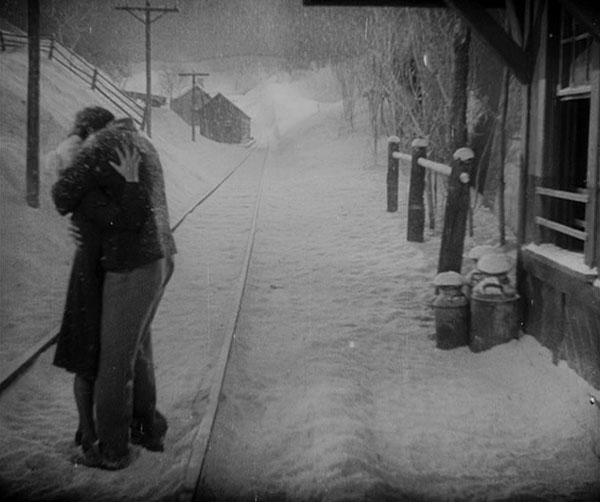
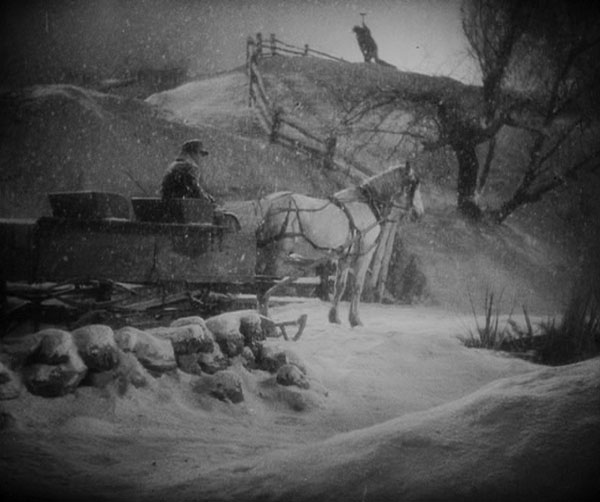
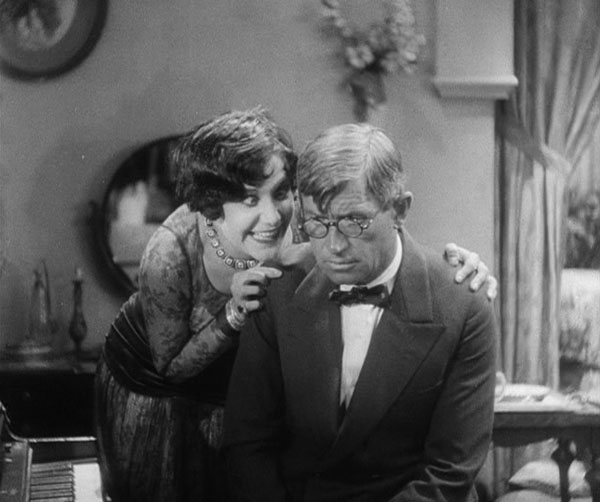
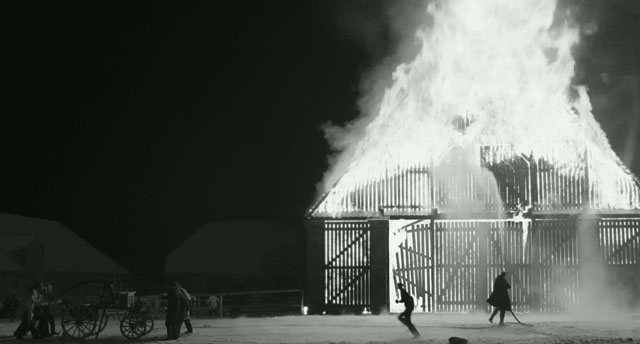
Katy said it didn’t feel very JohnFordian, but it did to me, because two thirds of my previous John Ford experience consisted of Judge Priest and The Sun Shines Bright. Takes place in a small town in the south – there’s mob violence and a courtroom climax, and along the way we hear “Dixie” more than once. Sounds extremely Fordian to me. In fact I’m thinking Atlanta-born writer Lamar Trotti, who also cowrote Judge Priest, could stand to vary his game.

Two simple men and their simple mother (Alice Brady, the mom in My Man Godfrey, in her final film) were enjoying simple pleasures in town when they got in a fight with a blowhard and he ended up dead. Blowhard’s buddy Ward Bond (John Wayne’s old friend in Rio Bravo) says they stabbed the blowhard, so off to jail they go. Fortunately, hat-wearing slave-freeing superhero Abe Lincoln (Henry Fonda with a fake nose, looking spookily Lincolnesque in the occasional profile shot) stops the angry lynch mob by picking on them one at a time (a la Sun Shines Bright) and agrees to defend the kids, in between watching his girlfriend (Pauline Moore) die and meeting a new girlfriend (Marjorie Weaver, the lady in The Cisco Kid And The Lady). It’s all based on a completely true story! Except that it was a blunt weapon, not a knife, and the accused men weren’t brothers, and one of them (the one not defended by Lincoln) was convicted of manslaughter and imprisoned for six years, and Lincoln got the other guy acquitted but there was no sneaky buddy to take the fall instead.

Movie slides along peacefully and slowly builds. Very pretty in parts. I’d need to read more or study further to figure why this was one of Sergei Eisenstein’s favorite films… missing something, as usual.

Felt slightly long and slow and full of old men for a Hawks movie. Gary Cooper is a hunky young encyclopedia writer locked in a house with his coworkers (including “Cuddles” Sakall). Barbara Stanwyck is the ball of fire who hides out with them on the pretense of helping with an entry on slang, hiding out from her gangster boyfriend (young Dana Andrews, star of one of my least-favorite Fritz Lang movies).

Mostly fun to watch for the language. Written by Billy Wilder and Lubitsch vet/future Sunset Blvd. collaborator Charles Brackett. Same cinematographer as Citizen Kane, the same year. Remade in ’48 with Danny Kaye in the Gary Cooper part, Virginia Mayo as Barbara Stanwyck and Louis Armstrong as Cuddles Sakall.

The internet likes to say the encyclopedaeists were inspired by Snow White’s seven dwarfs, and so here’s me on the internet faithfully repeating it.

Based on the bestest-selling novel which everyone in the world has now read. I’d heard it would be relentlessly bleak, and so that’s what it was. Hillcoat and Nick Cave and Viggo Mortensen and Javier Aguirresarobe (also cinematographer of Talk To Her, The Dream of Light, the Twilight saga) and Charlize Theron and the boy all did terrific jobs, first-rate, award-deserving and everything else.

But it’s kinda like Polanski’s The Pianist… a perfectly-made film in service of the most depressing story ever. One person survives a (nuclear/nazi) holocaust, and while that’s somewhat encouraging, the movie spends its runtime rubbing your nose in the terrible enormity of said holocaust making for a mega-bummer experience. If a great movie makes you feel crappy for having seen it, is it still a great movie?

I suppose Theron is only alive in flashback. She doesn’t have the survival instinct of her husband, just wants to kill her son and herself peacefully before cannibals catch them or they starve to death. Viggo won’t agree, so she wanders out into the cold alone. Viggo goes from being the only honest man in the world, protective and generous to his son, ruthless in his survival, to seeming slightly savage, giving a thief a death sentence, unable to ever trust anyone. When he dies from cold & sickness, the son is immediately picked up by Guy Pearce and family, and you get the feeling that he’s better off. Robert Duvall is unrecognizable as a decrepit man who may not be as feeble as he lets on. Viggo gets shot by an arrow, discovers a hidden food bunker, avoids cannibal camps, shoots a guy in the head – it’s hardly Children of Men as far as slam-bang action but it’s creepier as far as apocalyptic atmosphere.

Cute movie, actually one of my favorite Disney cartoons. That’s probably because I first saw it when I still liked Disney movies (age 10-ish) and didn’t see it again when I was sick of them (age 12-20). Watched it this time because I’ve been listening to Roger Miller albums on repeat all autumn and I never realized he played the troubadour narrator rooster and contributed songs to this movie. Miller has three original songs, Johnny Mercer wrote one, then there was a crappy love ballad which of course is the one that got oscar-nominated (and easily beaten by “The Way We Were”).

image

I thought Robin and Little John had a fight on a log but that must’ve been the Errol Flynn version. And I was expecting King Richard’s appearance at the end to be dramatic, a la Sean Connery in Prince of Thieves or Patrick Stewart in Men in Tights, but his scene got deleted for being frightening to children, so he only appears in epilogue. Lots of talk of death and hangings for a kids movie.

Director Wolfgang was a Disney animation lifer, from early 30’s shorts through feaures in the late 70’s. Robin is Brian Bedford (Grand Prix) – he doesn’t get his name on the poster like Tom Hanks in Toy Story. Former bandleader Phil Harris as Little John sounds annoyingly close to his Baloo. Andy Devine (Friar Tuck) was in Stagecoach and The Man Who Shot Liberty Valance. Monica Evans was in The Odd Couple, abruptly disappeared from the movies after voicing Maid Marian. Pat Buttram (heh), a western actor in the early 50’s, has the most memorable voice in the movie as the Sheriff. The oft-awarded Peter Ustinov (Lola Montes, Spartacus, Logan’s Run) is the prince (and the king) and famously gap-toothed comic Terry-Thomas (Danger: Diabolik, Bachelor Flat) is his snake assistant.

Surogat (1961, Dusan Vukotic)
Slightly naughty beach picture about a fat guy who brings inflatable ball, boat, car, food and girl. Real great anything-goes animation. Disney, Friz Freling and Chuck Jones must’ve cancelled each other out, giving the award to the underdog foreigner.
image

The Crunch Bird (1971, Ted Petok)
“Crunch bird, my ass!” Ugh, punchline shorts. Was there no competition this year? I would’ve awarded Thank You Mask Man over this. From a co-writer of What’s Up Tiger Lily, this beat a comic Canadian short about evolution and an adaptation of an Oscar Wilde fairy tale (OW wrote fairy tales?).
image

The Sand Castle (1977, Co Hoedeman)
A desert man with arms and legs but no body creates clay creatures to help him build a giant sand castle. All stop-motion, the short that (probably deservedly) beat Doonesbury at the oscars.
image

Every Child (1979, Eugene Fedorenko)
More of a foley demonstration than a proper cartoon. The animation is there I guess, though slightly Squiggle-visioney. Wow, someone sings the Umbrellas of Cherbourg theme. So the foley guys are telling the story of an unwanted baby… to a baby. One foley guy went on to voice the French version of Chief Quimby on Inspector Gadget. This beat a short called Dream Doll which I’d like to see, apparently an X-rated spoof of The Red Balloon.
image

Tango (1981, Zbigniew Rybczynski)
An empty room, simple tango music. A kid (looks like stop-motion cut-out photographs) throws a ball into the room, comes in, throws the ball outside, leaves, repeat. Then another person is added, then another and another, none of them interacting with each other until the very end. How’d they do it? Beat out some stop-motion from the great Will Vinton and a half-hour piece about a snowman.
image

The Man Who Planted Trees (1987, Frédéric Back)
Just about the happiest thing ever, so lovely it made my head hurt. Story of a lonely shepherd who singlehandedly reforests an entire region of France. I looked it up, hoping that it’s a true story, and unbelievably it is. Narrated by the familiar voice of Christopher Plummer and animated with lush, colorful sketches. The romantic short from the creators of Bob & Margaret and a big of head-morphing Bill Plympton hilarity never stood a chance against this beauty.
image

A Greek Tragedy (1985, Nicole Van Goethem)
The characters are man/pillars holding up a stone wall that has fallen into ruins. When it finally collapses, the pillars are free to frolic. The kind of simple cuteness you’d see at a festival with three of four similar pieces, not the kind I’d think would win a major award. Hard times in 1986. Actually this beat Luxo Jr. somehow. I guess computer animation wasn’t in style until ’88. At the same time, it’s nice
image

Tin Toy (1988, John Lasseter)
A one-man-band toy escapes the wrath of a slimy toddler, then grudgingly returns to cheer it up when it’s crying only to be ignored in favor of an empty box and a paper bag. Clear precedent to Toy Story. 1988 computer technology was not up to the task of accurate baby rendering, but it’s still pretty cool looking. It beat a Tex Avery-style short from the future director of FernGully and Cordell Baker’s great The Cat Came Back.
image

Manipulation (1991, Daniel Greaves)
A good ol’ artist’s-hands-interacting-with-drawing-table short, somewhere between Duck Amuck and Rejected. Funny how one of the most recent shorts is the one available in the lowest quality. The line-drawing guy turns 3D at the end, which I think was done in claymation. Very inventive and fun. Apparently Greaves’ Flatworld is also a must-see. No U.S. shorts in this year’s competition – this UK film beat out two Canadian pieces (including long-time fave Blackfly).
image

Mona Lisa Descending a Staircase (1992, Joan C. Gratz)
Really wonderful little animated film which would probably be the greatest thing ever if I was an art history major. Since I only knew about five of the paintings which were mighty-morphing into each other, I probably attribute more of the film’s beauty to its director than I probably should. Oh wait, it won the oscar so I guess I’m not the only one who was impressed.
image

Then again, some of it is just silliness.
image

Quest (1996, Tyron Montgomery)
A man made of sand navigates increasingly more difficult and dangerous worlds of paper, rock, metal and water. The end is the beginning – would work as a looping DVD or art installation. Nice stop-motion, like The Sand Castle but I liked this one better, Thought it was anti-technology for a while, but now I think its just trying to say the world is a dangerous place. Competition included an Aardman, a Canadian piece I’ve seen but don’t remember, and a stop-motion short from a future Pixar animator.
image

The Country Cousin (1936, Wilfred Jackson)
A Disney Silly Symphony. Country mouse loves all the expensive food in the city, but isn’t fond of cats, cars or roller-skaters so he hauls ass back to the country. Includes an extended drunky joke. It beat a Popeye cartoon and an MGM jazz short of racial caricatures.
image

The Milky Way (1940, Rudolf Ising)
Finally someone other than Disney takes the prize. Disney wasn’t even nominated – competition included the first Bugs vs. Elmer short and the first Tom & Jerry cartoon.
image

The Cat Concerto (1946, Hanna & Barbera)
Won the oscar despite allegations that the story was ripped off from W-B’s Rhapsody Rabbit, beating a George Pal puppetoon about John Henry, a Woody Woodpecker musical, and early appearances by Chip ‘n Dale and Foghorn Leghorn.
image

For Scent-imental Reasons (1949, Chuck Jones)
“Ahhh, le belle femme skunk fatale!”
The greatest sexual predator in the cartoons makes his fifth appearance. This beat a piece John Hubley made for UPA which I’d like to see.
image

Gerald McBoing-Boing (1950, Robert Cannon)
Gerald makes noises, is shunned, finds his place and everyone learns a valuable lesson. Beat out a Mr. Magoo cartoon (also from UPA) and one of my favorite Tom & Jerrys.
image

Toot, Whistle, Plunk and Boom (1953, Ward Kimball)
Full-on Disney animation plus outlines and photographs. I’ve seen part of this on those Disney Sing-Along Songs tapes that Trevor played on repeat for two years. The history of musical instruments in ten minutes. Possibly my favorite of all the oscar shorts so far, though I’ll bet it’s not widely played because of the racial stereotypes on display.
image

The first CinemaScope cartoon, originally released to accompany Fantasia – should be a required classic. Tough competition: Chuck Jones, UPA, Donald Duck and Ted Parmelee’s awesome The Tell-Tale Heart.
image

When Magoo Flew (1954, Pete Burness)
Ridiculous picture (and not always in a good way) complete with weird self-referential ending and a crabby complaint about television. Maybe Tashlin was hiding under a desk somewhere. Not a big Magoo fan, don’t know how this beat a Tom & Jerry mouseketeer short, tweety bird, Disney and Tex Avery. Dig the Ted Parmelee reference in the screenshot.
image

Speedy Gonzales (1955, Friz Freling)
This one doesn’t have the line I remember about wanting to get the cheese but being too lazy, but it does have the line “he’s a friend of my sister” / “Speedy is friend of everybody’s seester!” Another no-longer-politically-correct classic. Surprisingly beat the Hanna/Barbera holiday classic Good Will To Men and an acclaimed Tex Avery piece.

Visions of Europe is a 2004 anthology film with shorts by various directors about the current state of the continent, which I’ve already started to watch earlier and still may never finish. Pretty hit or miss.

The Miracle (Martin Sulik)
An immaculate conception story, the girl’s parents and priest trying to get answers. God’s message, via the girl, “We mustn’t build tower blocks. The big ones must heed the small. We need to travel more to resist the false messiah.” Weird, kinda spooky. Not sure if the floating coffee cup at the end helped or not.
image

Anna Lives In Marghera (Francesca Comencini)
Briskly edited montage of an Italian student who participates in Rage Against The Machine-soundtracked political protests and prays when she’s not working on her thesis about industrial pollution.
image

Children Lose Nothing (Sharunas Bartas)
A girl collects frogs. Two boys fight over a girl. A paper boat! Finely photographed brownish little art short. Symbolic of something!
image

Room For All (Constantine Giannaris)
Talking heads tell us about the immigrant experience in Greece. Giannaris just made a movie called Gender Pop – the title alone is more interesting than this.

Prologue (Béla Tarr)
Loooong black-and-white dolly shot (imagine that) with pretty music by Mihaly Vig showing hundreds of people waiting in line to get food. Tibor Takacs was one name in the credits – could it be the director of The Gate?
image

Invisible State (Aisling Walsh)
A serious man in a suit tells us angrily about human trafficking. “They will tell of Irish eyes not smiling.” Walsh made a teary Aidan Quinn drama the previous year.
image

Crossroad (Malgorzata Szumowska)
The adventures of a catholic cross outdoors at a crossroad. Eventually some coroners take down the classic Jesus and replace it with a blobby new plastic Jesus. Was it supposed to be funny? I found it kinda funny.
image

Paris By Night (Tony Gatlif)
Immigrants on the run, one of them injured, run through the Paris streets to some good music. Jarmuschy. Same year as Gatlif’s acclaimed Exiles.
image

Glorious (2008, Guy Maddin)
Far more guns, gangsters and cocksucking than has ever been in a Maddin film before. Features Louis Negin as a single-frame apparition turned fellatio-ghost. Must pay more attention to the music next time. In other news, when I looked up Louis Negin on IMDB, it says he played a zombie in Pontypool.
image

image

image

image

Yay, got me a 2007 disc of cartoons based on the work of Jim Woodring. Jim himself kicks off the collection with the one-minute Whim Grinder: A Frank Adventure, in which Frank and his pet… box? intercept a transmogrifying eggbeater from a mischievous devil.
image

Frank (Pushpow) (Taruto Fuyama)
I dig the use of the “meet george jetson” music cue. Watched twice because there’s a second audio track with elektronischy music by James McNew. Black and white and very stripey. Done in Flash, maybe? then transferred off a videotape from the looks of the credits. One of the greatest things ever.
image

Frank (Eri Yoshimura)
Next one, done in a puppet cutout style, is very different. Frank seems to be having a picnic with his buds until a rampaging pig beast tears them all apart. Seems about two minutes of animation edited into four. The closing credits are pretty nice – not so much the rest.
image

I’ve Been Twelve Forever (Michel Gondry)
Gondry talks with his mom, storyboards his dreams, builds a spinning camera-spirograph triggered by strings tied to Bjork’s fingers, makes cartoon farts with cotton balls, invents new animation methods, films himself in stop-motion, and discusses his best music videos. This turned out not to be a short at all, though I thought it would be when I started watching it, and much more elaborate and creative than its status as a DVD-extra on a music videos disc would suggest. I’m pretty sure I like this better than Be Kind Rewind. Co-directed with four people including Lance Bangs.

Wet Chicken (2003, Myznikova & Provorov)
A woman’s hair blows in the breeze, then she shakes her head, then she’s shot with a stream of water. Seems like the kind of rough materials that Shinya Tsukamoto would make something interesting from, but these guys forgot to make something interesting and accidentally released it like this. Too late to re-edit now that it’s on the internet.
image

The Marker Variations (2007, Isaki Lacuesta)
One ruler of Dijon uses photographs to rule, and the next uses them as execution aids. 12th century monks composed Bach concertos 900 years before Bach did, inscribing the notes into their stone architecture. Buenos Aires is “the divided city” so a story of two mirroring authors is told using split-screen images.

Opening with these unbelievable stories reminded me more of Magnolia than Chris Marker, but an exploration of the images and possible existence of Marker is what follows. He goes over Marker’s references, he asks his own Japanese friend the questions asked of Koumiko, and eventually he gets caught up in his own essay, his own connections, but accompanied by so many images from Marker’s films (not to mention the music) that none of it escapes, sticks in my mind. To a Marker-phile such as myself it’s just too much.
image

Musco (1997, Michael Smith & Joshua White)
A fake 1984 infomercial for a music-oriented lighting equipment company. I don’t get it. It was part of an art installation, and I don’t get those in general, maybe because I don’t live in New York.
image

Flash Back (1985, Pascal Aubier)
Two-minute short – soldier is killed in combat, life flashes before his eyes represented by photos going back in time until to the earliest baby picture. Guess Pascal had to find an actor with lots of family photos for this.
image

The Apparition (1985, Pascal Aubier)
A guy’s bathroom light makes the Virgin Mary appear in a church across town. Aubier ought to be at least as popular as Don Hertzfeldt.
image

Un ballo in maschera (1987, Nicolas Roeg)
Things I like:
1. That the king is played by a woman (Theresa Russell) with a mustache
2. That the action takes place in an ellipsis (“…but”) between the opening and closing text (“King Zog Shot Back!”)

Nice piece, set to music by Giuseppe Verdi. First segment of the anthology film Aria, which I must watch the rest of when I’m not so tired (next segment put me to sleep in a couple minutes).
image

Universal Hotel (1986, Peter Thompson)
“1980, I have a strange dream. Between the fortress and the cathedral is the universal hotel.” Slow, calm analysis of photos and reports about a nazi experiment where prisoners were frozen then revival was attempted using boiling water, microwaves and “animal heat.” “I make statements about the photographs which cannot be proven. I speak with uncertainty.” Increasingly intense, with narrated dreams illustrated with photography tricks, a murder-mystery without an ending. Last line: “they come while I’m asleep.” Scary, and I would not have watched this right now had I known nazis were involved, but now I’m glad I did.
image

Universal Citizen (1987, Peter Thompson)
Now in Guatemala, Peter talks with a concentration camp survivor who told himself he would move to the tropics if he survived. He did, so he does, laying in a hammock, floating in the warm water, working on the sun roof of his house, listening to Armenian records and refusing to be filmed. Mayan ruins. This time the dream/nightmare scenes lack narration. Ends with a joke (and a shot from the beginning of the other film). Oh wait, no it ends with depression after the credits. I preferred the joke.
image

Bunker of the Last Gunshots (1981, Jeunet et Caro)
There’s an insurrection inside the bunker. A timer count backwards, people have gas masks and eyegear and prosthetic limbs, there are shootings, eletroshock, cryogenics, there is complicated machinery, tubes and wires and hidden cameras. Possibly they are Germans, it is possibly post-apocalyptic, and the soldiers possibly go crazy and kill each other. I am not entirely sure of the politics, but it’s a neat little flick, definitely full of the clutter style of their later features.
image

Opening Night of Close-Up (1996, Nanni Moretti)
That’s just what it’s about. The nervous cinephile (Moretti himself) who runs an Italian theater is opening Kiarostami’s Close-Up and wants everything to be just right.
image

World of Glory (1991, Roy Andersson)
“This is my brother. My little brother. I suppose he is my only true friend, so to speak. [both look away uncomfortably]” I just checked and yeah, Roy Andersson is the acclaimed deadpan comedic filmmaker who made Songs from the Second Floor and You, The Living. I’d believe it, and be almost excited to see those two after viewing this short, a guy grimly introducing us to his sad life, with he and others looking slowly into the camera as if we’re to blame for all this – except why did it start with a mini-reenactment of the holocaust? The whole rest of the movie I’m wondering that… he won’t let go of the “blood of christ” wine pot at mass and it’s supposed to be a funny scene but I’m thinking “the holocaust?!?”
image

Reverse Shot explains:

World of Glory locates a society — ostensibly the director’s native Sweden, but easy interchangeable with any modern European country — so paralyzed by ennui, anxiety, and desperation that its inhabitants are apparitions. The main character is a thin, pasty man who takes us on a guided tour of his life — his loveless marriage, his stultifying job, his pathetic day-to-day activities. It was not until the second time I saw the film that I realized that this character had been present in the first shot: dead center of the frame, turning away from the proceedings every so often to fix us with his gaze. His meek, self-effacing misery in the later scenes thus comes into sharper relief: a person who does not act to avert tragedy endures beneath its weight.

image

Je vous salue, Sarajevo (1993, Jean-Luc Godard)
“Culture is the rule, and art is the exception. … The rule is to want the death of the exception, so the rule for Cultural Europe is to organize the death of the art of living, which still flourishes.” This two-minute piece is a montage made from a single photograph, with voiceover. Directly to the point, I like it better than almost all of Histoire(s) du cinema.
image

Origins of the 21st Century (2000, Jean-Luc Godard)
A bummer of a film, montaging footage from news videos and feature films (The Shining, The Nutty Professor, Le Plaisir) over quiet music with the occasional commentary or block lettering, war and death, pain and happiness and a few plays-on-words.
image

If 6 was 9 (1995, Eija-Liisa Ahtila)
Sex, split-screens and supermarkets. More people looking into the camera confessionally, but all about sex this time, not too similar to Today.
image

Can’t figure what a full hour-long Ahtila film would be like, but she’s made two of them so I’ll find out eventually.
image

Zig-Zag (1980, Raul Ruiz)
Ruiz had adapted Kafka’s Penal Colony ten years earlier so surely he knows he’s making another Kafkaesque film here. A man named H. “realizes he is the victim of the worst type of nightmare: a didactic nightmare” when, late for an appointment, he finds himself part of a global board game at the mercy of pairs of dice. The game keeps changing scale, zooming out, so H. has to travel further distances more quickly – from walking to taxi to train to plane. Rosenbaum (who says it’s Borgesian not Kafkaesque) says it was made to promote a map exhibition in Paris, which to me just makes it more strange than if it was promoting nothing at all. “The history of cartography [is] the business of labyrinth destruction.”
image

Either H. or the mysterious gamer was played by Pascal Bonitzer, cowriter of some of Rivette’s best films. “We now live in the pure instantaneous future.”
image