Only written by Preston Sturges, but I have no problem calling this a Sturges movie, full of his witty dialogue and manic energy. Sturges, who I’d just accused of ignoring women in Christmas In July, writes a fantasy chick-flick here. Girl works hard at menial job, then out of nowhere she gets fanciness thrown at her and a hot rich guy falls for her.

God’s own Jean Arthur is the girl, cuter here than in You Can’t Take It With You (in which this movie’s stuffy rich guy Edward Arnold played an even stuffier rich guy). He tosses a mink coat out the window and it lands on her, setting into motion a rags-to-the-appearance-of-riches story a la The Million Pound Note. A young Ray Milland (minus his X-Ray Eyes, some years before The Major and the Minor), earnest son of the Edward Arnold, falls for her and Louie, a chef turned hotel owner (played by Luis Alberni, who would go back to being a chef in The Lady Eve), thinking she’s having an affair with Edward Arnold, gives her a free suite to attract other trendy, wealthy socialites. Pretty sure she ends up with Ray Milland.

Katy liked it, too.

Saw Michelle Williams before in Brokeback.
Can’t recall her in Synecdoche or I’m Not There.
Very good performance.

She drives a car, has a dog, rations cash, seeks Alaska.

Car breaks.
Arrested for shoplifting.
Dog disappears.

Pleasant man named Wally played a drugstore security guard.

The movie credits would like to mention Will Patton.
He is the prestige.
Played a mechanic.
Last seen in Road House 2 (ouch)

Larry Fessenden, directed Habit, plays a crazy person.
Apparently he does that a lot.
Cabin Fever Part 2? That won’t be good.
Did anyone know there are two sequels to the Pulse remake?

Movie is well paced, well shot.
Does not make me as sleepy as Old Joy.
A pleasure to watch.

The dog lives.
It’s so cold in Alaska.

Been enjoying this show. After reading a heated online fight between auteurists over whether a single episode of the show can be judged as “a film by” the episode’s director apart from the rest of the series, I gave the idea two seconds’ worth of thought before ruling it total bunk.

But out of curiosity, the episodes were directed by: Clark Johnson (former Cronenberg effects artist, dir. SWAT with Sam L. Jackson), Clement Virgo (movie Rude which played Cannes & starred Clark Johnson), our old friend Peter Medak (The Washingtonians, The Ruling Class), Ed Bianchi (Deadwood), Joe Chappelle (Hellraiser 4, Halloween 6 and Hackers 2), Gloria Muzio (20+ different TV shows), Milcho Manchevski (Criterion-anointed classic Before The Rain), Brad Anderson (The Machinist, Session 9, Sounds Like), Steve Shill (Knight Rider relaunch pilot, upcoming Beyonce movie) and Timothy Van Patten (star of Master Ninja).

I’d love to say that everyone mumbled in the Van Patten episode, screamed in the Medak episode, and lost 50 pounds to appear in the Anderson episode, but it don’t work like that. The true heroes: Written and produced by ex-Baltimore-PD Ed Burns (also Generation Kill and The Corner) and David Simon (those two plus Homicide: Life on the Street).

Too many actors to go through… I mean, they were all in movies I’ve seen in roles I don’t remember, so I’ll catch them next time. Noticed a few of ’em came up in the same movie though, one called Perfume (not the Tom Tykwer) written and produced by David Holzman himself. Also notably, McNulty was third-billed in 300. Of the dead, club owner Orlando has since appeared in a TV movie starring Alan Rickman and Mos Def, and young Wallace moved on to All My Children and is co-starring in an Atlanta-shot movie with Keith David and Ernie Hudson this year.

Batrou is a cute student, the privileged daughter of a hardassed military governor/colonel with three wives. His youngest wife is strong-willed and troublesome (aren’t third wives always?) and close to the daughter’s age. The daughter is in love with Ba, and they hangs out with friend Seydou, studying for exams.

I’m not sure exactly what happens with the third-wife plot, or why the boys’ failing their exams helps to launch a student protest against the government (maybe the protest was already in place, and the boys just joined it), but the result is that Ba and Seydou are arrested and sent to hard training camp, where Seydou dies from the stress, and even Batrou is arrested by the unapologetic colonel.

Suddenly we’re back in familiar Cissé territory when Ba’s grandfather hears of his arrest, puts on his tribal garb and heads for the trees to make sacrifices and wish for supernatural assistance in overthrowing the colonel’s evil plans. Walks out of the trees into the colonel’s backyard and threatens him – colonel reponds as we’d expect by shooting grandpa in the back, but the bullets have no effect.

Bulletproof robes are all the ghosts of grandpa’s ancestors can provide, though – when he gets home he finds the house has been burned down and Ba is rumored to have been killed, so grandpa burns his ceremonial outfit and joins the people’s march against tyranny, which shakes up the government enough that the colonel is ordered to release Ba, who’s now free to run off with the colonel’s daughter.

This preceded Yeelen, which featured two of the same actors (the grandfather and the colonel). It lacks much of Yeelen’s striking imagery and unhinged craziness but it’s still a good movie (I liked it more than Xala) and oughtta be more readily available than it is.

N.F. Ukadike: “Ironically, Finye was partly financed by the military government of Mali. Tolerance and maturity prevailing, the government demonstrated that it is capable of listening to constructive criticism.” Kino’s promo copy plays up the romance and compares to Romeo & Juliet, says it “casts a critical eye on both the ancient and modern values.”

M. Dembrow: “In reality, young Malians would have to wait ten years after the making of Finyé for the military regime of Moussa Traoré to crumble. But with this film—and with Yeelen as well—Souleymane Cissé gave them powerful images of hope and resolve.”

An absolute monster of a movie. No longer called The Argentine and Guerrilla, it’s been simplified to Che part 1 and Che part 2 then run together into a “roadshow” with a 15-min intermission, a printed program, and no trailers, credits or titles.

Part one has flashbacks (or flashforwards, depending on your point of view) to Guevara speaking at the U.N., epic movie music, and titles telling us when and where (within Cuba) the action is taking place. Emphasis on Che’s medical skills and on all facets of the revolutionary struggle: weapons training, psychology and ideology, strategy and inter-group politics. Far as we can tell, it’s Fidel Castro who is leading the men, and Che is going where he’s told – though he gets the final glory of capturing the capital himself (against orders, which were to wait a couple days for the main group to arrive).

Part two: no flashbacks, no narrator, less obvious music, and titles simply number the days since Che’s arrival in Bolivia. Starts out a crafty spy tale, with Che in a master disguise to get into the country with everybody looking for him, then meeting the countrymen who yearn for revolution and think the time is right. Alas, the time is not right… the highly organized military government tracks the men, bombs their camps with help from the U.S., and most damning of all, turns the local citizens against the revolutionaries.

Part one is too much of a hero-portrait with too much of a classic film-history-reenactment trajectory, but part two is too dark, too gritty and hopeless with not enough signposts for the audience. The combination could’ve made for two so-so movies, but it doesn’t – not at all – instead, the weaknesses of each disappear in the presence of the other, forming one extremely strong work, probably Soderbergh’s best.

From the writer of Eragon and Jurassic Park III… I’m serious! Besides Cannes-winner Del Toro and hundreds of unfamiliar faces, we had Catalina Moreno (of Fast Food Nation, Maria Full of Grace), Gaston Pauls (star of Nine Queens), Lou Diamond Phillips (who I didn’t recognize; only place I’ve seen him in 20 years is Bats), Jsu Garcia (Traffic, Nightmare on Elm Street) and a cameo by Matt Damon.

1. Only movie in recent memory that makes me hope for a special-edition DVD so I can sit and watch making-of featurettes all night long to answer the record number of “HOW did they DO that”s which hit me during the screening.

2. Best use of 3D that I have ever seen. Implemented not to throw stuff at the audience’s face, but to bring us into the movie’s world and immerse us in all the handcrafted marvels within.

3. And a good, extremely imaginative story on top of that. The plotting gets a little video-game problem-solvey towards the end and Coraline’s own character could use more exploration, but hey, even WALL-E had problems. No need to nitpick when there’s so much here worth appreciating.

Mopey-teen title character deals with her new home and inattentive parents. Meets a talkative, twitchy boy with the disturbing-in-a-kids-movie name of Whyborn, a flea-training circus strongman neighbor, and two candy-appreciating, dog-collecting women who are also washed-up performers. Then Coraline finds a doorway into John Malkovich’s head, where dad is robotically nice (and sings just like They Might Be Giants), the performing neighbors are impossibly entertaining, and Whyborn shuts up… all catering to Coraline’s desire that everything should center around her. Fortunately, a stray cat fills her in on the diabolical reality involving an interdimensional witch who steals the eyes of children, and even more fortunately, the witch stupidly allows Coraline to bargain and cheat her way home, leading to a happy ending where C. has learned to better appreciate her real life.

Also: the armatures were fantastic! Guy named Jeremy Spake was their armaturist… I imagine we’ll be seeing big things from him in the future.

Fifth movie by writer-turned-director Cohen, and it’s surprisingly good – better and less campy than The Stuff. Tightly written (gets a lot done in 90 minutes) and fun to watch, kinda the opposite of Cohen-penned-but-not-directed Maniac Cop. Has that dull 70’s color, with get-the-job-done cinematography, but some odd creative shots keep things lively.

image

A sniper starts shooting citizens with fake-blood paintballs, causing them to boogie wildly in the streets. Pained-looking detective Peter Nicholas (Tony Lo Bianco of The Honeymoon Killers) goes up to talk to the killer. Asks his motivation, and we have our title. In a TV montage, the killer’s mom provides a sweet JFK-conspiracy reference and an announcer with a washcloth in his mouth gives us exposition.

Our freaked-out hero:
image

Our cop Tony goes home to his girl Casey (Deborah Raffin of Scanners II, who wears giant joke glasses throughout the film for some reason) and fakes like he’s going to finally divorce his separated wife Martha (doomed-looking Sandy Dennis of Who’s Afraid of Virginia Woolf, 976-EVIL)… but Tony is super-Catholic, which means lying to his live-in much-younger girlfriend is okay, but divorce is absolutely not.

image

More crazed killers take out more innocents, and obsessed Tony makes it his job to confront them all and ask “why did you do it” right before they commit suicide. He seems to be the only cop working on the biggest case in town. In middle of the St. Patrick’s Day Parade, cop Andy Kaufman (!!!!!!!) shoots some people. Mesmerizing scene, both because I’m wondering what Kaufman (a year after his mighty-mouse SNL debut) is doing in this movie, and because the crowd is so well-integrated into the scene that it looks like the parade was staged for the film, unlike the crappy parade shootout in Maniac Cop.

I’m not kidding – you can ask anyone. That’s Andy Kaufman.
image

This time Tony was warned beforehand of the killings by a beardy cultist (Sam Levene of Sweet Smell of Success and some 40’s noirs). Tony sleuths out that each of the killers had talked to a blurry-faced young man named Bernard (who later turns out to be Full Moon Pictures regular Richard Lynch). Movie now goes wacky… Tony finds the suspect’s mom, who reveals (via a sepia-toned nudity-filled flashback) that she was impregnated by God, a virgin when her hermaphroditic “son” was born – but due to some visual details in the flashback, the audience suspects not God but aliens. Tony talks a War of the Worlds-referencing polka-dot-hatted science editor at the newspaper into printing the story, which refers to Tony as a “suspended lieutenant” (we didn’t get a scene of his suspension, but if we were wondering why he never spends time at the station with other cops, now we know – that’s some script efficiency!). Meanwhile, seemingly undoing that script efficiency, a velvet-jacketed pimp stabs a cop on a stairwell with no connection to anything else.

image

Tony tracks down God, who turns out to be a glowing, nightie-wearing hippie basement-dweller who makes our cop see fires everywhere but seems to be unable to control his mind like he can control others. Why is this? Well, in the next scene, Tony visits a woman in a derelict nursing-home with a similar story (alien abduction, virgin birth, this time shot with greens and oranges with a disturbing closeup on a rubber vagina) played by Sylvia Sidney (of Fury and You Only Live Once in the 30’s, and recognizably the Slim Whitman-loving grandma in Mars Attacks!) and finds out he is her son, therefore the half-alien kin of God.

God:
image

Back to Tony’s personal life, Martha (who now looks like she has a cold) meets Casey for the first time, and the third line Casey ever speaks to the wife of her boyfriend is “why weren’t there any children?” Tacky, but there’s that efficiency again! Tony catches up with the cop-killer pimp and practices his God-powers by making the guy kills his friends then himself, then confronts Bernard-God, who has a vaginal Jesus-wound in his side (a born counterpart to Marilyn Chambers in Rabid) and strangles him (willowy, psychic Bernard-God doesn’t have much practice with physical activity).
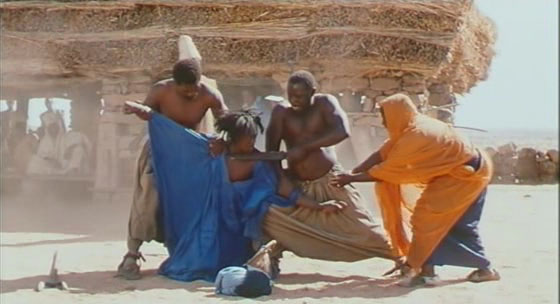
Jacob has many kids. His favorite son was killed by animals (bible scholar Katy tells me he’s not really dead) so Jacob is in mourning. King Hamor’s son wants to marry Jacob’s daughter Dina (after kidnapping/raping her), but Jacob’s not responding to requests nor is he acknowledging any of his children. Meanwhile, his brother Esau is lurking with his warriors. Jacob’s sons kill all of Hamor’s people (including Dina’s would-be husband) and there’s gonna be a three-way showdown, but Jacob comes to his senses in time and his clan goes off to Egypt where they’ll presumably find his not-dead son.

image

I also dug the flashback stories in the middle… and Jacob’s climactic nighttime battle with God. There’s lots more that I did not get. Found the movie hard to follow, but I think a passing familiarity with the bible (maybe the book of genesis) would’ve helped some. Was nice to watch anyway, with all the great desert locations, color-coordinated outfits and completely decent actors, a welcome change from the film-fest screeners that have become my constant sorrow.

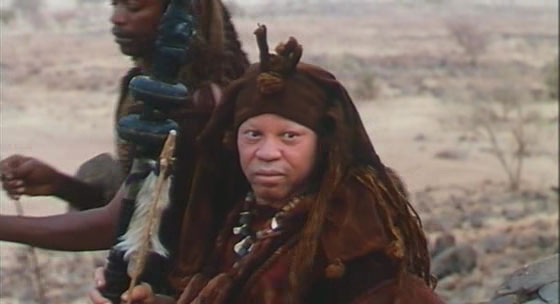
Albino musician Salif Keita, whose music I’m not all that into:
image

Of the lead actors, Salif Keita (Esau) is better known as a musician (he composed for Yeelen), Sotigui Kouyaté (Jacob) and Fatoumata Diawara (Dina) costarred in Sia, the Dream of the Python a couple years later in Burkina Faso, and Balla Moussa Keita (Hamor) appeared in Sissoko’s Guimba the Tyrant and a bunch of Souleymane Cissé films including Yeelen. Hamor is also the guy I would least recognize if I saw him again, unless he was wearing that coiled-white-tube getup.

Jacob:
image

Helpful bit from the distributor: “Based on the book of Genesis, chapters 33-37, the film follows the bitter rivalry between brothers Jacob and Esau and the resulting cycle of violence, with Sissoko mixing relevant allusions to African history and culture into the Biblical tale.”

NY Times called it confused and rambling. “Complicating matters is the involvement of Hamor, the leader of the Canaanities, when his son Sichem abducts Jacob’s daughter Dina (Fatoumata Diawara) and rapes her, then falls in love with her. In the most disturbing scene, a temporary peace is negotiated when Hamor accedes to Jacob’s demand that the Canaanite men be circumcised, and the obedient Canaanites glumly line up to be circumcised by a knife-wielding blacksmith.”

image

Sissoko: “In the Bible, there is a fraternity which does not stop conflict: we love one another and we fight. This is more and more apparent in the world today, in Rwanda, Yugoslavia, and in northern Mali. The same enmities existed amongst the patriarchs of the three great monotheistic religions. … In our farming and herding societies, people reinforce the rivalry between the nomads and farmers: the situation is analogous with that at the beginning of time.”

Movie was written by a French theologist. Sissoko only made one film after this then became Mali’s minister of culture. According to wikipedia, he’s off the government payroll as of late 2007, so maybe there’ll be another film soon.

Katy, here’s the link I told you about.

I can’t remember according to who was this the greatest film of 2006 (or ’07 or ’08, depending when they saw it) but I was predictably underwhelmed. Having seen The World and Unknown Pleasures, I kept my whelm-expectations low, so I was only mildly underwhelmed, but still…

A nice, straightforward story… woman is searching for her husband who went missing two years ago to obtain a divorce. We’re on the Yangtze (flood levels are lower than in the documentary since this one was shot sooner) but this movie has less of a tourist feel, sticks with the characters instead of reveling in landscapes. Don’t know which approach I preferred.

Quiet movie, medium-paced with lots of breathing room. Unexceptionally serious-artfilmesque for long stretches. But then there’s the aliens. One scene with a darting UFO in the sky, one awesome bit where a statue becomes a rocket and blasts off, and the final shot: the woman leaving town, looking back at a man walking a tightrope between two buildings unexplained. I am all for more weirdness in movies, but the weirdness here seemed to be wedged in where it didn’t belong.

According to IMDB, all the actors in this were in all the director’s other films (two of which I’ve seen, but I barely remember the films let alone the actors).

I hope I figure out what everyone is on about, watch this again sometime with a new appreciation for its rich subtexts and symbolism and emotional impact, and come back to revise this post, embarrassed that I once called such a masterpiece underwhelming and unexceptional. I surely enjoyed it more than The World (and 4-5 times more than Unknown Pleasures) so I’m getting closer anyway.