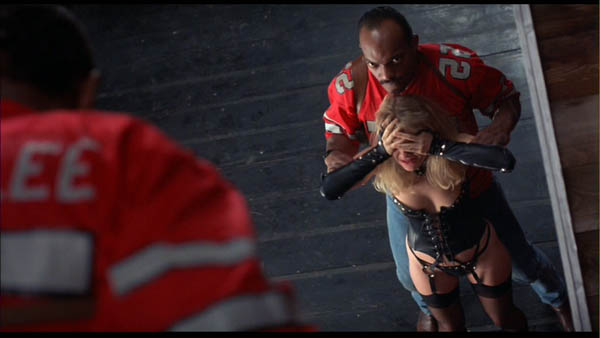
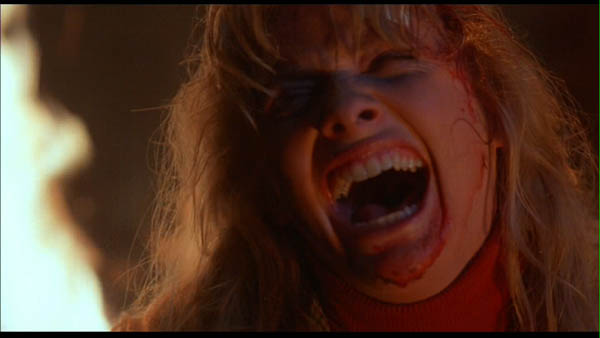
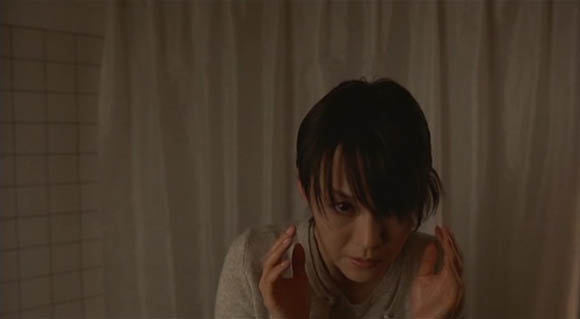
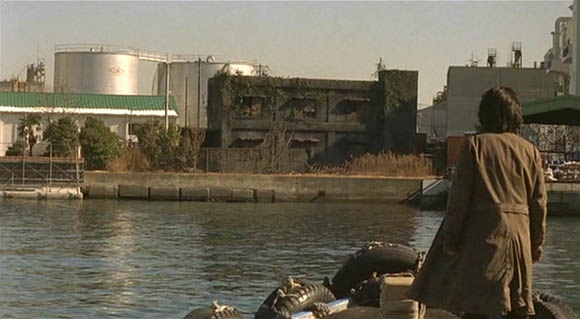
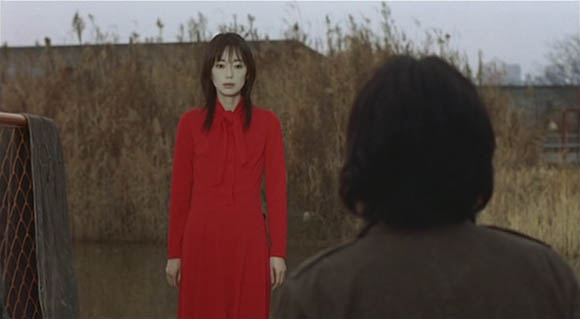
Starts with the end. All movies start with the end now.

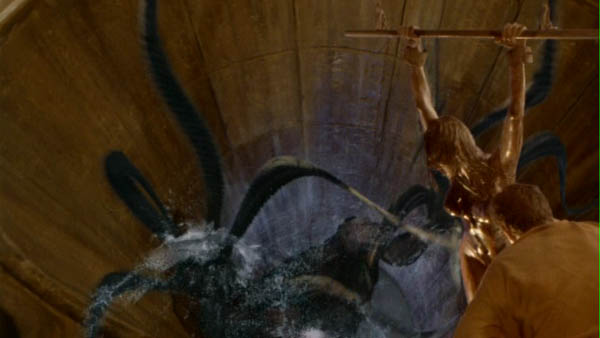
Kind of a disappointment. Not just that expectations were high, just that they were so high for so long and movie kept playing and finally I saw it in closing week and by then I knew it’d be a depressing fascist struggle film with metaphorical special effects and had already seen the monster with eyes in its hands a million times in promo photos. Had few delightful surprises to offer, just a good movie.

Let’s see… fascist Spain 1944, little Ofelia’s dad is dead and mom is marrying a psycho captain who moves them into the country to fight rebel forces who camp in the woods. Housekeeper Mercedes is in love with lead rebel and smuggles out food, supplies and information. A showdown ensues, rebels win the battle but not the war.

Oh also Ofelia finds an underground fantasyland where she tries to escape the pain of reality and eventually succeeds by getting shot to death by the captain and reuniting with her dead parents, now king and queen of Pan’s realm. A happy ending, not really.

Katy liked it I think.

Yay, I’ve been keeping this journal for one year!

I guess when I first started, I just wanted to write something, anything, to get into the habit of writing about movies, so April entries like The Palm Beach Story and Inside Man aren’t very helpful. Started getting better soon after with L’Age d’or and Moolaade, but I still write up a lot of short entries that I don’t think will be very useful in the long run.

Still, I believe this thing is serving its purpose. Making me think again about a movie a few hours to weeks after watching it is probably helpful to long-term memory, even if I’m not writing anything amazing. And if there’s something I was unclear on while watching a video, I can pick it up when going through the movie later to get screenshots. I don’t watch movies with the journal in mind, trying to think what to say about it before it’s even over, so it’s not distracting in a bad way, but I do sometimes try to remember lines or scenes so I can get a good quote or screenshot later. That can only be helpful – I want to be able to remember what I’ve watched. I mean, what’s the use of seeing every Fritz Lang movie if two years later I can only remember a third of ’em? Might as well have just watched a third of the Fritz Lang movies and not wasted my time on the others. And for the most part, I’ve stopped watching movies that I can’t pay attention to… playing “They Live By Night” on the TV while I’m facing away from it, missing most of the picture, just so I can say I’ve “seen” a Nick Ray movie. No point in that. So half the reason for this journal was to improve my memory of what I’ve watched, and hopefully it’s mission accomplished on that goal.

If the other half was to improve my writing by making myself practice writing (about movies) every day, that mission’s nowhere near accomplished. I’m not proud of any of these entries as writing samples… wouldn’t be able to argue my case as a film critic. I might’ve forced myself to give the proper amount of time and energy to the movies, but I’m not giving much time/energy to the writing itself, just tossing out thoughts as fast as they come when I get a free minute in the day, not forcing myself to really analyze the film or arrange my thoughts into something coherent or interesting. Haven’t been recommending anybody read this journal because I know if I wasn’t the one writing it, I wouldn’t want to read it either.

On the other hand, I’ve got 250 entries here. If I consider myself more of a cinephile than a writer on cinema, then it only makes sense that I’m devoting more time to watching the films than to reviewing them. I mean, this guy devotes tons of time and care to his entries, but he only has 65 entries in two and a half years. I’d rather stick with my method. 250 entries for some 340 movies. So on my running list of all the movies I’ve seen, I have notes on about 10% of them. Not bad!

Have I learned anything? How to very slightly hack style sheets in WordPress, I guess. Not really. Haven’t changed my perceptions on film or writing or anything.

At the start of 2006 I made myself a list of 100 titles I simply had to see that year. Took it chronologically, for the most part, and only made it 30-some titles in (through the 1950’s). Didn’t think of it as something that needed to be accomplished anyway, just as a guideline. Well this year I’ve made it definitely impossible with a list of 250+ titles for myself (including all the available Resnais, Marker & Rivette titles). Nice to set goals, anyway… I referred to the list only yesterday when deciding to rent these two Iraq documentaries.

I guess the biggest attitude change lately came while making my lists of favorite films from 2006 this January. I read other people’s lists and came across so many movies that I’d sort of meant to see in ’06 but had decided against, thinking they probably wouldn’t be great (rather than seeing anything that looks good, hoping it WOULD be great). Don’t know where that attitude came from, but it led me to miss what are belatedly some of my favorite movies of last year, seen this year on video. So I’m trying (and so far succeeding) to get out to the theaters more these days, attempting to stay current and live in-the-now instead of solely catching up on stuff from the 30’s and 50’s.

Changes to the journal: added the category listings on the right-hand side to collect writings on the same director or series, changed the layout a little to accomodate 600-pixel-wide images instead of limiting to 500.

Standout entries so far: none, really. I mean, Out 1 was long and exhaustive and some entries had nice screenshots and occasionally I’d play a commentary track and copy some bits from there, and I enjoyed watching the Phantasm series again and bitching about The Leopard, but I’m not ready to start a best-of-the-journal collection here.

Goals:
– stay current with new releases
– keep a notepad near the TV to write down cool quotes or ideas during the film
– see about 6-8 more Bunuel movies, make my way through Resnais and Marker.
– try harder to come up with something meaningful to say here
– read more books (Deleuze, other theory stuff)
– learn a little French
– keep writin’
– watch more movies!

Portrait of a whorehouse at a certain point in time when politicians were discussing whether to outlaw the profession (voted the ban down at the end of the movie, but it eventually passed, some say as a result of the movie). Six or seven prostitutes all with different desperate situations. One has a suicidally depressing home life with sick husband and infant they can’t afford, one is trying to support her son who disowns her when he finds out what she does at work, one is a rich bitch escaping her controlling father, one is aiming to escape through marriage but her husband mistreats her and she comes crawling back, and one is bilking her clients out of extra money so she can quit and start her own business (the only happy ending here).

The same sort of feminine miserablism that I’ve come to expect from Mizoguchi after Life Of Oharu. This one has a more impressive look to it (the main house and the street outside, the costumes, the acting, all exquisite) but still a depressing movie that I didn’t enjoy very much. I may have liked it better than Ugetsu though… have to see that one again, and check out Sansho The Bailiff sometime.

A turning-point year for Japanese cinema: Mizoguchi’s final film, the beginning of the Japanese New Wave, and (according to Reverse Shot) the beginning of “more socially critical efforts” by Yasujiro Ozu. It’s also the year of The Burmese Harp, but I haven’t seen that yet.

Saw this one with Pia from work.

A lonely mute girl gets raped, robbed, and raped again, all in one night. She stops the second guy though (kills him with an iron, chops him up), grabs his gun and goes on a vengeance spree through the city, killing just any man she can.

image

All this killing takes its toll on her daily life, and her seamstress friends at work start to notice the change. She sort of goes from righteous victim to homicidal maniac, but then she never quite loses our affection either. A lot more carefully measured and watchable than the grating Driller Killer.

image

One “victim” actually takes the gun and shoots himself out on a park bench. She doesn’t kill the dog (screen shot below). Eventually puts on the nun suit and goes all Carrie at a halloween party before she’s taken out.

image

Scott Ashlin says:
“What we get instead is… a film that depicts men in the harshest and most unforgiving light, presenting them as legitimately deserving a substantial proportion of Thana’s wrath. Simply put, Ms. .45 has no patience with mitigating circumstances. In this movie, people, both men and women, are defined entirely by what they do rather than by who they are. It doesn’t matter, or so Ms. .45 contends, whether an exploiter had a rough childhood or a bad day at work or a steady stream of shitty luck with the girls he dated in his formative years. Violence buys violence, end of story.”

image

September 2011: Great to see this again on 35mm at Cinefest.

Edmond doesn’t love his wife anymore, maybe never has, so he leaves her, just walks out into the night. Goes to a pawn shop, gets himself a nice knife. Walks around getting increasingly frustrated, looking for a woman, but when he finally gets one alone he slices her up. Ends up caught for the crime, in jail.

image

William H. Macy is Edmond, and it’s a David Mamet script, so of course Macy’s got those stilted speech patterns down as only he can. George Wendt runs the pawn shop, Joe Mantegna probably begged for a cameo, Julia Stiles is the hot girl who gets sliced, and good to see Jeffrey Combs in a non-lunatic role as a faggy desk clerk. That’s Mamet vet Jack Wallace as the priest. Feels great to see a “respectable” Stuart Gordon movie… the guy needs more recognition as expert auteur of slimy and disturbing entertainment.

image

Edmond is a complicated guy, alternating between meek + wormy and enraged + righteous while on the streets, then unremorseful on his way to prison. He’s almost a hero for how purely he unleashed his thoughts and desires, if only he weren’t so full of hate, misogyny, homophobia and racism. Edmond finds peace at the end, some huge black guy’s bitch, becoming everything he has feared and learning (having) to live with it. Maybe that’s what brings him peace, it’s not confronting his fears but having no choice in the matter, having no free will to worry about anymore. After all, the choices he made when he had choices to make turned out badly. Anyway, pretty great movie, short and shocking.

image

image

Doesn’t exactly make sense until the ending, where it is dedicated to a woman who wrote letters home from an asylum, so worth seeing again with that in mind from the start. Watched an old TV rip of this while pondering whether to spend $25 on their new DVD set. Really don’t need the director commentaries and I haven’t even gotten around to Piano Tuner of Earthquakes yet, so probably not.

image

Lots of close-ups on pencil leads here. For the first half, my lowered expectations of the Quays’ work since seeing Institute Benjamenta were unaltered, but then it started to come together with the completely awesome music by Stockhausen, images growing less abstract and almost wanting to join a narrative of some sort. Some of the weirdest music I’ve heard… don’t know if I need to get an album or if, like Morricone, I’ll like it better set to images like these. Anyway, turned out to be a fine little 20-min film, in whatever station-logo-blighted form I managed to watch it.

image

Has David Fincher settled down? After a longer wait than ever between movies, Zodiac is almost a classical Hollywood film, not as showoffy as his others. Only showoffy bits were a Grand Theft Auto 2 perfect top-down cab follow, and some text-in-the-scenery which is just repeated from Fight Club’s Ikea catalog scene. Not that I’m complaining – he’s gone and made a great movie without tricky editing or twist endings or cameras flying through banisters.

We see most of the suspected Zodiac killings as they happen, and see the newspaper’s and police department’s reactions to the letters he sends, but since Zodiac was never caught, the movie doesn’t stop, barrelling forward in time all the way to the 90’s (starts in summer 1969). So it’s long, but it has a lot to cover and never drags.

Movie’s not “about” the Zodiac events so much as three characters surrounding it… newsman Paul Avery (Robert Downey Jr, using both his physical comic acting and his drunken depraved acting in one meaty role), detective David Toschi (Mark Ruffalo, harder to track without the Eternal Sunshine beard) and cartoonist turned Zodiac obsessive Robert Graysmith (Donnie Darko, our central character if the movie has one).

Most impressive opening credits since A Prairie Home Companion. The three stars, then Anthony Edwards and Dermot Mulroney, whoever they are, plus Chloe Sevigny as Donnie’s wife, Brian Cox and Philip Baker Hall as guest experts, Elias Koteas and Donal Logue as cops, and Mr. Show’s John Ennis in one scene. I was too distracted by seeing Ennis in this movie to even realize who he was playing.

Based on the book by Robert Graysmith himself – probably the only Zodiac movie you’ll ever need. Funny, this coming out within a year of The Black Dahlia, a movie that starts with the facts, follows the same trajectory of the cops refusing to let the case go, working on it to the point of their lives falling apart, but then goes into fantasy territory with them finding a ludicrous resolution to the still-unsolved case. De Palma’s boasts a more inventive script and more inventive shooting style, but Fincher’s, sticking close to the facts and presenting them straightforward, is at least that movie’s match. I think most critics far preferred the Fincher to the De Palma, because they have no imagination or sense of fun.

Ozu’s final film, released less than a month before he died. Only my second, after Tokyo Story. Another film about family life, with emphasis on the play between generations in the same family and neighboring families. I know, that’s what they say all of his films are about.

It again stars Chishu Ryu (star of most late Ozu films, who lived through the 90’s and appeared in Kurowawa’s Ran) as a father (Hirayama). His wife died young, oldest son is married (and having money trouble), younger son lives at home, and daughter is marrying age but stays home to take care of her father and brother. Hirayama’s friends tell him that he should marry her off before she gets too old, and learn to take care of himself. He soon sees the wisdom in this, and tries first to pair her with a boy she has a crush on, the older brother’s friend. But when the boy turns out to be engaged already, the father goes to a guy his friend had in mind (who I don’t think we ever see).

Some post-war bits (we find out Hirayama was in the army when one of his former soldiers recognizes him in a bar). Oh, and he goes to the bar because the barmaid looks like his late wife when she was younger… would be a sorta sad scene, him drinking alone and gazing at this woman, if not for the soldier distractingly (comically) playing battle hymns and marching/saluting along.

Apparently this was the part of Ozu’s career when he had started to sympathize with younger generations, instead of showing them to be lazy and disrespectful (see: Tokyo Story). Didn’t sympathize TOO much though, as the oldest son is spoiled and irresponsible, taking money from his dad and blowing it on golf clubs. Even only having seen one of Ozu’s films before, I was startled when the movie began because it was in color… I think of him as a black-and-white filmmaker. So happy to see that Ozu is the Master everyone says he is, that his movies are so heartfelt and wonderful to watch. I get that Jean Renoir feeling of well-being afterwards, even though Tokyo Story (and The Lower Depths) was mostly depressing. Looking forward to his other 40+ features!

Don’t know why I saved this one for last… guess being based on a Clive Barker story made it seem like a safe bet. Might be my least-favorite episode in the series, though. I mean, “dance of the dead” was awful, but it had its apocalyptic rain scene to recommend it, and Robert Englund I guess. This one’s got mediocre actors speaking awful period dialogue in service of an awful script, and McNaughton (Henry: Portrait of a Serial Killer and Wild Things) doesn’t seem to be trying too hard, treating this as the low-budget TV episode it is, instead of aiming for something better like nearly every other director did. At least he got Jon Polito.

Dude pesters old woman necromancer to raise his beloved wife from the dead, she tells him the horrible story of Ernst Haeckel, a science student who once pestered necromancer Jon Polito. Ernst spends the night at an old man’s house. The man discloses that he keeps his young, beautiful wife by paying off Polito to reanimate her dead lover some nights so she can have a graveyard orgy. Ernst fouls everything up, the old man dies, Polito gets the high hat, and back in the “present day” the old woman reveals herself to be that young woman and she’s learned the necromancy art herself and has undead sex with Haeckel, yuck!

A slog to get through, mostly because of the dialogue… if Clive is smart he’ll want nothing to do with this one. Ohhhh, I see that George Romero was supposed to direct, but dropped out due to scheduling problems. Probably either his upcoming Stephen King movie or his upcoming zombie mockumentary. Between those two and this MoH episode, it’s hard to say which is the worst idea for Romero.

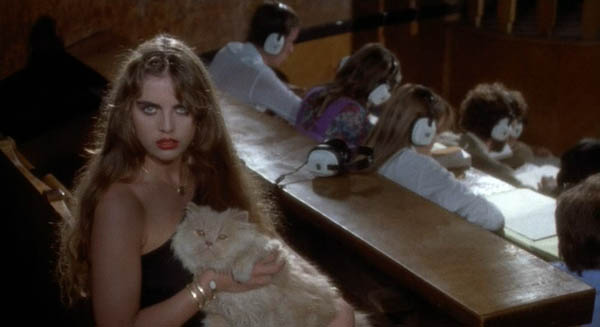
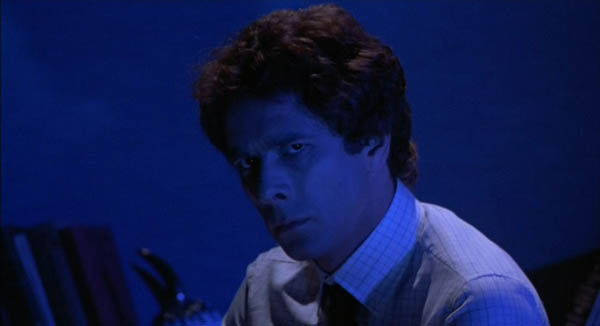
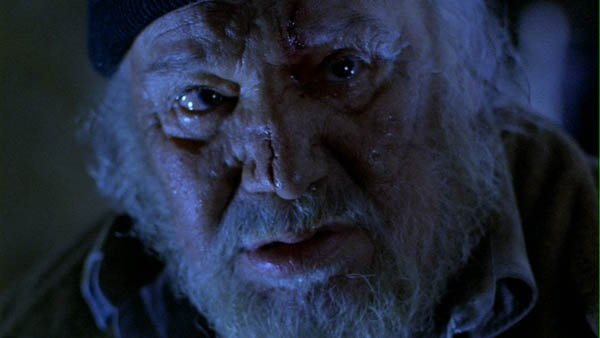
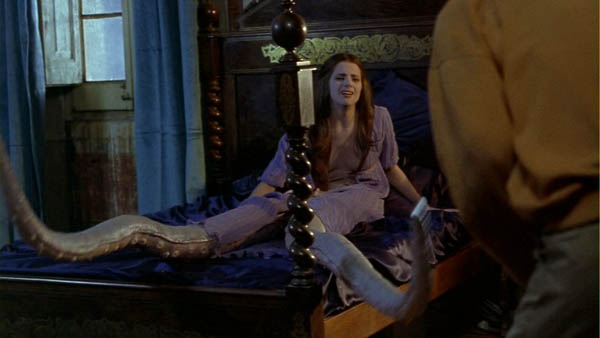
The high hat, the fake mustache:
image

The nudity:
image

Another angle on that:
image

The gang’s all here:
image

So the final Masters Of Horror Season One evaluation:

GREAT:
Cigarette Burns (Carpenter)
Homecoming (Dante)

GOOD:
Incident On and Off a Mountain Road (Coscarelli)
Dreams in the Witch-House (Gordon)
Deer Woman (Landis)
Fair-Haired Child (Malone)
Sick Girl (McKee)
Pick Me Up (Cohen)
Imprint (Miike)

OKAY:
Jenifer (Argento)
Chocolate (Garris)

BAD:
Dance of the Dead (Hooper)
Haeckel’s Tale (McNaughton)

A nice ratio, better than most X-Files seasons. On to season 2!