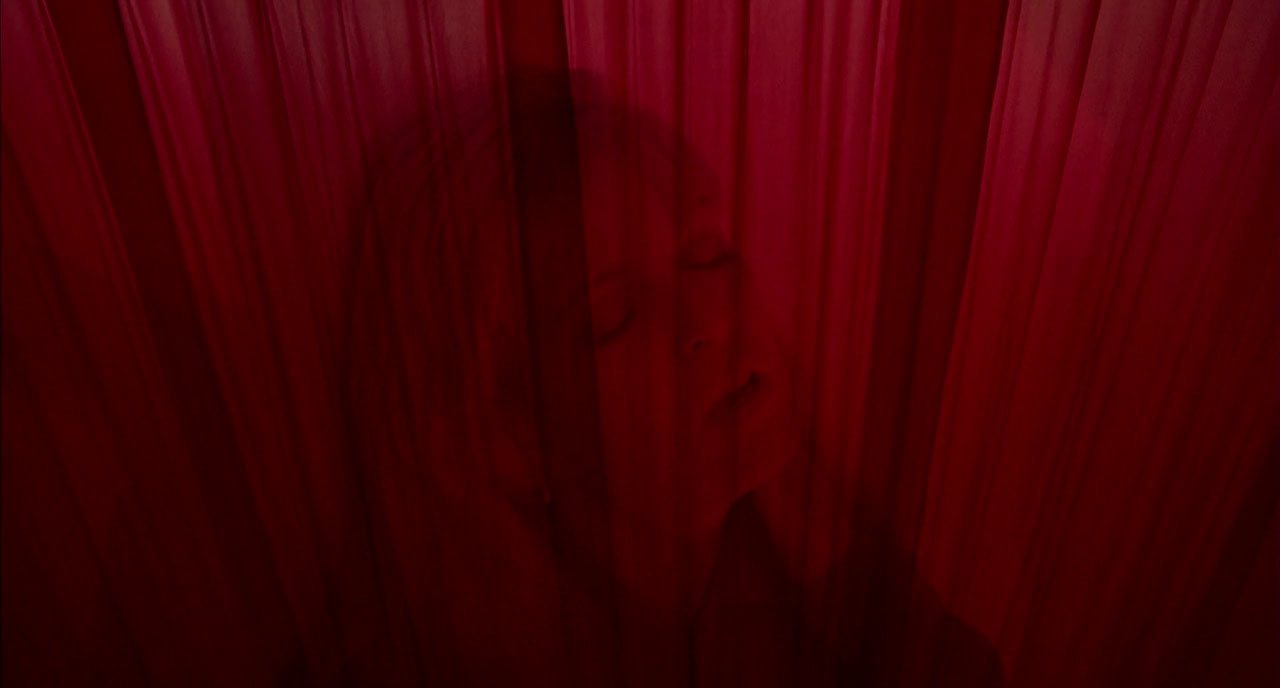
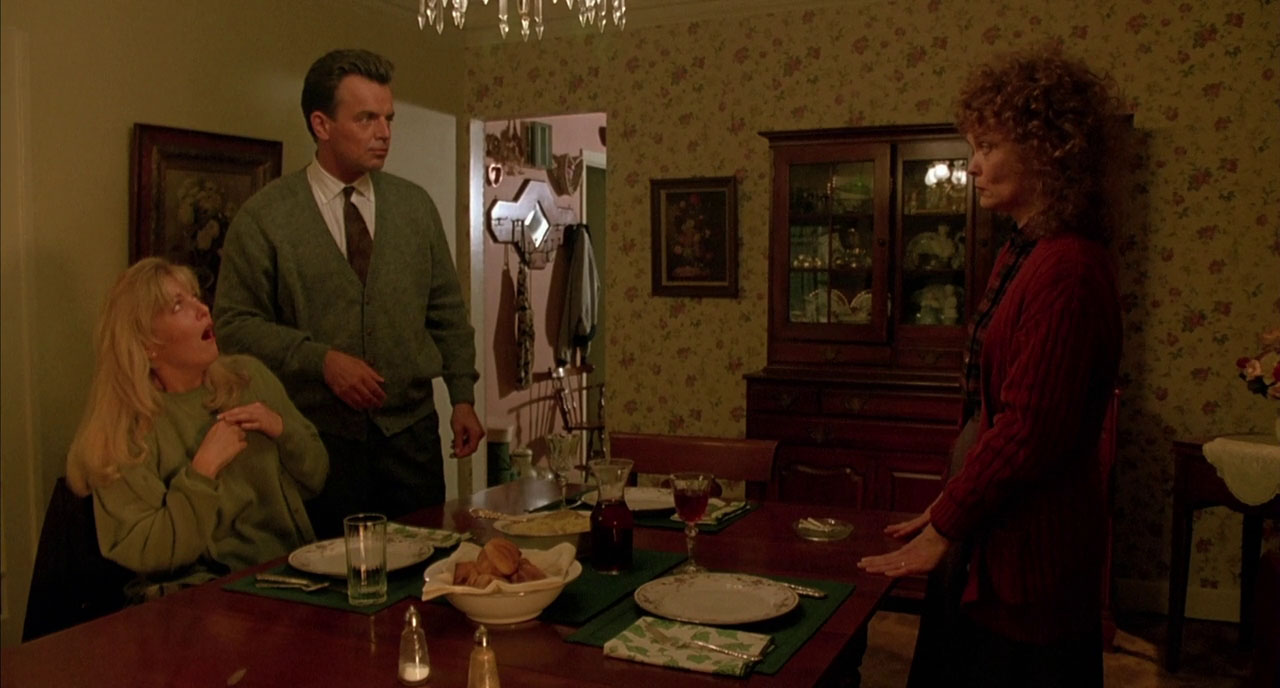
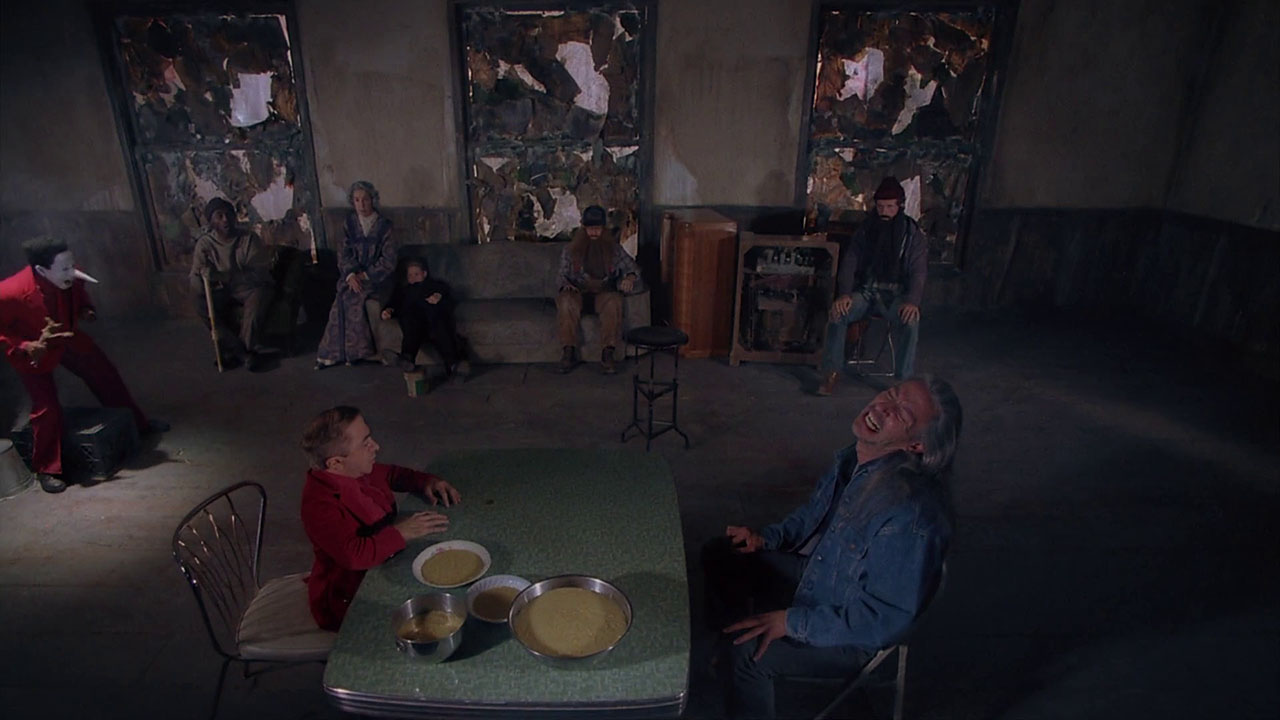
Qohen Leth (Christoph Waltz, not Michael Fassbender – I think of each as “the guy from Inglorious Basterds,” so get them confused) is a socially inept worker bee who doesn’t hate his video-game-reminiscent job, just hates having to come into work, so he gets permission to work from home on a special project from management (Matt Damon): proving “the zero theorem”. He’s aided/annoyed by Waltz’s direct supervisor David Thewlis, party-girl-for-hire Melanie Thierry (The Princess of Montpensier) and whiz-kid Bob (Lucas Hedges), who calls everyone else Bob so he doesn’t have to remember names. As Leth’s video therapist: Tilda Swinton – between this, Trainwreck, Snowpiercer and Moonrise Kingdom, she has really gotten into comedy lately.

Kinda about a search for the meaning of life (or a disproof of its meaning), with sort of a Dark City ending. Shot on the cheap in Romania.

Thierry at Leth’s glorious, delapidated-church home:

Sadly (so sadly) Mike D’Angelo might have put it best: “Like a relic from an alternate universe in which Brazil was made by an idiot.” Written by a creative writing teacher from Florida, it’s got its moments, but the story and characters and entire movie seem to add up to nothing (maybe the film proves its own theorem).
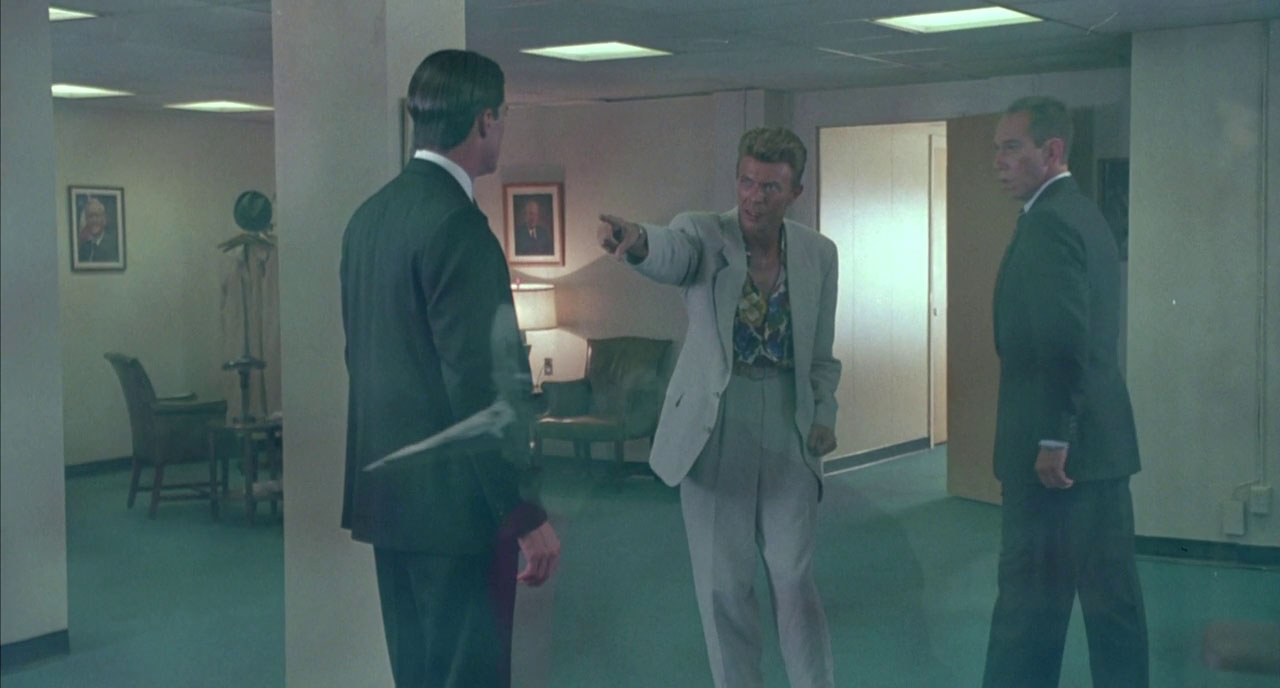
Leth and Bob at the park:

“Too much culture leads to barbarism and hinders development.”

One of those Ruiz movies like The Blind Owl and Manuel on the Island of Wonders, where it’s hard enough to make sense of the movie, but my low-res video copy makes it even harder. So this will have to count as a preview screening before Criterion inevitably announces their 12-disc blu-ray set of 1980’s Ruiz films. I just made myself unreasonably excited typing that sentence.

Anyway, like those two movies and City of Pirates, Ruiz blends psychology and imagery and politics and sarcasm in unlikely ways, creating a film that can be explained (as I attempt below) in narrative terms, but the story isn’t really the point.

Narcisso (Fernando Bordeu, Virgil in Ruiz’s A TV Dante) is a commie millionaire who invites a couple of sociologists (Luis: Jean Badin, who had small roles in Genealogies of a Crime and Three Crowns of the Sailor, and Eva: Willeke van Ammelrooy of elevator-based horror The Lift) to his house to study Adam and Eden, the two surviving members of a tribe with a complex and ever-changing language. Yes, the movie has characters named Adam, Eve AND Eden. But like Blind Owl and City of Pirates, the story is mainly a framework for Ruiz to pepper us with imagery (shadows and double exposures and massive red tinting), experiment with structure and language, and confound his own characters.

Luis (left) and Narcisso, with Adam and Eden in the background:

Ruiz’s and cinematographer Henri Alekan’s follow-up to The Territory. Lot of business involving mirrors (obvs, with a character named Narcisso). Mentions of offscreen wars. Characters tell stumbling stories, read lists and transcripts, boring the other characters (shades of the sleepy Stolen Painting narrator). Colonialism humor, language gags, references to similarly playful texts (I was proud of myself for recognizing dialogue from Calvino’s Invisible Cities). I think in the end, Eva and Narcisso end up together, Luis commits suicide, and Eva’s son becomes pregnant.

“7th May. Each month Adam and Eden exchange names.”

Q: “Are proletarians always strange?”
A: “Too much exploitation has made them strange. The pain has turned them insane.”
Q: “Do all proletarians of the world unite because the pain has made them insane?”
A: “No, that’s something else.”

Page 70 of the Michael Goddard book has an interesting bit on “accented cinema” which seems too long to transcribe here.

Rosenbaum:

This is one of Ruiz’s best collaborations with Chilean composer Jorge Arriagada — as much a mainstay in his work as Bernard Herrmann was for a spell in Hitchcock’s — whose scores specialize in furnishing lush, atmospheric Hollywood climaxes, often without any apparent dramatic motivation.

Wow, not only was this a return to the high quality of the second film, it also justifies the existence of the boring fourth film and goes back in time to erase the events of the stupid third film, single-handedly resurrecting the franchise from mediocrity. Actually I’m not positive about the order of events of the older movies and how this time travel affects them, but in the repaired future, Wolverine is happy to see Cyclops and Jean alive again and didn’t they die in part 3? Anyway this is the most excited I’ve felt about comic movies since 2004.

So in a future run by mutant-killing Sentinels, a small team survives by having Ellen Page send Bishop (Omar Sy of Intouchables) back in time a few days to warn when the sentinels are approaching. Wolverine (alongside Old X/Magneto) thinks he can be sent back further, so he heads for the 1970’s to reunite Young X/Magneto and keep Mystique from killing Sentinel architect Peter Dinklage, and maybe convince the scared humans that some mutants are alright and shouldn’t all be exterminated.

Prison guard vs. Quicksilver and a few rolls of duct tape:

Who Were All Those Mutants:
Beast returns from the prequel, but Azazel, Banshee, Angel and I think either Frost or Riptide have already been killed in backstory. Survivors in the sentinel-future include good ol’ Storm, portal-creating Blink, knifey Warpath, fiery Sunspot, icy Iceman, and metal-skinned Colossus. I barely remember Iceman and Colossus from part 3, thought for a minute that they and Sunspot might be from the Fantastic Four. Helping break Magneto out of another non-metal prison is the great Quicksilver. Rogue wasn’t even in the movie, though she’s in the credits – I was hoping to watch the extended “rogue cut” in theatrical re-release but it’s apparently not playing here and I got impatient. Stryker is introduced in the 70’s, and Toad gets a small role.

Also: apparently 1970’s tech allowed for DNA proximity readers, giant non-metal robot creation, and unexplained combinations of DNA with the robots.

Entrancing from the start, with striking images and a very mobile camera, almost in the mode of Mikhail Kalatozov’s recent The Cranes Are Flying. It’s always interesting when one of my favorite modes of filmmaking – immaculately composed frames, visual beauty in sharp black-and-white – is the early work of a filmmaker who progresses to more diffuse color photography (see also: Leos Carax, Pedro Costa, Ingmar Bergman). Cowritten with Andrey Konchalovsky, already a director himself, and half the cast would return in Andrei Rublev.

Ivan is a spy kid for the Russian army, trying to stay with his military family as long as possible, though they keep trying to ship him to military school and get him out of active combat. Story is told with flashbacks and sidetracks, and crazy great photography. Obviously, being a Russian war movie, it doesn’t end well.

D. Iordanova:

Nearly every scene in Ivan’s Childhood is handled in a manner out of the ordinary, suggesting heightened consciousness of style, point of view, framing, and fluid camera. … Polish filmmaker Andrzej Wajda’s Ashes and Diamonds seems to have had an artistic impact on the film, with its deep interiors lit by rays of light squeezing through cracks, its moments of veering consciousness, and especially its dislodged religious symbols placed amidst smoking ruins. Buñuel’s Los Olvidados, a critical realist film interweaving dream sequences, is a likely influence as well.

It is in connection with this film that [Tarkovsky] first spoke against the logic of “linear sequentiality” and in favor of heightening feeling through poetic connections, of using “poetic links” to join together film material in an alternative way that “works above all to lay open the logic of a person’s thought” and that is best suited for revealing cinema’s potential “as the most truthful and poetic of art forms.”

I watched this ages ago, taped off TCM with the English title My Name Is Ivan, so now I think of it as My Name Is Ivan’s Childhood. Won the top award at Venice vs. Vivre Sa Vie, The Trial, Lolita and Mamma Roma.

Oscar for best actress, obviously, and also seven more (director, cinematography, supporting for Joel Grey) but picture went to The Godfather. I don’t know Liza Minnelli from much – just this and Arrested Development – but she’s perfect in both. The movie though, eh, not my favorite nazi musical. Could’ve stood to be more musical, blurrier and more insane a la All That Jazz (I guess Fosse hadn’t had his drug-addled breakdown yet).

Brash dancer Minnelli gets a new roommate, closeted scholar Michael York. Both roomies have affairs with wealthy Max (Helmut Griem of The Damned and Les rendez-vous d’Anna) and help to hook up two of York’s English students (Fritz Wepper of The Bridge and Marisa Berenson, wife of Barry Lyndon). The nazi stuff is less foregrounded than I would’ve thought – they’re slowly going from a violent street cult to the dominant political party in the background of a story full of sympathetic gays and Jews. Fun times while they lasted, though. Interesting to watch this right before Phoenix, eliding the whole war in between.

I was pleasantly surprised by this – not the hyper-masculine grimy 1970’s picture I’d imagined (since it gets lumped in with Deer Hunter and Godfather and Saturday Night Fever and Deliverance in the “New Hollywood” category), but the Dazed and Confused of its time, an early-1960’s-set ensemble drama following a group of boys (and grudgingly some girls, but they don’t get prominence in the storylines or credits) between high school and college.

Wikipedia says all the guys are based on Lucas, in personality fragments, so people who knew him well must’ve seen this as a sort of George Lucas Multiplicity. Cowriters Huyck and Katz made Messiah of Evil around the same time, later worked with Lucas on Temple of Doom and Radioland Murders. Lucas was a producer on the mid-60’s-set sequel with the same cast minus Dreyfuss.

Curt = Richard Dreyfuss just two years before Jaws but looking ten years younger (based on my admittedly fuzzy memory of Jaws and the admittedly fuzzy picture of this movie on the Railyard screen). He’s got a scholarship but is thinking he’ll skip college. After a wild night getting roped into a local gang and trying to track down his dream girl, he changes his mind and heads off to school.

John = tough-guy racer Paul Le Mat (Melvin and Howard, Handle With Care, Puppet Master), who gets stuck with a young girl (Carol: TV’s Mackenzie Phillips) in his car, and is being hunted by street-race enthusiast Harrison Ford.

Steve = college-bound Ron Howard, who spends all night breaking up with his girlfriend Laurie (Cindy Williams of Laverne & Shirley), then reconsiders both college and the breakup.

Terry = nerdy Charles Smith (De Palma’s Untouchables, director of Air Bud), who somehow picks up an out-of-his-league blonde named Debbie (Candy Clark of Q: The Winged Serpent, The Blob) and keeps trying to impress her.

IMDB trivia: Harrison Ford is driving the Two-Lane Blacktop car!

No finches were hurt (but it was a close call).

Watched with Katy after episode 2 of The Story of Film (and after Chaplin’s The Circus, since I didn’t want to limit silent cinema viewing to the famous comedians). Pretty straightforward: husband (Johannes Meyer of Dreyer’s Leaves From Satan’s Book) has become a tyrant, mistreating his kids, disrespecting his nana (Mathilde Nielsen of The Parson’s Widow), and driving his wife (Astrid Holm, dying woman in The Phantom Carriage) away to her mother’s to recuperate. Now he has to run the house without his wife’s help, learning to appreciate all that she regularly does for the family.

Katy and I haven’t extensively studied the cinema of 1925 so we had little to say, style-wise, and I saw little in common with the later Dreyer films I’ve watched. Mostly it seemed a well-assembled showcase for great performances by the husband and nana. I’d have some nice screenshots of the close-ups if we hadn’t watched it on Hulu… oh wait, here are a couple stolen from the great DVD Beaver site:

A good rebellion story with some serious kung fu at the end, but most of the movie consists of training montages. Student Liu Yu-de escapes after his rebel-taught school is destroyed and family is killed by the occupying Tartars. None of the rebels were decent fighters, so wounded Yu-de flees to the Shaolin temple, rumored to have the best kung fu in town, gets sanctuary there, is renamed San Ta and starts training from the very bottom, working his way to total mastery in just a few years. The Shaolin monks’ official stance is that they ignore the politics of the outside world, but it’s San Ta’s drive to defeat the Tartars that fuels his rapid advancement. With no support or defined plan, he goes out and immediately challenges and slays the Tartar leadership, is then allowed to open his “36th chamber” to train civilians in martial arts.

Doomed Chia Yung Liu:

I find the kung fu sound effects to be distracting – a given weapon always uses the same effect at the same volume regardless of what it’s hitting. The audio in general was strangely echoey, as if a fake surround effect had been added to dialogue. And though this is supposed to be a mighty classic of the genre, I wasn’t too thrilled by the action either – maybe 1970’s kung fu films aren’t for me, because I prefer the floaty fantasy of House of Flying Daggers, the dreamy camera-play of Ashes of Time, and the inventive, flailing fights of Jackie Chan.

This movie was a huge influence on the Wu-Tang Clan, as seen below in a shot of San Ta’s head between two massive joints:

Chia-Liang Liu was a star director for Shaw Brothers studio, also made The 8 Diagram Pole Fighter and Drunken Master II, and worked on Tsui Hark’s Seven Swords. His brother Chia-Hui Liu stars as San Ta. Chia-Hui was later in Kill Bill and Man With The Iron Fists – of course, I’d be amazed if nobody from this film had been in Man With The Iron Fists. San Ta’s early inspiration, a rebel leader killed in a trap by the Tartars, is their other brother Chia Yung Liu (Legend of the Seven Golden Vampires). Lieh Lo, “the first kung fu superstar” played evil mustache general Tien Ta, defeated in the picturesque final fight by San Ta wielding the triple-staff he created. Before this, San Ta rounds up a few “hot-blooded youths” to help invade the Tartars: rebel leader Hung Hsi-kuan, suspicious and combative Lu Ah-cai (Norman Chu of Zu Warriors and We’re Going To Eat You), and social outcast Miller Six (Yue Wong, title star of Dirty Ho). One woman appears (Szu-Chia Chen of Rendezvous With Death and The Magic Blade) for about a minute. Two sequels would follow from the same director and star.

Whew. Pixar is back in a big way. Happy Amy Poehler leads a Herman’s Head of emotions inside a girl’s brain, and when the girl’s family moves across the country, shaking up her life (see also: Coraline, Totoro) and crumbling the “islands” that represent her core personalities, Sad Phyllis Smith (of Butter) slowly gains influence. And weirdly, that’s the “happy” ending, that it’s okay to be sad. Maybe too much frantic running around through the long-term memories department in the second half, but mostly it’s brilliant.

Jen Chaney:

Eventually, in another moment that will cause 3-D lenses to get misty, Joy sees that in many of the supposedly purely happy Riley memories, melancholy and disappointment were present, too. Light can’t exist without dark: It’s something most grown-ups know, but when Joy finally understands this, it feels as though we olds are really getting it for the first time, too.

Tasha Robinson:

The script makes the stakes bigger than whether one 11-year-old can learn to be happy again. Joy and her fellow emotions conflict on how to react to Riley’s circumstances, but they all care deeply about her, and worry about where she’s headed. And through their passionate concern, Docter builds the audience’s deep engagement with how Riley feels, how she expresses it, whether she can make herself understood to other people around her, and where her feelings take her. … Pixar vets will remember the profound emotions brought up by the opening sequences of Up, the final scenes of Toy Story 3 and Monsters, Inc., and so many other watershed moments in the company’s library of films. Inside Out not only evokes that profundity of emotion, it does it with emotions capable of examining their own response.

And I quote heavily from The Dissolve, my favorite film site, because I had these articles bookmarked to read after I saw Inside Out, and by the time I saw it, the site had shut down, causing Sadness to start touching all my film-criticism memory balls.

Lava (2014, James Murphy)

Two volcanoes sing each other a song of longing, looking for somebody to love-a (lava). Tasha: “The story doesn’t make a whole lot of sense. But hey, at least those sad volcanos get to date each other, right?” And at least Katy liked it.


EDIT: Watched Inside Out again on New Year’s Eve 2017/18