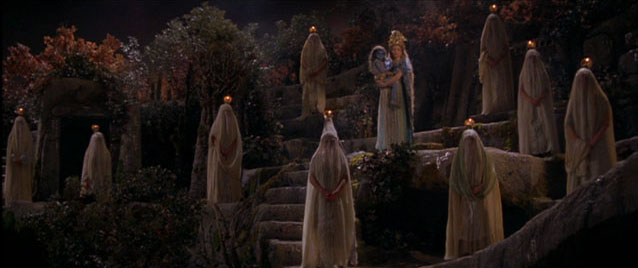
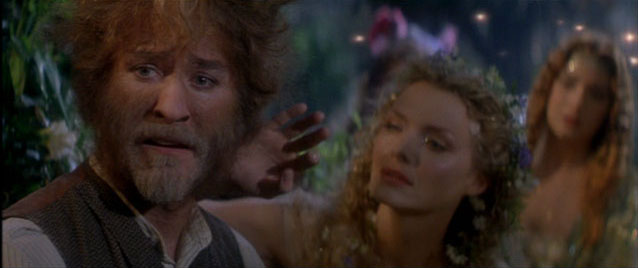
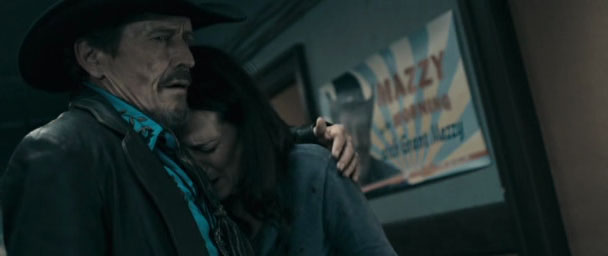
Puppetmaster
“Full Moon Productions presents…”
According to IMDB, this was Full Moon’s first feature. They’d go on to make some of my favorite direct-to-video absurd low-budget semi-horror movies of the early 90’s, including Stuart Gordon’s Pit and the Pendulum, the Louisiana sex/devil cult story Netherworld, and many Puppet Master sequels, plus movies that screamed “rent us” from the new-release shelf with names like Trancers, Subspecies and Dollman, but never quite seemed worth the three bucks.
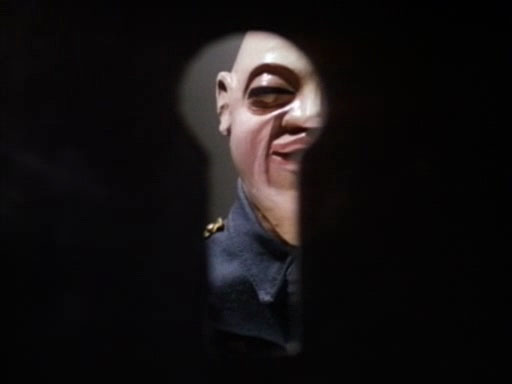
“A David Schmoeller film”
Or more accurately, a David Schmoeller VHS tape (were any Puppet Master movies released to cinemas?). He wrote and directed a Klaus Kinski torture film called Crawlspace, which I meant to watch last week instead of Pin… but foolishly did not.
“Puppetmaster”
Titles were re-capitalized to Puppet Master for the sequels, maybe to avoid confusion with Hsiao-hsien Hou’s acclaimed drama The Puppetmaster (whose runtime is longer than any two Puppet Master sequels put together).
“starring Paul Le Mat”
One could argue that Le Mat is an actual star, having played a title role in Demme’s Melvin and Howard and third-billed in American Graffiti. I didn’t find him photogenic, hence no screenshot… oh wait, this might be him screaming:

“and introducing Robin Frates”
This was pretty much the last time anyone heard from Robin Frates, except those who saw Schmoeller’s follow-up film The Arrival (not the Charlie Sheen one), which sounds appealingly like a sort of alien vampire Benjamin Button.

“special appearance by Barbara Crampton”
Star of Re-Animator and From Beyond! You’d think if her appearance was so special, she could’ve been given a better role than “woman at carnival.”
The theme music is nicer than this movie deserves.
Budget tip #1: Low-to-ground POV shots require no actual puppet effects, and are fun to watch. These are just great, the camera running behind feet and cars, jumping over suitcases and across piano keys.
William Hickey (Wise Blood, Prizzi’s Honor) is Toulon, the inspecifically-foreign-accented titular magician. He’s been discovered by sinister nazis, so he hides Happy/Sad Clown, Oriental Mustache and Hook-hand behind a wall panel and bites a bullet. The end.
The short-lived Toulon #1:

No wait! “Yale University, present day.” A dumpy Paul Le Mat dreams in color that he is dreaming in black and white while being attacked by leeches (I hope that’s exactly how the scene read in the script). Is Yale a carnival, or have we changed location to a carnival? Enter “woman at carnival,” visiting a psychic (Irene Miracle of Inferno) who lacks a stereotypical gypsy accent. Ooh they’re playing the ol’ scam-gypsy-who-sees-real-visions card as Barbara dreams up a puppet attack.

“I want you to recreate in your mind your wildest sexual fantasy.” Two sex-crazed psychic researchers (Balding Ponytail and Too Much Lipstick) call Le Mat (on the phone, disappointingly) to arrange a meeting at the hotel where Toulon died, where they’re met by their cynical psychic friend, their dead friend Neil, a crabby Mews Small (Scott Baio’s mom in Zapped!) and introducing Robin Frates.
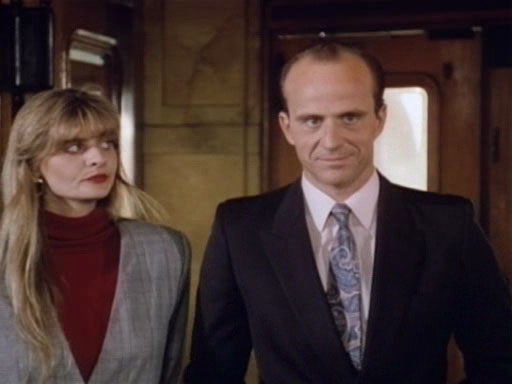
While our psychic friends creep around the place seeing visions and acting eccentric, Tiny (little puppet head and human hands emerging from a ribbed sweater) kills the peeping crabby lady and plays games with dead Neil. In true Friday the 13th fashion, the puppets go after the sexually active couple first – Too Much Lipstick is killed offscreen by Drill Head and a female puppet barfs leeches onto her tied-up husband. Tiny, boasting some impressive stop-motion, wounds the cynical drunk girl then Hook finishes her off in the elevator (if they were aiming for a Dressed To Kill reference, the editor wasn’t cooperating).
Dead Neil explains: “Metaphysically speaking, I killed myself, and using the techniques of the old puppet master I brought myself back to life.” But then Neil stupidly disrespects the killer puppets and they gang up on him, brutalizing a rubber hand before breaking out the drill and leeches (honestly the leeches aren’t very scary).

Written and produced by Full Moon head Charles Band, who had produced everything from Laserblast and Robot Holocaust to Stuart Gordon’s Dolls, Trancers and Ghoulies, TerrorVision and Troll, Clive Barker’s disowned first two pictures, and Sorority Babes in the Slimeball Bowl-o-rama – pretty much everything I watched on HBO at 2am in 1992. Effects by oscar-nominated Dave Allen, who worked on The Stuff, The Howling and Equinox.

–
Puppet Master 2
Hook, Clown, Drill, Tiny and Leech Woman resurrect Toulon using a magic potion before the credits even roll. This one is gonna be good.

“Full Moon Entertainment presents”
In the two years between the original and the sequel, Full Moon and Charles Band have involved themselves in a parallel-universe thriller, a sexy fantasy-horror starring Sherilyn Fenn (premiering the same week as Twin Peaks), Stuart Gordon’s Robot Jox and its Gordon-unaffiliated sequel
“directed by David Allen”
So they’ve handed the franchise right over to the effects crew. Part II is from the writer of Subspecies and cinematographer of Screwball Hotel (I’ll bet that’s not how they sold it on the poster).
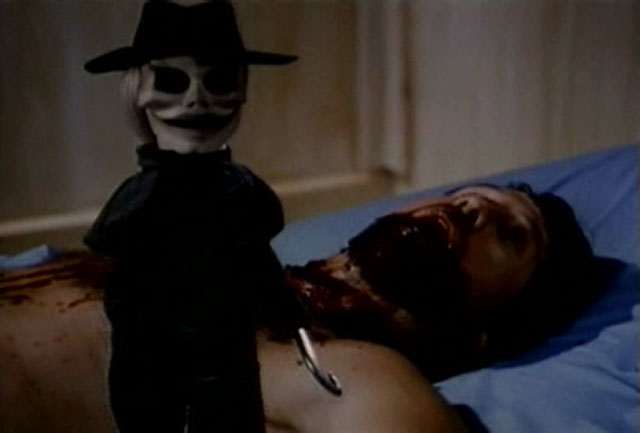
A U.S. government paranormal research van is poking around the old hotel, bearing bearded Lance (Demonic Toys), dark-haired Wanda, jokey cynic Patrick, serious Carolyn (of Robot Jox 2) and older new agey “truth comes from feeling” Camille (Frightmare, Night Shift). They tell us Paul Le Mat survived the first movie but wanted too much money for the sequel so he’s locked in an asylum. Then introducing the neighborhood Comic Relief Farmer and his pitchfork-bearing wife – “They say Satan’s got a suite of rooms in there!”
Tiny and Clown take care of pseudo-psychic Camille in secret, then Drill brains Patrick with everyone watching, is captured and dissected. I hope Drill will be okay!

The filmmakers overestimate the computing power of an Amiga 2000:

Toulon (a new actor) wanders in with an Invisible Man getup, calling himself Eriquee Chaneé (get it? Chaney?) claiming the hotel is his, then the group is joined by Collin “Corbin’s Brother” Bernsen, our first glimpse of star power (heh)

The farmer’s brains are removed by Leech Woman (movie is really into brains; I sense a zombie connection) who is then melted by the wife, immediately replaced by Torch, who burns her up, in a particularly poorly-lit scene. So Toulon is collecting brains to brew up a new batch of magic puppet juice and live another 50+ years as a puppet himself.

Flashback: Toulon remembers years ago in Egypt when he was a powerful magical puppetmaster but a crappy actor, and as punishment, an old merchant burns up the puppets using his mind. Hmmm.
The scene I remember best from the entire series (below): a boy is torturing his GI Joes with a whip, tries to play rough with Torch. The scene I remember least: pointless seaside romance between Carolyn and Corbin’s brother. Even adding a flamethrowing puppet and resurrecting Toulon from the dead, it’s not a better movie than the first one, which at least had characters which weren’t all interchangeable sexy college students.

Hook carves up Lance and Wanda, Puppet Toulon (I like him, a short guy with hard marble contact lenses) threatens Carolyn, and I’m not sure why the puppets turn on him then resurrect Camille to go terrorize an institute for “mentally troubled” children, but there you go.

–
Puppet Master 3
“Berlin – 1941”
Nazi experimenters succeed in reviving the corpses of dead soldiers. A young puppetmaster is interested.
Looks like something out of Day of the Dead:
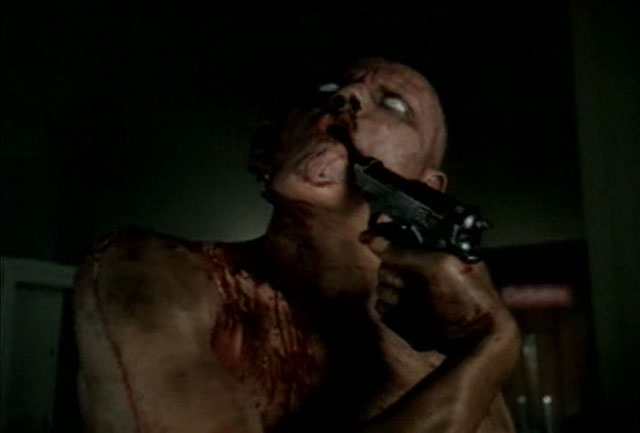
“Full Moon Entertainment presents”
This was Full Moon’s year. They had Stuart Gordon (Pit and the Pendulum), Trancers II (the Helen Hunt-starring sequel to a mid-80’s Charles Band film), and future sequel-bait Subspecies and Dollman.

“starring Guy Rolfe”
Finally a consistent Toulon – he’d play the part through 1999. Guy had been around – not just in stuff like Dolls (in which he also played a puppetmaster), but in Tashlin’s Alphabet Murders and Nick Ray’s King of Kings in the 60’s.
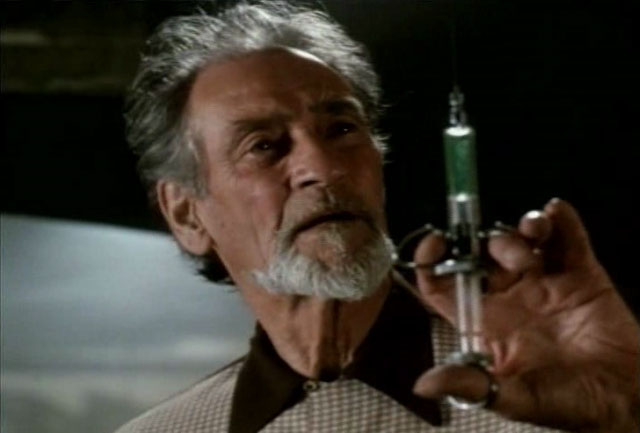
“directed by David DeCoteau”
The prolific Mr. DeCoteau had made such classics as Sorority Babes in the Slimeball Bowl-o-rama (which I have seen more than once) and Dr. Alien, would go on to make such classics as Frankenstein Reborn!, Final Stab and Wolves of Wall Street.
Sinister Eric Stein confronts Toulon about the Hitler-mockery satire of Toulon’s puppet show. Mrs. Toulon (Sarah Douglas of the first two Superman movies and Return of the Living Dead III) looks on. The stop-motion effects are still cool and still only one second long at a time. Two important and great new additions: the six-shooter cowboy puppet, and giving the puppets wordless voices (cowboy’s Jack Nicholson laugh is my favorite).

Gestapo Krauss (Richard Lynch) and Dr. Hess (Ian Abercrombie of Inland Empire) fight over Toulon’s fate. T’s wife is killed in a raid, then Tiny and Drill kill the nazis escorting T into custody – can’t argue with that. While T cries over his wife (along with the puppets, making the ending of part 2 more inexplicable) and gives his revenge monologue, the main general (a Bond movie regular) calls on the search. Leech Woman is still not interesting, even when she’s supposedly T’s murdered wife recurrected to kill Stein.

A distractingly weird-looking “young boy” (turns out it’s a short 22-year-old), also on the run, stays with Toulon while Six-Gun takes out the general (plenty of stop-motion plus a fall from a high window – along with the period costumes, looks like Full Moon is ramping up the budget). Toulon creates Blade, modeled after Krauss (who himself is modeled after Klaus Kinski), replacing his broken Hitler doll.
Kraus/Kinski/Blade:

There’s actually a story here, not just a bunch of idiots at a hotel getting killed one at a time. Hess turns out to be decent (well, as decent as any nazi scientist trying to reanimate dead soldiers can be), the father of the “boy” turns traitor to win his freedom, both die, Toulon strings up Krauss and escapes Germany with the “boy.” Weird to turn a slasher horror flick into a nazi adventure, but there you go.

“Photographed at Universal City Studios Hollywood” – there’s that budget I was talking about. Too bad it won’t last.

EDIT: Thanks to Frederic for pointing out the correct model of computer the filmmakers are misusing in part two. Apologies to Commodore 64 heads for the error.