More of a kids movie than I’d expected, after Looney Tunes was more of an adult movie than I’d expected. Has the kids-in-charge feeling of Explorers, but the kids are more horny, troubled teens than young dreamers. The movie, with its innocent toy creatures threatening a whole town and all its makeshift inventions, references its own debt to Gremlins by throwing the word “gizmo” around as David Cross’s computer password.

Sets up a fight between the military-chip-implanted Commando Elite (voiced by Tommy Lee Jones, Bruce Dern and the cast of The Dirty Dozen) and the peaceful alien Gorgonites (Frank Langella and the cast of Spinal Tap), joined by a frankensteined group of mutant barbies (Sarah Michelle Gellar and Christina Ricci).

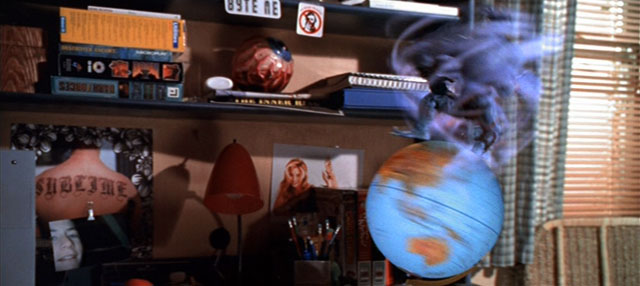
Purple whirling Gorgonite reminds of the Tazmanian Devil and one of the Twilight Zone creatures:
image

I admit the barbies were my favorites:
image

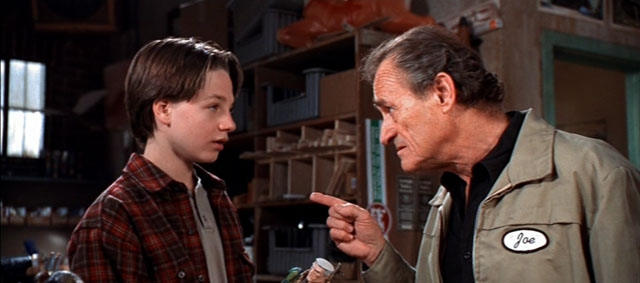
Dick Miller, making his umpteenth Dante film appearance, plays the twinkle-eyed adult who connects with our young protagonist (and gives him the devil toys).
image

Robert Picardo doesn’t get mentioned enough in these pages. He’s appeared in nine Joe Dante movies, most memorably as the cowboy in Innerspace.
image

Apparently it got somewhat-screwed with its PG-13 rating but still made a tidy profit, and probably helped get Dante Looney Tunes: Back In Action, which probably killed his career for a few years. Dedicated to the great Phil Hartman, murdered a month and a half before its release.

image

I’m not sure that I buy Tarantino films as thrice-a-decade Big Movie Events. If guy’s gonna make his fun genre flicks, I wish he’d make them more often. The movies he is emulating didn’t take this long to shoot. I’ve been seeing (and trying not to read) reports on this for years now, while I only heard of District 9 last week and I liked ’em both just as much.

One would think the movie follows the Basterds as they rampage through France and Germany killing nazis, but one would be wrong. Starts with a 20-some-minute scene of nazi Col. Landa (Christoph Waltz won best actor at Cannes – nobody can shut up about him) grilling French farmer Denis Menochet about the Jews he is hiding, in Landa’s patient, wordy (duh), polite, milk-drinking manner. The murdered Jewish family’s daughter Shoshanna (Mélanie Laurent of Indigènes, who will never have a better role) survives (an image reminiscent of the last-girl-standing final scenes of exploitation horror flicks) and three years later is running a movie theater she inherited from Maggie Cheung (in deleted scenes, which will hopefully surface). At that time, hero sniper Daniel Brühl (star of Goodbye Lenin and Salvador) is hot for her, arranges to hold the premiere of his new propaganda film at her theater. When she hears the entire nazi high command is attending, she plots to destroy the theater with them inside.

So what about the basterds? Well, they’ve got a plot of their own to show up at the film premiere, with the help of movie star Diane Kruger (star of Joyeux Noël), threatened when she is injured in a firefight at a group meeting place (which claims the life of my favorite basterd, Hunger star Michael Fassbender). QT allows a single scene of their nazi-scalping terror campaign (starring bat-man Eli Roth) to stand alone – the vast bulk of the movie is introduction then the week or two leading up to the film premiere.

The movie makes light of death and torture, essentially coming off as a comedy (Brad Pitt’s hilariously fake accent helps that assessment). RW Knight: “Overriding Tarantino’s gratuitous gore instincts is his allegiance to the power of the cinema, which he makes material (literal) here in the form of a combustible nitrate collection.” Surely there are tons of movie references, for once actually talked-about and plot-relevant (Goebbels, Emil Jannings, Leni Riefenstahl) instead of appearing as influences and references in Kill Bill and Jackie Brown (Death Proof had plenty of movie talk, too).

DCairns:

“It’s a film about cinema,” said Joe Dante, who was quite enthusiastic. Perhaps not a war film at all. Or a film about the victory of movies over war, somehow. Certainly, that’s literally what happens in the climax, which contains, all too briefly, the most beautiful image Tarantino has ever conceived or executed.

I have to say I didn’t take it as seriously as some, enjoying the hell out of the sight of Eli Roth machine-gunning Hitler’s lifeless body into the ground moments after the above-mentioned beautiful image (already-dead Shoshanna’s filmed face projected ghostlike on the smoke rising from the burning film stock). And the unusual structure, tense dialogue and Film Comment article’s about Tarantino’s references to American Indian massacres and other carefully thought-out pieces of writing make me think it could be worth taking more seriously. But if I take it seriously, I’ll have to consider the following.

DCairns again: “Inglourious Basterds in a way is about stealing back pleasure from horrible facts, the revenge of cinema upon tragic events, but as interesting as that is in the abstract, it doesn’t strike me as a healthy response. And the gloating nastiness is much closer to Nazism than it is to the spirit of resistance.”

A government paperwork wonk named Wikus is given the task of going door-to-door in the South African slums and telling all the aliens from another planet they are to be relocated. When he discovers one alien (and his young son) who has been reassembling their technology underground in order to retake control of their mothership, Wikus accidentally exposes himself to a chemical that transmogrifies him into an alien. Kickass action involving disintegration weapons and armored body suits follow. Weird, thrilling, completely unique movie – influences seem to be Cloverfield (handheld camerawork + action fx) and The Fly (Katy would not enjoy the Wikus-to-alien transformation).

The director on Peter Jackson’s involvement:

There’s no way I could have gotten this film made as what I wanted to make, without his involvement. So it’s much more than just saying, “Go and do what you want.” It’s “Can I put a guy in the movie who’s never acted before, but I think he can carry the lead role?” There’s no way that would have happened if he wasn’t producing it. So he said “Yes.” And then, “Can they keep South African accents? And they’re thick accents.” “Yes.”

This is a spinoff movie from a series called The Thick of It, which also starred Peter Capaldi as the terribly insulting PR guy, and which I must watch soon. Tom Hollander as the wishy-washy but morally secure minister and his head staffer Gina McKee (of MirrorMask) are new to the movie, but Tom’s assistant Chris Addison was in the show playing a different character. Kinda surprising, that, since in the movie he’s the new guy (and kinda our main character).

One lucky break: the new guy/main character isn’t a bland, naive kid who leads us insultingly through the situation, a conceit used by so many crappy movies. Everyone sorta knows what they’re doing here, and even though our guy is a fuckup (misses a major meeting, his girlfriend leaves him for cheating), he knows his way around his job. Anyway, movie follows these government guys as they trade secrets and rumors, fiddle with their publicity, and ultimately start an international war for the stupidest reasons possible – and it’s damned hilarious, and I’ve forgotten every joke so I must watch it again after catching up with the show.

Of course it’s not a british comedy without a Steve Coogan cameo (The Boat That Rocked, therefore, was not a british comedy). Here he plays Tom’s neighbor who starts a PR stink over a crumbling garden wall. I wouldn’t say it’s a non-comic role, but he has less funny dialogue than anyone else in the film, which seems odd.

“Don’t worry, I won’t steal your memories.”

Based on the behaviorist survival theories of Henri Laborit, playing himself, and written by Jean Gruault (who wrote for Truffaut and Rivette, including Paris nous appartient). One of the strangest, most off-putting movies I’ve seen by Resnais. It takes you through the lives and relationships of three characters, but without the subjective view of Providence or the single perspective of Je t’aime, je t’aime, and using the scientific mind theories to distance us from the characters, to think of them as lab animals (one recalls the white mouse from Je t’aime), like the Coens’ Burn After Reading but, of course, better. We’re back to the associative memory-editing of Muriel and Marienbad, appropriately as the narration explicitly tells us how memory works with our survival instincts.

Odd attempt to combine scientific thought with an entertaining story. Despite the lab comparisons breaking down our characters’ behavior, I didn’t feel completely detached from them or unsympathetic. In fact, maybe I was even more sympathetic, watching them fail and hurt each other while our scientist tells us their own lower instincts are responsible for the hurt. Besides the lab flashbacks, each main character has a favorite film actor, and when they’re having a mood, Resnais cuts in a short, dialogue-less associative clip of their hero portraying the same emotion.
image

Apparently this was supposed to be a documentary on Laborit, who said the only person who could make a successful documentary on his work would be Alain Resnais, who surprisingly agreed to do it, hiring Gruault to write the story around the theories. I would love to check out the half-hour interview with Gruault on the foreign DVD sometime.

Starts out by sketching the three protagonists’ life stories using stills a la La Jetee or Dog’s Dialogue, from birth through their career, then backs up to an earlier career stage and picks up with the story proper.

Janine Garnier (Nicole Garcia of Duelle) had communist parents, defied them to become a stage actress. After starring in a successful play for a year, she started an affair with radio news reporter Jean Le Gall and started work at a textile company, eventually becoming a manager.

image

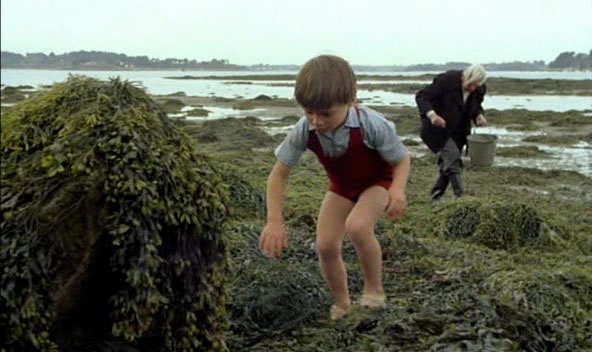
Jean (Roger Pierre), also a historian and a struggling author, had children with his wife Arlette (Truffaut star Nelly Borgeaud, the mysterious married woman in The Man Who Loved Women). He was born on a private island, to which he returns to clear his head or to impress girls.

image

René (Gerard Depardieu, who has come a long way since his Stavisky cameo) left his family farm to become an accountant. He works at the textile plant until there is a merger and he’s pitted against another accountant, an intimidating hyper-efficient guy (Gerard Darrieu, three shots down, who had small parts in Elevator to the Gallows, Z and The Elusive Corporal). Depardieu loses his post, is sent to a faraway town to manage another office, which separates him from his wife Thérèse (Marie Dubois, lead girl in Shoot the Piano Player, also in Malle’s The Thief) and makes him nervous all the time, not really being the managing type.

image

Jean has “kidney attacks,” lashing out at whoever is near him when he’s in pain. His wife Arlette visits Janine in secret and tells Janine she is dying as a (successful) scheme to get Jean back. Gerard can’t take the pressure of his new job and after a meeting with management (Janine herself) attempts suicide. All this is compared to studies of rats subjected to electric shocks, how they behave when escape is possible (escape!), when no escape is possible (depression) and when another rat is present (meaningless fighting). The movie’s scientist announces that the movie aims to show us how our brains work and cause negative behaviors so we can better understand ourselves and others. Ambitious movie!
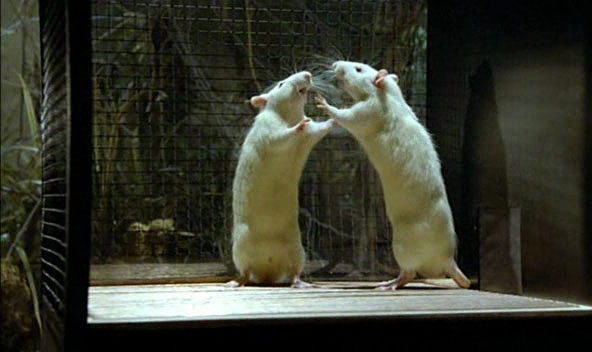
image

Human behavioral analysis (and/or Gerard Depardieu) must’ve been in vogue in ’80 because this won major critics awards and a Cannes jury prize. Lost all six of its Cesar nominations to The Last Metro (also starring Gepardieu), and lost its writing oscar to Melvin and Howard.

image

I’m not clear who Zambeaux was, but he’s played by Pierre Arditi, Rossellini’s Blaise Pascal, who became a Resnais fave (he was the silver-haired main man on Not on the Lips and the bartender in Coeurs). Jean’s family friend Michel (who helps Jean lose his job) is Philippe Laudenbach, below, who played the war-scarred young man’s buddy in Muriel, later in Truffaut’s Confidentially Yours.

image

from Emma Wilson’s Resnais book:

Mon oncle d’Amérique seeks to set up mirroring patterns between art and science through its own internal reflections. The manner of presentation of Laborit mirrors that of the protagonists, despite his different status with relation to the film’s drama. Fusing fiction and documentary, Resnais opens space in the film for Laborit to offer short discourses on human behavior. We see him talking to camera, presenting his ideas as if he were in a documentary. The experimental basis of his work is reflected as Resnais illustrates Laborit’s ideas with close-up scenarios showing laboratory rats. The relation of these scenarios, and of Laborit’s discourses, to the action in the film as a whole is further suggested as in its late stages we see both Le Gall and Ragueneau in rat form, with rat faces, acting out their own dilemmas.
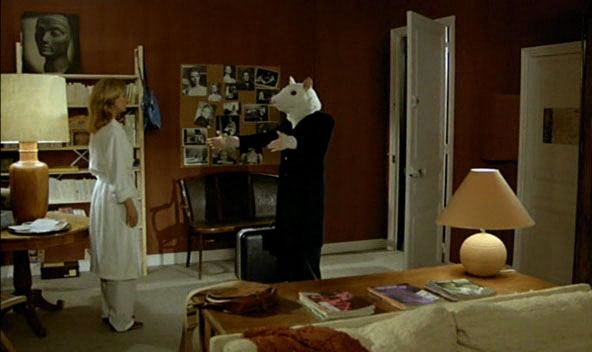
image

Houston, quoted by Wilson:

Not since Muriel, perhaps, has Resnais made a film structured for such precise, delicate and sympathetic effects; and it may not be coincidental that this is also the first film he has made for many years, really since Muriel, which is wholly French and of the present.

image

Grunes:

The title refers to an illusory ideal of happiness. What one of the characters says: “America doesn’t exist. I know; I lived there.”

image

I’d considered declaring August to be Shorts Month and watching hundreds of those, so I stocked up, but the inspiration had fled by the time the month rolled around. But we can’t let all these shorts go to waste, so I still watched more than usual.

73 Suspect Words and Heaven’s Gate (2000, Peggy Ahwesh)
Fun gimmick videos, one displaying the “suspect words” found by running the Unabomber manifesto through a spell checker, and the other listing off the search keywords of the Heaven’s Gate cult’s website. In the first the text appears quickly and fades out, and in the second the words flicker constantly.
image
image

Apocalypse Pooh (1987, T. Graham)
scenes from Apocalypse Now and Winnie The Pooh inexpertly combined. Actually the lipsync and some of the shot selections were pretty wonderful. I’m pretty sure nobody will ever care about this movie again now that a hundred thousand video mashups are clogging youtube, but it’s a cute piece of cult history. The poor video quality would turn on the guy who made Out of Print.

Thanksgiving Prayer (1991, Gus Van Sant)
William S. Burroughs hatin’ on America, being a general bummer, as is the fashion among leftists around Thanksgiving time. Decent video but I far prefer Ballad of the Skeletons with Allen Ginsberg.
image

Szalontudo (2006, Szirmai Marton)
That joke where guy 1 thinks guy 2 has stolen his food, so he starts eating from the other side, and they glare at each other eating the same food, then guy 2 walks off and guy 1 sees his food still untouched… he was eating guy 2’s food! Ah! This was terrible, with gross squishy chewing sound effects. Won an audience award in north-central Spain where they’ve never heard that joke before.
image

Le Vol d’Icare (1974, Georges Schwitzgebel)
I think it’s primitive animation made on a lite-brite. Or maybe it’s HyperStudio version 0.1. Story of icarus, I suppose. I liked the flocks of birds. What is that, a harpsichord?
image

Instructions for a Light and Sound Machine (2005, Peter Tscherkassky)
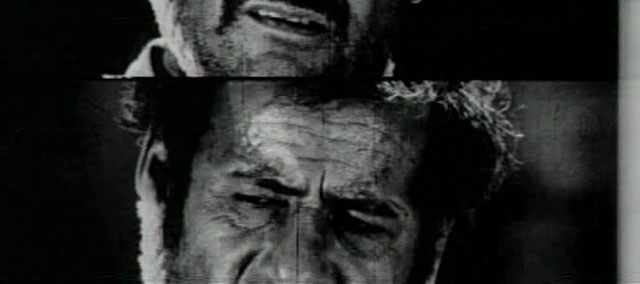
Pumping stutter-motion! Variable-speed lock-groove dude in a Leone western having a death-dream. Ends with words “Start,” “End” and “Finish” overlapping as the guy, appearing to be on fire, runs with mirrored graveyards above and below him.
image

The Adventurer (1917, Charles Chaplin)
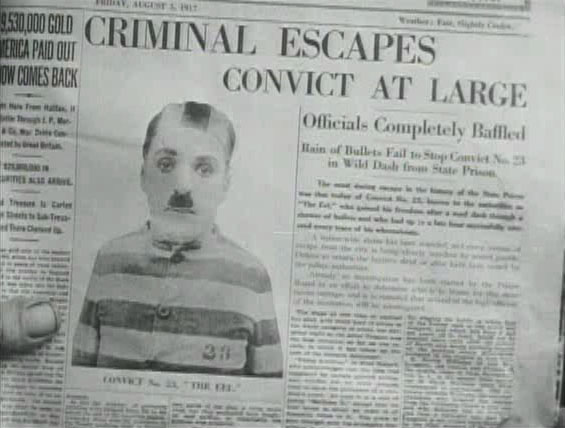
Weird to see Charlie as an escaped convict threatening cops with a shotgun. But there’s plenty of ass-kickin and cliff-jumpin so it’s alright. I forgot the encoding quality is garbage on my copy of these… must buy a better one.
image

image

Inflation (1927, Hans Richter)
Rich people, money, poor people, more money, stock traders, more and more and more money, digits rushing at the screen whilst speed-adjusted carnival nightmare music plays until the whole damn thing comes crashing down. Only two minutes long! An achievement.
image

Yellow Tag (2004, Jan Troell)
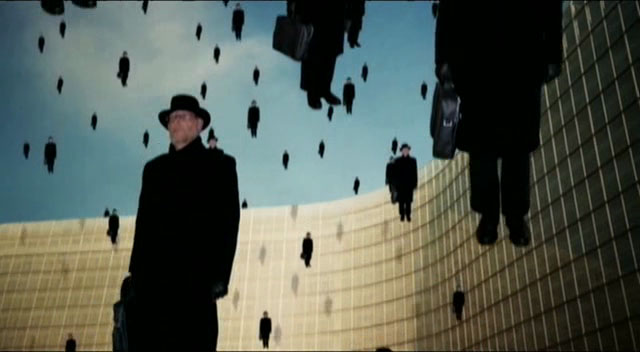
In the old days we were close to our farm animals but today governments require tracking ear-tags. Fun movie… maybe didn’t need the classroom and religious art scenes, but it makes up for that in the end by going all wacky with shooting galleries and suited men raining down outside some kinda UN building.
image

image

Crac! (1981, Frédéric Back)
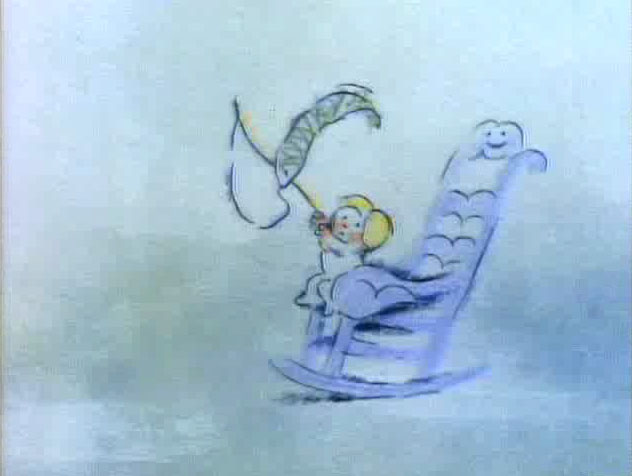
Animated story of the creation and long life of a rocking chair, accompanied by drum and fiddle music. It’s much better than it sounds.
image
image

Thigh Line Lyre Triangular (1961, Stan Brakhage)
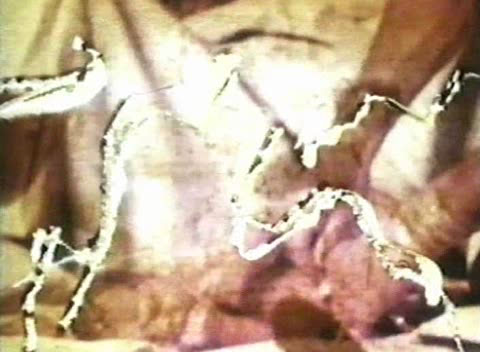
Arrrrgh, another birthing movie! Why did nobody warn me? Apparently the title is Brak-code for “vagina.” Once I got over the initial shock, this is excellent. Hand-processed frames over live-action film, intense.
image

image