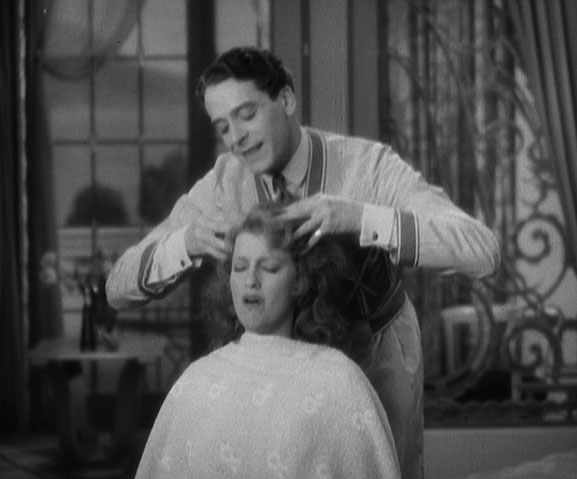
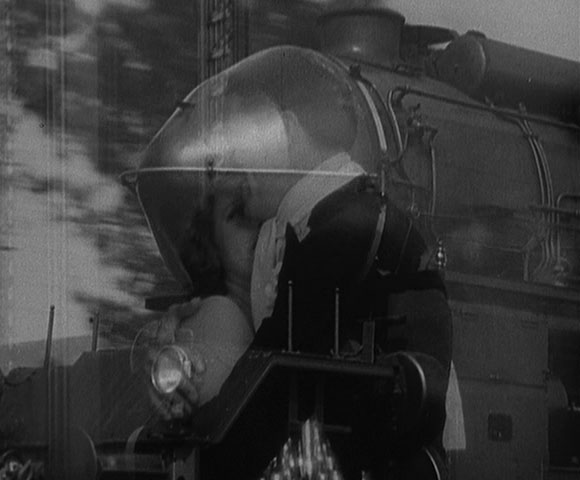
Claudette Colbert (pre-Palm Beach Story) is half broke, flees Monte Carlo for Paris then, stalked by her cab driver Don Ameche (who had the same mustache 50 years later in Coming To America), wins an awful lot of money on the craps table and loses it all a few seconds later.

image

Now truly broke, she sneaks into a fancy dinner party and hides in the back room playing cards, catching the eye of John Barrymore, five years after Twentieth Century and just as insane and hilarious in this one, but in a much quieter way, acting mostly with his eyes. As his cheating wife, Mary Astor is as comfortable acting rich and desirable as she is in The Palm Beach Story, but she’s less loopy here.

image

In fact, the whole atmosphere is quieter and less loopy than most so-called screwball comedies. Maybe the writers intended for this film to have more energy, more of a visual punch. I’m not sure, but Leisen’s (mis)treatment of Billy Wilder’s script caused an exasperated Wilder to become a director himself with The Major and The Minor – the same thing that happened a couple years earlier with Preston Sturges (Leisen’s Easy Living -> Sturges’s The Great McGinty). Can’t say that I see Wilder’s problem… the movie is pretty wonderful.

image

Barrymore is on to Colbert’s ruse, so he hires her to seduce his wife’s boyfriend away from her, in a comic-but-touching attempt to save his marriage. She pretty much succeeds, but Don Ameche holds a city-wide manhunt to find her and somehow they end up together because stalking = romance in early Hollywood cinema.

They’re not major characters – I just liked the hat:
image

A la Easy Living, it’s a movie where a regular girl is picked off the street and showered with money and nice clothes by a millionaire. Katy loves when that happens.

David Boxwell is comparing it to Rules of the Game:

In both films, the aristocrats walk away from the convulsive messes they make; but Midnight ultimately valorizes, in a predictable way for a Hollywood film, the ’30s populism embodied in Don Ameche’s character, the taxi driver Tibor Czerny. The film endorses the entrepreneur who arises from the working classes, since Tibor rejects whatever aristocratic heritage he has and is content to hustle just enough business to live happily. Indeed, it’s difficult to remember that he isn’t American, and Ameche, like the other American actors playing Europeans, makes no effort to adopt a foreign accent. And this being screwball comedy, Midnight lauds his eventual mastery over the knowing, independent, rootless American ‘gold-digger,’ whose material acquisitiveness sets the film’s comic plot spinning into high gear. …

The ease with which Midnight resolves the conflicts it sets in motion stands in stark contrast to the traumas of expulsion and death endured by some of the characters in Renoir’s film. In effect, if both films are ultimately about the degree to which a culture has the confidence to survive the inevitable upheaval of war, Midnight is an optimistic fantasy reassuring audiences of the superiority of American culture, however much it’s displaced onto a Europe that really consists of the process photography of a tourist’s Paris and some plaster Art Deco sets on the Paramount lot.

Some selections from the Treasures IV avant-garde set – just the ones from the 1950’s, so they’re all post-Desistfilm but pre-Mothlight.

Eyewash (1959, Robert Breer)
Flickers and movements, accurately titled. Saw this at the Anthology way back when. Think I prefer A Man And His Dog Out For Air over this. Includes a whole alternate version with (most of?) the same scenes in a different order.
image

Aleph (1956-66, Wallace Berman)
Berman isn’t a well-known filmmaker – this is his only film and it went unreleased (and even untitled) until now. A cool, unexpected addition to the set, instead of just focusing on known directors. Faces and jittery camerawork, bent and damaged and overlayed with filters and text, its jittery relentlessness (and John Zorn’s squealing sax) got me down after the first five of its eight minutes.
image

Odds & Ends (1959, Jane Conger Belson Shimane)
Stop-motion cut-outs and found footage and so on while a guy talks about jazz and poetry, this is supposedly an avant-garde spoof. If not for the jokey commentary, how can one tell serious experimental work from parody?
image

Bridges-Go-Round (1958, Shirley Clarke)
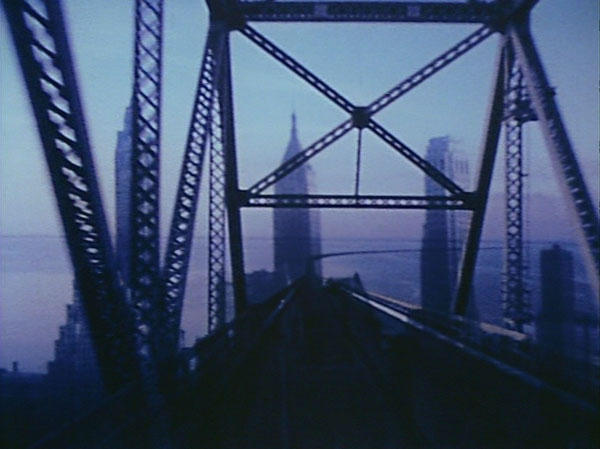
Have I seen this before, or only read about it? Looks familiar. A dance film with bridges, overlapping images like sci-fi architecture. Two scores – I prefer the Bebe Barron one.
image

Little Stabs at Happiness (1959-63, Ken Jacobs)
Just a dude with a grungy camera filming his friends and neighbors goofing around with props in a room and on a rooftop. Now that it’s less novel to own a camera, and the idea of releasing a film that isn’t a big studio production is nothing new, this seems to have lost its reason to exist. Then again, in Jonathan Rosenbaum’s Cinema Scope article he puts this in the “relatively familiar standbys” category, meaning cinephiles have been watching Jack Smith put balloons in his mouth for decades now, so maybe there’s something I’m missing. Some happy old records play over the start and end, but in the middle Jacobs narrates from ’63, telling us that none of these people shot in ’59 still talk to him, casting a mild bummer tone over the whole project.
image

Betty Boop in Snow White (1933, Dave Fleischer)
Just some animated shorts from the 30’s – but this one would fit in nicely with the avant-garde set because it is bonkers crazy and also one of the most excellent things ever. It’s vaguely SnowWhitey but the story comes second to wacky invention and Cab Calloway’s St. James Infirmary clown-ghost music video.
image

The Old Mill (1937, Wilfred Jackson)
This is Historically Significant, as the first film to use a multiplane camera. Won the oscar (same year as Torture Money) beating out something called Educated Fish and a dialogue-free animation of The Little Match Girl (sound familiar, Disney?). Animal life inside a battered windmill during an especially stormy night. Katy: “Aren’t owls supposed to be awake at night?”
image

Ferdinand The Bull (1938, Dick Rickard))
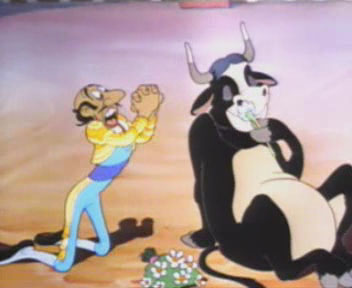
Won an oscar against three other Disney shorts (including Brave Little Tailor, one of the only mickey cartoons I still remember) and a Fleischer short about two donkeys. Ferdinand is a pansy bull who wants to sit and sniff flowers all day. All the other bulls desperately want to be picked for a bullfight (seriously?) but our pacifist Ferdinand gets picked over them. He screws around and doesn’t fight and instead of killing him they send him back to the meadow to sniff flowers again. I don’t know what’s the moral here.
image

Set over one year in the mid-to-late 30’s, mostly follows high-school-aged Titta and his family but leaves breathing room for the rest of the town and its inhabitants. The rare ensemble movie that gives everyone a memorably distinct identity without resorting to stereotyping.

On one hand, it would be worth renting the Criterion DVD and poring over the hours of extras. On the other hand, there’s no outside explanation needed for Amarcord. Need to watch this again and again… I’m pretty sure Katy would like it.

The title is slangy for “I Remember.”

I can’t account for why this won an oscar one year (best foreign film) and was nominated for more oscars (writing, directing) the following year.

I always think of “fascism” as a bad word, an insult thrown at your government by foreigners, forgetting that once Italians were screaming their support of fascism in the streets. Nutty buggers.

I don’t think this was packed with movie stars. Red temptress Magali Noël had been in Satyricon, Titta’s mom would appear in Cinema Paradiso 15 years later, and mad uncle Teo would direct a parody of The Exorcist.

So, another great Fellini film, combining the circus-film group atmosphere of 8 1/2 with touches of the tragedy of La Strada, with fortunately no La Dolce Vita influence to be found. I didn’t let the dubbing get me down, but I’d thought a new print of a new restoration of an only 30-year-old film would have more vibrant color than it did.

“If you strangle me, don’t stop midway. It’s too painful afterward.”

image

Kichi runs an inn, makes explicit advances on one of his workers. They begin passionate secret, explicit, OH-so-explicit sexual affair. Eventually he leaves his wife, the girl (Sada) and he move in together having continual sex, the sex gets more dangerous and starts involving knives and choking, and finally he lets her strangle him to death.

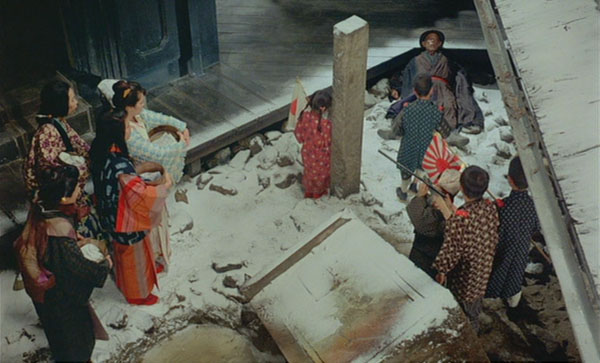
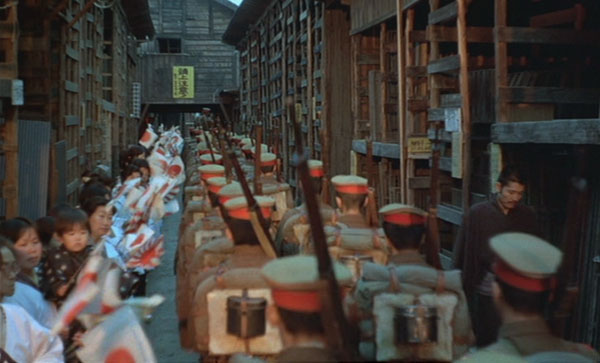
I liked Empire of Passion so I thought I’d like Oshima’s celebrated, scandalous arthouse porno even more, but was surprised not to. It’s got less cinematic flair than Passion, and less of a story too. I hate to say it, but all that sex gets boring after a while. Okay I take it back – there’s interesting stuff in here… some cool high shots (see below), a wildly fucked dream sequence where the woman grabs a naked six-year-old’s penis and won’t let go, a geisha gang rape, and some political business (nationalism on the streets, an army march – this is the year before the bombing of Shanghai) completely ignored by our sheltered protagonists, making me think this is a predecessor to Bertolucci’s The Dreamers.

image

Finally, a ridiculous closing voiceover tells us this happened in 1936 and she was arrested a few days later. I thought this was wedged in by the producers, but in his excellent commentary, Tony Rayns tells us that’s Oshima’s own voice.

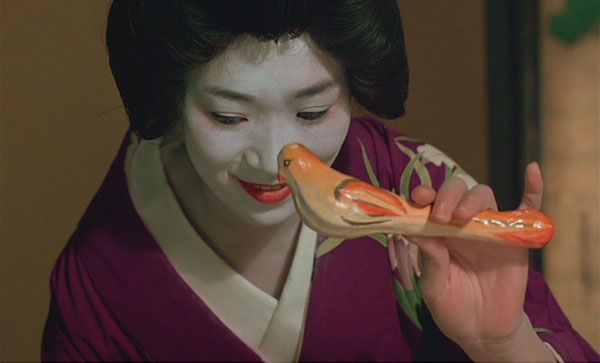
There’s more weirdness involving an egg, pubic hair consumption, fantasies of Sada killing Kichi’s wife, and a quirky dancing man. The girl has a scorpion tattoo on her ear – Tony didn’t tell us the relevance of that, so perhaps it has no relevance, because Tony knows all. The two have a fake marriage ceremony at an inn (not his inn, this is after they’ve run away) which leads to the geisha gang-rape and the quirky dancing man (below). I am already out of things to say… it’s a pretty simple movie for something so controversial.

image

Produced by Wakamatsu Koji (United Red Army), produced and suggested by Anatole Dauman (Hiroshima mon amour, Masculin Féminin, some Walerian Borowczyk features, Fruits of Passion, La Belle captive, Wings of Desire and Marker’s Level Five – wow).

Original title was Empire of the Senses. I assume the Mekons song Empire of the Senseless, with its lyrics about censorship, is referencing that. Oshima’s chosen Japanese title Ai no corrida (translated: Love’s Bullfight) looks to me like Spanish for Hey! No Running.

image

Tony Rayns:
“Oshima sees himself as standing apart from the consensus. For him, anybody who breaks the bounds of convention, anyone who dares to think for him or herself is in some sense an admirable figure,… hence an overall focus, I think, on the figure of the outlaw in many of his films.”

Most of the people in the film are women, including all the voyeurs (and there are many voyeurs). At the very beginning, a woman tries to initiate some lesbian sex with our hero and is rejected outright. Tony tells us these things explicitly delineate Senses from standard porn films.

image

More Tony:
“No two Oshima films look alike – there is no thing as the Oshima style.”

The geishas all falling upon each other as Sada has painful menstrual sex is “not a realistic detail.”

image

Girl who played Sada appeared the next year in a Kinji Fukasaku film with Sonny Chiba, otherwise not too many acting roles, while Kichi became a fairly successful actor. Typical. Although he was also a known actor before this, while she was just starting out in movies (previously in Terayama Shuji’s theater group). The actor playing an old tramp (glimped in the top screenshot) played the father in Kaneto Shindô’s Naked Island. Oshima didn’t finish his l’amour fou trilogy, and only made three more features and a couple documentaries over the next twenty years.

Wild Boys of the Road (1933)
TCM presented some pre-code treats from Wellman, who made a bunch of them. This was one of six films Wellman directed that year – those were the days.

A fully action-packed youth depression drama that wastes no time. Well-made and, incredibly (since I hate child performances in early movies), well-acted too. I kinda loved it.

Eddie (played Robbie the Robot in Forbidden Planet!) is a cool kid who proudly drives a junker car with impenetrable 30’s slang phrases scrawled all over it. He and his best friend Tommy (22-year-old Edwin Phillips) drive around, sneak into school dances and make out with their girlfriends a whole lot. Unfortunately, Tommy’s got The Great Depression, and he passes it on to Eddie, whose dad gets laid off, leading the kids to sell the car and flee the city to look for work elsewhere. While rail-riding, they meet a girl named Sally (Dorothy Coonan, 18, who married 37-yr-old Wellman the following year) who later gets raped by a train brakeman (Ward Bond, John Wayne’s murdered friend in Rio Bravo) – that and all the hot high-school kissing earlier in the picture justify the movie’s inclusion in whatever “forbidden” pre-code DVD set is coming out this week. One scene on the trains is memorably wonderful: rail cops ducking behind a barrier on the ground while being pelted with eggs by a hundred kids on the moving train – the one time the movie goes into giddy Zero For Conduct territory. But during all the fun, Sally is getting raped on a train car, and the kids take bloody offscreen revenge when the perpetrator is discovered, immediately and severely darkening the mood set by the egg-tossing scene.

Sally and the boys make it to Sally’s aunt’s house in Chicago. The aunt (Minna Gombell of a couple Borzage films) is extremely friendly and welcoming and feeds them all cake, but she’s also running a speakeasy, a brothel, or something else (it wasn’t very clear) and is immediately busted by the cops, leaving our kids on the run again.

Hard-luck kids from around the nation build a sort of youth shantytown in Ohio. Tommy loses a leg to a train. The kids flee to New York where Eddie finally finds a job, but in order to earn a quick buck to afford respectable clothes he accidentally gets mixed up with a holdup gang and is arrested. The judge, with a hard-luck kid of his own, buys their story and sends them home… maybe not the most believable ending in the world, but a deserved bit of relief.

Other Men’s Women (1931)

Back a couple years for this next one, the sound quality is noticeably worse. The movie is noticeably worse too… I’m not sorry I watched it, but I wouldn’t have missed much if I’d just gone to sleep dreaming of troubled youth.

Everything seems to revolve around trains in these movies. This time all our heroes work on the trains, starting with our cheesy lead, alcoholic Bill (Grant Withers, would play Judge Priest’s political rival 30 years later in The Sun Shines Bright), who is always handing out gum with his puzzling catchphrase “have a little chew on me.” He’s dating Marie, a big-eyed blond-wigged waitress played by Joan Blondell (popular in ’31 with Blonde Crazy and The Public Enemy, much later in Will Success Spoil Rock Hunter), but he’s fond of Lily (Mary Astor, the princess in The Palm Beach Story, far less outrageous here), the wife of his best friend Jack (Regis Toomey of The Big Sleep, played older salvation army man in Guys & Dolls). Bill, staying with the couple while he sobers up, presents it to Jack one day at work like this: “Lily and I found out all of a sudden we loved each other.” A fistfight ensues and somehow Jack is blinded… blinded! Things couldn’t get sillier – but wait – a rainstorm is flooding the river and threatening to knock down the dam. Bill figures if he drives a loaded train out onto the dam the extra weight will stabilize it. While more sensible supporting characters (have I mentioned James Cagney, a few months before The Public Enemy?) try talking him out of it, blind Jack sneaks onto the train and drives it onto the dam himself, resulting in a spectacular suicide. A few months later when things settle down, Lily and Bill are happily together, a weird sort of happy ending.

Written by Maude Fulton, who adapted a film of The Maltese Falcon the same year (not the one starring Mary Astor). I’m not sure if this is sordid enough to count as a naughty pre-code movie. I guess married Lily kisses another man. Bill acts gay for a laugh in an early scene, but that’d probably still be allowed. There’s another guy with one leg. Clever bit where Bill jumps off the head of a train slowly rolling past a coffee joint, gets himself a cup while counting the cars that pass, then jumping back on at the end. Nothing wrong with the film or the acting (though Bill and Marie suck at playing drunk – the illusion falls apart in close-up) but nothing especially exciting either.

JUDGE PRIEST (1934)

Something like John Ford’s 80th film, if IMDB can be trusted. Contemporary with L’Atalante and the silent Story of Floating Weeds. Set in 1890’s Kentucky – a couple decades past Civil War, which was still on everyone’s mind. And after all, the war wasn’t all that long ago… older audience members watching this film would’ve had parents who participated in it. Strange to think about now, a few more generations removed – my dad wasn’t born yet when this came out.

image

Humorist cowboy and populist philosopher Will Rogers plays the titular good-ol’-boy judge, and controversial sleepy-eyed black actor Stepin Fetchit is his sidekick. Priest is a former confederate soldier (“I kinda calmed down”) who is endlessly proud of Dixie, but respects the law and modern reality, or seems resigned to them anyway.

image

The judge’s nephew Jerome (Tom Brown) comes back to town and you can tell he’s supposed to end up with the neighbor girl Ellie May (Anita Louise) but he keeps ending up on dates with a dark-haired temptress instead (Rochelle Hudson, who voiced MGM cartoons and later appeared in Strait-Jacket and Dr. Terror’s Gallery of Horrors). Of course they do end up together after wasting plenty of screen time we’d rather be spending with Will Rogers, but first there’s some problem about Ellie May not having a father.

Our generic romantic leads… everything else in the film is more interesting than these two:
image

Trouble starts in town when the mysterious new guy in town, a blacksmith (the Walter Matthau-looking David Landau of Horse Feathers) punches out Flem the barber for making a crack about Ellie May. He is to be tried in court before Judge Priest, but meddling, villainous-looking senator Horace Maydew points out that Priest was present at the incident and took the blacksmith’s side, so Priest agrees to step down and let someone else (Henry Walthall, in the movies since 1908, costarred in Birth of a Nation and London After Midnight) preside. Priest stays involved by offering to defend the blacksmith, finally, triumphantly revealing him to be an ex-con, a confederate war hero, AND Ellie May’s father.

image

I found less stirring emotion in the overlong “dixie”-soundtracked heartfelt courtroom ending than in a scene early on with the judge talking to a photo of his dead wife. He’s supposed to be a lonely man, but with the young lovers and the big trial, and with Priest’s jovial nature, Ford doesn’t dwell on that aspect too much… just gives us that one lovely scene providing Priest with a deep enough soul to last the rest of the film.

image

Otherwise things stay pretty light, and there’s plenty of worthwhile diversions like the outrageous performance of Stepin Fetchit, and Hattie McDaniel (as Priest’s maid) singing “the sun shines bright in my old kentucky home.”

Look far-left for Hattie:
image

Screenplay written by Atlantan Lamar Trotti (American Guerrilla in the Philippines) and Dudley Nichols (Man Hunt, Scarlet Street). Based on a series of books by Irvin Cobb, author of McTeague (Greed), who hosted the Oscars the following year (1935 – this wasn’t nominated). Will Rogers had hosted in ’33. Time was unkind to the lead actors… Rogers, Walthall, and Landau all died within two years of the film’s release.

Sneering villain Horace Maydew:
image


THE SUN SHINES BRIGHT (1953)

I’d thought this would be a remake of Judge Priest, but not exactly. Sure, at the beginning a young man comes home and starts romancing a young girl with a conspicuously missing parent, and sure Judge Priest (now played by Charles Winninger, the captain in Show Boat) is our central character and Stepin Fetchit (the same actor!) is his slow, slurred-voiced sidekick/servant, but things take a turn from there.

image

Priest is still a likable soul, but now he’s an alcoholic on the verge of losing his seat to slick Horace Maydew. Priest doesn’t seem like he runs this hick town anymore – he’s an increasingly irrelevant member of a rapidly growing city. He’s a wise and engaging character, but he’s no Will Rogers. And while the first movie showed us the judge’s loneliness at the start then cheered us up for the next hour, this one gives the judge a rocky start (waking up and yelling for his negro servant to bring him whiskey!), builds him up more and more, then fires off a devastating visual ending, the judge silently retreating into his house alone.

Horace Maydew isn’t as cartoonish a bad guy in this movie:
image

The twist this time: young Lucy Lee’s mom, a prostitute who left town so her daughter wouldn’t grow up in shame, returns home to die. Lucy Lee finds out about this, and about her grandfather, the solitary wealthy General Fairfield (James Kirkwood, a director in the silent era, and the farmer in A Corner In Wheat), a former confederate who has distanced himself from his past and won’t talk before the veterans group which Priest leads each week.

The judge and the general share a tender moment:
image

Before LL’s mom died she asked brothel madam Mallie Cramp (Eve March: the little girl’s teacher in Curse of the Cat People, Hepburn’s secretary in Adam’s Rib) to give her a proper funeral and burial and strong-willed Mallie would like to, but she’s met with resistance by the townsfolk, who of course support the brothel but bristle at the idea of those women having public lives or even deaths.

image

The rest of the plot is more complex than in Judge Priest. No big climactic court case, but a few overlapping issues. First, Priest is up for re-election and it’s a close race with Maydew (Milburn Stone, a detective in Pickup On South Street the same year), who paints Priest as old-fashioned and out-of-touch. Young lover Ashby (stiff, cliff-faced John Russell, the main bad dude in Rio Bravo) wins a whip-fight (!) with slimy rabble-rouser Buck Ramsey (Grant Withers, who killed himself a few years later) over Lucy Lee (Arleen Whelan of Young Mr. Lincoln), and Ramsey returns leading an angry mob hoping to lynch young black harmonica player U.S. Grant Woodford suspected of raping a girl out of town. Priest is already politicking around town, leading his confederate group, and dealing with the Lucy Lee situation when he decides to risk his life by blocking the lynch mob and risk his reputation by being the first to follow the prostitute funeral procession through the streets. Priest closes those matters out (U.S. Grant is proven innocent and released, actual rapist Buck is shot trying to escape, Lucy Lee reconnects with her grandfather) just in time to cast the decisive vote re-electing himself. In the end he’s a hero of the town, and everyone stops by his house to wave and sing praises… but he still goes home alone.

image

There were 30+ John Ford films between Judge Priest and this (including Rio Grande and The Quiet Man) and he had nearly 20 more left in him. This one, unlike the original, can definitely not be called a comedy. It has some comic relief though, in the form of drunken hick sharpshooter duo Francis Ford (his 32nd and final appearance in one of his brother’s films) and Slim Pickens (a decade before Dr. Strangelove and Major Dundee). I wanted to like the 30’s movie more, with its lighter tone and a Judge Priest character who is affable without having to humbly heal the whole town’s social wounds while saving a boy’s life, but I think the latter movie impressed me more deeply. No doubt they’re both excellent and make for a lovely double feature though.

image

Jonathan Rosenbaum:

Today The Sun Shines Bright is my favourite Ford film, and I suspect that part of what makes me love it as much as I do is that it’s the opposite of Gone with the Wind in almost every way, especially in relation to the power associated with stars and money. Although I’m also extremely fond of Judge Priest, a 1934 Ford film derived from some of the same Irvin S. Cobb stories, the fact that it has a big-time Hollywood star of the period, Will Rogers, is probably the greatest single difference, and even though I love both Rogers and his performance in Judge Priest, I love The Sun Shines Bright even more because of the greater intimacy and modesty of its own scale.

I should add that in between Judge Priest’s stopping of a lynching and his triumphant re-election brought about in part by the potential lynchers is the act that the Ford regards as his key act of moral and civil virtue – arguably far more important in certain ways, at least in this film’s terms, than his prevention of the lynching. I’m speaking, of course, of his joining a funeral procession for a fallen woman on election day, thereby fulfilling her dying request that she be given a proper burial in her own home town. Once Billy Priest joins this procession, he is followed by almost every other sympathetic member of the community, starting with the local bordello madam and her fellow prostitutes, and continuing with the commander of the Union veterans of the Civil War, the local blacksmith, the German-American who owns the department store, Amora Ratchitt (Jane Darwell), Lucy Lee, Ashby, Dr. Lake, and finally – after the procession arrives at its destination, a black church – General Fairfield, Lucy’s grandfather, who has up until now refused to recognised his daughter under any circumstances.

There are actually two protracted and highly ceremonial processions in the film, occurring quite close to one another – the funeral procession for Lucy Lee’s mother and the parade of tribute to Judge Priest – and the fact that these two remarkable sequences are allowed by Ford to take over the film as a whole is part of what’s so extraordinary about them. Retroactively one might even say that they almost blend together in our memory as a single procession – despite the fact that the first is an act of mourning and the second is an act of celebration – and this undoubtedly contributes to the feeling of pathos in the film in spite of its overdetermined happy ending.

Ultimately, what the film may be expressing is neither celebration nor lament, perhaps just simply affection for cantankerous individuals who exude a certain sweet pathos because history has somehow passed them by – as someone says in the film, I believe in reference to the Confederate veterans, ‘the doddering relics of a lost cause’, which also suggests The Southerner as Everyman. This implicitly suggests a certain darkness as well as lightness – which is why the local blacks serenade the judge with ‘My Old Kentucky Home,’ the first line of which is, ‘The Sun Shines Bright’ – and yet this is a film bathed mainly in the melancholy of twilight. For to emphasise and focus on lost causes as opposed to causes that still might be won assumes a certain abstention from politics associated with defeatism – one reason among others, perhaps, why the Civil War plays such a central role in American history as well as in Ford’s work.

Someone can tell me if I’m out of line in quoting too heavily from this, but it’s so nice to see long, well-thought article devoted to an obscure classic film. If only EVERY film had as thorough a write-up on these internets. Maybe some day.

Our generic romantic leads. Once again, everything in the film is more interesting than these two, but this time Ford seems to realize it.
image

Merian C. Cooper’s name is on the title card – first time I’ve seen him mentioned in a non-King Kong context. I guess he exec-produced a bunch of John Ford movies. Shot by Archie Stout, who won an oscar the previous year for Ford’s The Quiet Man.

Only written by Preston Sturges, but I have no problem calling this a Sturges movie, full of his witty dialogue and manic energy. Sturges, who I’d just accused of ignoring women in Christmas In July, writes a fantasy chick-flick here. Girl works hard at menial job, then out of nowhere she gets fanciness thrown at her and a hot rich guy falls for her.

God’s own Jean Arthur is the girl, cuter here than in You Can’t Take It With You (in which this movie’s stuffy rich guy Edward Arnold played an even stuffier rich guy). He tosses a mink coat out the window and it lands on her, setting into motion a rags-to-the-appearance-of-riches story a la The Million Pound Note. A young Ray Milland (minus his X-Ray Eyes, some years before The Major and the Minor), earnest son of the Edward Arnold, falls for her and Louie, a chef turned hotel owner (played by Luis Alberni, who would go back to being a chef in The Lady Eve), thinking she’s having an affair with Edward Arnold, gives her a free suite to attract other trendy, wealthy socialites. Pretty sure she ends up with Ray Milland.

Katy liked it, too.

This will sound awfully disrespectful, but you’d think the renowned master of montage Eisenstein, he who reinvented movie editing, could pick up the pace a little. This movie drags. Each shot has a wonderful composition, and each shot is held for a second or two too long. And to be more disrespectful still, I beg to differ with E. Von Mueller calling Prokofiev’s score the best in history. But maybe he’s kicking back at home with an LP of the full orchestral arrangement, not the weak bits on the film itself (Criterion essay on the director/composer collaboration calls the soundtrack on the film “like a chamber ensemble recorded over a telephone”). I’ve still got to hear the re-recorded score sometime. And I intended to… but after the movie and the DVD commentary, I didn’t feel like going through it a third time.

The bloodless battle on the ice wasn’t exactly choreographed by Sammo Hung… buncha overarmored guys clumsily smacking into each other with weapons. But I’ve made fun of the acclaimed classic film enough now. Composition-wise it is beyond reproach… some of the most amazing-looking shots of the 30’s. A beautiful movie and a swell piece of anti-German propaganda (which is why it was celebrated, then banned, then celebrated).

How you know the Germans are Bad Men: they toss naked babies into fire:
image

Russia is under Mongol rule, but this is mostly ignored. Nevsky kicked the asses of the Swedes or some other country previously, so he’s called on to protect Russia from the invading Germans, who have already conquered one major town and killed everyone in it, including babies. Meanwhile in another town, two tough guys are competing for the only pretty girl. She says she’ll marry whichever fights the most bravely. So off they go with Nevsky, the town armorer (who dies from being too generous, giving away his best armor and saving the leftovers for himself) and a hot warrior woman. Battle on the ice lasts some 30 minutes. Crowd scenes outdo most of your Braveheart / Lord of the Rings epic battles with lovely, artistic shots of actual masses of people (outdone later in Ivan The Terrible), but close-ups of battle are a little lame. After, one guy is dying, other guy generously tosses the pretty girl at him and goes after the hot warrior chick. The glory of Russia is restored (well, they’re still under Mongol rule) and Nevsky goes back to his humble fishing life, after issuing a stern warning to the Germans which is screamed across the screen in giant bold text!

Mr. Nevsky:
image

A washed-up gambler (played by the writer/director) sits at a cafe recounting his life. We watch different episodes while he narrates. These episodes have no spoken dialogue except for this narration. So we are listening to Guitry talk for eighty straight minutes – no easy task.

Begins as a promising comedy. Our guy (“The Cheat”) steals from his mom, so isn’t allowed to eat the poison mushrooms that kill his entire family. Goes to live with an uncle, gets a job, this is when I start to realize that he’s never going to stop talking, and it gets less fun. It’s an okay movie, light, and funny at times, but seems nothing special.

Anyway, our cheat lives honestly and works hard after the mushroom incident, but seems to attract scoundrels. Eventually he embraces it and gets rich from cheating casinos – but one day his dealer is a guy who saved his life in WWI, and he takes it as a sign to stop cheating… but now he’s addicted to gambling, so he loses his fortune. Along the way he meets a woman who tries getting him to join her jewelry-robbing schemes, he marries a girl for tax purposes (it’s a business-only relationship, but years later he has sex with her in disguise, heh), he moves to Monte Carlo and becomes a croupier, and he tries to avoid an old woman (present-tense, in the cafe) who was his first fling back when he was an elevator operator.

I liked the opening credits best – filmed like one of those knowingly cheesy behind-the-scenes pieces from classic Hollywood, Guitry introduces all the major cast and crew on-camera. This is one of Guitry’s two most well-regarded films. I’m not gonna knock myself out to see the other (incidentally it’s Pearls of the Crown).