More 16mm screenings from Clay, Halloween-themed this time. Clay showing seasonal shorts reminds me of Robyn Hitchcock’s halloween show where he joked that since he’s only playing songs about ghosts and death, nearly half his catalog is disqualified.

The Skeleton Dance (1929, Walt Disney) was the first in the Silly Symphonies series, with good music-visual sync, but too much repeated animation. No spoken/sung dialogue, wordless skeletons playing in a cemetery until the sun comes up.

Runaway Brain (1995, Chris Bailey) is an excellent, fast-paced Mickey Mouse short with a mad scientist voiced by Kelsey Grammer, beaten for an academy award by Wallace and Gromit. Seems like nobody around me had heard of this before.

The Tell-Tale Heart (1953, Ted Parmelee), animated with some abstract imagery, overlapping shots and sharply-drawn characters. Has a deservedly high reputation, but beaten for an oscar by Disney’s Toot Whistle Plunk and Boom.

Betty Boop’s Hallowe’en Party (1933, Dave Fleischer) – always great to see a Betty short. Her party is pretty tame – kids bobbing for apples and singing like the birdies sing (tweet, tweet tweet) – until a bully shows up and she attacks him with her secret cache of ghostly evils. Full of amazing animation and visual ideas, beautifully synched to the music. I gotta get me a whole pile of these cartoons someday. I asked Wikipedia when the apostrophe disappeared from “hallowe’en” but it didn’t know.

Naturally the show was also full of TV episodes and classic commercials – Count Chocula vs. Franken Berry, of course, also a kids vehicle that looks suspiciously like the Wacky Wheel Action Bike (“you can’t ride it! you can’t ride it!”) and an awesome PSA warning kids to stay away from blasting caps.

Of the TV shows, we’ve got a Popeye the Sailor episode where an evil robot-popeye robs banks, the adventures of Goodie the Gremlin, who helps people invent the steam engine, airplanes etc. instead of tormenting people like the other gremlins want, a Spider-man episode where Green Goblin gets his hands on a book of voodoo spells, and a hilarious, surreal episode of Ultraman (featuring benign fluffy chattering Pigmon monster in a recording studio, giant plumed lizard monster with heat-seeking feather missiles, and the usual bonkers dialogue). Then the lower-tier corny garbage shows: a cartoon Sinbad the sailor, some dimwit monster who shoots smoke out of his head, Beany and Cecil meet the invisible man (1962, produced by a post-Warners Bob Clampett) and a Hal Seeger-created short called Batfink, in which BF and his dim pal Karate fight a magician.

“We’re alone and we stay alone. But what counts is to want something… no matter what the cost. There’s a bit of happiness in simply wanting happiness.”

Oops, we were supposed to end Agnes Varda Month with Jacquot de Nantes but I couldn’t get the subtitles to work, so we watched Jacquot’s own Nantes-set first feature. Not a musical like we’d hoped, but a gorgeous widescreen black and white, slightly melancholic drama with a lovely Young Girls of Rochefort-reminiscent ending.

Our listless hero is Roland (Marc Michel of Le Trou), who just wants to get out of town until he meets his crush from a decade ago, dancer Lola (Anouk Aimée). He sticks around to see if anything will happen between them, but she’s not interested, waiting for her long-lost love (and father of her child), messing around with an American soldier (New Jersey native Alan Scott who speaks hilariously horrid French) in the meantime.

Separately, Roland and the soldier also meet a young teen girl named Cécile, and Roland meets her lovesick mother (Elina Labourdette of Bresson’s Les dames du Bois de Boulogne) who tries in vain to distract him from Lola. Roland kills time at his favorite cafe with a woman in her 60’s (one of the card players in La Rupture) who talks about her son who has been away for too long. Everyone turns out to be connected – she’s the mother of Lola’s missing boyfriend who returns home to them in the final scene – giving Nantes a small-town feel, but it’s made small through the characters, not by the crane shots which make Rochefort look like a stage set.

Demy’s cinema is interconnected: Lola returned in Model Shop and Roland is the guy who marries Catherine Deneuve in The Umbrellas of Cherbourg.

NY Times: “Cécile, it’s worth mentioning, is Lola’s real name. All these people are to some degree reflections of Lola or her vanished lover, and part of the pleasure of the movie lies in watching Demy choreograph this intricate play of mirror images as the characters flicker past one another – sometimes recognizing themselves, fleetingly, but more often not.”

R. Bergan: “Its circular construction, frothiness, and long tracking shots are reminiscent of Max Ophüls, the film’s dedicatee.”

Summer 2015: Watched again from the new blu-ray, replaced screenshots.
Another great set of Clay’s 16mm cartoons, and it’s been too long since the last one.

Mysterious Mose (1930, Dave Fleischer) is a proto-Betty Boop (she looks like a dog; a sexy dog) cartoon in which she is haunted by a sorta ghost casanova. The Great Piggy Bank Robbery (1946, Robert Clampett) is a weirdly violent Daffy Duck gangster parody. Since his “Duck Twacy” fantasy is spurred by a knock on the head while reading comic books, it’d be a good short to play before Artists & Models. It’s Tough to Be a Bird (1969, Ward Kimball) is a Disney doc about birds and watchers with musical cartoon segments. And We Have Met the Enemy, and He Is Us (1973, Walt Kelly) is an unfinished Pogo cartoon with a harsh environmental message. I think all the voices were done by one guy.

Bunch of TV stuff. Spiderman fights a bank robber in a mole-man costume. There’s a Casper cartoon (in which Casper does not appear) about a watch repairman who gets attacked by an eagle at the end. Ralph Bakshi contributes an episode of Captain America. A horrible show called Hoppity Hooper (set in Wisconsin) with a Rocky-and-Bullwinkle-repetitive bit about “the traffic zone” was the low point. The high point was the hilarious 60’s-70’s commercials for Mr. Wizard, Hot Wheels, Cheerios and the like. Real fun program… too bad the next one is scheduled for the same night Art Brut is playing.

image

I think these might be time-lapse shots of the tide going out, but the picture quality is too poor to be sure. This is gonna be a rough one…

image

Opens with a closeup of Catherine Deneuve smiling, a good sign, but soon she and husband Michel Piccoli are in a car crash. Afterwards, she can’t speak anymore and he has a harry potter scar on his forehead. Some eerie, powerful string music and many close-ups of crabs later, we’re at a seaside town where the couple have come to recuperate. Apparently they don’t talk with the locals much because there’s plenty of gossip going around.

Sheet salesmen:
image

Doesn’t take long for things to get weird. Small hands drop buttons into pockets. Piccoli (whose character name is also Piccoli) gets scammed by traveling sheet salesmen. Fishermen provide La Pointe-courte flashbacks for the viewer. Piccoli beats a chef with a dead cat. But it’s not a comedy! Something dark and eerie is definitely going on.

Piccoli talks with a horse. The horse talks back.

Piccoli is a writer working on a story, and when we see him writing the dialogue being spoken by a woman across town, I’m never sure afterwards what is really happening and what’s part of his meta-movie.

horse: “What is your story about?”
MP: “It’s about a man who knows how to control people by remote control. … but it wouldn’t last very long, a minute at most. This guy would be a bad person, with an evil mind. He wouldn’t be human or animal anymore.”

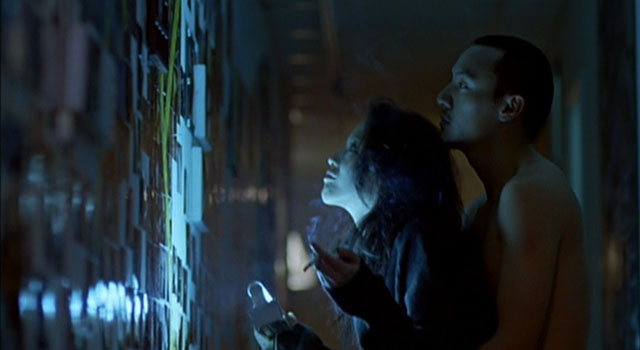
Soon Michel meets a bad man with an evil mind, Mr. Ducasse, who lives in a tower. He’s hired kids to drop magic discs into townspeople’s pockets which enable their wills to be controlled by his super computer. Ducasse calls the townfolk his “creatures”, gets Piccoli to play a game of Battle Chess with him over the fate of the town and of MP’s wife. MP is losing, but decides he doesn’t have to take Ducasse’s crazy misanthropic shit anymore, destroys the computer and tosses Ducasse from the tower. I’ll let NY Times give away the ending below.

image

Other notes I took while watching:

Catherine writes him messages, which I can’t read from the poor picture quality, and even if I could read them, they’d be in French. I have nice DVDs of Varda and Demy movies here, but I choose to watch a junk bootleg instead. Odd priorities.

The dead cat came with a piece of iron that makes the lights go out and causes people to act strange.

He just told a rabbit that his wife is pregnant.

Thief Max burns money, puts on diving suit, gets shot by partner.

You can’t tell much about the camerawork from my lo-res letterboxed videotape, but it’s one of the first films shot by William Lubtchansky (a decade before he began his 30+ year relationship with Jacques Rivette) along with two others. Interesting that all of her films until 1977 had multiple credited cinematographers.

Village Voice calls it “really botched” in their roundup for this year’s retrospective… “If it’s about anything, it’s about the creative process in action and stars that fine actor Michel Piccoli as a novelist who bases the characters in his story on friends and acquaintances.”

Ebert: “a complex and nearly hypnotic study of the way fact is made into fiction. It seems to operate on many levels, but in fact it operates on only one, illustrating how fantasy, reality and style are simultaneously kept suspended in the mind of a creative writer.”

NY Times: “Then love conquers all. The survivors of the seven subplots make happy arrangements — for example, the statuesque hotel keeper (Eva Dahlbeck) gives up mistressing for the town doctor and begins with an underage busboy. The writer almost completes his novel. The wife gets her voice back, pronounces her husband’s name (“Edgar”), and has her baby — a bawling creature who at the end fills up the screen precisely to balance (and somewhat to resemble) a crab creature that fills it at the beginning.”

image

image

The movie’s studied anthropology and attack on human behavior reminds me of Resnais’ Mon oncle d’Amerique. And also of Bjork’s “Human Behavior.” There’s definitely, definitely… definitely no logic.

2025: Rewatched this in modern HD quality and replaced half the screenshots.

I am not a number – I am a free man:

“I have enough joy for both of you. Happiness works by addition.”

image

Francois is so happy, because he has a wife (Therese) who cares only for him and their two lovely kids. He has a rewarding job as a carpenter, and a good relationship with his brother. One day he meets lovely postal worker Emilie and starts an affair with her, and now he’s even happier. Francois has so much joy that he can’t contain it all, so he tells his wife how happy he is to have two lovely women in his life, and an hour later she goes off and drowns herself. A few months pass before Emilie moves smoothly into the role of wife/mother, and Francois’ happiness continues as before.

Explaining the situation to the wife:
image

The movie, with its bright colors, prominent music, and unsettling focus and editing tricks, is amazing – probably my favorite Varda movie so far. I’d heard it was a deeply ironic, very unhappy movie but I don’t think that’s true, despite the death (not explicitly a suicide). Varda’s got happiness (in feeling and appearance) on her mind, but isn’t cutting it down or saying it doesn’t exist.

Fade to red:
image

Varda: “I imagined a summer peach with its perfect colors, and inside there is a worm. And impressionist paintings, which emanate such melancholy though they depict scenes of everyday happiness. I listened to Mozart, I thought of death’s preponderance. I wrote the film fast, and shot it fast, like the vivid brightness of our short-lived summers. At the time, it provoked much commentary. I said: ‘In a world full of prefabricated images of happiness, it’s interesting to take apart the cliches.'”

Agnes says at the time she hadn’t seen another film called Happiness and she liked the word. I guess Marker didn’t get the Medvedkin reissued until a few years later.

image

Lead actor Jean-Claude Drouot would go on to appear in Chabrol’s La Rupture and Klein’s Mr. Freedom, and his wife would continue not to be an actress, never appearing in another film. Marie-France Boyer (Emilie) had a couple starring roles after this, but fades away after 1970.

A few film references: they go to see a Louis Malle comedy (not giving the title or director, so it took some sleuthing), and watch a scene from Renoir’s Picnic on the Grass (an appropriate title, and another impressionism reference) on television. Then there’s the poster below, advertising Wilder’s Irma la Douche, John Wayne in McLintock, and is that Wyler’s 12-year-old Detective Story?
image

Movie got a silver consolation prize in Berlin after being beaten to the gold by Alphaville.

The New York Times didn’t get it (and called it Varda’s second feature – I guess if La Pointe Courte didn’t play NYC it doesn’t exist).

image

I want to quote the entire Amy Taubin essay because it’s great, but I’ll restrict myself to this bit about the final shot: “When we return in the last scene to this same patch of countryside, it is already late autumn. All that’s left of the sunflowers is their dry stalks. Just as François has replaced one wife with another, Varda replaces the late woodwind quintet with an even later and darker Mozart chamber work—a transcription for strings of the melodic themes of the original piece. The dirgelike sound suggests that as the family, holding hands, walks away from the camera, into the shadowy recesses of the forest, it is already entombed.”

image

The DVD extras are all by Varda herself – only other director I can think of who does that is Peter Jackson. Includes an interview between the two lead actresses and Varda’s daughter, which looks like it was edited by a crazy person. Short interviews with the people of Fontenay about their ideas of happiness. Writers’ quotes on happiness (“He who speaks of happiness always has sad eyes” – Aragon), interviews with two people with the last name Bonheur, a doc of lead actor Jean-Claude Drouot visiting the town of Fontenay and talking with locals about their memories of the film shoot, a 1964 documentary of Agnes on the film shoot (below, with husband Demy)
image

And four intellectuals discuss the film and its ideas of happiness, from which the following:

Michele Manceaux:
“If [the death] was an accident, it was psychosomatic. I think we can say it’s suicide. But it’s hard to fathom how something as serious as suicide could be treated in a story which is like a fairy tale.”

Frederic Bonnaud:
“Max Ophuls made a wonderful film called Pleasure, not Happiness. And the last line is ‘Happiness is not gay.’ That’s it, someone says, ‘But sir, happiness is not gay.’ And I think Agnes’ film is pretty much an analysis of that line.”

Nice to have a laptop full of movies on the plane. I’d loaded up on drowsy motion-sickness pills so instead of falling asleep in the middle of a feature (as I did with The Grand Duke’s Finances) I took a bunch of shorts. The first four are from the 2004 compilation Visions of Europe.

image

Europe Does Not Exist (Christoffer Boe)
A large businessman (actor from The Celebration) tries to pronounce the word “europe” with the help of a hot woman, I’m not sure why. Boe made the art-drama Reconstruction the year before this.
image

It’ll Be Fine (Laila Pakalnina)
Each scene a person or a few stand faces the camera for a not-fixed period of time, then finally nod and walk off. Some vaguely unsettling music and sci-fi soud fx. Europe! Director is an award-winning Latvian.
image

Die alten bösen Lieder (Fatih Akin)
Idel Üner sings about about the death of old evil songs in an empty theater while a guy who may be FM Einheit drills something and hammers a giant spring. B/W music video with a color scene. Interesting, but over my head if it had a point.
image

Cold Wa(te)r (Teresa Villaverde)
Illegal immigrants, I’m guessing – being rounded up on the shore (alive and dead) and processed by the authorities. Wordless, quiet, slow-motion. Not crazy about this one. Villaverde is Portuguese, has a film called Os Mutantes.
image

Love Exists (1960, Maurice Pialat)
“Deep in my memory, a train passes by just like in the movies. Memories and films are filled up with objects we dread.” You have to read the subtitles loosely – translation seems off. Present-tense empty landscapes accompany wistful music and a wistful narrator speaking of childhood memories from these places. I think it’s really easy to use cinema to express nostalgia. I won’t hold it against Pialat – still looking forward to checking his À nos amours and Naked Childhood. Gives way to distopian dread over the suburbs: “Again and again advertising prevails over reality.”
image

image

Charlotte et son Jules (1960, Jean-Luc Godard)
Translated as “Charlotte and her lover” for some reason. Girl (Anne Collette, returning from Charlotte et Véronique but not Charlotte and her steak) walks into Jean-Paul Belmondo’s apartment to jaunty music and he never stops talking for 12 minutes, essentially “I know why you left me, I knew you’d come back, I know why you’re back, I don’t need you, I do need you,” and when she finally gets a chance to speak it’s “I came back to pick up my toothbrush.” Godardian hilarity! Gérard Blain (of Truffaut’s Les Mistons) waits for her in the car. These last two movies were on that DVD “Their First Films,” alongside Resnais’s Le Chant du styrene and Rivette & Chabrol’s Le Coup du Berger
image

image

Superficially, this is closest to The Adventures of Robinson Crusoe than any other Bunuel movie. Voila: it is set on an island, features a fight for survival, and is in English. But psychologically, it’s most similar to early Mexican film Gran Casino because of… oh ha, I’m just kidding – I have no idea. In fact, it seems not even vaguely like anything else I’ve seen of Bunuel’s, not even Robinson Crusoe. It’s an American South civil rights drama set in isolation, so you’ve got lynch mob threats but no mob. Very good movie, excellent writing, I just can’t reconcile the Bunuel connection (not that it’s bugging me).

image

Traver, a black musician, flees to a small island, falsely accused of raping a white woman, and runs into Miller, the suspicious racist white dude who runs the place. Miller, meanwhile, is plotting to marry his young ward Evalyn, who’s really too young so he’ll be in trouble if people find this out. The irony that he’s helping capture Traver for sexual crimes (and the suspicion that Traver is actually innocent) isn’t lost on him, so despite his threatening poses, he eventually helps Traver escape after the arrival of a priest and a super-racist friend threatens to call attention (and that mob) towards the island.

Miller, introduced sneering with a dead rabbit in the foreground:
image

Has two of the same writers as Robinson Crusoe (aha!) and thrilling cinematography by Gabriel Figueroa of Simon of the Desert, Los Olvidados, Nazarin and Under The Volcano. Filmed in Mexico, and looks awfully dubbed at times. In the original short story, Traver gets killed at the end.

image

Senses of Cinema:

…though slow-paced and rather stilted, is nevertheless interesting in the way it frames racism and sexism as parallel discourses. … The Young One, unlike Robinson Crusoe, didn’t do well at the box office. Buñuel commented in My Last Sigh: “one of the problems [with it] was its anti-Manichean stance, which was an anomaly at the time, although today it’s all the rage.” Nevertheless his tone suggests that he is quite proud of these American productions, as if to say he could have been a Hollywood filmmaker like other European exiles, had chance not sent him to Latin America.

image

Slant:

Framed by a monophonic rendition of “Sinner Man” by Leon Bibb, the film has the scorching emotional urgency of a black spiritual. … In the constant frustration of Traver’s escape and Miller’s inability to play nice with him, Buñuel evokes the face of humanity repeatedly peeking out from and retreating into the steely shell of a racist comfort zone. To this already unnerving gumbo of feelings and ideas, the director adds a white supremacist hellbent on lynching Traver and a priest whose compassion has limits: he makes a case for Traver’s innocence but has Evalyn turn a mattress over so he won’t have to sleep on the same side Traver did the night before.

image

Main white dude Zachary Scott, facially Gary Sinise-like, had starred in Mildred Pierce and Renoir’s The Southerner in 1945. His final film appearance would be two years after this in Tashlin’s It’$ Only Money (I didn’t see that coming). Bernie Hamilton went on to play cops and convicts, a chauffeur, a “negro,” then in the 70’s had parts in Hammer, Bucktown and Scream Blacula Scream. I’m guessing this would be his career high point, then. The girl appeared two years later in another island drama, then IMDB loses track of her. Crahan Denton played the super racist guy, turned up appropriately enough in To Kill a Mockingbird two years later. And the priest, Mexican Claudio Brook, would star in Simon of the Desert, later in horrors Alucarda, Mansion of Madness and Cronos.

Features the upbeat pop title song. Obviously that’s why Snake Eyes had a title song – wasn’t some weird emulation of the James Bond franchise, it’s how De Palma has always made movies. I don’t remember any songs from Redacted, but I’m looking forward to Cyndi Lauper’s hit number “Casualties of War.”

A mildly Godardian 60’s-spirited anti-establishment comedy, full of proto-De Palma moments (split-screen, voyeurism, explicit reference to Antonioni’s Blow-Up, the book below). Not much attempt at continuity, more of a series of sketches about three guys.
image

Paul (Jonathan Warden, who never acted again) stays awake for three days to become enough of a nervous wreck to fail his army draft exams, then goes on a bunch of blind dates (introduced by title cards).
image

Lloyd (80’s horror staple Gerrit Graham) spends the whole movie obsessing over the Kennedy assassination.
image

Jon (Robert De Niro, later of Brazil) is a voyeur, always peeping at people through windows and cameras. He fails to get out of the draft, and in the final scene he’s with a news camera crew trying to get a Vietnamese village woman to strip as if there isn’t a war going on around him.
image

Does not seem like the kind of movie that would’ve inspired a sequel, but it did just that.

Wikipedia:

De Palma’s most significant features from this decade are Greetings and Hi, Mom!. Both films star Robert De Niro and espouse a Leftist revolutionary viewpoint common to their era. … Greetings is about three New Yorkers dealing with draft. The film is often considered the first to deal explicitly with the draft. The film is noteworthy for its use of various experimental techniques to convey its narrative in ultimately unconventional ways. Footage will be sped up, rapid cutting will distance the audience from the narrative, and it is difficult to discern with whom the audience must ultimately align.

image

J. Fox:

The characters’ dialogue is loose and improvisatory, but the overall effect is that of a play that’s been “opened out.” De Palma keeps restlessly inserting jump-cuts and changing scenery to provide interest, but it’s a very talky movie, and his camera is frequently stationary.

image

K. Uhlich:

No surprise then that De Niro’s Taxi Driver character has his roots in Jon Rubin, the protagonist of Greetings and Hi, Mom!. Initially a supporting player in the former (running around carefree as he and his two friends dodge the Vietnam draft) he comes front-and-center in the latter as the voyeuristic purveyor of “peep art”, the failure of which drives him to commit a terrorist act. Greetings plants the seeds of Rubin’s discontent in its best scene, a bravura real-time take in which the budding voyeur, as an off-camera voice, instructs a girl to take off her clothes. Funny and horrifying in equal measure, the fact that neither De Palma nor De Niro flinch from the sight before them speaks to the sequence’s great satirical punch. You laugh, but it sticks in your throat. You’re forced to consider two or more simultaneous responses, which is exactly what the best satire should do. And then the director and the actor take you further in a climactic scene with Rubin now in Vietnam instructing a Vietcong girl to strip for a news camera, thus conflating collective and personal voyeurism into the same sordid ball of wax.

The liner notes say that Cleo’s real-time progression through Paris is very accurate, and that the only cheat is that the 90-minute film wasn’t titled Cleo from 5 to 6:30. This was more documentary-like than I’d remembered. Somehow I’d turned it into a Godard film in my mind (possibly because of his appearance in the film-within, or maybe because I saw Breathless the same week), but it’s really quite naturalistic, the long travel segments in buses and cars reminding me more of Rivette than Godard.

image

Katy actually liked it – the first French movie she has liked in a year and a half (Amelie doesn’t count). She was especially happy about the guy Cleo ends up with at the end – an army guy on leave about to return to Algeria. They share a sense of foreboding in the park. He listens to her (unlike Cleo’s rushed boyfriend who visits her apartment) and accompanies her to the hospital, where her diagnosis is not so serious. Katy thinks the two of them will meet again, or at least that he will write.

image

I haven’t seen Cleo (Corinne Marchand) in anything else, though she’s in Demy’s Lola. I loved the scene where her composer (Michel Legrand!) and lyricist come to her apartment to try out some new songs – Cleo sings one and gets lost in a close-up.

Trapped inside the song (where the nights are so long):
image

Shut up, Michel Legrand:
image

Cleo’s maid Dominique Davray had small parts in Any Number Can Win and Casque d’or, and her nude model friend Dorothée Blank is still acting today, appearing in Resnais’ new Wild Grass. Her boyfriend/lover José Luis de Villalonga was in Malle’s The Lovers. Varda (along with Antonioni with L’Eclisse and Bunuel with The Exterminating Angel) lost the golden palm to a Brazilian realist movie about a sick donkey.

Cleo with maid in awesome apartment:
image

Dorothée Blank’s backside:
image

Cleo with Villalonga:
image