“It’s no use now. The letter will never reach Cape Verde.”

From the second scene it’s more theatrical/less documentary than In Vanda’s Room, which is a welcome change to me. Not coincidentally, I enjoyed it a hundred times more than Vanda. The Straubs would call me a stupid escapist, but I prefer having some sense of narrative and mystery over watching dudes shoot up and listening to Vanda cough for three hours.

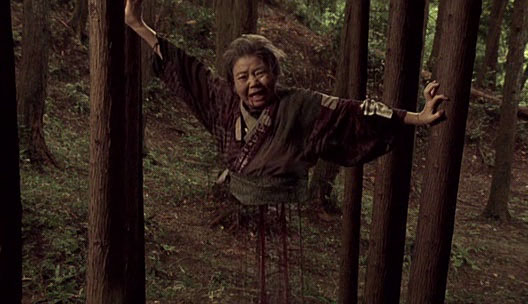
“Bete, your mother’s gone. She doesn’t love me anymore.” Ventura’s wife has left him, after smashing up the house and wrecking all his clothes, and he wanders the neighborhood, forlorn, visiting his children and talking with friends, reminiscing and flashing-back, and worrying about the future, meeting with a realtor to select a new white apartment in the anonymous new complex. Or is any of that true? By the end we’re not sure if Ventura had any children – if the younger adults he talks with (including Vanda) are truly related or just friends and acquaintances.

Vanda is doing alright, on methadone and married to a very supportive man, with a young daughter, although her mother is dead and her sister Zita kills herself halfway through the film, so everything’s not rosy. In an eleven-minute shot she talks about giving birth and learning to turn her life around (and she doesn’t cough anymore), with references to suicide-by-gas since Costa loves to reference his earlier works. Ventura himself sports a white-bandaged head in the second half, seeming to parallel Isaach De Bankolé in Casa de Lava.

Speaking of which, Ventura recites a letter featured in Casa de Lava many times throughout the movie, uses it as a personal mantra and tries to get his friend Lento to memorize it. Lento, it turns out, is probably dead, making me wonder just how much of the story is only in Ventura’s head. This unreliable story and character made me so much more interested and invested in the movie than I was in Vanda, or even Ossos. Similar camera work to those, although the camera does move in this one, more of Costa’s strict rules disappearing.

My birds liked the movie too, or at least they noticed it. The pet birds (finches?), heard but not seen in Vanda’s house, drove them nuts.

The original title was Juventude Em Marcha (“Youth on the March”, a revolutionary slogan and once the title of a 1950’s televangelist program), and the English title is Colossal Youth (once the title of a Young Marble Giants album). Funny, all the “youth” since there’s barely any youth in the movie (Vanda’s daughter). You could count the housing development – it’s “colossal” and new – but that’s not what the original title would be referencing. I listened to the Y.M.G. album for clues but I wasn’t smart enough to draw any connections, except that the title similarity was probably intentional. If Costa enjoys early Wire, he surely likes this too.

Ventura in Vanda’s room:

T. Gallagher:

Costa’s lines are sometimes flat, delivered in short bursts, and often elliptical and inscrutable, like the dialogue in Antonioni’s English-language movies – another challenge to the spectator. Yet, nonetheless, we can feel a Straub-like sensuality of people infusing the space around them deeply, overwhelming it with their vibes, even when they are merely visiting somewhere. Indeed, in Colossal Youth, even when Ventura leaves a shot, he is still there, somehow.

Ventura lives partly in fantasy, which Costa makes real: past and present co-exist, the dead live, Lento dies twice, walls have creatures on them, things don’t connect. Ventura’s wife, he says, “had Clothide’s face but it wasn’t her”. Nor, in Colossal Youth, do doors always connect, for neither the Housing Agent nor Ventura. “I’ve been having this nightmare for more than thirty years”, says Ventura. “Anxiety tormented me night after night. I used to get [the door] wrong all the time. I’d come back drunk from work and collapse into a strange bed. All doors looked the same back then.”

Costa: “One can imagine that Ventura is a double character. On one hand, we see him looking at young people, and on the other there is someone who isn’t he, who lives in the past, who could be a brother or someone else, his double. Ventura’s companion who plays cards, Lento, is Ventura when young. The same, with a bit of past, a bit of future.”

Watching the ghosts in the walls:

I can’t find Mark Peranson’s long interview with Costa regarding Colossal Youth anywhere in my pile of Cinema Scope issues, but in an earlier article he calls it a “Rivettian narrative, with possible unmotivated flashbacks, probable ghosts, and drawn-out scenes that appear improvised (some may be, but considering that Costa rehearsed and re-rehearsed, then shot a total of 320 hours over 15 months, with each scene having as many as 30 takes, I expect that the words were carefully chosen). … Ventura’s haunted mien is that of the living dead; the zombies are walking again.”

Also watched two related shorts, although I couldn’t psych myself into watching the third.

Tarrafal
Faster editing than the last three features, but it tricks you since the first half of the movie is all one shot (interrupted once by a title card). Jose talks with his mom about returning to Cape Verde for a long time, then he runs into Ventura. Ventura takes over the movie, conversing with dead friend Alfredo. Movie ends with an official notice saying Jose is to be deported, pinned to a wooden post with a knife.

The Rabbit Hunters
Ventura and Alfredo each wake up on the streets in the new housing projects, which are already covered with graffiti. They go about having some of the same conversations as in Tarrafal (it’s re-edited from some of the same footage), running into Jose and again ending on the deportation notice. Guess it was overkill to watch both of these the same day.

Jose in Tarrafal:

Ventura and Alfredo in The Rabbit Hunters:

Alfredo in both:

After “A Bill Morrison film” it says “A Michael Gordon symphony”, assigning auteur credit separately over the soundtrack, a rare thing. I didn’t love the symphony, though – an undertone even more monotonous than Philip Glass with bombs-falling string-sliding atop it. I enjoyed the bit where percussion chattering along with the background rhythm sounded like an old TV news theme song. But next time I’ll just listen to a Pinback album instead.

Visuals are exciting, though – Fragments of narrative films (and science films and home movies and other weirdness) gone Brakhage (or less generously, gone Begotten) through decay, slowed down so we can appreciate the distinct frame-by-frame damage.

I don’t understand what property of film decay causes the picture to go negative, bright whites turning black while the rest of the picture looks unaffected, but I’ve never much understood the chemical side of film anyway. Elsewhere, scenes are obscured by dark blots, sunken under oily water and giant amoebas, or just torn to shreds.

Forget the Great American Scream Machine – this is the most terrifying carnival ride. Each car emerges from a burbling time/space warp on left side of the frame, to circle around and go back inside. At the end of the ride, whoever’s left inside the reality-warp is doomed to spend the rest of their days in a hellish alternate dimension.

Second best part here, a boxer fighting an amorphous column of decay

This was both wonderful – an inventively whimsical little ride of a rigorous art film – and tedious in that way that non-narrative films can be. It wouldn’t be a Snow work if it didn’t test my patience a little – it’s part of his charm. This kind of thing is always very different with an audience, not that I think it’s likely I’ll ever get the chance. I picked up visual similarities to Presents and Sshtoorrty… not so much Wavelength unless you count every zoom as a reference to Wavelength (which I guess some critics do).

People walk through a door with the title printed on it (this is where the zoom comes in), while we hear Snow, offscreen, instructing each on the entrance of their timing. Cut to inside the office, and the camera rolls to the right, an infinite camera move since the set is digitally joined at the seams. He electrocutes all his actors, a chair disappears in a lap dissolve, blatant digital effects pop up, then the picture twists like a ribbon as it transitions to next scene. Apparently these are many different actors dressed similarly to give the appearance of a regular cast of characters, but I can’t see subtleties like that on my VHS copy… a shame.

A family sits in their garishly (digitally) decorated living room with a wall mirror reflecting the camera until objects fly off the wall and destroy themselves while the people sit still staring at the sky inside their television. Obnoxious noise permeates, except when one would expect a sound effect (during an explosion, say) when it goes silent.

A classroom is shot from above until the kids notice the camera, stack their desks so they can reach it.

Two people enter a too-small doorway at the same time, fusing and morphing into a slow-moving doorway-shaped block, which lumbers back into the infinite-loop office set. The credits show up before the hour mark and begin to lap themselves. The whole movie rewinds. Then at the end a couple enters a cinema and sits down to watch an early animated work by Snow.

J Hoberman calls it “that rarest of things—a summarizing work. Like Chantal Akerman’s Jeanne Dielman or Chris Marker’s Sans Soleil, it could be used to conclude Motion Pictures 101. … Rigorously predicated on irreducible cinematic facts, Snow’s structuralist epics – Wavelength and La Région Centrale – announced the imminent passing of the film era. Rich with new possibilities, *Corpus Callosum heralds the advent of the next. Whatever it is, it cannot be too highly praised.

Hoberman again: “a bonanza of wacky sight gags, outlandish color schemes, and corny visual puns that can be appreciated equally as an abstract Frank Tashlin comedy and as a playful recapitulation of the artist’s career.”

Pop Matters:

Similarly, domestic life in *Corpus Callosum is irrevocably altered by innovations. The home is filled with televisions, pizzas, and empty glasses. Intense oranges and pinks make the living room seem alive and breathing. The walls are decorated with paintings, an eye-test chart, a crutch, and a skeleton. A mirror reflecting what appears to be Snow and his film crew forms the focal point, reminding us that this film has an author, just as our own environments have human creators. In one 12-minute sequence, objects on the walls begin exploding, one at a time, into beautiful pixel starbursts. Snow, the reflected “god” (for he is creator of this space and the characters who dwell within) appears here to be an Old Testament type: he can give and he can take away.

NY Times:

In keeping with his lighter side, *Corpus is also fun … But then it starts to feel as if things are going on for too long. Mr. Snow realizes he is literally playing with time, though, and even jokes about it: he inserts the credits in the middle of the picture. … We get the point, but the movie goes on and on, using repetition to comment on repetitive behavior.

Rosenbaum, who ranked it his #1 movie of 2002, above even Platform: “Not counting the asterisk, the title refers to the tissue connecting the hemispheres of the brain, an apt reference given the prodigious and joyful inventiveness on display.”

In Snow’s description he says:

The sound – electronic like the picture – is also a continuous metamorphosis and as the film’s “nervous system”, is as important to the film as the picture. Or: the sound and the picture are two hemispheres joined by the artist. *Corpus Callosum is resolutely “artificial”, it not only wants to convince, but also to be a perceived pictorial and musical phenomenon.

… a shame, since my copy had lousy sound.

Funny that I watched this the day after The Last Movie, since it turns out Snow put out a record called “The Last LP”.

Snow, interviewed:
“Although it was all done in the computer, so there isn’t any film in it except for a little tiny bit at the end which is something I did in 1956 and is in a sense my first film. The film I usually refer to as my first film A to Z which is a cut out animation film in 1956. Where as what appears at the end here is, well something which we used to call flimsies. You see I started out in animation and that is how I got involved with film. We used to make the drawings on tracing paper, we would put them on pins with one over the other on a light box and you would draw them. And I did this little sequence of this leg stretching in 1956, but I never shot it, I just kept it as a flimsy. So I guess that is in a sense my first film or at least it was intended to be shot as film. But it was not shot as a film.”

Offscreen: Has it changed over the years, the audience reception?

Michael Snow: Yes. I don’t know what is happening to people but they are not as tough as they used to be. … I really want to make physical things so that the experience is a real experience and not just conceptual. Well yes there are ideas in the works, but they are also body affects, like the panning, for example in Back and Forth. I’ve seen someone get sick and people have fainted with La Region Centrale, so I must be doing something right.

“They say the hardest part of rollerblading is telling your parents you’re gay.”

Finally, a post-Mr. Show sketch comedy show that I love. Did Paul recommend this one? I think he did. Thanks, Paul.

Ringer guests include Brian Posehn, Jon Benjamin (as Bruce Willis), Patton Oswalt, Mary Lynn Rajskub, Kristen Schaal (of Valentine’s Day fame) and Jay Johnston.

Written by the main dudes plus Jon Glaser (not Jon Glazer) and some Funny or Die / Drunk History.

Maybe I should also check out: Parks & Recreation, Childrens’ Hospital, Players, and possibly The League though that one may rely on over-my-head football jokes.

Is it just me, or did a late episode repeat entire sketches from an earlier episode?

Finally caught up with this. Katy and I both liked. Moore has returned to the concerns of Roger & Me, watches the problems of Flint spread to the entire country, but as usual with him (and unusual for political documentaries in general), does it in a way that makes me interested and excited, not depressed. A couple token scenes of Moore trying to talk his way into corporate offices and an ending where he wraps Wall Street in crime scene tape aside, he seems to have listened to criticism and kept himself mostly off-camera. We noticed he was awfully polite and attentive to religion, trying to expand his support base out of the godless-liberal camp. Winning coverage of a factory sit-in and an evicted family that refused to leave balance out the bummers of underpaid airline pilots, life insurance policies on corporate employees and bullying bank bailouts… well, not really, but he makes it feel that way.

Predictably, critical response was off the charts… some raves, many attacks, and still more highly-qualified minor praises – mostly accusing him of simplifying the issues. But they’re issues that needed simplifying, and the accusation is an easy way for a film reviewer to imply their superior knowledge and understanding to Moore without having to defend themselves with examples. Anyway, Cine File put my thoughts succinctly: “Basically the achievement of Capitalism is to spell out the facts in such a way that they’re impossible to ignore. Nobody does it better than Moore.”

Best of all, I found out that in my lifetime, U.S. Presidents used to say things like this:

In a nation that was proud of hard work, strong families, close-knit communities, and our faith in God, too many of us now tend to worship self-indulgence and consumption. Human identity is no longer defined by what one does, but by what one owns. But we’ve discovered that owning things and consuming things does not satisfy our longing for meaning. We’ve learned that piling up material goods cannot fill the emptiness of lives which have no confidence or purpose.

– Jimmy Carter, 1979-07-15

“I thought you were my dead husband, but you’re just a little boy in my bathtub.”

The director is a different person from Jon Glaser, the stand-up comic I’ve seen a few times performing with Jon Benjamin. IMDB says Glazer directed Sexy Beast, which I rather liked even if I don’t understand its cult reputation, and Glaser cowrote Human Giant and performed in Baby Mama, The Toe Tactic and Pootie Tang. I’m gonna say Glaser is my favorite Jon(athan) Gla(s/z)er at the moment, but Glazer could definitely catch up.

Impossible to watch without thinking of Ruiz’s Comedy of Innocence, also dealing with a kid renouncing his parents and deciding he is someone else, inexplicably and with full conviction, leaving the adults wondering how to react. Very different styles and stories, though. This time the kid (Sean) thinks he is Nicole Kidman’s husband reincarnated, leading to serious problems since they both wish for this to be true but she can’t have a love affair with a ten-year-old.

Also unlike the Ruiz, this kid has an explanation. Anne Heche (electrifying in this – high-strung, cruel and beautiful) and Peter Stormare (kind of a lump) are old friends (I think Stormare might be the dead husband’s brother, and Heche his wife, but don’t hold me to that) coming to a party at which Heche is gonna give Kidman a box of love letters Kidman had sent her late husband, but Heche panics, runs outside and buries the box, which is found by the kid. The rest doesn’t exactly follow logically – movie still has an air of mystery, of spiritual possession – but it’s a partial explanation.

Hot-tempered rich guy Joseph (Danny “son of John” Huston) is to marry Kidman soon, so he doesn’t take well to the kid’s claims. He and gentle, logical Bob (must be someone’s brother, played by Arliss Howard: Cowboy in Full Metal Jacket) and Kidman’s pregnant sister Laura (Alison Elliott of Wings of the Dove) help her work with the kid (whose parents, completely at a loss, allow him to stay over unsupervised), trying to find holes in his story or understand his motives. I liked the movie very much, but the main problem I had was with its attempt to have it’s realism with its mysticism, sending first Nicole then Bob into a room to disprove the kid for two hours then show them bowled over by a couple correct anwers and elide whatever happens for the next hour and fifty-eight minutes, or making his parents total pushovers who stay away from Kidman’s house – always conveniently cutting to prolong the confusion, which contradicts the reality of all these suspicious adults who are supposed to be searching for the truth. If the movie isn’t going to take the approach of an airtight psychological mystery with a twist ending a la Shutter Island, I’d have preferred it head more towards the inexplicable Comedy of Innocence than straddle the line between them. But no matter, it’s an utterly enjoyable movie with awesome acting and unique enough filmmaking (shimmering, closeup-happy cinematography by Harris Savides: Zodiac, Elephant) to get me all excited.

The whole happy family – that’s Lauren Bacall in front of the cake:

I admit I was looking for the twist ending. Even though we know Heche buried something while the kid watched, I’m wondering which adult would have convinced the kid to concoct this lie. Not his parents, who seem very upset. Nicole’s mom Lauren Bacall doesn’t seem diabolical. Jimmy the doorman (played by cowriter Milo Addica) is friendly with the kid but would seem to lack enough information to plot this out convincingly. I stopped guessing when the kid strips and slides into the bath with Kidman – no adult could brainwash a 10-year-old into being so unlike a 10-year-old. Finally, in the weirdest scene of any movie I’ve seen this year, Sean is tested by a creepy Anne Heche, who it turns out had a long, intense affair with the dead man, unbeknownst to Sean since it wasn’t mentioned in the letters. She then confronts him, hissing, shattering his illusions of true love reborn. Mercifully, Kidman never learns of the affair and goes on to marry Joseph. In an otherwise unreal movie, Kidman spectacularly creates a very real sense of loss, and Glazer and his cowriters (Addica who wrote Monster’s Ball and Jean-Claude Carrière, a lead collaborator of Luis Buñuel, which makes perfect sense) must have realized it’d be too cruel to push her any further at the end.

Anne Heche:

Peter Stormare:

Birth was shat upon critically and commercially, which is how it landed at number eight on The Guardian’s list of the ten most underrated films of the decade (between Inland Empire and Songs from the Second Floor). Coincidentally at number eight of their outright best-of-decade list is Dogville, another Kidman/Bacall movie by a filmmaker who gleefully pushes everything over the edge, who would have had Heche gleefully destroy Kidman, the bastard.

Bob comforts Sean after Joseph goes on a rampage:

J. Anderson:

A brilliant score by Alexandre Desplat underlines Birth and completes it, causing it to slide slightly off-kilter with a tinkly music-box jingle and an ominous, nervous thumping heartbeat backdrop. This musical duality meshes perfectly with the fabric of Birth, in which Anna must choose between an impossible true love and a possible false one. It’s a brilliant film, but not a happy one. The filmmakers seem to have begun at the point in which love lives “happily ever after,” discovering only bitter disappointment and misled hope instead.

“The day the last concentration camp survivor dies, World War III will start.”

I like Louis Garrel, though I’ve only seen him in movies I like less than him (Love Songs, The Dreamers). Loved this one, though – finally everything coming together for both Garrels. Louis is a photographer here, comes to the house of Carole (Laura Smet of Chabrol’s The Bridesmaid) to take pictures, but starts an affair with her instead, while her husband Ed is off making a Hollywood film. They talk more about breaking up than being together, a strange, somewhat obsessive couple.

Louis with Carole:

“Carole’s been institutionalized!”
She turns out to be more than somewhat obsessive, and when she’s getting electroshock therapy I felt stupid for not realizing before that it’s a period piece… after all, it’s in black and white, there are iris-out transitions and film grain galore. But then she dies and her headstone reads 2007 and I feel stupid again.

Louis takes up with a nice new girl named Eve (Clémentine Poidatz of nothing I’ve heard of, but the guy who plays her dad cowrote Wild Reeds). But he’s still haunted by his old girlfriend, and it turns into a bit of a ghost story with great, mournful string and piano music. Awesome cinematography by William Lubtchansky, unexpected camera moves and story twists kept me on edge.

Louis with Eve:

D. Kasman:

Garrel’s smaller love tale following the epic-intimate May ’68 opus Regular Lovers, asks the filmmaker’s perennial question: how do you reconcile the unchangeable fate of the past with the quotidian sorrows and joy of the present? The answer is impossible, but the way Frontier of Dawn poses the question is frustrating but utterly effective. … Whether the choice of death is the ultimate kind of faith or the weakest of all is not something Frontier of Dawn is powerful enough to answer, but it asks vital, terrifying questions, transposed to a forlorn, gloriously star-crossed romanticism.

D. Phelps:

Frontier mostly takes place in white-walled limbo, anonymous chic, in which ageless youths spend their days writing love letters, while a gravestone reads 2007 (the ultimate joke) … Frontier is more a psychic porno, a love fantasy one step-up from a sex fantasy, about a relationship that only really works when the lovers are apart and thinking about each other (but works, as it never would in Hitchcock). … neither a visionary nor a realist, he’s no Romantic either: the Romantics locate themselves in what they see around them. Garrel’s characters look inward; nothing goes on around them. That love is the only reason to live is reasonable: Dreyer concluded the same. But Dreyer never said it was a good reason to die.

MJ Rowin:

There are a million conceivable ways to render this material trite, melodramatic, and laughable, but Garrel perfectly brings forth its eerie fatalism and its testament to love’s inextricably deceptive power to destroy. Just as his unshowy camerawork goes unnoticed until a simple pan or zoom calls attention to the carefulness of his compositions and the purpose of any deviations from pragmatic long-take coverage, so do Garrel’s narratives steadily, patiently build on gloom-drenched, picaresque rhythms, revealing an overall design only at the end.

Touches on food problems I’ve heard (and read) before in Fast Food Nation and The Future of Food, then adds more. Food seems terribly dangerous! We celebrating by eating at Farm Burger afterwards.

Eric Schlosser steals the movie – he’s an impressively engaging speaker – although depressed farmers get more screen time. If only Farmer John had been invited to lighten things up. High production values and well paced, a good documentary all around. No oscar though, thanks to The Cove. Featured speaker Michael Pollan supposedly showed the movie to secretary of agriculture Tom Vilsack, “a screening that Mr. Pollan described as uncomfortable” (NY Times) – wish there were more details on that.

The Times:

Because Food, Inc. was produced by Participant Media (among others), the company that backed An Inconvenient Truth, comparisons are inevitable. But there’s a big difference. After watching Al Gore explain the horrors of climate change, moviegoers can turn off a few lights, think about a Prius and call it a day. People who leave Food, Inc. still have to eat.

Indiewire:

Food Inc. is important in scope if not discovery, and the large territory it surveys allows it to make crucial connections between the act of buying groceries and illegal immigration, corporate patented seed, and tainted food.

The party poopers at Bright Lights call it “political pornography for environmentalists, vegans, socialists, and others already predisposed to agreeing with its argument and following its advice, while others are likely to interpret it as patronizing propaganda and get mad at the filmmakers instead of the corporations that are ruining the food supply.”

“You can’t trust cinema” – Straub

Costa brings his In Vanda’s Room minimalist shooting style into the editing room where Straub and Huillet are working on Sicilia!. I thought it sounded like a bore, but liked it a lot, surely more than Vanda itself. Guess I was interested in the process of it, and in rethinking Sicilia and learning about the filmmakers – the documentary aspect more than Costa’s aesthetic work, though seeing something so similar in look to Vanda made me reconsider Costa’s style too. So, a lot to think about, though I’m not sure about it being “maybe the best movie ever made about making movies” (Senses of Cinema possibly quoting Thom Andersen).

Huillet (below) is the quiet one, doing her work while Straub showboats and pontificates, talks about destroying truth, calls a matching shot “the most idiotic thing in filmmaking,” and quotes favorite films of his (of theirs). They take their editing job very seriously – Costa says they completed five cuts a day. They stop to screen and introduce some films, including The Chronicle of Anna Magdalena Bach, for a meager group of students, part of the deal they made to get free editing time at a university. Seems to be a documentary made for and by people who need no introduction to these filmmakers; an advanced course in their methods and personality. Funny that Costa points out his own sound design in this doc as “completely fake, anti-Straubian.”

More choice Straub quotes:

“Some people have the impression – because we reject verisimilitude and TV-style cinema, Dallas and all that shit, and even Woody Allen and Cassavetes, etc., that there is no psychology in our films. But that’s not true. All this is psychology. There is no psychology in terms of the performance of the actor because there is a dramatic abstraction that goes deeper than so-called verisimilitude. But it’s there, in between the shots, in the very montage and in the way the shots are linked to each other, it is extremely subtle psychology.”

“When you make films, you try not to say stupid things. You work hard to avoid them. You destroy cliches, go back, correct, abandon or add things. And then, in real life, you do talk nonsense. You end up destroying some of the work you do and the films you made.

“You cannot expect form before the idea.”
“First there is the idea. Then there is the matter and then the form. And there is nothing you can do about that. Nobody can change that!”