It’s a nice change that Ti West makes old-fashioned, slow-moving, simply-plotted horror films, but I think he goes too far in that direction. I didn’t like House of the Devil either, but at least the ending of that one was overall less lame. Here he gives the lead girl an inhaler (assuming nobody in the audience has ever seen a movie before), allows crappy, predictive string-drone music to detract from the decent cinematography, and sets up a boring haunted-hotel scenario with dense characters who do things like go down to the basement when they’ve been warned not to.

Claire and McGillis:

Claire (Sara Paxton of Last House on the Left Remake) costars with Pat Healy (a Ford brother in The Assassination of Jesse James), who was the one character I kinda liked, because he’s so flaky. He runs a terrible-looking website about hotel ghosts, but he’s lazy as shit and doesn’t seem too excited about ghost-hunting (turns out he invented all his ghost stories). And at the end, after declaring his love to Claire and saying he’ll do anything for her, he flees the hotel in terror, leaving her to die alone (from ghosts? or asthma? we’ll never know!)

1980’s starlet Kelly McGillis plays a surly washed-up actress and spirit-healer, Tiny Furniture‘s Lena Dunham has one scene as the annoying girl at a coffee shop, and George Riddle, looking like a death-bed Gene Hackman, is an old man who wants to die in the room where he stayed on his honeymoon.

Claire stalked by undead Gene Hackman:

Of all the loud genre movies I rented this week, this one was the champion. A lot like Super (or a comedy Falling Down), a hilarious piece of wish-fulfillment that turns ever-darker. Joel “Bill’s brother” Murray hates his life (in which everyone calls him “bro”) but mostly hates self-centered airheads on television, so after he’s fired then misdiagnosed with a Joe vs. the Volcano-esque brain-plot-device, he chooses to go on a rampage instead of killing himself, killing a spoiled sweet-16 reality star, then her parents. It gets uncomfortably more similar to Super when Frank unwillingly attracts a teen-girl sidekick (Roxy) whom he keeps calling “Juno”.

Watching this a week after some nut shot up a Batman screening, I was surprised at the scene where Frank and Roxy shoot up an underattended movie matinee because a row of teens wouldn’t shut up and put down their phones (scored to a cover of Bjork’s It’s Oh So Quiet). They kill a republican TV talking-head, a guy who takes up two parking spots and a funeral-protesting cult leader. The media keeps misinterpreting their motives, and the killers grow more comfortable with their motels-and-murders lifestyle, gearing up towards a lovingly-shot slow-motion suicidal massacre on a live American Idol-like show.

Excellent movie, more complicated than it seems.

The AV Club gets it:

It isn’t a funhouse mirror; it’s just a mirror. The debasement on its airwaves isn’t some Ow My Balls-style future Idiocracy, but rather a straightforward reflection of what’s already present… The key point about God Bless America is that it’s extreme but not exaggerated, a dark comedy that indulges — and questions — a violent, misanthropic fantasy about laying waste to the cultural landscape while staying grounded in a recognizable reality. In other words, Goldthwait isn’t doing the satirical equivalent of shooting ducks in a barrel here, though his recreations of televised stupidity do offer a funny twinge of recognition. What interests him more is how we live in that culture, particularly those who are alienated by it.

Writer/director Goldthwait:

I could have made a whiney movie or a documentary about how nasty our culture is, and a couple of other people that may see things the way I do would have liked it. Or I could have made a comedy that was very aggressively saying, “Cram it” to all these people, and that’s what I chose to do.

Herzog, whose voice is too rarely heard, listens to the stories of people affected by a stupid double murder in Texas, mostly the victims’ families but also a few unenlightening minutes with the killers themselves. There’s little attempt to question whether these two (one of whom is on death row; the other avoided execution because his dad cried in front of the jury) actually committed the crimes. And there’s little attempt to make polarizing statement regarding the death penalty, until the end when the movie tries to land hard on the anti- side. But I’ve been on the anti side for years, and the movie almost has me convinced that the death penalty is a great thing, because these kids are horrible and have learned nothing, so they might as well be dead. One of the highlights is a long interview with a former death row prison guard, who walks us through the whole procedure before saying he had to quit after too many executions messed with his head. No mercy from Texas. Music by Soul Coughing’s Mark De Gli Antoni.

I didn’t catch the toy Totoro but made some other Ghibli connections. Arrietty stands on the boy’s shoulder like the fox-thing in Nausicaa. She’s a 13-yr-old girl making her first adventure into grown-up life (and making a mess of it) like Kiki’s. Also: too many songs with vocals. Adapted by Miyazaki from a novel that’s been filmed a bunch of times before. The title has been changed, but the miniature people, at least in the English version, are still called Borrowers.

The main rule, strictly obeyed for generations, is never to be seen by humans, but on her first night out to snatch a sugarcube with dad, Arrietty is spotted by a drowsy, sickly boy spending the summer with his aunts or whoever they are: a decent one and a horrible troll woman whose goal in life is to find and destroy the borrowers. So Arrietty’s family packs all their belongings to move away (aided by an awesome feral borrower named Spiller, while the boy tries to find Arrietty and be friends. Probably would’ve been cooler in theaters, but at home I kept finding myself wondering why I’d rented a kids’ movie and wasn’t watching Pola X instead.

Methodical, slowly-building story, from night into morning. Nothing much is happening, as a police chief, prosecutor, doctor and whole crew of cops and diggers drive a suspect (and barely-seen second suspect) from one landscape to another as he tries to recall where it was that he killed and buried his brother. I’m suspicious of the acclaim because I wasn’t a huge fan of Climates (though I liked it, which is easy to forget since Katy vocally hates it), but soon I’m drawn into the atmosphere and have to admit it’s a great movie. But then I interrupt my viewing around the same time the tone of the film changes when they find the body and drive into town, and when I return, the last 45 minutes seemed completely off.

Chief has a short temper, is mad that nobody seems to be able to do his job without shouted instructions. Prosecutor has to pee a lot, asks Doctor a lot of questions. Through his answers, Doctor indirectly reveals that the prosecutor’s wife probably killed herself. Arab is the driver, who married a woman from a nearby town which he seems to hate. Suspect One looks like Vincent Gallo, stays silent for almost the whole movie, except to ask someone to look after his wife, and to cry when a kid in town (dead man’s son – but really his own son, as revealed earlier) throws a rock at his head. An all-male cast except two small non-speaking roles for two pretty young women.

Chief front left, Arab front right:

Music swells up after 17 min and it occurs we haven’t heard any yet, but it was the chief’s ringtone. Mid-search, they break at the town Arab’s wife comes from, eating with the mayor (Ercan Kesal of Three Monkeys, co-writer of Anatolia) and his family. His gorgeous daughter serves everybody by candlelight, and Suspect One has a vision of his dead brother.

When the body is found, Suspect Two blurts out “I’m the one who killed Yasar,” but nobody seems to notice or care. Back in the city, body identification by the widow, then (off-camera but squishy-sounding) autopsy, the doctor staring out the window.

“You can say ‘Once upon a time in Anatolia when I was working out in the sticks, I remember this one night which began like this.’ You can tell it like a fairytale.”

Some cool scenes. Arab is talking to Doctor, the camera behind his head, Doctor not responding, then camera comes around and we see that Arab’s not speaking, but his voice continues. How much did he say, and how much was in his head? After a fight, an apple rolls down a hill and down a stream, probably a glaring metaphor but I just enjoyed watching the apple, flashing back to The Four Times. A few brief, eerie uses of slow motion.

Also, the doctor finds a rock face while taking a pee:

People are keeping secrets for mysterious reasons. I thought it was philosophy in the guise of an investigation movie, but then after they find the body it becomes an investigation movie (usually the other way around).

S. Foundas in Cinema Scope does a good job conveying the atmosphere of the film without getting bogged down in story (what little there is). “In methodically tracing the play-by-play of a seemingly routine police investigation, it is a film of many details but no explanations, a mystery that conjures a sense of the eternal.”

the director, quoted in Time Out:

‘The real story was told to me by a doctor,’ Ceylan says. ‘But yes, the doctor in the film is a little like me in terms of personality. He is a very rational person, but of course that is not enough to deal with life. Life has a metaphysical dimension too. There are questions that you cannot answer with knowledge. The doctor has these questions in his mind. The important thing is that, by the end of the film, we see that he has the ability to feel something for somebody else. That’s the hope for him.’

Reverse Shot:

Infidelity comes to represent the highest, most irrevocable form of betrayal, the most persuasive case for one person’s essential remoteness from another, as well as a fault line between the sexes (2006’s Climates explored similar terrain, coolly anatomizing the aftermath of a breakup). This is just one of many irreconcilable binaries in Ceylan’s films: urban/rural, parents/children, movement/stasis. His characters are more often than not caught in the middle of a protracted process of disillusionment, a long, slow loss of faith in the idea that they can form meaningful or lasting associations even with lovers or family, or that they can escape on a moment’s notice from the lives they’ve made for themselves… These days, thoroughly forlorn depictions of the human condition rarely come outfitted with such strikingly realized environments or such a seamlessly integrated sense of humor — Ceylan’s jokes don’t upset the mood by leavening it, or move the dial toward caricature, but arise naturally from the gaps in communication between the characters.

Varda films her own travels for a year or so, as she visits old friends and new, goes to lots and lots of art exhibits and museums, and attends retrospectives of her work. “Now that I’m old, everyone tends to give me awards and trophies.”

I didn’t get tired of the framing story: a tree at her offices is severely pruned, all shot in still photographs. And speaking of photographs, the main excitement in episode one is that she visits Chris Marker at his studio. She shoots the cables behind his computers, “the secret threads of the labyrinth of his art.” A Demy-fest celebrating the 50th anniversary of Lola, featuring Aimee, Piccoli and Varda’s children. Lots of exciting artwork.

Manuel de Oliveira attends Varda’s screening in Lisbon. Somebody explains Oliveira’s cinema: “He says reality is merely the result of certain conventions. It’s very important in Manoel’s films to understand that society becomes the artifice. Cinema is not the artifice. Manoel’s films help us get some distance from this reality imposed on us, so we can interpret it in another way.” Then Oliveira clowns around for Varda, doing his Chaplin impression and miming a fencing match, and my understanding of him changes. When he was a piece of trivia, The Oldest Working Filmmaker, it always seemed like he had very little time left, that each film might be his last (a review I found of Non, over two decades and thirty films ago, suggested that it would be his last), but seeing him in action I suddenly realize that he may live forever.

Varda chills in Marker’s world:

Oliveira:

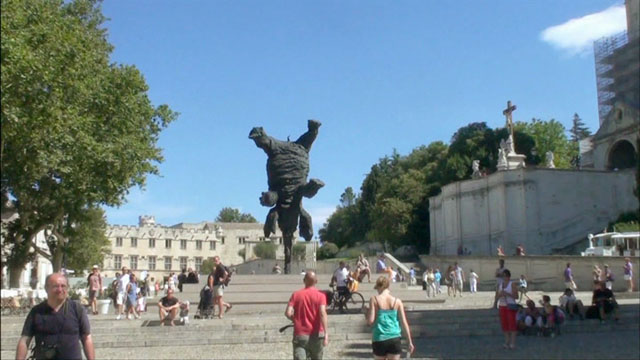
Ep. Two, she goes to Brazil and meets Glauber Rocha’s daughter and Jeanne Moreau for the Rio film festival. A chair in a gallery prompts a montage of chairs Varda has photographed. Stockholm, and an Ingmar Bergman auction. Agnes is so fascinated by her interviewer, they end up swapping jobs. She calls gallery director Hans Ulrich a “contemporary art detector.” Varda meets Jonas Mekas and Yoko Ono while dressed as a potato. Flashbacks to Vagabond and Beaches. An elephant upon its trunk announces an exibition.

Agnes Potato with Mekas:

Ep. Three: igloos in Basel. Varda’s installation film Patatutopia is a triptych of potato images. Another installation of interviews, each one playing on its own television in front of its own easy chair. “A piece by George Segal attracts my attention. I didn’t know how to film my distress when Jacques died. So I wrapped myself in white, like plaster, and imitated Alice. I listened to music we both loved. Artists invent ways for us to express our emotions.” At the Alliance Francaise she attends a presentation of Beaches and a photo exhibit, including portraits she took of filmmakers (Demy, Visconti, a superb shot of Fellini). She visits the Hermitage and flashes back to Russian Ark, then back in Paris has a fascinating chat with artists Annette Messager and Christian Boltanski.

the Segal piece:

Patatutopia:

Boltanski’s holocaust-metaphor used-clothing installation:

Ep. Four: setting up a Beaches installation, with sand and her shack made of filmstrips. Some visitors to the shack: “Their interpreter murmurs ‘New Wave'”. Digital beaches, a man who collects buttons (and button stories), then a return to La Pointe Courte, where she films the 2010 version of the same jousting tournament she shot in 1954 for her first feature. A Marker grinning cat leads to more museums, including an exhibit by a painter who works only in black. I liked how he displays his paintings, suspended in the middle of a room instead of upon the walls, so you can look past one to compare it with another in 3D. Jean-Louis Trintignant recites poetry in the park – this kind of thing never happens where I live.

Varda street on la pointe courte:

Trintignant:

Ep. Five: a visit to her buddy Zalman King, Richard Pryor’s costar. Towers built by a “hero of outsider art.” Interview with a reluctant participant at the gang violence memorial. She talks about Jim Morrison and visits her old beach house, presumably during the Lions Love era, then toys with blue screens on the beach. Some 15th century angel/Jesus paintings then, more fun, skeletons in Mexico City. Agnes gets her interpreter to play piano and her assistant to pose nude for a photograph. Interview, with clips of Japon, with Carlos Reygadas, before visiting Frida Kahlo’s house. A juice factory that also houses a massive collection of modern art. Matthew Barney, Marina, Abramovic, and the best molé in town.

Zalman:

Agnes and Mexico interpreter Elodie, not nude:

And the series ends with no grand sweeping statement on the travels, just a series of sketches accumulated over a year or two, the time it took for the tree in her courtyard to completely re-grow.

Right after I read about his trilogy, a Glawogger film opens in my neighborhood, so the wife and I went on a date to see his whore movie. There are interviews with the participants, but mostly it’s an immersive thing, you figure out how the whoring works in each region by fly-on-the-walling it. But M.G.’s great innovation is to produce a verite/interview doc with killer camerawork and sound design. You sometimes get curious framing or a decent music score in a doc, but usually the serious documentarian’s stylistic presence is felt through editing. Not anymore, as the weird vibes of CocoRosie swirl through a surprisingly elegant movie about prostitutes in increasingly desperate conditions.

First Thailand: the girls have home lives and ideas about what they’d like to do post-prostitution. Their brothel advertises, accepts credit cards and employs a woman who acts like a den mother. Then Bangladesh, a sharp step down in living conditions, as kids are sold to live and work in a complex they’ll never afford to leave. Finally Mexico, where it’s every girl for herself, with no supervision, a desperate, dangerous-seeming atmosphere, and enough of a who-gives-a-fuck attitude that the filmmaker is allowed inside to watch some whoring in action: sadness for everyone involved.

Katy and I discussed the movie for like ninety minutes, but that was a month ago, so I cannot provide a summary.

C. Huber in Cinema Scope:

Thriving on contradiction and observational curiosity as usual, Glawogger still resolutely rejects social cause-pandering, but scratches for something deeper by contrasting the rituals of love (for sale) in three different cultures, religions and economies: a look not just at prostitution, but the relationships between men and women in contemporary society that yields telling and ambivalent insights.

“I’m only a ghost, but a ghost isn’t nothing.”

Always great to see a new Maddin work, and this exceeded expectations. Exciting yet familiar, new with firmly recognizable bits of the old, and filmed in a different medium than usual (digital!), like Maddin’s Moonrise Kingdom. “I know a lot of people who follow me probably figured I’d be the last person in the world to switch to digital, and that I also sort of ride a penny-farthing with a bowler hat, but I don’t. I want to be a normal guy. I’m just an artist trying to make stuff that matters to me.” (AV Club)

In this post I quoted Maddin saying that his next feature would have footage from his shorts, “a Frankenstein feature film built together from a bunch of dead short commissions,” and there are two shorts since My Winnipeg that resurface in Keyhole: Glorious (Louis Negin as a ghost, penises growing through walls) and Send Me to the ‘Lectric Chair (Isabella and a homemade electric chair).

Nice, clear images, with relatively restrained editing, apparently because Guy could afford an art department so didn’t have to hide the cheapness of his sets. Great, unusual, moody music, and crazy amounts of lightning flashing from outside. But it’s not Maddin Lite by any means – he hasn’t grown up and made a normal movie. He and George Toles have come up with a haunted-house gangster flick/family psychodrama (it’s like The Six Hundredth Sense) full of enough insane details to rival any previous Maddin feature.

Ulysses (Jason Patric of Sleepers, The Lost Boys) appears late to the party, after his men have shot their way into a house surrounded by the cops. The movie pronounces its disdain for reality from the start, when he lines all the men against the wall, telling the still-living ones to face him, then sends the others outside. “Cops’ll make sure you get to the morgue.” There’s no glowing aura or translucency – the dead look and behave like the rest of us.

B/W Rossellini behind a colored curtain:

Ulysses seeks his wife Hyacinth (Isabella Rossellini), who is locked in her bedroom at the top of the house with a lover named Chang, while her father Louis Negin is chained to her bed. Negin also acts as part-time narrator: “I am a part of the house you’re looking at. It would be misleading to say I LIVE here.” As Ulysses stalks the house, he gradually unlocks doors and begins to regain his memories.

“Something’s wrong. I can’t hear my own thoughts.”

The Men: Big Ed was in charge of the group before Ulysses arrives, wants to be in charge again, Heatly is Ulysses’ adopted son, sometimes-nude Rochelle (Ulysses’ mistress) only speaks French, Denton (Brent Neale, Renfield in Maddin’s Dracula) wears a hat, Milo has a scarf, Belview (Claude Dorge of The Saddest Music) is a deliciously overacting dapper dude in a tie, Denny is a wet drowned girl, and Ogilbe is Kevin McDonald.

Ulysses, who keeps changing the clocks in the house, warns everyone to stay away from the ghosts, but Kevin McDonald attempts sex with a floor-scrubbing woman in the hallway, sparks fly, and he continues riding her in death, whipped by Negin from behind, as she appears not to notice him.

Ulysses gathers all the guns and drops ’em down the trash chute, but when they’re heated by the furnace, one shoots Heatly dead. Someone drowns in the house’s indoor bottomless bog, and Big Ed fries in the makeshift bicycle-powered electric chair he built to trap Ulysses. “You can’t electrocute a man twice,” says Ulysses as he turns the tables, so perhaps he’s returned from death row. Meanwhile, the cops are still outside…

Big Ed strapped into his own invention:

Ulysses attends to Heatly:

Ulysses is sad when Heatly dies, but doesn’t seem to recognize that the hostage he drags all around the house is his real son Manners, supposedly his only surviving child, though we see the others in the house, Ulysses not recognizing any of them at first. Ned (Darcy Fehr, star of Cowards Bend the Knee) is drinking milk, the head of daughter Lota is in a flowerpot, and youngest son Brucie is masturbating (“playing Yahtzee”) under the stairs.

Manners:

Also, Udo Kier gets one scene (not enough!) as a doctor paying a housecall to examine the drowned Denny, despite the fact that his own child died that night in the hospital. Lots of family death in this movie.

More details of the house: furniture placement is important (Ulysses makes his men undo their arrangement alterations), and there’s a stuffed wolverine named Crispy and a pneumatic tube delivery system in the walls. Manners, who has fallen for Denny, is finally released, as is Louis Negin. Ulysses makes it to his wife’s chambers and shoots Chang, and at dawn all ghosts and signs of the police shootout quietly vanish.

Young lovers, one of them dead:

NYTimes:

Like his Homeric namesake Ulysses is seeking a way back to his wife, though there is not much evidence of love or loyalty between them. Nor is Keyhole, narratively speaking, a reimagined Odyssey any more than it is a ’30s crime drama. It’s more like a dusty attic full of battered, evocative cultural references.

Maddin again:

We just live in a space that’s just thronged with ghosts and I honestly think I’m even a ghost sometimes. I often wonder if when I die, and I don’t believe in ghosts, but if I’m going to haunt any place, it’s that childhood home that I keep falsely remembering. In my dreams now I very rarely dream of people. I just dream of that space. I’m walking around and I’m the only person in it. I’m actually haunting in the future, in my dreams anyway.

The dialogue George [Toles] and I write isn’t naturalism, but [Patric] knows how to give it a reading that makes it adhere to a character. If no one likes the movie, they should at least watch Jason, just to see how he’s taken lines that would be impossible to read naturalistically and how he puts them into his processor and spews them out. It’s kind of amazing.

Chris Evans (Human Torch in the Fantastic Four movies) is a scrawny wannabe soldier who doesn’t want to kick ass to show the world that America is #1, he just wants to end global bullying. Against the advice of military dude Tommy Lee Jones, scientist Stanley Tucci sticks Evans into a machine (built by Iron Man’s Dad, Dominic Cooper) that gives him awesome muscles. He gets an invincible shield (which has no magic flying powers, it’s just throwable and bouncy), then is sent on tour to sell war bonds for a year. That was unexpected.

When nazi-spinoff villain Hugo Weaving, who underwent an early version of the Captain America process which gave him mega-muscles but turned his face red, steals Thor’s magic god-box and kills Tucci, Cap goes after him. No time to fall in love with drill instructor Hayley Atwell (of The Prisoner remake), Cap is off to defeat the Red Skull and his morally uneasy scientist Toby Jones. Success, however Cap’s best friend Bucky falls to his death, and Cap falls to his presumed death until he’s dug up by Sam Jackson seventy years in the future.

Joe Johnston previously helmed similar period-adventure-hero flick The Rocketeer and the credited screenwriters (rumor has it there were many more) wrote the Narnia movies and that Peter Sellers bio-pic with Geoffrey Rush.