Masterful mashup of different ghost movie premises, dead girl is forced to Monsters Inc before she Back to the Futures, joins a misfit team of has-beens and together they thrive.


Masterful mashup of different ghost movie premises, dead girl is forced to Monsters Inc before she Back to the Futures, joins a misfit team of has-beens and together they thrive.
After Alone, why not watch another girl get kidnapped by a serial killer and try to escape her fate. This time things are more complicated – we see other victims, there’s an attempted rescue, and the maniac is a boater who feeds captured surfers to sharks while filming them on VHS.


Surfer Zephyr (of Southbound) has a lovely time with new friend Moses, then she drives to the beach, gets kidnapped by a maniac and locked on his boat with fellow victim Heather. Really Good Guy Moses keeps searching for her, connects the clues, and arrives only to be kidnapped himself, then Z chews off her own thumb to escape from the cuffs Saw-style. Byrne is two for two, now I’ve gotta catch The Loved Ones. Everyone else who watches this already knows who villain Jai Courtney is – I’ve only seen him in Edward Furlong cosplay as a lead-in to Yoga Hosers.


Most straightforward story of the season: Jess is kidnapped by creepy mustache man (who recently played a cop in Companion), escapes getting serial-killed by fleeing into the woods, then jumping into a river, then playing the most dangerous game (with hunter Robert as collateral damage). She does manage to kill the dude and get rescued, but her biggest triumph is grabbing his cellphone and trash talking him to his wife (who thought he was on a business trip).


A year after part one, teen Sienna is dressing as Non-Copyright-Infringing Victoria Secret Wonder Woman for a halloween party with her friends while her little brother Jonathan is going through a (timely) nazi phase and discovering The Backstory relating to their dead artist father and killer klown Art, when his hero comes around and terribly torture-kills all of their family and friends. Looks slick, and I like Art’s new imaginary girlfriend, but all of this feels like an Elm Street sequel where each scene last too long. I was annoyed much of the time, but can’t stay mad at my best friend Art The Clown.


The girl has a musical advertisement dream sequence:

People seem unhappy with this movie because it’s full of cliches, is All About Trauma, and it torments and abuses and murders children. But I had a pretty good time watching Sally Hawkins learn about demonic resurrection rituals on bootleg VHS then bumble around until her plan gets so out of control that she kills herself. Also fun because both Foster Mom Sally and her cat-strangler son are dangerous, and we don’t learn until late that she has got him possessed by demons and wants to do the same with her new blind ward Piper, painting P’s older brother Andy as a problem child to get him sent away. And her cat is named Junkman, pretty good name.

This has got one of those modern sound mixes where the dialogue is buried, too bad, but the one-star reviews were wrong, Kahn is back baby! [an hour later] Okay, they buried the dialogue because it’s bad, lot of embarrassing culture war stuff, but most of the visuals are still good, Kahn is kinda back baby! This week I watched two Superman-adjacent movies about townspeople zombied by gooey creatures, and this one doesn’t come off great when closely compared to Slither.

The ick has been around for decades, suddenly becomes hostile and starts zombifying people, leading washed-up science teacher Brandon Routh to summon his old hometown-hero energy and fight back with student Grace (who played Young Supergirl, appropriately) plus fellow losers The Goth One and The Arty One. Big year for guys going on adventures with high schoolers who they believe to be their illegitimate daughters. At least we all learned about some key figures in existentialism.


Framing story starts out as some kid’s stop-motion army-guy video, nice.
1. Phony from top to bottom, a punk band goes to the basement venue where another punk band died in a fire three years ago on this very night, and gets murdered by ghouls. Director Maggie Levin “is a filmmaker with rock n’ roll roots” per her bio, argh.

2. Better: sorority pledge (girl from Synchronic) is buried alive as a hazing thing, cops chase off the aboveground girls as a rainstorm is coming through. Synchronic Girl meets a sinister ghost while buried alive while drowning while covered in spiders, oof, and all the other girls get supernaturally leaky-coffin’d next. Director Johannes Roberts made two killer shark movies and a failed Resident Evil reboot.

3. Some underlit Nickelodeon game-show called Ozzy’s Dungeon is Double Dare meets torture porn. Donna competes in a doomed wish-fulfillment game that nobody has ever won, then her surviving family turns the tables on the host, taking him into the victory cave(?) beneath the set to meet the fat-suit wishmaster, but apparently the girl’s wish was to explode the heads of her family members, like a cut-rate version of The Viewing. Directed by Flying Lotus themself.

4. Older brother Dillon of the stop-motion kid is a horny teen who films himself skating and doing pranks. Their friend Boner is an apocalypse prepper – this turns out to be unimportant, as focus turns to the hot medusa across the street who turns the boys into statues for attempting to install spyware on her new imac. Only good joke in the movie is the package delivery service being called DUI. Tyler MacIntyre also made the pd187-approved Tragedy Girls, and looking up the lead actress is how I found out someone remade Castle Freak.

5. Coven is doing a summoning ceremony, but demon Fircus interferes and drags the cameraman Troy and Nate to hell, where they meet Mabel the Skull Biter, the movie’s only good character, and scramble to return to the surface when the coven’s portal opens at midnight. Also the movie’s best segment, the only one that doesn’t look like shit on purpose, so I assume it made the top ten of Vulture’s ambitious V/H/S segment ranking… nope, Dowd got it all wrong. The Winters also made a haunted house livestream influencer movie starring Mabel.

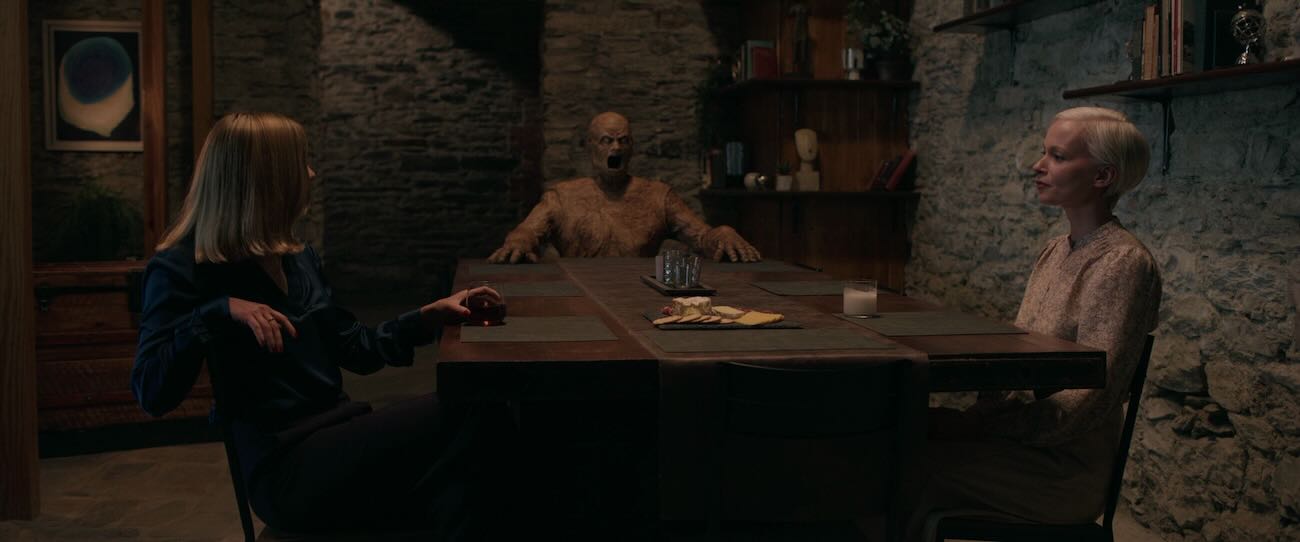
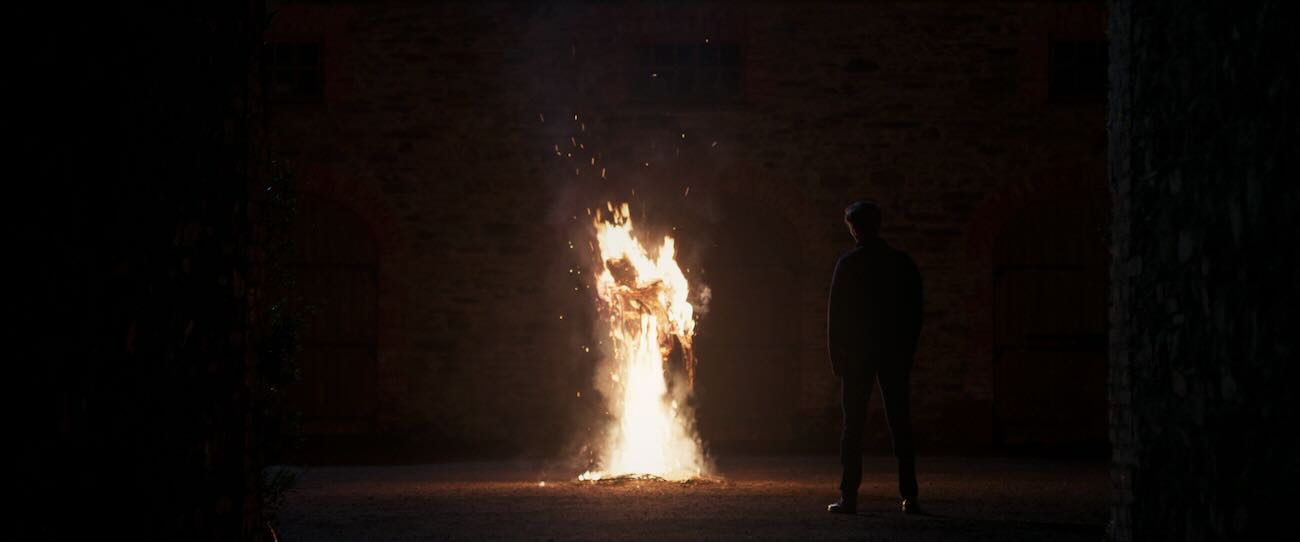
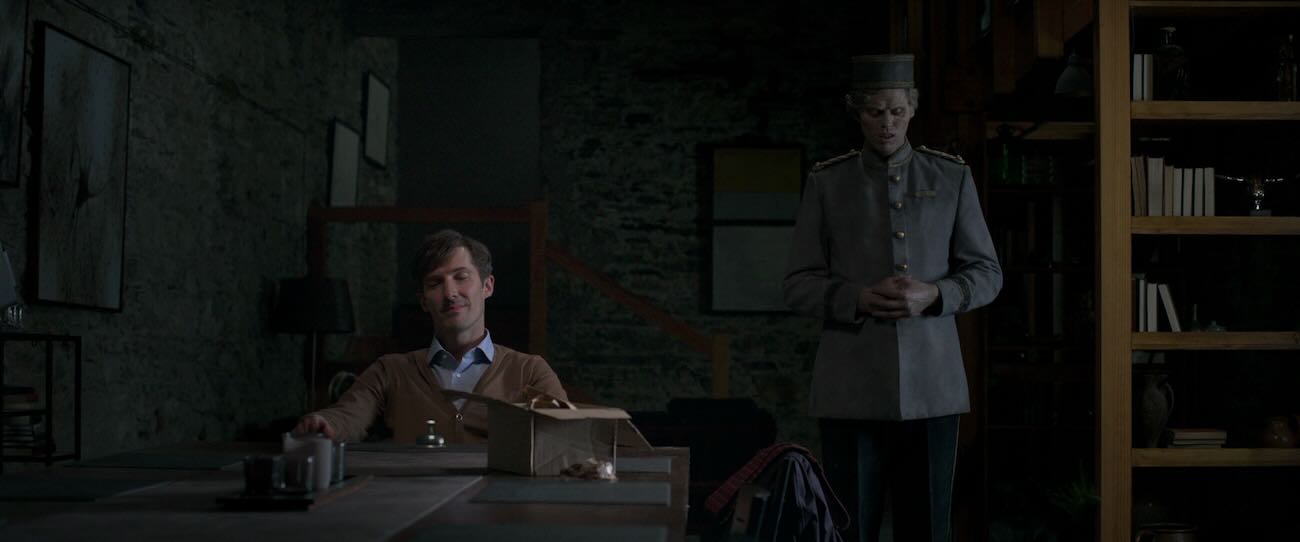
My second movie this week where someone runs a cursed antique shop – in this case it’s the blind sister of “Brian May” Ted’s murdered wife (Carolyn Bracken, playing both sisters, was my mother in You Are Not My Mother). On the anniversary of her sister’s death, Blind Darcy comes over bearing cursed antiques for the husband and his new hotgirl (“Do I look stupid?” “I have no idea what you look like. You sound stupid.”) Backstory ensues, the argument of whether Asylum Olin with weird eyes (who also had weird eyes in The Northman) or Asylum Ivan (The Hole in the Ground) actually did the murder is academic, since the husband definitely ordered it. The hotgirl and blind sister both die, the husband can’t help himself from ringing the little bell he was gifted, leading to the best final shot of the season.
John Semley in The Nation:
From Pynchon’s 1990 novel Vineland, Anderson borrows a basic conceit: A group of countercultural misfits, living underground, whose lives-on-the-fringe are disturbed by the return, years later, by a government tormentor operating as a stand-in for that all-American avatar of authority and oppression typically called “The Man.”
…
At first blush, Vineland seemed unadaptable in a contemporary context. Not only because of the density of the prose or the lunacy of its plot—which includes a Godzilla attack, a UFO, and a tow truck that ferries the spirits of the damned to hell—but because of its chronology … But Anderson’s film proves that these more central divisions — between freaks and squares, parents and children, the rigid brokers of authority and subversive agents of liberation — can be mapped across American history.
Perhaps what I liked most about this After Hours-esque odyssey of Leo being a bozo father trying his best though, is that he ultimately contributes next to nothing in terms of physical help to Willa who is experiencing her own completely separate bravura setpiece, that builds itself out so patiently from so many gradually accumulated details you honestly don’t realize you’re in PTA’s version of a T2/Friedkin car chase until it’s already under way.
Israel Daramola in Defector:
I’m reminded of another great character in the film: Deandra (Regina Hall), who generates so much sadness and empathy with how she looks at and regards other characters, especially Willa, and how Anderson photographs those feelings that can’t be grasped with words on her face and then frames it in a scene. There’s so much love and care all over this movie full of anguish, explosions, and weed jokes.
Also Good: Paul Duane
Reminder to revisit Robert Daniels’s Time piece after seeing The Mastermind and Eddington.
And of course Nayman, whose Coens book I just finished and whose Anderson book is on deck.